During the week after Easter Sunday, I had the opportunity to gather wild ramps with my friend Nancy in the forest around her farm. For those who are unfamiliar, ramps are kind of like little wild onions. It was a clear and mild day during an unusually rainy spring. Before heading out into the woods, we took a trip over to the greenhouse, where some seedlings needed watering. Her greenhouse is a homemade structure with a cathedral ceiling covered in clear plastic.
As Nancy walked up and down the aisles with her water-hose, I thought back to the Easter Vigil service I had attended at an Episcopal church the Saturday night prior. My friend Ed, the priest, had dedicated the church’s new Paschal candle, led us in the renewal of our baptismal vows, and sprinkled us with holy water in the same way that Nancy was now blessing the baby plants, nurturing fragile new life with the most basic elements of water and light.
After Nancy finished her botanical asperges with the seedlings, we made our way through some of the muddiest terrain imaginable toward the hillside where wild ramps were to be found. As we sloshed through the quagmire, Nancy and I talked about how she came to fall in love with organic farming. The details of that story are hers to share, but the process of telling the story as we walked reminds me of the many biblical readings from the Torah and the prophets that take place in the middle of the Episcopal Easter Vigil service. The readings chronicle the long and messy journey of the Jewish people from slavery and exile into freedom.
Finally, we arrived at the wooded hillside that was covered in patches of wild ramps. These precious little vegetables are currently in high demand among upscale restaurants all over the country. Some farmers earn a significant portion of their annual income with a single load in their pickup trucks. And there we were, sitting in the abundance of a remote hillside in rural New York with a small fortune growing around our feet.
Is this not the essence of Easter? The triumph of abundance and life over scarcity and death! It’s no mistake that Christians celebrate this, our highest holiday, during the springtime. The smell of dirt emerging from beneath the melting snow and the sight of flowers bursting forth from their buds are sacramental reminders of the resurrection life that pervades this universe in which we live. This most precious treasure is the free gift of God for all who will open their hearts and embrace it as such.
Nancy the farmer, priest of God’s green earth, made this truth real to me in a new way as she tore off a piece of edible ramp-leaf and handed it to me on that hillside saying, “Here. This is Communion.” As I put it in my mouth, I couldn’t stop myself from saying “Amen” with my whole heart.
Legend has it that, sometime around the year 600 BCE, there was a plague that struck the ancient city of Athens, Greece. At a loss over what to do, they called in the philosopher Epimenides, who came promptly. The plague, so they thought, was due to one of the gods being angry with the city. In order for the plague to be lifted, that deity would have to be appeased by a sacrifice. But the ancient Greeks had so many gods, how were they to know which one was upset?
Epimenides proposed a solution. He took a group of sheep to the Areopagus (a.k.a. “Mars Hill”) and released them to go out in every direction. He ordered attendants to follow the sheep and, wherever one laid down to rest, there they built an altar and made an offering to whatever god or goddess was associated with that place. In this way, thought Epimenides, they would cover all their bases and increase their chances for beating the plague.
But there was still one problem: what if the sheep lay down in a place that had no affiliation with any deity? “Well,” he said, “build an altar anyway!” Maybe there was another god or goddess who was not in their pantheon. In that way, they would really really cover all their bases. So, according to this legend, that’s how it came to pass that Athens had altars that were dedicated “to an Unknown God”. After the plague had passed, the Athenians maintained the altars in remembrance of what had happened there.
Centuries later, the apostle Paul happened across one of these altars during his visit to Athens. And Paul, ever the conscientious preacher, decided to use it as a sermon illustration. The leading citizens of Athens invited Paul to speak in the Areopagus, the exact same place from which Epimenides had originally sent out the sheep, and they listened to what he had to say.
While the sight of so many altars to so many different gods and goddesses made Paul extremely uncomfortable, he was nevertheless very affirming of the Athenians’ religious practice. “Athenians,” he said, “I see how religious you are in every way.” He then went on to describe how he had come across Epimenides’ “altar to an Unknown God” during a stroll through town. Paul also praises their philosophical insight, quoting directly from Epimenides himself, “In [God] we live and move and have our being”.
Isn’t this odd? A Christian missionary preaches a sermon where he praises the polytheistic religious practices of the Greeks, doesn’t mention Jesus (except indirectly), and fails to reference even a single verse of the Bible. In fact, he takes as his text a poem written by Epimenides, a pagan philosopher! I don’t know about you, but I can imagine pastors getting fired from their churches for less than that! Yet, this is the great apostle Paul, the Church’s preeminent theologian, a New Testament author, and the preacher who supposedly set the standard by which all others would be judged. What in the world was he trying to do here?
First and foremost, I think Paul was making a statement about God by the way in which he paid respect to the philosophies and the religious practices of the Athenians. Paul was saying that the Christian God honors wisdom and devotion wherever it is found, even when it is found in those who are not Christians.
“All truth is God’s truth.” This is a scandalous statement. It has serious implications for us all, especially those of us who live in an era of history that has seen so much division and conflict along religious lines. If the God we worship as Christians is the same God who Paul preached about to the Athenians, then we too are called to honor and celebrate truth wherever we find it, even when it comes from non-Christian sources. While this does not mean that God is calling us to give up what is unique and special about our Christian faith, it does mean that God is calling us to look for the best (not the worst) in our neighbors of other faiths. It means that Buddhists, Hindus, Muslims, and Atheists are not our enemies. It means that God is calling us all to learn from each other and grow together.
Augustine of Hippo, a famous theologian from the fifth century, said it this way, “A person who is a good and true Christian should realize that truth belongs to [God], wherever it is found, gathering and acknowledging it even in pagan literature.” (On Christian Teaching II.75)
“All truth is God’s truth.” This statement also has implications for our lives outside the specifically “religious” sphere. It means that the discovery of truth in fields like science, medicine, art, government, and commerce has a divine quality to it. In our society, which tries to keep the sacred apart from the secular, there is an assumed conflict between “faith and science” or “faith and politics”. But if we take Paul’s implications seriously, then the line between sacred and secular is blurred. Suddenly, the fight to cure diseases like cancer and AIDS becomes a holy quest. Likewise, those who work to further the common good in both private and public sectors are engaged in a spiritual vocation.
In the sixteenth century, the reformer John Calvin wrote, “If we regard the Spirit of God as the sole fountain of truth, we shall neither reject the truth itself, nor despise it wherever it shall appear, unless we wish to dishonour the Spirit of God.” Calvin goes on to describe disciplines such as politics, philosophy, rhetoric, medicine, and math. He finishes, “No, we cannot read the writings of the ancients on these subjects without great admiration. We marvel at them because we are compelled to recognize how preeminent they are. But shall we count anything praiseworthy or noble without recognizing at the same time that it comes from God?” (Institutes 2.2.15)
While Paul proclaimed his deep admiration for the Athenians’ wisdom and devotion, it’s important to note that he also challenged them toward growth. He invited them to “repent”, that is, metanoia, which is Greek for “change the way you think” or “think differently”. Paul’s particular challenge to the Athenians had to do with their relationship to their objects of worship. He said, “The God who made the world and everything in it, he who is Lord of heaven and earth, does not live in shrines made by human hands, 25nor is he served by human hands, as though he needed anything, since he himself gives to all mortals life and breath and all things.” Quoting the philosopher Aratus, Paul continues, “29Since we are God’s offspring, we ought not to think that the deity is like gold, or silver, or stone, an image formed by the art and imagination of mortals.” Paul invited his Athenian listeners to open their minds and think beyond the level of surface appearances to the deeper spiritual reality in which we all dwell. He said, “26From one ancestor [God] made all nations to inhabit the whole earth… 27so that they would search for God and perhaps grope for him and find him—though indeed he is not far from each one of us. 28For ‘In him we live and move and have our being’”.
In the same way, we as Christians have something to say to world around us. The word “evangelism” has become kind of a bad word in our society. It conjures up mental images of TV preachers asking for money. For others, it makes them think of religious groups who use guilt and fear in in order to convert and manipulate others. Well, evangelism doesn’t have to mean any of those things. In fact, the word itself literally means “gospel” or “good news”, which is the exact opposite of guilt, fear, and manipulation.
Don’t we have good news to deliver to the world around us? Don’t you? What kind of difference has God made in your life? What does your faith mean to you? Maybe it gives you a sense of continuity with the past or hope for the future. Maybe your faith in God helps you find strength and comfort for today. You should feel free to share that experience with others as you participate in respectful conversation that celebrates their own wisdom and devotion. Who knows? You might find that someone is quite touched by what you have to say. They might even start to feel more interested in or attracted to Christianity. If so, that might be a good time for you to invite that person to attend church with you. I know it sounds cliché, but it’s a big and lonely world out there. Some folks feel lost in it. They’re looking for something to believe in or somewhere to belong. If one of your friends is searching in that way, why not invite them to explore that feeling together with us?
Evangelism doesn’t have to be a dirty word. In fact, it doesn’t have to be a word at all. Some of the most powerful sermons are the ones we preach with our actions. After all, a single act of compassion says more about God than all the books in a theology library. As you have often heard me say, “Preach the gospel always. Use words when necessary.”
“I’ve been looking for a Savior in these dirty streets…”
This lyric from Tori Amos has been the tagline for this blog since I started it last year. It describes what I’m trying to do in my off-beat approach to ministry. I want to go out there in the world and discover Jesus alive in the people around me.
Today, I caught a sighting of him.
Jesus shows up several times in this video footage from ABC News. See if you can spot him:
Matthew 25:31-40:
When the Son of Man comes in his glory, and all the angels with him, then he will sit on the throne of his glory. All the nations will be gathered before him, and he will separate people one from another as a shepherd separates the sheep from the goats, and he will put the sheep at his right hand and the goats at the left. Then the king will say to those at his right hand, “Come, you that are blessed by my Father, inherit the kingdom prepared for you from the foundation of the world; for I was hungry and you gave me food, I was thirsty and you gave me something to drink, I was a stranger and you welcomed me, I was naked and you gave me clothing, I was sick and you took care of me, I was in prison and you visited me.” Then the righteous will answer him, “Lord, when was it that we saw you hungry and gave you food, or thirsty and gave you something to drink? And when was it that we saw you a stranger and welcomed you, or naked and gave you clothing? And when was it that we saw you sick or in prison and visited you?” And the king will answer them, “Truly I tell you, just as you did it to one of the least of these who are members of my family, you did it to me.”
This week’s sermon from First Presbyterian, Boonville.
The text is John 14:1-14.
“Do not let your hearts be troubled.”
These are good words to hear from Jesus on the morning after the end of the world. According to Harold Camping, president of Family Radio, the Final Judgment of humanity was scheduled to begin last night (May 21, 2011) at 6pm. Mr. Camping came up with this conclusion using a combination of literal and symbolic interpretations of certain biblical texts and then combining those interpretations with some fancy mathematics. Judging from the fact that so many of us are still here today, I think we can safely say that Mr. Camping’s calculations were (at least) slightly off.
This is not the first time someone has made such precise predictions about the Apocalypse. In fact, Mr. Camping himself previously insisted that the end of days would arrive promptly on September 6, 1994. Before him, there was the very famous case of the Millerites. This sect of believers followed the teachings of one William Miller, who predicted that Christ would return and the world would end before March 21, 1844. After this day came and went without incident, the deadline was extended to April 18 and then October 22. After his third failed prediction, Miller’s followers gave up on him. However, several of them went on to found the Seventh Day Adventist and Jehovah’s Witness churches in subsequent years.
So yes, apocalyptic enthusiasts are nothing new to Christian history. In fact, Jesus even warned us to watch out for folks like this. When the disciples asked Jesus about the end of the world, he told them in Matthew 24,
…if anyone says to you, ‘Look! Here is the Messiah!’ or ‘There he is!’ —do not believe it. 24For false messiahs and false prophets will appear and produce great signs and omens, to lead astray, if possible, even the elect. 25Take note, I have told you beforehand. 26So, if they say to you, ‘Look! He is in the wilderness,’ do not go out. If they say, ‘Look! He is in the inner rooms,’ do not believe it. 27For as the lightning comes from the east and flashes as far as the west, so will be the coming of the Son of Man.
Instead, Jesus comforts his followers with these words from today’s gospel reading:
Do not let your hearts be troubled. Believe in God, believe also in me. 2In my Father’s house there are many dwelling places. If it were not so, would I have told you that I go to prepare a place for you? 3And if I go and prepare a place for you, I will come again and will take you to myself, so that where I am, there you may be also.
When it comes to this “end of the world” business, Jesus is essentially saying, “Don’t worry about it” and “Trust me.” Nevertheless, there always seems to be someone out there who claims to have the inside scoop on when and how the world is going to end. They claim to know “the way” to secure one’s eternal destiny in light of the coming devastation. Well, Jesus had a thing or two to say about that as well. He reminded his followers they already knew “the way” to God.
“Wait a minute,” one of them said, “what ‘way’ are you talking about, Jesus? I don’t remember you saying anything about a ‘way’!”
“Sure you do,” Jesus said, “It’s me. I am the way.”
Now, if you’re still feeling confused as you read this, don’t worry. It’s supposed to be confusing. This is another classic example of Jesus talking right over the heads of his disciples. He uses these cryptic images in order to shake people out of their normal way of thinking. Jesus wants to expand their (and our) minds to operate on a spiritual level, far above that of ordinary reasoning.
With this famous phrase, “I am the way, and the truth, and the life”, we are venturing into territory that makes Christianity unique among the religions of the world. In many world religions, there is usually founder or other figurehead who acts a messenger for the Divine. That person is given a message that will guide the world toward salvation or enlightenment. Moses received the Torah, Muhammad received the Qur’an, and the Buddha received the Eightfold Path. In each of these cases, it’s the message, not the messenger, that’s most important. The unique thing about Christianity is that the messenger is the message. God is not revealed through a book or a teaching, but through a person, namely, Jesus of Nazareth. To know Jesus is to know God. If you want to know what God is like, look at Jesus.
This makes people uncomfortable. A personal God is too unpredictable and too intimate for most people. The only way to be in a relationship with a personal God is to come to know, love, and trust that person. Most people (including Christians) feel much more at ease with a God who can be contained within a body of teaching (like the Bible) or an institution (like the Church). Protestants do it just as much as Catholics. So-called “liberal” Christians do it just as much as so-called “conservatives”.
Let me give an example:
Many people in our society are quite familiar with the traditional evangelical presentation of the Christian message: Jesus Christ was born, so they say, in order to die on the cross as a sacrifice for the sins of humankind so that people can go to heaven when they die. The way to God is through the cross of Christ.
On the other hand, many people are also quite familiar with the progressive and “liberal” presentation of Christianity: Jesus Christ was an inspirational activist and philosopher whose teachings offer humankind a system of ethics that will lead us toward a more spiritually enlightened society. The way to God is through the teachings of Jesus.
I think both of these perspectives fall short of Jesus’ intention. Both the cross and the teachings of Christ are of paramount importance in the larger scheme of things, but they are only parts of the whole. It’s the person of Jesus Christ who is the final revelation of God to humankind. Jesus is the way. If we want to get to know God, we must get to know Jesus.
How do we do that? I don’t have an answer to that question. Sure, I could hand you a list of activities (like reading the Bible or going to church) that are supposed to help you get to know Jesus, but that would be just another way of putting God into a manageable box that can be unlocked with the right formula. The fact is that there are as many ways of getting to know Jesus as there are ways of getting to know any other person.
Think about the last time you were really in love or had a crush on someone. What did you do? You spent a lot of time thinking about that person. You hung on his or her every word. You gazed longingly over your shoulder whenever that person walked by. You studied every feature on his or her face. You spent as much time as possible with that person. Your friends probably got sick and tired of hearing you talk about it.
In the same way, getting to know Jesus is more like falling in love than signing a contract. The only difference between us and his earliest followers is that we don’t get the luxury of his physical presence with us. We have to get to know Jesus in other ways. I can’t tell you how it’s going to happen for you, because it’s different for everybody. However, I can offer you some ideas about how it might happen.
For some people, getting to know Jesus happens dramatically and suddenly, like falling head-over-heels in love. For others, it happens gradually over a long period of time, like sharing a cup of coffee with an old friend. For some people, it happens through conventional channels, like going to church or reading the Bible. For others, it happens in very surprising and unconventional ways.
My favorite story of an unconventional encounter with Jesus comes from the autobiographical work Traveling Mercies by Anne Lamott. (I should warn you that this vignette will be edited for content, as Anne is known for being a somewhat foul-mouthed saint.) This scene opens with Anne living on a houseboat at the end of a dock, deep in the throes of her addiction to alcohol and drugs. One week prior, she’d had an abortion and was still bleeding profusely. During this time, she would occasionally visit a Presbyterian church near her house, but would always sneak out before the sermon. Anne continues:
Several hours later, the blood stopped flowing, and I got in bed, shaky and sad and too wild to have another drink or take a sleeping pill. I had a cigarette and turned out the light. After a while, as I lay there, I became aware of someone with me, hunkered down in the corner, and I just assumed it was my [late] father, whose presence I had felt over the years when I was frightened and alone. The feeling was so strong that I actually turned on the light for a moment to make sure no one was there—of course, there wasn’t. But after a while, in the dark again, I knew beyond any doubt that it was Jesus. I felt him as surely as I feel my dog lying nearby as I write this.
And I was appalled. I thought about my life and my brilliant hilarious progressive friends, I thought about what everyone would think of me if I became a Christian, and it seemed an utterly impossible thing that simply could not be allowed to happen. I turned to the wall and said out loud, “I would rather die.”
I felt him just sitting there on his haunches in the corner of my sleeping loft, watching me with patience and love, and I squinched my eyes shut, but that didn’t help because that’s not what I was seeing him with.
Finally I fell asleep, and in the morning, he was gone.
This experience spooked me badly, but I thought it was just an apparition, born of fear and self-loathing and booze and loss of blood. But then everywhere I went, I had the feeling that a little cat was following me, wanting me to reach down and pick it up, wanting me to open the door and let it in. But I knew what would happen: you let a cat in one time, give it a little milk, and then it stays forever. So I tried to keep one step ahead of it, slamming my houseboat door when I entered or left.
And one week later, when I went back to church, I was so hungover that I couldn’t stand up for the songs, and this time I stayed for the sermon, which I just thought was so ridiculous, like someone trying to convince me of the existence of extraterrestrials, but the last song was so deep and raw and pure that I could not escape. It was as if the people were singing in between the notes, weeping and joyful at the same time, and I felt like their voices or something was rocking me in its bosom, holding me like a scared kid, and I opened up to that feeling—and it washed over me.
I began to cry and left before the benediction, and I raced home and felt the little cat running along my heels, and I walked down the dock past dozens of potted flowers, under a sky as blue as one of God’s own dreams, and I opened the door to my houseboat, and I stood there a minute, and then I hung my head and said, “F**k it: I quit.” I took a long deep breath and said out loud, “All right. You can come in.”
So this was the beautiful moment of my conversion.
This week’s sermon from First Presbyterian, Boonville.
The text is good old Psalm 23.
Over the course of these past seven months, I’ve been getting to know all of you as I begin my tenure of service as your pastor. During that time, one thing has become quite clear to me: it’s been a long and hard road for you in your search for a new pastor. There’s been a lot of heartbreak and frustration. Mistakes have been made. New hopes have turned into false starts on more than one occasion.
I know something about how that feels. Today, I’d like to share some of my story with you. I’d like you to know something of the road that has brought me to you at this particular time. I’ve had my own share of mistakes, heartbreaks, and frustrations along the way. But I’m sharing my part of this story because I believe that, in spite of all the setbacks, the Holy Spirit has brought us together at exactly the right time.
As most of you already know, I began my career in ministry as an Episcopal priest. The denomination I served was not the large mainline Episcopal Church that most people are familiar with. (In other words, it was not the same denomination that’s associated with our good neighbors down the road at Trinity Episcopal on Schuyler Street.) I served a small independent group that was founded as a separate organization about ten years ago. Out of respect for that church and the people in it, I won’t be naming any names this morning. I was initially attracted to their ministry ideals and their commitment to serving the poor. But I discovered in time that a denomination that small comes with its own set of problems. The top-down hierarchy meant there was little accountability for those at the top of the organization. Sadly, abuse of power was bound to happen in that kind of situation. And it did happen.
It would be inappropriate for me to go into gruesome details about the nature of the abuse, suffice to say that it eventually reached a point where I found it personally and ethically impossible for me to continue serving as a priest in that church. So I made the decision to leave.
This was the hardest decision I have ever had to make. Years of prayer and preparation had gone into my process of ordination to the priesthood. The decision to serve that church was not one I made lightly or rashly. The decision to leave was even harder. I consulted several trusted friends, family, and professionals. I went through some very long days of struggle and self-doubt about my sense of call to the ministry. Yeah, it felt like I was walking “through the valley of the shadow of death”. Not my physical death, but the death of my dreams, the death of certain close relationships in my previous church, and the death of my plans for the future.
Yes, I’ve been through that valley. I know you’ve been through that valley as a church. I also know that many of you have been through that valley as individuals. So, this morning, I’d like for us all to keep our own personal experience of this “valley of the shadow of death” in mind as we explore the 23rd psalm.
First of all, this is one of the most famous passages in the entire Bible. I had us read it together this morning in the King James Version because that’s the version in which most people are used to hearing it. The language may sound archaic, but to many of us, it’s also comforting.
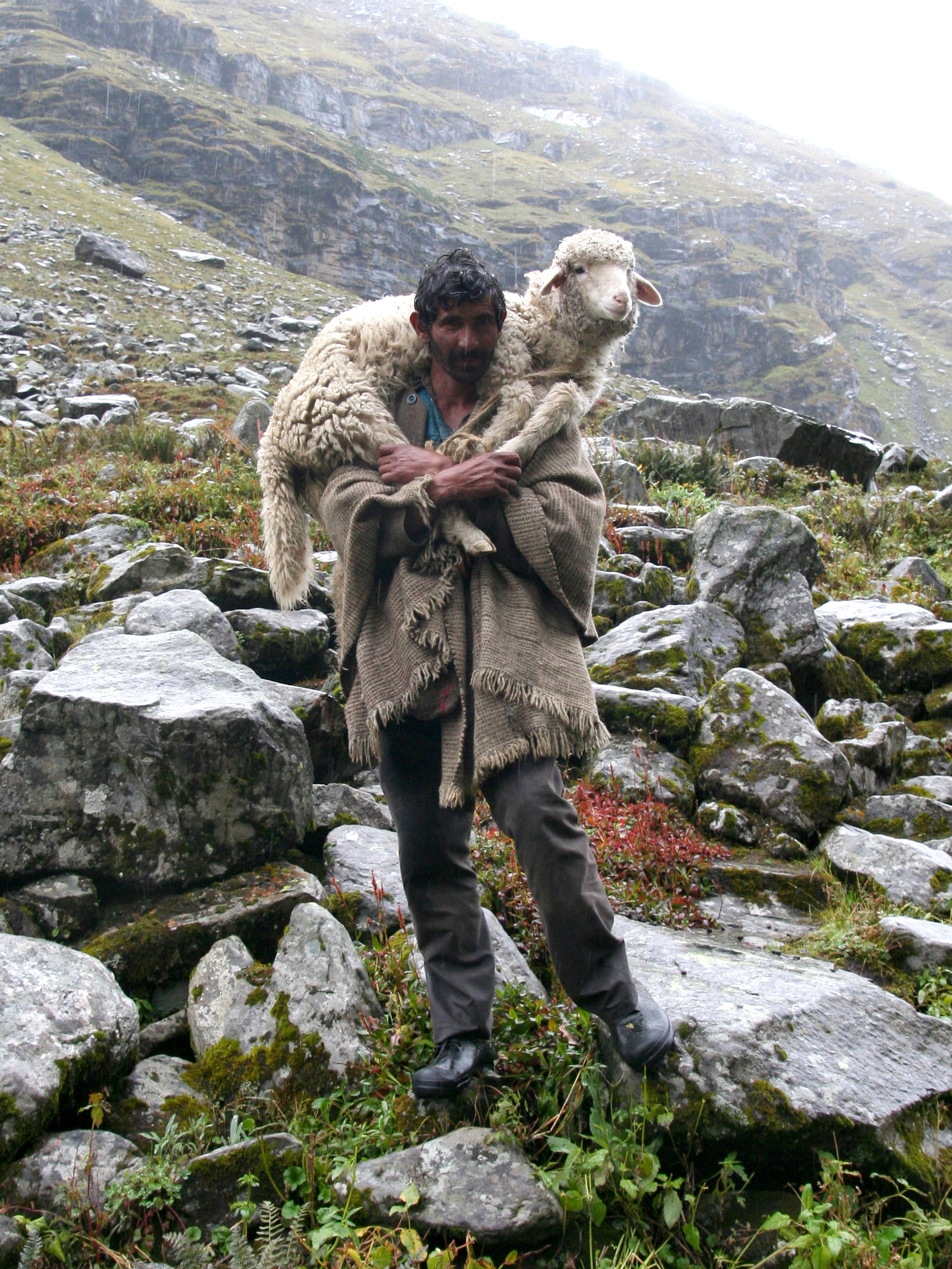
Obviously, the language of this psalm paints a picture of God as the Great Shepherd. Shepherding was an important job in the ancient world. Livestock was a measure of one’s wealth in those days, much like an investment portfolio is for us today. The richer you are, the more you need a shepherd’s help. Ironically, the shepherding profession itself was not held in high esteem. Shepherds were thought of as dirty hillbillies. This was not unusual in ancient agricultural societies. More “civilized” farmers who settled down and established a homestead on a particular piece of land often looked down on the nomadic shepherds, who had to travel wherever there was sufficient pasture and water for the sheep. Farmers spread lots of nasty rumors about shepherds.
In fact, this farmer vs. shepherd rivalry is so long-standing, some biblical scholars think it may have been the inspiration for the legendary Cain and Abel story in Genesis 4. These two brothers were the first sons born to Adam and Eve after their expulsion from the Garden of Eden. Cain, the elder, stronger, and more “civilized” brother was a farmer, while Abel, the younger and weaker brother was a nomadic shepherd. I could go into more interesting detail about their story, but that would be an entirely different sermon. For now, it helps us to see that shepherds were looked down upon in the ancient world.
What does it mean that God was identified with this necessary-but-despised profession? I like to think it means that God, the Great Shepherd, isn’t always present to us in ways that are nice and pretty. Sometimes, God seems to be very “rough around the edges”. This makes me think of the character Strider in J.R.R. Tolkien’s classic, The Lord of the Rings. Strider is a dark and mysterious wanderer. Nobody knows if he can really be trusted, but it turns out that he is actually destined to be a great king over the land of Gondor. In spite of his rough appearance, Strider is one of the most noble and trustworthy characters in the book. I think that God, the Great Shepherd, is quite similar to Tolkien’s Strider.
As Psalm 23 progresses, we learn more about God’s job as the Great Shepherd. We learn first that the Shepherd is a Guide. The flock is destined for “Green pastures” and “still waters”, places of rest and refreshment, while they walk with God. Even in the darkest valley, the sheep are never alone or abandoned. Their final destination is the place where God lives, the place where a home has been prepared for them by the Shepherd.
The second thing we learn is that the Shepherd is a Guardian. The “rod” and “staff” mentioned in verse 4 are actually weapons used to fight off wolves that might try to attack the sheep. As flocks of sheep wandered through the wilderness, they would often have to worry about predators that might be stalking them from behind. Who knows what kinds of dangerous and wild animals might be following the flock? But the sheep says in verse 6 the Great Shepherd is so good at the job that only “goodness and mercy shall follow me all the days of my life”. No wild animals here!
Third, we learn that the Great Shepherd is a Host. The sheep says that the Shepherd “preparest a table for me in the presence of mine enemies”, therefore “my cup runneth over.” The nomadic life of sheep and shepherds often looked unstable to outsiders. They had little control over outward circumstances. How could one know whether there would be sufficient food or water at the next stop? I’m sure it was nerve-wracking. Faith in God’s providence for our lives can be just as unsettling. We never know whether feast or famine lies around the corner. It feels more sane and stable to trust in the fragile and fabricated security systems of wealth and power in our society. But the fact is that we cannot effectively “insure” our health, life, or property any more than helpless sheep can safely find their own way to food and water in the deserts of Palestine. We need a guide and provider. Will we trust the Shepherd to do this for us?
Fourth, we are told that the Shepherd is a Healer. The sheep says that the Shepherd “restoreth my soul” and “anointest my head with oil” (a common medicinal practice in the ancient world). Tending to sick and wounded sheep was a big part of the Shepherd’s job. More than anyone else in this room, I’m sure our veterinarian friend, Terry Hausserman, could tell us detailed stories about animals in need of tender care. God promises to do this for us.
All of these roles for the Great Shepherd (Guide, Guardian, Host, and Healer) have been much needed by me and the people of this congregation during this long and difficult period of transition. Can God be trusted to fill these roles for us? Well, I can tell you what I’ve seen in my own experience:
After I decided that it was time for me to leave my previous denomination, I made a call to my friend Naomi Kelly, who is the co-chair for the Committee on Ministry in this presbytery. I explained the situation and she was sympathetic. It would be an understatement to say that these colleagues received me with open arms. The committees and the stated clerk of presbytery literally bent over backward to welcome me as one of their own. It didn’t happen overnight. Paperwork and exams were involved. There was also the issue of receiving a call. In order for me to come on board, I would need to receive a pastoral call from a congregation.
Well, it just so happens that, the next Sunday after my initial phone call to Naomi, I was scheduled to preach here in Boonville. My decision to leave my previous denomination was so fresh, I wasn’t yet talking about it to anyone outside of my inner-circle of close friends. I came here that morning and did what I always do. But then, after the service, a group of elders basically cornered me in the sanctuary. “What will it take,” they said, “for you to consider coming here to be our pastor?” Let me tell you, I was totally blown away. There was no way that any of these folks could have known about the decision I had just made in the previous week. How is it that they picked that exact moment to approach me about becoming the pastor? I wanted to come right out and tell my whole story right then, but prudence dictated otherwise and I simply said that we should consult the presbytery’s Committee on Ministry and ask for their guidance.
But there was obviously someone bigger than a committee that was guiding us in that moment. In spite of the dire circumstances of that “dark valley”, I can honestly say that I have never in my life felt so clearly the presence of God the Great Shepherd as Guide, Guardian, Host, and Healer than I did in that moment. Even as God was leading me away from an unhealthy situation, God was also leading me toward this new future in ministry. God’s timing was impeccable. So yes, I’ve been through the “valley of the shadow of death”, but I also know that I need “fear no evil” for the Great Shepherd is with me. Throughout my ordeal, God has been my Guide, Guardian, Host, and Healer.
I can see the hand of the Great Shepherd at work in the life of this congregation as well. Yes, it’s been a long and hard road in your search for a new pastor, but you’ve never wandered alone or abandoned. In fact, you’ve always had what you were looking for. Did you know that the word “pastor” is actually Latin for “shepherd”? You’ve been searching for a new pastor, but all along you’ve been under the care of the Great Shepherd (the Great Pastor). In a very real sense, I’m only serving this congregation as the “assistant pastor”. It’s not my job to guide, guard, host, and heal you. I’m here to help you look for the ways in which God is already doing those things. “The Lord is my shepherd; I shall not want”. God has been your pastor all along; there is nothing you lack. And let me tell you, as a pastor, God is a tough act to follow!
As you sit here this morning, you may be walking through your own personal “valley”. Maybe it’s the loss of a job, a relationship, or your health. Your circumstances will inevitably be different from mine, but the question is the same: Can God be trusted as Guide, Guardian, Host, and Healer? I invite you to look around in your present situation. See whether God has already been present and active in these ways. Also, I invite you to be patient and see what might be coming around the bend. Ask God to show you these things. As Jesus promised, those who seek will find. And those who trust in the Great Shepherd will dwell in God’s house forever.
Apologies to anyone who is uninterested in church politics, but…
Today marks an historic occasion for the Presbyterian Church (USA). Twin Cities Presbytery voted to ratify an amendment to the Book of Order that would allow lesbian, gay, bisexual, and transgendered (LGBT) people to serve openly as deacons, elders, and pastors. This amendment was passed by the General Assembly, but needed ratification by a majority (87) of the denomination’s 173 presbyteries.
Today, Twin Cities Presbytery cast the 87th vote in favor of ratification.
The Presbyterian Church (USA) now joins the United Church of Christ, the Episcopal Church, and the Evangelical Lutheran Church in America as mainline Protestant churches in the US that allow ordination equality for LGBT Christians.
This is a really big deal for us in the PC(USA). As we move forward in this new stage of ministry, there is still work to be done and prayers to be prayed. Of particular concern to me are:
1. The ongoing cause for marriage equality in church and society. LGBT people are still not allowed to get married in our denomination (and most of our states). Many of us would like to see that changed.
2. There are many thoughtful and faithful Christians in our denomination who will feel quite threatened by today’s development. Their concern is that our denomination is departing from biblical and historic Christian practice. While I personally disagree with their interpretation of the Bible on the issue of LGBT equality, I respect their faithful witness to the gospel and feel glad to count them as colleagues and members of my own family. My hope and prayer is that Christians on both sides of this debate might engage in fruitful and transformative dialogue with one another. Hopefully, we can continue to undertake this journey together in the PC(USA). If not, I pray that provisions can be made for individuals and churches to part ways amicably, in hopes of future reconciliation. To this end, I would call on denominational officials to let these churches depart with a blessing and not let issues of interpretation and conscience degenerate into petty spats over church property. The so-called “evangelical” and “progressive” voices need each other if we are to become a church that truly reflects the image and likeness of God.
There is a phrase attributed to the French philosopher Voltaire that goes something like this: “God created man in his own image, and then man returned the favor.”
What Voltaire meant by this is that people tend to conceive of God in ways that match their view of themselves and the world. To liberals, God is a liberal. To Tea Partiers, God is a Tea Partier. To chauvinists, God is masculine. To feminists, God is feminine. To self-haters, God is judgmental. To narcissists, God is all about them.
As finite human beings, we inevitably have to use limited human language to describe our infinite God. We rely on images like “Shepherd” and “Parent” to understand the relationship between God and creation. These metaphors can be helpful, because they take what is ultimately unknowable and present it in terms that are familiar to us.
The problem comes when we hold onto these images and ideas too tightly. We try to squeeze the infinite mystery of God into finite boxes of our own making. We try to force God to relate to us on our own terms.
Psychologists call this kind of behavior “delusional”. The biblical authors called it “idolatry”. People would rather bow down to visible and tangible gods of their own making than stand in awe of an invisible and eternal mystery that moves outside the realm of their understanding.
When people in our society think of “idolatry”, they imagine ancient polytheists offering various sacrifices before stone statues. But the truth is that idolatry is not limited to one kind of religious practice. Even Christians fall prey to idolatry. They do it every time they try to squeeze God into the walls of a church or the pages of the Bible. Don’t get me wrong: churches and Bibles are wonderful tools that can guide us in our relationship with God. They can show us how to find God in our daily lives, but they are only a means to an end. When Christians do the opposite, when they treat the means as an end in itself, and they stop looking for the divine presence in the world around them, then they are guilty of the sin idolatry. By limiting God’s sphere of operation to a book or a building, they force God to meet them on their own terms (so they think). This is exactly the sort of thing that we can see going on in today’s gospel reading.
The apostle Thomas, who is often called “Doubting Thomas”, gets an undeserved reputation from this passage. There are some who chastise him as the one apostle who was unwilling to believe the truth of the resurrection. Others praise Thomas as the father of all skeptics who demands facts before faith. Doubt is the sentiment most closely associated with Thomas. But I don’t think he deserves that distinction.
After all, wouldn’t you or I do the same if we heard that one of our loved ones had suddenly returned from the grave? We would want to see it for ourselves, wouldn’t we? Any of us would ask a lot of hard questions before we accepted the reality of a dead man walking.
Also, in his questioning of the other apostles, Thomas was only following one of Jesus’ own commandments! In Luke 21:8, Jesus said, “Beware that you are not led astray; for many will come in my name and say, ‘I am he!’ and, ‘The time is near!’ Do not go after them.” How can we blame Thomas for doing his job as a faithful disciple of Jesus? So, from both rational and religious perspectives, one can understand Thomas’ reticence to accept these rumors of resurrection.
Doubt is not Thomas’ problem. Doubt is the sign of a clear head and an honest heart. If Thomas has a problem it has to do with one word: “Unless”. He says, “Unless I see the mark of the nails in his hands, and put my finger in the mark of the nails and my hand in his side, I will not believe.” With this one word (“Unless”), Thomas is demanding that Christ meets him on Thomas’ own terms. In the arrogance of his ignorance, Thomas is convinced that he, more than all the other disciples, has what it takes to establish the criteria for true faith.
As it was with Thomas, so it is with us. You and I live in a society that is becoming increasingly polarized in more ways than one. People on all sides of the religious and political spectra have stopped listening to one another and started insisting on certain ideological criteria that must be met before we validate the intelligence and good faith of those who disagree with us. Even though much of this debate takes place in the name of Christ, I fear that too little of it takes place in the spirit of Christ. People on all sides are quick to squeeze God into boxes with labels like “biblical truth” or “human rights” and demand that Christ meets them on their own terms (whatever those terms may be).
So then, what are we to say? Is there any hope for us “Thomases” out there? Does this passage offer any relief from this impasse? I think so. John’s gospel continues the story on the next Sunday, when Thomas and the other disciples were once again gathered together. It says at verse 26: “Although the doors were shut, Jesus came and stood among them and said, ‘Peace be with you.’”
In spite of Thomas’ roadblocks to faith, in spite of the “shut doors” that surrounded this motley crew of disciples, Jesus is present. No barrier is sufficient to keep the risen Christ at bay. Jesus encounters Thomas in the midst of his struggle. He doesn’t wait until Thomas has resolved his issues. He even offers to meet Thomas’ criteria for belief. Jesus says, “Put your finger here and see my hands. Reach out your hand and put it in my side.”
I find it most interesting that John’s gospel doesn’t tell us whether Thomas actually did reach out and touch Christ’s wounds. That much is left up to the reader to decide. Whether he did or didn’t, the emphasis of the story is on Christ’s offer and Thomas’ response, “My Lord and my God!” When faced with the real presence of the crucified and risen Christ, Thomas’ issues seem to just melt away. In the words of the philosopher John Hick, Thomas moves from “self-centeredness” into “reality-centeredness”. All of a sudden, his agenda, his criteria, his arrogance, and his terms just don’t seem to matter as much as they used to. This new openness paves the way for Thomas to rejoin the fellowship of disciples and believe the truth of the resurrection, even if he wasn’t quite clear on the facts.
This gives me hope for all of us as well. It gives me confidence that the infinite God who dwells in our midst will continue to come bursting out of our finite little boxes. The presence of the risen Christ speaking peace to struggling unbelievers in a room full of shut doors gives me fuller assurance that the “shut doors” in my own arrogant, ignorant, and unbelieving heart cannot and will not keep the peace of Christ away from me. This is true for you as well. It is true for all of us. This week, as you go back out into the cacophony and conflict in your work, home, church, and society, I invite you to meditate on this Easter truth.
The apostle Paul puts it so well in Romans 8:38-39:
I am convinced that neither death, nor life, nor angels, nor rulers, nor things present, nor things to come, nor powers, nor height, nor depth, nor anything else in all creation, will be able to separate us from the love of God in Christ Jesus our Lord.



 Hopping Hadrian's Wall