
Sermon for Proper 24, Year A
“Render unto Caesar those things that are Caesar’s, and to God those things that are God’s.”
Familiar words. They are frequently cited as a reference to the separation of church and state. There’s only one slight problem with that: Separation of church and state are not what Jesus was talking about.
In Jesus’ time, there was no separation of religion and politics, where Caesar had the political sphere, God had the religious sphere, and they both staid in their respective lanes. Religion was a political affair, as we can see in the complicated relationships that happened with the religious leaders, living under occupation by the Roman Empire. Also, politics was religious, especially insofar as Caesar himself claimed to be “the Son of God.”
The concept of separation of church and state is a modern one and a good one. I wholeheartedly support it, because it protects the church from the state and the state from the church, but it’s not what this passage is about.
We default to old habits, like associating this passage with the separation of church and state, because it’s easier to let challenging questions can become comfortable answers. And that’s pretty similar to what is actually happening in today’s Gospel.
Richard Rohr is a spiritual writer who said, “Religion is, ironically, often the safest place to hide from God.”
It seems counterintuitive. We ask, “Isn’t religion how I connect with God? I come to church, receive the sacraments, read the Bible to hear from God, and pray for guidance from God.”
But sometimes, speaking only for myself, I read the Bible, not to learn and grow, but to prove that I’m right.
And sometimes I pray, not because I’m looking for guidance, but because I’m looking for permission.
Sometimes I listen to someone I disagree with, not to understand that person’s perspective, but so I can make up my next argument in advance.
And sometimes I ask questions, not to explore the truth more deeply, but to set a trap for someone else. That’s exactly what the Pharisees and Herodians were doing to Jesus in today’s Gospel.
The trap starts with flattery. They say, “Teacher, we know that you are sincere, that you teach the Word of God in truth, and you show deference to no one. So tell us, is it lawful to pay taxes to the emperor or not?”
This was a question to which there was no good answer. If Jesus had said, “no, don’t pay taxes to the emperor,” then they could say, “Aha, we’ve got you! You are causing sedition and treason. You are trying to rise up against Rome, so we can get Pontius Pilate to come and kill you.”
But if he had said, “Yes,” then they could say to their Jewish neighbors, “See? He’s not really one of us!”
If Jesus had said Yes or No, it would have been a bad answer, but Jesus is a pretty smart guy. He sees what they’re doing and calls out their hypocrisy.
Hypocrisy, in this case has a very specific definition. It’s not just somebody who fails to live up to their ideals. Because that applies to every single one of us in this room.
In this case, the Pharisees and Herodians are hypocrites because they are telling the truth in the service of a lie. They are not interested in seeking truth; they’re interested in what they think the truth can do for them. They’re using the truth. That’s the hypocrisy that Jesus is calling out in today’s gospel.
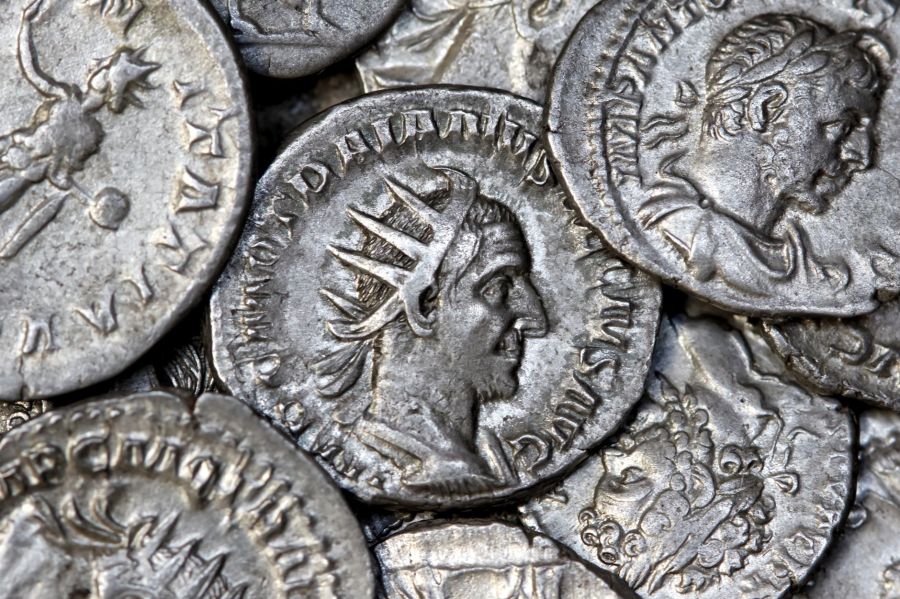
He says, “Okay, I’ll play. Show me the coin used for the tax.”
So they bring him the coin. He holds it up and says, “Whose image is this?”
And they say, “It’s Caesar’s image.”
That’s the moment when Jesus reversed the trap on them. Caesar’s face was on the coin, but Caesar himself, as a human being, was made in God’s image. So, whose image was really on that coin? God’s. That’s how Jesus exposed their hypocrisy.
Jesus demonstrated how the religious authorities were failing to recognize the image of God. So, when He says, “Render unto to Caesar what is Caesar’s,” He is really saying, “Let Caesar have this silly little coin if he wants it, but give to God what is God’s.”
What belongs to God?
You. Me. Everything. The universe.
That’s how Jesus avoids their trap and exposes their hypocrisy for what it is. The coin may bear Caesar’s image, but Caesar himself, along with you, me, and everyone else, bear God’s image. Jesus exposed the hypocrisy of the religious authorities, but the good news is that he keeps engaging with them.
He keeps posing these uncomfortable questions in order to get them to look below the surface fights over religion and politics. He says, “I want you to see the presence of God in all of this.” That is true spiritual insight.
When we look at the world through those eyes, we discover that we don’t have to craft a fancy image for ourselves. Because we already bear the image of God. We don’t have to earn it, and we can’t lose it. No matter how good or how bad we are, as persons, the Imago Dei is simply there.
And so Jesus, yes, does expose their hypocrisy, but the good news is that exposure does not lead to rejection, but healing.
I experienced a little bit of that this week while I was preparing this sermon.
I started reading and praying through the text, like I usually do, and I was thinking about all the people I don’t like. I thought, “They’re all hypocrites with ulterior motives!” I was going to come up with all kinds of witty examples to prove their hypocrisy.
But then I started looking a little deeper. I stopped looking at their motives and started looking at my own. I was crafting a sermon that was all about pointing the finger at “those hypocrites over there,” so I was falling into the same trap that the Pharisees and Herodians fell into.
Sometimes, when I’m reading an article, I check to see whether the author is part of my ideological “club.”
Sometimes, I assume the negative intentions of another person before I’ve really heard them out.
Sometimes, like the Pharisees and Herodians in this passage, I might technically tell the truth about something, but do it in a misleading way. It might be true to the letter of the truth, but not to the spirit of the truth.
I came to this passage, looking to point my finger at people I don’t like, but I ended up pointing at myself. That was painful, but it was also healing.
Because, even in that mistake that I was making, I was still loved. I am still made in the image of God.
All the people I love are still made in the image of God.
All the people I don’t like are still made in the image of God.
And that’s true, whether I want to admit it or not.
But if I can embrace that truth, I can grow, even though that growth is sometimes painful.
What it requires is that I have the humility to admit when I’m wrong and the courage to see the image of God in someone with whom I disagree.
When Jesus presented these questions and exposed the hypocrisy of the Pharisees, the text tells us that they were “amazed.”
Amazement is amazing. Rabbi Abraham Joshua Heschel said, “To be spiritual is to be amazed.”
For a brief moment, Jesus’ question opened up their horizons, giving them an opportunity to look deeper, to see the true meaning of who they are, and experience the true meaning of their lives in this world.
The tragedy is that they were not willing to stay that amazement.
The text says, “When they heard this, they were amazed; they left him and went away.”
That’s a tragedy for them and a warning for us.
We occasionally will have moments where tough questions are able to open our minds and hearts. If we can stay in that moment of radical amazement, letting the questions break us open, then the possibility of transformation begins.
We have an opportunity to see the presence and image of God in ourselves and in everyone around us: The inherent beloved-ness, “the dignity of every human being,” as we say in our Baptismal Covenant.
What this opportunity requires of us is that we stay in the difficult questions long enough to be amazed, and stay in the amazement long enough to be changed.
As you go out into this week, I encourage you to be open to the challenging questions that come your way. Be open to radical amazement at the most ordinary things. Let that amazement change you from the inside out, so that you can know yourself, and everyone else, to be utterly unique reflections of the image of God.