
This week’s sermon from First Pres, Boonville.
Click here to listen to it at fpcboonville.org
The text is I Thessalonians 4:1-13.
“Space: the final frontier. These are the voyages of the starship Enterprise. Its continuing mission: to explore strange new worlds, to seek out new life and new civilizations, to boldly go where no one has gone before.”
These words were a mantra to me during my childhood. For those who might not recognize them, they come from the opening credits of the TV show Star Trek. And every Saturday night at seven, I could be found in the living room with our family television set tuned to channel 12. And for the next hour, I would be transported (“beamed up”, if you will) into the 24th century and onto the bridge of the USS Enterprise, where Captain Picard would be my guide as we faced crises of galactic importance (but none so complicated that they couldn’t be resolved by the end of the hour). This weekly ritual was like a Sabbath to me. Star Trek gave me comfort and it gave me hope. It restored my faith in the power of the human spirit.
One of my favorite things about Star Trek is its constant theme of exploration. The crew of the starship Enterprise spent a lot of time in distant and uncharted regions of the galaxy. They existed on the growing edge of human experience that led to new discoveries and new insights. Something about that spoke to me. At ten years old, I knew that was how I wanted to live my life.
Initially, my hunger to explore was directed outward to the stars. I wanted to travel into outer space. To be honest, I still do. Whenever humans get around to colonizing Mars, I figure they’ll eventually need pastors up there. And you know what? I’d put in for that call! I’m just sayin’…
In the meantime, I’ve turned my attention to exploring the “inner space” of spirituality. The territory is different, but that drive to explore is the same. I still want to “boldly go where no one has gone before.” That’s what motivates me to keep going and keep growing as a human being. I can’t say that I’ve ever explored completely new ground for humanity, but I’m constantly discovering plenty of territory out there that’s new to me. It’s exciting and I love it.
Some of us explore because we want to. Others explore because they have to. One of my hardest moments as a pastor came last year when my wife and I co-officiated at a funeral for a baby. In that moment, every bit of conventional wisdom, biblical scholarship, and theological understanding went right out the window. We were forced to explore completely new territory. It wasn’t fun or exciting but we had to go there because the parents of that little girl were depending on us. We had no answers for them. There is no bumper sticker slogan in the world that will make that kind of pain easier to deal with. So, we were forced to explore new territory.
As hard as it was for us, it was a million times harder for the parents. They said it felt like they had been initiated into a club that no one wants to be a member of. They would have given anything to be anywhere else in that moment. That kind of exploration is nothing but torture.
That’s the kind of exploration the Thessalonian Christians were forced into in today’s scripture reading. We’ve been learning a lot about the Thessalonian church during these past few weeks. They were a dynamic, loving, and spiritually vibrant church. When the apostle Paul came through town as a missionary, these folks were particularly and remarkably open to what he had to say. Their reputation as people of faith had spread all over the region. But they also had some hard questions that they were struggling with.
You see, a big part of Paul’s message had to do with the return of Christ. When he preached, he made it sound like Jesus might be coming back as soon as next Thursday, certainly within the lifetimes of his audience members! From what we can tell, it seems like Paul himself truly believed that was the case. He wasn’t trying to pull the wool over anyone’s eyes.
The problem came as time went by. Jesus was nowhere to be seen. What happened? Did they miss it? Was Paul wrong? The point when they got really REALLY nervous is when people in their community started dying. What would happen to them? If they weren’t here when Jesus got back, would they be lost forever? The Christian church never had to ask these kinds of questions before. They didn’t have any answers to fit the mold. What were they supposed to do now?
It was a moment of necessary spiritual exploration. They were asking questions that no one had thought to ask before. What will happen to our deceased Christian friends? What will happen to us if Jesus doesn’t return during our lifetime?
It must have been a difficult moment for Paul as a pastor. He had taught his flock in the best way he knew how. Had all of that ministry been in vain? Was there any hope left? Paul was forced into some pretty heavy-duty spiritual exploration.
He begins with the assumption that there is hope. He may not know much else, but he believes that God in Christ can be trusted. That’s number one. Next, he thought about what he already knew he believed. In verse 14, he talked about how they already believed that “Jesus died and rose again”. To him, this meant that the dead are not beyond God’s care. Inspired by further reflection and a powerful visionary experience, Paul presented the Thessalonian Christians with an image of “meet[ing] the Lord in the air.” In other words, Paul was saying that there is a place (i.e. “in the air”) where heaven and earth come together. In this place, we have communion with Christ, each other, and all of those who have died before us. They are not gone. We will be together again.
Paul gives the Thessalonians this inspirational exploration as a source of strength and encouragement. It’s something to hold onto in dark and uncertain times so that they might also hold onto hope. It’s a mental image that arises out of questions they’ve never had to ask before. In one sense, it represented a shift away from what they had initially been taught. Jesus might not physically return within their chronological lifetime. On the other hand, it points to much deeper truths that do not change. Hope does not change. God’s faithfulness does not change. God’s love, which is stronger than death itself, does not change.
In the same way, we who live in the 21st century are forced into constant exploration. Society around us is changing on a scale and at a rate that is heretofore unknown in the history of our species. We are asking questions that have never been asked before. What are appropriate Christian responses to evolution, human cloning, or same-sex marriage? There are many people of faith who claim to know the answers already, but the reality is that those are questions that Jesus and Paul never had to ask in the time and place in which they lived. It is left to us to faithfully explore these questions and try to answer them in a way that affirms those things that don’t change: God is faithful. There is hope. God loves you.
We’re probably going to disagree with one another in the answers we come up with. That’s okay. It’s all part of the process of exploration. It’s a lot of trial and error. In fact, I think we’re more likely to get at the (capital T) Truth if we go ahead and assume that each of us is probably going to get the answers wrong somewhere along the line. Remembering that will keep us humble.
There is a wonderful hymn that is not in our hymnal. It was written in the 1850s by a man named George Rawson who based the words off of the last sermon preached to the Plymouth Rock pilgrims before they left Europe for the New World. It goes like this:
“We limit not the truth of God to our poor reach of mind —
By notions of our day and sect — crude partial and confined
No, let a new and better hope within our hearts be stirred
For God hath yet more light and truth to break forth from the Word.”
So, go out from this place today and back into the final frontier. Remember your continuing mission: to explore this strange new world, to seek out new light and new revelations, to boldly go where no one has gone before! Remember, above all else, those truths that don’t change: God is faithful. There is hope. God loves you.

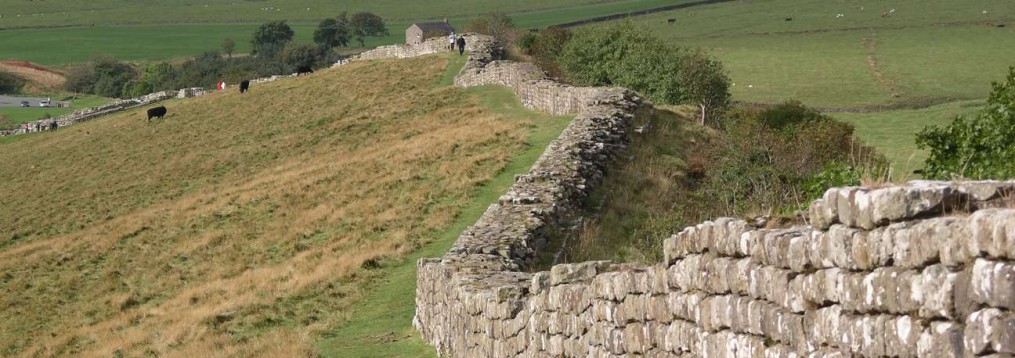
 Hopping Hadrian's Wall