
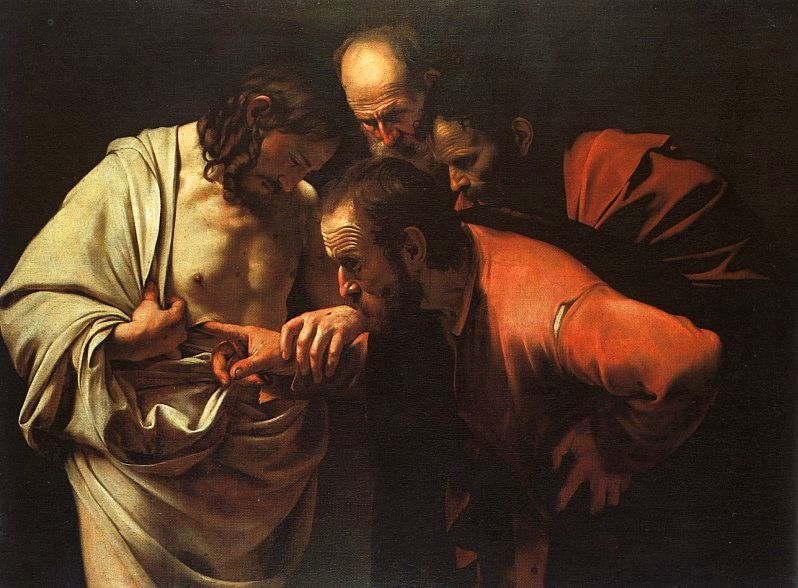
Extraordinary Claims Require Extraordinary Evidence

Sermon for the Second Sunday of Easter.

The biblical text is John 20:19-31.

Once upon a time, there was an expecting mother. In her womb, there were twins. These twins, as people often do when they spend a lot of time together, liked to talk about various things. One day, a particularly philosophical question came up. One turned to the other and asked, “Do you believe there’s any such thing as life after birth?”

“Never really thought about it,” the other twin said, “but I highly doubt it. We’ve never seen anything outside of this place. No one who leaves ever comes back. I think that, when the time comes for us to be born, we just go through that passage and cease to exist.”

“I disagree,” the first said, “I mean, you’re right that we’ve never seen anything outside of this place, but just look at these eyes, ears, hands, and feet that we’re growing! Why are we growing them, if we’re never going to use them? I bet, after we go through that passage, we’ll find out there’s a whole world outside that we’ve never seen before. I have no idea what it will be like, but I have a hunch our time in this womb is getting us ready for whatever comes next.

“That’s the most ridiculous thing I’ve ever heard,” said the other. “I bet the next thing that you’re going to tell me is that you’re one of those crazy religious people who believes in the existence of Mom!”

“Well, I don’t think I’m crazy,” the first said, “but, as a matter of fact, I do happen to believe in Mom.”

“Oh, really?” The other said, “Then why don’t you enlighten me, if you’re so wise? I’ve been in this womb for almost nine months, but I’ve never seen a ‘Mom’ or any evidence that convinces me to believe there’s any such thing as life after birth. So then, just where is this hypothetical ‘Mom’ that you supposedly believe in?”

“It’s hard to explain,” the first said, “but I think that Mom is everywhere, all around us. Everything we see in this womb is a part of Mom. So, I guess, it’s kind of like… maybe we’re growing inside of her? You said you’ve never seen Mom, but I think we’ve never seen anything other than Mom. I don’t pretend to have the answer, but I suppose it’s just another one of those things we won’t know for sure until after we’re born.”

There are two things I’d like to point out about this little parable, which I have adapted from Catholic priest and author Henri Nouwen. First of all, neither twin in the story is in a position to know, with any certainty, what the full truth of the matter is. The answers to questions about “life after birth” and “the existence of Mom” are pretty obvious to you and me, who have lived outside the womb for most of our existence, but we can imagine how scary it must have been when we were going through the process for the first time. Even now, uncertainty about “life after death” and “the existence of God” makes us nervous. Maybe someday in eternity, we’ll look back on our earthly lives and laugh at how little we knew back then, but today we can only know what we know, which might give us a little sympathy for those unborn twins and their philosophical questions.

The second detail from that story I’d like us to notice is that the presence of doubt has absolutely no bearing on the twins’ status as beloved children of their mother. She will love them just the same, no matter what philosophical conclusions they draw during their time in utero. In the same way, even the oldest among us are still babies in the eyes of God. Our eternal Mother knows full well that human beings are incapable of answering the biggest questions about reality, so she is able to have sympathy for those who struggle honestly with doubt. Just like those babies in utero, each and every one of us will be loved forever, no matter what we come to believe during our brief time on this Earth.

This means that doubt is not a barrier to faith.

This second fact about Nouwen’s parable of the twins is what I want us to keep in mind, as we turn to look at today’s gospel.

The story of St. Thomas’ encounter with the risen Christ is the most thorough treatment of doubt in the New Testament. Our brother Thomas gets an unfair shake when we use his name to make fun of someone for being “a Doubting Thomas.” After all, Thomas was only doing what any of us would have done, if someone came to us with news that seemed unbelievable. For this reason, I like to think of Thomas as “the patron saint of critical thinkers.” The scientist Carl Sagan famously quipped that “extraordinary claims require extraordinary evidence.” I imagine Dr. Sagan applauding when St. Thomas proclaims, “Unless I see the mark of the nails in his hands, and put my finger in the mark of the nails and my hand in his side, I will not believe.”

The most intriguing aspect of this story is not Thomas’ doubt, but Jesus’ response to it. If John’s gospel had been written by modern Fundamentalist Christians, they probably would have said that Jesus couldn’t appear in the upper room until the other disciples had excommunicated Thomas for his skepticism. If Jesus appeared at all, it would probably be on the far side of the locked door, shouting about how Thomas is a “sinner” and is “going to hell,” if he doesn’t change his mind. But that’s not what actually happens in John’s gospel.

In the real version of the story, the text says, “Although the doors were shut, Jesus came and stood among them and said, ‘Peace be with you.’” Thomas’ doubt, for Jesus, was not a reason to stay away, but a reason to come closer. Thomas’ doubt, for Jesus, was not a reason to offer words of judgment, but a reason to offer words of peace. Jesus doesn’t command Thomas to have blind faith, but gives him the extraordinary evidence he’s looking for.

The presence of this passage in our sacred Scriptures should shape the way we deal with doubts, both our own and those of others. It should help us learn how to accept the process of critical thinking as a necessary part of faith. It should lead us, not to retreat from hard questions, but to advance alongside them.

As Episcopalians, we are blessed with abundant spiritual resources to help us on this journey. The Episcopal Church is part of the Anglican theological tradition. One of the things that makes Anglicanism distinct from some other expressions of Christianity is the way in which we think about our faith. Some other churches see their faith as a monolithic statement by a single and infallible authority. For Roman Catholics, it’s the Pope; for Fundamentalist Protestants, it’s the Bible. But the Anglican theological tradition, as far back as Fr. Richard Hooker in the 17th century, has always viewed Christian theology as a three-way dialogue between Scripture, tradition, and reason.

This way of thinking about our beliefs, sometimes called “the three-legged stool,” means that Episcopalians see our religion as a never-ending conversation. Everyone gets to have a seat at the table, but no one gets to stand on the table and yell at everyone else. Unlike some other religious traditions, Episcopalians do not view their leaders as infallible. We honor our ancestors, but we also believe the Church can be wrong. An interpretation that made sense at one time might stop making sense for future generations. A way of life that seemed just and holy in one century might seem abhorrent in another, and vice versa. This doesn’t mean that “anything goes” in Christian faith and practice, but it does mean that Episcopalians are always open to having a conversation about it.

This understanding of the Christian faith means that Episcopalians can be notoriously hard to pin down when someone asks what our church believes. We frequently disagree with each other, sometimes passionately. The late comedian and devout Episcopalian Robin Williams once said, “No matter what you believe, there’s bound to be an Episcopalian somewhere who agrees with you.”

Finally, thinking of the Christian faith as a three-way dialogue between Scripture, tradition, and reason means that The Episcopal Church is a place where you can bring your whole self to church: Protestant and Catholic, conservative and liberal, believer and skeptic. To all these parts of ourselves and each other, the sign outside our churches around the country proclaims the message loud and clear: “The Episcopal Church welcomes you!”

Whoever you are, whatever you believe, however you identify, and wherever you are on your spiritual journey, you are welcome in this sacred space. That is the message that Jesus proclaimed to St. Thomas in today’s gospel. That is the message that The Episcopal Church seeks to embody every day, as it has for hundreds of years. And that is the message that I hope you hear in this sermon today: That you, with all your doubts and fears, are still a beloved child of God, and you are welcome in this place.

Amen.

Where I Stand Is Where I Fall

Sermon for Sunday of the Passion: Palm Sunday.

Click here to read the biblical texts.

Imagine, if you will, a presidential motorcade coming into town. People line the streets, waving American flags. Secret service agents and police officers surround the limousine on all sides, ready to jump into action if there is a problem.

Now, imagine that, on the other side of town, another kind of parade is happening. In this procession, the leader is riding in a little clown car. People still line the streets, cheering. They are playing Hail to the Chief on kazoos. If we saw this silly demonstration, we could easily understand that it was meant to be a parody of the bigger and more serious motorcade happening elsewhere. This was exactly what was happening on Palm Sunday, as Jesus rode into Jerusalem on a donkey.

In Jerusalem, during the time of Jesus, it was customary for the Roman governor to make a military parade through the city during the week before the holiday of Passover. The Roman province of Judea was known for being a troubled place that frequently experienced violent insurrections. The risk of uprising was especially high during the Passover season, when the Jewish people celebrated their deliverance by God from slavery, tyranny, and genocide in Egypt. Governor Pilate’s annual show of force at that time was intended to nip those thoughts in the bud, before people got any bright ideas about acting on them.

Jesus’ triumphal entry, on the other hand, was a deliberate lampoon of the governor’s bravado. He based his demonstration on the words of the prophet Zechariah from the Hebrew Scriptures:

“Rejoice greatly, O daughter Zion! Shout aloud, O daughter Jerusalem! See, your king comes to you; triumphant and victorious is he, humble and riding on a donkey, on a colt, the foal of a donkey” (Zechariah 9:9).

By comparison, Jesus’ gathering was quite small, filled with the most obnoxious riffraff in town, and was obviously poking fun at the powers-that-be. It’s no wonder then that the authorities were anxious that this little demonstration might attract the wrong kind attention from Pontius Pilate and his soldiers. I can hear fear in their voices as they say, perhaps while glancing nervously over their shoulders, “Teacher, order your disciples to stop.” Jesus responds, rather poetically, “I tell you, if these were silent, the stones would shout out” (Luke 19:40). Paraphrasing Jesus’ words, I imagine Jesus shrugging his shoulders and saying, “Yeah, sure… Good luck with that!”

The serious point that Jesus was making with this little demonstration of political theater is that the so-called powers-that-be in this world are not so powerful as they think. They show their strength through competition and violence, but Jesus shows us another way to live.

Our Epistle reading this morning tells us something about how that other way looks. St. Paul tells us that Christ, “though he was in the form of God, did not regard equality with God as something to be exploited, but emptied himself” (Philippians 2:6-7a).

This “emptying” that Paul talks about is the self-giving love that Jesus radiates from every cell of his body. It stands in stark contrast to the competitive systems of domination that tend to rule the world, both in Jesus’ time and ours.

The “way of the world,” as we are socially trained to accept it, is the way of the zero-sum game, where there are winners and losers, us and them, insiders and outsiders. We see it everywhere: in military conflicts, sporting events, political elections, and business deals. We get so accustomed to this way of thinking, it even finds its way into our families, neighborhoods, and churches. But this way of thinking comes with a downside: When left unchecked, it destroys the very communities that it depends on.

Consider, for example, the “Super Chicken” experiment conducted by evolutionary biologist William Muir at Purdue University. Dr. Muir was interested in improving the egg-laying potential of chickens, so he took the top-producing chickens from each coop and put them together in a “super coop,” expecting this coop to out-perform all the others. What he discovered, though, was surprising. The “super coop” did not perform better than the other coops, but worse… much worse, in fact, because the super chickens all killed each other. Dr. Muir did what he did in the name of improving efficiency, but ended up creating an environment full of aggressive and territorial over-achievers.

This doesn’t just happen with chickens, either. Back in the 1990s, there was a very successful company called Enron. This company had a “rank and yank” practice where they would evaluate their employees and fire the bottom 10% of performers each quarter. Like Dr. Muir, they were trying to increase productivity, but created a company culture where competition led to dishonesty. Eventually, the whole company collapsed under the weight of its own cut-throat practices. The Enron company went bankrupt, thousands of people lost their jobs, and the leaders went to jail.

When we make an unholy idol of winning, we end up losing our souls.

When Jesus, the Son of God, came into this world, he didn’t come to win; he came to love. He didn’t come to seize power, but to give his life for others. The paradox is that this is what true power looks like: Not the power to control, but the power to love without limits.

There is a scene in one of my favorite TV shows where the hero is trying to convince his nemesis to join the hero in a worthy cause. The nemesis complains, “But you can’t win!”

And the hero replies:

“Winning? Is that what you think it’s about? I’m not trying to win. I’m not doing this because I want to beat someone, or because I hate someone, or because I want to blame someone. It’s not because it’s fun. God knows it’s not because it’s easy. It’s not even because it works—because it hardly ever does. I do what I do because it’s right. Because it’s decent. And above all—it’s kind. Maybe there’s no point to any of this at all. But it’s the best I can do. So I’m going to do it. And I will stand here doing it until it kills me. Who I am is where I stand. Where I stand is where I fall. Stand with me.”

I can’t help but hear Jesus in those words. Not trying to win, but just doing what is right, decent, and kind, standing in love until it kills him, and inviting us to stand with him. That’s who Jesus is; as Christians, that’s who we believe God is.

Christians imagine God, not as an “old man in the sky,” but as a flowing river of love. The mystery of the Trinity envisions the one God as three persons (i.e. Father, Son, and Holy Spirit), a community, a network of relationships, bound together in perfect love.

Whenever someone is baptized in the name of the Trinity, we are proclaiming our faith that this person, and every person, is caught up in that never-ending flow of love. The Trinity is why we, as Christians, are happy to say, “God is love, and those who abide in love abide in God, and God abides in them” (1 John 4:16). We don’t just attach the adjective “love” to the noun “God,” we go all the way to saying that God is love itself. And love, as we remember from English class, is a verb.

And if love is a verb, and God is love, then God is a verb. God doesn’t just exist; God happens wherever love is happening. If a river were ever to stop flowing, it would cease to be a river and become a lake. In the same way, if God’s love were ever to stop flowing outward in greater and greater circles of community, God would cease to be God.

This is the alternate way of living that Jesus presents to us on Palm Sunday: The way of self-giving love. Jesus does this because that’s who Jesus is, that’s who God is, and that’s who we are called to be.

Jesus didn’t come to win; he came to love. He didn’t ride a war horse; he rode a donkey. He didn’t exploit his power; he emptied himself.

Today, Jesus invites us to stand with him.

So, as we enter Holy Week, let us stand with him, not because we want to beat someone, but because it’s right, because it’s decent, and above all—It’s kind. Maybe it won’t lead to us winning the competitions that the world values so much, but it’s the best that Jesus can do, and he will stand here doing it until it kills him. It’s who Jesus is, and who he is is where he stands, and where he stands is where he falls. We already know from experience that the cut-throat way of the world is doomed to failure, so let us try this other way instead. Let us stand with him in love, through Holy Week and every week, until it kills us. Until that Easter morning when the tomb is opened and even death itself is swallowed up in victory, powerless against the relentless flow of God’s love.

An Impact Beyond the Intent

Photo credit: Enrique López-Tamayo Biosca, CC BY 2.0 https://creativecommons.org/licenses/by/2.0, via Wikimedia Commons

Sermon for the Fifth Sunday in Lent.

Click here to read the biblical texts.

Back before my wife Sarah and I had started dating, we were in that awkward stage where we were both noticing each other, but neither one had worked up the courage to make a move, so we just kept dancing around the subject. One night, Sarah invited me to a party at her house, and we ended up talking on the couch long after everyone else had left. It was getting late, Sarah reached forward for her drink on the coffee table, I unconsciously stretched, and she accidentally sat right back into the spot where my arm was. Sarah was like, “That was smooth! Can we talk about this?” On the outside, I played it very cool and calm, but on the inside, I was like: “AAAAAAAAAAAAAAAAAAAAAAHHHHHHHHHHHHHH!!!!!!!!!!!!!!”

Anyway… to make a long story short: It went pretty well and we’ve been married for 20 years.

The moral of the story is that our actions sometimes have an impact beyond what we intended them to have. That was certainly the case with St. Mary of Bethany in today’s gospel.

Mary’s anointing of Jesus happens at a very important turning point in the larger story of John’s gospel. Up until this point, Jesus had been dropping hints about his true identity, but from this point forward, he would begin to speak more openly as the story moved toward its climax with his crucifixion and resurrection.

In the chapter just prior to this one, Jesus raised Mary’s brother Lazarus from the dead. This miracle, according to John, was the catalyst that caused the religious leaders to begin plotting to have Jesus killed. As this part of the story begins, Jesus is having dinner at the home of Lazarus, Martha, and Mary. The memory of Lazarus’ death and resurrection was very fresh. Mary would have been deeply moved by the miracle she had just witnessed. Not only had Jesus turned her grief into joy, he had also rescued Mary and Martha from a life of poverty and degradation, which would have absolutely happened to two unmarried women who no longer had a man to speak for them in their patriarchal society. Jesus had saved, not one life, but three lives in his raising of Lazarus from the dead. Mary probably felt that she owed Jesus her life at this point.

As a sign of her gratitude, the text tells us that Mary took “a pound of costly perfume.” The Greek word for “costly perfume” is myrrh, which was used for burial rituals. It is quite likely that Mary had bought this perfume to use for her brother’s funeral, which was no longer necessary, thanks to Jesus. By breaking it open and pouring it on Jesus’ feet, she was expressing her relief and gratitude for what Jesus had done for her and her family.

This, all by itself, would have been a powerful statement, but Jesus gives it an even greater significance that Mary herself could not have known. Jesus says, “She bought it so that she might keep it for the day of my burial.”

Jesus knew, whether through supernatural clairvoyance or just an insightful hunch, that his own death was impending. Mary’s act of devotion meant more than she could possibly have known. Just as Mary honored Jesus with her gratitude, Jesus honored Mary with the knowledge of what her gesture truly meant to him.

The moral of this story is the same as the one I told about my wife and me: Our actions sometimes have an impact beyond what we intended them to have.

Our individual lives are a part of a larger story. Like ripples in a pond, God’s grace expands the meaning of what we do to cosmic significance. If, as Jesus says, even the hairs on our head are numbered, then surely no small act of goodness or kindness goes unnoticed by the God who made the universe.

My favorite modern example of an action that has a greater impact than its intent is the story of Fr. Trevor Huddleston, an Anglican priest who ministered in South Africa in the early twentieth century. Fr. Huddleston was an outspoken activist against the apartheid policies that discriminated against people of color in South Africa. One of the many racist laws on the books at that time was that, whenever a darker-skinned person passed a lighter-skinned person in the street, the darker-skinned person had to step off the curb into the gutter and lift their hat in deference to the lighter-skinned person. Fr. Huddleston, who was himself a lighter-skinned person, thought this racist law was absolutely ridiculous. So, he made it his regular practice that, whenever he passed a person of color in the street, he would step off the curb and lift his hat in a gesture of respect to this fellow child of God. Technically, this was an act of civil disobedience against South African law, but Fr. Huddleston practiced this as an act of divine obedience to the higher law of God, which says that all people are created equal.

One day, Fr. Huddleston was walking down the street and saw a little boy and his mother coming his way. As was his usual practice, he stepped off the curb and lifted his hat in a gesture of respect as they walked by. The boy and his mother were people of color. The little boy asked his mother, “Mummy, who was that man?” And the mother replied, “Son, that man is an Anglican priest, and furthermore, he is a man of God.”

The little boy, telling this story years later, said, “That was the day that I decided I too wanted to be an Anglican priest, and furthermore, a man of God.” That little boy grew up to be Archbishop Desmond Tutu, who helped President Nelson Mandela dismantle the satanic apartheid system that kept God’s beloved children in chains for so many years. It is possible that Fr. Huddleston might have had no memory of that particular day, in which he acted with the same integrity that inspired his actions every day. Like St. Mary of Bethany, Fr. Huddleston could certainly not have known that his simple act of stepping off a curb would have a ripple effect that would eventually lead to the undoing of the twisted system against which he was protesting.

Kindred in Christ, I invite you today to consider how your own simple acts of compassion and courage may have a similar ripple effect on the world in which we live. One never knows when a word of kindness or a gesture of gratitude may have an impact far bigger than its intent. Many such acts are known to God alone, but rest assured that they are known. Jesus says, in his Sermon on the Mount, “When you give alms, do not let your left hand know what your right hand is doing, so that your alms may be done in secret, and your Father who sees in secret will reward you” (Matthew 6:3-4).

Dr. Martin Luther King, in his Letter from a Birmingham Jail, wrote, “We are caught in an inescapable network of mutuality, tied in a single garment of destiny. Whatever affects one directly, affects all indirectly.”

As witnesses of the gospel of Jesus Christ, I want to encourage you this day to speak up whenever one of our siblings in Christ has offered some small word or deed that has impacted your day. It is quite possible that the giver of this gift is unaware of what it meant to you. Be quick to offer thanks to them, and to God for them.

If you are on the receiving end of such recognition, I invite you to listen with ears of your heart, giving thanks to God, who has multiplied the impact of your small gift to mean more than you intended.

Dearly beloved, our lives are not our own and they are not lived alone. It is up to us to enlighten our neighbors with knowledge as they have enlightened us with the love of Christ in their hearts. Who knows whether that grateful acknowledgement might be the very encouragement needed by a weary soul who is secretly despairing of life itself? By adding our small gesture of thanks to the common wealth, we may provide the necessary means by which a life might be saved.

Like St. Mary of Bethany, our actions have an impact far beyond their intent. Let us remember this fact and draw strength from it. May we trust that our lives matter more than we know.

Amen.