
Touching Grass

Sermon for Proper 17, Year C

Click here for the biblical readings

When I was a kid, growing up in the 80s and 90s, Nintendo was a big part of my life. I spent a lot of time perfecting my fine motor skills with games like Super Mario Brothers and Street Fighter II. The only problem was that I developed a bad habit of losing my temper at the TV screen whenever things weren’t going my way in the game. When my poor mother would hear me screaming from the next room, she knew it was time to come in and tell me to turn off the game and go play outside.

Now that I have teenagers of my own, I’ve noticed that their generation has coined a new phrase to deal with this exact situation. When someone is showing signs of having become too wrapped up in drama on the internet, their friends will say to them, “Go touch grass.”

In previous generations, parents might have worried that the mention of “grass” indicated that their kids were engaging in, shall we say, a bit of “recreational chemistry.” But, in present day terms, “touch grass” means temporarily unplugging from the virtual world in order to get back in touch with actual reality. If you’ve been online too long, you need to go touch grass. It’s the same thing that my mother was trying to tell me, back in 1992.

In a way, “touch grass” is also the same point that Jesus is trying to make in today’s gospel. When people are getting too wrapped up in “playing the game” of social hierarchies, they sometimes need to turn it off, reengage with reality, and maybe even go outside and literally “touch grass.”

Whether or not we happen to be of the online generation, we all have a tendency to get wrapped up in silly games that sometimes stress us out. The technology is new, but human nature remains just the same as it ever was. At school, there is a pecking order that dictates who gets to sit at the “cool kids’ table.” At work, certain voices are more likely to be listened to in a meeting. In our neighborhoods, people scramble to “keep up with the Joneses,” while forgetting that everyone is a “Jones” to someone else. The game of social hierarchies is crazy-making. That’s why all of us need to periodically turn it off, go outside, and touch grass.

That’s how we remember that the essence of the good life is not about competition, but communion. It’s not about beating each other, but being together.

In today’s gospel, Jesus is enjoying a meal at someone’s house on the Sabbath day. This is an important detail. In the gospel according to St. Luke, the Jewish concept of Sabbath, the day of rest, comes up repeatedly. For Jesus, the day of rest was not a day of religion, rules, and rituals, but a weekly reminder of the way life is meant to be. Many of Jesus’ healing miracles took place on the Sabbath. People were restored on this day, not only to physical health, but also to their rightful place as equal partners in their community.

A significant part of the Sabbath, for our Jewish neighbors today as well as back then, is the common meal. In Jesus’ time, the seating chart at these meals was very important. The right kind of people had to have the right seat at the right supper in the right house. The whole thing was a game about reinforcing social hierarchies (much like the “cool kids’ table” in every school cafeteria).

At first glance, it seems like Jesus is teaching strategic etiquette for getting the right place at the right table, but what he’s actually doing is subverting the social order by encouraging people not to play the game of social hierarchies. For Jesus, the big Sabbath meal is a symbol of reality, as seen from a spiritual point of view. The most honorable guests, in God’s eyes, are those who willingly take a lower position in order to make space for others at the table.

From the point of view of the Christian spiritual tradition, this parallels nicely with the mystery of the Incarnation, where the Divine Source of all Being “became flesh and lived among us” (John 1:14) in the person of Jesus the Christ.

In Christ, according to the Christian tradition, God’s own self took the lowest place by being born to an impoverished refugee couple, in an occupied country, in the feeding trough of a stable outside of an overfull inn. In today’s terms, it would happen in the parking lot of a run-down motel, somewhere in the West Bank of Palestine.

From the point-of-view of the powers-that-be, such a baby would be nothing more than another mouth to feed, a nameless statistic in the latest news about the latest airstrikes, and a drain on national resources. But, from the Divine point of view, such a birth marks the coming of salvation and liberation into the world. This is the truth that Christians proclaim every time we celebrate Christmas.

Kindred in Christ, this is what it means to “take the lowest place.” It means becoming vulnerable and standing with the most disenfranchised people on earth. In Christian terms, this is what it means to save the world. Jesus the Christ didn’t do it by climbing the social ladder, but by intentionally taking the “lowest place” among humanity. We who claim to be the people of Jesus must follow suit, as the Scriptures say in 1 John 2:6, “whoever says, ‘I abide in him,’ ought to walk just as he walked.”

Dear kindred in Christ, our Lord invites us to “touch grass” because that is exactly what God did in the mystery of the Incarnation. Jesus the Christ took the lowest place among humanity in order to exalt humanity to the “right hand” of God, “in the heavenly places, far above all rule and authority and power and dominion, and above every name that is named, not only in this age but also in the age to come” (Ephesians 1:20-21).

Friends, our Lord asks this of us because he knows that real life is not about beating each other, but being together.

When I think about this way of being together, what comes to mind is Crescent Comics and Games, which sits just a few yards from our church’s front door, on Chicago Street. This establishment is a prime example of a “third place,” as described by Ray Oldenburg in his 1989 book, The Great Good Place.

A “third place,” according to Oldenburg, is different from a “first place” (the home), and a “second place” (the workplace), because it is a place where people can come and be human, without the expectation of monetary participation. Third places are important because they provide space for people to hang out, converse, and figure out who they are, without having to make a purchase or prove their monetary worth.

Other examples of third places include places of worship, public libraries, community centers, and internet chat rooms. They are absolutely essential for functional democracies, but they are becoming increasingly rare in our consumer-oriented society.

Crescent Comics and Games is a for-profit business, but it also functions as a third place because people come there to play games, even if they don’t buy anything from the shop. Logan and Colleen, the owners of this shop, have intentionally made their business a place of welcome for everyone in Coldwater. Those who play games in their store are welcome to make a purchase, but it is not required for participation in the games that take place there. That is why I ultimately consider their shop to be a third place in our beautiful town.

The kinds of games that people play there are manifold. Most significant to me are the role-playing games, one of which is run by our own parishioner and cameraman, Chris Russell.

Here’s the thing to understand about role-playing games: They aren’t about winning or losing. In role-playing games, the players work together to overcome a common challenge and tell a story that is greater than any one of the individual players present. The story is the thing that matters most, and the players either succeed or fail together. I can think of no greater parallel to the Church than this. We, the people of faith, are called together by Christ, not to compete with one another, but to work together in service to a Grand Story that is greater than any one of us.

Kindred in Christ, I believe that the Church is called to be a third place, like Crescent Games and Comics, in our community today. We ought to be a place where people from every walk of life can come and know that they will find a friendly face and a safe shelter from the storms of life.

This is what Jesus the Christ meant when he encouraged his followers to “take the lowest place” in the social hierarchy of Sabbath suppers in his day.

I pray that our church might be a “third place” where every person in our city can come to touch grass, find safety, hospitality, and love in the name of Jesus Christ our Lord, who taught his followers that real life is not about beating each other, but being together.

Amen.

God Don’t Make No Junk

Sermon for Proper 16, Year C

Click here for the biblical readings

Once upon a time, there was a big family, who all lived together in a big house. Each member of this family had a special, magical gift. One was very strong, one could talk to animals, another had powers of healing, and another could control the weather. But then there was another member of the family, Bruno, who could see visions of the future that no one else wanted to see. His gift made people uncomfortable, so the rest of the family banished him from the family. Whenever anyone asked about him, the family would say, “We don’t talk about Bruno.”

But here’s the thing: Poor Bruno didn’t just go away when he was banished; he stayed in the house and lived in the walls, where no one could find him. Eventually, his ominous visions of the future started coming true. Finally, the family realized that they needed Bruno’s help because his visions provided the wisdom they needed to fix their problems. In the end, they saved their family and their house, not by getting rid of Bruno, but by bring him out of the walls and reintegrating him into the life of their family.

The story I have just told you is the plot of the Disney movie Encanto. You may or may not have seen it. But even if you haven’t seen it, I think its story rings true for most of us in the real world.

Many of us, in our families or neighborhoods, can think of people who we would rather not acknowledge or talk about. They make us feel awkward or angry with their unusual ways. We would rather just pretend that they didn’t exist at all, but the thing is that we can’t ever really get rid of them. We can push them out of sight and out of mind, but they are never truly gone.

If we’re honest, we can admit that the reason why such people make us so uncomfortable is that they remind us of truths within ourselves that we would rather not acknowledge. But if we’re truly honest, we can even admit that each one of us has a “Bruno” within ourselves: Some part of us that we wish wasn’t there, because it makes us uncomfortable.

These unwelcome parts of ourselves often get pushed to the side, or even banished into the unconscious parts of our minds, because we would simply rather not deal with the inconvenient truths that they present us with. But the fact is, for us just as much as for the family in the movie Encanto, we can never truly be set free until we recognize these banished parts of ourselves and welcome the truthful message they bring us. This is a story about every single one of us, and it is also the story of today’s gospel.

The woman that Jesus encounters in today’s gospel is a person who knows what it’s like to be pushed aside and forgotten. As a woman, she was already banished to the far corners of the synagogue. The men were the ones who could stand in the center and lead the assembly in singing praises to God.

In addition to her gender, this woman also had some kind of psychosomatic ailment that kept her “bent over” and “quite unable to stand upright” for almost twenty years. On a metaphorical level, this illness made the woman present herself to the world as something less than what she truly was. Her story makes me think of people I know who feel like they are defective or less than their peers because of some quality about themselves that they think will be perceived as unacceptable to the people around them. Her story makes me think also about those parts of myself that I would rather hide from the world because they make me feel ashamed. Like the family in Encanto, I would much rather push those parts of myself out of sight and out of mind, hoping that the world will never find out about the secret that I am so desperately trying to hide. But Jesus doesn’t play that game.

When Jesus encounters this woman, he invites her to come stand in the center of the synagogue. He proclaims to her, “Woman, you are set free from your ailment,” and then reaches out and lays his hands upon her. It is not lost on me that this laying on of hands is the same gesture that a bishop performs during the ordination of a priest. Jesus is ordaining and empowering this woman to stand up and claim her true identity in the midst of the people of God. I think it is no coincidence, therefore, that the woman in this story immediately straightens up to her full stature and begins praising God.

It is also no surprise, at that point, that the managers of that religious institution suddenly become indignant and begin to argue about the petty minutiae of religious law, even though they have literally just witnessed a miracle taking place. But Jesus is having none of their hypocrisy; he calls it out for what it is. Jesus would rather risk blasphemy by breaking the rules than keep the rules and sacrifice the real needs of human people. This is the kind of Savior that Jesus Christ is: with us, for us, in us, and through us. He breaks religious rules for the sake of human needs, and he invites us to do the same.

I remember a time, early in my ministry, when I was the pastor of First Presbyterian Church of Boonville, New York. It was a small, traditional church in a small, traditional town. At that time, the Presbyterian denomination was in the process of revising its official stance on the ordination and marriage of LGBTQ+ people in the church. One prominent member of the church, a man named Rick, came to me and told me that he was gay. He said that, in light of the changes happening in their denomination, he wanted to come out of the closet to his church family. Whether they loved him or hated him, he wanted them to know him as he truly was.

I told Rick that, since I was still new at the church, I couldn’t predict how the parishioners would respond, but I would proudly stand beside him as his pastor, no matter what. So, we planned a church supper to discuss the changes that were then happening in our denomination. At the end of the conversation, I invited Rick to the front of the room to tell his story.

After he finished talking, there was a long moment of silence. I held my breath as I waited to hear how the church would respond. You could have heard a pin drop in that room.

The first person to speak up was a longtime member of the church who very rarely said a word, good or bad.

“Well,” she said, “God don’t make no junk!”

What happened next, I can only describe as a “Tidal Wave Group Hug.”

The entire mob of people of the church rushed to the front of the room, covering Rick with their tears and their love. His elderly aunt said, “I’m so proud you’re my nephew!”

And I was never so proud to be their pastor as I was in that moment.

From that day on, First Presbyterian Church of Boonville became a bastion of civil rights for LGBTQ+ people in upstate New York. They embodied the all-inclusive and unconditional love of Jesus Christ in a way that I would not have thought possible for such a small church in such a small town. They did it because they loved their friend Rick, and because they followed their Lord and Savior Jesus Christ, who called them to love their neighbors as themselves.

Kindred in Christ, this is what it looks like when a community of believers lives out the call to be the hands and feet of Jesus Christ in this world. This is what it looks like when the Church, following in the footsteps of her Lord, invites marginalized people into the center of our collective life, lifts them up, and empowers them to sing God’s praises in our midst.

My question to you today is this: What happens when it’s your turn? What happens when those parts of yourself that you have ignored, repressed, or banished get invited to stand up straight in the center of the room and lead the chorus of God’s praise? What happens then?

[QUICK DISCLAIMER: To my wonderful and beautiful introverts in the room: I know you feel terrified by what I just said. I just heard all of your blood pressures go up simultaneously. Please don’t worry; I won’t make you stand at the front of the room. To you, I would ask the following: What happens when that one person you love the most feels so invigorated by your presence that THEY go to the front of the room and sing God’s praise? Afterwards, they turn to you with a subtle wink and silently mouth the words, “Thank you.” What happens then?]

Well, I’ll tell you what happens then: The kingdom of God comes on Earth, as it is in Heaven. The followers of Jesus begin to act more and more like their Lord and Savior. “The power of love overcomes the love of power,” as Jimi Hendrix once said, and the world understands anew the meaning of those old words: “Jesus loves me, this I know…”

Kindred in Christ, the Spirit of Jesus is among us today, just as the physical Jesus was present with that woman in today’s gospel, setting you free to stand up straight and sing God’s praises. Let us sing those praises together and empower our neighbors to stand and sing with us, so that they too might know the love that sets us free.

Amen.

Pardon Our Dust

Sermon for the Tenth Sunday after Pentecost.

Click here for the biblical readings.

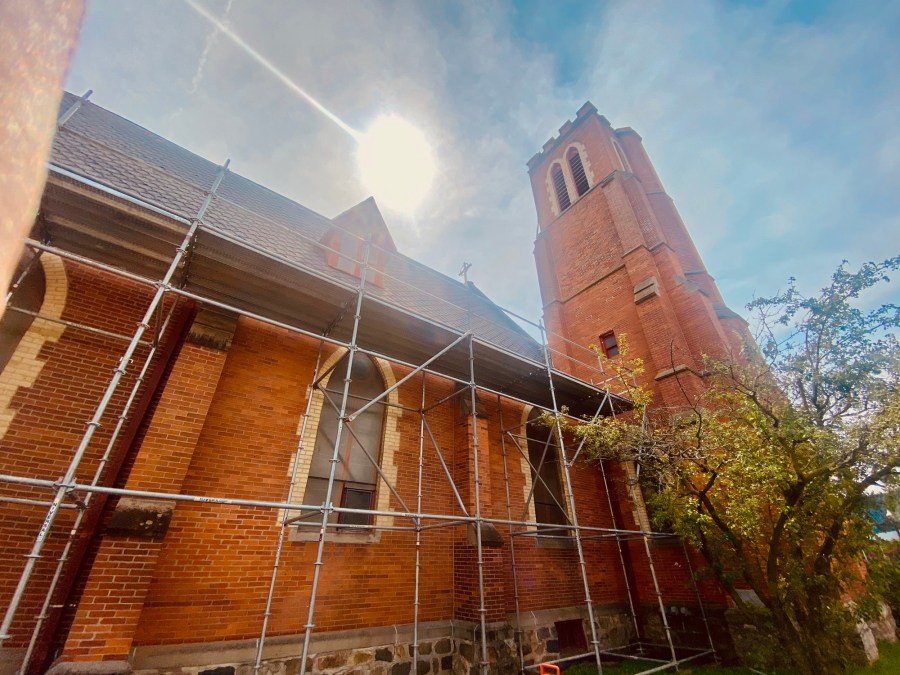
If you’ve been at the church building at all for the past couple of weeks, you’ve probably noticed that things have been a little different: You can see the scaffolding and the workers walking around on top of it. You can hear the sound of hammers and machinery. I’ve received multiple phone calls from people asking where to park or which entrance to use. There is no getting around the fact that this roof restoration process has been disruptive to our normal routines, as a church.

And yet… it’s absolutely necessary. Our building is more than just a lovely addition to the downtown historic district; this building is a tool that God has lent our church, so that we can do the work of ministry: Loving and serving our Coldwater neighbors in the name of Christ. Restoring the roof is practicing good stewardship over that which we have borrowed from God, just like we might take extra good care of a car or a book that we had borrowed from a friend.

Nevertheless, the process of caretaking has been especially disruptive to our normal routines for these past few weeks…

People tend to not like disruption in their daily routines. It’s inconvenient (we are creatures of habit, after all). It gets in the way of our plans (although, as they used to say, “If you want to give God a good laugh, tell him your plans”).

Disruption can come to our lives in many forms: the loss of a job, the breakup of a relationship, accidents, illness, or death. Sometimes, it’s even a happy occasion, like getting married, having a baby, graduation, or retirement. It’s good stuff, but it’s still disruptive to our regular routines.

As creatures of habit, we tend to see disruption as a problem and peace as a solution, but Jesus (in today’s gospel, at least) seems to see it the opposite way.

Jesus asks his disciples, “Do you think that I have come to bring peace to the earth?” And then, he answers his own question, “No, I tell you, but rather division!”

Now, this is where we might say, if we were present at this conversation, “Now wait just a minute, Jesus! Aren’t you supposed to be the Prince of Peace? At Christmastime, aren’t we supposed to say, ‘Peace on Earth and goodwill to all’?”

And Jesus would respond, “Yes, but what exactly do you mean by ‘Peace’?”

Peace is a good thing, but it is often misunderstood by those who would rather settle for normalcy than challenge the status quo. We sometimes try to “keep the peace” by avoiding uncomfortable conversations, inconvenient truths, and important decisions. That kind of “peace” is no peace at all, according to Jesus. That kind of (so-called) peace is toxic.

Dr. Martin Luther King, Jr. said that peace, “is not the absence of conflict, but the presence of justice.” Justice, as Dr. King meant it, is fair and harmonious relationships between people. It has less to do with punishment and more to do with what St. Paul meant by the word “righteousness” in his epistle to the Romans. Peace, as Jesus meant it, is what happens when people address old patterns of behavior, become aware of unconscious habits of thinking, and seek to make amends for the mistakes of the past. Peace upends our lives and refuses to leave us as it found us. Peace asks something of us. Peace, as Jesus Christ intends it, is disruptive.

That’s why Jesus says, in today’s gospel, that he has not “come to bring peace to the earth… but rather division.” Jesus disrupts our false illusions of peace in order to bring us closer to true peace, which can be found in right relationships between God, our neighbors, and ourselves. Sometimes, disruption is necessary in order to bring us into the good life that God intends for us.

Here’s the thing I want us to carry away from this sermon today:

When Jesus stirs up the dust in our lives, it’s not to tear us down; it’s to make us stronger, so we can join him in building something even better.

The mess in our lives, just like the mess in our church building this week, is not a sign of failure; it is a sign of God at work.

I have found this principle to be true in my own life:

When I was a kid, my Uncle Hutch was a spiritual leader in our family. He was a United States Army chaplain who served in the first Gulf War and later as a commercial chaplain for truck drivers in South Carolina. He is a very tall, wise, and kind-hearted man who I have always looked up to, both literally and figuratively.

Whenever we would gather at his house for Thanksgiving dinner, Uncle Hutch would lead the prayer. Whenever someone in the family was getting married, Uncle Hutch would officiate the service. Whenever one of us needed spiritual counsel, we would call Uncle Hutch.

In recent years, Uncle Hutch’s health has begun to decline. Now in his eighties, his spirit is stronger than ever, but his physical body is showing the inevitable signs of age. As this has happened, without anyone making an official proclamation, I have noticed the family roles that were previously assigned to Uncle Hutch now gradually falling to me.

I have to admit that this prospect is daunting. First of all, I am keenly aware that my personal views on various matters differ somewhat from those of my family. Lastly, and far more significantly, how could I possibly fill the shoes of a man of God that I have admired since the day I was born?

The task seems impossible to me.

When I called my Aunt Faith to ask permission to share this story today, she told me that none of us can ever “fill the shoes” of another person. The best we can do is to “follow in their footsteps” in our own particular way, even if our way differs somewhat from the way in which the original person would walk it.

The shift in family roles has certainly been disruptive, to say the least, but I must also admit that it has led to some of the most deep and honest conversations with my family that I have ever had. Whenever significant events happen, good or bad, I have become the one that my family members call to seek comfort and advice. I still don’t feel up to the challenge, but I try my best to meet it to the best of my limited ability. I can only trust God’s Holy Spirit to fill in the blanks where my personal wisdom is most definitely lacking.

It is in moments like these that I ask the age-old question, “What would Jesus do,” or, secondarily, “What would Uncle Hutch do,” to respond to the problems that are presented to me.

The shift in family roles has most definitely been disruptive to my felt sense of peace, but I can also see how it has been part of God’s work in the life of my family.

Kindred in Christ, I put it to you today that the disruptions in our lives are not problems, but the very solutions that we have been seeking to the questions that beset us. The God we believe in, revealed through the person of Jesus Christ, is a God who asks tough questions and leads us through the desert of conflict, in order to bring us to the true peace that consists of right relationship between God, our neighbors, and ourselves.

Let us not shy away from tough questions and gravitate toward easy answers, but sit in the tension that leads to “the peace that passeth all understanding.” Let us hang upon our hearts a sign that says, “Pardon our dust” while we wait in the confidence that God is not done with us yet, but is still working to bring us to the fullness of peace in Christ Jesus our Lord.

As a tangible sign of our faith in God’s work in our lives, I would like to invite to the front of the church Mr. Mike Woodhouse, manager of Sheriff Goslin Roofing Company, and any members of his crew who are present with us today.

These people have been hard at work on the roof of this historic building. I would like to introduce them to you so that you can thank them and join me in a special blessing over their work, as well as a prayer for their safety while they lovingly restore the roof of this building.

Let us pray.

Loving God, you have gifted these workers with the skill and the will to work for the restoration of this church building, which you have lent to us for the purpose of continuing the work of Jesus Christ on this Earth, by loving you with our whole heart, soul, mind, and strength, and loving our neighbors as ourselves. In Christ’s most holy Name, we bless the labors of these workers and pray for their safety from dangers seen and unseen, that the goodness they create with their hands may be matched by the sincerity of our hearts. We ask these things and bless these workers in the Name of the Father, and of the Son, and of the Holy Spirit. Amen.

Kindred in Christ, these workers are a symbol to us of the good work that God is doing in each of our lives. May each and every one of us come to acknowledge this work and bless the disruptions, not as a problem to be solved, but as the means through which God is bringing each of us, in our own time, to the fullness of peace that can be found in Jesus Christ our Lord.

Amen.

What Matters Most (Rooted & Rising, Week 4 of 4)

Sermon for the eighth Sunday after Pentecost (Proper 13, Year C)

Click here for the biblical readings.

I’d like to tell you about a guy named Alcibiades.

He lived a long time ago, in ancient Greece, way before Jesus was even born. And he was an absolute rock star in his day. He was good-looking, well-liked, and tremendously successful. 

He rose to prominence in the city-state of Athens as a student of Socrates, a politician, and a military commander. One night, during a fit of drunken debauchery, Alcibiades and his friends defaced several statues of the god Hermes. This caused an outrage among the respectable citizens of Athens, so Alcibiades turned tail and escaped to their rival city of Sparta. 

Now, Sparta was the kind of place where they raised their kids like Navy SEALS, so Alcibiades traded his Athenian Gucci for Spartan camouflage and put his strategic skills to use for the sworn enemy of Athens. It would be like the football coach at U of M stealing their playbook and going to coach for MSU!

While living in Sparta, Alcibiades once again got himself in trouble by getting a little too “up close and personal” with the wife of a local politician, so he went on the run yet again and found himself in Persia. While living there, he used his influence to get himself back to Athens, but even that didn’t last long. He ended up dying in exile, without any friends or allies.

Alcibiades was the kind of guy who could charm the ice off an igloo. Socially, he was like a chameleon, who could change his colors to suit whatever environment he was in. He could be anyone you wanted him to be. Anyone, that is, except himself. 

We’ve all probably known someone like that: Someone who takes on a completely new personality, based on who they’re dating. If I’m being truly honest, I can even find a bit of Alcibiades in myself. In fact, I’ve already done it in this very sermon! 

A moment ago, I made a sportsball reference… but I don’t actually follow any sports! I only said it because I thought it would resonate with you. In fact, I had to Google, “Who is U of M’s rival” before I wrote that sentence. So yes, we all do it. We are all guilty of hiding or changing who we are because we think it will make us look more appealing to the people we are with. It’s a universal human phenomenon.

Today is the final week in our summer series on the book of Colossians. In the first week, we talked about how we are rooted in love, even when cynicism, fear, and indifference tell us otherwise. In the second week, we talked about how our true self is found in the connection and interdependence we have through Christ. Last week, we talked about how we are already whole and complete in Christ, not through effort but through grace. Today, we are going to talk about what we can let go of, precisely because we are rooted in love, connected in Christ, and saved by grace.

In short, what we can let go of is the insecurity that leads us to put on all kinds of fake masks to impress the people around us.

It’s this fundamental insecurity, this fear that something in us is missing or broken, that leads people to divide themselves into competing groups, point fingers at others, and generally tear one another to shreds in order to make themselves look (and feel) better. The author of Colossians calls this insecurity the “old self” and points to examples like, “fornication, impurity, passion, evil desire, and greed.”

Then they keep going: “anger, wrath, malice, slander, and abusive language.”

If I were to hold onto this list of moral vices and keep a tally, while watching the daily news and the commercials between segments, I would probably be able to check off each one (multiple times) by the end of the first hour. Some might say this is because America is a hopeless den of sin, but I say that we do these things simply because we are insecure people who don’t know how deeply we are all loved and cherished by the God who made us.

Kindred in Christ, love speaks the truth about who you really are. Colossians says that your true self is “hidden with Christ in God.”

That word, hidden (Gk. kekryptai), doesn’t mean “lost,” but “protected.” It’s like a seed that has been planted in the ground, waiting to grow into a tree. The text goes even farther than that, saying that “Christ is all and in all.” The Bible lists no exceptions to that rule. Finally, the author of Colossians says, “When Christ who is your life is revealed, then you also will be revealed with him in glory.” 

That word, glory (Gk. Doxa) means “radiance” or “inherent worth.” I look at the faces in this congregation today and I see people who are radiant and inherently worthy of love.

I find these words to be profoundly mystical and amazing. According to this passage of Scripture, Christ “is your life” and “Christ is all and in all.” There are no exceptions listed. In fact, the author goes to great lengths to specifically say that there are no exceptions. In Christ,

“there is no longer Greek and Jew, circumcised and uncircumcised, barbarian, Scythian, slave and free.”

All dividing lines of social class, ethnicity, and religion are rendered obsolete in Christ. We could add to that list things like sexual orientation, political party, immigration status, or any of the other categories that divide people today. None of them matter anymore, when we begin to look at ourselves and each other through the loving eyes of Christ. Christ “is our life.” Christ “is all and in all.” You don’t have to take my word for it; it’s right there inthe Bible!

Friends, the fact that you are unconditionally loved by God is the fundamental truth of your existence. It is who you are. Nothing else matters. 

I recently saw an internet meme. I don’t know who originally said it, but I 100% agree with it: “You will never look into the eyes of someone who God does not love.” 

Anglican author C.S. Lewis said it a little more eloquently:

“There are no ordinary people. You have never talked to a mere mortal. Nations, cultures, arts, civilizations—these are mortal, and their life is to ours as the life of a gnat.”

This truth applies, not just to others, but to the person you face in the mirror as well. Christ “is your life.” Christ “is all and in all.” Everything else is just window dressing, so we can let it fall away.

Your job title, your salary, your academic diplomas, your number of online followers, and the number on your bathroom scale are all figments of the collective imagination that we can let go of in the light of God’s immortal love. You are loved. This is the only truth that matters in the end.

When I worked as a hospice chaplain, in the years between my ordained ministry as a Presbyterian minister and an Episcopal priest, I had the solemn privilege of sitting with many people in their final days and hours of life. In all that time, I never heard a single person brag about their net worth or their worldly possessions. 

What I heard them say, again and again, is four things. And I’m not the only one to notice these four things that people say at the end of life. Dr. Ira Byock, a palliative care physician who works with dying people, noticed people saying these same four things and wrote about them in a book called, The Four Things That Matter Most.

The four things that matter most, the things that people say on their deathbed, are: 

  • I forgive you,
  • Please forgive me,
  • Thank you, and
  • I love you.

At the end of our lives, when all of our worldly accomplishments and artificial categories are being stripped away by our impending death, the four things that matter most are: I forgive you, please forgive me, thank you, and I love you.

Dr. Byock asks,

“What would it be like if we said these things, not just when we are dying, but throughout the entirety of our lives?”

Our faith gives us the power to do just that.

The purpose of the Christian faith is not to get us ready for heaven after we die, but to enable us to live in heaven, at least in part, before we die. 

If we live our lives in the belief that we are loved by God, we will have the power to let go of the made-up categories that divide us on this Earth. We will be able to “strip off the old self,” as the author of Colossians says, and live in the reality of our true self, which is Christ: beloved and loving, rooted and rising in love. Just as Jesus Christ was during his time on Earth, so are we in our time. 

You are loved in abundance; therefore, give love in abundance. This is the central truth of the Christian faith. This is the truth that I hope you have heard during our summer sermon series on the book of Colossians, and it is the truth that I hope you will give to the world for the rest of your days.

Amen.