The Anxious Bench

John Grebe, OCC's avatarMercersburg Mystic

“An Anxious Bench may be crowded where no divine influence whatever is felt. A whole congregation may be moved with excitement, and yet be losing at the very time more than is gained in a religious point of view. Hundreds may be carried through the process of anxious bench conversion, and yet their last state may be worse than the first. It will not do to point us to immediate visible efforts, to appearances on the spot, or to glowing reports struck off from some heated imagination immediately after. Piles of copper, fresh from the mint, are after all something very difference from piles of gold.” ~ John Williamson Nevin, The Anxious Bench

“Vows and pledges that spring from excitement rather than reflection are considered fanatical, and as such neither rational nor free; and thought in certain cases men may seem to be strengthened and supported by them in the…

View original post 589 more words

By Nheyob (Own work) [CC BY-SA 3.0 (http://creativecommons.org/licenses/by-sa/3.0)], via Wikimedia Commons

Carpenter, Interrupted

Click here to read the bulletin, including the biblical text.

Introduction

They say, “If you want to give God a good laugh, tell him your plans.”

I’ve been looking around this week for the original source of that quote. I can’t find a definitive answer. Some say it was from a comedian like Woody Allen or Lily Tomlin. Others chalk it up to an old Yiddish proverb: “We plan; God laughs.”

Personally, I like to imagine that it comes from St. Joseph the Worker, husband to the Blessed Virgin Mary and guardian of the child Jesus. Even if he did not utter these exact words himself, I think he would certainly smile and nod his head at their meaning. He knows, better than most, what it means to have one’s plans interrupted by God.

Exegesis

Today’s gospel is all about being interrupted.

It opens with Mary and Joe, a nice Jewish couple about to begin their life together as husband and wife. Then, all of a sudden, their plans are interrupted with the news that Mary was going to have a baby.

This was a big deal. Not only is having a first child a huge moment for any couple, but this situation was complicated by the fact that Mary and Joe were not yet officially married. Even worse, Joe was certain that he was not the father.

This was heartbreaking news. All of his plans for the future were suddenly thrown up into the air. In most cultures, a scenario like this would almost certainly be the subject of town gossip, but in first century Palestine, it was also a death sentence. Joseph could legally have Mary tried and executed, but he opts for a more gentle approach instead. He decides to resolve the matter quietly by breaking off the engagement and moving on with his life. All in all, it was the honorable thing to do for a man both fair and kind in the midst of a crisis.

That’s when God interrupts Joe’s story.

As Matthew tells it, an angel visited him in a dream, telling him not to be afraid because everything was happening as part of God’s plan. Joe, remarkably, listens to this dream and the wedding is still on, despite the public ridicule he would doubtless receive from friends and relations.

It takes a special kind of faith to be that open to God’s interruption in one’s life. We humans are creatures of routine and ritual. We like things done the same way every time. When things don’t go according to plan, we have a tendency to get frustrated. We don’t like being interrupted.

This tendency of ours is especially apparent when it comes to matters of faith and morality. We want to believe that God is unchanging. We like the comfort of knowing that what’s right is right and what’s true is true, for all time and forever. We depend on our religious institutions to always stay the same, meeting in the same place, singing the same songs, and telling the same stories, from cradle to grave, and continuing long after we are gone.

So, what are we to do then with stories like this one, when God interrupts, not only one family’s personal expectations, but also their foundational sense of right and wrong? Why would God, in bringing Christ the Son into the world, expose the Holy Family to danger and disgrace, and even violate the boundaries established by divine law in the Torah?

In that sense, our familiar Christmas story is profoundly disturbing. But in another sense, it is deeply comforting for all of us whose lives rarely go according to plan and often fail to live up to our most deeply held values.

The first thing this story tells us is that God is able to work with people whose lives are less than perfect.

The second (and more important) lesson this story tells us is that sometimes those imperfections and interruptions are the very things that God can use to bring good into the world. Sometimes, the interruption is the main point with God.

Whether it’s an unexpected pregnancy, a medical diagnosis, a lost job, a broken relationship, a personal failure, a missed opportunity, or any other unfortunate event, all of it is material that God is using to bring forth new life and freedom into the world.

Conclusion

That was the story for Mary and Joe and their unexpected pregnancy. The miracle born of their less-than-perfect circumstance was no less than Jesus Christ himself.

In the same way, I believe that Christ is being born into the world through each and every one of us, each day.

You might be tempted to look at your life, with all its imperfections and interruptions, as wasted time and space. But I would invite you, challenge you, dare you even, as we move from Advent into the Christmas season, to look at your life with the eyes of faith. God is doing something wonderful with your life. Christ is being born into the world again today, even through you.

God’s will for your life is for you to see the image of Christ in yourself and those around you. No person or situation is so bad that God can’t work with it. And God, as St. Paul writes in his letter to the Romans, causes “all things [to] work together for good for those who love God, who are called according to his purpose.”

This is the good news of Christmas: that God enters into this broken world, as it is, through us, as one of us, and brings good out of it for God’s own glory and praise.

St. Matthew writes in his gospel, “Now the birth of Jesus the Messiah took place in this way.” Not some other way that might have seemed more ideal, but “in this way.”

This is how God worked through Mary and Joe in their less-than-perfect situation and it is how God is working in you and through you, no matter how bad your life might seem today.

Accepting the Embrace of God – Lectio Divina (Reblog)

Article by Luke Dysinger OSB

A VERY ancient art, practiced at one time by all Christians, is the technique known as lectio divina – a slow, contemplative praying of the Scriptures which enables the Bible, the Word of God, to become a means of union with God.   This ancient practice has been kept alive in the Christian monastic tradition, and is one of the precious treasures of Benedictine monastics and oblates.  Together with the Liturgy and daily manual labor, time set aside in a special way for lectio divina enables us to discover in our daily life an underlying spiritual rhythm.  Within this rhythm we discover an increasing ability to offer more of ourselves and our relationships to the Father, and to accept the embrace that  God is continuously extending to us in the person of his Son Jesus Christ.

Click here to read the full article

The Cold and Dark Season

This week’s sermon from North Presbyterian, Kalamazoo

Click here to see the bulletin of the liturgy, including the biblical text

After an unseasonably mild autumn, it’s finally beginning to feel like winter here in Michigan. The nights are getting longer and the weather is getting colder.

I love that the Church’s celebration of Advent happens to coincide with the onset of winter in the Northern Hemisphere. I take it as an apt metaphor for my spiritual life.

In spite of the commercial holiday hype, I have always been more of an Advent person than a Christmas person. Advent is about waiting in the darkness and the cold for God to show up, and when God finally does show up (at Christmas), it doesn’t look how I expected. Those expecting the “King of kings and Lord of lords” are met with a refugee baby born into poverty in a backwater village of an occupied country. It’s not what anyone expected, yet this is how God chooses to come to us.

I strongly suspect that I am not alone when I describe my spiritual life as “waiting in the darkness and the cold.” Popular conceptions of faith and spirituality focus on feelings of serenity, unshakeable commitment, and an immediate sense of God’s presence through dramatic events like visions and miracles.

But most who have seriously tried to live the life of faith will tell you that it’s not much like that at all. In fact, it’s mostly just a struggle. There’s an awful lot of waiting around involved, and in the internal space created by that waiting comes pouring all the junk of my ego, old habits, and false perceptions of myself. It’s not fun or particularly peaceful.

The benefits and blessings are certainly there for those who persevere, but they are often much more slow and subtle than we would like. So, why on earth would anyone put themselves through the trouble?

Because, to quote the novelist Gertrude Stein, “there’s a there there.” There really is something to it. One might call it “the peace that passeth understanding” or the presence of the Holy Spirit. This presence is often subtle and unexpected. Don’t blink, or you’ll miss it. Most of the time, I’m not able to accurately identify what God has been working in my life until after the fact. Looking back, I can sometimes put the pieces together and go, “Oh yeah… there’s a there there!”

Spirituality is a process that takes time to grow. I think that’s why Christ compares faith to a mustard seed: it’s not much to look at in the beginning and it doesn’t sprout all at once, but give it time and you will begin to see that it is a living, breathing, growing thing. It requires patience and a willingness to keep an open mind. The good news is that Christ is an experienced farmer who understands the slow, subtle ways of growth and refuses to give up on his struggling crops.

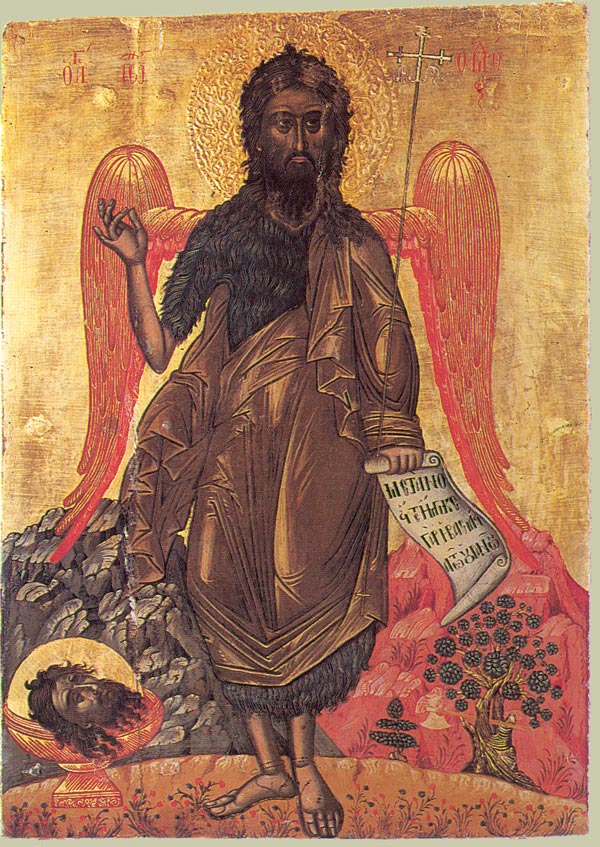
That is the lesson that St. John the Baptist is learning in today’s gospel.

John, as we know from last week, was a revolutionary prophet and a dangerous radical. He was among the first to correctly identify his cousin Jesus as “the Lamb of God, who takes away the sins of the world.” He understood the purpose of his whole ministry as preparing the way for the Christ.

Unlike the apostles and the crowds, John understood that the Messiah’s liberation of God’s people would be more spiritual than political. But he himself also had a few preconceived notions about what this would look like that turned out to be a little off-base. John believed that the Christ would finally come to “set things straight” in Israel. He would cleanse the people of their sin and get them back on track to having a healthy relationship with God. These notions were confirmed, in his mind, at Jesus’ baptism in the Jordan River. Here, finally, was the in-breaking of the Messianic age. Now things would really start to change… except they didn’t… at least, not right away.

Jesus turned out to be a more gentle Messiah than the one John was imagining. He led with grace, accepting sinners as they were and trusting that grace to do its slow, subtle work in their lives. He kept company with a rough crowd and seemed to condone their unseemly activities by his relative silence.

To make matters worse, things were not going particularly well for John. After speaking out against the personal life of the local puppet king, John was arrested and thrown into prison. Didn’t Jesus realize how bad things were getting? Wasn’t he going to do something about all this injustice? Wasn’t Jesus supposed to be the one who would baptize “with the Holy Spirit and fire”? So… where was that fire, already?

St. John the Baptist, like so many of us in this long, cold, and dark “Advent of the soul” (as my friend Renee calls it), was struggling with his faith. Let’s take a look at what he does about it:

When John heard in prison what the Messiah was doing, he sent word by his disciples and said to [Jesus], “Are you the one who is to come, or are we to wait for another?”

And how does Jesus respond to this question? With characteristic gentleness. He doesn’t berate or upbraid John for his lack of faith. In fact, he compliments him. He says to the crowd:

“What did you go out into the wilderness to look at? …A prophet? Yes, I tell you, and more than a prophet… Truly I tell you, among those born of women no one has arisen greater than John the Baptist”

Jesus praises his friend and cousin. John’s doubt does not reduce Jesus’ opinion of him one iota.

Too many of us feel afraid to engage with faith in the midst of doubt. We have this bizarre notion that doubt is the antithesis of faith, so it couldn’t possibly belong at church or in our conversation with Jesus. But I reject that idea outright.

Doubt is what makes faith possible. Without it, faith is nothing more than a blind acceptance of ideas that don’t ask anything of us. I don’t put much faith in the Law of Gravity because I simply accept it as a fact. It requires no imagination or personal commitment on my part. Faith in Christ, on the other hand, is of an entirely different order. Because I struggle with doubt in this area of my life, I have to dig deep and risk the very essence of my being on this mystery. It’s like doing a trust-fall exercise off the edge of the Grand Canyon. I have to give my whole heart, soul, mind, and strength to it. That’s why it matters to me, more than anything else in this world. None of that would be possible for me without the simultaneous presence of doubt. In the words of Episcopal priest Fr. John Westerhoff, “The opposite of faith is not doubt, but certainty.”

Christ understands this reality, which is why he is then able to be so gentle with John.

And John, for his part, does the perfect thing: he goes to Jesus with his doubts and asks the honest question that is on his mind.

Those of us, like myself, who find faith to be a constant struggle have a good friend in St. John the Baptist. He shows us how to come to Christ with our doubts and incorporate them into our faith and spirituality. Christ, for his part, is not scared of us or our struggles with doubt. Christ has the grace to accept us, not just in spite of our doubts, but with them. That is the good news that Christ has for us in today’s gospel.

And with that good news comes a call to respond:

Christ loves us just as we are, and loves us too much to allow us to stay that way.

After complimenting John (“Truly I tell you, among those born of women no one has arisen greater than John the Baptist”), Jesus invites him and us, by extension, to take the next step of faith:

“yet the least in the kingdom of heaven is greater than he.”

Now matter how much Christ loves us, and no matter how far we have come in the life of faith, there is always room to grow. There is always a next step to take in faith. That is what Christ is inviting us to do today: Not to be perfect or pretend that we don’t struggle with doubt, but simply to take that one, small, next step toward God.

Jesus has some very specific advice to John for how to do this:

“Go and tell John what you hear and see: the blind receive their sight, the lame walk, the lepers are cleansed, the deaf hear, the dead are raised, and the poor have good news brought to them. And blessed is anyone who takes no offense at me.”

Jesus invites John to open his eyes, ears, heart, and mind to what is happening around him. He asks him to pay attention. John, as we know, had some pretty specific ideas about what he thought the Messiah would be and do. When he didn’t see those things happening, his doubt momentarily got the better of him. The things he thought God should be doing were not getting done.

So Jesus very gently redirected his attention to the things that were getting done. It’s not as though Jesus was simply sitting down and twiddling his thumbs all day. Far from it:

“the blind receive their sight, the lame walk, the lepers are cleansed, the deaf hear, the dead are raised, and the poor have good news brought to them.”

God was doing something different from what John thought God would do, but that didn’t mean that God wasn’t doing something. Jesus invites John to take the next step of faith by setting aside his own preconceived notions and keeping an open mind. That’s what faith looks like in the midst of doubt.

Here in this Advent season, I believe Christ is inviting you and me to do the same thing.

It is so easy to stumble into old patterns of doubt and despair when life doesn’t go the way we think it should. We look around at the way things are in our personal lives/families/church/country/world and can’t help but wonder whether something has gone wrong. In the darkest and coldest times, it may even seem like God is absent. We may wonder, like John, whether this Jesus guy might not be everything he’s cracked up to be. We question whether the Christian life is worth all the effort.

In those moments, Christ comes to us with all the love and acceptance he gave to his friend John. He invites us to look around at all the good that is happening, instead obsessing over the things we wish were happening. It might feel like Advent, but the truth is that Christmas is already here: God is with us, meeting us in the cold and dark seasons of the soul, working for the good in our lives and world, and loving us with a love that will not let us go.

Revisiting Spiritual Warfare as a Progressive Christian

Lectio divina on this morning’s second reading from the Daily Lectionary.

Click here to read it.

you are all children of light and children of the day; we are not of the night or of darkness. (1 Thess 5:5)

Of course, Indigo Girls fan that I am, I immediately started singing this song in my head:

My place is of the sun and this place is of the dark
and I do not feel the romance, I do not catch the spark.
By grace, my sight is growing stronger
and I will not be a pawn
for the Prince of Darkness any longer.

I’ve been thinking a lot about spiritual warfare lately. You know, angels n’ demons n’ stuff.

When I was part of the charismatic movement in college, I obsessed over this topic in a literalistic sense. Once I left behind the conservative theology I formerly held, this is one of the things I stopped thinking about.

In recent years, I have been returning to the language of my tradition with a new set of eyes. This has come as I have re-engaged with traditional liturgy, mostly through the Book of Common Prayer and the Rule of St. Benedict.

The funny thing, especially for one who identifies as a theological “liberal”, is that the transformation process is a two-way street. Yes, I am a bit revisionist in the way that I engage with the language of my tradition. I read a lot of Marcus Borg and use catchphrases like, “I take the Bible seriously, but not literally.”

My worldview shapes the way I interact with the liturgy. But the opposite is also true: The liturgy also shapes ME and the way I interact with my worldview.

I am not a strict religious naturalist. The philosophical term that most closely aligns with my personal belief is panentheism (Google it). I believe that the mythical language of my tradition gives me access to a dimension of reality that is not accessible (for me, anyway) through the rational processes of the scientific method. As one sister is fond of saying, “There’s a THERE there,” when it comes to theology.

(EDITORIAL NOTE: Dr. Renee Lee Gardner, Formation Minister at St. Luke’s Episcopal Church, Kalamazoo and my personal source for this quote, has informed me that the phrase originates with novelist Gertrude Stein.)

It has been quite easy to affirm that idea in pleasant matters related to God, Christ, and the Sacraments. But what about the darkness: i.e. sin and the demonic?

Several recent events have coalesced to lead me back to the language of spiritual warfare.

On a personal level, I have sat with dear friends who wrestle with addictions and broken relationships. On a social level, I am watching with deep lament the bitter hatred that seems to have taken hold of my country and manifested itself through the Trump campaign.

My partner recently attended the Why Christian? conference in Chicago and participated in a breakout session on Reclaiming Spiritual Warfare for Progressive Christians led by Richard Beck, author of Reviving Old Scratch.

Other thinkers who have been informative for me on this subject have been my seminary professor Bob Ekblad, Walter Wink, William Stringfellow, and Rene Girard.

There seems to be a real substance to evil that exists at the personal and social levels. These forces of darkness do not bow to human reason or willpower. In short, they are stronger than we are. So, how do we resist them?

I am still working that out. Do demons possess the quality of objective, personal existence, as I do? I don’t know yet. Can these forces be ultimately tamed by discipline, legislation, education, and non-violent direct action? I tend to think not. There is much about which I remain agnostic.

I have no problem seeing demons, as they are portrayed in religious art, as psychological projections of these forces. But that does not mean they are mere fantasies. I cannot deny that the struggle itself is real. There’s a there there.

Liberalism, in its justified excitement about the universe and human nature, has not “given the devil his due” when it comes to the reality of evil. As C.S. Lewis famously commented in The Screwtape Letters, the devil’s greatest trick was convincing the world that he did not exist.

G.K. Chesterton, in his critique of modern theology in Orthodoxy, wrote:

“If it be true (as it certainly is) that a man can feel exquisite happiness in skinning a cat, then the religious philosopher can only draw one of two deductions. He must either deny the existence of God, as all atheists do; or he must deny the present union between God and man, as all Christians do. The new theologians seem to think it a highly rationalistic solution to deny the cat.”

I think the time is coming for liberal and progressive Christians to take sin and the demonic as seriously as we take the reality of God.

More importantly:

I do not believe we enter into this struggle of spiritual warfare alone. I believe I have touched, at the heart of the universe, a loving presence that is constantly leading us in the direction of shalom: peace and justice.

When we dream of a world that is free from hate, exclusion, greed, and indifference, we are not making this up. This is not liberal idealism; it is truth.

I believe that God is at work in us and in the universe itself, harmonizing the discordant noise of the tohu va bohu (Heb. “formless void”) into a symphony that reflects the beauty of the Trinity.

This is the work that Christ came to earth to complete: “The Son of God was revealed for this purpose, to destroy the works of the devil” (1 Jn 3:8).

The Church, Christ’s Body on earth and in heaven, has been given the necessary weapons to effect this warfare. But how do we do this? How do we wage war on war itself? How do we exclude exclusion? How do we oppress oppression? How do we kill death?

We have a spiritual arsenal at our disposal. We have the prayers and the Scriptures. We have the sacramental rites of Anointing, Confirmation, Matrimony, Holy Orders, and Reconciliation. Each deployment of these weapons plants a flag on the battlefield against death, indifference, isolation, anarchy/oppression, and bitterness (respectively).

The primary difference between these weapons and the weapons of the world is that they bring life, rather than take it. We wage a very different kind of warfare than that of the world. St. Paul writes:

“Our struggle is not against enemies of blood and flesh, but against the rulers, against the authorities, against the cosmic powers of this present darkness, against the spiritual forces of evil in the heavenly places” (Eph 6:12).

And again:

“The weapons of our warfare are not merely human, but they have divine power to destroy strongholds” (2 Cor. 10:4).

More importantly, we have the Sacrament of the Eucharist as the “principal act of worship,” according to the Book of Common Prayer. In this celebration, we return tangibly to the truth that we are one with each other, for we are all one in Christ. The Eucharist is the ultimate act of resistance against the forces of darkness, within and without.

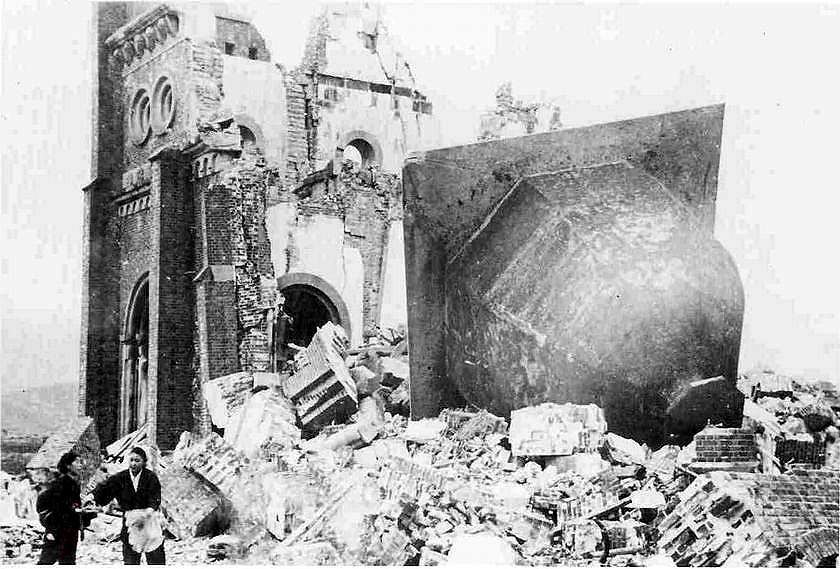
The Church might even think of the Eucharist as our “nuclear option.” Its effect is 180 degrees opposite to that of an atomic bomb:

In a brilliant flash of light, the vaporous forms take on solid substance and come to life. Communal structures are formed and built up by a shockwave that makes no distinction between man, woman, and child; soldier or civilian. The fallout creates a radioactive zone where sickness is healed and life enriched. When people remember this event, they will celebrate the many lives that were saved.

Finally, in the Sacrament of Baptism, the Church has its D-Day on the soil of the world. In a world-system based on institutionalized injustice, Baptism is treason. In it Christians pledge their allegiance to new a new regime, the kingdom of heaven. It is an Exorcism and the beginning of an invasion against the occupying powers of darkness.

In the baptismal rite of the Book of Common Prayer, we recite:

Do you renounce Satan and all the spiritual forces of wickedness that rebel against God?
I renounce them.

Do you renounce the evil powers of this world which corrupt and destroy the creatures of God?
I renounce them.

Do you renounce all sinful desires that draw you from the love of God?
I renounce them.

Do you turn to Jesus Christ and accept him as your Savior?
I do.

Do you put your whole trust in his grace and love?
I do.

Do you promise to follow and obey him as your Lord?
I do.

Above all, I trust in the divinity that I have experienced, as a Christian, in the person of Jesus Christ. God becomes real to me in the story of Christ’s incarnation, life, death, resurrection, ascension, and return. Whether all of this turns out to be literally factual or mythic symbolism is beside the point, I experience it as true and believe it.

I trust that the presence of the living Christ is at work in me and the world to bring us inexorably toward the goal of union with God.

“I am confident of this, that the one who began a good work among you will bring it to completion by the day of Jesus Christ” (Philippians 1:6).

Until then, the peaceful insurgents resist:

The Unquenchable Fire

Click here to read the service bulletin, including the biblical text

Introduction

There is a story of a young novice in a monastery who goes to his abbot and says, “Father, what can I do to attain Salvation?”

The wise old abbot responds, “As little as you can do to make the sun to rise in the morning.”

So the novice replies, “What then is the purpose of meditation and all our spiritual exercises?”

And the abbot says, “To make sure that you are awake when the sun begins to rise.”

I love this story because it does such a good job of getting right to the reason why we, as people of faith, put ourselves through the hard work of prayer and the rigorous demands of the Christian life.

Saved by Grace

As Christians in the Reformed tradition, we are fond of insisting that salvation comes to us by grace, as a free gift apart from our good works, ritual observance, and correct theology. We receive this gift by faith, but even that receiving faith, St. Paul says, is a gift from God, “so that none may boast.”

We sainted sinners and sinful saints are utterly incapable, either by works or by faith, of doing anything to make the light of Christ appear in our hearts or world. Like the young monk in the story, we can do as little to attain salvation as we can to make the sun rise in the morning.

Like the shepherds of Bethlehem in the Christmas story, we do not bring Christ to birth, we simply bear witness as the Word of God “takes on flesh and dwells among us.”

Exegesis

In today’s gospel, we encounter a man who understands intimately what it means to bear witness to the presence and activity of Christ in the world.

Radical Prophet

St. John the Baptist was a dangerous radical and progressive prophet whose task was to “prepare the way” for Christ’s first coming to earth. I call him a “radical” because of the Latin term radix, which means “root.” John was a powerful mystic. As the last prophet from the Old Testament era, his ministry was inspired, not by a particular school or tradition of rabbinic interpretation, but directly by God.

Religious traditions need prophetic renewal from time to time. Without direct experience of the divine, religions begin to calcify and get “stuck in their ways.” The Buddha played a similar role in the Hindu faith. We Protestants might point to Martin Luther and John Calvin as prophetic voices in 16th century Europe. In Judaism, there were many prophets who arose throughout the history of Israel. Prophets, as radicals, reconnect the faithful to the “root” of their faith in God. They are always “dangerous” to established authorities because they call into question “the way we’ve always done it” and remind us of our core commitments to God and neighbor.

This is exactly what St. John the Baptist is doing in today’s gospel. He calls the people to a renewal of their spiritual and political lives by announcing:

“Repent, for the kingdom of heaven has come near.”

Bearing Fruit

He has particularly harsh words for the Pharisees and Sadducees, the two major parties of established religious authorities in first century Judea. To them, John says:

“You brood of vipers! Who warned you to flee from the wrath to come? Bear fruit worthy of repentance.”

By “fruit,” John means the kind of changed life that a person leads when they have come into a deep relationship with God.

The religious leaders would have been understandably offended by such comments. They might point to their seminary degrees on their office walls. Or they might make reference to their traditional ancestry, which they trace back through the prophet Abraham in the biblical book of Genesis.

But John anticipates this defensive response. He says:

“Do not presume to say to yourselves, ‘We have Abraham as our ancestor’; for I tell you, God is able from these stones to raise up children to Abraham.”

In other words, John recognizes this ruse for what it is: a distraction from living the kind of life that God envisions for the covenant community. After liberating the Hebrews from slavery in Egypt, God said to them, in effect, “I want you to be a different kind of community from the nations you see around you. Old patterns of exclusion and oppression must not be present among you. I want the nations of the world to look at you, my people, and see what kind of God I am.”

But the people of Israel, like all peoples, were consistently unable to live up to this high standard. We read in the Old Testament just how often God’s people “missed the mark” and began to take on characteristics of Egypt, Canaan, and Babylon. They worshiped humanly constructed images and ideologies in place of God, exploiting the earth and their neighbors. This is why God continually sent prophets like John. They called the people back to what it means to be God’s covenant community on earth.

Facing the Consequences

When the people refuse to listen (which is most of the time), God warns them that this way of life (“Every man/woman for him/herself”) leads only to death and destruction. This is why John says:

“Even now the ax is lying at the root of the trees; every tree therefore that does not bear good fruit is cut down and thrown into the fire.”

Notice how John does not name God as the source of this destruction. We might be tempted to think of God as the primary actor in this event, but I think it would be just as legitimate to think of it as a natural consequence of our tendency toward selfishness and the violent ways of the world. God’s intention, in sending us the prophets, is to save us from this path of self-imposed destruction. If we refuse to heed this warning, God respects our decision by allowing us to face the consequences of our actions.

Wheat and Chaff

The good news is that there is another way. Even in the midst of our rebellion against God’s ways of peace, God is present and active. In first century Judea, God sent St. John the Baptist to prepare the way for Christ.

John says:

“I baptize you with water for repentance, but one who is more powerful than I is coming after me; I am not worthy to carry his sandals. He will baptize you with the Holy Spirit and fire. His winnowing fork is in his hand, and he will clear his threshing floor and will gather his wheat into the granary; but the chaff he will burn with unquenchable fire.”

At first glance, this image might seem like another warning of wrath and judgment. But it might help if we look more closely at John’s image of the Messiah as a farmer winnowing a harvest of wheat.

Wheat grains grow inside of a husk on a stalk, much like corn. In order to salvage the nutritious wheat, the husk must be removed. This is done by a process called “winnowing.” In the ancient world, farmers did this by setting the pods over a fire. The heat would crack the husks open and the wheat would fall out. Then the farmer would toss the pile in the air with a large fork. The wheat would fall through while the husks (called “chaff”) would be blown away by the wind.

Here’s the interesting thing: the wheat and the chaff are parts of the same plant. I take them, not as symbols of two different kinds of people (“good” and “bad”), but as two realities that exist within myself. I am, at the same time, both sinner and saint. There are good parts of me and bad, wheat and chaff.

Chaff is an essential part of wheat. It protects the precious grain while it grows on the stalk. Without it, the grain would be vulnerable to predators and the elements. But there comes a time when the chaff must be removed, or else the grain will never fulfill its destiny to make new plants or be ground and baked into bread. In the same way, we who live in this complicated world are a mixture of more useful and less useful parts. These parts of us must grow together for a time, so that we can become fully-formed, well-rounded people. We wrestle with these complexities and long for the simplicity of a life where only good remains forever.

When I imagine my destiny at the end of life, I imagine God taking those less useful parts of me and separating them from the goodness in me that reflects the divine image. I see divine judgment as the “winnowing” process, by which goodness is preserved and evil eliminated. Whatever is left at the end of this process is that which will live forever in God.

Unquenchable Fire

How will God accomplish this division of good and evil with us? John tells us quite clearly:

“He [Christ] will baptize you with the Holy Spirit and fire.”

This is directly related to the winnowing process. The Holy Spirit, the presence of God within us, is the winnower’s fire that liberates the good wheat from the chaff we no longer need in our lives. God is at work within us, transfiguring us day by day into the divine image and likeness.

And John reassures us with the good news that this inner fire of God is “unquenchable.” That is, all the chaff and sin within us is unable to snuff out the presence and power of the Spirit.

Kindled by Water

This fire was kindled in us, ironically, by water in our baptism. In that moment, when the benefits of Christ’s death and resurrection were applied to us, the Holy Spirit came to dwell in us in a way that cannot be undone. Baptism is not so much something that we do for God so much as something that God does in us. Baptism is the sign and seal of God’s pledge to save us and never leave nor forsake us.

Baptized Christians are part of Christ’s Body, and Christ loves us as dearly as we love the parts of our own bodies. He could not abandon us any more than one of us could cut off a hand or a foot. This is why John calls the fire “unquenchable.” We can resist the Spirit, but we cannot snuff her out entirely.

Application

The prophet invites us, in this Advent season, to “prepare the way” for Christ’s coming by cooperating with the energy of the Holy Spirit, who is already at work in us, separating the good wheat from the chaff we no longer need. We are invited to return to the roots of our faith and consider again what it means to be a member of Christ’s Body, the covenant community of God’s Church in the world.

This work is not something we do for God, but what God is doing in us. We cannot make Christ appear in our hearts any more than we can make the sun to rise in the morning. The good news is that Christ is already here, working God’s will in us through the power of the Holy Spirit. Our only choice is whether we will resist or cooperate with the work of the Spirit in our lives.

St. Paul writes, in his first letter to the Thessalonians:

“May the God of peace himself sanctify you entirely; and may your spirit and soul and body be kept sound and blameless at the coming of our Lord Jesus Christ. The one who calls you is faithful, and he will do this.” (1 Thess. 5:23-24)

This Advent, may we open our hearts to allow the fire of the Spirit to crack open our hard shells, and the wind of the Spirit to blow away that which we no longer need. May the water, wind, and fire of baptismal grace gather us once again into the barn of the Church, where we will dwell together in peace at Christ’s coming.

Spiritual Nexus

What a great PBS program that highlights my home monastery, St. Gregory’s Abbey, and the other spiritual communities surrounding it in Three Rivers, Michigan.

I have written previously on this blog about my personal experience in Three Rivers, specifically through the monastery. Click here to read that article.

Ever since my first visit to the abbey, I have wondered whether pre-European communities felt similarly drawn to this land. I am also curious about the “Ley Lines” idea. I know nothing of the philosophy behind it, but the confluence of spiritual centers in a single area makes one wonder. Before now, I had only encountered “Ley Lines” in science fiction, but my experience in Three Rivers is giving me cause to wonder whether there might be some truth to them.

The Rev. George MacLeod of the Iona Community describes his Scottish island home as a “thin place”, where the border between heaven and earth is somehow more permeable. I would not hesitate to use the same language to describe Three Rivers.

The PBS program Religion & Ethics NewsWeekly recently did a story on the spiritual communities of Three Rivers. I have never personally visited the other spiritual centers around the abbey, although I receive spiritual direction from a member of the Apple Farm community. The video is posted below.

http://player.pbs.org/viralplayer/2365886858/

Here is also a link to a new book about the area, Spiritual Nexus: Discovery in America’s Heartland by William Allan Baltz.

If you have not yet visited Three Rivers, you really are missing out!

Click here to learn more about visiting St. Gregory’s Abbey, Three Rivers.

Telling Stories

This week’s sermon from North Presbyterian, Kalamazoo.

Click here to read the biblical text

Sermon text

One of the funnest (and funniest) parts of Thanksgiving dinner is when family and friends start sharing stories around the table. They often start with something like, “Remember that time Uncle Harvey…”

In our family, my wife and I have one that we never get tired of telling the kids. It’s the classic story of “How I met your mother… twice.”

I first met Sarah at a student conference in western North Carolina in the summer of 1999. We had a nice chat on a group hike, established that we had a mutual friend, shook hands, and parted ways. Four years later, I was getting onto a bus in Vancouver, Canada, having just moved there to begin seminary. The woman across the row from me struck up a conversation. We had a nice chat, established a mutual friend, and… suddenly both of us had a major case of déjà vu.

As it turns out, she was the very same person I had talked to four years prior. When life gives you a second chance like that, you take it. We began dating less than a month later and married before the end of graduate school.

People love to tell family stories like this, especially during the holidays, because they help to give our lives a sense of meaning and purpose. In a world that often seems so random and out-of-control, these stories give us a hunch that there is some other Will working itself out through our existence. They remind us that we are not alone in this universe and that life itself is meaningful and good. We never get tired of telling or hearing them.

Of course, these stories don’t just exist in our families. They are a major reason why we come to church. The Bible itself, even though it is a collection of many different stories, tells one Big Story that continues to shape and change our lives today.

The biblical story is that the infinitely loving God of the universe created the world and called it Good. When we humans, in our selfishness, turned away from God and each other and fell into slavery to sin, God did not abandon us. After centuries of reaching out to us through prophets and sages, God took on flesh and came to dwell among us in the person Jesus Christ. When we refused to listen to Jesus and tried to silence him by the violence of crucifixion and death, God summarily rejected our rejection by raising Jesus from the grave. Now, we who are baptized into Christ share the healing power of his resurrection and function with the world as his Body, his hands and feet, on earth until he comes again in glory. On that day, the dead will rise and the whole creation will be made new, as God originally intended, and governed with divine justice and mercy.

This is the story we Christians tell ourselves each Sunday in church. We hear it in the Scriptures and see it in the Sacraments. We leave the liturgy each week, fed with the Body and Blood of Christ, and are sent out into the world to be the Body of Christ. It cannot be understated just how important that mission is in this world, where life often seems so empty and meaningless.

Jesus talks about this Christian story in today’s gospel reading. Like any good story, this one has a beginning, a middle, and an ending. Today, Jesus is talking to us about the ending.

He starts by undermining two thousand years of Christian speculation about the end of the world. Look in the Religion section of any bookstore, and you will find multiple books claiming to have figured out the scoop on when and how the end times will take place. But Jesus says in this passage, “But about that day and hour no one knows, neither the angels of heaven, nor the Son, but only the Father.”

St. John Chrysostom, a bishop in the early Church, agrees with Jesus on this. He wrote that human beings “should not seek to learn what angels do not know.” Jesus does not give his followers any “insider information” on the end of the world. What he asks of them is far more difficult.

What Jesus asks of Christians is that we “stay awake” and “be ready” for history to reach its conclusion. This is important. Life on this planet often feels chaotic, empty, and meaningless. To the eyes of a person without faith, it seems like a random series of events that are just happening. Without a sense of purpose in life, we are wont to slip into a mindless pursuit of pleasure and avoidance of fear.

In Jesus’ mind, this state of existence is not unlike the condition of the world immediately before the great flood of Noah. He says, “For as in those days before the flood they were eating and drinking, marrying and giving in marriage, until the day Noah entered the ark, and they knew nothing until the flood came and swept them all away, so too will be the coming of the Son of Man.”

Another way of saying this is that it was “business as usual” for everyone until the moment when the rain began to fall. They were so caught up in their little plans and schemes, they didn’t realize that God’s great story was in the process of unfolding all around them. When the moment of truth came, they were not ready.

Jesus reminds us that the world does not revolve around us. The universe will not stop its ordinary operation to accommodate our plans, however great we think they may be.

The good news is that God has an even greater plan, and we are invited to play a part in it. Jesus invites us today to reorient our lives around God’s vision for the world. God’s dream is to renew the face of the earth so that it reflects the harmonious beauty that God intended for it to have at the beginning. God dreams of a world where the hungry are fed, the sick are healed, strangers are welcome, and sinners are forgiven. Jesus often referred to God’s dream as “the kingdom of heaven”. It is the one thing around which he oriented his entire life and ministry.

The work of the kingdom of heaven has been going on since the dawn of time. It began in earnest with the incarnation, life, death, and resurrection of Jesus Christ. It continues today through Christ’s Body on earth, the Church, and will draw to a conclusion at some unknown point in the future. It is God’s dream and Jesus is inviting us to be a part of it. We come to church each week and tell each other these stories in order to be reminded that this universe is no accident, and our lives are no random series of events.

This week, we begin the liturgical season of Advent, as we prepare to celebrate that beloved moment in God’s story when Jesus Christ, the Word of God, “took on flesh and dwelled among us.” But it is also a time when we look forward to Christ’s second coming at the conclusion of history. It is a time when we are invited to reorient our lives around the divine vision of a renewed creation, the vision for which Jesus lived, died, and lives again in us.

In this coming holiday season, let us not get caught up in our cultural patterns of materialism and greed. Let us also avoid the backward-looking nostalgia for the “good old days” of Christmases past. Let us instead look within and around us for the work that Christ is giving us to do in this world today. Finally, let us look forward to the day when God’s story finishes with a happy ending and all of creation joins in the song of unending praise to its Creator, Redeemer, and Sanctifier.

Let us pray.

“O Come, Desire of Nations, bind all peoples in one heart and mind; bid envy, strife, and discord cease; fill the whole world with heaven’s peace.” Amen.

Resistance

Love is our resistance.
They’ll keep us apart
and they won’t stop breaking us down.
Hold me.
Our lips must always be sealed.
The night has reached its end,
we can’t pretend,
we must run…

“People who say they follow a poor, itinerant savior who came to bring good news to the poor and freedom to captives have elected a president who speaks contemptuously of women and people of color, and whose election has sparked celebration by the Ku Klux Klan and outbreaks of violence and harassment against Muslims, Jews, Latinos, women, immigrants and LGBT people.

Christians who voted for Trump may claim policy or economic reasons for having done so. But by electing a man whose words and actions support and incite hatred and violence, the church has failed the country, and we have a lot of soul searching to do.” -the Rev. Gay Clark-Jennings, President of the House of Deputies, the Episcopal Church

Click here for more details on how this resistance will look for the next 4 to 8 years, from Gay Clark-Jennings, President of the House of Deputies of the Episcopal Church.