The Real Legacy of the English Reformation

Reblogged from The Liturgical Theologian.

Cranmer was responsible for the first piece of liturgy written in English (the Great Litany of 1544), much of the Book of Homilies, the inclusion of the Great Bible in parishes around the nation, and the 1549 and 1552 Books of Common Prayer. These landmarks insured one thing: a common language for the faith and worship of the Church in England. Every parish in the country would now read the same Bible, hear the same homily, and pray the same prayers in the exact same language…

…What then is the true legacy of the English Reformation? A common Bible and a common prayer book in a common language for a common people.

Click here to read the full article

Star Trek made me a moral person (reblog)

This is a reblog from Samantha Field, an author who has quickly become a new favorite of mine in the blogosphere. Samantha writes with a rare combination of personal vulnerability and razor-sharp insight. After you’ve read this one, I highly recommend perusing other articles on her site. Enjoy!

Star Trek, in many ways, is a modern morality play. There’s more nuance, more shades of grey, more complicated human realities, but what it does best is feature people with all their flaws and beauties struggling to make the world a better place. Sometimes, they fail. As Chakotay learns in “The Year of Hell,” sometimes even your best and purest motives are wrong. In Star Trek, though, winning is defined not by typical notions of success and wealth and power, but by understanding. When characters learn more about themselves– like Data learning about fear in Star Trek: Generations– or about other people, nations, planets, and species, that’s what the show considers a success.

Click here to read the full article.

Call Them Here

The text is Mark 10:46-52

I’ve recently been invited to help my friend, Minister Pamela Robinson of Emerging HOPE Ministries, with her doctoral dissertation. It’s been a privilege to assist with this project because the work she’s doing is so important. The research she is doing is about helping churches raise their awareness of people who live with mental illness or developmental disabilities. Her very helpful term for these conditions is “invisible disabilities”. She calls these disabilities “invisible” because their presence in people is less obvious than a visual or mobility impairment.

There is a stigma around cognitive disabilities in this culture because, in the eyes of many people, mental illness doesn’t count as a “real” disease, like cancer or the flu. Many of us who live with mental illness are often told to “just snap out of it” or “have faith” (as if depression or anxiety could be controlled by flipping a switch). Believe me: if any of us could choose to stop having these symptoms, WE WOULD.

Under the weight of this social stigma, we who live with mental illness often become “invisible people” who suffer silently and alone from the effects of our conditions. We are treated as failures, ne’er-do-wells, and misfits in a society that measures the “worth” of a person based on his or her ability to produce and consume in a capitalist economy.

In this morning’s gospel, we encounter the story of a person, Bartimaeus, who was similarly “invisible” to the people of his own place and time.

There are several things it is important to note about Bartimaeus as a person. First of all, his name. In Aramaic, it literally means “son of Timaeus”, which is to say that he really doesn’t have a name or unique identity of his own. He is only identified in relation to other people. As a physically disabled (“blind”) non-worker in the economy (“beggar”), Bartimaeus doesn’t count as a “real person” in the eyes of his neighbors, so he has been pushed to the margins of society (“by the roadside”), where his presence and voice can be conveniently ignored (“Many sternly ordered him to be quiet”).

Yet, there is more to Bartimaeus than meets the eye on the surface. He might be visually impaired, but we the readers quickly learn that his spiritual insight goes deeper than that of his neighbors. He sees Jesus more clearly than anyone. As Jesus draws near, Bartimaeus begins to make quite a fuss, calling out to Jesus as the “Son of David”.

“Son of David” is a messianic title, referring to King David’s heir, God’s anointed, and the rightful king of Israel. Many have speculated about Jesus’ identity up to this point in Mark’s gospel, St. Peter has even realized the truth in private, but this is the first time in Mark that anyone, anywhere publicly identifies Jesus as the Messiah.

What Bartimaeus says to his Messiah next is “have mercy on me!” This sounds to us like a plea for forgiveness, but is actually more like a welcoming affirmation. Caesar used to enter the city of Rome in triumphant procession with the citizenry crying “Lord, have mercy!” around him on every side. It’s kind of like an ancient version of “Hail to the Chief” or “God Save the Queen”. Bartimaeus has something unique to teach his people: he knows who Jesus really is, but they don’t want to hear it, so they yell at him to sit back down and be quiet.

Sadly, this story is way too familiar for many of our brothers and sisters who live with disabilities, visible or invisible, in the church. As human institutions, churches often act like the crowd around Bartimaeus: ignoring and objectifying disabled people, pushing them to the edges of church life and telling them not to make too much of a fuss, so that business-as-usual can continue uninterrupted on Sunday morning. What these churches don’t realize is that every person is made uniquely in the image of God, therefore each individual has something to teach the rest of us about God that cannot be learned from anyone else on earth. Those who lose the most when disabled people are ignored are not the disabled people themselves, but those who ignore them. So it was with the crowd around Bartimaeus, and so it is in too many churches today.

But the good news is that Jesus is not content to simply walk by while this happens. Jesus listens to the voice of the voiceless and ensures that the lessons they teach will not go unheard. Looking closely at his interaction with Bartimaeus, we can get an idea of how Christ is working with disabled members in the church today, through the power of the Holy Spirit.

To begin with, the first important thing that Jesus does is nothing. He simply stops. The text says he “stood still”. What this tells us is that Jesus is willing to be interrupted by this person. Sure, Jesus is busy. Sure, he has other important things to do (go to Jerusalem and save the world, for instance). But business-as-usual gets put on the back burner for Jesus when it comes to having a relational encounter with this person. Imagine the church doing that! Imagine what Christianity in this world would look like if the leaders of the church were willing to put aside their overcrowded schedules and interrupt business-as-usual in order to listen to the pained cries of needy people.

The second thing Jesus does is say, “Call him here.” He re-arranges his ministry so that the marginalized person sits at the center of the action and concern. And he doesn’t do it alone, either. Jesus could have easily called Bartimaeus over himself, but he enlists the help of the whole community, instead. So then, it is the crowd that changes its tune and says to Bartimaeus, “Take heart; get up, he is calling you.” Again, imagine the church doing this today: becoming a community that speaks forth Christ’s calling on the lives of the very people whom the world ignores!

The next thing Jesus does is give a voice back to the voiceless. Instead of presuming to know what is best for this other person, Jesus asks, “What do you want me to do for you?” This is a very important detail because Jesus is relating to Bartimaeus as a real person, not just as an object or problem to be dealt with. And when the miracle is said and done, Jesus even gives the credit back to Bartimaeus himself: “your faith has made you well.”

Imagine a church focusing its ministry like this: interrupting business-as-usual to forge real, authentic relationships with people whose voices have not yet been heard in the mainstream of society. Imagine the church becoming a community where people are treated like people. Imagine a church that re-orients its entire ministry to put marginalized people at the center of its life and action. Imagine a church that doesn’t just welcome people who live with mental illness, but empowers them to fulfill their calling in Christ. Can you imagine a church like that?

I can.

I can imagine that kind of church because that is exactly the kind of ministry that North Presbyterian Church has been doing for the last 27 years. This is who we are. This is what we do. This is the kind of community the Holy Spirit has made us into.

So many of us, myself included, have tried to make our spiritual home in churches where we are tolerated at best, or rejected at worst. But the Holy Spirit has called us together in this little community where we can be a light to the world.

And our ministry is not going unnoticed. What we do here has been written about in college and seminary textbooks. Letters of support have poured in from all over the country. Denominational officials are telling us how we have inspired a movement, how we have shaped the national church, how we are pioneering a new model of ministry from which all churches can learn.

North Church may be a little church, but we are “the biggest little church in Kalamazoo.” Our significance doesn’t come from a huge budget or fancy programs, but from the fact that we are doing the kind of ministry that Jesus demonstrated with Bartimaeus: centered on building relationships with marginalized people who live with mental illness.

The power of the special work we do is rooted in the power of the gospel itself and grows out from it to form a community where all people can find a home.

The power of this church comes from that core truth we tell each other week after week:

“I love you. God loves you. And there’s nothing you can do about it!”

Be blessed and be a blessing.

Wearing the Collar

Reblogged from Anglican Pastor

When I was in discernment for the priesthood – and even before formal discernment had begun – my spiritual director asked me wonderfully probing questions.  “Why do you feel a need for ordination?  What can you do with a collar that you can’t do without one?”  The answers are many and this is not the place to explore them.  But I do realize now, even if I didn’t fully then, that a priest is called in a unique way to be a public witness to the presence of Christ, not just in the parish, but in the world.  In a nominally Christian culture that is, in reality, increasingly secular or pagan, the simple wearing of a collar is a countercultural act of Gospel proclamation.  With no words necessary, the collar nonetheless testifies to the mystery of faith:  Christ has died.  Christ is risen.  Christ will come again.  As a priest, I have this great opportunity; it is something I can do with the collar that I can’t do as easily without it.  This will inform my decision about wearing the collar this afternoon.

Click here to read the full article

The Blind Man Who Could See

andrewmarrosb's avatarImaginary Visions of True Peace

Bartimaeus

The story of Jesus healing the blind man Bartimaeus is considered by many Bible scholars to be the closing bookend of what is called an inclusio. An inclusio is a literary device where two passages echo each other in such a way as to create bookends for the material in between them. In this portion of Mark, the two echoing stories involve the healing of a blind man. The material between these two stories is the journey to Jerusalem. The first healing (Mark 8: 22-26) takes place at Bethsaida. The second takes place as Jesus arrives at Jericho, the last stop before arriving in Jerusalem. In the intervening material the journey is punctuated by Jesus’ three predictions of his passion coupled with the incomprehension of his disciples. Each of these predictions is also accompanied by disputes among the disciples as to who is the greatest.

The blindness of the two…

View original post 404 more words

Anglicanism and the Benedict Option

Reblogged from Anglican Pastor

The Anglican spiritual theologian Martin Thornton once remarked that “the genius of St Benedict cannot be confined within the walls of Monte Cassino or any other monastery.” In continuing a discussion of the so-called Benedict Option, and what it means for Anglicans, my suspicion, and what is becoming my conviction, is that we Anglicans hold to a tradition which is not only well-suited to the Benedict Option, but which is the very thing itself. To be sure, there are Anglicans who would never in a million years consider themselves as such, but one can hardly deny the Benedictine character of Anglicanism, in her Prayer Book, in her mission, or in even the unique spiritual tradition of the English people. In the Middle Ages, England was often referred to as the “land of the Benedictines,” dotted as it was with monasteries, typically tied to the cathedral cloisters, following the Rule.

Click here to read the full article

What Do You Say to the Person who has Lost Everything?

This week’s sermon.

The text is Job 38:1-7, 34-41.

Last week, we asked the question: “What do you get for the person who has everything?” And the answer we came up with, following the gospel story of Jesus and the rich man, is “Nothing.”

This week, we’re going to flip that question around 180 degrees and ask, “What do you say to the person who has lost everything?”

That’s the question that hits us as we read the story of Job, as we have been doing in our readings from the Hebrew Scriptures these past few weeks. The book of Job contains the most well-known story of suffering in all of human history. This story has been read the world over by people in different countries, languages, and religious traditions.

The story follows this guy Job, a decent person who stands by helplessly as everything he loves is suddenly taken away from him. In the end, he is left sitting by himself on a garbage heap, wondering what the heck just happened. Eventually, his friends come along and try to comfort him with sage advice and religious platitudes like, “Don’t worry, God has a plan” and “Everything happens for a reason.” But these bumper-sticker slogans do nothing to comfort Job in the midst of his pain. In fact, Job’s friends end up making the situation worse as they proceed to blame the victim for his own suffering. Following the line of conventional wisdom that one finds in the book of Proverbs, they theorize that God must be punishing Job for some secret sin, and if Job would simply search his heart and confess whatever he had done wrong, the affliction would leave him and all would be well again.

But Job isn’t buying what these so-called “defenders of the faith” are selling. Their sloganeering has less to do with comforting the suffering person and more to do with comforting themselves. They think that if they can identify some specific reason why all this suffering was visited upon Job, then they can prevent something similar from happening to them. So they recite these pointless platitudes that seem reasonable to them, but do nothing to alleviate Job’s pain.

Sadly, I’ve noticed this same tendency in a lot of religious people over the years. When unthinkable tragedy strikes, people of faith are often the first to offer some kind of explanation or solution, no matter how badly conceived, whether it was asked for or not. They say things like, “God has a plan… Everything happens for a reason… God took your baby because he needed another angel in heaven… There’s a lesson in this for you, if you would just learn it… You just need to have more faith… God never gives you more than you can handle…” Just like Job’s friends, I think those who say these things are more interested in comforting themselves than comforting the one who is suffering. People who are going through incredible pain don’t need bumper stickers or Bible verses, they need friends who will stay with them through the pain, listen to their struggles, and not try to “fix” them.

Like Job, most people who suffer know instinctively how unhelpful these pat answers are. They might listen politely, but on the inside they usually walk away feeling more alone and hopeless than ever. Job, however, was not so polite in his response to his friends. He was brutal in his honesty. He defended his own integrity, shook his fist at the sky, and straight-up accused God of being unfair.

At the beginning of his story, Job’s remarks still sound conventionally religious: “Naked I came from my mother’s womb, and naked shall I return there; the Lord gave, and the Lord has taken away; blessed be the name of the Lord.” (1:21) A little while later, Job’s anger begins to show as he curses the day he was born (3:1). He is harsh toward his friends and their unhelpful advice, calling them “miserable comforters” and wondering why they keep talking at all.

Eventually, Job lets loose his anger toward God directly. He says that God has wronged him (19:6), denied him justice (27:1), and demands a response from God (31:35). There is nothing in Job’s tirade that sounds like traditional piety or stoic resilience in the face of suffering. He says that God owes him an answer; he dares God to come down from heaven and face him like a man, and that’s exactly what happens.

Today’s reading from the book of Job outlines the beginning of God’s response to Job’s demand. Job finally gets the face-to-face encounter he’s been shouting for, but it doesn’t exactly turn out like Job had expected.

To begin with, God doesn’t offer Job any answers, only questions: sixty of them, to be exact. The first question sets the stage for the rest: “Who is this that darkens counsel by words without knowledge?” And it only gets more intense from there: “Where were you when I laid the foundation of the earth? …On what were its bases sunk, or who laid its cornerstone when the morning stars sang together and all the heavenly beings shouted for joy? …Who has put wisdom in the inward parts, or given understanding to the mind?” This is just a small sample of the questions God asks Job in response to Job’s demand for an answer.

Job finally gets his face-to-face encounter with God, but none of the answers he was looking for. The voice from the whirlwind overwhelms Job with a barrage of questions about the mystery and the grandeur of the universe. Job is left standing in awe. His only response, at the end of the interrogation, is a stunned silence. In chapters 40 and 42, he calls himself “small” and says, “I lay my hand on my mouth… I have uttered what I did not understand, things too wonderful for me, which I did not know.”

Job’s experience of God’s presence is hardly sweet, comforting, or peaceful, but it was exactly what he needed. The attempt of Job’s friends to present a tame, orderly, and comprehensible God left Job feeling empty and dissatisfied, but the blunt force of awestruck mystery was enough to shake him out of his pain-induced stupor. Job never got his answer, but he got what he needed: a direct experience of God’s presence. Job says, “I had heard of you by the hearing of the ear, but now my eye sees you”. Somehow, that was enough for Job, even when there were no answers or solutions to be found.

So, this leads us back to our initial question.

Last week, we asked, “What do you get for the person who has everything?” And the answer we came up with was, “Nothing.”

This week, we are asking, “What do you say to the person who has lost everything?” And the answer is the same: “Nothing.”

This is an important lesson for us to learn in today’s Church, where too many Christians are prone to lean back on empty platitudes instead of trying to be really present with those who suffer. It’s not our job to offer easy answers to tough questions or come up with quick fixes to big problems. Our job is to be with each other when we suffer, to listen, to empathize, to ask questions. Somehow, this means more to people than all the answers and solutions in the world. Our friends in pain may never remember what we say, but they will remember that we were there with them when times were tough. This is the Church at its best.

What’s even cooler is that, in the midst of our care for each other, we begin to sense another, mysterious presence in our midst. Our love for each other points the way to a bigger love, the Biggest Love, that holds the universe together in arms that will not let us go.

I think about this mystery each Sunday as we celebrate the Eucharist. As a pastor, people often come to me with problems we don’t know how to solve and painful questions I don’t know how to answer. It gets overwhelming sometimes. I am keenly aware that many of you may be going through something horrible this morning, and there is nothing I can say from this pulpit that will make you feel any better. Clergy are neither psychologists, nor social workers, nor business managers, nor politicians. I don’t actually know how to fix the problems in your life, the church, or the world, but what I can do is invite you down to the front of this church each Sunday, hand you a piece of bread, and say, “The Body of Christ, given for you.”

What I can offer you is Christ, sacramentally present with us in bread and wine. As we share the Body of Christ, we become the Body of Christ (you are what you eat). We become part of each other through Christ, and Christ’s presence becomes apparent among us through each other. This presence, more than anything else, is the most healing thing we can offer to each other in moments of pain.

Let us be present with each other then, no matter what we are going through, in order that we may be attentive also to the healing, sacramental presence of Christ in our midst.

I Am a Mainline Protestant Under the Age of 35. Yes, We Exist.

By Olivia Whitener

Reblogged from Sojourners.

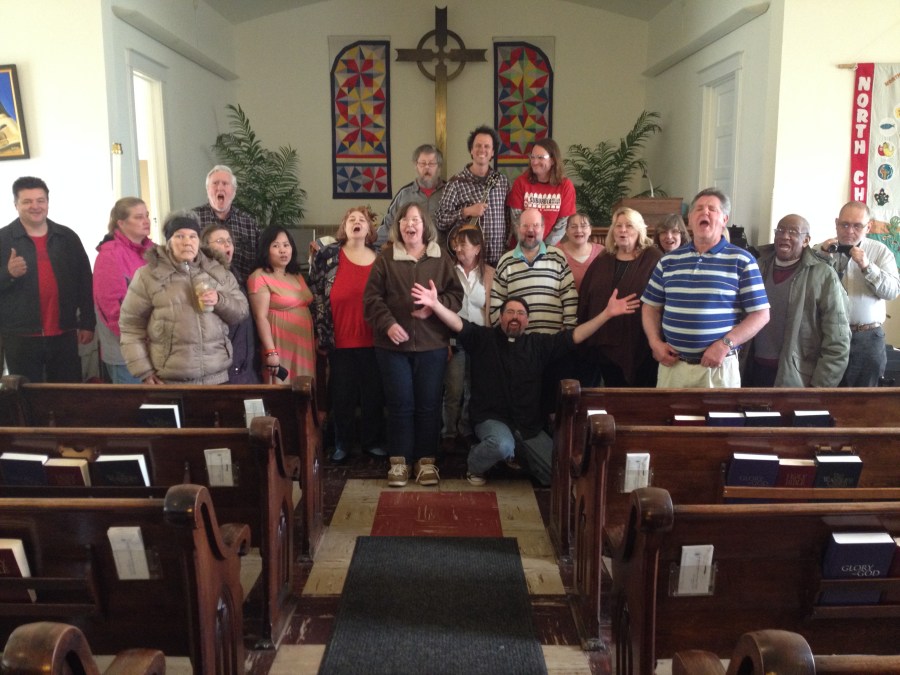
I am a Mainline Protestant under the age of 35. Yes, we exist.

I spend (most of) my Sunday mornings sitting in a pew at an Evangelical Lutheran Church in America congregation, singing old hymns, and reciting the Lord’s Prayer which I have had memorized since before I went to school.

At age 22, I make an effort to get my dose of word and sacrament before heading to brunch on Sunday mornings. Though I love the beach, I found greater joy in singing songs and leading Bible studies at a mainline church camp during my recent summers.

I love the sound of an organ.

Unlike 35 percent of my age-group peers, I hold much of my identity in my Christian tradition. But while many are losing hope in the church as a community and institution, I experience a place where I can struggle alongside others and find support. There are many ways the church has failed us; religion is often used to justify gross injustices, leaving many feeling abandoned by the place where I have found a home. And sometimes being a Christian and being a member of a worshipping community is hard, because it is another responsibility on our shoulders and it requires us to give back.

It isn’t always convenient, but here’s why I stay…

Click here to read the full article

Living In Between: Adventures of a Presbyterian pastor on a Jesuit campus

Reblogged from Presbyterians Today

By the Rev. Abby King-Kaiser

Protestants prioritize the Word, Scripture. We take it very seriously. So seriously. Worship thus centers on the Word. Even the formal ways we talk about worship usually relates back to the Word. Catholic Mass, on the other hands, centers on the sacrament. The altar is the centerpiece, and much of the rest of worship, prayer, and even a faithful life, flows from the sacrament. It even changes the way we talk about encounters with God.

This doesn’t mean that Communion isn’t essential for Presbyterians (though the infrequency of its celebration in some of our congregations may raise questions to that effect) or that Catholics are unconcerned about Scripture. It’s just a question of where our emphasis lies.

Perhaps we can learn from each other.

Click here to read the full article

Why the Filioque Sucks: An Explainer

The Filioque was added to the Nicene Creed unnecessarily and without due ecclesiastical process. Also, it messes with the orthodox expression of the mystery of the Trinity and rearranges it into a hierarchical ladder. Is it any wonder then, that pneumatology has become such a widely neglected discipline in western theology?

There is an aesthetically pleasant balance that emerges sans Filioque, with the Son “eternally begotten” and the Spirit “eternally proceeding” from the Father.

Another orthodox source I was reading recently pointed out that God the Father is always described in the Scriptures as the the source of the Godhead. Christ is called “the Son of God” and the Holy Spirit is “the Spirit of God”, but the Father is never called “the Father of God”, but simply “the Father”.

Anglicans have called for the removal of the Filioque from all future Prayer Book revisions since the 1978 Lambeth Conference. In the Presbyterian Church (USA)’s Book of Confessions, the Nicene Creed is included with the Filioque, but a note is made regarding the controversy. The decision to keep it in appears to be based on the historical fact that Presbyterianism draws its theological heritage from the western (i.e. Roman) stream of Christianity, which is where the Filioque originated.

Nevertheless, the 1989 Presbyterian Hymnal places parentheses around the relevant words, like so:

I believe in the Holy Spirit, the Lord, the Giver of Life, who proceeds from the Father (and the Son).

This is how I print the Creed in my church bulletin. It marks the controversy and gives those who know their history the option of not reciting the Filioque. I print the words, even though I personally disagree with their inclusion, because that is how the Creed appears in our Book of Confessions.

I’m with the Dean on this one. You can read his thoughts and decide for yourself.

Reglogged from the Crusty Old Dean.

We, in the West, many of whom have been coddled by establishment and cultural hegemony, can shrug more easily at whether words matter or not.  As the Egyptian Coptic Bishop Bishoy put in in the news release that prompted this whole blog post, “As a church that has been persecuted for most of its existence, our faith and faith issues are exceptionally important.”

Click here to read the full article.