Faithful Wounds and Tough Love

Today’s first reading at the Office of Vigils was from Jonah 1:11-17.

Nevertheless, the men rowed hard to bring the ship back to land, but they could not, for the sea grew more and more stormy against them.

I love the story of these sailors at the beginning of the book of Jonah. So gentle and humane are their spirits that they would even defy the pronouncement of divine judgment for the sake of their fellow human being. It reminds me of my own approach to life and ministry: Let theology be flexible; only let me care well for those entrusted to me.

Generally speaking, I think we need more people like these sailors in today’s world, where relationships are often sacrificed on the altars of ideology: opponents are demonized, gay and lesbian children are kicked out of homes by their parents, and friendships are ended (or never begun) because two people see the world differently. Where are kind souls who would risk their own lives (or their theologies) for others’ sake?

Nevertheless, there comes a moment in the development of relationships where it becomes impossible to go on, to grow as human beings in relationship, unless we risk confrontation and have the courage to tell one another the bad news.

This takes an incredible amount of trust between all parties if it is to work well.

St. Benedict writes in chapter 69 of his Rule:

Care must be taken that no monk presume on any ground
to defend another monk in the monastery

This sentence is written for those people who have made a lifelong commitment to one another in the intentional community of a monastery. Such commitment is not made lightly and only comes after an extended period of formation in the novitiate. People who have reached the point of professing permanent vows have presumably built enough trust with one another (and their superiors) to engage in the difficult work of truth-telling. We should be able to say the same about marriage, parenthood, and a handful of other relationships in life.

Rescuing (Benedict calls it “defending”) one another, so that our loved ones never have to experience any pain or hardship can sometimes short-circuit God’s work in their lives. There are trials we must endure if we are to grow as human beings and we must be able to trust God and a few others to help us work through them, rather than avoid them.

“Faithful are the wounds of a friend,” goes the old saying in Proverbs 27:6 (KJV). Speaking the truth in love is an icky-tasting medicine. It should be used like a surgeon’s scalpel: as rarely as possible and only with great care by one who has earned the right to be heard.

The sailors on Jonah’s ship reached the point where they could not go on any longer. Like the addict who has “bottomed out”, they had to make a choice between drastic action or death. After a final prayer, they did what had to be done: they tossed Jonah overboard.

As it turns out, this hard act of trust had salvific implications, not only for their physical lives, but their spiritual lives as well. They came away from this encounter with a deepened reverence for Yahweh. Likewise, the sailors’ willingness to do the hard thing opened up the possibility for Jonah to fulfill his own destiny. The doom he feared did not come upon him: Jonah was rescued (albeit in the most disgusting way possible) and he went on to be the vessel of Ninevah’s deliverance from destruction. An entire city was saved because of the sailors’ willingness to let go and cast Jonah overboard.

Do we have that kind of faith in God and each other? Are we willing to do the hard thing and “speak the truth in love” (Eph. 4:15) when necessary?

Many who participate in Alcoholics Anonymous or other 12 Step groups have learned that kind of trust through their sponsors and the power of the group. Tough love makes recovery possible.

I learned it from a trusted mentor when I was in college. He loved me enough to back me up against a wall and tell me some hard truths when I needed to hear them. He did not employ this technique often or lightly. He did not do it just to “be right” or for the sake of his own ego. He earned the right to be heard by me. Faithful were the wounds of this friend.

A New Altar

Today’s reading is taken from 1 Maccabees 4:36-51.

It’s found in the part of the Bible that Protestants refer to as the Apocrypha. Christians in the Reformed tradition generally do not consider these books to be inspired or authoritative for establishing doctrine. Nevertheless, reading the Apocrypha can be helpful “for examples of life and instruction in behaviour, but the church does not use them to establish any doctrine” (from the Church of England’s 39 Articles of Religion).

Today’s reading is taken from the part of the story upon which the Jewish feast of Hanukkah is based. Judas Maccabee and his brothers defeated the enemy army against all odds and then went about the arduous work of cleansing and rededicating the temple.

The most difficult question concerned the altar of burnt offerings, upon which an enemy general had sacrificed a pig to a foreign deity. The priests determined that this violation of their sacred space was severe enough to warrant significant changes before they could move on in the process of healing.

And they thought it best to tear [the altar] down, so that it would not be a lasting shame to them that the Gentiles had defiled it.

There are times in life when one must make a break with the past in order to move forward in faith. Sometimes, this even involves breaking away from the religion of the past.

I have known many good people who have made such a shift:

  • Catholics who become Protestant and Protestants who become Catholic;
  • Evangelicals who become Liberal and Liberals who become Evangelical;
  • Activists who become contemplatives and contemplatives who become activists;
  • Traditional liturgists who come to appreciate the freedom of contemporary worship and contemporary worshipers who fall in love with traditional liturgy.

Sometimes in life, we need to make a new beginning, to “forget what lies behind and strain forward to what lies ahead” (Phil 3:13). We must tear down an old altar and build a new one. There are many reasons why someone might feel the need to make such a shift: perhaps they experienced abuse or trauma in their old church, perhaps their legitimate questions or doubts were silenced by insecure leaders, perhaps their church’s staid formalism left no room for them to develop a personal relationship with God, or perhaps their church failed to provide them with adequate guidance for navigating the difficult waters of life.

Whatever one’s reasons for tearing down an old altar and building a new one, two features stand out from this story and strike me as significant. I will address them in reverse order:

First, “[the priests] took unhewn stones, as the law directs, and built a new altar like the former one.”

The new altar is not constructed casually. The priests drew from the deepest roots of their religious tradition in the construction of this new altar. The break with the past was not a clean break. They keep that which is truest and best from the past and use it to make something that is simultaneously old and new. G.K. Chesterton described his own spiritual journey as the dual experience of setting out on a journey of exploration and arriving home at the same time.

Such was the case with me when I went through my own process of building “a new altar”. When I left the Evangelical faith of my upbringing, I wondered for a while if I even believed in God or if I could still call myself a Christian. During this time, I thought about continuing my career in the Unitarian Universalist Association, where I could avoid answering such questions.

I came to love and appreciate my UU brothers and sisters during that season. My soul was sustained by songs from their hymnal (which I could still sing with gusto in my state of doubt) and sermons from the epic All Souls Unitarian Church of Tulsa, OK. To this day, theirs are some of the best sermons I have ever heard.

But in the end, I decided to remain within my mainline Christian denomination. Two books in particular reminded me that I do indeed believe in God and I am indeed a Christian. The first was The Case for God by Karen Armstrong. The second was The Dark Night of the Soul by St. John of the Cross. They presented me with a new way of faith that brings me into a face-to-face encounter with the Great Mystery that has the power to transform my life from the inside out. The way forward, for me, actually involved reaching back farther into the roots of my tradition. I am a Christian, my heart belongs to Jesus, and there is nothing else I can be, even though my Christianity today looks very little like it did ten years ago.

My new altar is built of the same kind of “unhewn stones” as the old one. I take my direction from Scripture and church tradition, so there is continuity as well as innovation in my faith.

The second significant feature of the Maccabees’ new altar is that the priests, after they had torn down the old altar, “stored the stones in a convenient place on the temple hill until a prophet should come to tell what to do with them.”

The old stones are not thrown away. They may not be useful for their former purpose, but they are not garbage.

There are many elements of my Evangelical heritage that I continue to hold in reverence and appreciation. In particular, I most highly value the Evangelical love affair with Scripture, their emphasis on developing a personal relationship with God, and their passion to share their faith with the world. These are elements that Catholics and Liberals could learn from and be enriched by, if only we could stop ourselves from throwing the baby out with the bathwater. Likewise, there are elements of Catholic and Liberal traditions that could bring depth and breadth to those who walk the Evangelical path.

When we build our new altars, let us store the old stones “on the temple hill” (i.e. on sacred ground), so that we might keep the good parts of the spiritual traditions that were handed down to us. Even if we don’t yet know what to do with those stones, we should keep them in sight while we worship at the new altar, trusting that there may yet come a day when some deeper prophetic wisdom might enlighten us as to how we might better integrate the old with the new in some new combination of reverence that transcends anything we could possibly build for ourselves right now.

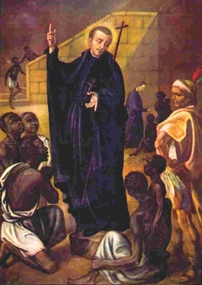
Living Humanly in the Midst of Death: Obadiah and St. Peter Claver


Public domain. Retrieved from Wikimedia commons.

This morning’s first reading at Vigils was from the Jewish prophet Obadiah 1:10-16.

In this passage, the prophet gives a stark warning to the nation of Edom, related to Israel through the brothers Jacob and Esau. According to the Talmud, Obadiah himself was an Edomite who converted to Judaism. He was also said to be a descendant of Eliphaz, the friend of Job. I find it fascinating that Obadiah is identified with a friend of one who suffered and then chastises his own people for refusing to do the same.

Obadiah’s beef with Edom is that they refused to get involved when the Babylonian Empire invaded and conquered the Kingdom of Judah, enslaving its people. He writes:

On the day that you stood aside, on the day that strangers carried off his wealth, and foreigners entered his gates and cast lots for Jerusalem, you too were like one of them.

The result of this inaction, according to the prophet, is that cycles of violence will continue to be perpetuated. Those of us who excuse ourselves by saying “it’s not my problem” are not immune from the effects of violence. Obadiah says:

As you have done, it shall be done to you; your deeds shall return on your own head.

The end result is that we will annihilate one another, not by conscious actions, but through our mutual indifference and passive participation:

For as you have drunk on my holy mountain, all the nations around you shall drink; they shall drink and gulp down, and shall be as though they had never been.

Perhaps the most insidious aspect of privilege is the self-deception that keeps us from accepting the reality that “we are caught up in an inescapable network of mutuality” (MLK). This is the demonic lie by which we absolve ourselves of responsibility when another woman fleeing domestic violence cannot obtain shelter because “she hasn’t been abused enough”, another black teenager is gunned down, and another lesbian couple’s home is broken into and the words “Move or Die” are scrawled on the wall. All of these have happened in my city (Kalamazoo, MI) this year.

In stark contrast to the indifference of Edom, there is the caring action of St. Peter Claver (1581-1654), who we remember today. Claver was a Jesuit priest and missionary to Colombia who focused his ministry on the slaves who were being brought across the Atlantic from Africa.

He brought food, medical care, and education to his fellow human beings in the ships’ holds. He refused to disembark until each person inside had received some measure of care. He likewise declined to accept the hospitality of slave owners. By the end of his life, he had baptized over 300,000 slaves, saying, “We must speak to them with our hands before we speak to them with our lips.”

Claver lived in a time when it was not possible for one person to turn the tide of the slave trade. Yet, he found a way to “live humanly in the midst of death” (Wm. Stringfellow). He refused to accept or participate in the injustice of his time.

People of faith and conscience, like St. Peter Claver, cannot afford remain silent or neutral in the face in injustice. We must not “stand aside” like Edom.

Perhaps we feel overwhelmed or hopeless when we think of our unfair social system that resists change. Perhaps the problem seems too big or too far away to do anything of significance. Perhaps we cannot do everything, but let us do something.

May God show each of us some way (however small) to “live humanly in the midst of death”, that we might find ourselves on the right side of history and our lives bear fruit for eternity.


Winning One Another: Jesus’ Guide to Conflict Resolution

In this morning’s gospel reading, Jesus has a lot to say about the way we fight.

He starts with the phrase “If another member of the church sins against you” but I think it also would have been fair if Jesus had said, “When another member of the church sins against you” because anyone who has been part of a particular church community longer than a few months can verify that the following statement is true: conflict is inevitable.

We are going to disagree; we are going to fight. It’s not a question of if but when. Why? Because the Church is made up of selfish, immature sinners: loved sinners, redeemed sinners, sinners called by Christ & empowered by the Spirit to become saints, but sinners nonetheless. And what is true of the parts, in this case, is also true of the whole. The “one, holy, catholic, and apostolic Church” of Jesus Christ is prone to the same kind of divisive, petty, and selfish conflict that disturbs the rest of the human race. We can’t get away from it.

With that fact in mind, Jesus concerns himself with in this passage is not whether we fight but rather how we fight. When we fight, we are called to fight in a way that demonstrates who Christ is and what Christ means to us as Christians.

Jesus said, “By this everyone will know that you are my disciples, if you have love for one another.” Do we dare think that this commandment only applies to those moments when we are all getting along and everyone likes each other as much as they love one another? On the contrary, I think Jesus’ commandment that we love one another as he loves us matters even more when we are fighting and we don’t like each other. As G.K. Chesterton once said, “The Bible tells us to love our neighbors, and also to love our enemies; probably because generally they are the same people.”

Moments of conflict are the moments when loving your neighbor matters most, because these are the moments when we, as Christians, have the biggest opportunity to preach the gospel of Jesus Christ, not only with our lips, but in our lives. As the Church of Christ, we cannot afford to let these opportunities pass us by.

So then, how shall we fight, as Christians?

The first thing Jesus says about fighting as a Christian has to do with our goal in fighting. Why do we fight? What is the purpose? Do we fight in order to win? That certainly seems to be the world’s goal in the way it fights.

Is the fight over when the enemy lies defeated, when we’ve crushed our opponent, and we’ve proved our arguments to be right beyond any shadow of a doubt? Is that why we fight? Jesus would say no.

If winning was just about winning the fight, then the gospel, the central Christian message, would probably sound something like this:

God made the earth and called it good, but humankind came along and sinned, breaking God’s just laws;

God tried to correct us, giving us the law and the prophets to guide us back toward doing right, but when we still refused to listen and went on sinning, God sent his only begotten Son Jesus Christ, conceived by the power of the Holy Spirit and born of the Virgin Mary, to make us suffer and die as punishment for our sins; thus, the righteous wrath of God was satisfied and moral order was restored to the universe;

then Jesus sat down at the right hand of his Father in heaven while the angels of God rejoiced and sang God’s praises over the smoldering ashes of the earth, which was now cleansed by fire from the filth of sinful humanity.

Doesn’t sound like much of a gospel, does it? The word “gospel” means “good news” but that message is neither good nor news. In fact, it’s the same old destructive story that people and nations have been playing out between themselves for millennia. The gospel, the good news of Jesus, is something entirely different.

The Nicene Creed says that it was “for us and for our salvation” (not for our punishment) that Jesus came down from heaven. “For our sake he was crucified under Pontius Pilate.” The creed also says that Jesus “suffered death” instead of dealing it out.

The Bible tells us that “God so loved the world that he gave his only Son” and “This is love: not that we loved God, but that he loved us, and while we were yet sinners, sent his only Son to die for us.” This is the Christian gospel: the good news that saves us.

If all that mattered was winning the fight and being right, then God never would have gone through the trouble of saving the world. God could have won the argument any time and silenced us forever with the fire of divine wrath, but that wasn’t enough for God.

It wasn’t enough for God to simply win the fight; God wanted to win us. God wants us to live in an intimate relationship with him and with our neighbors. When we sin against God and one another, those relationships are broken and fights happen. God’s goal is not to win the fight, but to heal those broken relationships. That’s the deepest longing of God’s heart and God will not rest until it is accomplished. As St. Augustine of Hippo said, way back in the 5th century: “God will not allow us to go to hell in peace.”

If restoring relationship is God’s ultimate goal in working through conflict, then it should be ours as well.

There is a particular turn of phrase that Jesus uses at the beginning of our gospel reading this morning: “If the member listens to you, you have regained that one.” Some other translations (NASB) say, “if he listens to you, you have won your brother.” Notice that Jesus doesn’t say “you have won the argument”; he says, “you have won your brother (or sister).” In other words: it’s not about winning the fight; it’s about winning each other.

Jesus takes these relationships so seriously, he calls upon us to enlist all of our personal and collective resources in the task of restoring them when they are broken. Christ calls us to apply the healing power of ever-widening circles fellowship where people speak the truth in love.

And if those gentle efforts appear to be finally fruitless before a hard hearted person who will not listen, Jesus says, “let such a one be to you as a Gentile and a tax collector.”

Many people have interpreted these words of Jesus to mean excommunication from the church. After all, Gentiles and tax collectors were outsiders to the religious community of Jesus’ day, right?

Well… not exactly.

Here’s the thing: Jesus kind of had a reputation when it came to Gentiles and tax collectors. There was the Roman centurion, who Jesus said had greater faith than any of his Israelite compatriots. He healed the man’s sick servant. He did the same thing for a Canaanite woman whose daughter was afflicted by demons. I guess that’s what it means for Jesus to treat someone “like a Gentile.”

Then there were Matthew Levi and Zaccheaus: both tax collectors with whom Jesus broke bread. Jesus made a pretty regular habit of eating with notorious tax collectors, sinners, and other religious outsiders – a gesture that said, “There is a place for you at my table; I accept you as you are; you are family to me.” That’s what being a “tax collector” means to Jesus.

When it comes to dealing with conflict in the church, Jesus’ bottom line is this: If what you’re doing isn’t working, LOVE MORE. When you have a problem with somebody, go talk to them yourself. If that doesn’t work, expand the circle of care to include a select few others. If that doesn’t work, enlist the loving attention of the entire church. And if all else fails, open the floodgates of heaven and unleash the full torrent of grace: the grace that compelled the father of the prodigal son to run out and meet him “while he was still a long way off”; the grace that blinded Paul on the road to Damascus as he hunted and killed Christians, transforming him into a preacher of the faith he once persecuted; the grace that inspired Zacchaeus the tax collector to sell all his possessions and repay fourfold what he had gained by theft and extortion.

In the eyes of the world, grace seems weak and pointless. People cannot fathom the idea of strength without force. Most people haven’t contemplated the patient power of water, which slowly wears jagged rocks down into smooth pebbles after millions of years of and gently and faithfully flowing across the surface of stone. The river of grace wins in the end, eroding even the hardest hearts.

Jesus is able to accomplish this miracle in people because he faithfully keeps his river of grace flowing in the same direction: toward the restoration of broken relationships. Jesus is interested in winning hearts, not fights and we, as his disciples, need to be about that same business.

If, for whatever reason, we cannot find that same grace in ourselves, then perhaps we need to repent: to seek God’s forgiveness, so that the river of grace might smooth over the jagged edges of our hard hearts and flow through us to our contentious neighbors who need to feel love’s gentle power just as much as we do.

Pope St. Gregory and the River of Prayer

Robin Stott [CC-BY-SA-2.0 (http://creativecommons.org/licenses/by-sa/2.0)%5D, via Wikimedia Commons

Today is the memorial of St. Gregory the Great, the Benedictine monk and Pope who was responsible for the establishment of the Benedictine monastic tradition in western Europe. The most common form of plainsong chant bears his name (Gregorian), but was not actually set down until centuries after he lived. It is also thanks to Gregory that we know anything about the life of St. Benedict himself, although much of what Gregory wrote is surely legend.

As for the connection to my own Presbyterian tradition: the reformer John Calvin, as anti-catholic (i.e. “Romophobic”) as he was, he nevertheless referred to Gregory as “the last good Pope.” High praise from an unlikely source that highlights the natural affinity I’ve noticed between the Presbyterian and Benedictine traditions:

  • The unaccompanied singing of psalms in worship
  • An inclination toward visual simplicity
  • The conviction that all of life is sacred
  • Liturgical flexibility between independent communities (e.g. the use of the Presbyterian Directory for Worship and the Benedictine Thesaurus for giving general guidelines without prescribing a single, set liturgy)
  • The surprising number of Presbyterian clergy and laity who also happen to be Benedictine oblates: Kathleen Norris, Rachel Srubas, Eric Dean, Laura Dunham… and in the case of Lynne Smith: one Presbyterian pastor who is also a Benedictine nun.

This affinity is especially striking to me, as a Presbyterian who feels called to highlight the catholicity of our faith and help our denomination return to our liturgical and sacramental roots.

Today’s second reading from the Liturgy of the Hours is borrowed from one of Pope St. Gregory’s homilies on the book of Ezekiel. His text is Ezekiel 3:17 – “Mortal, I have made you a sentinel for the house of Israel.”

Gregory had this to say:

Note that one whom the Lord sends forth as a preacher is called a sentinel. A sentinel always stands on a height in order to see from afar what is coming. Those appointed to be a sentinels for the people must stand on a height for all their life to help the people by their foresight.

He speaks longingly of his days in the monastery and laments the drama he gets sucked into in his pastoral ministry. Immediately after reading this passage at the Office of Readings, I checked my email to find literally dozens of invitations had arrived overnight for me to participate in activist events, political campaigns, and one public forum. Later today, I’ll be heading into my office to return phone calls, answer emails, oversee building repair projects, and brainstorm emergency fundraising ideas.

This never-ending laundry list reminds me of the most important part of my day: the extended prayer times I carve out as the church office opens and closes. There are times when I am tempted to see that time as self-indulgent: after all, my elders and deacons don’t get to consider prayer part of their workday, why should I? But Gregory indicates that pastoral work wouldn’t be possible without it.

Prayer is the height on which the sentinel stands in order to gain perspective for everything else that needs to be done. To paraphrase Richard Rohr: Prayer is not one of the ten thousand things that make up our lives; it is the lens through which we see those ten thousand things.

Thomas Keating likewise uses the image of a person sitting by on riverbank, watching the boats go by. The boats are those thoughts, perceptions, events, and needs that constantly assault us all day long. The goal of prayer (contemplative prayer in particular) is to look past the boats and focus on the river. This is God, the Ground of Being, who holds each “boat” in the current of divine energy that flows back into the ocean, from which we all have come.

Shut up and Hug Me

Today’s sermon from North Presbyterian Church

northchurchblog's avatarNorth Presbyterian Church

When my wife and I were in our first years of marriage, we didn’t have a lot of money. One Christmas, we decided not to buy gifts for one another, but make them instead. Her gift to me was most memorable: a book of coupons.

One was a coupon for “Extra time browsing at Barnes & Noble”, another was a “Get out of doing the dishes” coupon, but my favorite one came with the promise that it was “infinitely renewable”. It said: “Shut up and hug me.”

When she gave it to me, she explained what it meant: “Any time you see me getting so caught up in something important I’m doing (or something that I think needs to be done) that I forget to stop, look you in the eye, and really be there with you, you can hand me this coupon and expect an immediate response. And you…

View original post 1,637 more words

Who do you say that I am?

northchurchblog's avatarNorth Presbyterian Church

I’d like you to imagine for a moment that you are a member of a small tribal village living in the depths of the Amazon. Your people have had little contact with the outside world for generations. However, your village has recently been stricken with a plague. People are sick and dying.

Following the ancient traditions handed down by your parents and grandparents, you believe that there is a sacred order to the universe. When things go wrong, there is a reason. A local shaman informs the village elders that one of the gods has become angry and is punishing the people. This god must be appeased by way of a sacrifice or ritual, then the plague will end. So, the elders begin soliciting offerings from you and your neighbors for the sacrifice: animals, crops, etc. Your ancestors have always trusted people like this shaman; there’s no reason to doubt.

View original post 1,530 more words

The Only Argument Jesus Ever Lost

Today’s sermon from North Church

northchurchblog's avatarNorth Presbyterian Church


Image from Wikimedia Commons

This is a passage that can be very difficult to understand. It helps to look closely at some of the geographic details in the text and think about what they would mean to a Jewish person in the time of Christ.

First of all, let’s look at where Jesus and his disciples are located as the curtain goes up: they are “the district of Tyre and Sidon”. That’s Gentile territory: non-Jewish people, different language, different culture, different religion. They are outside their comfort zone, beyond the pale of ordinary experience, behind enemy lines in unfamiliar territory. If this were the Wizard of Oz, this would be the part where Dorothy says, “We’re not in Kansas anymore, Toto.”

Let’s go a little deeper down the rabbit hole, shall we? While Jesus is in this unknown territory, he is approached by a woman with a problem. And…

View original post 1,578 more words

Whole Making

“To follow Christ is to be engaged in such a way that one’s stance of being in the world is unitive not divisive. Eucharistic life sacramentalizes the vocation of whole-making by offering one’s life for the sake of drawing together that which is divided. Eucharist is bread being broken and eaten for the hungry of the world. It is the food that gives strength to make every stranger beloved, the “yes” of our lives to God’s mysterious cruciform love.”

–Ilia Delio, The Emergent Christ, p.67

First Steps

Looking into my eyes,
they could speak no more,
except to say, “Speak no more.”

But how can I keep from speaking what I have seen and heard?

Debate cannot convince.
Threats do not cajole.
Controversy will not be contained.

You know whose friend I am.

Even now,
the hand is stretching out:
your healing is stalking you.

This gathering place will be shaken.