 The famous author and Presbyterian minister Eugene Peterson tells a great story about something that happened to him when he was growing up in Montana. Eugene used to have to deal with a bully named Garrison Johns. Garrison used to pick on him and take cheap shots. All along, the adults in his church kept telling Eugene to “turn the other cheek” and “pray for those who persecute you.” When Garrison found out that Eugene was a Christian, he started calling him “Jesus-sissy.” Finally, the day came when Eugene decided that he’d had enough. He was walking home from school with Garrison beside him, hurling his usual barrage of jeers and jabs. I’ll let Eugene Peterson tell the rest of the story in his own words:
Something snapped within me. Totally uncalculated. Totally out of character. For just a moment the Bible verses disappeared from my consciousness and I grabbed Garrison. To my surprise, and his, I realized that I was stronger than he. I wrestled him to the ground, sat on his chest and pinned his arms to the ground with my knees. I couldn’t believe it – he was helpless under me. At my mercy. It was too good to be true. I hit him in the face with my fists. It felt good and I hit him again – blood spurted from his nose, a lovely crimson on the snow. By this time all the other children were cheering, egging me on. “Black his eyes! Bust his teeth!” A torrent of vengeful invective poured from them, although nothing compared with what I would, later in life, read in the Psalms. I said to Garrison, “Say Uncle.” He wouldn’t say it. I hit him again. More blood. More cheering. Now the audience was bringing the best out in me. And then my Christian training reasserted itself. I said, “Say, I believe in Jesus Christ as my Lord and Savior.” And he said it. Garrison Johns was my first Christian convert.
(Christ Plays in Ten Thousand Places, 134-136)
This story is a great example of a Christian doing the right thing in the wrong way. We Christians are famous for that. Ironically, it seems like we tend to be at our worst when we try to do something really big and beautiful for God.
Take, for example, the story of the Roman emperor, Constantine I. Constantine was the first Roman emperor to become a Christian. He legalized Christianity and ended centuries of persecution against the Church. That was a good thing, as far as Christians were concerned. However, he also started the process of merging church and state into one institution, a state of affairs that would eventually lead to the Crusades, the Spanish Inquisition, and the Salem Witch Trials. From Constantine’s point of view, he was establishing the kingdom of heaven on earth in the form of a Christian government. But when that government (and its successors) started to operate, it started to look less like the kingdom of heaven and more like all the other kingdoms of the world. In the end, the Roman Empire became just another superpower, but with the name of Jesus tacked on it.
That’s part of the problem with us humans: we assume that our ways are God’s ways, that a good end justifies bad means. We think that, in order for right and good win to out over evil, we have to use power and violence to force our will (or God’s) on others. But that isn’t how God works in the world.
We’re talking a lot about authority and kingship today. First of all, we’re wrapping up our six week series on the Great Ends of the Church. We’ve covered the first five already: the proclamation of the gospel for the salvation of humankind; the shelter, nurture, and spiritual fellowship of the children of God; the maintenance of divine worship; the preservation of the truth; and the promotion of social righteousness. This week, we’re looking at the final Great End of the Church, which is the exhibition of the kingdom of heaven to the world. We’re going to talk about what it means to “exhibit” “the kingdom of heaven.”
Today also happens to be Ascension Sunday, the holiday when we celebrate Jesus returning to heaven to sit at the right hand of God, as it says in the book of Acts. The meaning behind this image is the sovereignty of Christ as ruler over all creation.
So the subject of kingship is our central theme today. You might have picked up on this theme in our first reading from the letter to the Ephesians where the author talks about Christ, who is seated “at [God’s] right hand in the heavenly places, far above all rule and authority and power and dominion, and above every name that is named, not only in this age but also in the age to come.” Obviously, this is an image of supreme authority.
Based on what people tend to experience from the corrupt powers and authorities of this world, one might imagine a person with supreme authority to wield it like an Adolf Hitler or a Joseph Stalin. But that doesn’t seem to be the case with Jesus. His idea of kingly authority is very different from most others’. In our gospel reading, Jesus described his idea of what God’s kingdom, God’s ideal society might look like as it becomes established in the world.
It doesn’t look like an invading dictatorship or a hostile takeover by a competing corporation. There’s no violence and coercion in this kind of kingdom. Jesus said the coming of God’s kingdom is like “a mustard seed that someone took and sowed in his field; it is the smallest of all the seeds, but when it has grown it is the greatest of shrubs.” A little later, he said, “The kingdom of heaven is like yeast that a woman took and mixed in with three measures of flour until all of it was leavened.”
According to Jesus’ model, the kingdom of God is a growing thing. It works slowly and subversively beneath the surface of society. I especially love the image he uses about the kingdom being like yeast that leavens a loaf of bread. For those who might not know about bread making, yeast is alive. It’s a little microscopic organism that causes bread to rise once the yeast has infected the entire batch.
Did you get that? God’s kingdom is like a microbe: the smallest kind of life-form. It’s the exact opposite of dominating power and overwhelming violence. The various authorities of this world depend on violence and power to preserve order and get things done, but Jesus’ kingdom of God seems to work on the exact opposite principle: smallness and weakness. The greatest way to exercise power, according to Jesus, is by exercising service and mercy.
Jesus seems to have had some very upside-down ideas about kings and kingdoms. I would daresay that Jesus also seemed to have some very upside-down ideas about life itself. When Jesus first shared these radical ideas, he wasn’t just talking about a new system of government; he was talking about a new way to be human.
Jesus’ vision for the transformation of the world was a grassroots vision. In fact, the term grassroots isn’t even sufficient to describe it because it doesn’t go deep enough. We might have to make up a new word for this: how about heartroots? Jesus’ vision for establishing the authority of the kingdom of heaven on earth is a heartroots vision. It’s not imposed from the outside or above, like a bureaucratic dictatorship or an invading army: it changes the world from the inside out. Like a mustard seed or yeast.
Few of Jesus’ followers, even among Christians today, have ever accepted his teaching about nonviolence, service, and mercy in the Heartroots Revolution. By most accounts, these crazy, impractical should have been dismissed long ago, but they weren’t. For some reason, they continue to chase, disturb, and haunt us to this day, slowly transforming our hearts from the inside out… just like yeast slowly leavening a batch of bread dough.
I believe that we are called to be like that yeast in Jesus’ parable. In contrast to the violent and coercive way that power is exercised in the governments and corporations of the world, the citizens of the kingdom of God use the gentle skills of presence and persuasion. We work our Heartroots Revolution from the inside out.
We’re kind of like mothers in that way. They say a mother’s work is never done. I’ve certainly been reminded of that truth this week as my own mother has been staying at my house and helping me take care of my kids while my wife is out of town at a conference. Her help has been most appreciated.
But the real work of motherhood happens as her unconditional love and deeply held values shape the persons and perspectives of her children. That’s how God works in the world as well. That’s what it looks like when God’s kingdom comes “on earth as it is in heaven.”
Unlike the young Eugene Peterson, God will not pin us to the ground and punch us until we agree to follow Jesus. God doesn’t work through violence and coercion. Neither should we do so as citizens of the kingdom of God. We will not establish God’s kingdom by forcing our will on others through direct violence, or the threat of violence, or behind-the-scenes manipulation. The arrival of the kingdom of heaven on earth is not to be equated with the success of our country, our political party, our business, or our church. God’s vision is bigger and deeper than those things. God, like a mother who will neither forget nor forsake her children, works the Heartroots Revolution from the inside out, moving slowly and patiently across time. We Christians show ourselves to be citizens of God’s kingdom when we work in the same way: when we show up to work or school each day, consciously carrying the Holy Spirit in our hearts and letting our words and deeds act like yeast, leavening the loaf of our community with faith, hope, and love. That’s what God’s Heartroots Revolution looks like.
I want to send you out this week with that image in your mind. Wherever you go, whatever you do, think of the Holy Spirit living in your heart, leading you to act like an undercover agent, infiltrating the dark systems of this world with the light of love. Let Jesus be your model for how to do this. To the best of your ability, say and do things the way you imagine him saying and doing things. If you’re not sure what he would do, try picking up a Bible and reading from one of the gospels. Maybe one of those stories about his life will spark your imagination.
May your life, like Jesus’, exhibit the kingdom of God to the world. May others look at you and hear through your words and deeds the message that brings us together and carries us into the world each week: “I love you, God loves you, and there’s nothing you can do about it.” Be blessed and be a blessing.
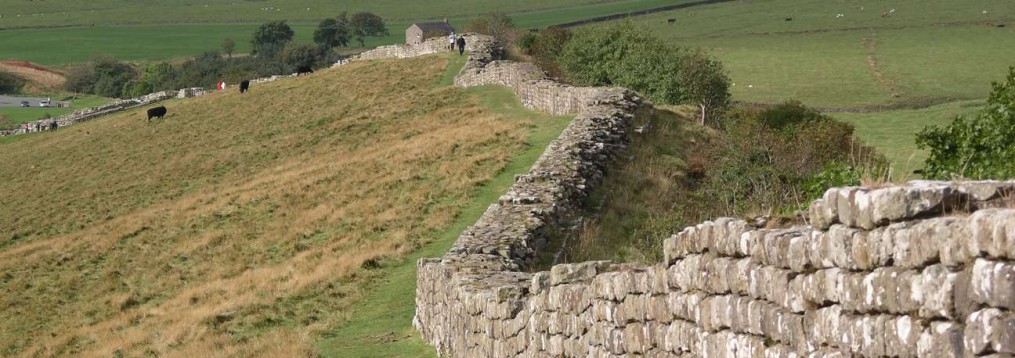


 Hopping Hadrian's Wall