
Excerpt from God Has A Dream:
There is a lovely phrase which St. Paul uses in his letter to the new Christian converts in Galatia. And that phrase is “in the fullness of time.” Paul speaks about how when Jesus was born it was at just the right time, all the pieces had fallen into place, the antecedents were just right, and it all happened at exactly the right moment. A little earlier would have been too soon and a little later would have been too late. When it happened it could not have been at any other moment.
Last year, many of us had a good laugh at the hype created by a fringe religious group who claimed to have exclusive knowledge that the end of the world was coming on May 21, 2011. As you may (or may not) recall, the day itself came and went without event. This was by no means the first time someone tried to cash in on apocalyptic hype. At the turn of the Millennium, there was “much ado about nothing” regarding the Y2K computer bug. In the 19th century, a man named William Miller made three unsuccessful attempts to predict the end of the world before his followers lost faith in him. Even before that, at the turn of the previous millennium, Pope Sylvester II trembled in prayer in his church, convinced that the world would come to an end that very night. Later this year, so we’re told, the Mayan calendar is supposed to run out, leading some people to speculate that this ancient civilization knew something we don’t about the apocalypse.
Predicting the what, where, and when of the end of the world has never failed to be a sensationalistic, money-making pastime for would-be prophets and their paranoid followers. We Christians have proved to be especially vulnerable to these scam artists, mainly because of the presence of the book of Revelation at the end of the New Testament. Many claim that this document, when read and interpreted properly, provides a detailed road map for the end of the world. It’s bizarre and cryptic imagery are said to contain secret messages about the Apocalypse that are meant to be decoded by those with the proper biblical study tools. The downside of this approach is that every single prediction supposedly “decoded” from the book of Revelation has turned out to be wrong. God’s plan, it seems, is not so readily available for human review and approval, but that hasn’t stopped people from trying to figure it out anyway.
Many of us might find it easy to laugh at them for their misguided pursuit. However, I’d like to take a moment to sympathize with them. My theory is that folks who tend to obsess over this kind of thing are looking for something. I think they’re looking for a sense of meaning and purpose in life. They want to believe that God has a plan for the world and that we’re not all just wandering aimlessly through history. I can relate to that.
The next step that most of these folks take is to apply this concept of God’s plan to their personal lives. They might say, “Not only does the universe have a destiny, but so do I. I’m an important part of God’s plan. Therefore, my life has meaning.” Like I said before, I can respect that need. I feel it too. I think we all do. But we have to watch out and make sure that we don’t carry this idea too far.
Our ancestors in the Calvinist tradition were famous for believing that God predestines the fate of every single human being. They believed that some people were destined for eternal bliss in heaven while others were doomed to endless suffering in hell. What makes the difference, they said, is “unconditional election” by God. God chose who would be “saved” or “damned” from the beginning of time, and there is nothing that anyone can do or say to change their fate. What’s more is that there was no way to know with any absolute certainty about which category you were in. This theological belief, called “double predestination”, caused people a lot of anxiety.
I’ve also seen people take the idea of God’s plan to unhealthy extremes in rather mundane matters. When I was in high school, I worked in a bookstore that had a section where we sold religiously themed posters. One day, I was walking through the stacks when I came across a woman who was kneeling on the floor, weeping. She had two posters laid out on the floor in front of her. The problem, it turned out, was that she couldn’t figure out which poster God wanted her to buy. Just like those folks who are obsessed with predicting the end of the world and the early Calvinist belief in double predestination, this person in the bookstore had taken the idea of God’s plan too far.
When I think about the idea of a divine plan for my life or history, I try not to get too hung up on the details of what, when, and where certain things are supposed to happen. If we occupy our time with those kinds of questions, I think we’re more likely to end up in an unhealthy state of mind. Rather, when I think about God’s plan, I prefer to ask questions of who, how, and why.
God is far less interested in what you’re doing and more interested in who you’re becoming, how you’re living, and why you do what you do. These are questions of the heart. Answering these questions goes a long way in helping us forge a sense of meaning and significance in our lives. For example, let’s take a young person in school who is trying to decide on a career path. I don’t think God tends to care very much whether someone decides to become a lawyer, a doctor, or a minister. Those are questions of what, where, and when. Of greater concern to God is whether that person wants to become a lawyer in order to just make money or to serve the greater cause of justice. In God’s eyes, a waitress in a diner with a heart for hospitality is more holy, more in step with God’s plan, than a minister who just likes to hear the sound of his own voice. Who we are is much more important than what we do.
That’s why I tend to avoid the phrase “God’s plan” when it comes to the events of history. I much prefer to think of “God’s vision” or “God’s dream” as Desmond Tutu calls it. God’s dream is a dynamic thing. It’s always changing and in motion. God is the ultimate creator of this dream, but has invited each one of us to become co-creators with God and each other. Archbishop Tutu says it like this:
It has often been said, “What we are is God’s gift to us. What we become is our gift to God.” What we become is not about status, it is about love. Do we love like God, as God so deeply desires? Do we become like God, as God so deeply desires us to be?
As for the substance of the plan itself, the shape it takes is up to us, and God works with and around what we bring to the table. Again, in the words of Archbishop Tutu:
There is a wonderful Portuguese saying that God writes straight with crooked lines. God works through history to realize God’s dream. God makes a proposal to each of us and hopes our response will move His dream forward. But if we don’t, God does not abandon the goal, He does not abandon the dream. God adjusts God’s methods to accommodate the detour, but we are going to come back onto the main road and eventually arrive at the destination.
I love that phrase: “God writes straight with crooked lines.” To me, it describes so well my experience of life in this world where things don’t always go according to plan. Accidents happen. Things don’t always go your way. Life goes on. It doesn’t mean that God isn’t present or working in this world and in our lives. It means that, if we’re going to look for God, we have to look deeper than the level of surface appearances and random events.
When someone gets sick, or an accident happens, or a terrible tragedy overtakes us, people are prone to ask, “Why is God doing this?” or “Why did God allow this to happen?” I have to be honest with you, I don’t think God had anything to do with it. The God of love that I believe in is not in the business of causing cancer and car accidents. I think these things just happen. The God I believe in is the one who meets us in the middle of these disasters and leads us to respond in a certain way.
One of my favorite examples that I use to illustrate this point is the terrorist attacks of September 11. Some people said that God allowed those airplanes to crash because God was judging the United States for one reason or another. I don’t think that’s true. I don’t see God in that at all. I see God in those volunteers who climbed the smoldering piles of rubble with buckets in their hands to get the trapped survivors out. I see God in the police and fire fighters who risked or gave their lives to save others. That’s where God is. That’s God’s plan, God’s dream, in action.
I don’t know if there will one day be an apocalyptic end to the world. I don’t know if there will be a once & for all victory of goodness over evil “in the fullness of time”. I don’t know if we, or our children, or our grandchildren will ever live in a perfect world.
I don’t know much, but this is what I believe:
When I look out at the stars in the heavens, I see a harmony that human selfishness cannot touch. We might destroy ourselves and each other someday. We might even take our whole planet into extinction with us. But the beauty of nebulae, quasars, and galaxies will still be there. The impulse toward order and equilibrium will never be gone from our universe. That same impulse exists in each one of us. We call it life, we call it justice, and we call it compassion. I call it God. As long as there is a universe to exist, God will never stop working within it to shape darkness, death, and chaos into light, life, and love. As long as we are alive in this world, God will never stop inviting us to join God in this continuing mission. I close this sermon and end this series by going back to the words of Desmond Tutu himself:
All over this magnificent world God calls us to extend His kingdom of shalom—peace and wholeness—of justice, of goodness, of compassion, of caring, of sharing, of laughter, of joy, and of reconciliation. God is transfiguring the world right this very moment through us because God believes in us and because God loves us. What can separate us from the love of God? Nothing. Absolutely nothing. And as we share God’s love with our brothers and sisters, God’s other children, there is no tyrant who can resist us, no oppression that cannot be ended, no hunger that cannot be fed, no wound that cannot be healed, no hatred that cannot be turned to love, no dream that cannot be fulfilled.
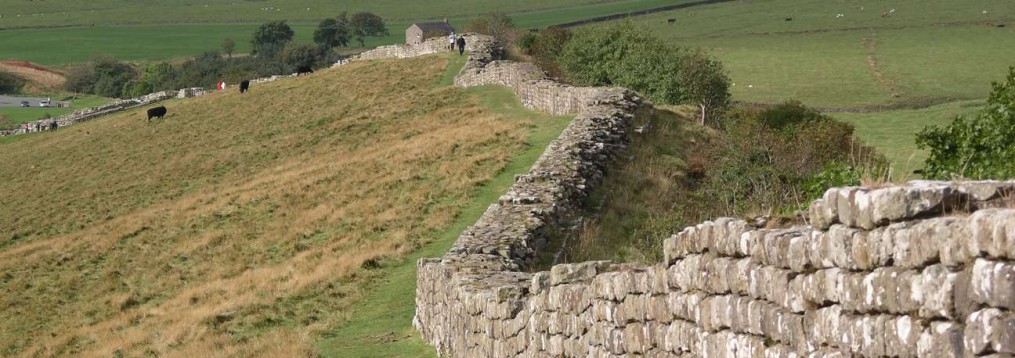


 Hopping Hadrian's Wall