Consciousness is not something that can be measured, quantified, or reduced to neural, brain-based processes. It is not something confined to the human mode of being in the world, nor can it be identified solely with what many religions claim to be the unique quality of life after death. Consciousness transcends all the names and labels that we put on it. It does not belong to the sphere of observable material reality; however, it is structured within universal life, and evidence for it can be gleaned from several of evolution’s creations.
Never one to hog the blogosphere, today’s offering is my wife’s sermon from yesterday. I learned to preach from her. She’s way more innovative in her use of the medium. Enjoy!
That’s right—I’ve started the count over, again. Three days ago, I thought it was the end of the world—I thought I would count the rest of my life from that day—the day Jesus died, but today I’m starting over. Today will always be Day 1 of the rest of my life, because the impossible happened! Jesus is back! Jesus appeared to us in the upper room, in the flesh. We touched him. He spoke to us and ate with us! This is not only Day 1 of the rest of my life, it is the day the whole world changed.
Day 2
We’re all still jittery from last night—it’s so hard to believe. But the hardest part is that Thomas missed it. He joined us this morning, and we told him how Jesus…
Today, as many of you may or may not know, happens to mark the 100th anniversary of the sinking of the RMS Titanic. The story of the Titanic is one of the most well-known tragedies of the 20th century (I am, of course, referring to the actual ship and not the movie… although the movie was pretty bad). I am proud to say that I was a Titanic enthusiast long before the film came out. I was just a little kid in 1985 when the wreck was discovered by Robert Ballard, the legendary ocean explorer. When I was learning to read, my mother bought me a copy of a kids’ book called Titanic… Lost and Found! Later on, my very first “grown up book” was The Discovery of the Titanic by Robert Ballard. I even own a small piece of coal that once sat in Titanic’s boiler room. It was recovered from the wreck site at the bottom of the ocean.
In addition to the popularity of James Cameron’s blockbuster film, I think there are many reasons why the story of the Titanic continues to haunt our collective memory and imagination. One could easily call it a “multi-faceted tragedy.” On the one hand, it is a story of foolish human arrogance: unwavering faith in “progress” and technology that led to calling the ship “unsinkable,” even though it obviously was not. On the other hand, it is a story of human vanity. Titanic’s builders used the cheapest and most brittle of low-quality iron in their construction of the ship’s hull. They preferred to spend their money on lavish decorations like gold-gilded dinner plates and the magnificent grand staircase that we saw in the movie. Some scientists have theorized that, had the ship’s hull been made of sterner stuff, it might not have buckled as badly after striking the iceberg. The ship would still have gone down, but it would have happened much slower and allowed more time for rescue ships to arrive and save lives. But, in my mind, the greatest tragedy of the Titanic is that it is a story of human prejudice. Great pains were taken to maintain the distinction between the upper and lower class passengers on the Titanic. They were not allowed to mix under any circumstances. There were still many in that day who believed in the inherent superiority of upper class people over others.
These class distinctions were maintained, even after Titanic received her fatal blow from the ice berg. The crew shut iron gates in the hallways to keep the lower classes below deck. As a result, people in steerage were blocked from getting to the lifeboats. Meanwhile on deck, lifeboats for first class passengers were being lowered only half-full. Apart from the crew, most of those who died on the Titanic were from the lower classes. This, to me, is the single most tragic fact of the Titanic disaster. It represents an almost total breakdown in human community. Artificial distinctions and privileges were maintained, even in a life-or-death situation. I can’t think of anything else that takes us farther away from what God intends for us as a human family.
It’s easy for us to sit here this morning, look back in time, and shake our heads at their prejudice. We think we’ve evolved beyond that. In some ways, we have: most folks these days have dropped the overt sense of aristocratic pedigree that once dictated social relations in Europe and North America. But, in other ways, we in 2012 are still very much as our ancestors were in 1912. We still like to categorize ourselves and write each other off for being different from one another. Some of our distinctions are obviously trivial, such as preference in music or sports. Other distinctions, like those involving politics and religion, seem to bear more momentous weight in the public sphere.
Looking at the bitterly divided state of things in our society and world today, it seems to me that we too are guilty of maintaining artificial distinctions and privileges among ourselves, even in the face of dire consequences. Folks seem only too willing to write one another off as “those people” and forego the gentle arts of communication, coexistence, and compromise. Even after one hundred years, it seems that we have not yet learned our lesson.
I believe the sacred scriptures of our religion offer us an alternative vision for human community. We read this morning in our passage from the book of Acts a very different scene from the one described on the deck of the Titanic in her final hours. We are told that the members of the early church were “of one heart and soul.” So deep was their commitment to God and one another that they abdicated their rights to private property. Yet, we are also told, “there was not a needy person among them.” I don’t know about you, but to me, that sounds a whole lot more like a hippie farm than a church!
In the midst of this “experiment with socialism,” the text tells us that there is something else going on that is of paramount importance to the church’s identity. It says that they “gave their testimony to the resurrection of the Lord Jesus.” Somehow, this singular activity of testifying to the resurrection was central to everything else that was going on in their community.
What I find interesting is that the text of Acts doesn’t tell us what they said. It doesn’t tell us how the apostles and early Christians testified to the resurrection. To be sure, this is something that Christians continue to do to this day. Some folks try to “testify to the resurrection” by constructing historical and scientific arguments for the likelihood that Jesus got up out of his tomb and walked the earth again. Some folks simply tell the story over and over again (like this church does at Easter). But the most important way that people (back then as well as now) “testify to the resurrection” is in the way they live.
When I look at that beautiful depiction of the early church, sharing what they have, meeting peoples’ needs, and generally being a community “of one heart and soul,” I am struck by that community’s similarity to Jesus’ vision of the kingdom of heaven-on-earth, where “the last will be first” and “the greatest among you will be the servant of all.” The powers-that-be of Jesus’ time were threatened by his message. The crucifixion was their final “no” to everything that he was and did. But the resurrection was God’s resounding “yes” that trumped the world’s “no.” Truly, where God is concerned, love is stronger than death. In this chapter of Acts, we have a community where people dared to love like Jesus did. Their daily lives served as indicators that Jesus’ dream was coming true and that the life of Christ was alive in them. Their lives together served as a living testimony to the resurrection of Jesus.
This reminds me of the words to an old gospel hymn:
He lives, He lives, Christ Jesus lives today!
He walks with me and He talks with me
Along life’s narrow way.
He lives, He lives, salvation to impart!
You ask me how I know He lives: He lives within my heart.
You and I have not had the privilege of physically walking and talking with the historical figure, Jesus of Nazareth, as the early apostles did. However, we are not therefore excused from the task of testifying to his resurrection. We, who claim to be his followers in the world today, give testimony to the world through the presence of the risen Christ in our hearts. When we allow that Christ-like love to have its way in our lives, it does something inside of us. It puts us back in touch with the true meaning for our lives and the center of the universe. We experience Christ, not as an historical figure who lived two millennia ago, but as a living and breathing presence in our midst today. Like the hymn says, “He lives within our hearts.”
There is another hymn that communicates this same idea. We sang it as our opening hymn this morning. Did you catch the lyrics?
They cut me down and I leapt up high,
I am the life that can never ever die!
I’ll live in you if you live in me,
I am the Lord of the Dance, said he.
Earlier in that same hymn, it says, “I am the dance and I still go on!” Your life is a testimony to the presence of the living Christ in you. Wherever faith conquers fear, Christ is alive! Wherever equality dissolves prejudice, Christ is alive! Wherever selflessness conquers selfishness, Christ is alive! Wherever opposing individuals or groups sit down together to seek peace and understanding, Christ is alive! God’s resounding “yes” trumps the world’s final “no.” Wherever these dreams become reality in our lives, we show the world with our lives that Christ is a present and living reality, not just some inspirational figurehead confined to the annals of history. Christ is the dance we dance. Christ is the undying life within us. How do we know he lives? He lives within our hearts! Just look at our lives and see!
This is good and empowering news for us, but it also bestows a great responsibility upon us. We need to ask ourselves on a regular basis whether the lives we live, as individuals and as a church, are proclaiming a message of resurrection to the world. We need to ask ourselves if we are living as resurrectionpeople. Are we practicing what we preach? The great American poet and essayist, Ralph Waldo Emerson, once said, “Don’t say things. What you are stands over you the while, and thunders so that I cannot hear what you say to the contrary.”
There are all kinds of big and little ways that we can live as resurrection people. Some of us will change the world with our testimony. Most of us will not. All we can do, according to theologian William Stringfellow, is “live humanly in the midst of death.” Our little deeds of compassion and care must carry the light for us. We, through our actions, can create a small community of kindness around us that has the potential to outlast the empires of history. The Christian church began as a small, persecuted sect in the shadow of the Roman Empire. Yet, here we are, Christians still celebrating, worshiping, and caring together, centuries after the fall of Rome. The presence of the risen Christ in us is stronger and more enduring than the dominating force of empire.
Then again, we never know what kind of impact our small acts of kindness might have on the world at large. There is a story of a young black boy and his mother walking down a city street in South Africa during the reign of Apartheid. There was a law then that black folks had to step aside when white folks passed their way on the sidewalk. As this mother and son were walking along, they encountered a white man walking the other way. As he drew near, the boy was shocked to see the white man step aside and lift his hat as they passed by. The boy asked, “Mummy, who was that man?” His mother replied, “That man was an Anglican priest and furthermore he is a man of God.” The little boy would later say, “That was the day I decided that I wanted to be an Anglican priest and furthermore a man of God.” That little boy grew up to be Archbishop Desmond Tutu, the pastor to a nation who helped to peacefully dismantle Apartheid and usher in a new era of equality for his country and set an example to the world. Who could have predicted that his calling would be inspired by one small, illegal act of kindness and respect given one day on a street corner? Christ is alive! Christ is risen indeed!
I’d like to close with another story from the Titanic. In the midst of all the arrogance, vanity, and classist inhumanity of that tragic story, there is the noble tale of Fr. Thomas Byles. He was a Catholic priest on his way to officiate at his brother’s wedding in the States. During the night, he was twice offered a space in a lifeboat, but gave it up to other passengers both times. He said he would stay on board so long as there was a single soul in need of his ministrations. He heard confessions and said prayers. The last time anyone saw him alive, he was saying the rosary on deck, surrounded by a crowd of Catholics, Protestants, and Jews. There, in the desperation of that moment, distinctions between race, class, ethnicity, and religion were all erased. It seems that only grace remained once the gravity of the situation set in. I find it amazing that, even there, in the midst of this great tragedy, a small group of people encountered the eternal mystery of God together in ad hoc community. Even as they walked together through the valley of the shadow of death, their lives “gave testimony to the resurrection of the Lord Jesus, and great grace was upon them all.”
Here is a YouTube video of the Most Rev. Katharine Jefferts-Schori (Presiding Bishop of the Episcopal Church) offering wise and wonderful words about the religious diversity in which we live.
Here is some practical advice for all you single fellas that also provides some erudite analysis of gender inequality as applied to safety concerns. Kind of depressing that things are this way, but they are what they are. So, here are some tips for navigating the minefield.
It’s been a rough half-century for folks in the mainline Protestant denominations. The numbers are undeniable. We are smaller than we were in the 1950s and 60s. Everybody seems to have a pet theory about why this is happening.
Extremists on one side are convinced that this decline in numbers is caused by fanatical adherence to superstitious dogmas that have been rendered irrelevant by philosophical, scientific, and technological advancement. Extremists on the other side are convinced that the wrath of God is smiting our denominations with death because they have bowed down to the heresies of the modern world. I want to say the same thing to extremists on both sides:
“Shut up and sit down. This kind of talk isn’t helpful.”
While these voices tend to be the loudest, I find more often that they are in the minority. Most folks in our churches identify themselves as moderates who tend to lean to one side of the spectrum or the other.
In spite of rampant conspiracy theories to the contrary, I find that most moderates on both sides are compassionate and intelligent believers who are essentially saying the same thing:
“I want to stay faithful to the core values of my faith, but I’m afraid that my denomination is becoming a place where I won’t be able to do that.”
We’ve all been through this before. American mainline Protestant churches have split over the abolition of slavery, biblical literalism, the ordination of women, and (most recently) same-sex marriage.
My own denomination, the Presbyterian Church (USA), which I will abbreviate as PC(USA), is currently wrestling with the recent creation of a group that calls itself the Evangelical Covenant Order of Presbyterians (ECO). ECO is a group that has come together out of its founders’ desire to have a denominational community with shared theological values and a commitment to evangelical mission in the world outside the walls of the church. They believe the PC(USA) has drifted from its core theological roots and become too inwardly and institutionally focused. They see the PC(USA)’s recent decision to allow for the ordination of non-celibate lesbian, gay, bisexual, and transgendered (LGBT) people and this summer’s upcoming vote on same-sex marriage as symptoms of the larger and deeper theological problem.
Just to be clear about where I stand, let me lay all of my cards out on the table. Those who know me or follow this blog will already know this, but I’ll say it again for the sake of any newcomers and first-time readers. I identify as a theologically liberal Presbyterian. I am a vocal advocate for LGBT equality in church and society. I am not a part of ECO. In fact, I probably represent much of what they think is wrong with the PC(USA).
The PC(USA) itself does a fairly good job at holding the middle ground in this debate. They follow the example of Karl Barth and other Neo-orthodox theologians of the 20th century. How do I know the denomination does this? Because it frustrates folks on both sides. Liberals think it’s too conservative and conservatives think it’s too liberal.
Liberals and conservatives have their own unique ways of vying for greater power in the decision-making process. Liberals tend to invest in taking hold of regional and national positions of authority in the councils (formerly known as governing bodies) of the denomination. They, in the tradition and spirit of historic liberalism, tend to put their trust (too much trust, I would say) in the amendment of large-scale human institutions. The heroes of this bunch tend to be Moderators of our General Assembly and professors at our denominational seminaries. In science-fiction terms, they see themselves as the United Federation of Planets (Star Trek).
Conservatives, on the other hand, love to cast themselves in the role of the oppressed underdog. They see themselves as heirs of the American Revolution and the Protestant Reformation. Their heroes tend to be the pastors of large and wealthy congregations. They tend to idolize their pastors and demonize the denomination. As one elder screamed (yes, screamed) during a recent meeting in our area, “The PC(USA) just wants more of our money so they can keep spreading their lies!” In science-fiction terms, they see themselves as the Rebel Alliance, fighting the Sith-dominated Galactic Empire (Star Wars).
In reality, both sides are delusional. The PC(USA) is not the United Federation of Planets and ECO is not the Rebel Alliance. It’s pretty obvious to me that we’re essentially dealing with two different religious traditions under the roof of one denomination. This leaves us with two options. We can either: (A) Organize our denominational life together in such a way that leaves room for both parties to coexist, or (B) Peacefully part ways in a spirit that is consistent with our highest shared values.
As a liberal, I will primarily direct my critical comments toward the members of my own party. But before I do that, I want to invite any conservatives and evangelicals to listen in and witness one liberal who is not a demon-possessed heretic that wants to invade your church, seize your building, fire your pastor, and force you into compliance with my wicked homosexual agenda. Are you ready? Let’s go.
I am a liberal who supports the creation of ECO. My reasons for doing so are primarily biblical in nature. I was reading Genesis 13 the other day, where the nomadic caravans of Abram and Lot are traveling together through the Promised Land, but have achieved critical mass in regard to the land’s ability to support both groups. Conflict began to brew. Abram then takes the moral high ground,
Let there be no strife between you and me, and between your herders and my herders; for we are kindred. Is not the whole land before you? Separate yourself from me. If you take the left hand, then I will go to the right; or if you take the right hand, then I will go to the left.
Abram even lets Lot have his first choice of the land. There is a recognition that division is necessary, but a complete rejection of backbiting and contentiousness. Here is an example of a person of faith who can declare “Separate yourself from me” and “we are kindred” in the same paragraph.
In the same way, our denominational landscape is being strained in the attempt to support both liberals and evangelicals. It is clear that there are many among us who no longer wish for our caravans to sojourn together. As heirs of Abram’s covenant, why can’t we do with each other what Abram did with Lot? Who among us will take the moral (i.e. relational) high ground?
In this moment, I would call upon my fellow liberals to step up to the plate. You have invested much energy in securing positions of power for yourself at the presbytery and General Assembly levels. Use the power afforded you by those positions to walk like Jesus, who said,
You know that the rulers of the nations lord it over them, and their great ones are tyrants over them. It will not be so among you; but whoever wishes to be great among you must be your servant.
I would venture to say that we should support the creation of ECO, let these congregations and presbyteries go their own way, and find a way to send them off with a parting blessing: their buildings, investments, and pensions. Let’s leave a legacy that will provide an open door for reconciliation in some future generation.
Institutional division is not necessarily a church schism. We can part ways and remain true to each other on multiple levels. After Abram and Lot part ways, the relationship between them continues to grow faithfully. Abram fights for Lot, rescues him from danger, and prays earnestly for his well-being. Let’s learn how to do the same for each other. Enough of all this backbiting crap.
Listen, we don’t really need their numbers and their money. Their presence will not hold back the tide of mainline decline. We are still shrinking, no matter what. This is a subject for another blog post, but I see mainline decline as a good thing.
My point is that we might best guard the “peace, unity, and purity of the church” by allowing people to go their own way, even if we happen to disagree with where they are going. We made a vow to guard the “peace, unity, and purity” of the church, not necessarily the denomination. We should be careful to distinguish between the two.
Liberal Presbyterians: be ye not afraid of ECO. Support its creation. Send them off with a blessing. Like Abram and Lot, let there be no strife between them and us; for we are kindred.




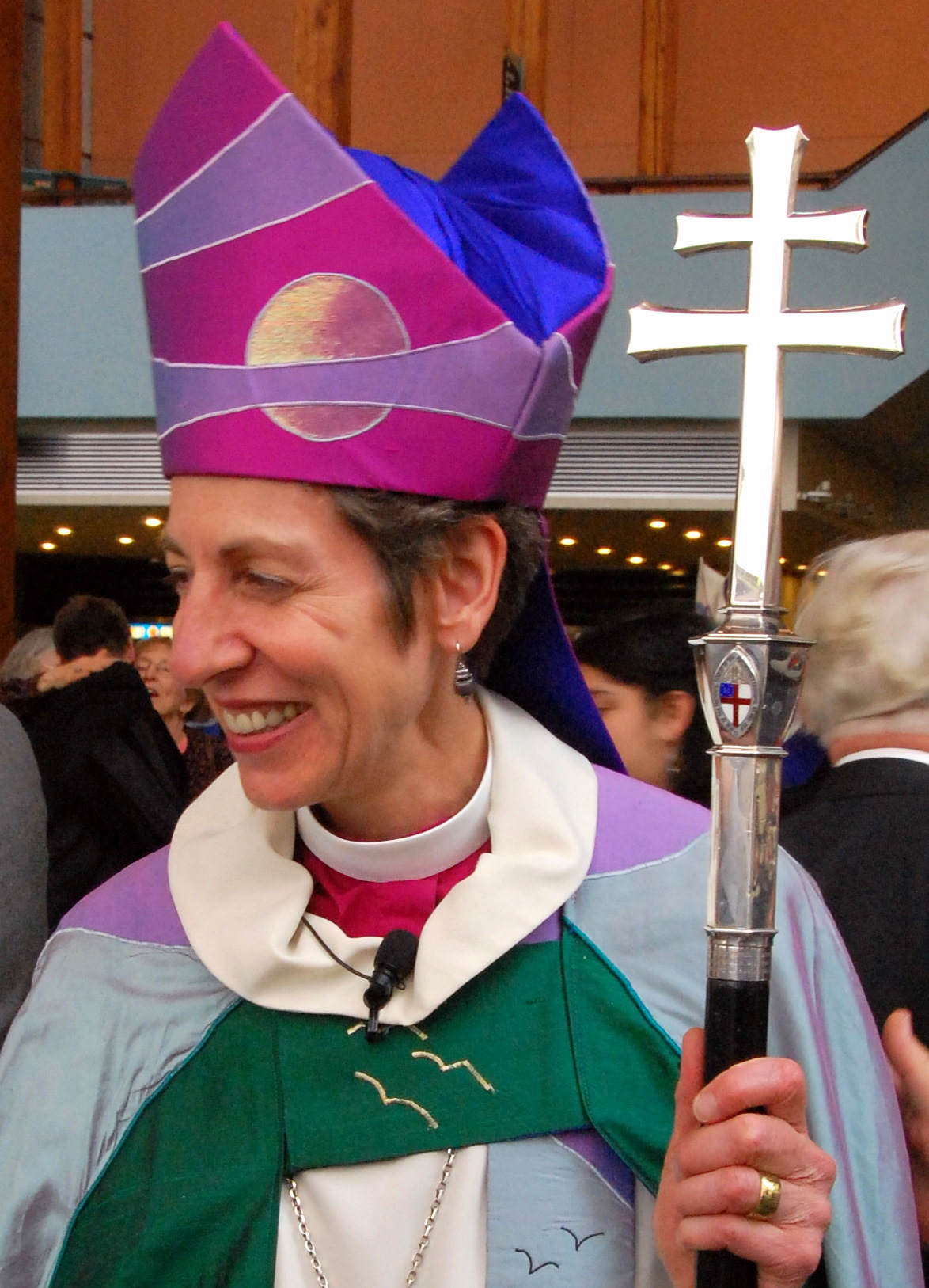 Here is a YouTube video of the Most Rev. Katharine Jefferts-Schori (Presiding Bishop of the Episcopal Church) offering wise and wonderful words about the religious diversity in which we live.

 Hopping Hadrian's Wall