
Author: J. Barrett Lee
Evolutionary Thoughts: Creed
I’ve been enjoying a book by the Irish Catholic priest Diarmuid O’Murchu called Evolutionary Faith: Rediscovering God in our Great Story (Orbis: 2002).
O’Murchu is an innovative mystic with a poet’s heart. Neither his theology nor his science are very orthodox. He kind of picks and chooses what he likes from both. Of course, if we’re honest, every single one of us would have to admit that we do the same.
More inspiring than informative, this book has really had my wheels turning lately. I’m going to start posting some fascinating snippets on this blog. I really don’t care if you’re not impressed with him (I’m not always) or if you don’t agree with him (I don’t always). He’s introduced me to some new ideas and authors that are quite fun and interesting.
Think of this as the jungle-gym on the playground of ideas. The following is from the book (p.2-3):
My Evolutionary Creed
- I believe in the creative energy of the divine, erupting with unimaginable exuberance, transforming the seething vacuum into a whirlwind of zest and flow.
- I believe in the divine imprint as it manifests itself in swirling vortexes and particle formations, birthing forth atoms and galaxies.
- I believe in the providential outburst of supernovas and in the absorbing potential of black holes.
- I believe in the gift of agelessness, those billions of formative aeons in which the paradox of creation and destruction unfolds into the shapes and patterns of the observable universe.
- I believe in the holy energy that begot material form and biological life in ancient bacterial forms and in the amazing array of living creatures.
- I believe in the incarnation of the divine in the human soul, initially activated in Africa over four million years ago.
- I believe in the “I Am Who I Am,” uttered across the aeons, pulsating incessantly throughout the whole of creation and begetting possibilities that the human mind can only vaguely imagine at this time.
- As a beneficiary of the Christian tradition, I believe in the power of the new reign of God, embodied and proclaimed in the life of Jesus and offered unconditionally for the liberation of all life-forms.
Last summer, I also enjoyed reading Prayers to an Evolutionary God (Skylight Paths: 2004), a daily devotional by William Cleary based on Evolutionary Faith. You can order both books on Amazon.com by clicking on the image:


Dear Ellen, I believe in dance too
Ellen doesn’t usually talk about her critics on her show, and I don’t usually talk about Ellen on my blog, but we’re both making exceptions today:
Ellen Addresses Her JCPenney Critics.
After this segment, Ellen followed up with “I also believe in dance.”
I believe in dance too…
What is a Miracle?
Sorry to crowd the blogosphere today, but I happened across this brilliant passage while reading Schleiermacher and couldn’t resist the urge to post:
What is a miracle? What we call miracle is everywhere else called sign, indication. Our name, which means a wonder, refers purely to the mental condition of the observer. It is only in so far appropriate that a sign, especially when it is nothing besides, must not be fitted to call attention to itself and to the power in it that gives it significance, Every finite thing, however, is a sign of the Infinite, and so these various expressions declare the immediate relation of a phenomenon to the Infinite and the Whole. But does that involve that every event should not have quite as immediate a relation to the finite and to nature? Miracle is simply the religious name for event. Every event, even the most natural as usual, becomes a miracle, as soon as the religious view of it can be the dominant. To me all is miracle. In your sense the inexplicable and strange alone is miracle, in mine it is no miracle. The more religious you are, the more miracle you would see everywhere. All disputing about single events, as to whether or not they are to be called miraculous, gives me a painful impression of the poverty and wretchedness of the religious sense of the combatants. One party show it by protesting everywhere against miracle, whereby they manifest their wish not to see anything of immediate relationship to the Infinite and to the Deity. The other party display the same poverty by laying stress on this and that. A phenomenon for them must be marvellous before they will regard it as a miracle, whereby they simply announce that they are bad observers.
-Friedrich Schleiermacher
On Religion: Speeches to its Cultured Despisers (1799)
p.88
An Ass and a Bunch of Zombies: The Triumphal Entry and Occupy Wall Street
This is a fascinating and sympathetic critique of Occupy Wall Street from ProgressiveChristianity.org
An Ass and a Bunch of Zombies:
The Triumphal Entry and Occupy Wall Street


Elements of Worship: Sacrament
This week’s sermon from First Presbyterian, Boonville.
The text is I Corinthians 11:23-26.
Click here to listen to this sermon at fpcboonville.org
“ACHOO!”
“Bless you!”

Do you know why people say that when someone sneezes? The practice goes back almost to the time of Christ, but nobody knows for sure how or why it got started. There are a number of interesting theories out there. Some think it started during an outbreak of the bubonic plague as a way of commending people to God’s care when nothing more could be done for them (i.e. “It’s been nice knowing you”). Tibetan Buddhists believed that sneezing provides a moment of “clear consciousness” (like dying, falling asleep, or meditating) during which one might be able to achieve Enlightenment. But my favorite explanation is this one: when you sneeze, your soul is temporarily dislodged from your body. The blessing makes it go back in so that the devil won’t come and possess you.
That’s just one example of the kinds of crazy superstitions that we got rid of at the end of the middle ages in western society. We might still say “bless you” when somebody sneezes, but I seriously doubt that anyone still believes that it’s your soul trying to leave your body. We needed to get rid of that superstition (along with several others). I, for one, am glad that our society no longer burns women at the stake because “they might be witches.”
The light of reason brought us out of those dark ages and into the modern era, where humanity has grown by leaps and bounds. We’ve landed on the moon and created a global communication network so efficient that I could just flip out my phone and have a conversation with someone in India if I felt like it. Letting go of these old superstitions has, on the whole, been a good thing. But, like everything else in this world, our so-called Enlightenment has its dark side. We now live in a world that is “disenchanted”. We’ve lost that sense of meaning and connectedness with the world around us. We no longer see spirits and fairies in the trees and rivers. If we think of God at all, it is as some distant and abstract Creator who has little or nothing to do with the world as we know it. Naïve superstition gives way to cynical materialism and we see ourselves as random collections of atoms that just conveniently happen to make consciousness possible. The world around us becomes an empty shell of resources just waiting to be exploited for profit. Human life becomes equally meaningless under this mindset. What matters is gaining the upper hand in the ongoing battle for survival (which we all eventually lose).
In reaction to this sinister cynicism, some religious folks have chosen to side with the aforementioned distant Creator. They gather round their campfires and sing, “This world is not my home, I’m just a-passin’ through” and “Some bright morning, when this life is over, I’ll fly away.” These folks want to save their souls from this wicked world in order to enjoy the blessings of some far-off heaven for eternity. This perspective may seem more like faithfulness at first, but it nevertheless leaves this world looking just as empty and meaningless as cynical materialism does. It is the advocates of this kind of escapism who shout things like, “Drill, baby drill!” and figure, “This whole world is going to hell anyway, so why bother to take care of it?”
We needed to drop the ridiculous superstition of the middle ages, but I wonder if maybe we threw out the baby with the bathwater? Secular and religious folks alike have lost all sense of connectedness to God, the earth, and each other. Both sides are saying that this earth just doesn’t matter.
Is there some way to reconnect with that larger sense of meaning and mystery in the cosmos without going back to that ridiculous superstition? I think so.
We’re currently in the middle of a five-week sermon series on the Elements of Worship. We’ve already looked at the Word, prayer, and service as Elements of Worship. Next week, we’ll be talking about relationship. This week, we’re talking about sacrament.
The word sacrament comes from a Latin word that means mystery. When Christians talk about sacraments, they’re typically referring to one of two church events: Baptism and the Eucharist (a.k.a. the Lord’s Supper or Holy Communion). A few weeks ago, we had a service where talked about the sacrament of Baptism at length in the sermon. We even baptized three new people into our congregation. So this week, I’m mainly going to focus on sacrament of the Eucharist (which we happen to be celebrating in our service later today).
In the sacrament (mystery) of the Eucharist, we celebrate three realities. First, we remember Jesus: who he is and what he did. Jesus revealed the heart of God to the world in a way that no one else ever has. He “gave himself for us” in a life of service and love. We participate in that act of self-giving when we remember him and receive his gift of himself, his body and blood, into our own bodies.
Second, we participate in a present reality. Remember the old saying, “You are what you eat”? Well, it’s true. We are the body of Christ. Through him, we are also part of each other: one loaf, one cup, one body, one family. They also say that “blood is thicker than water”. In this case, the blood of Christ is thicker than our own blood. The blood of Christ flows in our veins. Gone is any illusion of pedigree, race, nationality, status, or caste. As Christians, this is where our loyalty lies. This is where our true identity is to be found. Blood is thicker than water and this blood is thickest of all. When we target, discriminate against, or otherwise antagonize those who have been to the table of Christ with us, we are turning our backs on our own kin. This is a truth worth remembering whenever we are next tempted to divide the world into “us” and “them”.
Finally, Christians at the Lord’s table anticipate the future with hope. Christ told his disciples that he would drink wine with them next when the kingdom of God comes in its fullness. The end of history is often described in the scriptures as a fully-catered wedding reception. The bread and wine we now eat and drink around this table is a foretaste of that coming celebration when all things are made new, justice and equality are established on earth, and (as it says in Revelation) “God will wipe every tear from [our] eyes. Death will be no more; mourning and crying and pain will be no more.” When the tides of despair threaten to overwhelm us, we have these edible tokens to hold onto. They are the aperitifs of the heavenly banquet.
In the Eucharist, we are fed with spiritual food. This sacrament, I think, holds the key to reconnecting us with our lost sense of wonder and mystery. Without it, Christian faith too easily becomes just one more product for sale in the modern marketplace of ideas. With it, we are able to “taste and see that the Lord is good.” Through this sacrament, we touch the mystery of Love that springs from the very heart of the universe and reaches out to its edges. Just as we say in the Great Thanksgiving, I invite you to “Lift up your hearts” to see that “heaven and earth are full of [God’s] glory”.
How do we do this? How can we “lift up our hearts”? Well, I think we can start by simply celebrating the sacrament as often as we can. As recently as the 1970s, most Presbyterian congregations celebrated the Eucharist only four times a year. Since then, the frequency has increased. Most of our churches celebrate it monthly. More and more, there are churches in our denomination that are beginning to celebrate the sacrament on a weekly basis. In our church, that is a decision for the session of elders to make. I would like to encourage those of you who are currently serving as elders to meditate on this and consider increasing the frequency with which we celebrate communion. In our Book of Order it says that the Eucharist “shall be celebrated regularly and frequently enough so that it is clear to all that the Lord’s Supper is integral to worship, and not an addition to it.”
We Presbyterians are used to thinking of our Sunday worship as revolving around the central event of reading and preaching God’s Word. This is true. But it’s also true that we worship in a binary system. Our liturgy revolves around the twin stars of Word and Sacrament. They are meant to go together. John Calvin, one of the founders of our tradition, urged his churches in Geneva to celebrate Communion weekly. Calvin told them that, yes, the scriptures make up the foundation of the church, but the sacraments are its pillars. The church won’t stand up without both to support it. Let’s make sure that we are not starving ourselves of Christ’s spiritual food and drink.
The moment of real transformation comes when we begin to see the presence of Christ, not just in this bread and wine, but everywhere we look. This is what it means to “lift up your hearts” and see that “heaven and earth are full of [God’s] glory,” as it says in the liturgy. The more regularly we honor the presence of the sacred mystery in this bread, the more we will begin to see it in all bread. And we will see that, like this consecrated bread, all bread is meant to be shared. So let’s share our bread with those who are hungry. And I’m not just talking about literal bread either: let’s share the bread of freedom and equality with all. Let’s learn to share the bread of work, education, healthcare, and housing with those who are also our brothers and sisters. They are God’s children and we are one family. This sharing is a sacramental sharing. It’s an integral part of what we do here on Sunday.
This whole universe is sacred. It is infused with divine glory from stem to stern. Our celebration of the sacraments helps us reconnect with that mystery. Let’s make that connection as deeply and as often as possible, so that it might stay with us as we go out from this place to share our bread with the hungry and be the body of Christ in the world.
Lift up your hearts. Heaven and earth are full of God’s glory. Let us give thanks.
Hamatreya
By Ralph Waldo Emerson
Bulkeley, Hunt, Willard, Hosmer, Meriam, Flint,
Possessed the land which rendered to their toil
Hay, corn, roots, hemp, flax, apples, wool and wood.
Each of these landlords walked amidst his farm,
Saying, “‘Tis mine, my children’s and my name’s.
How sweet the west wind sounds in my own trees!
How graceful climb those shadows on my hill!
I fancy these pure waters and the flags
Know me, as does my dog: we sympathize;
And, I affirm, my actions smack of the soil.’
Where are these men? Asleep beneath their grounds:
And strangers, fond as they, their furrows plough.
Earth laughs in flowers, to see her boastful boys
Earth-proud, proud of the earth which is not theirs;
Who steer the plough, but cannot steer their feet
Clear of the grave.
They added ridge to valley, brook to pond,
And sighed for all that bounded their domain;
‘This suits me for a pasture; that’s my park;
We must have clay, lime, gravel, granite-ledge,
And misty lowland, where to go for peat.
The land is well,–lies fairly to the south.
‘Tis good, when you have crossed the sea and back,
To find the sitfast acres where you left them.’
Ah! the hot owner sees not Death, who adds
Him to his land, a lump of mould the more.
Hear what the Earth says:–
Earth-Song
‘Mine and yours;
Mine, not yours, Earth endures;
Stars abide–
Shine down in the old sea;
Old are the shores;
But where are old men?
I who have seen much,
Such have I never seen.
‘The lawyer’s deed
Ran sure,
In tail,
To them, and to their heirs
Who shall succeed,
Without fail,
Forevermore.
‘Here is the land,
Shaggy with wood,
With its old valley,
Mound and flood.
“But the heritors?–
Fled like the flood’s foam.
The lawyer, and the laws,
And the kingdom,
Clean swept herefrom.
‘They called me theirs,
Who so controlled me;
Yet every one
Wished to stay, and is gone,
How am I theirs,
If they cannot hold me,
But I hold them?’
When I heard the Earth-song,
I was no longer brave;
My avarice cooled
Like lust in the chill of the grave.
Copied from http://www.vcu.edu/engweb/eng372/emersonpoems372.htm
Passing the ‘Beck’
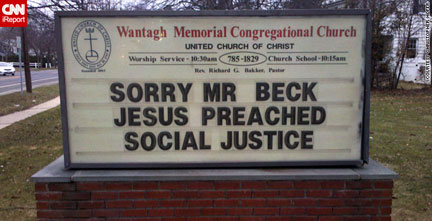 The article linked below reminds me that it was just about a year ago that Glenn Beck issued a call for people to leave churches that espouse “social justice” as part of their faith. He not-so-subtly implied that we’re all a bunch of Commies and Nazis (he’s only half-right).
Looking back, it occurs to me that if any of my congregants were predisposed to accept whatever Glenn Beck says as gospel truth, then they would probably be happier in a different church anyway. Go with God, but go.
As for me and my house, we hope to continue with Jesus’ 2,000 year old “experiment with socialism”.
So long, Mr. Beck. Don’t let the door hit ya where the good Lord split ya. And may I ask: “How insane do you have to be for Fox News to tell you to shut up and get out?”
Here’s the article:
 Hopping Hadrian's Wall