Book Review: How We Learn to Be Brave

I wrote the following book review for my diocesan magazine in late 2023. Reposting now because of the increased interest in Bishop Budde’s book.


Edgar Budde, Mariann. How We Learn to Be Brave: Decisive Moments in Life and Faith.(New York: Avery, Penguin Random House LLC, 2023) 
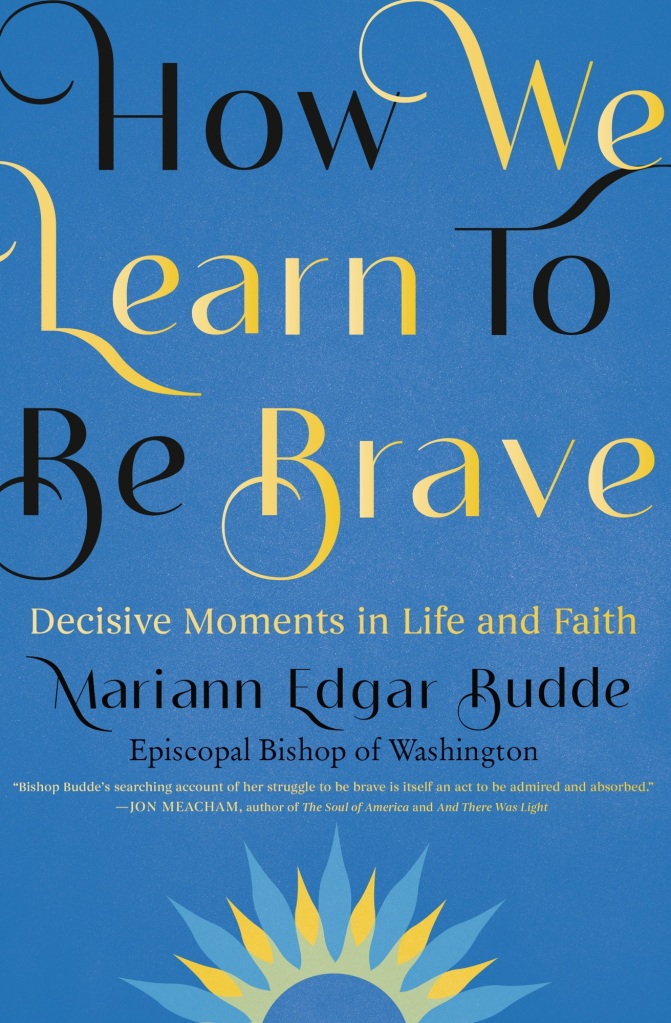
How We Learn to Be Brave: Decisive Moments in Life and Faith is the third and most recent book by the Rt. Rev. Dr. Mariann Edgar Budde, the ninth and current bishop of the Episcopal Diocese of Washington. Published earlier this year, this book was inspired by the teargassing of protesters to make room for a political photo-op outside St. John’s Episcopal Church, Lafayette Square on June 1, 2020. This event, and the ecclesiastical response to it, propelled Bishop Budde and The Episcopal Church into the center of public attention for the first time since Presiding Bishop Michael Curry preached at the royal wedding of 2018. 

The book begins with an account of the events of June 1 from Bishop Budde’s point-of-view. After the initial retelling, the author occasionally refers to the events of that day, but the main thrust of the book has significantly more breadth and depth. As the title indicates, this is not a book about political grandstanding; it is a book about bravery.  

Part memoir, part history, and part theological treatise, this book focuses on the virtue of courage as a choice that we make. Bishop Budde writes: 

Decisive moments involve conscious choice, impressing their importance upon us as we experience them, for we know that we’re choosing a specific path of potential consequence. In a decisive moment, no matter how we got there, we no longer see ourselves as being acted upon by the slings and arrows of fortune or fate, but as ones with agency. We’re not on autopilot; we’re not half-engaged. We are, as they say, all in, shapers of our destiny, and cocreators with God. (xviii) 

Across the chapters that follow, Bishop Budde explores the various kinds of decisions to which the virtue of courage may call us. There are chapters on Deciding to Go, Deciding to Stay, Deciding to Start, Accepting What You Do Not Choose, Stepping Up to the Plate, The Inevitable Letdown, and The Hidden Virtue of Perseverance. 

Each chapter includes an autobiographical vignette and an historical profile to illustrate the particular theme. While the book is intended for a larger audience, the author does not shy away from biblical, liturgical, and theological references particular to Christians. Most (though not all) of the historical profiles are of prominent Episcopalians whose names are easily recognizable, even though their Episcopal faith may not be as widely-known. Historical examples include Franklin and Eleanor Roosevelt, Supreme Court Justice Thurgood Marshall, Jonathan Myrick Daniels, and the Rev. Dr. Pauli Murray. Contemporary Episcopal voices cited by the author include Dr. Brené Brown, the Rev. Dr. Kelly Brown Douglas, and Rachel Held Evans. The author makes a special point of highlighting examples from the lives of women and people of color.  

When it comes to the autobiographical sections, the author does not shy away from experiences of personal failure and disappointment. This spiritual reflection on the virtue of courage is not a self-congratulatory polemic. There are many times in life when courage calls us to take responsibility for our mistakes. Bishop Budde describes personal experiences of such moments with an abundance of honesty and humility. 

My primary criticism of the book is a relatively small and forgivable one. There are times when the several examples of historic Episcopalians come across as advertisements for our denomination. As a reader, it seemed like the author was implying, “Look at all these cool Episcopalians! Don’t you want to be one too?” A greater religious diversity among historical examples would have decreased my sense of evangelistic pressure and increased the book’s appeal to a wider audience. That being said, I think this fault is minor because the Episcopalians the author cites are indeed examples of the virtue she is expounding. Furthermore, since the author is an Episcopal bishop, I can’t really blame her for wanting to highlight the denomination she serves. 

All in all, I think this book will appeal to parish book groups and individuals looking for personal development. Its language is accessible to readers without a theological education and its spiritual dimension is broad enough to include people who do not identify as religious. Finally, though I must admit some personal bias on this point, I think this book would be an excellent choice for Episcopalians in the process of discernment and formation for ordained ministry.  

Courage, like love, is more choice than feeling. We blaze the trail of God’s call by putting one foot in front of the other, falling down, getting up, changing direction, and starting again. How We Learn to Be Brave gives ample inspiration, encouragement, and guidance for that process. 
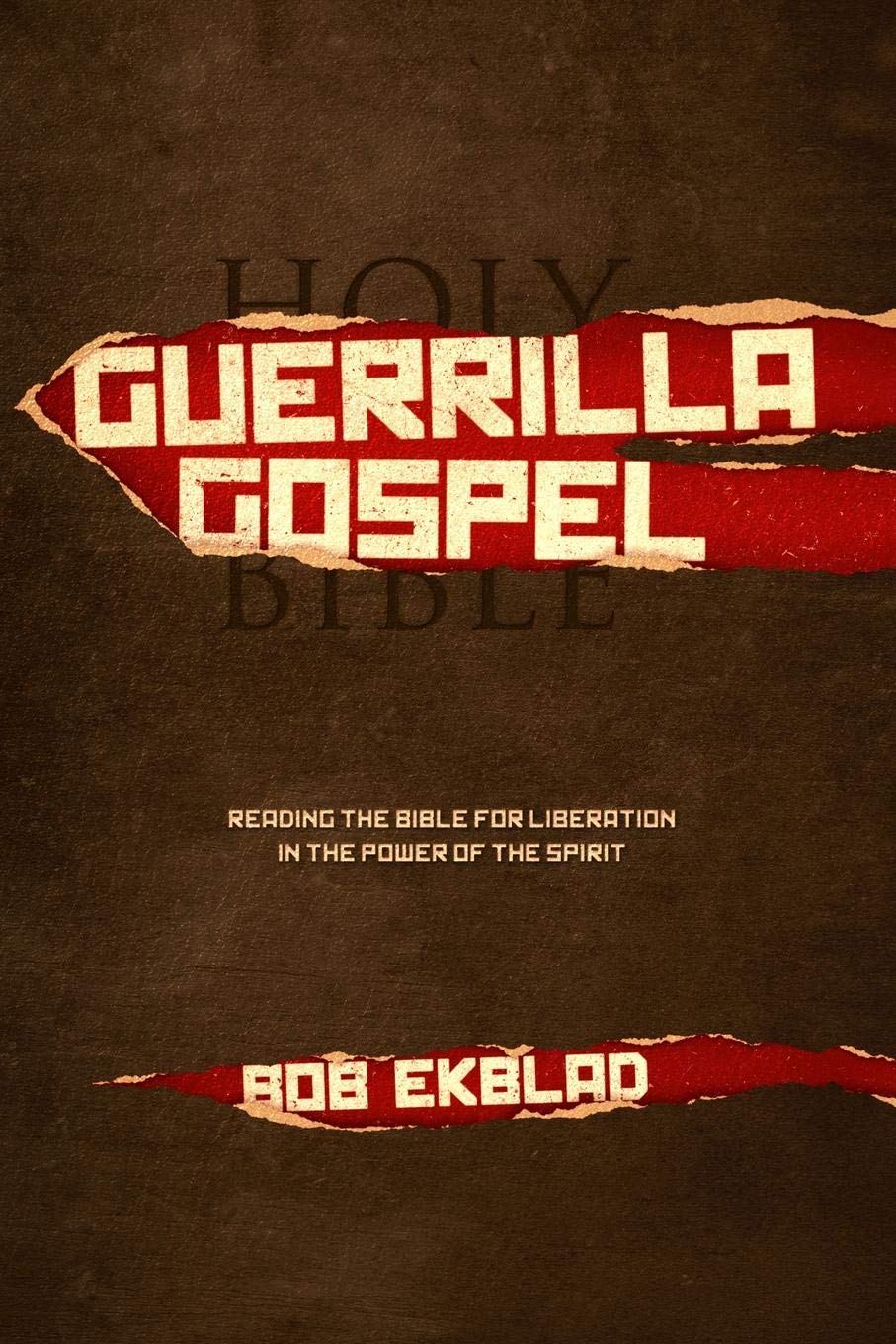
Book Review of ‘Guerrilla Gospel: Reading the Bible for Liberation in the Power of the Spirit’ by Bob Ekblad

Bob Ekblad. Guerrilla Gospel: Reading the Bible for Liberation in the Power of the Spirit (Burlington, WA: People’s Seminary Press, 2018).

It is a great honor to be asked to read and review an advance copy of Guerrilla Gospel: Reading the Bible for Liberation in the Power of the Spirit by my friend and teacher, Bob Ekblad.

Bob and I first met fourteen years ago, when I was a seminarian at Regent College in Vancouver, BC. It was through his classes that I began to discern my sense of call to ordained ministry. I walked into his class with one career plan and walked out with another. Over the intervening decade and a half, Bob’s ideas have continually influenced the shape, location, and direction of my ministry as a substance abuse counselor, street chaplain, and pastor to a congregation of mentally disabled people.

Click here to read a blog post on how I have made use of Bob’s methods in my own ministry setting.

Bob taught me how to read the Bible with a new set of eyes. I had previously approached the Scriptures as a compendium of morals and doctrines. Bob showed me how to encounter and inhabit the Bible as a treasury of liberating news for people who live outside the bounds of institutional religion.

Guerrilla Gospel is a follow-up to Bob’s earlier book, Reading the Bible with the Damned (WJK: 2005). Both books present the sound theological basis for Bob’s method of biblical interpretation and illustrate the process with copious personal stories. Readers will derive the most benefit by perusing both books, though either one can stand on its own merit.

While Reading the Bible with the Damned focused on the theological framework, Guerrilla Gospel gets down to the nitty-gritty details of preparing and leading Bible studies with marginalized people. With its more practical emphasis, Guerrilla Gospel answers my one remaining question after finishing Reading the Bible with the Damned: “How do I actually do this?”

Clergy will find much in this book that is familiar from seminary courses in biblical exegesis, and will benefit from seeing how Bob applies these study methods in ministry contexts outside the institutional church. Lay leaders will also find in Guerrilla Gospel a thorough, yet accessible, crash-course in biblical interpretation. I would recommend this book for anyone seeking to start a Bible study in a traditional church setting, but especially for those who practice their ministry in marginal places like jails, prisons, drug rehabs, and homeless shelters. Hopefully, those who read Guerrilla Gospel from within the institutional church will be inspired to reach out and find the Spirit present and active in unexpected places. Believe me, you will be glad you did.

One of Bob’s greatest gifts is the way he so skillfully navigates the convergence of disparate streams of Christian thought. There is something in this book for almost everyone. Evangelicals will connect with Bob’s deep love of Scripture, charismatics with his openness to the movement of the Holy Spirit, contemplatives with his explications of centering prayer and monastic spirituality, academics with his erudite scholarship, and social justice activists with his background in liberation theology.

At the same time, Bob’s unique theological location guarantees that Guerrilla Gospel also has something to make everyone uncomfortable. Readers of all theological stripes should come prepared for a challenge to their unconscious biases and assumptions. Wise and discerning readers will remain open to having their horizons expanded.

As a high-church Episcopalian, the one thing I would have liked to read more about in Guerrilla Gospel is the role of the Sacraments in ministry contexts like Bob’s. To be sure, the subject is not entirely absent. Another of his previous books, A New Christian Manifesto: Pledging Allegiance to the Kingdom of God (WJK: 2008), has an amazing chapter on Baptism. Personal stories from his several books, including Guerrilla Gospel, frequently touch on the topics of healing (Unction), confession of sin (Reconciliation), family relationships (Matrimony), personal commitment (Confirmation), and ‘deputizing’ for ministry (Ordination) from a less formal perspective. In a future book, I would be very interested to read more about the ways Bob has witnessed the Holy Spirit liberating ministry through the celebration of the Eucharist, and what its theological implications are for margins and mainstream alike.

Whether the reader is clergy or laity, evangelical or progressive, contemplative or charismatic, leading ministries of education within the church or outreach beyond the church, Bob Ekblad’s Guerrilla Gospel: Reading the Bible for Liberation in the Power of the Spirit has something to inspire, inform, comfort, and challenge anyone who wants to be part of Jesus’ liberating movement on earth.

Also by Bob Ekblad:

Further reading:

(Reblog) Review of Lupton’s Toxic Charity

Review of Toxic Charity by Robert Lupton

Ryan P. Cumming of the Evangelical Lutheran Church in America has written a top-notch critical review of this book that has recently been making waves in the non-profit sector of our community. The book is quite popular and those who love it accept its conclusions as gospel truth. Cummings does an excellent job in his short review of pointing out the book’s finer points while also not glossing over its major flaws.

Most other reviewers speak admiringly of the author and his statements. The few negative reviews tend to emphasize the reviewer’s pet issues (i.e. social justice, evangelism, etc.) while ignoring the substance of the book itself. This is the first critical review I’ve seen that treats the substance of the book fairly:

I won’t dignify his words with the verb “argues” because Lupton doesn’t argue his points; he simply states them.  I would be concerned that statements like this, when coupled with his criticisms of charity, would motivate more people to avoid service work in the first place than to engage in the community development he suggests…

…The difficulty here is not his rejection or support of foreign aid or welfare.  There are arguments to be made on both sides of the debate.  The problem is that the only apparent research Lupton draws on is Dambisa Moyo’s controversial 2009 book Dead Aid.  Outside of this, Lupton appears to draw on his own experience, which I admit is extensive, but this does not make for a well-defended argument.   And this is vitally necessary when making statements about both the poor and government’s relationship to them that are far from self-evident.

Click here to read Cumming’s full review at elca.org

Religious Liberalism 101: A Book Review of Paul Rasor’s ‘Faith Without Certainty’

I haven’t done a book review in a while, but I’ve been reading some good ones.  Just yesterday, I finished Faith Without Certainty: Liberal Theology in the 21st Century (Skinner House: 2005) by Paul Rasor, a Unitarian Universalist minister and college professor who currently works as director of the Center for the Study of Religious Freedom.

Enemies and allies of liberal theology are similarly inclined to use the term ‘liberal’ as a synonymn for ‘other’.  Until the last year or two, I myself was completely unaware of the historical depth contained within the joint traditions of Unitarianism and Universalism.  Knowing only what I’d been told from my evangelical upbringing, I had always thought that Unitarian Universalists (UUs) were ‘loosey-goosey’ and ‘airy-fairy’ liberals who had respect for neither tradition nor truth and adopted an ‘anything goes’ policy in regard to morality and ethics.  I would tell jokes like:

Q: What do you get when you cross a Jehovah’s Witness with a Unitarian Universalist?

A: Someone who comes knocking on your door for no apparent reason.

OK, I have to admit that I still chuckle at that one, even though I know it’s not true.  UUs are deeply committed to their theology and ethics.  If one knocks at your door, you can bet that it’s for a very good reason.  What I discovered is that UUs (as well as other religious liberals) are committed to process over content.  In other words, they’re more interested in how you live than what you believe.  This is beautifully reflected in the UUA’s Seven Principles.  I would love to go into greater detail about them here, but that will have to wait for another blog post.  The UUA, while it represents the largest organized group of religious liberals, is not the only place where they hang out.  There continue to be many of us who try to embody a similar flavor of religion within our respective communities.  What matters is that we who identify ourselves with this label (‘liberal’) must be able to simultaneously hold and share a conscious awareness of who we are and what we stand for in a positive sense.

Given the myriad ways that the term ‘liberal’ gets thrown around without being defined, I’m grateful for Rasor’s concise and readable primer that actually digs into the real roots  and trajectories of the liberal theological tradition.

If you don’t have time to read the entire book, the first two chapters after the introduction will familiarize you with what it is that religious liberals believe and how we came to embrace those values.  Whether you’re out to support or criticize us, it’s important that you know what you’re getting into.  Love or hate us for what we are, not what we’re not.

The remainder of the book lays out some of the challenges and frontiers that liberal theology is currently facing in its ongoing development.  With the arrival of the postmodern era, liberal religion (as a decidedly modern phenomenon) is reevaluating many of its core commitments (in much the same way that evangelical Christians (another modern movement) are also doing via the ‘Emergent Church’ movement).  Hard and fast categories, such as rugged individualism and universal human experience, are being questioned in the light of community, culture, and language.

Rasor is highly critical of his own liberal tradition in relation to issues of race and social class.  Despite its value of diversity, liberal religion continues to exist as a predominantly white and middle-class movement.  While his criticisms are honest and accurate, I wish that he had spent more time with them.  He mentions social Darwinism and the rise of manifest destiny in America, but he says nothing of Eugenics or the Holocaust, both of which were fueled in part by liberal theology.  These massive moral failures demonstrate that no one group, however utopian their ideals, is above the human tendency toward self-justified violence and oppression.  My primary criticism of Rasor’s book is that it seems to minimize and/or ignore these most prominent failures of liberal religion.

On the other hand, I was highly impressed by Rasor’s distinction between liberal and liberation theologies.  These two categories are often associated with one another in the common mind, mainly because of shared emphases on social justice.  However, as Rasor observes, they arise from different historical sources, make use of different methods, and emerge with very different values and convictions.  Liberation theologians tend to hold scripture and tradition much more closely, even as they criticize and reinterpret them.  Not all theological liberals are liberation theologians (and vice versa).  One need only look at the sermons of Archbishop Oscar Romero of El Salvador to see his deep commitment to the historical orthodoxy of Roman Catholicism.  If anything, I came away from Rasor’s book with an awareness that the construction of a theology that is simultaneously liberal and liberationist would prove to be a most difficult task.  Indeed, evangelicals would probably have an easier time of it, given the place they grant to the Bible in their theological systems.

All in all, I highly enjoyed Rasor’s book during my two weeks of vacation.  I expect that I will keep it on my shelf and refer to it often as a concise introduction to what religious liberals actually believe.

Click here to order this book on Amazon.com

Mindfulness Meditation

This is my church newsletter column for this month:

While my son was in the hospital this summer, I stumbled across the work of Dr. Jon Kabat-Zinn, a professor at the University of Massachusetts Medical School and founder of the Mindfulness Based Stress Reduction Clinic.  Dr. Kabat-Zinn is credited with being the first person to make use of meditation as clinical practice in western medicine.  According to Dr. Kabat-Zinn, the words meditation and medicine both come from the same Latin word: medeor, which means “to heal”.

After listening to an on-line lecture and reading Dr. Kabat-Zinn’s book Full Catastrophe Living, I decided to start practicing mindfulness meditation.  After almost two months, I can tell you that it has indeed been a “healing” addition to my daily self-care routine.  More than any other single practice, mindfulness meditation was most helpful in getting me through the crisis of my son’s early and traumatic arrival into the world.  My closest friends have remarked that I actually seem to be more relaxed than usual, in spite of my unpredictable circumstances!

Dr. Kabat-Zinn presents this practice from a clinical (rather than spiritual) point of view.  However, I have found it to be most helpful to my spiritual life as well.  By “tuning in” to the present moment, I have become more aware of God’s loving and peaceful presence within and around me throughout my day.  Sunsets and changing leaves have captured my attention in new ways.  I find that I can say in my daily life what we say to God during our Communion service each month:

Holy, holy, holy Lord,

God of power and might,

heaven and earth are full of your glory.

When I relax into the present moment and accept it as it is, I find that heaven and earth are indeed full of God’s glory!

If you would like to try mindfulness meditation on your own, here’s how it works:

Sit still for three minutes, close your eyes, and try to pay attention to your breathing.  Don’t breathe any differently than you normally do.  You’re breathing all the time, whether you realize it or not.  Just try to become aware of what is already happening without your conscious effort.  Start with this and see what happens.  How did you feel before, during, and after the exercise?  Once you’ve done this once, try and do the same for five minutes a day.  When you feel ready, increase that amount to ten minutes a day, then fifteen, then twenty, etc.  Dr. Kabat-Zinn recommends practicing this exercise for 30-45 minutes every day (I’m only up to twenty minutes right now).

After practicing, you might not feel any different than you normally do.  That’s okay.  The point of this exercise is to practice being rather than doing.  It’s a healthy alternative to our culture’s constant pressure to “keep going” all the time.  Many of us have forgotten the sound of silence and the feel of stillness.  We identify so strongly with our activities and accomplishments that we lose touch with our true identity as beloved children of God.  I recommend this exercise as a way of bringing us back to an awareness of who we really are.

If you’re interested to learn more, check out this lecture on You Tube:

You can also order this and Jon Kabat-Zinn’s other books on meditation from Amazon.com:

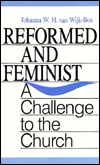
Reformed and Feminist

Johanna W. H. van Wijk-BosReformed and Feminist: A Challenge to the Church (W/JKP: 1991).

Johanna W. H. van Wijk-Bos’ Reformed and Feminist: A Challenge to the Church is a semi-autobiographical introduction to feminist thought viewed through the lens of Protestant biblical scholarship.  Wijk-Bos argues that the study of the Judeo-Christian scriptures has something valuable to add to the process of women’s liberation and that the time has come for Christian churches to assist in the radical reform of patriarchal institutions.

In the first chapter, Wijk-Bos shares a considerable amount of detail from her own life-story in order to establish herself within her own context as a Dutch, reformed, and feminist woman working as a pastor and biblical scholar in the U.S.  The second chapter explores the concept of biblical authority as it emerged during the Protestant Reformation.  Wijk-Bos pays special attention to the particular developments of Calvinism in continental Europe during the 16th century.  In the next chapter, the author examines some of the particular hermeneutical issues that arise when one explores the biblical text from a feminist perspective.  Chapter four applies feminist hermeneutics to three particular texts from the Hebrew scriptures: the story of Jael (Judges 4:17-22), the story of the prophet’s widow (II Kings 4:1-7), and the story of Esther.  In the final chapter, Wijk-Bos issues a missional call for the Christian churches to address the heretofore ignored presence of women in the biblical texts, in our worshiping communities, and in society at large.  Wijk-Bos uses the story of Ruth as a biblical example of women working together for their mutual liberation (and that of society at large) from the bonds of patriarchy.

In this short book, Wijk-Bos offers an engaging and concise introduction to Christian feminist thought that is perfect for neophytes such as myself.  Her narrative tone helps the arguments impact the reader in a fresh way.  The autobiographical and biblical texts provide a mutual context for one another that helps the reader see old passages in a new way.  This book had my attention from beginning to end.  Like the disciples on the road to Emmaus, I felt my heart burning within me as I read.  Wijk-Bos has simultaneously accomplished two very difficult tasks.  First, she has sparked my interest in feminist thought and has re-presented obscure biblical texts in a fresh and relevant way.  I highly recommend this book to feminists who wonder whether the Bible has any good news to offer women.  I also recommend it to Christians who are frustrated with their Bible and want to view it with a fresh pair of eyes.

The book can be purchased on Amazon.com by clicking here.