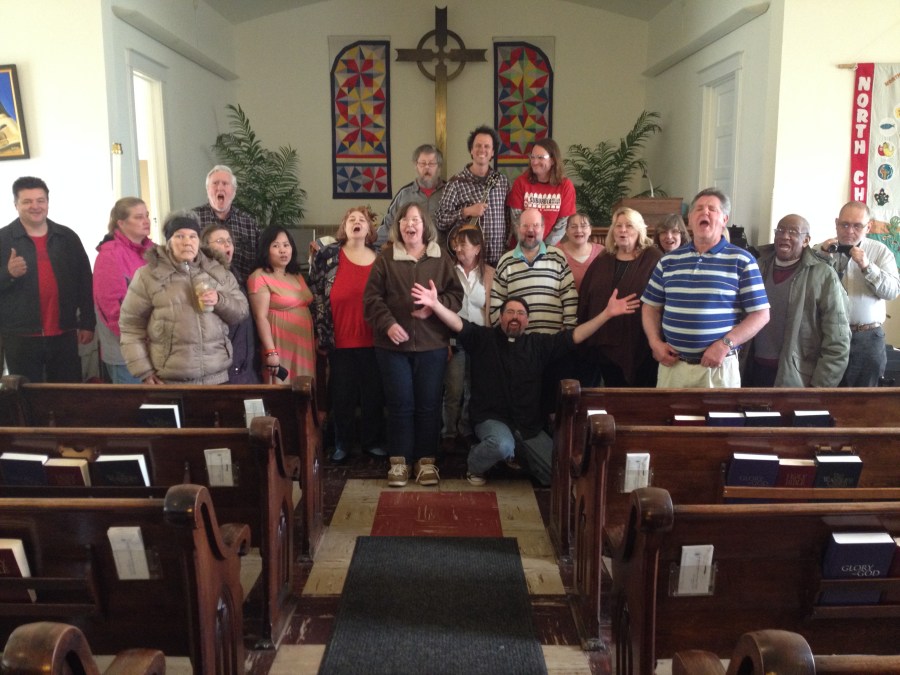
God wants spiritual fruits, not religious nuts

Today’s sermon from North Presbyterian Church.

The text is Luke 3:7-18.

Jesus is coming!

That’s what Christians believe. We say it a lot, especially in this season of Advent. The phrase has a dual-meaning for us. First of all, we use it as we prepare our hearts and minds for the upcoming celebration of Christmas. We remind ourselves annually that, in the mystery of the Incarnation, God crossed the divide between heaven and earth to meet us here, where we live. We couldn’t get ourselves to heaven, so heaven came to us.

But there is a second layer to our celebration of Advent. We’re not just looking back to remember when Jesus came to earth the first time; we’re also looking forward to his Second Coming and preparing ourselves for it. Christians believe that God’s story is not yet over. We believe that history is not a random series of events, but the gradual unfolding of God’s plan for the world over time. History is going somewhere, and we believe the day will come when the divine plan is accomplished and all that is wrong will be set right in the world. Until then, we are invited to play a small part in that unfolding story as Christ’s church on earth.

We remind ourselves that Jesus is coming so that we don’t forget or lose heart in the struggle to establish God’s kingdom on earth as it is in heaven. The drudgery of everyday life, combined with the tyranny of the urgent, can easily distract us from the primary purpose of our lives. The still-unfolding story of God’s creation and redemption of the universe in Christ is what gives our lives meaning. We say, “Jesus is coming” in order to remind ourselves of that. As we sing in the hymn For All the Saints: “And when the strife is fierce, the warfare long, steals on the ear the distant, far-off song and hearts are brave again and arms are strong. Alleluia! Alleluia!”

But we also sometimes use that phrase in ways that are less than helpful. For many Christians, “Jesus is coming” has become an escapist slogan. We sometimes use it as an excuse to not get involved in the very real problems of the world around us. We say, “Jesus is coming… so we don’t need to worry about preserving our natural resources, fighting poverty, or working for social justice.”

There is a popular idea that has taken hold in some Christian circles. It’s called the Rapture. Many claim that it is a biblically-based doctrine, even though it did not exist at all before the 1830s (when it was invented out of thin air by two preachers named John Darby and Charles Scofield). Those who hold to this idea believe that the world is soon headed for a seven year period of great suffering called the Tribulation. During this time, an evil world leader called the Antichrist will achieve global dominance through a reign of terror. At the end of these seven years, Jesus will return to judge the world and history will reach its conclusion. But before all this happens, according to Darby and Scofield, all true believers in Christ will be mysteriously “caught up in the air” (i.e. Raptured) and taken out of the world to be with Christ, so that they won’t have to endure such pain and suffering.

What it means then, for those who accept this idea, is this: So long as you are in God’s club, you don’t have to worry about all that difficult stuff in life. Our club membership grants us a “get out of jail free” card. By this, we know that we are in God’s good graces and can expect to be excused from the many trials and tribulations that afflict the world from time to time.

It is this same kind of attitude that St John the Baptist is addressing in today’s gospel reading. His prophetic ministry was taking off, John himself had become quite the popular preacher, and people were coming out in droves to hear the sermons and get their spiritual “membership card” stamped by participating in the ritual cleansing of baptism. But John very quickly realizes what’s going on and, in typical prophetic fashion, addresses the issue head-on.

“You children of snakes!” He says, “Who warned you to escape from the angry judgment that is coming soon? Produce fruit that shows you have changed your hearts and lives. And don’t even think about saying to yourselves, Abraham is our father. I tell you that God is able to raise up Abraham’s children from these stones.”

John is talking here about those who take pride in their cultural and religious heritage. They thought to themselves, “We’re members of God’s club! Our dues are paid and our card is stamped, therefore we shouldn’t have to worry about what comes next.”

In John’s place and time, it was Jewish ancestry that counted for membership in God’s club. Here and now, we have different criteria for membership, but the process is the same. We like to think of ourselves as “the good guys” by virtue of our ethnicity, nationality, or political affiliation.

We even do this when it comes to the way we practice our religion. We rely on church affiliation, regular attendance, or the size of our offering check as indicators of our membership in “God’s club.” If John the Baptist were with us today, he might say something like: “Don’t even think about saying to yourselves, we are Presbyterians. I tell you that God is able to raise up Presbyterians from these stones.”

What John is trying to do here, both in his day and ours, is draw our attention to what it is that spirituality is all about. He’s trying to help us distinguish between the grain of wheat, which is the kernel of our faith, and the husk that surrounds it.

John says, “I baptize you with water, but the one who is more powerful than me is coming. I’m not worthy to loosen the strap of his sandals. He will baptize you with the Holy Spirit and fire. The shovel he uses to sift the wheat from the husks is in his hands. He will clean out his threshing area and bring the wheat into his barn. But he will burn the husks with a fire that can’t be put out.”

Wheat, just like ears of corn, grows inside of a husk that carries and protects it. The husk is part of the wheat, the wheat wouldn’t survive without it, but there comes a time when the husk must be discarded in order for the wheat to fulfill its destiny and become what it was meant to be.

In the same way, the elements of our religion (e.g. churches, denominations, buildings, rituals, the Bible, and the Sacraments) are like husks of wheat. They are necessary to protect the seed, which is our faith, but they are only a means to an end. God, according to John the Baptist, is not interested in our husks, but in the fruit that grows from the seed inside the husk. He says to the people in the crowd, “Produce fruit that shows you have changed your hearts and lives.”

A changed life is the fruit that grows from the seed of faith. The evidence of authentic faith is not religious observance, church attendance, tithe checks, or Christian bumper stickers. The evidence of faith is when your neighbors in the world look at you and say, “There’s something different about you.” St Paul called this “the fruit of the Spirit” in his letter to the Galatians. He described this “fruit” as “love, joy, peace, patience, kindness, goodness, faithfulness, gentleness, and self-control.”

When the husk of our religion has done its job well, the seed of faith will grow up to produce this kind of fruit in our lives. When we see that fruit, in our lives or in anyone else’s, we can trust that it comes from an authentic faith (no matter what its previous husk may have looked like).

The really interesting thing about fruit is that each kind is unique to the tree that produced it. Oranges don’t grow on apple trees or grapevines. Fruit grows naturally out of each tree’s unique identity. In the same way, the fruit of the Spirit growing in your life will inevitably look different from the fruit of the Spirit growing in the life of your neighbor. I think this is why John the Baptist, in today’s reading, gave different instructions to different groups of people.

The crowds asked [John], “What then should we do?”

He answered, “Whoever has two shirts must share with the one who has none, and whoever has food must do the same.”

Even tax collectors came to be baptized. They said to him, “Teacher, what should we do?”

He replied, “Collect no more than you are authorized to collect.”

Soldiers asked, “What about us? What should we do?”

He answered, “Don’t cheat or harass anyone, and be satisfied with your pay.”

The fruit for which John was calling is diverse. It comes in all shapes, sizes, and colors. I think that’s why Paul kept his description of this fruit very broad and general. God wants us to have the freedom to explore the unique ways that the fruit of the Spirit might take form in our lives.

When it comes to the way we talk about religion today, I think we spend way too much time arguing over the husks (the religious externals), instead of nurturing the growth of spiritual fruit (the seed of faith). I saw a bumper sticker once that said, “God wants spiritual fruits, not religious nuts.”

I think our friend St John the Baptist would agree with that. In this Advent season, as we await the coming of Jesus, may we become the kind of Christians who know how to discard the husk of religion when it is time, and nurture the growth of the Spirit’s fruit in our lives and in our world.

The Unanxious Fig

The text for this week’s sermon is Luke 21:25-36

Do you ever feel anxious about the future?

That’s a silly question, I know. Everybody does.

What do you tend to get anxious about?

For some people, it’s the state of the country or the world-at-large. They wonder, “Where are we going and why are we in this handbasket?” For others, it’s particular circumstances that may or may not be arising in their future. Younger folks tend to ask questions like, “Will I get the job I want? Will I find true love? Will I have kids?” People at the middle of life’s journey ask, “Will I keep this job? Will my kids turn out okay? Will my marriage last?” Sometimes, they even have to jump back to the first set of questions as life, jobs, and relationships don’t turn out exactly as expected. Finally, people in the latter part of life’s journey ask, “What will happen to my spouse/kids/home after I’m gone? Will there be anyone left to care about the things I care about?”

I’m currently at the stage where I worry most about all the many things that need to get done at work or at home. It seems sometimes like there aren’t enough hours in the day for me to keep on top of every task that needs to be completed.

Whatever the object of our anxiety, the process remains the same. Furthermore, there will never come a time when all of our excessive worrying turns out to be the key that unlocks the solution to all of life’s problem. There will never be a day when the headlines on our newspapers read, “Local hero cures anxiety by thinking about it real hard.”

Thankfully for us, the problem of anxiety is nothing new for the human race. Ancient writings reveal that the battle with fear has been waged for thousands, if not millions, of years. In this morning’s gospel reading, Jesus describes a time when “dismay,” “confusion,” and chaos come upon the earth. He says that people will “faint from fear and foreboding of what is coming upon the world.” I don’t know about you, but that sounds like every age of human history to me.

It should be no surprise that doomsday prophets keep popping up in the media, year after year. Because every period of history has felt like the “end times” to those who lived in it.

In response to this “fear and foreboding of what is coming upon the world,” Jesus does something very interesting. If you remember, he has just described the shaking of entire planets and “the roaring of the sea and surging waves.” So, what symbol then does he use to conjure up hope in the midst of chaos and anxiety?

Jesus says, “Look at the fig tree and all the trees. When they sprout leaves, you can see for yourselves and know that summer is near.”

He goes back to one of those small, simple images from nature. This seems to be a favorite teaching strategy of Jesus. He draws his teaching illustrations, not from huge, dramatic happenings, but from the little things of this world. When people asked him to describe the kingdom of heaven, he pointed to flowers and birds, farmers planting crops and workers harvesting them, bakers kneading bread dough and merchants trading in the marketplace. When Jesus points out the fig tree in today’s reading, he’s giving people the smallest glimmer of hope in the midst of big anxiety. I can imagine scared people shouting back at Jesus, “Hey man, what gives? The whole world is coming apart and you want us to look at some little tree?! That’s ridiculous! You’ve got to give us a better sign of hope than that.”

The images Jesus uses are all very ordinary images from everyday life. There’s nothing particularly dramatic or profound about them, yet these little things, according to Jesus, are the things that reflect the glory of God’s kingdom on earth.

Jesus says, “Look at the fig tree and all the trees. When they sprout leaves, you can see for yourselves and know that summer is near. In the same way, when you see these things happening, you know that God’s kingdom is near.”

Jesus points out the sprouting of the fig leaves, not because they are a powerful sign of hope in themselves, but because they indicate a deeper, natural rhythm that pulses at the heart of the universe, like a heartbeat. This rhythm was put there by God. We can even see it with our own eyes if we stop to look… really look.

Day and night, summer and winter, new moon and full moon, childhood and old age, work and rest, breathe in and breathe out. These signs of hope are there. They tells us, in their own quiet way, that this universe is not just some random explosion of chaos into which we humans have accidentally stumbled for a few odd years of existence. The pulse of nature whispers to us that there is a divine plan unfolding within us and around us. The psalmist tells us, in Psalm 19:

Heaven is declaring God’s glory; the sky is proclaiming his handiwork. One day gushes the news to the next, and one night informs another what needs to be known. Of course, there’s no speech, no words—their voices can’t be heard—but their sound extends throughout the world; their words reach the ends of the earth.

Both Jesus and the psalmist are urging us to listen for nature’s silent voice. We can’t hear it with our ears, so we have to listen with our hearts. Unlike some other religious traditions, Christians don’t believe that nature itself is God, but we do believe that the created universe has the capacity to reveal something of God to us, provided that we have the ears to hear.

If we do listen to nature’s message, Jesus promises, we will “know that God’s kingdom is near.” Now, here’s something we’ve done together before. I’m returning to it again (and will continue to do so in the future) as a helpful reminder. The old King James Version of the Bible translates “God’s kingdom is near” as “the kingdom of God is nigh at hand.”

Hold out your hand in front of you. Think about that phrase, “the kingdom of God is nigh at hand.” Heaven is not far away. God is not far away. The place where God lives and reigns is “at hand.” God really is this close to us, “closer to us than our own hearts,” as St. Augustine would say.

Our lives in this universe are not some random accident, they are part of the divine purpose that is unfolding from the heart of all things. Jesus said, “Heaven and earth will pass away, but my words will certainly not pass away.” In other words, the individual, little parts of this universe (i“heaven and earth”) are certainly finite and temporary (“will pass away”), but God’s plan: the purposeful, underlying rhythm of the cosmos (Jesus called it “my words”), is eternal (“will not pass away”).

The image of the fig tree is meant to remind us of God’s plan, so that we might draw hope from it.

This hope we discover when we listen to creation’s heartbeat, according to Jesus, is not simply for our comfort; it asks something of us as well. In response to the nearness of God’s kingdom (manifested in the sprouting fig tree), Jesus gives us a Don’t and a Do.

The Don’t is this: “Take care that your hearts aren’t dulled by drinking parties, drunkenness, and the anxieties of day-to-day life.”

Now, we could easily take this command of Jesus as a simple condemnation of all alcohol (many Christians have done so), but I think that narrow interpretation misses the point that Jesus is trying to make. Jesus is not trying to say that alcohol itself is evil. It’s simply another substance on this earth. What concerns Jesus is our relationship with all the substances of this earth. Jesus is warning us against our very human tendency to want to numb ourselves against all the painful things that can happen in life. And we don’t just do this with alcohol either: we numb ourselves with drinks, food, sex, entertainment, work, even religion. None of these things are bad in themselves, but all of them can act like a drug to keep us from experiencing the true depths of life.

The problem is this: the anesthesia we use to numb ourselves from the pain of life also numbs us against the experience of deep joy and hope. If we refuse to feel the bad, we will not be able to feel the good either. Jesus said in John 10:10, “I came so that [you] could have life—indeed, so that [you] could live life to the fullest.” Staggering through existence in a numbed state until we die is less than the kind of full, rich life that Jesus intends for us.

The Do Jesus gives us is this: “Now when these things begin to happen, stand up straight and raise your heads, because your redemption is near.”

Jesus tells us, his followers, to “stand up straight” when the rest of the world is “faint[ing] from fear and foreboding of what is coming upon the world.” When we see the disturbing reports on the news, when we hear the end-time fanatics prophesying doom and gloom, the believer’s job is to remain still and calm, like the eye of a hurricane. The storm may rage around us, but we remain at peace in the center. We may not be able to do anything to change our circumstances, but we can remind ourselves that there is a divine purpose at work in the unfolding of this universe. Our spiritual disciplines, such as prayer and meditation, help us to stay in touch with that calm center.

When the rest of the world sees this difference in us, it will wonder why we do not fear what it fears. The people around us will ask, “Why aren’t you panicking with us? Don’t you realize the world is coming to an end?” And we can answer in the words of the old hymn:

My hope is built on nothing less than Jesus’ blood and righteousness;
I dare not trust the sweetest frame, but wholly lean on Jesus’ name…

When darkness veils his lovely face, I rest on his unchanging grace;
in every high and stormy gale, my anchor holds within the veil.

On Christ, the solid rock, I stand; all other ground is sinking sand,
all other ground is sinking sand.

Not Even One Stone

I delivered this sermon this morning just after announcing to the congregation our session’s decision to leave our building and move our church’s ministry to a new physical location after almost a century at the corner of Burdick & Ransom. I don’t think it was a coincidence that today’s gospel reading in the lectionary is the story of Jesus predicting the destruction of the Jerusalem temple. Some weeks, the Holy Spirit makes more work for me…

The text is Mark 13:1-8.

If you knew that you only had a week, month, or year to live, how would you choose to spend that time? What do you want your life to stand for? When other people look back at your life, what would you want them to remember about you? These are the questions that a wise person asks in the face of mortality.

The truly wise among us realize that life cannot last forever, therefore the truly wise among us also realize that each life must be lived for something larger than itself. Every mortal life, it seems, is a means to an end.

Each of us has probably known, met, or heard about at least one person who made his or her mortal life meaningful by dedicating it to something larger than himself or herself. We tend to respect or admire such people when we meet them. Their examples might even inspire us to look more deeply at our own lives, face our mortality in new ways, and discover meaningful possibilities within us that we hadn’t noticed before. It’s a beautiful thing when that happens.

As it is with individuals, so it is with groups of people. These groups might last much longer than we do, but they too will one day fade from existence. Families are mortal. Surnames and lineages come to an end through a lack of offspring. Churches and other faith communities are mortal. There comes a point when dwindling membership and a lack of funds causes an institution to close its doors. Nations are mortal. The Roman Empire was once the dominant superpower in the world, unlike anything else that had come before it. Where is the great Roman Empire today? Buried under the rubble of history and preserved in ruins frequented by tourists in Bermuda shorts. Finally, even the planets and stars are mortal. One day, our very own sun will burn up all of its hydrogen fuel and explode into a violent supernova, momentarily becoming the brightest star in some distant sky.

If coming to grips with our own individual mortality is difficult, accepting the mortality of families, churches, species, and stars feels almost impossible. Yet, the same truth applies to these larger mortal beings that first applied to mortal human beings: it is in facing mortality that we find meaning.

Let’s look at this idea in relation to this morning’s reading from Mark’s gospel. The story opens as Jesus and his disciples are leaving the great Jerusalem temple, the epicenter of Jewish worship in the first century CE. Jesus, as usual, is storming out in a huff after yet another fight with the established religious authorities.

It’s at this point that Jesus’ disciples, in their usual tactless and somewhat dimwitted manner, decide to stop and admire the lovely architecture of this religious icon and national monument of Judaism. They say of the temple, “Teacher, look! What awesome stones and buildings!”

Jesus is unimpressed. He says, “Do you see these enormous buildings? Not even one stone will be left upon another. All will be demolished.”

He’s talking about mortality of the temple: this central symbol of religious and national identity for the Jewish people. They were under the impression that this sacred building would stand forever under divine protection. For them, the temple was immortal. It was an end in itself as a center of worship. The idea had never occurred to them that it might not be there one day.

As it turns out, Jesus’ prediction was spot-on. The Jerusalem temple, like any human being, was mortal. It was eventually burned to the ground by the Romans during an uprising in the year 70 CE. It was never rebuilt. The site where it once stood is now occupied by the Dome of the Rock, one of the most sacred places in Islamic religion.

The destruction of the temple was unthinkable to the average Jew, but to Jesus it was inevitable. The wisdom of Jesus did not stop with an awareness of his own individual mortality, but extended to embrace the mortal and finite nature of all things. Just as it was for individuals, so it is for temples, religions, countries, species, planets, and stars: to face mortality is to find meaning.

If our great struggle in life is limited to ensuring the continued existence of particular people, places, institutions, or things, then we have already doomed ourselves to failure. Nothing lasts forever. We need to accept that. What Jesus said about the Jerusalem temple, we could say about anything: “Do you see these enormous buildings? Not even one stone will be left upon another. All will be demolished.” All things are mortal.

The sooner we realize this truth, the sooner we can get on with the business of asking the really important questions about existence in reality. Concerning our individual selves, we can ask: “What am I living for? What will people remember about me when I’m gone? What will be my lasting contribution to the world around me or the universe as a whole? What is the meaning of my life?”

The day will come when we, along with our families, our church, and our country, will only exist as a chapter in a history book. Accepting the inevitability of this fact, we need to ask ourselves: “When that day comes, what will we want that chapter say?”

As a congregation, we’ve been asking ourselves some very hard questions this year. We’ve been participating together in the New Beginnings assessment and discernment process. Throughout this process, the biggest and most pressing question we’ve had to ask ourselves is: “What is the church?”

Is the church a building? Is it an institution?

Or is it a community of people on a mission? A community of people, called together by Jesus Christ, living together in Christ, and following Christ into the world to live that mission?

Our final answer has been that third option: the church is a community of people on a mission.

Because we believe this, we have been able to make a bold new decision this week. We have decided to leave the building where we have worshiped for almost a century in order to continue the ministry of our church in a new location. The session, the presbytery, and I are currently working together on the details, and we will call a congregational meeting in a few weeks to let you know what the plan is.

This new move is not a death, but a resurrection.

We are not doing this because the church is dying; we are doing this because Jesus is alive.

We are honoring the heritage of the ministry that has been passed down to us, not by preserving it, but by continuing it.

We are doing this because:

The Spirit of the Lord is upon [us],
because the Lord has anointed [us].
He has sent [us] to preach good news to the poor,
to proclaim release to the prisoners
and recovery of sight to the blind,
to liberate the oppressed,
and to proclaim the year of the Lord’s favor.”

We are doing this because Jesus said:

“I’ve received all authority in heaven and on earth. Therefore, go and make disciples of all nations, baptizing them in the name of the Father and of the Son and of the Holy Spirit, teaching them to obey everything that I’ve commanded you. Look, I myself will be with you every day until the end of this present age.”

Our ancestors in the faith (and in this church) believed this, I believe it, and the session believes it. Brothers and sisters, do you believe it?

Let’s go follow Jesus.

Turning the World Upside Down

In lieu of my own sermon, which I am accustomed to posting here on Sundays, I would like to offer instead this mighty moment that took place at the National Cathedral in Washington, DC today.

The event is the installation of Bishop Michael Curry as the 27th Presiding Bishop of The Episcopal Church. I got to experience it as it was broadcast over the livestream this afternoon. Bishop Michael had me cheering, shouting, and clapping, even though I was alone in my bedroom.

I love both traditional liturgy and progressive theology. There are some who say, “Those religious rituals are dry, joyless, and spiritually dead.” There are some who say, “Those liberals are biblically illiterate heretics who only preach about what they don’t believe and reduce Christian faith to political activism.” I have been told more than once that there is no way that Jesus Christ could be present by the power of the Holy Spirit in my church.

To those who would make the above accusations, I would invite them to take forty minutes or so to listen to Bishop Michael’s sermon. You may not agree with everything you hear, but I sincerely hope that you will see what I see here: Jesus Christ living and working through a progressive Christianity that is theologically grounded, biblically shaped, Spirit filled, and sold out in service to God and neighbor. Get ready, my friends, because it’s time for CHURCH!

Call Them Here

The text is Mark 10:46-52

I’ve recently been invited to help my friend, Minister Pamela Robinson of Emerging HOPE Ministries, with her doctoral dissertation. It’s been a privilege to assist with this project because the work she’s doing is so important. The research she is doing is about helping churches raise their awareness of people who live with mental illness or developmental disabilities. Her very helpful term for these conditions is “invisible disabilities”. She calls these disabilities “invisible” because their presence in people is less obvious than a visual or mobility impairment.

There is a stigma around cognitive disabilities in this culture because, in the eyes of many people, mental illness doesn’t count as a “real” disease, like cancer or the flu. Many of us who live with mental illness are often told to “just snap out of it” or “have faith” (as if depression or anxiety could be controlled by flipping a switch). Believe me: if any of us could choose to stop having these symptoms, WE WOULD.

Under the weight of this social stigma, we who live with mental illness often become “invisible people” who suffer silently and alone from the effects of our conditions. We are treated as failures, ne’er-do-wells, and misfits in a society that measures the “worth” of a person based on his or her ability to produce and consume in a capitalist economy.

In this morning’s gospel, we encounter the story of a person, Bartimaeus, who was similarly “invisible” to the people of his own place and time.

There are several things it is important to note about Bartimaeus as a person. First of all, his name. In Aramaic, it literally means “son of Timaeus”, which is to say that he really doesn’t have a name or unique identity of his own. He is only identified in relation to other people. As a physically disabled (“blind”) non-worker in the economy (“beggar”), Bartimaeus doesn’t count as a “real person” in the eyes of his neighbors, so he has been pushed to the margins of society (“by the roadside”), where his presence and voice can be conveniently ignored (“Many sternly ordered him to be quiet”).

Yet, there is more to Bartimaeus than meets the eye on the surface. He might be visually impaired, but we the readers quickly learn that his spiritual insight goes deeper than that of his neighbors. He sees Jesus more clearly than anyone. As Jesus draws near, Bartimaeus begins to make quite a fuss, calling out to Jesus as the “Son of David”.

“Son of David” is a messianic title, referring to King David’s heir, God’s anointed, and the rightful king of Israel. Many have speculated about Jesus’ identity up to this point in Mark’s gospel, St. Peter has even realized the truth in private, but this is the first time in Mark that anyone, anywhere publicly identifies Jesus as the Messiah.

What Bartimaeus says to his Messiah next is “have mercy on me!” This sounds to us like a plea for forgiveness, but is actually more like a welcoming affirmation. Caesar used to enter the city of Rome in triumphant procession with the citizenry crying “Lord, have mercy!” around him on every side. It’s kind of like an ancient version of “Hail to the Chief” or “God Save the Queen”. Bartimaeus has something unique to teach his people: he knows who Jesus really is, but they don’t want to hear it, so they yell at him to sit back down and be quiet.

Sadly, this story is way too familiar for many of our brothers and sisters who live with disabilities, visible or invisible, in the church. As human institutions, churches often act like the crowd around Bartimaeus: ignoring and objectifying disabled people, pushing them to the edges of church life and telling them not to make too much of a fuss, so that business-as-usual can continue uninterrupted on Sunday morning. What these churches don’t realize is that every person is made uniquely in the image of God, therefore each individual has something to teach the rest of us about God that cannot be learned from anyone else on earth. Those who lose the most when disabled people are ignored are not the disabled people themselves, but those who ignore them. So it was with the crowd around Bartimaeus, and so it is in too many churches today.

But the good news is that Jesus is not content to simply walk by while this happens. Jesus listens to the voice of the voiceless and ensures that the lessons they teach will not go unheard. Looking closely at his interaction with Bartimaeus, we can get an idea of how Christ is working with disabled members in the church today, through the power of the Holy Spirit.

To begin with, the first important thing that Jesus does is nothing. He simply stops. The text says he “stood still”. What this tells us is that Jesus is willing to be interrupted by this person. Sure, Jesus is busy. Sure, he has other important things to do (go to Jerusalem and save the world, for instance). But business-as-usual gets put on the back burner for Jesus when it comes to having a relational encounter with this person. Imagine the church doing that! Imagine what Christianity in this world would look like if the leaders of the church were willing to put aside their overcrowded schedules and interrupt business-as-usual in order to listen to the pained cries of needy people.

The second thing Jesus does is say, “Call him here.” He re-arranges his ministry so that the marginalized person sits at the center of the action and concern. And he doesn’t do it alone, either. Jesus could have easily called Bartimaeus over himself, but he enlists the help of the whole community, instead. So then, it is the crowd that changes its tune and says to Bartimaeus, “Take heart; get up, he is calling you.” Again, imagine the church doing this today: becoming a community that speaks forth Christ’s calling on the lives of the very people whom the world ignores!

The next thing Jesus does is give a voice back to the voiceless. Instead of presuming to know what is best for this other person, Jesus asks, “What do you want me to do for you?” This is a very important detail because Jesus is relating to Bartimaeus as a real person, not just as an object or problem to be dealt with. And when the miracle is said and done, Jesus even gives the credit back to Bartimaeus himself: “your faith has made you well.”

Imagine a church focusing its ministry like this: interrupting business-as-usual to forge real, authentic relationships with people whose voices have not yet been heard in the mainstream of society. Imagine the church becoming a community where people are treated like people. Imagine a church that re-orients its entire ministry to put marginalized people at the center of its life and action. Imagine a church that doesn’t just welcome people who live with mental illness, but empowers them to fulfill their calling in Christ. Can you imagine a church like that?

I can.

I can imagine that kind of church because that is exactly the kind of ministry that North Presbyterian Church has been doing for the last 27 years. This is who we are. This is what we do. This is the kind of community the Holy Spirit has made us into.

So many of us, myself included, have tried to make our spiritual home in churches where we are tolerated at best, or rejected at worst. But the Holy Spirit has called us together in this little community where we can be a light to the world.

And our ministry is not going unnoticed. What we do here has been written about in college and seminary textbooks. Letters of support have poured in from all over the country. Denominational officials are telling us how we have inspired a movement, how we have shaped the national church, how we are pioneering a new model of ministry from which all churches can learn.

North Church may be a little church, but we are “the biggest little church in Kalamazoo.” Our significance doesn’t come from a huge budget or fancy programs, but from the fact that we are doing the kind of ministry that Jesus demonstrated with Bartimaeus: centered on building relationships with marginalized people who live with mental illness.

The power of the special work we do is rooted in the power of the gospel itself and grows out from it to form a community where all people can find a home.

The power of this church comes from that core truth we tell each other week after week:

“I love you. God loves you. And there’s nothing you can do about it!”

Be blessed and be a blessing.

What Do You Say to the Person who has Lost Everything?

This week’s sermon.

The text is Job 38:1-7, 34-41.

Last week, we asked the question: “What do you get for the person who has everything?” And the answer we came up with, following the gospel story of Jesus and the rich man, is “Nothing.”

This week, we’re going to flip that question around 180 degrees and ask, “What do you say to the person who has lost everything?”

That’s the question that hits us as we read the story of Job, as we have been doing in our readings from the Hebrew Scriptures these past few weeks. The book of Job contains the most well-known story of suffering in all of human history. This story has been read the world over by people in different countries, languages, and religious traditions.

The story follows this guy Job, a decent person who stands by helplessly as everything he loves is suddenly taken away from him. In the end, he is left sitting by himself on a garbage heap, wondering what the heck just happened. Eventually, his friends come along and try to comfort him with sage advice and religious platitudes like, “Don’t worry, God has a plan” and “Everything happens for a reason.” But these bumper-sticker slogans do nothing to comfort Job in the midst of his pain. In fact, Job’s friends end up making the situation worse as they proceed to blame the victim for his own suffering. Following the line of conventional wisdom that one finds in the book of Proverbs, they theorize that God must be punishing Job for some secret sin, and if Job would simply search his heart and confess whatever he had done wrong, the affliction would leave him and all would be well again.

But Job isn’t buying what these so-called “defenders of the faith” are selling. Their sloganeering has less to do with comforting the suffering person and more to do with comforting themselves. They think that if they can identify some specific reason why all this suffering was visited upon Job, then they can prevent something similar from happening to them. So they recite these pointless platitudes that seem reasonable to them, but do nothing to alleviate Job’s pain.

Sadly, I’ve noticed this same tendency in a lot of religious people over the years. When unthinkable tragedy strikes, people of faith are often the first to offer some kind of explanation or solution, no matter how badly conceived, whether it was asked for or not. They say things like, “God has a plan… Everything happens for a reason… God took your baby because he needed another angel in heaven… There’s a lesson in this for you, if you would just learn it… You just need to have more faith… God never gives you more than you can handle…” Just like Job’s friends, I think those who say these things are more interested in comforting themselves than comforting the one who is suffering. People who are going through incredible pain don’t need bumper stickers or Bible verses, they need friends who will stay with them through the pain, listen to their struggles, and not try to “fix” them.

Like Job, most people who suffer know instinctively how unhelpful these pat answers are. They might listen politely, but on the inside they usually walk away feeling more alone and hopeless than ever. Job, however, was not so polite in his response to his friends. He was brutal in his honesty. He defended his own integrity, shook his fist at the sky, and straight-up accused God of being unfair.

At the beginning of his story, Job’s remarks still sound conventionally religious: “Naked I came from my mother’s womb, and naked shall I return there; the Lord gave, and the Lord has taken away; blessed be the name of the Lord.” (1:21) A little while later, Job’s anger begins to show as he curses the day he was born (3:1). He is harsh toward his friends and their unhelpful advice, calling them “miserable comforters” and wondering why they keep talking at all.

Eventually, Job lets loose his anger toward God directly. He says that God has wronged him (19:6), denied him justice (27:1), and demands a response from God (31:35). There is nothing in Job’s tirade that sounds like traditional piety or stoic resilience in the face of suffering. He says that God owes him an answer; he dares God to come down from heaven and face him like a man, and that’s exactly what happens.

Today’s reading from the book of Job outlines the beginning of God’s response to Job’s demand. Job finally gets the face-to-face encounter he’s been shouting for, but it doesn’t exactly turn out like Job had expected.

To begin with, God doesn’t offer Job any answers, only questions: sixty of them, to be exact. The first question sets the stage for the rest: “Who is this that darkens counsel by words without knowledge?” And it only gets more intense from there: “Where were you when I laid the foundation of the earth? …On what were its bases sunk, or who laid its cornerstone when the morning stars sang together and all the heavenly beings shouted for joy? …Who has put wisdom in the inward parts, or given understanding to the mind?” This is just a small sample of the questions God asks Job in response to Job’s demand for an answer.

Job finally gets his face-to-face encounter with God, but none of the answers he was looking for. The voice from the whirlwind overwhelms Job with a barrage of questions about the mystery and the grandeur of the universe. Job is left standing in awe. His only response, at the end of the interrogation, is a stunned silence. In chapters 40 and 42, he calls himself “small” and says, “I lay my hand on my mouth… I have uttered what I did not understand, things too wonderful for me, which I did not know.”

Job’s experience of God’s presence is hardly sweet, comforting, or peaceful, but it was exactly what he needed. The attempt of Job’s friends to present a tame, orderly, and comprehensible God left Job feeling empty and dissatisfied, but the blunt force of awestruck mystery was enough to shake him out of his pain-induced stupor. Job never got his answer, but he got what he needed: a direct experience of God’s presence. Job says, “I had heard of you by the hearing of the ear, but now my eye sees you”. Somehow, that was enough for Job, even when there were no answers or solutions to be found.

So, this leads us back to our initial question.

Last week, we asked, “What do you get for the person who has everything?” And the answer we came up with was, “Nothing.”

This week, we are asking, “What do you say to the person who has lost everything?” And the answer is the same: “Nothing.”

This is an important lesson for us to learn in today’s Church, where too many Christians are prone to lean back on empty platitudes instead of trying to be really present with those who suffer. It’s not our job to offer easy answers to tough questions or come up with quick fixes to big problems. Our job is to be with each other when we suffer, to listen, to empathize, to ask questions. Somehow, this means more to people than all the answers and solutions in the world. Our friends in pain may never remember what we say, but they will remember that we were there with them when times were tough. This is the Church at its best.

What’s even cooler is that, in the midst of our care for each other, we begin to sense another, mysterious presence in our midst. Our love for each other points the way to a bigger love, the Biggest Love, that holds the universe together in arms that will not let us go.

I think about this mystery each Sunday as we celebrate the Eucharist. As a pastor, people often come to me with problems we don’t know how to solve and painful questions I don’t know how to answer. It gets overwhelming sometimes. I am keenly aware that many of you may be going through something horrible this morning, and there is nothing I can say from this pulpit that will make you feel any better. Clergy are neither psychologists, nor social workers, nor business managers, nor politicians. I don’t actually know how to fix the problems in your life, the church, or the world, but what I can do is invite you down to the front of this church each Sunday, hand you a piece of bread, and say, “The Body of Christ, given for you.”

What I can offer you is Christ, sacramentally present with us in bread and wine. As we share the Body of Christ, we become the Body of Christ (you are what you eat). We become part of each other through Christ, and Christ’s presence becomes apparent among us through each other. This presence, more than anything else, is the most healing thing we can offer to each other in moments of pain.

Let us be present with each other then, no matter what we are going through, in order that we may be attentive also to the healing, sacramental presence of Christ in our midst.

What Do You Get For Someone Who Has Everything?

This week’s sermon.

The text is Mark 10:17-31.

What kind of gift do you get for the person who has everything?

I did some Google research on that very question this week, and here are a few of the ideas I came across:

  • A wine rack made out of snow skis.
  • A corkscrew that looks like a fish.
  • Cufflinks that look like glasses.
  • A beer holder for your bike.
  • A snowball slingshot.
  • A pillow that functions as a working remote control.
  • A robotic exoskeleton.
  • A hovercraft.
  • Contact lenses that project TV directly onto your eyeballs.
  • A belly button brush (I don’t want to know).
  • Anonymous business cards you can leave on people’s windshields to complain about their parking.

You and I live in a highly consumeristic society. We want everything to be “Bigger! Better! Faster! More!” We are constantly inundated with messages trying to sell us stuff. One study declared that the average American is exposed to 247 advertisements a day. We are told that our spouses will love us more if we buy them diamonds; we will become better basketball players with the right kind of shoes; we will appear sophisticated if we drive the right kind of car; and (my personal favorite) we will become “the most interesting man in the world” if we drink the right kind of beer. We are locked into the ridiculous habit of “spending money we don’t have to buy things we don’t need to impress people we don’t like.”

It’s a ridiculous cycle that all of us are caught up in. We need to be reminded of its ridiculousness from time to time, for the sole reason that no one has ever seen a hearse pulling a U-Haul. You can’t take it with you. There has to be more to the meaning of life than the acquisition of “stuff.”

Unfortunately, we’ve been so shaped by our consumer society that we’ve forgotten how to think outside the box of “getting more stuff.” We’ve even applied the principle to our religious life.

We’ve been trained to think that spirituality, salvation, or enlightenment are all about gaining something for ourselves: knowledge, wisdom, inner peace, mystical experiences, etc. And we think we can earn the rights to this consumer product through religious observance, correct theology, or moral fortitude.

We have been trained to interact with God in the same way that we might interact with a clerk at 7-11: approach the counter, exchange payment, receive desired product. The problem with this is that the kind of relationship that God wants to have with us goes far deeper than the kind of momentary interaction we have with clerks at the store, where neither party is likely to remember the other person’s name by the end of the day. God wants more than that (from us and for us). But in order to get us into that kind of relationship, God has to shake us out of our consumer-capitalist mindset.

That is exactly what Jesus is trying to do with the rich man in today’s gospel.

The story begins with the rich man approaching Jesus with a question: “Good teacher, what must I do to inherit eternal life?”

And that’s our first indicator, right there: the little word do. He assumes that there is an exchange that needs to take place. He intends to do something for God, and then receive something else (i.e. eternal life) from God in return for his payment of doing. We soon learn that this particular person is already quite wealthy (he is “the man who has everything”), and as such has learned to interpret his entire life in terms of economic exchange (even his relationship with God). He is approaching God with a proposal for a business transaction and nothing more.

But Jesus responds, not by imparting some new knowledge to this man, but by appealing to what he already knows: “You know the commandments,” he says, and then proceeds to recite several of the Big Ten from the book of Exodus.

The rich man is clearly unimpressed. “Yeah, yeah,” he says, “I know all that stuff already. I’ve been doing it since I was a kid. But else needs to happen? I feel like there’s something more to life, something I’m missing, so I want to make a deal with you, Jesus, and obtain whatever it is that I am lacking.”

So there it is. Jesus is now faced with the question: What do you get for the man who has everything?

And this is Jesus’ answer: Nothing. Jesus gives him Nothing.

It’s not that Jesus doesn’t give him anything; it’s that Jesus gives this man the gift of Nothing.

Jesus says to the man, “You lack one thing; go, sell what you own, and give the money to the poor, and you will have treasure in heaven; then come, follow me.”

In other words, he says, “Take all your possessions and the mindset that comes with them, take all your merit badges and accomplishments, take your experiences, take your trophies and diplomas down from the wall, take your preconceived notions about God, take your politics, your religion, your economics, take it all, and let it all go.” And he says that same thing to us today.

The best those things can do is feed our ego, which is a false conception of who we are. Our true self, the deepest part of us that is made “in the image and likeness of God” lies far deeper than those things. And we can only discover that true self by letting go of these other things in our lives that tempt us to identify with them.

Many of us, including the rich man in this story, are too frightened to embark on this journey of discovery. We are afraid that, if we let go of all these other identifiers, we might discover that there is no true self underneath the piles of “stuff” we have accumulated over the course of a lifetime. We think those “things” are us. We say, “I am the person who does this; I am the person who owns that; I am the person who is this.” We hold onto these false idols and identify with them because we are scared that, deep down, there is no Great “I Am” holding it all together. So we think it’s up to us. And too many of us go to our graves, kicking and screaming, and defending our little patch of earth until our hearts stop beating.

But here’s the thing: We’re wrong about all that. In spite of our deepest fears, there is a Great I Am who is deeper still (“Closer to us than our own hearts,” as St. Augustine says).

The rich man in today’s gospel, for whatever reason, was unable to let go and join Jesus on this journey of discovery. He wasn’t able to accept the gift of Nothing from Jesus. He walked away sad, still identifying himself with the “stuff” that he thought was his. But there have been others along the way who have accepted Jesus’ gift of Nothing.

Most notably, there is St. Paul the Apostle, who wrote much of the New Testament. He, like the rich man, had amassed a great treasury of accomplishments in the name of patriotism and religion. He lists them in his letter to the Philippians:

“If anyone else has reason to be confident in the flesh, I have more: circumcised on the eighth day, a member of the people of Israel, of the tribe of Benjamin, a Hebrew born of Hebrews; as to the law, a Pharisee; as to zeal, a persecutor of the church; as to righteousness under the law, blameless.”

These are things that Paul used to identify himself and uphold his little false ego-self. But then something happened to him: he had a blinding encounter with the risen Jesus on the road to Damascus. And this was the result, after his conversion:

“Yet whatever gains I had, these I have come to regard as loss because of Christ. More than that, I regard everything as loss because of the surpassing value of knowing Christ Jesus my Lord. For his sake I have suffered the loss of all things, and I regard them as rubbish, in order that I may gain Christ and be found in him”

St. Paul received Jesus’ gift of Nothing and was transformed by it. He discovered the truth: that there is a Great I Am at the heart of all things. The true self that Paul discovered was not another ego like the one he had constructed, but the Spirit of Christ himself. He writes in his letter to the Galatians: “I have been crucified with Christ; and it is no longer I who live, but it is Christ who lives in me.”

This is the goal of all Christian spirituality: not a list of religious accomplishments, but a letting go of all these things so that we can receive Jesus’ gift of Nothing and so discover our true identity in Christ.

One of my favorite authors, Fr. Richard Rohr, calls this “the Spirituality of Subtraction.” It’s not about gaining more experiences or accomplishments. It’s about letting go of those objects, experiences, and accomplishments we think we own.

What does this look like when we live it out? How do we measure Nothing? How do we chart our success in the art of letting go?

The only answer I can even begin to imagine for that question is this:

We achieve success by accepting failure. That’s the only way to make spiritual progress in the Christian life. We learn to accept ourselves (maybe even love ourselves) with all of our faults and limitations. When we fail or fall, we laugh at ourselves, rather than beat ourselves up.

The theologian Paul Tillich said it like this:

“You are accepted. You are accepted, accepted by that which is greater than you, and the name of which you do not know. Do not ask for the name now; perhaps you will find it later. Do not try to do anything now; perhaps later you will do much. Do not seek for anything; do not perform anything; do not intend anything. Simply accept the fact that you are accepted!”

This is what we call “grace.” This is what it means to receive Jesus’ gift of Nothing. And when we can do this (i.e. achieve success by accepting failure), a most amazing thing happens: our acceptance of ourselves and our failures starts to spill over toward acceptance of other people and their failures. Grace is contagious.

And here’s the really neat thing: in the end, it changes the way we understand God. As we open our hearts to grace, we gradually stop imagining God as the angry judge in the sky who makes impossible demands on us for the sake of religious observance, moral fortitude, or theological accuracy. We begin to see God as Jesus saw God: the Giver of Grace, the Giver of Nothing, the Great I Am beneath and beyond our false little ego.

And with that in mind, we can step back out into this world with full assurance of that which we affirm every Sunday:

That God loves us and there’s nothing we can do about it.

And There Is More…

This week’s sermon.

The text is Mark 8:27-38.

“Have you been SAAAVED?”

People ask me that sometimes.

I say Yes, I’m a Christian. I’ve been baptized, confirmed, and ordained. I serve as a pastor in the Presbyterian Church.

And they ask me again, “But are you SAAAVED?!” They want to know whether I can identify a particular moment in time when I made a decision to “give my heart to Jesus.” Depending on the theological orientation of the person asking the question, they might also want to know if that decision was accompanied by baptism by immersion, falling down under the power of the Holy Spirit, or ecstatic speaking in tongues.

Now, don’t get me wrong: I’m not trying to disparage or discredit any of these phenomena; many faithful Christians (including not a few Presbyterians) have experienced changed lives as a result of them. My only problem is when people treat these blessings from God as criteria by which one person can judge whether or not another person counts as “a real Christian.”

People who speak of being “saved” in this way typically think of salvation as a one-time event, but I think this conception falls short of what we find in the pages of the Bible. What I take away from my reading of the Scriptures is that salvation is not a one-time event, initiated by the Christian through an act of faith, but an ongoing process, initiated by Christ through an act of grace.

My favorite response to that question (“When were you saved?”) comes from the prominent 20th century Swiss Reformed theologian, Karl Barth. Someone asked him, “Dr. Barth, when was the exact moment when you were saved?”

Karl Barth responded, “I was saved at 3 o’clock on a Friday afternoon, on a hill outside the city of Jerusalem, in the year 33 A.D.”

When people ask me whether I’ve been saved, I want to say, “Yes, I’ve been saved, I am being saved, and I will be saved, thank God, not by virtue of my own merits or pious experiences, but by the limitless grace of God that has been made known to me in Christ Jesus and never stops working in me to finish the good work that was begun at the creation of the universe.”

So, are we saved? Yup.

Salvation is a process: an ongoing process whereby we are continually growing in our knowledge and love of God, our neighbors, and ourselves. There is not a soul on this earth right now who can rightfully claim to possess the fullness of salvation. There is no one who has achieved (or received) perfect knowledge and love of God. No matter how good or wise we are, there is always room for us to grow. With God, there is always More.

Jesus talks about that very thing in today’s gospel reading. He asks his disciples, “Who do people say that I am?” And he gets the answers then being generated via speculation in the rumor mill. Unsurprisingly, these ideas conform to the religious concepts and categories of their time. “Jesus is a prophet,” they say, “like Elijah or John the Baptist; he is a messenger, sent by God, to tell the people of Israel something important.” And to this, Jesus says in effect, “Yes. You’re right. I am a prophet, I do speak truth to power, I am here to set God’s people back on the right track… but there’s more.”

So, he asks his disciples, “But who do you say that I am?” And Peter takes it to the next level, he says, “Okay Jesus, I get what you’re doing here. You’re a prophet, but not just a prophet; you’re more than that. I say you’re the Messiah: God’s anointed leader who will march into Jerusalem by the power of the sword, kick out those pesky Romans, and usher in a new Golden Age of purity and prosperity.” As Peter speaks, I imagine the Battle Hymn of the Republic playing in the background:

“Mine eyes have seen the glory of the coming of the Lord;
he is trampling out the vintage where the grapes of wrath are stored;
he hath loosed the fateful lightning of his terrible swift sword;
his truth is marching on. Glory! Glory, hallelujah!”

This is Peter’s idea of what it means to be the Messiah. This is his answer when Jesus asks him, “Who do you say that I am?” And Jesus says again, “You’re right: I am the Messiah… but there’s more.” I am marching to Jerusalem, not to conquer and kill, but to be killed. And our people will not receive me, but reject me. Peter’s definition of Messiah is entirely inadequate. There is more to Jesus than that…

And Peter, bless his heart, does exactly what any of the rest of us would do in his situation. Does he sit back and rethink his previously held assumptions? Does he thank Jesus for this valuable perspective and insight? No, he gets angry and rebukes Jesus for challenging his preconceived notions.

Don’t we all do the same thing? We don’t like it when people challenge our assumptions about the world. Jesus is like that neighbor kid who comes over to play and breaks all our favorite toys. That’s just who Jesus is. No wonder nobody likes him. No wonder the people rejected him and had him killed. No wonder his closest disciples betrayed him, abandoned him, and eventually denied they even knew him. Jesus doesn’t know how to play nice. He’s doesn’t leave well enough alone.

But what we fail to see is that Jesus does these things to us, not because he’s the mean bully from down the street, but because he loves us. Jesus loves us exactly as we are, and refuses to let us stay that way. He knows there is more to life than we have heretofore conceived. And he wants us to experience its fullness in abundance, but first he has to pry us loose from those old ways of thinking and behaving. He has to deconstruct our feeble, limited ideas about who he is and what he means.

The people said he is a prophet, and he is more than that. Peter said he is the Messiah, and he is more than that. Christians say he is our Lord and Savior, and he is more than that. Theologians say he is God Incarnate, the Second Person of the Trinity, and he is more than that. No human words or ideas can ever sufficiently sum up the totality of who Jesus is. Anything we can say about him, he is all that and more.

The journey of the Christian spiritual life is about following this Jesus, who is “all that and more.” Christian spirituality is about remaining continually open to these new depths and new dimensions of God that are being continually revealed to us in Christ. Our task, as believers, is not to plant our flag on a particular ground of theology and defend it against all comers. Our calling is to keep on following, to keep travelling forward into the next truth that Jesus wants to reveal to us.

I love this sentence by the famous Trappist monk and spiritual author, Thomas Merton: “If the you of five years ago would not consider the you of today a heretic, you are not growing spiritually.”

Salvation is a journey. It is a process. It’s not about having the theologically correct answer to Jesus’ question, “Who do you say that I am?” It’s about letting Jesus ask us that question over and over again. It’s about growing in love and wisdom, outgrowing the answers we thought we already had. It’s about following Jesus, one step at a time, toward an unknown Promised Land.

Brothers and sisters, we are about to embark on a journey of discovery and discernment this week, as a parish. We have already completed the first phase of New Beginnings assessment program. Now begins the task of looking over the data and deciding together what we will do with it. We may find ourselves facing difficult decisions in the days ahead. We may hear Jesus challenging our assumptions about what it means to be the church.

Because being the church is not about the beauty of our buildings, the success of our institutions, the size of our bank accounts, the style of our worship, or the effectiveness of our programs. Church is about much more than that.

It was two years ago this week that my family and I first arrived in Kalamazoo, so I could begin this call as pastor of North Church. Within a week of our arrival, I made a point of sitting down with my predecessor, our pastor emeritus, Rev. Bob Rasmussen. Over lunch, I asked him, “What do you think this church needs most?” And I’ll never forget what he said to me. It was three words: “Just the Gospel.”

And that’s it. That’s what it means to be the Church. To follow Jesus Christ. To know and love our God, our neighbors, and ourselves. To let Jesus ask us that question, again and again, day after day, “Who do you say that I am?” That’s all there is to it.

We could have the rest of those aforementioned trappings or not. We could go back to being like Eliza Valentine and our first ancestors at North, a crowd of misfits, meeting in the woods, fending off stray cows with sticks, and we would still be the Church of Jesus Christ.

“Just the Gospel.” That’s all we need. I want you to remember that as we begin our process of discernment this week. And if you can’t hear that from me, then hear it from Pastor Bob.

On the surface, it might seem like Jesus is that mean kid who comes over and breaks all our toys, but deeper truth is that he loves us. And he does what he does in order to free us from the trappings that hold us down, the lies that prevent us from experiencing the abundant life he has prepared for us to walk in. Jesus loves us and stands in front of us, two steps down the road, beckoning us forward with the question, “Who do you say that I am?”

What he wants from us is not a final answer, but another step forward in faith. He wants us to keep asking ourselves that question with the ever-present realization… that there is always more.

https://drawception.com/viewgame/ms8Cj1mZ1G/pregnant-jesus/

Christ our Mother

The text for this sermon is Mark 7:24-37.

[Editorial note: I didn’t realize until after I wrote this sermon that it’s Labor Day weekend.]

I saw a video this past week of two guys who believed their wives were exaggerating when it came to the pain of childbirth. The two of them were talking real tough as they walked into a hospital together. But while they were there, a doctor hooked them up to electrodes that caused contractions in their abdominal muscles of a comparable severity to labor contractions for just one hour. The result was hilarious (and the best part is that their wives got to see the whole thing). Let’s just say that, after all was said and done, those guys weren’t talking so tough anymore.

Obviously, I can’t speak from firsthand experience, but I trust the mothers around me when they tell me that childbirth is one of the most painful things a human being can experience in life. And I also believe those same mothers when they tell me that the pain is worthwhile.

What makes the pain of labor worthwhile is that it is pain with a purpose. It is meaningful pain. A mother willingly undergoes this suffering for the sake of the child, who she loves, and to whom she is giving the gift of life. I have seen this joy that redeems the suffering in my own mother, my wife, and in almost all the mothers I know. They tell me it’s worth it and I believe them.

I was thinking about motherhood and labor pains this week as I read this Sunday’s Gospel. In these verses, there is a tremendous amount of maternal imagery that Mark uses. The first is obvious, as we follow the story of a mother, the Syrophoenician woman who would stop at nothing to relieve her daughter’s suffering. Her motherly love gave her the faith to defy the cultural, religious, and gender stereotypes of her time and stand up to Jesus, demanding healing for her child.

The second maternal reference is less obvious. It takes place a few verses later as Jesus takes a hearing-impaired man with a speech impediment aside to administer healing in private. After placing fingers in the man’s ears, spitting, and touching his tongue, St Mark tells us that Jesus looked up to heaven, “sighed and said to [to the man], “Ephphatha,” that is, “Be opened.””

The key word here is sighed. In the original Greek, the word is estenaxen. In other parts of Scripture, this word is translated as “to groan” or “to grieve.” One word study I consulted defined estenaxen as “to groan because of pressure of being exerted forward (like the forward pressure of childbirth).” Estenaxen is the Greek word that is used to describe the kinds of sound that an expecting mother makes in the delivery room. Now… I don’t know about you but, based on this working definition, I think it would be fair to say that our English translation (the NRSV) might be a little too conservative when it translates estenaxen in this passage as “sighed.” I would like you to imagine Jesus crying out with the same intensity as a woman in childbirth. This is an expression of deep, gut-wrenching pain that is undertaken for the sake of love and giving life.

Most immediately, the birth happening in this passage is that of the man who cannot hear or speak. Jesus says to him (and we can imagine him screaming it) in Aramaic: “Ephaphtha!” “Be opened!” Christ’s healing power is opening the doors of communication in this person’s life: allowing him to understand others and be understood by others for the first time in his life. This is no small miracle, especially for us as we read it today in this polarized society where the channels of interpersonal communication are being cut off by the barriers of race, class, politics, and religion. The ability to communicate is central to our identity as human beings, made in God’s image. Jesus gave this man that gift: the gift of humanity that can be seen and recognized by all. When I read the headlines from Ferguson, Baltimore, Charleston, and Houston, when I see videos of reporters being gunned down on live TV and photos of dead immigrant children washing up on the beach, I pray that Jesus will once again give birth to that kind of miracle in us today. Lord, open our ears to hear and our tongues to speak clearly because we have obviously stopped communicating with each other.

Speaking more broadly, I believe that Jesus endures the pain of childbirth for all of us in his passion and death on the cross. In this saving work, Jesus is our mother who gives birth to us, in a spiritual sense. This image of Jesus as a pregnant mother might seem strange or disturbing to us, whose theology has been shaped by centuries of sexism in the institutional church, but I assure you that it is thoroughly biblical and orthodox.

You don’t even have to take my word for it; look it up for yourself in Matthew 23:37: “Jerusalem, Jerusalem, the city that kills the prophets and stones those who are sent to it! How often have I desired to gather your children together as a hen gathers her brood under her wings, and you were not willing!” Jesus did not shy away from referring to himself as a mother.

Writing about a thousand years ago, an English theologian and monk named St Anselm of Canterbury said:

Jesus, as a mother you gather your people to you; *
you are gentle with us as a mother with her children.
Often you weep over our sins and our pride, *
tenderly you draw us from hatred and judgment.
You comfort us in sorrow and bind up our wounds, *
in sickness you nurse us and with pure milk you feed us.
Jesus, by your dying, we are born to new life; *
by your anguish and labor we come forth in joy.

A few centuries after Anselm, another English monastic, a mystical visionary named Julian of Norwich, wrote:

Christ came in our poor flesh *
to share a mother’s care.
Our mothers bear us for pain and for death; *
our true mother, Jesus, bears us for joy and endless life.

Jesus is our mother, who suffers the pains of childbirth for us and for what he intends to be born in us. In the pain of our lives, we too are in the process of birth. St Paul writes to the Romans:

“I consider that the sufferings of this present time are not worth comparing with the glory about to be revealed to us. For the creation waits with eager longing for the revealing of the children of God… We know that the whole creation has been groaning (there’s that same Greek word again) in labor pains until now; and not only the creation, but we ourselves, who have the first fruits of the Spirit, groan (there it is again) inwardly while we wait for adoption, the redemption of our bodies. For in hope we were saved. Now hope that is seen is not hope. For who hopes for what is seen? But if we hope for what we do not see, we wait for it with patience.”

All of us, along with Jesus himself and the whole universe, are screaming with the pain of childbirth. The pain in our lives is not meaningless. I cannot and do not claim to know why particular instances of pain and suffering occur, why they take the form they do, or why they are so intense for some and so mild for others. Let me say it again: I know nothing of these things.

But what I do not know, I believe. I believe that our pain can be meaningful, that our pain, if we let it, can make us stronger, braver, more empathetic, and more compassionate toward our fellow suffering human beings (i.e. more like Christ himself). I believe that we will discover the meaning of our pain, not by looking back and asking “Why me?” but by looking forward and asking “Now what?”

I believe the meaning of our pain will become clearer as we hold onto each other’s hands, breathing together like pregnant women in labor in the same maternity ward at the same time, working with Jesus, our mother and our midwife, who is giving birth to himself in us.

“Therefore,” it says in the New Testament book of Hebrews, “since we are surrounded by so great a cloud of witnesses, let us also lay aside every weight and the sin that clings so closely, and let us run with perseverance the race that is set before us, looking to Jesus the pioneer and perfecter of our faith, who for the sake of the joy that was set before him endured the cross, disregarding its shame, and has taken his seat at the right hand of the throne of God.

Consider him who endured such hostility against himself from sinners, so that you may not grow weary or lose heart… lift your drooping hands and strengthen your weak knees, and make straight paths for your feet, so that what is lame may not be put out of joint, but rather be healed.”

First Steps Toward Freedom

“Denial ain’t just a river in Egypt.”

This is a slogan we often use in the recovery community. And I find that it is accurate. For those who are recovering from an addiction, or those who care for those in recovery, denial is often the first and greatest obstacle standing between the addict and sanity.

Before the journey toward freedom can begin, the addict first has to admit that there is a problem.

This is why the first of Alcoholics Anonymous’ Twelve Steps is: “We admitted we were powerless over alcohol—that our lives had become unmanageable.” Those who are able to honestly take this one step find themselves on the road to recovery and a new life. In the words of the Chinese sage Confucius, “A journey of a thousand miles begins with a single step.” On the journey to recovery from addiction, that first step is the overcoming of denial and the admission that there is a problem.

As many of you know, I worked as a substance abuse counselor before I was ordained. During that time, I encountered a lot of denial in my clients.

Typically, this denial would take one of two forms:

  1. Outright denial. This is the voice that says, “There is no problem.” This is the addict’s first line of defense against reality. They minimize and hide their dysfunction for as long as possible. They are lying (mostly to themselves). Their families and partners are usually complicit in the lying: trying to survive and present to the world the image of normalcy (this is what we refer to professionally as codependent behavior). This is the strategy that most addicts and their families will maintain for as long as possible.
  2. Deflection. This is a more sophisticated strategy that addicts use when the situation has become so dire that it is no longer possible to deny that a problem exists. Deflection is the voice that says, “The real problem is not with me [or my drinking/drug use/gambling/eating/working/sex-life] but with [this other thing].” Deflection is what happens when someone says, “I only drink because my [partner/family/boss] stresses me out!” They blame society, the past, bad luck, or anything else they can think of to take the focus off themselves and their addiction. Most of the time, addicts have become so good at deflection, they’ve even tricked themselves into honestly believing what they’re saying. That’s what makes denial such a big obstacle for addicts on the road to recovery.

Now, I don’t think this logic of denial and deflection applies only to those people who struggle with the compulsive use of substances or behaviors that we typically think of as addictions. I believe that we are all addicts at some level. It’s just that some addictions are more socially acceptable than others. We find it easy to look down on those who are addicted to things like alcohol, drugs, sex, or gambling. But we admire those who have an addictive relationship with family or work; we call them dedicated, when in reality, their behavior is destructive to themselves and others. I’ve come to believe that political fanaticism and religious fundamentalism are also forms of addiction (see September 11, 2001 and the Holocaust as examples). These addictions are just powerful and dangerous as any drug.

We, as an addicted society, have learned how to maintain our denial over our dysfunction by deflecting the blame onto others. We say, “I’m not the problem; the problem is with those liberal/conservative, black/white, feminist/misogynist, rich/poor, gay/homophobic, Muslim/atheist people.” We look everywhere for the source of our problems. Every place but one… within.

In today’s gospel reading, Jesus shines the light of truth on a very similar process taking place in his own society.

It begins with the scribes and Pharisees, the religiously observant and morally upstanding pillars of the community (I like to call them the Upright Citizens Brigade …improv comedy fans take note). These members of the “moral majority” are grilling Jesus about his disciples’ failure to observe proper handwashing protocol before eating dinner.

Now, I can’t totally fault them for this because, as a parent, I regularly (daily) have to remind my kids about the importance of washing hands before dinner. Furthermore, the Jewish ritual of handwashing was not simply a matter of religious observance, but also a matter of public sanitation. Historians have noted that Jewish communities in Europe, for example, were disproportionately unaffected by plagues because their religion required regular bathing and other sanitary practices, whereas the Christian religion did not. So, the handwashing thing really did serve an actual purpose.

But Jesus isn’t faulting them over their concern for public health. He’s less interested in what they doing and more interested in why they’re doing it. The real matter, for Jesus, is not having clean hands before dinner, but having a clean heart before God. That’s what Jesus is concerned about.

What Jesus sees in the scribes and Pharisees is an attempt to deflect attention away from the condition of their inner lives by focusing on the externals of religious observance. Moreover, they were doing this in a way that was specifically designed to undermine Jesus’ authority as a teacher, thereby preserving their own power-base. They weren’t really concerned with religious observance or public sanitation, just making themselves look good at someone else’s expense.

That’s why I tend to be skeptical when I see preachers in the media with an ax to grind, bashing other people over the head with their Bibles. When I see that, I think, “Somebody’s deflecting.” There’s something they don’t want us to see (or don’t want to see in themselves), so they put all the negative attention on someone else in the name of truth and righteousness. It’s classic addict behavior.

But Jesus isn’t buying their act. He sees into people’s hearts, which is why he calls these religious leaders hypocrites and says, quoting the prophet Isaiah, “This people honors me with their lips, but their hearts are far from me”.

He shines the light of truth on their denial and deflection when he says, “Listen to me, all of you, and understand: there is nothing outside a person that by going in can defile, but the things that come out are what defile. For it is from within, from the human heart, that evil intentions come”.

The problem, according to Jesus, is not what goes on around us, but what is going on within us. Jesus teaches his followers in the Sermon on the Mount:

“Do not judge, so that you may not be judged. For with the judgement you make you will be judged, and the measure you give will be the measure you get. Why do you see the speck in your neighbour’s eye, but do not notice the log in your own eye? Or how can you say to your neighbour, “Let me take the speck out of your eye”, while the log is in your own eye? You hypocrite, first take the log out of your own eye, and then you will see clearly to take the speck out of your neighbour’s eye.”

Again, it’s not about what goes on around you; it’s about what’s going on within you. The real issue is not the speck in your neighbor’s eye, but the log in your own. Recognizing this and admitting it is the first step on the path to sanity, recovery, enlightenment, and salvation.

Many years ago, there was an essay contest for a newspaper in Britain. The prompt was: What’s wrong with the world? And it was the famous Christian author G.K. Chesterton who wrote the winning response. It read:

Dear Sirs,
I am.
Sincerely,
G.K. Chesterton

Are we willing to admit that about ourselves? Are we willing to look deep into ourselves, past the mental fog of denial and deflection, to that place where we recognize that the real problem with the world is not what goes on around us, but what’s going on within us?

That’s a tall order. It’s not an easy thing to do. In fact, I would venture to say that it would be impossible for us to even begin this task, were it not for the grace of God leading and loving us to honesty.

The first of the Twelve Steps in Alcoholics Anonymous is “We admitted that we are powerless… that our lives had become unmanageable.” But that is only the first step. It leads immediately to the next two steps: “[We] came to believe that a Power greater than ourselves could restore us to sanity” and “Made a conscious decision to turn our will and our lives over to the care of God as we understood Him.” These three steps form the bedrock of our recovery from any addiction, whatever form it may take.

Here in the Church, we follow a similar path in our liturgy each Sunday at the Examination of Conscience and the Confession of Sins. In that moment, we pause and take a break from our denial and deflection. We cease from pointing the finger and look instead within ourselves:

“Most merciful God, we confess that we have sinned against you in thought, word, and deed, in what we have done, and in what we have left undone. We have not loved you with our whole heart, we have not loved our neighbors as ourselves.”

We say this prayer each week, not to wallow in guilt, but to rest in grace: God’s amazing grace, which is given to us free of charge. God is not interested in making us feel guilty, but in helping us face reality. This is why the very next thing we do is listen to the words of the Assurance of Pardon:

“Almighty God has mercy on us, forgives us all our sins through our Lord Jesus Christ, strengthens us in all goodness, and by the power of the Holy Spirit keeps us in eternal life.”

These words are spoken to us, this grace is given to us, not just so we can get our tickets stamped for heaven, not just to get us a second chance with God, but to strengthen and empower us on the road to recovery (which we in the Church have historically referred to as sanctification).

This journey begins, continues, and ends in God, by the power of the Holy Spirit, as we go from strength to strength, from glory to glory, being transformed, one day at a time, ever more into the likeness of Jesus Christ, “the Alpha and the Omega”, “the pioneer and perfecter of our faith.”