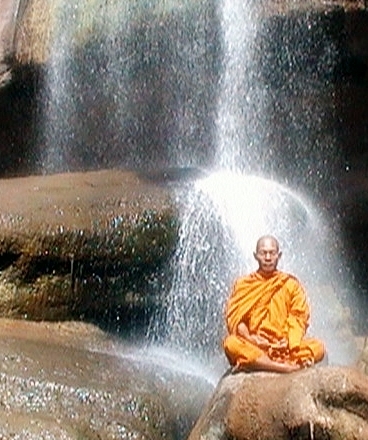
The Presence in the Absence

I don’t know about you, but I sometimes get a bit discouraged when I read the stories and poems of the Bible.  It seems that people back then had a much more immediate sense of God’s presence than we do today.  On almost every page, there are tales of visions, voices, angels, and miracles.  Meanwhile, even the most spiritually-inclined of us today have to rely on powers of reason, conscience, intuition, and imagination when forming our ideas about who God is and how God relates to us.  It’s easy for us to feel left out when we read the Bible because most of us haven’t had the kind of direct and intense mystical experiences described in its pages.  After all, who here has ever walked on water or seen the ocean part in front of them?  My guess is that not many of us have.  If only there was someone in the Bible whose experience of God looked more like ours!  Well, as it turns out, there is just such a person: Esther.

This morning’s first reading comes to us from the book that bears her name.  As a matter of fact, this week is the only week in our church’s three-year lectionary cycle that makes use of the book of Esther, which means that I’ll have to give you a lot of back story in a short amount of time.

The story of Esther takes place during a rather dark period of Jewish history.  In 587 BCE, the kingdom of Judah was conquered by the Babylonian Empire and its elite and aristocratic inhabitants were taken off into slavery, where they lived for the next several generations.  During this time, they struggled to preserve whatever tattered pieces of their culture and religion that they could.  A little while later, the Babylonians themselves were conquered by the Persians.

It is during the Persian occupation that the story of Esther is set.  It’s a story of struggle and survival in the midst of powerlessness.  Esther represents the weakest and most vulnerable members of society.  She was a Jew in a Persian culture, she was a woman, and she was an orphan.  In the ancient world, you really couldn’t get much lower on the social food chain than that.

Through a series of unlikely circumstances, Esther found herself being recruited into the personal harem of the Persian king.  This position would provide her with a modicum of security and comfort, but it came at the price of being an object of desire to be used by someone else.

As the story unfolds, Esther eventually becomes the king’s wife around the same time that a plot is being hatched to commit genocide against the Jewish people.  Due to her position as queen, Esther is in a unique position to save her people.  However, doing so would involve a great deal of personal risk to her.  In Persian culture, it was a capital offense to approach a king without being invited.  This particular king, Ahasuerus, had already demonstrated his willingness to deal harshly with any kind of insubordination, even from his wife.

Esther has a hard choice to make: she can keep silent and allow her people to die in order to save her own life, or she can risk her life in order to save the lives of her people.  It was her cousin and caretaker, a man named Mordecai, who gave her this advice: “Who knows? Perhaps you have come to royal dignity for just such a time as this.”

After hearing these words, Esther decides to take the risk.  Approaching the king unannounced, Esther pleads for her life and that of her fellow Jews.  The king has compassion on her and punishes Haman, the mastermind behind the genocide plot, but is too late to stop the plan from being carried out.  At the last minute, he makes provision for the Jews to defend themselves against their attackers.  The day is saved.

All in all, the book of Esther makes for a great story.  It’s full of intrigue on the one hand and irony on the other.  There are some outright hilarious moments as Haman, the villain, repeatedly sets himself up for failure and humiliation.  This is a story of underdogs winning out over powerful forces of hatred and evil.  Just like it happens in the movies, trust and faithfulness are enough to beat the odds.

There’s only one thing missing from the biblical story of Esther.  Its conspicuous absence sets this story apart from all others in the Bible.  Can you guess what it is?  It’s God.

God is never mentioned in the book of Esther.  Not even once.  This is so unusual for the Bible, where visions, voices, angels, and miracles abound.  All we see here are human beings, caught in a difficult situation, and trying to make the best of it.

I like that.  It gives me hope.  It reminds me of my own spiritual life, where I often have to ask hard questions and figure things out for myself.  It would be most convenient if I could get a visit from an angel every time I had a question or a problem, but that just doesn’t seem to be how God works in my life.  The God I believe in is one who encounters people on the journey of life and gives them the gifts of reason, conscience, intuition, and imagination.  These are the God-given tools with which we all must chart our own course in life, trusting that the path we take will lead us home to our true selves and the Mystery of Being, which we call God.  There are no easy answers or quick fixes in this life.  There is only the journey and the hard choices we must make along the way.

For me, the book of Esther is a brilliant illustration of this principle in action.  God does not show up in any immediate way.  God’s presence is implied.  Mordecai expresses the divine trait of wisdom.  Esther embodies faith and courage.  In the end, the implication is that God has been present and active all along, even though the heavens have been silent and apparently empty.

In the book of Esther, God is the presence in the absence and the voice in the silence.  So it is, I think, in our lives.  Faith, for most of us, grows gradually as we learn to trust in that absent presence and silent voice.  We find God in ourselves and in the people around us.  We feel a tug in our hearts that leads us in the direction of faith, hope, and love.  Those who follow the leading of that tug discover for themselves where that mysterious road goes.

Just like Esther and Mordecai, we can’t tell where the road will take us or whether our efforts will be successful.  All we have in our possession are bits and pieces of some larger puzzle that may or may not be solved at some point in the future.  The best we can do is lay our individual puzzle pieces down onto the table and try to see where they fit into the larger picture of the whole as it gradually comes together.

If you’re here this morning and your experience of faith has largely been an experience of doubt, silence, and absence, I want to encourage you with Esther’s story.  You’re in good company.  Your experience of absence does not necessarily amount to an absence of experience.  God is present and active in your life, whether you realize it or not.

As you struggle along in life, trying to walk by your own inner lamp of reason, conscience, intuition, and imagination, remember that you are not alone.  Others, like Esther and Mordecai, have gone this way before.  More importantly, there is one who walks with you, beside and within, who first gave light to your inner lamp and has promised to keep it burning through all eternity.


Let’s Talk About It

Martin Buber, author of ‘I and Thou’. Image is in the public domain.

Mark 9:30-37

Today, I would like to talk about it.  I’ve been thinking about it for a while.  Maybe it’s been on your mind too.  It goes without saying that I think it’s important.  In fact, it’s probably the kind of thing that we should have brought up sooner than we have.  What is it?  Well, I’ll tell you what it is.  In fact, I’m already telling you what it is.  I’m talking about it right now.  Do you get it?

It.

It is a big word.  It is not very long, but it has a lot of meaning packed into itself.  The Jewish philosopher Martin Buber says that there are two ways in which you can relate to a being in the world (i.e. a person, life form, thing, etc.): you can relate to any being as an It or as a You.

When we choose to relate to something (or someone) as an It, we objectify that being.  In other words, we treat it like an object to be used.  Objects have value.  They are worth something.  Their value is often based on their function (i.e. what they can do).  My car has value based on its ability to take me from point A to point B efficiently and comfortably.  We make use of objects as means to an end.  When a particular object has outlived its functionality, it is either fixed or thrown away and replaced.

When, on the other hand, we choose to relate to something (or someone) as a You, we personalize that being.  A person doesn’t have value or worth.  A person has dignity.  You can’t put a price on a person’s life.  A person is literally priceless.  A person is not an object to be used.  A person can never be used as a means to an end.  As the philosopher Immanuel Kant has famously said, each and every person is an end in himself (or herself).  When a person’s life or existence comes to an end, that person is mourned.  He or she can never be replaced.

I begin today by talking about the word it because of the place this word holds in this morning’s reading from Mark’s gospel.  The scene begins as so many of them do, with the disciples competing, posturing, backbiting, one-upping, gossiping, and generally showing off amongst themselves.  “Who is the greatest?” they ask each other.  “Who among us is Jesus’ favorite?”  “Which one of us has the truest and best interpretation of Jesus’ teachings?”  When I read this, I think about our own denomination, the Presbyterian Church (USA), as it is currently in the process of ripping itself in two over the issue of homosexuality.  Each side in this debate claims to have a monopoly on God’s truth and the only legitimate interpretation of Scripture.  Behind this bitter argument, I feel like I can still hear the echoes of Jesus’ disciples fight amongst themselves over who is the greatest.  As usual, the disciples’ self-centered argument blinds them from seeing what Jesus is showing them about God, themselves, and reality.  They can’t see the forest for the trees.

Cue Jesus.  How does Jesus respond to this latest display of religious ridiculousness?  He turns their idea of greatness on its head by saying, “Whoever wants to be first must be last of all and servant of all.”  What happens next is even more interesting.  We the readers encounter that big-little word: It.  The text tells us that Jesus, “took a little child and put it among them; and taking it in his arms, he said to them, ‘Whoever welcomes one such child in my name welcomes me, and whoever welcomes me welcomes not me but the one who sent me.’”

Most of us will be familiar with this story of the child from Sunday school.  Many of us who grew up going to church remember singing songs like Jesus loves the little children of the world and looking at pictures of a kind and smiling Jesus, playing with children, holding them in his arms, and resting them on his knee.  We tend to filter these gospels scenes through our own idealized images of childhood as a time of innocence and playfulness.  In first century Palestine, they had no such illusions.  In that world, they had a 30% infant mortality rate.  Of those who survived, 30% were dead by the age of five and 60% by the age of fifteen.  For folks in that culture, childhood was a time of danger.  Children were vulnerable.  For parents, children were necessary but uncertain investments.  Children just didn’t matter to people in that society because they were little more than a drain on family resources until they reached young adulthood.

A child then, in that society, was no more than an It.  It was a vulnerable liability.  Jesus, when he wanted to turn his disciples’ preconceived notions of power and greatness upside down, held up a child as the symbol of the divine presence in their midst, not because he thought children were cute and innocent, but because he knew they were vulnerable.  Jesus looked past the It and saw the You in the ones who matter least.  Doing so, he taught his followers, is the key to seeing and serving God in this world.

Today, two thousand years later, it seems that we are still learning this lesson from Jesus.  We still have an innate tendency mistake a You for an It, to treat a person like an object.  How many times have we heard scorned lovers cry, “I feel so used” or “Such-and-such a person used me”?  How often do we hear powerful and successful people say things like “It is not my problem” or “It is not my responsibility” in relation to the poorest and most vulnerable members of society?  If we’re going to call ourselves Christians, if we want to take Jesus’ words seriously, then we have to agree with him that “Whoever welcomes one such child in my name welcomes me, and whoever welcomes me welcomes not me but the one who sent me.”

This is the fundamental principle underlying all Christian ethics.  This is where the It becomes a You.  Martin Buber said, “In every You we address the eternal You”, which is God.  The Bible tells us in 1 John 4:16, “God is love and those who abide in love abide in God, and God abides in them.”  Whenever we flawed and finite mortals find it in our little hearts to love in the slightest degree, we touch the very face of God.  In that moment when an It object becomes a You person in our eyes, the veil between heaven and earth is rent asunder and eternity comes pouring into our lives.  This is what Jesus had in mind when he taught us to pray, “Thy kingdom come, thy will be done, on earth as it is in heaven.”  Whenever we choose to love another in whatever small way we can, we make a little heaven on earth in that moment.

Another important word that Jesus mentions in this passage is ‘welcome’.  He says, “Whoever welcomes one such child in my name welcomes me, and whoever welcomes me welcomes not me but the one who sent me.”  This idea of welcoming has to do with the Middle Eastern customs of hospitality.  We North Americans have a very watered-down idea of what hospitality is all about.  We think it’s all about making polite small talk over coffee and setting out fresh towels with clean sheets.  Most of us tend to measure ourselves by the standard of “hostess-ness” set by Martha Stewart’s TV show.  But hospitality in the ancient world had little to do with Martha Stewart.  Remember that they had no cell phones or AAA service.  There wasn’t even a regular police force to keep people safe on the open road.  Strangers in a foreign city had no guarantee that their basic human rights would be respected by the citizens of that town.  This was a universal fear for all travelers.  As a result, their culture developed the custom of hospitality as a religious obligation, if not a legal one.  Hospitality, in this sense of the word, has to do with one’s duty to offer provision and protection to traveling strangers.  Welcoming someone meant that you were taking personal responsibility for that person’s life.  This is what Jesus meant when he said “welcome”.

When Jesus was first teaching this spiritual principle to his disciples, he used children as his example of overlooked and vulnerable people who often get treated as Its instead of Yous.  Who, in our society, would fit that description today?  It’s easy for us to see how elderly and permanently disabled people would count as overlooked and vulnerable.  Most folks would probably extend that definition to include combat veterans, laid off workers, and other examples of people who count as the “worthy” or “deserving” poor.  But what about those who our society labels as the “undeserving” poor?  I’m thinking of people like convicts, drug addicts, and panhandlers.  It’s easy to feel justified in treating them like Its instead of Yous because of the damage they have done to themselves and others.  However, Jesus doesn’t seem to make that kind of distinction in his ministry.  He listed prisoners among those who require care and compassion in God’s name.  He was infamous for extending hospitality toward self-destructive outcasts and rejects.  Whether they deserved it or not, Jesus treated each one of them like a You instead of an It.

How about yourself?  How do you fit into this grand scheme of deserving and undeserving people?  How often do you feel vulnerable or overlooked?  Where and when have you been treated like an It instead of a You?  My guess is that we do this to ourselves on a regular basis.  We objectify ourselves whenever we measure the quality of our lives against some outside standard of success, happiness, or beauty.  We treat ourselves like an It whenever we build our sense of value and self-worth on the basis of achievements or possessions.  All this really does in the end is feed our egos, which have nothing to do with who we really are.  If we could somehow learn to relate to ourselves as Yous instead of Its, we would be able accept ourselves for who we really are, complete with all our faults and flaws.  You could begin to embrace who you are and reclaim your inherent dignity as God’s child, made in God’s image, and a temple of the Holy Spirit.

Cultivating a You-relationship with others is not limited to human beings, either.  We can learn to see the earth itself, with all of its plants, animals, and ecosystems, as a personal You in its own right.  This doesn’t necessarily mean that we need to buy into superstitious myths about fairies and tree spirits.  We can live as perfectly rational people and still treat the earth with dignity and respect as an end in itself.  In this way, all of nature can become a portal through which we come to glimpse the very face of God.

We don’t even need to stop there.  We can look around at all those things that we take for granted as Its because they don’t possess the quality life, as we know it.  We objectify them because they appear to be objects to us.  But have you ever had a piece of art affect you on a personal level?  Have you ever seen a painting, a film, or heard a poem or a piece of music that touched your life in a deep way?  Beethoven’s 9th Symphony and John Coltrane’s album, A Love Supreme, have both done that for me.  These products of creative genius serve as windows into the soul of the artist.  They communicate something about the nature of what it means to be human.  In doing so, they also reveal something about the very heart of God.  We can learn to see that when we relate to these works of art as You.

This task is somewhat easier when we are talking about beautiful art produced by brilliant minds, but what about the more mundane expressions of human ingenuity that we encounter on a daily basis?  I mean, have you ever really looked at a power drill or thought about it with any seriousness?  Imagine the work that went into designing such a device.  Imagine the factory workers who manufactured it or the minimum wage employee at the hardware store who sold it to you.  When you consider these questions, even for a moment, and give thanks, you are encountering that power drill as a You instead of an It.  You are consciously holding that tool in a way that allows it to become a portal for you, through which the kingdom of heaven is able to invade earth and set up camp in your life.

This was the end-result that Jesus had in mind when he said, “Whoever welcomes one such child in my name welcomes me, and whoever welcomes me welcomes not me but the one who sent me.”  Heaven is not a place, but a state of mind.  Heaven is a way of seeing and being in the world where we “live, move, and have our being” in conscious awareness of the One “from whom, through whom, and to whom” all things come.  It was for this reason that Jesus interrupted his disciples’ ego-driven pursuit of power and greatness by drawing attention to that which is normally dismissed as forgettable and unimportant.  Jesus saw the You beyond the It in that child.  His hope was that his disciples might one day learn how to do the same, so that these overlooked and dismissed ones might find their dignity and claim their identity as open gates of heaven, through which the reality of eternity is made manifest in space and time.


Words of Wisdom

The Lamp of Wisdom: sculpture at Waterperry Gardens. Image by Vanderbilt Divinity Library.  Retrieved from http://diglib.library.vanderbilt.edu/act-imagelink.pl?RC=54977 on September 16, 2012.

Church is probably going to feel like an Indiana Jones movie this morning because I’m taking you on a hunt for lost treasure!  We’re going to explore some dangerous and exciting new territory.  There’s bound to be risks aplenty.  The treasure we’re looking for doesn’t belong on a dusty old shelf in some museum; we’re going to put it to good use in our lives, where it can yield a return on our investment.

(OK, that opening was a bit gimmicky, but give me a break, I’ve got to start the sermon somewhere!)

What I’m interested in doing today is exploring one of the lost treasures of the Bible itself.  It sounds weird to hear someone talk about “lost treasures in the Bible”, right?  I mean, isn’t the whole thing right there for us to open and read anytime we like?  Of course it is!  However, there are certain parts of the Bible that have been passed by or ignored over the years.  This usually happens because these passages just don’t fit very well with the big ideas of the people in charge, so they get minimized and pushed aside while other passages take center stage.  Once this has happened for several generations or even a few centuries in a row, most people forget those passages are even there.  But that’s just the thing about the Bible: if you actually read it, it has a way of challenging the status quo and opening you up to new ideas that the powers-that-be might even call “heresy”.

This is exactly what happened with our Protestant ancestors, Martin Luther and John Calvin.  Once they actually got their hands on the Bible itself, it led them to challenge a thousand years of church tradition and authority.  Both of them were eventually excommunicated for preaching this crazy idea that regular people, not just priests and monks, should be able to read the Bible for themselves, in their own native language.  It’s just like Desmond Tutu said in God Has A Dream, the book our congregation read together last summer:

Oppressive and unjust governments should stop people from praying to God, should stop them from reading and meditating on the Bible, for these activities will constrain them to work for the establishment of God’s kingdom of justice, of peace, of laughter, of joy, of caring, of sharing, of reconciliation, of compassion.

This morning, as we open the pages of this dangerously subversive and revolutionary manifesto that we call “the Bible”, we’re going to be searching for a particularly fascinating “lost treasure” that has been hidden in plain sight for thousands of years.  This treasure that I’m talking about is actually a biblical character, like Jesus and Moses.  Her name is Wisdom.

To the ears of us North Americans, talking about Wisdom as a person sounds weird.  We’re used to thinking of Wisdom as a virtue or a concept, like intelligence or compassion.  Wisdom (so we think) is not a person, but a character quality possessed by those of our elders who have lived long and lived well.  We all aspire to be holders of Wisdom in our old age.

But that’s not how the Bible portrays Wisdom.  The Bible sees Wisdom as a person, not a concept.  In this morning’s Old Testament reading, taken from the book of Proverbs, Wisdom is portrayed as a bold and brave woman:

Wisdom cries out in the street;
in the squares she raises her voice.
At the busiest corner she cries out;
at the entrance of the city gates she speaks:
‘How long, O simple ones, will you love being simple?
How long will scoffers delight in their scoffing
and fools hate knowledge?
Give heed to my reproof;
I will pour out my thoughts to you;
I will make my words known to you.

There is so much to love about the scene that is being set here.  First of all, as I’ve already pointed out, Wisdom is portrayed as a person, a woman.  In Hebrew, the language of the Old Testament, the word for Wisdom is Hochma.  In Greek, the language of the New Testament, the word for Wisdom is Sophia.  That’s where we get words like philosophy from.  Philosophy literally means “the Love of Wisdom”.  Sophia also happens to be a very familiar name for women in our culture.  Sarah and I actually considered naming our daughter Sophia, but then we found out that it was the single most popular name for baby girls in 2008, so we decided to name her something more unique to her.  So, for the remainder of this sermon, in order to emphasize the personal and feminine nature of Wisdom, as she is portrayed in the Bible, I will be referring to her by that Greek name: Sophia.

What kind of woman is Sophia?  We learn right away from this passage in Proverbs that she is both unconventional and courageous.  Proverbs says that she “cries out in the streets” and “raises her voice” at “the busiest corner”.  Imagine, if you will, the gender-segregated world of ancient Palestine.  In that culture, a woman’s traditional sphere of influence was limited to the home.  Proper women, so they said at the time, didn’t make their presence known in public, which was the domain of men.  If a woman needed something to get done outside of the home, she had to get it done through a man, like her husband, brother, or father.  There were only two kinds of women who would raise their voices on a busy street corner: prostitutes and desperate women who had suffered such an injustice that they had no other choice but to take matters into their own hands.  Either way, whenever a woman raised her voice in public, people were apt to think the worst.

So, I think it’s extremely significant that when we first meet Sophia, here in the book of Proverbs, she is crying out in the streets.  The fact that she is doing so in that culture meant that something had gone very, very wrong indeed: either something was wrong with her or something had gone wrong with the world.  Her willingness to speak up makes her the kind of person who is able to think outside the box and color outside the lines of what is socially acceptable.  She is this strong, creative, and dynamic presence who raises her voice in order to change things for the better.  In that way, the figure Sophia reminds me of pioneering women like Eleanor Roosevelt or the famous primatologist Jane Goodall.  Both of these women, in the fields of politics and science, respectively, made a lasting difference by trespassing over the borders of what was expected of them from society.  If we were to make a movie about Sophia, I think I would cast someone like Whoopi Goldberg or Kathy Bates in the lead role.

What can we learn about Sophia from looking elsewhere in the Bible?

In Proverbs 8, we meet her again.  Just like before, she is crying out in the street in defiance of public opinion.  She says:

To you, O people, I call,
and my cry is to all that live.
O simple ones, learn prudence;
acquire intelligence, you who lack it…

…I have insight, I have strength.
By me kings reign,
and rulers decree what is just;
by me rulers rule,
and nobles, all who govern rightly.
I love those who love me,
and those who seek me diligently find me.

At this point in the poem, things start to get really interesting.  Up to now, we might still be able to dismiss Sophia as an impersonal concept, symbolically represented as a woman, but listen to what she says later in chapter 8:

Ages ago I was set up,
at the first, before the beginning of the earth…

When [God] established the heavens, I was there,
when he drew a circle on the face of the deep,
when he made firm the skies above,
when he established the fountains of the deep,
when he assigned to the sea its limit,
so that the waters might not transgress his command,
when he marked out the foundations of the earth,
then I was beside him, like a master worker;
and I was daily his delight,
rejoicing before him always,
rejoicing in his inhabited world
and delighting in the human race.

This is most interesting.  Sophia, according to the ancient Hebrew sage who wrote this poem, holds a prominent place in cosmic scheme of things.  Somehow, God works through Sophia in creating and shaping the world.  The natural order we observe in the universe, according to this poem, is the direct result of God’s creative energy working with and through Sophia.  Earlier, she says, “By me kings reign, and rulers decree what is just”.  This means that the ideals of goodness and justice, far from being arbitrary cultural norms, are actually woven into the very fabric of the universe by Sophia herself.  In this sense, she can be compared to that which Chinese philosophers have referred to as the Tao, the fundamental organizing principle of the cosmos.

We can learn even more about the development of the idea of Sophia by looking at the books of the Apocrypha.  While these books, written by Hellenistic Jews in the centuries after the last Jewish prophet and the birth of Christ, were not accepted as sacred Scripture by the Protestant reformers, they are nonetheless helpful for demonstrating the developing thought patterns of the Jewish people in the years leading up to Jesus’ lifetime.  This passage, a meditation on Sophia, comes from chapter 7 of a book called The Wisdom of Solomon:

because of her pureness she pervades and penetrates all things.
For she is a breath of the power of God,
and a pure emanation of the glory of the Almighty;
therefore nothing defiled gains entrance into her.
For she is a reflection of eternal light,
a spotless mirror of the working of God,
and an image of his goodness.
Although she is but one, she can do all things,
and while remaining in herself, she renews all things;
in every generation she passes into holy souls
and makes them friends of God, and prophets;
for God loves nothing so much as the person who lives with wisdom.
She is more beautiful than the sun,
and excels every constellation of the stars.
Compared with the light she is found to be superior,
for it is succeeded by the night,
but against wisdom evil does not prevail.

What I find so fascinating about this passage is that the figure of Sophia is becoming more and more closely associated with God’s own self.  As we move into the New Testament, the apostle Paul refers to Christ as “the Wisdom of God” in his first letter to the Corinthians.  Decades later, someone writing in Paul’s name expanded on this association of Christ with Sophia in the epistle to the Colossians.  Listen for the similarity between this passage about Christ and the one we read earlier from Proverbs 8:

[Christ] is the image of the invisible God, the firstborn of all creation; for in him all things in heaven and on earth were created, things visible and invisible, whether thrones or dominions or rulers or powers—all things have been created through him and for him.

It seems that the early Christians saw Christ as the earthly embodiment of Sophia herself.  More than anyone else in history, Jesus lived a life in harmony with this fundamental organizing principle of the universe.

How can it be then, that such an important figure as Sophia has become one of the “lost treasures” of the Bible?  The answer, I think, comes from the various kinds of cultural momentum and inertia that can be found in people of every place and time.  Christianity itself has grown up in a patriarchal society.  The sad fact is that women’s voices have not counted as much as men’s voices.  When it comes to the metaphors we use to describe God, Christians have embraced images of masculinity and power (e.g. Almighty Father, King of Kings, Lord of Lords, etc.) to the exclusion of more feminine images (e.g. Sophia raising her voice in the marketplace).  Nevertheless, our sacred Scriptures remind us that men and women are both equally made “in the image of God”.  The Bible also gives us several feminine metaphors for God apart from Sophia the Wisdom Woman.  Deuteronomy 32 describes God as an eagle teaching her young to fly.  Isaiah 49 describes God as a mother who could never forget her baby.  Women served as metaphors for God in more than one of Jesus’ parables.  One of my favorite images comes from the Hebrew root of the term that gets translated as “tender mercies”, a character quality that is often applied to God.  In Hebrew, the word for “tender mercies” is rachamim, which comes from the word rechem, which literally means “womb”.  When the Bible tells us that we are the recipients of God’s “tender mercy”, it means to say that we are being nurtured and loved as we grow within the very womb of God.  I like to tie this right back in to the image of Sophia as a metaphor for God.  When I think of God, I have little use for the image of an angry, powerful man with a long white beard who sits on a throne above the clouds, hurling thunderbolts of judgment down to the earth.  That kind of Deity sounds more like Zeus than Jesus.  When I think of God, I prefer to think of Sophia: that brave and beautiful woman who raises her voice for justice in the city streets and carries the earth like a baby on her hip.  That’s the God to whom I have given my heart.

This week, as you go out into the streets where you live, work, and play, I pray that your ears would be open to Sophia’s voice, calling out to you.  Whether you are walking along an autumn trail, sitting in a meeting, milking a cow, or ringing up a cash register, may you become aware in those moments of that same sacred presence that shaped and renews the cosmos.  Like Jesus, may you feel her creative energy pulsing through your veins and granting you the insight you need in order to live a life in total harmony with the universe itself.

“If I can learn, so can you”

Horshack from Welcome Back Kotter

When I was serving as a priest in the Free Episcopal Church, my bishop had a wonderful saying that I continue to carry with me in life: “The opposite of faith is not doubt, it is certainty.”  I love that.

I love that saying because it so beautifully messes with our society’s cultural assumptions about what it means to have faith.  To the modern mind, having faith means possessing absolute certainty about a set of ideas, even if you can’t prove those ideas to be true.  If faith really does equal certainty, then a person of faith would necessarily have to be like the character Horshack on the old sitcom, Welcome Back Kotter: “Oh! Oh! Oh!  I know the answer!”

If faith is all about certainty and knowing the answer, then the voice of faith becomes just one more voice, shouting above the noise of every other political ideology and commercial product that claims absolute certainty for itself about the answer to “life, the universe, and everything”.  If having faith really is just about being certain, then the church is just another Horshack, shouting from the back of the classroom: “Oh!  Oh!  Oh!  I know the answer!”

But I don’t believe that’s true.  I don’t believe that faith is just another voice, trying to shout over the crowd in the marketplace of ideas.  Furthermore, I don’t believe that faith has anything do with certainty at all.  If anything, I believe that absolute certainty is the exact opposite of faith.  If you’re absolutely certain about your faith, then there’s no stretch that your intuition or imagination has to make.  In order for faith to be authentic, our hearts have to be free to make that leap of trust into the unknown.  We have to come to that healthy and humble point of being able to honestly say, “I don’t know.”

The modern world doesn’t like those words: “I don’t know.”  The modern world wants certainty, but our ancestors in the pre-modern world (ancient and medieval) were much more comfortable with not knowing the answers when it comes to the mystery of existence.  Ancient theologians and philosophers taught their students that, if they truly wanted to understand the meaning of God, then they always had to keep their minds in motion.  Anytime they settled on an idea and claimed to have the final answer, they were told to keep looking, because any answer that a human being could fully understand was obviously not the whole truth about God.

Thomas Aquinas, a medieval theologian, claims to present five proofs of the existence of God.  But if you read his five arguments, you’ll walk away frustrated and disappointed because he brings his readers to the point of accepting the need for an explanation of the origins and orderliness of the universe, but then he just stops cold in his tracks.  Aquinas leaves his readers on the brink of a precipice, peering into the dark abyss of the unknown, wondering what might be out there.  He never actually goes so far as to prove, once and for all, that God exists.

This, it would seem, is the stance of faith for the ancient and pre-modern spiritual masters: the stance of openness and reverence toward the great mystery of existence in the universe.  This kind of faith is not a faith that claims to know all answers with absolute certainty.  This faith is a leap of faith, made by a mind in motion.  In today’s gospel reading, we can see that kind of faith in Jesus himself and in the Syrophoenician woman he meets in the city of Tyre.

At this point in the gospel story, Jesus is traveling through foreign territory.  As a Jew in the city of Tyre, he was “a stranger in a strange land”, a fish out of water for sure.  The text itself doesn’t say exactly what business brought Jesus to that city, but it does say that, for whatever reason, he was trying to lie low while he was there.  But, unfortunately for Jesus, word got out that he was in town and someone in need came to see him.

This woman was not Jewish.  She came from a different race and religion than Jesus.  On top of that, she was a woman speaking up for herself.  In the patriarchal world of the ancient Middle East, this was not the norm.  She may have been a widow with no surviving male relatives to act as her official mouthpiece in public.  Whatever the reason, the fact that she was making a scene remains the same.  A non-Jewish woman was confronting a Jewish man in public.  This would have been the scandal of the week in the city of Tyre.  If they’d had tabloids and paparazzi back then, this would have been on the front page.

But you see, she didn’t care about that.  She was desperate.  The text of Mark’s gospel tells us that her daughter had “an unclean spirit”, but it doesn’t tell us exactly what that means.  In the ancient world before the advent of modern medicine, mental and neurological illnesses like epilepsy, Tourette’s syndrome, and schizophrenia were often misdiagnosed as demonic possession.  This might have been one of those cases.  On the other hand, it’s not entirely inconceivable that there really was something happening to this little girl on a supernatural level.  Jesus and his fellow Jews in the first century CE would have had no problem whatsoever with that idea.

A first century Jew would have been especially unsurprised to hear of demonic activity in a city full of pagans, like Tyre.  “Of course she has an unclean spirit,” a typical Palestinian Jew would have said, “All these people in this city have unclean spirits, on account of their bowing down to false gods and idols!”

At first, Jesus seems to concur with that party line.  He refuses to help her because she is not Jewish.  He says to the woman, “Let the children be fed first, for it is not fair to take the children’s food and throw it to the dogs.”  Dogs?  That’s a little harsh, even for Jesus.  No one would have blamed her for storming off, offended, but that’s not what she does.  This woman is desperate and she believes that Jesus is the only one who can help her.  Her love for her daughter leads her to stand up and ride roughshod over the sacred barriers that separated people of different genders, races, and religions in that society.  Here, at the end of her proverbial rope, she throws all caution to the wind and takes matters into her own hands.  I like to imagine that she got up off her knees, looked Jesus right in the eye, and put a finger in his face when she said, “Sir, even the dogs under the table eat the children’s crumbs.”

I wish the text of Mark’s gospel had described the look on Jesus’ face when she did that.  But we don’t get that luxury.  In the text, Jesus responds to her boldness by saying, “For saying that, you may go—the demon has left your daughter.”  There is a TV movie on the life of Jesus that came out about 13 years ago.  This scene from today’s gospel reading appears in that film.  The screenwriter takes some liberties with the text and embellishes the point being made with additional dialogue from Jesus.  In the movie, Jesus turns around and says to his disciples, “This woman has taught me that my message is for [all people, not just the Jews].  If I can learn, so can you.”

I love that idea.  Jesus, far from being a distant and static object of worship, is an intimate and dynamic presence in our lives.  The Spirit of Christ grows within us as Christians in every generation are called to speak the truth in love to an ever-changing world.  The needs of the world today are different than they were two thousand years ago.  We are called to follow where Christ is leading us today, not where Christ led our ancestors five hundred years ago.  Let me give you one example: just a few decades ago, the idea of racial integration would have sounded ludicrous.  But today, none of us would want to worship in a church that had “Whites Only” printed on the marquee outside.  The fact that we would now find that offensive and unacceptable is a sign of the Holy Spirit working and growing within us, leading us into new levels of truth that our ancestors weren’t yet ready to hear.  What new truths is the Spirit leading you into today?  What ancient barriers of close-minded prejudice is Christ tearing down in this generation?  When our children and grandchildren grow up and look back at this era of history, will they be proud of us for taking risks and standing up for what we thought was right?  Will they see evidence of Christ growing in our hearts?

I certainly hope so.  I hope we leave them a legacy that they can run with.  I hope that same Spirit will grow in them and lead them to follow Christ in ways that make me feel uncomfortable.  I pray today that your faith in the growing Christ will lead you out of the static realms of certainty and across the established borders of this world and up to the brink of the precipice where you too can gaze with reverence and humility into the darkness of the unknown abyss, defying every humanly-constructed ideology, confessing with scandalous honesty the creed openness before the mystery of existence: “I don’t know the answer.”


The Big Picture

Do you ever feel like you get “stuck in your head”?

You know what I mean by that: you start thinking about some question or some problem in your life and it just takes over your whole mental process for hours or even days at a time.  Later on, when you look back at the situation with the benefit of hindsight, you can’t understand how in the world you got yourself so worked up over such a little thing!

Personally, this kind of thing happens to me a lot.  For those who don’t know my back story, I have been engaged in a lifelong battle with a particularly severe form of Attention Deficit Disorder (ADD).  One of the most counter-intuitive symptoms of this disorder is something called hyperfocus.  It sounds weird because ADD is typically associated with an inability to focus on one thing for an extended period of time, but thanks to whatever chemical imbalance causes the disorder, many of us who have ADD also have this involuntary capacity to occasionally hyperfocus or fixate on something past the point where it’s rational or healthy to do so.  In other words, it’s really easy for us to get “stuck in our heads” over some relatively small and insignificant issue.

For example, there was a time in my life when I was thinking about joining a new church, but I couldn’t decide whether I wanted to be Presbyterian, Lutheran, or Episcopal.  For most people, this would not be a big deal.  Most mainline Protestants are pretty similar to each other, but my hyperfocus kicked in and I was up until all hours of the night, reading each tradition’s history and theology.  You could find me at 4am, pacing the floors of my apartment and wringing my hands because I couldn’t figure out which church was the right one for me.  How irrational is that?!  At the time, it felt like the most important decision I would ever make.  In hindsight, it all seems pretty silly.  That’s ADD in action.

If I had been born only a generation earlier, I would have been dismissed as lazy, slow, absent-minded, or scatter-brained.  However, recent advances in medical science combined with the attentive care of my parents and teachers allowed me to rise above my limitations and achieve my full potential as a human being.  These days, I’m on medication that keeps my brain from running away with itself like it used to.  I’m far less prone to fixate on particular problems or get “stuck in my head” over little things.

How about you?  Even if you don’t have ADD, there comes a time in every life when one is liable to get carried away or “stuck in your own head” over some issue or another.  We all have ways of putting up mental filters like horse blinders in moments of crisis.  Sometimes, this is necessary: a particular problem is so big or so important that it needs your full attention for a moment.  However, the trouble comes when we leave those blinders up all the time so that we never see the joys and concerns of the wider world around us.

Personally, I think our whole North American culture has become “stuck in its head” in a number of unhealthy ways.  First of all, we’ve been trained by over 200 years of philosophy since the Enlightenment to prize the life of the individual mind over the life of the body and the community.  This tendency goes back to a very famous philosopher named Rene Descartes.  He was the philosopher who first said, “Cogito ergo sum (I think, therefore I am).”  When he said that, he was trying to use his powers of reason to prove one and for all that there is such a thing as a soul.  He was a brilliant person.  We owe a lot to him.  He lived and wrote during the Thirty Years War: a time when religious division fueled political conflicts.  After fighting as a soldier in that war, Rene Descartes became convinced that he could use reason to construct the kind of belief system that both Protestants and Catholics could confirm.  That way, he thought, these bitter religious wars would become unnecessary and naturally fizzle out over time.  It was a noble intention.

Furthermore, Descartes method of reasoning was a major step in the development of individualism, wherein the rights and responsibilities of even a single person matter in the grand scheme of things.  Up to that point in history, the needs of individuals were always subjected to the needs of the group.  Thomas Jefferson wrote in the Declaration of Independence that all people are “created equal” and possess certain “unalienable rights”: “Life, Liberty and the pursuit of Happiness.”  Jefferson could not have written those words were it not for the groundwork of individualism laid by Rene Descartes.  So, that’s the good part of individualism.  We need it.  We wouldn’t be who we are today without its influence.

However, there is also a downside.  Individualism can lead us to get “stuck in our heads” in an unhealthy way.  Ironically, it can lead us to disregard the rights and needs of other individuals.  Through it, we have learned to justify selfishness over compassion.  We are told that “greed is good” and generosity only encourages laziness.  We have a tendency to get so obsessed with our own “pursuit of Happiness” that we would deny that same “unalienable right” to our equals.  The culture of individualism unfortunately leads people to the hypocritical place where the “unalienable” rights to “Life, Liberty, and the pursuit of Happiness” are only granted to those who can afford them.  Unchecked individualism is damaging to the life of a community.

The second way in which our whole culture has a tendency to get “stuck in its head” has to do with the way in which we value the life of the mind over the life of the body.  This takes us back to Rene Descartes as well.  He believed that a person’s identity could be identified with his or her ability to reason.  Descartes decided that he could doubt every aspect of his existence: his body, his sense perceptions, and his thoughts.  The one thing that a person cannot doubt or deny is the fact that he or she is thinking.  That’s where Descartes got his famous phrase: “I think, therefore I am.”

Once again, this development has had a positive effect.  Through it, we have learned to use the power of reason to improve our lives.  Descartes himself helped to lay the foundation upon which the Scientific Method was later developed.  Much of what we take for granted in science and technology would not have been possible without the way in which he shaped our thinking.

However, there is a downside to this as well.  Western European and North American cultures have had a tendency to value the mind at the expense of the body.  For example, jobs where people work with their brains tend to be more socially prestigious than jobs where people work with their hands.  A doctor (in this culture) is generally considered to have a “better” job than a nurse.  It’s not a matter of skill or hard work.  There are nurses who have doctoral degrees in their field, yet they are constantly under pressure from some MDs to not use their title, “doctor”, even though they’ve earned it.  “Doctors” are generally thought of as mental laborers while “nurses” are generally thought of as physical laborers.  Never mind that we can’t run a hospital without people to do both jobs.  Our culture has trained us to value the one and take the other for granted.  We’re all “stuck in our heads” when it comes to career prestige.

Likewise, our valuation of the mind over the body has led North Americans to abuse and mistreat the earth in so many ways.  Organisms and ecosystems are our partners on this planet, but many in our culture have come to see them as resources to be exploited.  We’re “stuck in our heads” here as well.  We’ve become so myopic about the survival and prosperity of our own species that we’ve forgotten about the basic state of interdependence in which we already exist.  When we damage the water and the air, we are only hurting ourselves.  We roll our eyes when some activist talks about “the environment” because we forget that we are the environment.  When we recklessly drive species after species into extinction, we are only hastening the moment of our own extinction.  Where the planet itself is concerned, there is no “survival of the fittest”.  There comes a time when competition must give way to cooperation or else everyone loses.

We can’t afford to stay “stuck in our heads” anymore.

A few minutes ago, I mentioned that I am now on medication that prevents me from getting “stuck in my head” because of my ADD.  I wonder, is there some kind of “medicine” for our cultural tendency to get “stuck in our heads” in these ways that I just talked about?  I think there is.

We read a passage this morning from Jesus’ teaching in the Sermon on the Mount.  He addresses his own culture’s tendency to get “stuck in its head”.  He says to his followers, “I tell you, do not worry about your life, what you will eat or what you will drink, or about your body, what you will wear. Is not life more than food, and the body more than clothing?”  Like us, Jesus’ listeners are “stuck in their heads” and caught up in their own little worlds where everything revolves around them and their immediate needs and wants.

Jesus is trying to get them to take their blinders off and see the bigger picture of reality.  He’s taking them on a journey from being self-centered people to becoming reality-centered people.  This is a path followed by people from every religious tradition, although they might understand and express it differently.  I don’t say that in order to minimize or disrespect the very real differences between religions, but it’s worth noting that we do share some common elements with each other, not the least of which is this sense that (A) “there is something wrong with the world” and (B) “there is a way out of the wrongness”.  Christians have traditionally called the wrongness, “sin”, and the way out, “salvation”.  Here in this passage from the Sermon on the Mount, Jesus is showing people a way out of the wrongness.

What is the way out?  How does Jesus propose to take us on that journey from being “stuck in our heads” to seeing the big picture?  What is the medicine that he prescribes for treating our cultural myopia?  The medicine is the universe itself.  He says, “Look at the birds of the air; they neither sow nor reap nor gather into barns… Consider the lilies of the field, how they grow; they neither toil nor spin, yet I tell you, even Solomon in all his glory was not clothed like one of these.”

Jesus draws his listeners’ attention to the natural balance of life and creation.  In order to liberate people from being stuck inside their own self-centered obsession, he asks them a rhetorical question: “Is not life more than food, and the body more than clothing?”  The answer, of course, is yes.  There is more to life than all that.  We ought to lift our vision higher and examine our individual needs in the context of the big picture.  There is more to see, if only we can remove these horse blinders of selfishness and meditate on the sacred harmony we find in the universe around us.

We are part of the big picture.  We are gifted with life in the context of our ecosystem.  Our planet is delicately balanced in its orbit around the sun, not so close that we burn up and not so far away that we freeze.  Our sun is one of several hundred billion stars that make up the beautiful spirals of the Milky Way galaxy.  Our galaxy is one of 170 billion galaxies in the observable universe that got started with a Big Bang approximately 13.75 billion years ago.  This is the big picture.  In the grand scheme of things, our self-centered obsessions are pretty small.  Jesus was right: life is more than food and the body more than clothing.  There is more.  WAY more!  And the amazing thing is that it all flows together so well, without our being able to control or direct the process in any way.  It’s just there.  It’s just happening.  Meditating on that reality can help us to maintain an attitude of humility before the mystery of existence.  It reminds us that we can never know all the answers to the secrets of the universe.  It keeps us from getting “stuck in our heads” with our own petty little problems.  Humanity is told in the book of Genesis, “you are dust, and to dust you shall return.”  We are small, this is true.

But on the other hand, meditation on creation reminds us that we are also big.  We are more than those problems that threaten to keep us “stuck in our heads”.  As Jesus said, our lives are more than food and clothing.  According to legend in the book of Genesis, human beings are dust into which the breath of life has been breathed.  Our bodies are vessels for the Ruach HaKodesh, which is Hebrew for “the Sacred Breath”.  Another way to translate that same phrase is “Holy Spirit”.  We all hold this mysterious gift called Life for the limited time that we are on this earth.  The Sacred Breath (Ruach HaKodesh, “Holy Spirit) flows into and out of us all.  We don’t get to decide where and when we live or what will happen to us while we are here.  The only thing we get to choose is what we will do with the time we have.  Will we stay “stuck in our own heads” or will we lift our vision higher in order to see the big picture?

You are bigger and smaller than you think.  You are a speck of dust into which has been breathed the Holy Spirit, the Sacred Breath of Life.  You were born into a nest of cosmic harmony as part of “the interdependent web of all existence”.  As Jesus taught us to do, use this time you are given to honor that sacred harmony and contribute to it by living a life of service and compassion toward your fellow creatures.


In the Fullness of Time

Excerpt from God Has A Dream:

There is a lovely phrase which St. Paul uses in his letter to the new Christian converts in Galatia.  And that phrase is “in the fullness of time.”  Paul speaks about how when Jesus was born it was at just the right time, all the pieces had fallen into place, the antecedents were just right, and it all happened at exactly the right moment.  A little earlier would have been too soon and a little later would have been too late.  When it happened it could not have been at any other moment.

Last year, many of us had a good laugh at the hype created by a fringe religious group who claimed to have exclusive knowledge that the end of the world was coming on May 21, 2011.  As you may (or may not) recall, the day itself came and went without event.  This was by no means the first time someone tried to cash in on apocalyptic hype.  At the turn of the Millennium, there was “much ado about nothing” regarding the Y2K computer bug.  In the 19th century, a man named William Miller made three unsuccessful attempts to predict the end of the world before his followers lost faith in him.  Even before that, at the turn of the previous millennium, Pope Sylvester II trembled in prayer in his church, convinced that the world would come to an end that very night.  Later this year, so we’re told, the Mayan calendar is supposed to run out, leading some people to speculate that this ancient civilization knew something we don’t about the apocalypse.

Predicting the what, where, and when of the end of the world has never failed to be a sensationalistic, money-making pastime for would-be prophets and their paranoid followers.  We Christians have proved to be especially vulnerable to these scam artists, mainly because of the presence of the book of Revelation at the end of the New Testament.  Many claim that this document, when read and interpreted properly, provides a detailed road map for the end of the world.  It’s bizarre and cryptic imagery are said to contain secret messages about the Apocalypse that are meant to be decoded by those with the proper biblical study tools.  The downside of this approach is that every single prediction supposedly “decoded” from the book of Revelation has turned out to be wrong.  God’s plan, it seems, is not so readily available for human review and approval, but that hasn’t stopped people from trying to figure it out anyway.

Many of us might find it easy to laugh at them for their misguided pursuit.  However, I’d like to take a moment to sympathize with them.  My theory is that folks who tend to obsess over this kind of thing are looking for something.  I think they’re looking for a sense of meaning and purpose in life.  They want to believe that God has a plan for the world and that we’re not all just wandering aimlessly through history.  I can relate to that.

The next step that most of these folks take is to apply this concept of God’s plan to their personal lives.  They might say, “Not only does the universe have a destiny, but so do I.  I’m an important part of God’s plan.  Therefore, my life has meaning.”  Like I said before, I can respect that need.  I feel it too.  I think we all do.  But we have to watch out and make sure that we don’t carry this idea too far.

Our ancestors in the Calvinist tradition were famous for believing that God predestines the fate of every single human being.  They believed that some people were destined for eternal bliss in heaven while others were doomed to endless suffering in hell.  What makes the difference, they said, is “unconditional election” by God.  God chose who would be “saved” or “damned” from the beginning of time, and there is nothing that anyone can do or say to change their fate.  What’s more is that there was no way to know with any absolute certainty about which category you were in.  This theological belief, called “double predestination”, caused people a lot of anxiety.

I’ve also seen people take the idea of God’s plan to unhealthy extremes in rather mundane matters.  When I was in high school, I worked in a bookstore that had a section where we sold religiously themed posters.  One day, I was walking through the stacks when I came across a woman who was kneeling on the floor, weeping.  She had two posters laid out on the floor in front of her.  The problem, it turned out, was that she couldn’t figure out which poster God wanted her to buy.  Just like those folks who are obsessed with predicting the end of the world and the early Calvinist belief in double predestination, this person in the bookstore had taken the idea of God’s plan too far.

When I think about the idea of a divine plan for my life or history, I try not to get too hung up on the details of what, when, and where certain things are supposed to happen.  If we occupy our time with those kinds of questions, I think we’re more likely to end up in an unhealthy state of mind.  Rather, when I think about God’s plan, I prefer to ask questions of who, how, and why.

God is far less interested in what you’re doing and more interested in who you’re becoming, how you’re living, and why you do what you do.  These are questions of the heart.  Answering these questions goes a long way in helping us forge a sense of meaning and significance in our lives.  For example, let’s take a young person in school who is trying to decide on a career path.  I don’t think God tends to care very much whether someone decides to become a lawyer, a doctor, or a minister.  Those are questions of what, where, and when.  Of greater concern to God is whether that person wants to become a lawyer in order to just make money or to serve the greater cause of justice.  In God’s eyes, a waitress in a diner with a heart for hospitality is more holy, more in step with God’s plan, than a minister who just likes to hear the sound of his own voice.  Who we are is much more important than what we do.

That’s why I tend to avoid the phrase “God’s plan” when it comes to the events of history.  I much prefer to think of “God’s vision” or “God’s dream” as Desmond Tutu calls it.  God’s dream is a dynamic thing.  It’s always changing and in motion.  God is the ultimate creator of this dream, but has invited each one of us to become co-creators with God and each other.  Archbishop Tutu says it like this:

It has often been said, “What we are is God’s gift to us.  What we become is our gift to God.”  What we become is not about status, it is about love.  Do we love like God, as God so deeply desires?  Do we become like God, as God so deeply desires us to be?

As for the substance of the plan itself, the shape it takes is up to us, and God works with and around what we bring to the table.  Again, in the words of Archbishop Tutu:

There is a wonderful Portuguese saying that God writes straight with crooked lines.  God works through history to realize God’s dream.  God makes a proposal to each of us and hopes our response will move His dream forward.  But if we don’t, God does not abandon the goal, He does not abandon the dream.  God adjusts God’s methods to accommodate the detour, but we are going to come back onto the main road and eventually arrive at the destination.

I love that phrase: “God writes straight with crooked lines.”  To me, it describes so well my experience of life in this world where things don’t always go according to plan.  Accidents happen.  Things don’t always go your way.  Life goes on.  It doesn’t mean that God isn’t present or working in this world and in our lives.  It means that, if we’re going to look for God, we have to look deeper than the level of surface appearances and random events.

When someone gets sick, or an accident happens, or a terrible tragedy overtakes us, people are prone to ask, “Why is God doing this?” or “Why did God allow this to happen?”  I have to be honest with you, I don’t think God had anything to do with it.  The God of love that I believe in is not in the business of causing cancer and car accidents.  I think these things just happen.  The God I believe in is the one who meets us in the middle of these disasters and leads us to respond in a certain way.

One of my favorite examples that I use to illustrate this point is the terrorist attacks of September 11.  Some people said that God allowed those airplanes to crash because God was judging the United States for one reason or another.  I don’t think that’s true.  I don’t see God in that at all.  I see God in those volunteers who climbed the smoldering piles of rubble with buckets in their hands to get the trapped survivors out.  I see God in the police and fire fighters who risked or gave their lives to save others.  That’s where God is.  That’s God’s plan, God’s dream, in action.

I don’t know if there will one day be an apocalyptic end to the world.  I don’t know if there will be a once & for all victory of goodness over evil “in the fullness of time”.  I don’t know if we, or our children, or our grandchildren will ever live in a perfect world.

I don’t know much, but this is what I believe:

When I look out at the stars in the heavens, I see a harmony that human selfishness cannot touch.  We might destroy ourselves and each other someday.  We might even take our whole planet into extinction with us.  But the beauty of nebulae, quasars, and galaxies will still be there.  The impulse toward order and equilibrium will never be gone from our universe.  That same impulse exists in each one of us.  We call it life, we call it justice, and we call it compassion.  I call it God.  As long as there is a universe to exist, God will never stop working within it to shape darkness, death, and chaos into light, life, and love.  As long as we are alive in this world, God will never stop inviting us to join God in this continuing mission.  I close this sermon and end this series by going back to the words of Desmond Tutu himself:

All over this magnificent world God calls us to extend His kingdom of shalom—peace and wholeness—of justice, of goodness, of compassion, of caring, of sharing, of laughter, of joy, and of reconciliation.  God is transfiguring the world right this very moment through us because God believes in us and because God loves us.  What can separate us from the love of God?  Nothing.  Absolutely nothing.  And as we share God’s love with our brothers and sisters, God’s other children, there is no tyrant who can resist us, no oppression that cannot be ended, no hunger that cannot be fed, no wound that cannot be healed, no hatred that cannot be turned to love, no dream that cannot be fulfilled.

Stillness: Hearing God’s Voice

Psalm 131

Excerpt from God Has A Dream:

God is available to all of us.  God says, “Be still and know that I am God.”  Each one of us wants and needs to give ourselves space for quiet.  We can hear God’s voice most clearly when we are quiet, uncluttered, undistracted—when we are still.  Be still, be quiet, and then you begin to see with the eyes of the heart.

One image that I have of the spiritual life is of sitting in front of a fire on a cold day.  We don’t have to do anything.  We just have to sit in front of the fire and then gradually the qualities of the fire are transferred to us.  We begin to feel the warmth.  We become the attributes of the fire.  It’s like that with us and God.  As we take time to be still and to be in God’s presence, the qualities of God are transferred to us.

Far too frequently we see ourselves as doers.  As we’ve seen, we feel we must endlessly work and achieve.  We have not always learned just to be receptive, to be in the presence of God, quiet, available, and letting God be God, who wants us to be God.  We are shocked, actually, when we hear that what God wants is for us to be godlike, for us to become more and more like God.  Not by doing anything, but by letting God be God in and through us.

As many of you already know, we’ve been making our way through this summer with Desmond Tutu’s book, God Has A Dream.  Last week, we read the chapter entitled “Seeing With the Eyes of the Heart” and we talked about the way in which you and I are called to look past our present life-circumstances and deep into this present moment in which we find ourselves.  It is here, in the very essence of this moment, that we find the loving presence of God: creating and sustaining us moment-by-moment.  We took a look at the lives of those remarkable individuals who, through their own “seeing with the eyes of the heart”, were able to bear witness to God’s ongoing redemption of the world.  We talked about Joseph from the book of Genesis, who was sold into slavery by his brothers, falsely imprisoned for a crime that he did not commit, and eventually elevated to a high office in the land of Egypt.  He looked with the eyes of his heart and saw God at work in his life, drawing light out of darkness, order out of chaos, and life out of death.  When his brothers came back, groveling and begging, he seized the opportunity for reconciliation instead of revenge.  He said to them, “Even though you intended to do harm to me, God intended it for good.”

We also talked about Nelson Mandela, who went to jail as an angry young man in the 1960s and emerged to become the first black president of South Africa and a moral leader of the free world.  Finally, we also talked about Jesus, who suffered an ignoble death by torture and execution as a failed nonviolent revolutionary under the thumb of corrupt political and religious leaders, but whose life continues to shine as a beacon of hope for over two billion Christians in the world today, two millennia after his birth.

This week, we’re going to talk about how it is that we too can learn to see “with the eyes of the heart” and become the kind of people who see past surface appearances and into the very essence of reality.  The key element in this process, according to Archbishop Tutu, is the practice of stillness.

We North Americans, on the whole, tend to be suspicious of stillness.  Personally, I have a three year old at home, so I usually equate the sound of silence with trouble.  There have been many times when I’ve emerged from an extended period of pleasant silence only to discover the bathroom sink decorated with lipstick or a dining room chair entirely slathered with diaper cream.  Silence is not golden.  Silence is suspicious.  Tell me, parents and grandparents, am I right?

But, even without the presence of our tiny little bundles of destruction, we North Americans still tend to be suspicious of stillness.  We prefer to keep the radio or TV going at all times in order to keep the stillness at bay because the bottom line is that, at heart, we’re afraid of stillness.

Why?  What is it about stillness that scares us so much?

Based on what I’ve seen in myself and others, I think it’s two things.  First of all, we’re afraid that if we surrender to stillness and allow ourselves to just sit in silence for a while, we’ll be overwhelmed by that haunting sense of loneliness and isolation we carry inside us.  This is true for all of us, without exception.  Deep down, we are all afraid of being alone.  So we try to keep moving with the herd and keep up with the pack of our fellow homo sapiens.

The second thing that scares us about stillness is the way that our own thoughts tend to creep up on us when we’re not constantly overloading ourselves with information.  Specifically, I’m talking about that inner voice of criticism and self-hatred that follows us around.  You know the one I’m talking about: it’s the voice that says things like, “You’re not good enough.  You’re not smart enough.  You’re not pretty enough.  You’re not successful enough.  You don’t work hard enough.  You don’t make enough money.  Your house isn’t clean enough.  You don’t spend enough time with your family.  You don’t spend enough time at the office.  You don’t pray enough.  You don’t go to church enough.”  It could be any or all of those voices that you hear inside your head.  It could even be something else that pertains specifically to you, but you get what I’m saying.  We feel guilty because there’s always something more that we could or should be doing.  It’s really too much for any one human being to manage, so we just try to stave off the guilt by drowning out that inner voice with noise… any noise will do, so long as we don’t have to be left alone with our thoughts.

Aloneness and self-criticism, those are the two things that scare us most about stillness.  Together, they form the reason why we fill our lives with endless amounts of what Shakespeare called “sound and fury”.  Our fear keeps us running from our true selves and, ironically, the source of our power to overcome our fear, change our own lives, and maybe even the world around us.

Most of my heroes in this world points to their respective practices of prayer and/or meditation as their primary source of energy and inspiration for the extraordinary work they do.  I’m thinking of my usual list: people like the Dalai Lama, Dorothy Day, Mahatma Gandhi, Mother Teresa, Dietrich Bonhoeffer, Oscar Romero, Martin Luther King, and yes, Desmond Tutu.

Archbishop Tutu says:

The Spirit of God sends us into the fray, as it sent Jesus, but we must observe the sequence in his life and we will see that disengagement, waiting on God, always precedes engagement.  He waited to be anointed with God’s Spirit, which made him preach the Good News to the poor and the setting free of captives.  He went into retreat in the wilderness.  He had experience of the transfiguration and then went into the valley of crass misunderstanding and insistent demand.  If it was so vital for the Son of God, it can’t be otherwise for us.  Our level of spiritual and moral growth is really all we can give the world.

So you see, not only is the practice of stillness essential for Desmond Tutu in his work, but it was even essential for Jesus himself.  There is something about the stillness itself that empowers us to overcome the fear that keeps us from stillness.

There are several scenes in the gospels where Jesus deliberately takes time away by himself or with only a few close friends to pray and commune with God.  I like to imagine that it was in these moments of quiet contemplation, as he observed the world around him with the eyes of his heart, that he received the inspiration for most of his parables and teaching.  Maybe there was a day when he was struggling with how to explain the Kingdom of God to his students.  Then, looking around on the lonely hill where he had gone to meditate, he spotted a mustard bush with a bird’s nest in it.  And that’s when it hit him: “Aha!” he says, “That’s it!  The Kingdom of God is like this mustard bush.  It starts as a tiny seed, but then grows into a great, big bush where birds can come and build their nests.”  Maybe the same kind of thing happened for those times when he compared the Kingdom of God to crops growing in a field, a woman kneading bread dough, or farm workers calling it a day.  I can easily imagine that it was through his practice of meditation that he came to realize the truth of God’s abundant providence as it was revealed in the natural world.  With the eyes of his heart opened through prayer and meditation, he was able to look around and see God’s love in the birds of the air and the flowers of the field.  Birds and flowers don’t drive themselves crazy running rat race or keeping up with the Joneses, yet God feeds and clothes them so well that we hold them up as our highest standard of beauty.  Think about it: what do people do at weddings and proms when we want to look our best?  We decorate our clothes, our dinner tables, and our churches with flowers.  It’s like all our finest fashion designers and interior decorators just give up because nothing they make can compete with the beauty of what God has already made.  Kind of ironic, isn’t it?

Jesus’ practice of prayer and meditation gave him the eyes to see that.  And I think the same can be true for us as well.

The great prophets, mystics, and sages of the world’s religions drew spiritual power from their cultivation of stillness in the practice of prayer and meditation.  Like each and every one of us, each and every one of them probably wrestled with the same fears and insecurities.  They too probably had times when they were afraid to be alone or were haunted by the inner voices of criticism and self-hatred, but they bravely faced the darkness, the silence, and the stillness rather than running away or trying to fill every moment with some kind of noise or activity.  And the amazing thing is this: they found what Jesus found in the stillness.  The eyes of their hearts were opened and they began to see another, deeper reality.  They began to hear another voice in the silence.

Instead of that haunting voice of criticism and condemnation, they began to hear the voice of love and acceptance.  You are loved.  You matter.  Paul Tillich, the great twentieth century theologian, described that voice like this:

Grace strikes us when we are in great pain and restlessness. It strikes us when we walk through the dark valley of a meaningless and empty life. It strikes us when we feel that our separation is deeper than usual, because we have violated another life, a life which we loved, or from which we were estranged. It strikes us when our disgust for our own being, our indifference, our weakness, our hostility, and our lack of direction and composure have become intolerable to us. It strikes us when, year after year, the longed-for perfection of life does not appear, when the old compulsions reign within us as they have for decades, when despair destroys all joy and courage. Sometimes at that moment a wave of light breaks into our darkness, and it is as though a voice were saying: “You are accepted. You are accepted, accepted by that which is greater than you, and the name of which you do not know. Do not ask for the name now; perhaps you will find it later. Do not try to do anything now; perhaps later you will do much. Do not seek for anything; do not perform anything; do not intend anything. Simply accept the fact that you are accepted!”

Likewise, instead of the loneliness of which we are so afraid, the great mystics, in their stillness, experience a deep sense of belonging and interdependence.  I am not alone.  My life is connected to and dependent on yours.  We belong to the trees, the animals, the earth, and they belong to us.  We share this one planet in common.  All life has its origin in the heart and mind of God.  Therefore, all life is significant, important, and worth preserving.  Everything and everyone belongs in this web of existence.  We can never truly say “I don’t need you” to anyone and no one can truly it to us.  We affect each other.  We are a part of each other.

My favorite illustration of this truth comes from science itself: Did you know that most of the atoms in your body could only have been formed during the superhot explosion of a supernova?  Do you know what that means?  It means that, at the most basic level, the very substance of our bodies is made of the remnants of old, exploded stars.  You and I are literally made of stardust.  Isn’t that amazing?  And, since matter cannot ultimately be destroyed, it makes me wonder what the atoms of my body will be part of in another four billion years.  Who knows?  Maybe these very oxygen atoms coming out of my lungs right now will one day be breathed in and out by another preacher in another kind of church on another world where she is telling her congregation about this same reality of interconnected existence.

I’m sorry if this is starting to sound a little too much like science fiction for you, but I get really excited about it because it’s just so amazing.  We are never alone.  We are all connected.  We are part of an interdependent web of existence.  Within and around us all is that great, eternal mystery that we Christians call God.

This mystery is the ultimate reality that the great spiritual geniuses of the world have discovered in their practice of stillness.  Instead of the voice of criticism, they discovered the voice of love.  Instead of being alone, they discovered that they belong to the great community of life.  That dual sense of acceptance and belonging is what gives them the power to stand up, speak out, and overcome all kinds of wrong and injustice in the world.  Archbishop Tutu, Dr. King, Mahatma Gandhi, and the Dalai Lama were all able to face the darkness because they knew from their practice of stillness that injustice was doomed to fail because it goes against the grain of nature.  Exclusion and inequality based on something as ridiculous as ethnicity or skin color is not only offensive, it is ridiculous.  There’s no way it can succeed because that’s just not how the universe was designed.  Martin Luther King, quoting the Unitarian minister named Theodore Parker, once said, “The arc of the universe is long, but it bends toward justice.”

When we are troubled by the evil we see in this world, we can laugh in its face.  We can know that it’s ultimately doomed to fail and disintegrate.  Just as sure as the law of gravity, the wrong in this world will one day fall to the ground.  This promise woven into the very fabric of space and time.  When we cultivate the practice of stillness through our own exercises of prayer and meditation, we can learn to hear that voice and trust that promise as well.  We, like our prophetic heroes, can be empowered to become world-changers.

All that is required of us is nothing.  We must simply be.  As someone once told me, we have to remember that we are human beings and not human doings.

If you have never taken the time to cultivate a practice of stillness, I would like to encourage you to do so.  Take fifteen or twenty minutes out of your day and just sit in the quiet.  Just be.  Many of us have heard the urgent phrase, “Don’t just sit there, do something!”  Right now, I want to encourage you to do the opposite: “Don’t do something, just sit there!”

With your eyes closed and your back straight, focus your attention on rhythm of your breathing.  Whenever you notice your mind beginning to wander, just gently bring your attention back to the unconscious rhythm of your breath.  If your mind wanders a thousand times, just gently bring it back a thousand times.  It’s simple, but it’s not easy.  Try this for twenty minutes a day and see what a difference it makes in your life.  If you can’t find twenty minutes, then do it for fifteen, or ten, or five.  Any practice is better than no practice at all.  Believe me, I have two jobs and two kids, so I know how hard it can be to find twenty quiet minutes to yourself in a day.  But if I can do it, anyone can.

Stillness is frightening, but it is also your friend.  Within its bosom, we find the power of acceptance and belonging that can set us free from what we fear most.  In silence, we can hear the voice of God reminding us that we are loved and inspiring us to love the world as God does.


Seeing With the Eyes of the Heart

Morpheus, a character from ‘The Matrix’ who introduces people to “the real world” by inviting them take a red pill. “If you take the red pill,” he says, “you stay in Wonderland and I show you just how deep the rabbit hole goes.”

Genesis 50:15-21

Click here to listen to this sermon at fpcboonville.org

Excerpt from God Has A Dream

Dear Child of God, I am sorry to say that suffering is not optional.  It seems to be part and parcel of the human condition, but suffering can either embitter or ennoble.  Our suffering can become a spirituality of transformation when we understand that we have a role in God’s transfiguration of the world.  And if we are to be true partners with God, we must learn to see with the eyes of God—that is, to see with the eyes of the heart and not just the eyes of the head.  The eyes of the heart are not concerned with appearances but essences, as we cultivate these eyes we are able to learn from our suffering and to see the world with more loving, forgiving, humble, generous eyes.

I have to confess that I really get a kick out of those movies and TV shows whose plots are built around the premise that the everyday “normal” world we all inhabit is a hollow fantasy and the “real” world is way more intense and exciting than most people can imagine.  I went to college in the late 90s and the movie that most exemplifies this idea for people my age is The Matrix, starring Keanu Reeves.  In this movie, the “normal” world turns out to be a computer simulation used by evil robots who are trying to control the minds of the human race.  The main character, a regular guy with a boring job in the beginning, turns out to be a hero with super-powers who is destined to save humanity from the robots.

Another example is the TV show Weeds.  This show takes place in sunny, suburban California, where a soccer mom named Nancy is trying to make ends meet for herself and two kids.  But the deep, dark secret is that Nancy is actually selling marijuana.  The show follows Nancy as her life drifts farther and farther away from the world of PTA meetings and white picket fences and into the criminal underworld of gangsters and drug dealers.

What all of these movies and shows have in common is the idea that the “real” world is somehow darker and seedier than the “normal” world.  Wesley Snipe says it like this in the movie Blade: “You better wake up. The world you live in is just a sugar-coated topping! There is another world beneath it – the real world. And if you wanna survive it, you better learn to pull the trigger!”

Sounds pretty intense, doesn’t it?

I think these stories tend appeal to people because they reflect, in a metaphorical way, the experience of disillusionment that everyone goes through in the process of growing up.  When we were young, our parents tried to shelter us from the harsh realities of life.  We do the same for our kids and grandkids.  Are there any good parents who don’t worry about the amount of gratuitous sex and violence their kids see on TV?  I doubt it.  We instinctively want to protect our kids from being exposed to those realities too soon, even though we all know our kids will eventually see them anyway, in spite of our best efforts.

So, why do we try to shield them?  Why, instead, do we bring them to church and enroll them in Sunday school where they can learn the stories of the Bible and the basic beliefs and values of our faith?

There are many out there who argue that we are simply trying to delay the inevitable.  They would say that we are trying to keep our kids locked up in a fantasy world that’s “just a sugar-coated topping” in the words of Wesley Snipe.  They would say that we parents are pining for our lost innocence and therefore trying to prevent that loss from happening to our kids.  Afraid of reality, they say, we try to keep ourselves and our children imprisoned in a fantasy world where everything is fine and everyone is happy all the time.

Religion, according to these folks, is the ultimate enforcer of the fantasy world.  Karl Marx, the philosopher who founded the idea of Communism, called religion “the opiate of the masses.”  Faith in God, he said, was part of the fantasy world.  The real world, according to Marx, was a struggle to the death between the haves and the have-nots.  Religion, he said, was one of the tools that the haves used to keep the have-nots in line.  Similarly, the philosopher Friedrich Nietzsche, who famously declared that “God is dead,” considered virtues like compassion and humility to be part of the morality of the weak.  According to Nietzsche’s thinking, might makes right.  The only real winner is the superman who rises above the masses and imposes his will upon his fellow human beings.  Power, according to Nietzsche, is the only real morality.  It should come as no surprise then, that Nietzsche’s number one fan in the twentieth century was a man named Adolf Hitler.  Nazism was basically just Nietzsche’s philosophy in practice.

Both Marx and Nietzsche (the founders of Communism and Nazism, respectively), as materialist philosophers with a cynical edge, believed they had found the real world beneath the surface of everyday “normal” reality.  Each one thought he possessed the secret knowledge that held the key to history.  And you know what?  They were right… to a point.

They were right in observing that the happy world of easy answers, black & white morality, and “happily ever after” fairy tale endings is ultimately a fantasy constructed by people who want to shield themselves and their kids from the harsh realities of real life.  They were right in observing that many people use religion as a means of enforcing belief in the fantasy, threatening hellfire and damnation to those who question or doubt the fantasy’s validity.  They were right in guessing that truly mature people are those who can face the darkness of reality and see this complicated world for what it really is.  They were right in those things.

But they were also wrong.  They were wrong insofar as they believed that they had fully sounded the depths of reality.  They were wrong insofar as they presumed that this new level of consciousness they had uncovered was the final one.  They were wrong, not because they went too far in their quest for the truth, but because they didn’t go far enough.

As a person of faith, I believe there is another level of reality, of which Marx and Nietzsche were apparently unaware.  The existence of this level of reality can be neither proved nor disproved by philosophy.  Reason can lead us only to the point of possibility, at which point each of us must then freely choose for ourselves what we will accept as the more probable truth.

The world I see beneath the so-called “real” world of harsh realities is characterized by the presence of justice and compassion.  Hindus call this reality “Brahman.”  The ancient Greeks called it “Logos.”  Jews, Christians, and Muslims throughout history have traditionally identified this reality as personal and called it “Adonai,” “Allah,” or “God.”

God, so we say, is the one “from whom, through whom, and to whom” all things come.  It is in God that “we live, move, and have our being.”  For us, God is the mysterious “all in all” at the heart of the universe.  And what is the character of this ultimate reality?  We say that it is love.  “God is love,” as it says in the Bible.  How do we know this to be true?  We don’t, in an absolute sense.  We trust it to be true, however, because of what we have experienced in and through the person Jesus of Nazareth.

Looking at the life of Jesus, we experience something that Christians for millennia have chosen to accept as a revelation of God, the ultimate nature of reality.  Because of Jesus, we choose to believe that God is love.  We see it in the way that he drew our attention to flowers, birds, sunshine, and rain as evidence of God’s providential care.  We hear it in the parables he told about the Good Samaritan and the Prodigal Son.  We feel it in the way he touched the unclean lepers and welcomed outcast sinners to dine at his family table.  Above all, we encounter it in the way that he died: forgiving his enemies and entrusting his spirit to God’s care.  Because of this, we say, “This is love.  This is ultimate reality.  This is what God is like.”  Because of this, the cross of Christ has become the central symbol of our faith.  And, because of this, we refuse to believe that death can have the final word over such love, so we celebrate Easter, the central holiday of our faith.  We tell stories of how, after Jesus’ death, some women came to his grave to pay their respects.  Upon their arrival, they found the tomb empty and the stone rolled away.  Then an angel suddenly appeared and asked them, “Why do you look for the living among the dead?  He is not here.  He is risen.”

Can we prove beyond a shadow of a doubt that these things actually happened?  No.  But we believe them to be true because the love we see in Jesus leads us to believe that “love is strong as death” and is the creative power that gave birth to the universe.  The belief that “God is love” is the ultimate truth that “was from the beginning, that we have heard, that we have seen with our eyes, that we have looked at and touched with our hands” in the person of Jesus.  We can’t prove any of this.  The truth of it can’t be forced on anyone.  It must be freely chosen.

We are free to choose whether we will confine Jesus and his message of love to the annals of history or see him as our living window into the ultimate nature of reality.  This is what Desmond Tutu means when he talks to us about “seeing with the eyes of the heart” in this week’s chapter of God Has a Dream.

This new way of seeing, Tutu says, changes things.  It changes the way we look at Jesus, the way we look at others, the way we look at ourselves, and the way we look at the world.  Archbishop Tutu says:

Many people ask me what I have learned from all of the experiences in my life, and I say unhesitatingly: People are wonderful.  It is true.  People really are wonderful.  This does not mean that people cannot be awful and do real evil.  They can.  Yet as you begin to see with the eyes of God, you start to realize that people’s anger and hatred and cruelty come from their own pain and suffering.  As we begin to see their words and behavior as simply the acting out of their suffering, we can have compassion for them.  We no longer feel attacked by them, and we can begin to see the light of God shining in them.  And when we begin to look for the light of God in people, an incredible thing happens.  We find it more and more in people—all people.

There is another story in the Bible of a person who was able to look past his own disillusionment and “see with the eyes of the heart.”  I’m talking about the story of Joseph, from the Old Testament book of Genesis.  Joseph, you may remember, was his father’s favorite son.  This fact made his brothers green with envy to the point where they faked his death and sold him into slavery.  Later on, Joseph was falsely accused of rape by his boss’ wife and ten thrown into prison to rot.  Much later, after a few providential run-ins with royal officials, Joseph was freed from prison and appointed to what we might call the Vice Presidency of Egypt.  It was at this point in the story, in the midst of a severe famine, that Joseph’s brothers show up again, this time groveling and begging for food, not realizing who they were talking to.  This would have been the perfect opportunity for revenge.  No one would have blamed him for holding a grudge, but that’s not what happened.  In this story, after telling his brothers who he was, Joseph wept with them and forgave them.  He said to them, “Even though you intended to do harm to me, God intended it for good”.

Joseph knew all about disillusionment.  His fairy tale dreams were shattered at an early age.  He was well aware that, beneath the world of his childhood dreams, reality was a lot more complicated.  However, unlike Marx, Nietzsche, and the producers of those movies I mentioned, Joseph never stopped searching for that presence of justice and compassion at the heart of the universe.  I think it’s pretty clear that he must have found, or at least glimpsed, what he was looking for.  Somehow, he was able to look past the darkness and into the light beyond.  This way of seeing with the eyes of the heart brought Joseph to the point where he was able to forgive those who had done such unforgivable things to him.  He was even able to see the hand of providence at work at work in his circumstances, saying, “Even though you intended to do harm to me, God intended it for good.”

Desmond Tutu tells us the story of another modern-day Joseph who was able to overcome injustice and let it shape him for the better.  He writes:

Nelson Mandela spent twenty-seven years in prison, eighteen of them on Robben Island breaking rocks into little rocks, a totally senseless task.  The unrelenting brightness of the light reflected off the white stone damaged his eyes so that now when you have your picture taken with him, you will be asked not to use a flash.  Many people say, “What a waste!  Wouldn’t it have been better if Nelson Mandela had come out earlier?  Look at all the things he would have accomplished.”

Those ghastly, suffering-filled twenty-seven years actually were not a waste.  It may seem so in a sense, but when Nelson Mandela went to jail he was angry.  He was a young man who was understandably very upset at the miscarriage of justice in South Africa.  He and his colleagues were being sentenced because they were standing up for what seemed so obvious.  They were demanding the rights that in other countries were claimed to be inalienable.  At the time, he was very forthright and belligerent, as he should have been, leading the armed wing of the African National Congress, but he mellowed in jail.  He began to discover depths of resilience and spiritual attributes that he would not have known he had.  And in particular I think he learned to appreciate the foibles and weaknesses of others and to be able to be gentle and compassionate toward others even in their awfulness.  So the suffering transformed him because he allowed it to ennoble him.  He could never have become the political and moral leader he became had it not been for the suffering he experienced on Robben Island.

All of us are bound to become disillusioned in the process of growing up.  That much is inevitable.  What is not inevitable is how we will respond to our disillusionment.  Will you halt your search for truth with those cynics who say “God is dead” and “might makes right”?  Or will you continue to follow the living Christ ever deeper into the heart of reality where you can experience firsthand the love of God giving birth to the universe?

My prayer is that we would all choose to see with the eyes of the heart, that we would all come to know this eternal love for ourselves, and that we would all be forever transformed by that experience.


God Only Has Us

John 6:1-15

After this Jesus went to the other side of the Sea of Galilee, also called the Sea of Tiberias. A large crowd kept following him, because they saw the signs that he was doing for the sick. Jesus went up the mountain and sat down there with his disciples. Now the Passover, the festival of the Jews, was near.

When he looked up and saw a large crowd coming towards him, Jesus said to Philip, ‘Where are we to buy bread for these people to eat?’ He said this to test him, for he himself knew what he was going to do.

Philip answered him, ‘Six months’ wages would not buy enough bread for each of them to get a little.’

One of his disciples, Andrew, Simon Peter’s brother, said to him, ‘There is a boy here who has five barley loaves and two fish. But what are they among so many people?’

Jesus said, ‘Make the people sit down.’ Now there was a great deal of grass in the place; so they sat down, about five thousand in all. Then Jesus took the loaves, and when he had given thanks, he distributed them to those who were seated; so also the fish, as much as they wanted. When they were satisfied, he told his disciples, ‘Gather up the fragments left over, so that nothing may be lost.’ So they gathered them up, and from the fragments of the five barley loaves, left by those who had eaten, they filled twelve baskets.

When the people saw the sign that he had done, they began to say, ‘This is indeed the prophet who is to come into the world.’

 When Jesus realized that they were about to come and take him by force to make him king, he withdrew again to the mountain by himself.

Excerpt from God Has a Dream

Dear Child of God, do you realize that God needs you?  Do you realize that you are God’s partner?  When there is someone hungry, God wants to perform the miracle of feeding that person.  But it won’t any longer be through manna falling from heaven.  Normally, more usually, God can do nothing until we provide God with the means, the bread and the fish, to feed the hungry.  When a person is naked, God wants to perform the miracle of clothing that person, but it won’t be with a Carducci suit or Calvin Klein outfit falling from heaven.  No, it will be because you and I, all of us, have agreed to be God’s fellow workers, providing God with the raw material for performing miracles.

There is a church in Rome with a statue of Christ without arms.  When you ask why, you are told that it shows how God relies on us, His human partners, to do His work for Him.  Without us, God has no eyes; without us, God has no ears; without us, God has no arms.  God waits upon us, and relies on us.

A couple of weeks ago, I returned home one day to find my wife in tears, sitting on our living room sofa with our laptop open in front of her.  Looking up, she said, “You’ve got to see this!”  It was a YouTube video recorded in the Spanish city of Sabadell.  For the first time ever, I wish we had a video screen in this church so I could show it to you instead of describing it.  In this video, a man, dressed in a tuxedo and holding a large double bass, is standing out in the town plaza with an empty hat in front of him.  After a moment, a little girl, probably about five years old, walks up and drops a few coins into the hat.  The man with the bass immediately starts playing a tune.  After a moment, a woman walks up behind him with a cello, sits down in a chair, and starts to play along with him.  A moment later, a couple of violins and a bassoonist appear.  By now we’ve begun to recognize the tune as the choral finale from Beethoven’s Ninth Symphony, better known as The Ode to Joy.  One by one, every few seconds, another musician emerges from the crowd and joins the growing orchestra.  By the end, there is a full symphony with chorus in the plaza, belting out this most beautiful and memorable piece of music above the din of the crowds and traffic.  The people who have gathered to listen are either singing along, dancing, weeping, or just standing there with their mouths hanging open.

What I love most about this video is how it reminds me of the story we just read from John’s gospel, where Jesus feeds the crowd of five thousand people with only a few loaves and fish.  In that story, the loaves and fish came from a kid who had brought them along for his lunch.  Just like the little girl in the video, this boy’s small offering triggered a pre-arranged event that transformed an ordinary moment into a miracle.  All that was needed was one small gesture of generosity to set things in motion.

That is so like God.

People tend to have this idea about God as this all-powerful “sky wizard” who can do anything and everything.  God just sits on a cloud all day, controlling every little thing that happens.  For this kind of God, human free will is kind of an afterthought.  In fact, it doesn’t even really matter at all.  We’re all just pawns in a chess game to that kind of God.  But that’s not the God we read about in this week’s Bible reading and it’s not the God that Desmond Tutu tells us about in this week’s chapter of God Has A Dream.

The God that Jesus reveals to us in this passage from John’s gospel is the God who actively invites human participation in the ongoing process of creation and redemption.  This God makes a special point of going out of the way to include contributions from the members of society who matter the least (in the world’s eyes).  The author of John’s gospel goes out of the way to mention that the loaves and fish used by Jesus came from a boy’s lunch.  John’s gospel is the only one of the four that mentions this point.  It’s no small detail.

Children, in the ancient world, were not typically the objects of affection that they are today.  We tend to idealize childhood and give special attention to our kids, but in the ancient world, a child was just another mouth to feed until she or he was old enough to work.  In that world, many children died before the age of five, so most parents would hesitate to get too attached to a child who they weren’t sure would survive.  That’s why it’s such a big deal that Jesus was the kind of person who went out of his way to bless children and value their presence, like he did in today’s gospel reading.  Jesus was probably one of the only adults to do so in his society.  To everyone else, children were nothing but a nuisance, but Jesus saw them for the human beings that they are.  That’s why, on another occasion, he made a special point of welcoming children and blessing them when his disciples were trying to send them away.  It must have blown their minds the first time Jesus held up a child as the role model for pure faith!

The God who Jesus reveals is a God who works with us, in us, and through us.  And, by us, I mean all of us, from the greatest to the least.  This God is not some distant “sky wizard” who treats people like chess pieces.  This God sees human beings as partners.  This is what Desmond Tutu calls us in his book.  You and I are “God’s partners”.  He goes even further to call us “God carriers”.  He says: “In the Christian point of view, our God is one who took our human nature…  You don’t have to go around looking for God.  You don’t have to say, “Where is God?”  Everyone around you—that is God.”

Personally, I like that idea of us being “God carriers”.  It kind of makes God look like a virus that spreads from person to person until the whole world is infected.  That might not sound very pleasant at first, but imagine a kind of virus that, instead of making you sick, makes you healthier.  Imagine a virus that gives life instead of taking it.  A virus is the smallest kind of life form that transforms its host from the inside out.  It gets passed around through little moments of contact, like a touch or a kiss.  Pretty soon, it takes over the world.

Isn’t that what God is like?  That’s what Jesus was getting at when he said, “The kingdom of heaven is like a mustard seed that someone took and sowed in his field; it is the smallest of all the seeds, but when it has grown it is the greatest of shrubs and becomes a tree, so that the birds of the air come and make nests in its branches.”  A little later, Jesus made the same point again: “The kingdom of heaven is like yeast that a woman took and mixed in with three measures of flour until all of it was leavened.”  In both of these parables, something small and insignificant grows and grows until it transforms its environment from the inside out.  That’s how God works in the world.  God does not impose God’s will on the world by coercion from the outside.  No, God brings about God’s will in the world by persuasion from the inside.  Do you get the difference?  It’s subtle but important.  Coercion forces another person to do what you want.  Persuasion invites another person to join you.  Coercion takes away a person’s freedom.  Persuasion respects freedom.  Coercion changes only the outward circumstances.  Persuasion changes the heart.  Our God, the God of Jesus and Desmond Tutu, works from within.  God is transforming the world from the inside out and we, you and I, are all invited to be God’s partners in this project.

God is a virus.  And you and I?  We’re carriers.  Our job is to spread the God virus until the whole world is infected.  Every little moment of contact, every good deed, every gesture of compassion, every random act of kindness, and every senseless act of beauty, no matter how small or unnoticed: each of these contributes to God’s ongoing vision of changing the world from the inside out.  You are all “God carriers.”  You are all God’s partners.

I want to invite you to go out into the world this morning like the little boy from our gospel reading or the little girl from that YouTube video.  Go out with your little offering, your loaves and fish or your pocket change, and offer that up in the full and conscious faith that your little gift is really part of God’s big idea, God’s dream.  Know that you, in your small and intentional acts of kindness, are offering up to God the raw materials out of which miracles are made.  You might never know what kind of impact your life will have, but, like a small stone dropped into a large pond, the effects of your actions will become ripples that eventually reach to the farthest shore of eternity.  No life is insignificant and no person is without dignity for we are all God’s partners in the task of transforming the world from the inside out.


God Loves Your Enemies

This week’s sermon from Boonville Presbyterian.
Excerpt from chapter 4 of the book:

Dear child of God, if we are truly to understand that God loves all of us, we must recognize that He loves our enemies, too.  God does not share our hatred, no matter what the offense we have endured.  We try to claim God for ourselves and for our cause, but God’s love is too great to be confined to any one side of a conflict or to any one religion.  And our prejudices, regardless of whether they are based on religion, race, nationality, gender, sexual orientation, or anything else, are absolutely and utterly ridiculous in God’s eyes.

This past week was one of those weeks for me when current events caused me to rethink my entire Sunday sermon.  We’ve been making our way through this book, God Has A Dream by Desmond Tutu, and I was already planning to preach this week on chapter 4: “God Loves Your Enemies”.  I had planned on using historical figures and events in order to illustrate my points about justice and forgiveness, but then we all woke up yesterday morning to news reports about a brutal massacre at a movie theater in Aurora, Colorado.  With 71 people wounded or killed, some of them children as young as 6, this is now being called the worst shooting spree in U.S. history.

Integrity prevents me from ignoring this awful headline while I extol the virtue of forgiveness in your presence.  I’m a firm believer that anything we talk about, sing about, or pray about “in here” (i.e. in this sanctuary on a Sunday morning) has to matter “out there” (i.e. in places like Aurora, Colorado) or else it just doesn’t matter.

In moments like this, I think justice and forgiveness matter now more than ever.  However, unlike some other preachers you might hear, I won’t be offering you Bible verses or bumper-sticker slogans designed to help you get around or get over horrible tragedies like this.  Instead, just like we’ve been doing these past few weeks, we’ll be talking today about the kinds of spiritual values that can help us get through the horror.

The main value I want to talk about today is one that guided Archbishop Tutu and the Truth & Reconciliation Commission in their work of rebuilding South Africa after the fall of the racist Apartheid regime.  They knew that if they were going to create a new society where people of all races could live together in freedom and equality as “the rainbow nation”, then they would need a different model of justice than the one most commonly associated with western culture.

You see, the model of justice to which we westerners are most accustomed is technically referred to as retributive justice.  You might not have heard that term before, but you are almost certainly familiar with the concept.  Retributive justice is built on the principle of crime & punishment.  “You do the crime, you do the time” is one example of retributive justice.  “An eye for an eye” is another example of the same principle.  The idea behind retributive justice is that, if a perpetrator suffers to the same extent that he or she has caused others to suffer, then justice has been served.

On the whole, this isn’t a bad starting point for thinking about justice.  It’s based, first of all, on the principle of reciprocation.  “You scratch my back and I’ll scratch yours” is a positive example of the principle of retributive justice in action.  Many of our professional and business relationships are solidly built upon this idea.  The promise of reciprocation provides people with an incentive for cooperation, since they can accomplish more together than they can alone.  Reciprocation works out pretty well for most people, most of the time.

When it comes to crime and punishment, this same principle seems to apply as a good foundation for fairness: “If you give me something, then I owe you something of equal value; If you take something from me, then you owe me something of equal value.”  All in all, it sounds pretty fair.

Over time, we’ve managed to build a complex criminal justice system around this basic idea of fairness.  The development of governments means that some offenses aren’t committed just against individual people, but against society as a whole.  We’ve come up with multiple ways for offenders to pay back the debt they owe to society: through paying fines, performing mandatory acts of community service, serving time in prison, or (in extreme cases) paying with their lives.  Some other cultures who operate with a retributive model of justice still make use of physical suffering as a means of restoring the balance of fairness.  In those societies, thieves have their hands cut off and delinquents are publicly whipped, although most people in our country find the ideas of maiming and torture distasteful, to say the least.

So, while the basic principle of retributive justice tends to work pretty well for most people, most of the time, it does have its limits.  There comes a point when we need to go beyond it in order to serve the causes of real peace and justice.

For example: what do you do when a perpetrator commits a crime so heinous that no amount of retribution can restore the balance of fairness?  I think we’re all finding ourselves in just such a situation this weekend as headlines pour in about the massacre in Colorado.  12 people are dead and dozens more wounded.  Even if James Holmes (the shooter in Colorado) was to receive the death penalty, there’s no way for him to be killed 12 times.  It’s just not possible for the balance of fairness to ever be restored through retribution in a case like this one.

Here is another example: what do you do when retribution brings no peace?  Larry Whicher, whose brother Alan was killed in the Oklahoma City bombing of 1995, was present for the execution of Timothy McVeigh, the man responsible for that attack.  After it was over and McVeigh was dead, Larry said, ”I expected more of a sense of closure and relief than I had. It was weird.”  “An eye for an eye” was not enough to serve justice and bring peace to Larry Whicher.

Jesus seemed to have an inner sense that retribution was not enough to right all the wrongs of this world.  In defiance of his own culture and religious tradition, he called upon his followers to move beyond the “eye for an eye” principle of justice.  He seemed to indicate that something more is needed if people truly want to find peace in the wake of injustice.  What could that “something more” be?

Desmond Tutu ventures a guess, drawing on his own cultural traditions.  He says:

We have a had a jurisprudence, a penology in Africa that was not retributive but restorative.  In the traditional setting, when people quarreled the main intention was not to punish the miscreant but to restore good relations.  For Africa is concerned, or has traditionally been concerned, about the wholeness of relationship.  That is something we need in our world, a world that is polarized, a world that is fragmented, a world that destroys people.  It is also something we need in our families and friendships, for restoration heals and makes whole while retribution only wounds and divides us from one another.

The end-result, the goal, of the justice process, according to Desmond Tutu, is not punishment but forgiveness.  Justice is served and peace is found when genuine friendship between victim and offender is able to emerge.

This is difficult.  Forgiveness is far more difficult than mere punishment.  Some might even call it impossible.  But if we are going to call ourselves Christians and followers of Jesus, then we have to at least allow for the possibility that he was onto something when he said what he said about moving beyond “an eye for an eye.”  The call to Christian peacemaking is a call to trust that forgiveness is much more foundational to the fabric of the universe than retribution.  We might even say that forgiveness lies at the very heart of God.  Therefore, when we mere mortals choose to walk the hard road of forgiveness, we aren’t just laying the foundation for greater peace in our hearts and justice in the world, we are drawing near to God.  In fact, I would venture to say that we are never closer to God than when we find it in our hearts to forgive those who have sinned against us.  Forgiveness is the single hardest, yet most worthwhile, calling of the spiritual life.

While I was preparing for this sermon, I came across the story of Rais Bhuiyan, a gas station attendant from Bangladesh, living in Texas in 2002.  One day, he was working behind the counter when a man came in and pointed a shotgun at his face.

The man with the gun asked him, “Where are you from?”  Before Rais could answer, the man shot him in the face at point blank range.  Miraculously, he survived, although he was horribly scarred and lost his right eye.  The man with the gun, Mark Stroman, had already killed two other men in the same way.  Mark called himself “the Arab Slayer” and claimed to be carrying out these killings as vengeance for the 9/11 terrorist attacks.

While he was recovering in the hospital, Rais Bhuiyan promised Allah that he would make a pilgrimage to the holy city of Mecca if he was allowed to live.  As it turned out, Rais lived and made good on his promise to Allah.  During his pilgrimage, Rais came to the conclusion that God was calling him to forgive the man who shot him.  From then on, Rais formed a relationship with Mark Stroman and tried to stop his execution.

“This campaign is all about passion, forgiveness, tolerance and healing. We should not stay in the past, we must move forward,” Rais said, “If I can forgive my offender who tried to take my life, we can all work together to forgive each other and move forward and take a new narrative on the 10th anniversary of 11 September.”

In response to this, Mark Stroman had this to say, “”I tried to kill this man, and this man is now trying to save my life. This man is inspiring to me.  Here it is, the attacker and the attackee, you know, pulling together. The hate has to stop – one second of hate will cause a lifetime of misery. I’ve done that – it’s wrong, and if me and Rais can reach one person, mission accomplished.”

Ultimately, Rais Bhuiyan’s attempts to stop Mark Stroman’s execution failed and Mark was put to death by lethal injection.  The article I read was published on the day he died and I was shocked when I looked up at the date it was published: July 20, 2011.  Exactly one year to the day before James Holmes opened fire on a movie theater full of people in Aurora, Colorado.

This is what restorative justice looks like.  This is what we get when we move beyond “an eye for an eye”.

I’m not saying that it comes easily or quickly.  The road to forgiveness is a long one.  It’s full of twists and turns and pot-holes along the way.  Sometimes, it feels like you’ve been traveling it forever with no end in sight.

When I think about the struggle to forgive, I think about the closing scene from the movie Dead Man Walking, starring Susan Sarandon and Sean Penn.  The scene takes place at the funeral of Matthew Poncelet, a young man who has just been put to death for murder.  Sister Helen, the main character of the film, looks up to see Mr. Delacroix, the father of the murder victim, standing on the outskirts of the cemetery during the service.  After it’s over, she walks up and talks to him.

He says to her, “I don’t know why I’m here.  I got a lot of hate.  I don’t have your faith.”

Sister Helen responds, “It’s not faith.  I wish it were that easy.  It’s work.  Maybe we could help each other find a way out of the hate.”

“I don’t know,” he says, “I don’t think so.”  And then he walks away.

But then, in the very last shot of the movie, we see Sister Helen walking into a church.  The camera peers through one of the windows from the outside.  Inside the church, we see Sister Helen and Mr. Delacroix kneeling together in prayer.  I love this final image.  Here we have a man who is not there yet, when it comes to forgiveness, but is walking the path and working through the problems.  I love this image because I think it’s a perfect analogy for where we are today: you and I, together in this church.

Only two short days since a brutal massacre, you and I are not there yet when it comes to forgiveness.  Yet, we have come together this morning because we choose to have faith in “that which is within each of us and yet greater than all of us.”  We have come here today because we suspect that there is more to this universe than senseless violence, that life itself has meaning, and that the powers of death and hatred will not have the final word.  We have come here today following a “holy hunch” that there is more at work within us and around us than the blind forces of reciprocation and retribution.  When it comes to forgiveness, we may not be there yet, but we are walking the path, participating in the process, and working through the problems.

We are here today, we are together, and we are not alone.  That fact, by itself, gives me hope and strength enough to keep going on the journey toward forgiveness.

I love you.

God loves you, God loves each and every person who was in that movie theater on Friday, God even loves James Holmes, and there is nothing we can do about it.

Be blessed and be a blessing.