The Great Shepherd

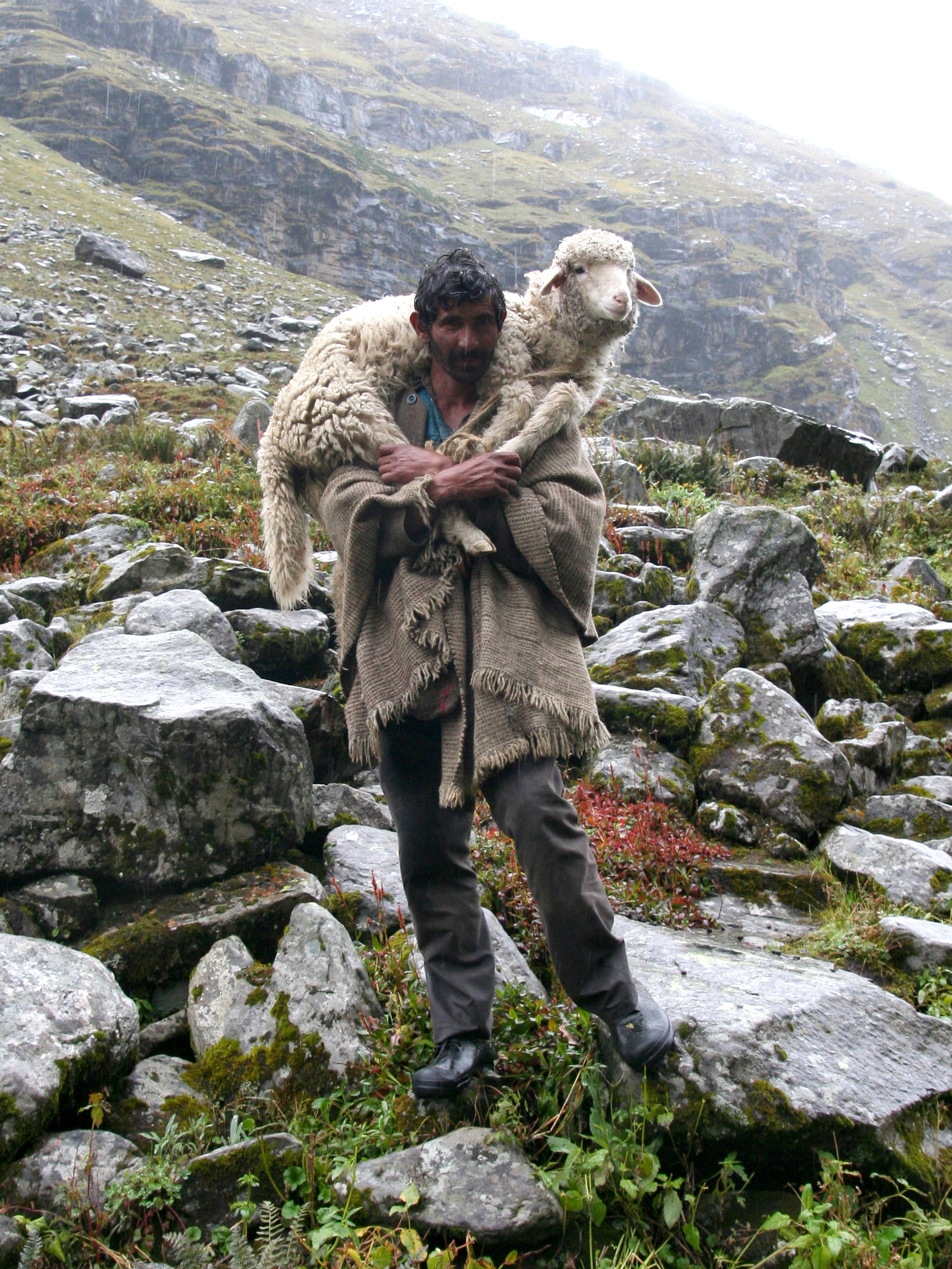
Himalayan shepherd. Image by Raja Selvaraj.

This week’s sermon from First Presbyterian, Boonville.

The text is good old Psalm 23.

Over the course of these past seven months, I’ve been getting to know all of you as I begin my tenure of service as your pastor.  During that time, one thing has become quite clear to me: it’s been a long and hard road for you in your search for a new pastor.  There’s been a lot of heartbreak and frustration.  Mistakes have been made.  New hopes have turned into false starts on more than one occasion.

I know something about how that feels.  Today, I’d like to share some of my story with you.  I’d like you to know something of the road that has brought me to you at this particular time.  I’ve had my own share of mistakes, heartbreaks, and frustrations along the way.  But I’m sharing my part of this story because I believe that, in spite of all the setbacks, the Holy Spirit has brought us together at exactly the right time.

As most of you already know, I began my career in ministry as an Episcopal priest.  The denomination I served was not the large mainline Episcopal Church that most people are familiar with.  (In other words, it was not the same denomination that’s associated with our good neighbors down the road at Trinity Episcopal on Schuyler Street.)  I served a small independent group that was founded as a separate organization about ten years ago.  Out of respect for that church and the people in it, I won’t be naming any names this morning.  I was initially attracted to their ministry ideals and their commitment to serving the poor.  But I discovered in time that a denomination that small comes with its own set of problems.  The top-down hierarchy meant there was little accountability for those at the top of the organization.  Sadly, abuse of power was bound to happen in that kind of situation.  And it did happen.

It would be inappropriate for me to go into gruesome details about the nature of the abuse, suffice to say that it eventually reached a point where I found it personally and ethically impossible for me to continue serving as a priest in that church.  So I made the decision to leave.

This was the hardest decision I have ever had to make.  Years of prayer and preparation had gone into my process of ordination to the priesthood.  The decision to serve that church was not one I made lightly or rashly.  The decision to leave was even harder.  I consulted several trusted friends, family, and professionals.  I went through some very long days of struggle and self-doubt about my sense of call to the ministry.  Yeah, it felt like I was walking “through the valley of the shadow of death”.  Not my physical death, but the death of my dreams, the death of certain close relationships in my previous church, and the death of my plans for the future.

Yes, I’ve been through that valley.  I know you’ve been through that valley as a church.  I also know that many of you have been through that valley as individuals.  So, this morning, I’d like for us all to keep our own personal experience of this “valley of the shadow of death” in mind as we explore the 23rd psalm.

First of all, this is one of the most famous passages in the entire Bible.  I had us read it together this morning in the King James Version because that’s the version in which most people are used to hearing it.  The language may sound archaic, but to many of us, it’s also comforting.

Obviously, the language of this psalm paints a picture of God as the Great Shepherd.  Shepherding was an important job in the ancient world.  Livestock was a measure of one’s wealth in those days, much like an investment portfolio is for us today.  The richer you are, the more you need a shepherd’s help.  Ironically, the shepherding profession itself was not held in high esteem.  Shepherds were thought of as dirty hillbillies.  This was not unusual in ancient agricultural societies.  More “civilized” farmers who settled down and established a homestead on a particular piece of land often looked down on the nomadic shepherds, who had to travel wherever there was sufficient pasture and water for the sheep.  Farmers spread lots of nasty rumors about shepherds.

In fact, this farmer vs. shepherd rivalry is so long-standing, some biblical scholars think it may have been the inspiration for the legendary Cain and Abel story in Genesis 4.  These two brothers were the first sons born to Adam and Eve after their expulsion from the Garden of Eden.  Cain, the elder, stronger, and more “civilized” brother was a farmer, while Abel, the younger and weaker brother was a nomadic shepherd.  I could go into more interesting detail about their story, but that would be an entirely different sermon.  For now, it helps us to see that shepherds were looked down upon in the ancient world.

What does it mean that God was identified with this necessary-but-despised profession?  I like to think it means that God, the Great Shepherd, isn’t always present to us in ways that are nice and pretty.  Sometimes, God seems to be very “rough around the edges”.  This makes me think of the character Strider in J.R.R. Tolkien’s classic, The Lord of the Rings.  Strider is a dark and mysterious wanderer.  Nobody knows if he can really be trusted, but it turns out that he is actually destined to be a great king over the land of Gondor.  In spite of his rough appearance, Strider is one of the most noble and trustworthy characters in the book.  I think that God, the Great Shepherd, is quite similar to Tolkien’s Strider.

As Psalm 23 progresses, we learn more about God’s job as the Great Shepherd.  We learn first that the Shepherd is a Guide.  The flock is destined for “Green pastures” and “still waters”, places of rest and refreshment, while they walk with God.  Even in the darkest valley, the sheep are never alone or abandoned.  Their final destination is the place where God lives, the place where a home has been prepared for them by the Shepherd.

The second thing we learn is that the Shepherd is a Guardian.  The “rod” and “staff” mentioned in verse 4 are actually weapons used to fight off wolves that might try to attack the sheep.  As flocks of sheep wandered through the wilderness, they would often have to worry about predators that might be stalking them from behind.  Who knows what kinds of dangerous and wild animals might be following the flock?  But the sheep says in verse 6 the Great Shepherd is so good at the job that only “goodness and mercy shall follow me all the days of my life”.  No wild animals here!

Third, we learn that the Great Shepherd is a Host.  The sheep says that the Shepherd “preparest a table for me in the presence of mine enemies”, therefore “my cup runneth over.”  The nomadic life of sheep and shepherds often looked unstable to outsiders.  They had little control over outward circumstances.  How could one know whether there would be sufficient food or water at the next stop?  I’m sure it was nerve-wracking.  Faith in God’s providence for our lives can be just as unsettling.  We never know whether feast or famine lies around the corner.  It feels more sane and stable to trust in the fragile and fabricated security systems of wealth and power in our society.  But the fact is that we cannot effectively “insure” our health, life, or property any more than helpless sheep can safely find their own way to food and water in the deserts of Palestine.  We need a guide and provider.  Will we trust the Shepherd to do this for us?

Fourth, we are told that the Shepherd is a Healer.  The sheep says that the Shepherd “restoreth my soul” and “anointest my head with oil” (a common medicinal practice in the ancient world).  Tending to sick and wounded sheep was a big part of the Shepherd’s job.  More than anyone else in this room, I’m sure our veterinarian friend, Terry Hausserman, could tell us detailed stories about animals in need of tender care.  God promises to do this for us.

All of these roles for the Great Shepherd (Guide, Guardian, Host, and Healer) have been much needed by me and the people of this congregation during this long and difficult period of transition.  Can God be trusted to fill these roles for us?  Well, I can tell you what I’ve seen in my own experience:

After I decided that it was time for me to leave my previous denomination, I made a call to my friend Naomi Kelly, who is the co-chair for the Committee on Ministry in this presbytery.  I explained the situation and she was sympathetic.  It would be an understatement to say that these colleagues received me with open arms.  The committees and the stated clerk of presbytery literally bent over backward to welcome me as one of their own.  It didn’t happen overnight.  Paperwork and exams were involved.  There was also the issue of receiving a call.  In order for me to come on board, I would need to receive a pastoral call from a congregation.

Well, it just so happens that, the next Sunday after my initial phone call to Naomi, I was scheduled to preach here in Boonville.  My decision to leave my previous denomination was so fresh, I wasn’t yet talking about it to anyone outside of my inner-circle of close friends.  I came here that morning and did what I always do.  But then, after the service, a group of elders basically cornered me in the sanctuary.  “What will it take,” they said, “for you to consider coming here to be our pastor?”  Let me tell you, I was totally blown away.  There was no way that any of these folks could have known about the decision I had just made in the previous week.  How is it that they picked that exact moment to approach me about becoming the pastor?  I wanted to come right out and tell my whole story right then, but prudence dictated otherwise and I simply said that we should consult the presbytery’s Committee on Ministry and ask for their guidance.

But there was obviously someone bigger than a committee that was guiding us in that moment.  In spite of the dire circumstances of that “dark valley”, I can honestly say that I have never in my life felt so clearly the presence of God the Great Shepherd as Guide, Guardian, Host, and Healer than I did in that moment.  Even as God was leading me away from an unhealthy situation, God was also leading me toward this new future in ministry.  God’s timing was impeccable.  So yes, I’ve been through the “valley of the shadow of death”, but I also know that I need “fear no evil” for the Great Shepherd is with me.  Throughout my ordeal, God has been my Guide, Guardian, Host, and Healer.

I can see the hand of the Great Shepherd at work in the life of this congregation as well.  Yes, it’s been a long and hard road in your search for a new pastor, but you’ve never wandered alone or abandoned.  In fact, you’ve always had what you were looking for.  Did you know that the word “pastor” is actually Latin for “shepherd”?  You’ve been searching for a new pastor, but all along you’ve been under the care of the Great Shepherd (the Great Pastor).  In a very real sense, I’m only serving this congregation as the “assistant pastor”.  It’s not my job to guide, guard, host, and heal you.  I’m here to help you look for the ways in which God is already doing those things.  “The Lord is my shepherd; I shall not want”.  God has been your pastor all along; there is nothing you lack.  And let me tell you, as a pastor, God is a tough act to follow!

As you sit here this morning, you may be walking through your own personal “valley”.  Maybe it’s the loss of a job, a relationship, or your health.  Your circumstances will inevitably be different from mine, but the question is the same: Can God be trusted as Guide, Guardian, Host, and Healer?  I invite you to look around in your present situation.  See whether God has already been present and active in these ways.  Also, I invite you to be patient and see what might be coming around the bend.  Ask God to show you these things.  As Jesus promised, those who seek will find.  And those who trust in the Great Shepherd will dwell in God’s house forever.

Not Thomas’ Problem

This week’s sermon from First Pres, Boonville.

The text is John 20:19-31.

There is a phrase attributed to the French philosopher Voltaire that goes something like this: “God created man in his own image, and then man returned the favor.”

What Voltaire meant by this is that people tend to conceive of God in ways that match their view of themselves and the world.  To liberals, God is a liberal.  To Tea Partiers, God is a Tea Partier.  To chauvinists, God is masculine.  To feminists, God is feminine.  To self-haters, God is judgmental.  To narcissists, God is all about them.

As finite human beings, we inevitably have to use limited human language to describe our infinite God.  We rely on images like “Shepherd” and “Parent” to understand the relationship between God and creation.  These metaphors can be helpful, because they take what is ultimately unknowable and present it in terms that are familiar to us.

The problem comes when we hold onto these images and ideas too tightly.  We try to squeeze the infinite mystery of God into finite boxes of our own making.  We try to force God to relate to us on our own terms.

Psychologists call this kind of behavior “delusional”.  The biblical authors called it “idolatry”.  People would rather bow down to visible and tangible gods of their own making than stand in awe of an invisible and eternal mystery that moves outside the realm of their understanding.

When people in our society think of “idolatry”, they imagine ancient polytheists offering various sacrifices before stone statues.  But the truth is that idolatry is not limited to one kind of religious practice.  Even Christians fall prey to idolatry.  They do it every time they try to squeeze God into the walls of a church or the pages of the Bible.  Don’t get me wrong: churches and Bibles are wonderful tools that can guide us in our relationship with God.  They can show us how to find God in our daily lives, but they are only a means to an end.  When Christians do the opposite, when they treat the means as an end in itself, and they stop looking for the divine presence in the world around them, then they are guilty of the sin idolatry.  By limiting God’s sphere of operation to a book or a building, they force God to meet them on their own terms (so they think).  This is exactly the sort of thing that we can see going on in today’s gospel reading.

The apostle Thomas, who is often called “Doubting Thomas”, gets an undeserved reputation from this passage.  There are some who chastise him as the one apostle who was unwilling to believe the truth of the resurrection.  Others praise Thomas as the father of all skeptics who demands facts before faith.  Doubt is the sentiment most closely associated with Thomas.  But I don’t think he deserves that distinction.

After all, wouldn’t you or I do the same if we heard that one of our loved ones had suddenly returned from the grave?  We would want to see it for ourselves, wouldn’t we?  Any of us would ask a lot of hard questions before we accepted the reality of a dead man walking.

Also, in his questioning of the other apostles, Thomas was only following one of Jesus’ own commandments!  In Luke 21:8, Jesus said, “Beware that you are not led astray; for many will come in my name and say, ‘I am he!’ and, ‘The time is near!’ Do not go after them.”  How can we blame Thomas for doing his job as a faithful disciple of Jesus?  So, from both rational and religious perspectives, one can understand Thomas’ reticence to accept these rumors of resurrection.

Doubt is not Thomas’ problem.  Doubt is the sign of a clear head and an honest heart.  If Thomas has a problem it has to do with one word: “Unless”.  He says, “Unless I see the mark of the nails in his hands, and put my finger in the mark of the nails and my hand in his side, I will not believe.”  With this one word (“Unless”), Thomas is demanding that Christ meets him on Thomas’ own terms.  In the arrogance of his ignorance, Thomas is convinced that he, more than all the other disciples, has what it takes to establish the criteria for true faith.

As it was with Thomas, so it is with us.  You and I live in a society that is becoming increasingly polarized in more ways than one.  People on all sides of the religious and political spectra have stopped listening to one another and started insisting on certain ideological criteria that must be met before we validate the intelligence and good faith of those who disagree with us.  Even though much of this debate takes place in the name of Christ, I fear that too little of it takes place in the spirit of Christ.  People on all sides are quick to squeeze God into boxes with labels like “biblical truth” or “human rights” and demand that Christ meets them on their own terms (whatever those terms may be).

So then, what are we to say?  Is there any hope for us “Thomases” out there?  Does this passage offer any relief from this impasse?  I think so.  John’s gospel continues the story on the next Sunday, when Thomas and the other disciples were once again gathered together.  It says at verse 26: “Although the doors were shut, Jesus came and stood among them and said, ‘Peace be with you.’”

In spite of Thomas’ roadblocks to faith, in spite of the “shut doors” that surrounded this motley crew of disciples, Jesus is present.  No barrier is sufficient to keep the risen Christ at bay.  Jesus encounters Thomas in the midst of his struggle.  He doesn’t wait until Thomas has resolved his issues.  He even offers to meet Thomas’ criteria for belief.  Jesus says, “Put your finger here and see my hands. Reach out your hand and put it in my side.”

I find it most interesting that John’s gospel doesn’t tell us whether Thomas actually did reach out and touch Christ’s wounds.  That much is left up to the reader to decide.  Whether he did or didn’t, the emphasis of the story is on Christ’s offer and Thomas’ response, “My Lord and my God!”  When faced with the real presence of the crucified and risen Christ, Thomas’ issues seem to just melt away.  In the words of the philosopher John Hick, Thomas moves from “self-centeredness” into “reality-centeredness”.  All of a sudden, his agenda, his criteria, his arrogance, and his terms just don’t seem to matter as much as they used to.  This new openness paves the way for Thomas to rejoin the fellowship of disciples and believe the truth of the resurrection, even if he wasn’t quite clear on the facts.

This gives me hope for all of us as well.  It gives me confidence that the infinite God who dwells in our midst will continue to come bursting out of our finite little boxes.  The presence of the risen Christ speaking peace to struggling unbelievers in a room full of shut doors gives me fuller assurance that the “shut doors” in my own arrogant, ignorant, and unbelieving heart cannot and will not keep the peace of Christ away from me.  This is true for you as well.  It is true for all of us.  This week, as you go back out into the cacophony and conflict in your work, home, church, and society, I invite you to meditate on this Easter truth.

The apostle Paul puts it so well in Romans 8:38-39:

I am convinced that neither death, nor life, nor angels, nor rulers, nor things present, nor things to come, nor powers, nor height, nor depth, nor anything else in all creation, will be able to separate us from the love of God in Christ Jesus our Lord.

Rejecting Rejection: An Easter Sermon

The Risen Christ by He Qi

My first Easter sermon at First Presbyterian, Boonville.  The text is Matthew 28:1-10.

Philip Gulley and James Mulholland tell a story in their book, If Grace Is True (HarperCollins: 2003), about a scene that is probably familiar to all of us (especially those of us who are parents).  It goes like this:

When I was about five years old, I demanded my mother buy me a certain toy.  She refused, explaining she didn’t have the money.

I recall flying into a rage and screaming, “I hate you!”

My mother was utterly unperturbed.  She didn’t spank me and send me to my room, though that would have been understandable.  She didn’t break into tears.  She didn’t drag me to a therapist.  She most certainly didn’t buy the toy.  She simply said, “Well, I love you, and your hate can’t change my love.”  (p.110)

I think most of us have been there, am I right?  If you haven’t experienced it firsthand, you’ve probably seen something like it in public.  As the father of a two-year-old, I’m intimately familiar with what goes through a parent’s head in a moment like that.  I worry about making a scene.  I wonder what other people must be thinking about me as a parent.  I’m scared that, no matter what I do, I might be psychologically scarring my child for life.

But when I see other parents dealing with similar meltdowns in public, I don’t judge them.  In fact, my heart goes out to them.  I don’t think they’re bad parents.  I see others like me who are just doing the best they can in a difficult moment.  The only parents I worry about are the ones who return the rage in kind.  You know what I’m talking about.  All of us lose our cool with our kids on occasion, but it’s pretty obvious when a parent in public crosses the line verbally or physically.  In the effort to maintain control of the situation, they lose control of themselves.  Those are the parents that other people tend to worry about.

Imagine what people would think if the mother in Gulley and Mulholland’s story had shouted, “I hate you, too!” and stormed out of the store, leaving this five-year-old little kid to find his own way home.  We would be horrified!  We would run to the child’s aid and probably call the police.  We would say that such a mother deserves to be locked up in jail.

Unfortunately, there are those among Christians past and present who believe that this is exactly how God behaves.  Those who turn their backs on God, so they say, are doomed for eternity.  Those who reject God will be rejected by God.  They claim that God, who is infinitely holy and righteous, must respect the freewill of these unrepentant sinners and allow them to receive exactly what they deserve.  Most Christians who believe this can quote lots of Bible verses to support their position.

What I can’t understand is this: if we would call the police on any human mother who abandoned her child in that way, then why wouldn’t we do the same for a parental deity who abandons even one of God’s children to eternal torment?  Why should we worship God for doing that for which we would incarcerate a human?  It doesn’t make sense.

Fortunately for us, that is not the God who we worship.  The God of love revealed in Jesus Christ is more like the mother in the first story from Gulley and Mulholland’s book.  When we scream, “I hate you!” at God, God responds, “Well, I love you, and your hate can’t change my love.”  This God rejects the rejection of the rebellious children.

This God would rather leave the ninety-nine sheep in the field to go search for the one who is lost.  Jesus tells us in Luke 15 that this good shepherd searches until that lost sheep is found and carries it home rejoicing.  Jesus teaches his followers to love their enemies because that’s what God does.  He says, in Matthew 5:44-45,

Love your enemies and pray for those who persecute you, so that you may be children of your Father in heaven; for God makes the sun rise on the evil and on the good, and sends rain on the righteous and on the unrighteous.

Not only did Jesus teach us about God’s love, he showed it to us in the way that he unconditionally accepted the most messed-up and undesirable people of his day as members of his own family.

More than any other story in the scriptures, the story of Jesus’ death and resurrection shows us just how far God is willing to go in order to reject our rejection.  Last Sunday, and then again on Good Friday, we heard the story of how the powers that be in the world rejected Jesus.  The political and religious authorities wanted to shut him up.  His closest disciples betrayed, denied, and abandoned him.  Last week, we also looked at the hard fact that you and I are really no different from the crowds who shouted, “Hosanna!” on Palm Sunday and “Crucify!” only five days later on Good Friday.  The cross stands as a reminder of the lengths to which we, the people of this world, will go in order to reject Jesus.  Like five-year-olds throwing temper tantrums, we scream, “I hate you!” to God at the top of our lungs.  With all our pretended power, we lash out with the very worst torture and death that we can muster.  Intoxicated by our ability to inflict death, we delude ourselves into thinking that we’re so strong.  We can even make God go away… permanently!

But then, on the third day, on that first Easter Sunday, something happened.  It says in today’s reading from Matthew that there was an earthquake.  Matthew is the only one of the four gospels to record this fact.  What does it mean?  I like to think it means that something fundamental at the very heart of reality shifted in that moment.  The power of life overcame the power of death.  The very worst of human hatred was undone by the very best of God’s love.  In the cross, the world rejected Jesus Christ.  But in the resurrection, God rejected the world’s rejection.  This is what Easter is all about!

As if this weren’t enough, look again at what happens in verse 10.  Jesus appears to the two Marys and gives them a message for his “brothers” (meaning the twelve disciples).  Remember that the last time we saw any of them in Matthew was in 26:56, when they were all running away from Jesus in his hour of need.  They rejected him.  But the risen Jesus nevertheless calls them “brothers” and invites them to return to the mission they had begun together.  He rejected their rejection.

This is (very) good news for people like me who struggle with our loyalty to God.  If God were to respect my freewill and give me what I deserve (and sometimes ask for), I would be abandoned like a five-year-old in a department store with no way home.  I am thankful that God does not respect my freewill, but goes out of the way to seek after me until I am found.  I am thankful that God has rejected my rejection.

What does this mean for all of us?

Maybe you are a Christian, but you struggle with things like sin and doubt.  Well, the good news for you is that you don’t have to impress God with your morals or your dogma.  The only thing for you to do, in the words of the theologian Paul Tillich, is “accept the fact that you are accepted.”

Maybe you’re here today and you’re not a Christian.  Maybe you want to believe in something, but can’t wrap your mind around some theological point or maybe you’re sickened by the judgmental hypocrisy of those who call themselves Christians.  The good news for you is that the God of love revealed in Jesus Christ is not the cold-hearted and small-minded bookkeeper of conventional religion.  The God I believe in is not standing at a distance, waiting to burn you in hell.  My God is just as angry about the pretended piety of so-called “saints” to which you have borne witness.  Likewise, God is not threatened by honest questions on a quest for truth.

Whatever your individual struggle may be, what I want you to take away from this Easter is that, in the resurrection of Jesus, God has rejected your rejection.  Sure, you might kick and scream like a kid having a tantrum.  You might even deny God’s existence or yell, “I hate you!” to the empty sky, but in those moments, the God I believe in just holds you that much tighter with an eternal love that will not let you go.

From “Hosanna” to “Crucify” in Five Easy Steps!

Here is the Palm/Passion Sunday sermon from First Presbyterian, Boonville.

The texts are Matthew 21:1-11 and Matthew 27:11-54.

I’d like to paint a verbal picture for you.  Think of how you would feel if you bore witness to an event such as this:

Imagine that Air Force One lands in town.  The crowd goes wild as the President gets off the plane and walks down a red carpet, flanked by a crowd of people waving American flags.  The TV news cameras are rolling as the band strikes up “Hail to the Chief”.  The President is shaking hands and kissing babies as he goes by.  After a moment, the band starts to play “The Star-Spangled Banner”.  Everyone stops what they’re doing and turns to face the flag with hands over their hearts.  Now, imagine that all of this is happening on the 4th of July.

Can you imagine how the people in this Independence Day crowd that day might feel?  If so, then you can imagine how the people felt in the crowd on that first Palm Sunday, when Jesus rode into Jerusalem.  It was a quintessentially Jewish moment.  I mean this, not just in a religious sense, but in a national sense as well.

Let’s look at the details:

First, Jesus rides into town riding a donkey with her colt.  This is exactly how the Jewish prophet Zechariah said that God’s Messiah would come.  The Jews believed that the Messiah (“Anointed One” in Hebrew) would be a mighty king who would liberate Israel from foreign tyranny so the people could live and worship in freedom.  Next, we learn that the people were making use of palm branches as they saw him coming.  This is not a random choice.  The palm tree was a national symbol for Jews in the first century.  This would be like people waving all kinds of American flags as the President drove by.  Also, people were shouting, “Hosanna!”  This comes from a Hebrew word that literally means, “Save us, please!”  It would be like people shouting “Liberty” or “Freedom Now” in our country.  This phrase, along with “blessed is the one who comes in the name of the Lord”, is part of Psalm 118, an old hymn for Jews.  Finally, all of this was happening on the week before Passover, the greatest of holidays.  Passover, for Jews, was not just a religious holiday; it was also a national holiday.  During Passover, Jews told and retold the story of how they came to be who they are as a nation of God’s chosen people.  It was like celebrating the 4th of July for Jews.

So, when all of this happened at once (donkey, palm branches, Hosanna, and Passover), this crowd of people got really excited.  They thought that big changes were about to happen for them and their country!  However, we know that this excitement didn’t last very long.  Fast forward to five days later and the same people who were shouting, “Hosanna!  Hosanna!” had started shouting, “Crucify!  Crucify!” about the exact same person.  What could have gone so wrong during those five lousy days?  Personally, it makes me glad that our elected officials get at least one full term in office before people want to hang them out to dry!

I think the answer to what went wrong that week lies in the excitement we see in the people at the beginning of the week.  Excitement is great.  It gets people motivated.  It makes them feel good about themselves.  But it has a dark side.  Whenever people get super-excited about something, it usually means that they have some pretty big expectations to go with it.  And people definitely had some serious expectations about Jesus as their Messiah.

They wanted their Messiah to be a military commander, a political administrator, and a spiritual guide (at the same time).  That’s a lot to ask of one person, but it’s what they expected (and they weren’t going to budge on any of it).  When Jesus showed up, they certainly had mixed feelings about him.  On the one hand, he healed the sick, challenged the powers-that-be, and radically reinterpreted the Torah (their Bible).  On the other hand, he refused to take up arms and talked instead about suffering and forgiveness.  What kind of “Messiah” was this?

Their confusion lasted right up until the end of Jesus’ ministry.  On Palm Sunday, it looked as if their dreams were about to come true: Jesus was acting exactly like a Messiah should.  By Good Friday, it looked as if all their hopes were dashed: Jesus was acting nothing like a Messiah should.  The great irony is that Jesus really was their Messiah (at least, that’s what we Christians believe), but his idea of Messiah was very different from theirs.  He really did wear a crown, but it was a crown of thorns.  He really was hailed as “King of the Jews”, but it was written on a sign posted above his cross.  He really did gain victory over his enemies, but it was a victory of love and not a victory of violence.

It’s easy for us to look back and chuckle at the people’s flawed expectations of Jesus as Messiah.  We have the luxury of knowing what comes next (on Easter Sunday).  They didn’t.

But I think the question is worth asking: do we have flawed expectations of Jesus as our Messiah?  Do we think we have all the answers about Jesus figured out?  Have we put him in a safe little box that conforms to our own pre-conceived notions about the world?  The tendency I’ve noticed is that, if you ask people to describe Jesus, they’ll probably describe someone who is simply a bigger and better version of themselves.  For them, Jesus is American, Middle-class, Conservative/Liberal, Presbyterian, or Christian.

The challenge of Lent, as a season of penitence, is for us to realize that Jesus is none of those things.  He is Holy (which means “different” or “special”).  He rises above the categories and ideologies that we would impose on him.

But we, like the crowds on Palm Sunday, still come with our excitement and our expectations.  But, as Jesus fails to live up to our expectations, our excitement turns to confusion, confusion to disappointment, and disappointment to anger.  So that, by the end of the week, we too stand with that crowd, screaming, “Crucify!  Crucify!”

Yes, the challenge of Lent is for us to let Jesus break out of the box that we have put him in.  The challenge is to let go of those categories and those old ways of thinking.  But the hard fact of the matter is that we have failed to do so.  In spite of our best Lenten disciplines, in spite of the chocolate we didn’t eat or the TV we didn’t watch, in spite of our honest reflection and repentance during these forty days, in spite of all those things: we would still crucify him again.  He would still shock and offend our expectations to the point where we would use any means necessary to shut him up.  Our shouts of “Hosanna in the highest!” are no more lasting or genuine than the shouts of those people who lived in first-century Jerusalem.

That’s the harsh reality, but it’s not the end of the story.  That part comes next week.  If you want to hear it, I guess you’ll have to show up!  But for now, I’ll just offer this as a foretaste of the Easter gospel:

Jesus knew what was in hearts of those people.  He knew what they were going to do to him, but that didn’t stop him.  He still drew close to them.  He welcomed their praises, shallow as they were.  He loved them, even though they would come to hate him.

As it was with that crowd so it is with us.  As faithless as we are, Jesus still draws near to us… and loves us.

Jesus Gets His Hands Dirty

Last week’s sermon from First Pres, Boonville.

The text is John 9:1-41.

One of the most annoying things about Jesus is that, when you ask him a question, you almost never get the kind of answer you expected.  He has this way of turning questions on their head.  His response tends to shed more light on the person asking the question than it does on the issue at hand.  Such is the case in today’s gospel reading.

The scene opens with Jesus and his disciples encountering a blind man while they are in Jerusalem for a religious holiday.  As they pass by, one of them asks a question that has plagued philosophers for thousands of years:  “What is the nature of suffering and evil?”

This question is especially troubling to those of us who believe in God.  People have come up with all kinds of theories that try to find an answer.  Some suggest that God is loving but not almighty.  In other words, God cares about suffering but cannot do anything about it.  Others say that God is almighty but not loving.  God could solve the world’s problems but just doesn’t care.  Finally, some suggest that God is both loving and almighty, but that all suffering is merely an illusion or a misunderstanding on our part.

For Jews in Jesus’ day, the most common answer was judicial.  They believed that everything happens for a reason.  If someone was happy, healthy, and prosperous, then that person was being blessed and rewarded by God.  If someone was suffering, then that person was being punished for their sins.  This judicial theory is probably what Jesus’ disciples had in mind when they asked, “Rabbi, who sinned, this man or his parents, that he was born blind?”

Even though they had their own pet theory to explain why this person was suffering, it didn’t answer all their questions.  In fact, their pet theory left them with quite a dilemma.  You see, the man in question had been blind from birth.  There was no way he could have violated Jewish law before the onset of his blindness.  Therefore, God was either punishing this person for someone else’s sin or God was punishing this person for a sin that had not yet been committed.  Either way, God comes across as unfair.

Jesus doesn’t resolve this dilemma for them.  He lets it stand out like a hole in the middle of a donut.  He says, “Neither this man nor his parents sinned; he was born blind so that God’s works might be revealed in him.”  Rather than taking a side in this debate, Jesus once again turns the entire question on its head.  He says, in effect, “You’re asking the wrong question.”  His response seems cryptic and mysterious because Jesus is answering the question they should have been asking all along.  He continues, “We must work the works of him who sent me while it is day; night is coming when no one can work.  5As long as I am in the world, I am the light of the world.”

What does that mean?  It means that Jesus is trying to shift their attention.  He’s saying, if you really want to look for God in the midst of these tragic situations, don’t waste your time looking at the cause of the pain; look instead at the response to the pain.  The most important thing, to Jesus, is that we be doing God’s work.  And what’s the very next thing he does?  The text says, “he spat on the ground and made mud with the saliva and spread the mud on the man’s eyes”.  In other words: Jesus got his hands dirty.  While other people were standing around and arguing about philosophy, Jesus was busy healing those who hurt most.

But the scene doesn’t stop there.  The recently-healed blind man quickly became the center of controversy in Jerusalem.  This time, the debate was all about whether Jesus had the proper credentials to work such a miracle.  Witnesses were called while scholars debated back and forth about the issue.  All the while, the healed person is stuck in the middle.  He doesn’t have any answers.  He was probably still using his brand new eyes to figure out the difference between red and blue.  When they push him, he says, “I do not know whether [Jesus] is a sinner. One thing I do know, that though I was blind, now I see.”  He stays true to his experience and simply tells the world what happened to him.

Eventually, it becomes pretty clear to this guy that he is simply a pawn being used in someone else’s religious and political agenda.  What I like best about this guy is his moxy (chutzpah).  Once he realizes what’s going on, he’s not content to play his part and go home.  No, he stands up and gives them a piece of his mind.  In more ways than one, his eyes were open.  Better than anyone else in the room, this “ex-blind man” was seeing things clearly.  So he stands up to this room full of rabbis and tells them off!

Well, these rabbis weren’t used to being spoken to like that!  After hurling a few choice insults about the nature of this man’s parentage, they voted unanimously to kick him out of the synagogue.  He was anathema, excommunicated, dis-fellowshipped, dishonorably discharged, and “don’t let the door hit you in the rump on your way out!”

So, there he was.  His situation seemed hopeless.  For years, he had been excluded from the life of his community because of his disability.  Now, he was kicked out and called a heretic.  What was he supposed to do now?  He probably felt further away from God than ever before.

I love that Jesus decides to show up again at this point in the story.  It says, “Jesus heard that they had driven him out, and… found him”.  Then Jesus affirms what the blind man had suspected all along: that he could “see” better than any of those rabbis and scholars.  In spite of their educated debate over this controversy, they had completely missed the point about what Jesus was doing.  But this blind man got it, and Jesus wanted to make sure that he knew it.  Jesus said, “I came into this world… so that those who do not see may see, and those who do see may become blind.”  Once again, Jesus makes sure that those who fall through the cracks of controversy and debate find their honored place in heaven’s economy.  The pawns become the kings.  The victims become the heroes.  Jesus shows us that these suffering and forgotten people are the ones who matter most to God.

For the past month or so, the world has been watching in horror at the multiple disasters that have befallen the country of Japan.  As if earthquake and tsunami weren’t enough, people are now facing the perils of radiation and nuclear meltdown.  The death toll has almost reached 12,000.

In times like this, many people instinctively search for answers in the midst of suffering.  They engage in controversy and philosophical debate because it’s easier than facing the reality of tragedy.  In the days immediately following the earthquake, one Christian blogger posted a statement in the style of the Old Testament prophets.  This person went on for quite a while, offering an itemized list of Japan’s sins.  The post read (speaking for God in the first person), “I will punish you for your sins with my passion, and destroy you completely Japan by earthquake and tsunami.  I will get you, the little island, back into the water, where you came from, and where you will be just like a piece of wrack (sic) sinking into the bottom of the sea.”

It’s easy to stand at a distance and pass judgment on an entire nation.  It’s harder to do as Jesus did: to get our hands dirty in the business of healing.  Our controversial issues and philosophical debates keep us at arm’s length from the suffering of our fellow human beings.  But Jesus goes out to meet these forgotten and suffering ones right where they are.

Thankfully, there are those who are doing just as Jesus did in the midst of this tragedy.  Earlier this week, I received an email from friends of my family in Japan.  It’s a statement made by an American living in Tokyo who is not a Christian.  He works in the Tokyo office of Goldman-Sachs.

Here is what the email said:

Friends

The response to the earthquake by many of the westerners here in Japan has been to head straight to the airport and get out of the country.

The Christian missionaries here have done just the opposite; they collect relief supplies and go straight to the disaster area to help out.

It is truly amazing what they have accomplished.

They collect supplies through donations from local citizens and international aid associations.

Then they get trucks, road permits and take the supplies to the 400,000 people who have lost their homes to the earthquake, tsunami and evacuations from the exclusion zone around the nuclear reactors.

Churches in the affected region are often used as distribution points.

Some of these churches have been damaged by the earthquake, and some are even without electricity.

This has been a 24/7 job for many of my missionary friends, but I have not heard a complaint from even one of them.

If someone were to ask me where I think God is in the midst of the Japanese tragedy, I would read them this letter.

When we go looking for God in the midst of suffering, whether it’s our own pain or the tragedy of an entire nation, let’s not get lost in philosophical debate over the causes.  Rather, let’s follow Jesus and get our hands dirty in the work of healing.  That’s where we’ll find God in all of this.

The Harvest is Here

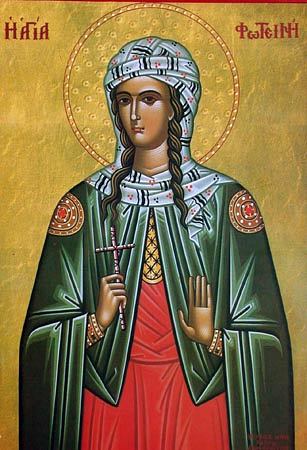
St. Photina, "The Enlightened One". Traditional name for the Samaritan woman at the well. Legend has it that she was martyred after spitting in Emperor Nero's face.

Today’s sermon from First Presbyterian, Boonville.

The text is John 4:5-42.

Over the past few decades a lot has been said and written on the topic of church growth in North America.  Most sources agree that there has been a tremendous decline in membership for older, mainline congregations like ours.  Many popular sources are selling the idea that the key to reversing this trend lies in imitating the worship style and the theological leanings of evangelical mega-churches.  However, I’m not convinced.

Here’s why: I heard about an Episcopal church in Colorado.  This was a small, traditional parish.  Their numbers were dwindling.  Almost all the members left in the pews were grandparents or great grandparents.  There was nothing about this parish that fit the popular model for church growth.  Closure seemed inevitable.

Several of these aging church members felt led to start a youth group.  They were praying for an opportunity to start one.  But even their priest was telling them not to hold their breath over it.  Their big opportunity came one day when that same priest was sitting in a local coffee shop.  He was wearing a clerical collar, which clearly identified him with his profession.

The priest looked up and suddenly, there was a teenager was standing in front of him.  This rough-looking young man was clad in leather and had piercings in every conceivable orifice.  “Hey.”  He said, “Are you one of those ministers who can do funerals without the body there?”  After taking a second to compose himself, the priest asked the teenager to sit down and talk.  As it turns out, he had a friend who had recently died of a drug overdose.  His family lived out of state and had shipped the body back east for burial.  None of his local friends had a chance to grieve their loss.  The priest said yes, their church could certainly have a memorial service for this young man.

The members of the church wanted to get involved too, but they were at a loss as to how to do it.  They had nothing in common with this group of hard-edged, punk rock teenagers.  When they prayed for a youth group, they were thinking of a cadre of nicely-dressed, well-behaved high school students who attended Bible studies and held bake sales.  What were they supposed to do with this motley crew?

After giving it some thought, they could think of only one natural way to relate to these youth: they were all grandparents.  Why not act like it?  On the day of the memorial service, they made their fellowship hall as warm and cozy as possible.  They made tea and hot chocolate.  They set out fresh-baked cookies on hand-crocheted doilies.  And when the youth arrived, everyone agreed to pretend they were their own grandkids.

Most of the youth stuck around for the reception.  Amid a sea of black leather and glinting lip rings, one could see an entire rainbow of artificial hair colors.  The event was such a success, they decided to invite the teenagers back at the same time next week.  To their surprise, most of them came back!  Week after week, the most unlikely relationships formed between these folks in their eighties and this scary-looking group of punk-rock teenagers.  They got the youth group they had been praying for, but it looked nothing like they expected!  Moreover, it bore no resemblance to the trendy programs that are supposed to attract youth to a congregation.

This kind of thing has happened before in Christian history.  In today’s gospel reading, we read about Jesus’ unconventional model for church growth in the most unlikely places.  It happened among a group of Samaritans.

This was the last place where Jesus’ disciples expected to find a warm welcome.  Samaritans and Jews shared common ethnic and religious roots, but the Samaritans were regarded as heretics and half-breeds.  No self-respecting Jew would be caught dead with a Samaritan in public.  Some Jews traveling from Galilee to Judea would go almost a hundred miles out of their way in order to avoid Samaritan territory.  It was bad enough that Jesus had decided to go through Samaria instead.  Did he have to talk to them as well?

As it turns out, these Samaritans gave this Jewish rabbi a warmer welcome than any synagogue.  Even in Jesus’ own hometown, they had tried to throw him off a cliff!  But these half-breed heretics had opened their doors and welcomed Jesus and the disciples with open arms.  When the members of the village heard Jesus speak, they all believed in him.  A church sprang up overnight in this Samaritan village.

What’s even more surprising is that the catalyst for this explosive church growth was not the local mayor or clergyperson, but the village pariah.  It was almost unthinkable that Jesus would even talk to her in the first place.  First of all, she was a Samaritan.  We already talked about the inborn hostility there.  Second, she was a woman.  Nice Jewish boys didn’t talk to women in public (not even their own wives).  Finally, she was even outcast from her own people.  The text tells us that she met Jesus by the well at noon.  In that world without air conditioning, it was ridiculous to go to a well at noon, when the sun was beating down.  Most people would go at sunrise or sunset, when the weather was cooler.  The village well is where people would gather to chat and gossip.  The only reason to go to the well at noon was if you didn’t want to bump into anyone else.

Later in the story, we learn a little more about this person.  We find out that she’d been married five times and was currently living with a man outside of wedlock. Even today, two millennia later, most people who read this story assume that she was a serial divorcee who hopped from relationship to relationship.  But here’s an important detail about ancient Semitic culture: women were not allowed to initiate a divorce.  A husband could divorce his wife for any reason (even if she burned his supper) but a wife had no rights.  She may have been abused and discarded by man after man until she landed in her current situation, where the man she was with didn’t even have the decency to make the relationship legitimate.  We don’t even know that this woman was divorced at all.  In a country with such a low life-expectancy, it’s entirely possible that she was simply widowed five times over.  It seems that she could have landed in her situation through no fault of her own.  Nevertheless, she was still considered “damaged goods” by her neighbors.  Her story would provide ample fuel for the local gossip engine.

Yet, in spite of all these barriers, Jesus chooses this woman to be the agent of transformation in her village.  He engages her in theological conversation.  He effectively ordains her as an evangelist to the village.  Through her, the entire village comes to faith in Christ and opens their arms in welcome to this band of strangers.  Jesus’ model for church growth makes use of the most unlikely people in the most unlikely places.  But, apparently, it works.

What did the disciples think of all this while it was happening?  Well, we read in the text that they were “astonished” at Jesus’ incessant boundary pushing.  It was bad enough that they had to go through Samaria at all, but then Jesus starts talking with this woman, and then they end up spending two days there: eating and sleeping with these untouchable, half-bred heretics!  If their old rabbis ever heard about this, they’d all be kicked out of the synagogue for sure!

Jesus interrupts their astonishment with an invitation.  He tells them it’s time to let go of their expectations and their pre-conceived notions about other people.  Jesus says, “Look around you.  You think the harvest is still a few months off, but I’m telling you that the time for the harvest is now!  So, get out your sickle!”  Jesus tells them it’s time for them to open their eyes and see what God is doing around them (even in this least-expected place).  He wants them to “enter into the labor”, to be part of what they see God doing here and now.  For Jesus, this is the key to effective church growth, not a bunch of fancy programs.  Jesus gets it.  The Samaritans got it.  The disciples were starting to get it.  The Episcopal church in Colorado got it.  What about us?

In spite of what popular sources say, I’m not ready to pronounce our church dead yet.  I think God still has a harvest for us here in Boonville.  It won’t look like the “good old days” all over again.  1955 has come and gone.  Likewise, it won’t look like these evangelical mega-churches.  That’s not who we are as a church or a community (besides, we don’t have the parking space).  It will involve letting go of our old expectations and pre-conceived notions.  The good news is that this is already happening.  You’re already doing it.  When you started your search for a new pastor over a year ago, who would have thought that you would be interested in calling an Episcopal priest with a pony tail?  But here we are!

What other “astonishing” surprises does God have in store for us?  Where is the harvest happening here and now in Boonville?  That’s the question we have to ask ourselves as a church.  I have a few of my own ideas about how we might answer that question.  I see this church as a haven for people who, for whatever reason, have been made to feel unwelcome at other churches in the North Country.

I’m thinking of people like intelligent skeptics who are interested in faith, but have a lot of honest questions about it.  Too many churches out there tell people to “shut up” and “get in line” with traditional doctrine.  I see this church as a place where people can ask their honest questions without fear of rejection.  Maybe we won’t even know the answers, but we can ask those questions together.

Likewise, I also see our church as the kind of place where people who are gay or lesbian can find a welcoming church home.  Too often, people in our society face exile from their churches, their families, and their homes when they “come out of the closet” (which means being honest and open about their attraction to people of the same gender).  Among youth, it’s one of the top causes of suicide and homelessness.  I believe that our church can be a place in the North Country where that doesn’t need to happen.

I envision this church as a haven where people can come, with all their doubts and their differences, and be welcomed as one of “us” rather than one of “them”.  I see this church as a place where people can come looking for belonging, and through that, find themselves believing.  This is the gospel harvest that Jesus has prepared for us.  Are we ready to “look around us” and “enter into the labor” of this harvest?  I think so.

Funeral Message

This is a sermon I recently preached for a funeral in my church.  The text is Ephesians 1:3-14.

As I was preparing this message for today, I asked around for stories about Ruth that people might like to tell.  When we gather together to celebrate the life of someone we love, telling stories often happens naturally.  We look for those moments that were particularly tender or funny.  Something inside of us reaches out for those “big” memories when we remember someone.  However, I should thank you, Emily, for reminding me that it’s not the big memories but the little ones that really stick with us.  I asked if she had a story she would like me to include in the message and Emily told me, “You know, it’s actually those little things that I remember most: things like Christmas Eve and apple pie… her apple pie.”  Likewise, I was looking through photos with Donna and Carleen the other day, and we came across one where Ruth was obviously mid-sentence and had her hand out in a characteristic gesture.  And they said they could just hear her saying, “And let me tell you something…”

It’s the little moments that we remember most.  It’s the little moments that define a person.   As it turns out, Emily agrees with the famous, ancient Roman biographer Plutarch, who said,

“I am not writing histories but lives, and a man’s most conspicuous achievements do not always reveal best his strength or his weakness.  Often a trifling incident, a word or a jest, shows more of his character than the battles were he slays thousands… so I must be allowed to dwell especially on things that express the souls of these men, and through them portray their lives, leaving it to others to describe their mighty deeds and battles.”

So today, I’m going to focus on those little moments in Ruth’s life.  As Emily and Plutarch tell us, these moments tell us the most about who Ruth is.  Also, I think those little moments illustrate best the truth that Ruth herself wanted us to hear today.

Ruth herself picked out this passage from the New Testament book of Ephesians that we read a few minutes ago.  It took a little research, because she told us the page number, but not the exact chapter and verse where she wanted us to start.  Donna, Carleen, and I looked together at Ruth’s Bible, looking specifically at the little notes she made for herself in the margins.  We don’t know why, but something about these words struck Ruth in a particular way.  The three of us got to bear witness to those “little moments” that Ruth had while reading her Bible and something struck her as meaningful.  As I was preparing my message this morning, I had a keen sense that I wasn’t just researching another passage of the Bible, but I was having a kind of second-hand conversation with Ruth herself.  There was something that she wanted to tell us through this passage from St. Paul’s letter to the Ephesians.  Let’s see if we can figure out what it is that she wanted us to hear…

If you asked the average person on the street, they would probably tell you that religion is something we do: there are particular beliefs that we accept, certain rituals that we participate in, and certain ethical rules that we follow.  But you know what’s really interesting about this passage that Ruth chose for us to read today?  It’s a quick summary of important spiritual ideas, but it says almost nothing about beliefs, rituals, or morals.  This passage says almost nothing about what we’re supposed to do!

However, it has a lot to say about what God is doing.  In this passage, it says that God has “blessed us with every blessing”, “chosen us to be his own”, God is “making us holy” (“holy” means “special”), and has “covered us with his love.”  It also says that God “adopts us into his own family” and has “showered down upon us the richness of his grace”.  Finally, it says that God “understands us” and “gathers us together from wherever we are”.  That’s quite a list!  And it’s all about what God is doing.

You and I are surrounded by this incredible mystery of infinite love.  In the Christian churches, we call this mystery “God”.  And when we say that we “believe in God”, we’re expressing our trust in that mystery.  We trust that good is stronger than evil, life is stronger than death, love is stronger than hatred, and life is stronger than death.

Philosophically, we can say that we “believe” any old fact that we observe:

“I believe the sky is blue.”

“I believe the grass is green.”

“I believe that the Packers won the Superbowl this year.”

But when we say, “I believe in you” to someone, we’re saying something about trust.  We’re saying something personal.  In a way, we’re committing a part of ourselves to what we trust in.

When we trust in this mystery of Love (when we trust in God), that commitment makes a difference in the way we live our lives.  Sometimes, it makes a difference in big ways.  But most of the time, we can see the difference in those little things.  Ruth trusts in the God who loves her, and we can see that trust and that Love flowing through her in that smile, that laugh, that look, that apple pie, that Christmas morning, those little notes in her Bible, and the kiss goodbye.

You, and I, and Ruth are surrounded by this Love that will not let us go.  It holds us together in life and in death.  It’s bigger than the universe and older than time.  Today, I want to invite you to trust in that Love.  Let it shine through you in those little things you do, just like it did in Ruth.  That’s what it means to be a spiritual person.  That’s what it means to be a person of faith.  Ruth understands that and I think she wants us to understand that as well.

Born Again… and Again… and…

Nicodemus?
Nicodemus?!

This week’s sermon from First Pres, Boonville.  The text is John 3:1-17.

There’s a guy with whom my wife went to high school named John.  In many ways, John was a stereotypical rebellious teenager.  He was really into parties and some drugs.  He questioned authority on everything. He walked around with enough chips on his shoulder to fill a Dorito bag.  But there was one way in which John did not fit the stereotype: he went to church every week.

Let me be clear about a few details: First, his parents didn’t make him go to church.  He decided to go on his own.  Second, John didn’t put on a pious façade for his church family.  He didn’t pretend to be one person on Saturday night and another on Sunday morning.  In fact, John was just as bitter and cynical at church as he was at home or school.  When people asked him why he bothered to go to church at all, he openly told them, “I don’t practice Christianity.  I don’t believe it.  I don’t get it at all, but I keep thinking that someday I might, and I want to be here when that happens.”

In a lot of ways, John reminds me of Nicodemus in today’s gospel reading.  He doesn’t “get it” either.  Jesus talks to him about being “born again” (or “born from above”) and “the wind blowing where it chooses” but it all goes straight over his head.  If anything, Nicodemus walks away from Jesus with more questions than answers.

At the beginning of the passage, it says that Nicodemus “came to Jesus by night”.  Most biblical scholars agree that this isn’t just talking about the time of day.  Rather, the author is trying to tell us something about Nicodemus himself.

A little background information might help that make sense:

The author of John’s gospel has a lot to say about Jesus being “the light of the world”.  Light-imagery comes up again and again in John.  Jesus is the light, while the rest of the world, by contrast, is dark.  So, when John says that Nicodemus “came to Jesus by night”, it means that Nicodemus exists in a state of spiritual darkness.

That being said, Nicodemus doesn’t seem to be such a bad guy.  First of all, he addresses Jesus with an unusually high degree of respect.  He uses the title “Rabbi”.  This is not what one would expect.  Nicodemus was a socially prominent, educated, and pious Jew.  Jesus, on the other hand, was without formal education and hailed from Nazareth, a place not known for producing prodigies.  In today’s terms, it would be like a Harvard professor walking up to a country bumpkin and calling him “Doctor” or “Reverend”.  Listen to what he says to Jesus: “Rabbi, we know that you are a teacher who has come from God; for no one can do these signs that you do apart from the presence of God.”

We meet Nicodemus again in John 7, when he defends Jesus against the attacks of the religious leaders.  Finally, he shows up in John 19, where he helps to bury Jesus and honors him with an expensive funeral fit for a king.  Nicodemus never has a distinct “born again” moment of conversion.  In fact, it’s unclear if he ever actually became a Christian.  Ancient legends indicate that he did eventually join the Church, but the scriptures themselves don’t state that explicitly.  Based on what we do know of him in John 3, 7, and 19, it seems like Nicodemus was on a slow and gradual journey of spiritual growth.

He feels genuinely drawn to Jesus, but he still struggles.  He’s curious enough to ask questions, but he’s not yet ready to make a leap of faith.  He wants to believe, but something inside is holding him back.  Does any of this sound familiar to you?  It does to me.

Like Nicodemus, I don’t have a distinct “born again” moment in my life.  I too have been on a slow and gradual journey of spiritual growth.  I’ve often been challenged with new ideas that go straight over my head at first.  I’ve had to go back to the beginning to reread and reinterpret my Bible so drastically that I felt like a kid in Sunday school all over again.  In that sense, you could say I was “born again… and again… and again.”

The NRSV translates “born again” as “born from above”.  When it says “from above”, it’s kind of like when a jazz musician says to the band, “Let’s take it from the top.”  It means, “Let’s start all over again.”

So, what causes this kind of “starting over” to happen?  We know straight away that it’s not the direct result of intellectual argument.  Throughout this passage, Nicodemus is trying to have a philosophical discussion with Jesus, but Jesus isn’t playing along.  Nicodemus keeps asking, “How can this be?”  And Jesus keeps throwing out these images that seem to make no sense.

In this way, Jesus is acting like a Zen master who is trying to expand his student’s consciousness.  Zen masters do this by presenting their students with something called a koan.  A koan is a kind of riddle that can’t be solved with rational thought.  The point is for the student to meditate on the riddle until she learns to break out of old habits of thinking.  For westerners, the most well-known koan is, “What is the sound of one hand clapping?”  Jesus’s words about being “born from above” and “the wind blowing where it will” are kind of like a Christian koan.  He’s trying to help Nicodemus expand his thinking to a spiritual level.

The realm of the spirit is far bigger than the realm of the mind.  On a spiritual level, people are able to grasp certain truths that defy rational explanation.  For example: Christians believe that God is both three and one; Jesus is fully divine and fully human; the bread and wine are also the body and blood of Christ.  These ideas are contradictions when we try to understand them rationally, but they make sense as spiritual truths.

Presbyterian and Reformed Christians have often emphasized this “more than rational” quality of faith and spirituality.  For us, “faith” is more than a list of doctrines to which we give intellectual assent.  We believe that faith is a gift.  Faith doesn’t come about from sophisticated intellectual arguments.   It grows in us by the inspiration of the Holy Spirit.  The Holy Spirit is God at work within us and around us.  The Spirit leads us in the direction of faith, goodness, and wholeness.  This is taking place, even before we profess our faith in Christ.  Look at Nicodemus: the text tells us that he was still in “darkness”, but something was attracting him toward Jesus, the light of the world.

There’s a particular image in this text that really stood out to me this week.  Jesus tells Nicodemus that one must be “born of water and the Spirit” in order to enter the kingdom of God.  What does that mean?  Some scholars think that this is a reference to the sacrament of baptism, and they may well be right about that.  Other scholars think that Jesus is comparing two different kinds of birth: natural and spiritual birth.  We know that when a baby is born into this world, a lot of water is involved.  For the first nine months of its existence, a baby lives in the darkness of the womb, surrounded by this amniotic fluid.  The fluid (this “water”) protects the baby and feeds it with vital nutrients until it’s ready to be born “into the light” of this world.

In the same way, Nicodemus is kind of like an embryo in this passage.  He’s not ready to be born.  He still lives in “darkness”.  But the Holy Spirit is kind of like the amniotic fluid of a mother’s womb.  The Spirit surrounds him and feeds him with nutrients until he’s ready to be born (again and again).

This image gives me hope for myself and other people like Nicodemus and John, my wife’s friend from high school.  None of us totally “gets it” when it comes to Christian faith.  We’re struggling, we’re doubting, but we’re also growing.  Nicodemus is repeatedly drawn to Jesus.  John was inexplicably drawn to church.  I am continually drawn back to the scriptures, trusting that God has yet more light to shed on my understanding.  It’s comforting for me to know that none of us is alone in this journey.  You may feel like you’re constantly starting over.  You may feel like you’ve got more questions than answers.  You may feel like you’re just wandering aimlessly.  But let me give you some hope this morning: you are being nurtured by the Holy Spirit and led from darkness into light.

If you sense that attraction at all, I encourage you to follow it.  Keep coming back to church.  Keep searching the scriptures, even if you don’t understand them.  Keep on reaching out to God in prayer.  Keep on coming back to be fed by the sacrament of the body and blood of Christ.  I encourage you to follow this attraction and see where it leads you.  It might not happen all at once, but I have faith that eventually, you will “get it”.  We all will.  Thanks be to God.

Into the Wilderness

Cordelia Chase from "Buffy the Vampire Slayer"

This week’s sermon from First Pres, Boonville.  The text is Matthew 4:1-11.

Today marks the first Sunday in the season of Lent.  They say that Lent is a time for admitting and giving up your vices.  I’ve got one that I’m not quite ready to give up yet, but I don’t mind admitting it to you: I watch too much TV.  That may not sound like much at first, but it gets more impressive when you realize that I don’t actually have a TV in the strictest sense of the term.  My wife and I have a unit on which we can watch videos and DVDs, but it receives no signal from the airwaves.  So, whenever we want to watch something new, we have to go through the effort of procuring our own material.  So, when I tell you that I watch too much TV, believe me when I tell you that it’s a lot of work!

Lately, I’ve been indulging my addiction with a show called Buffy the Vampire Slayer. It’s a ridiculous story about an average high school student named Buffy in Sunnydale, California who happens to hunt vampires and other monsters in her spare time.  She does this with the help of her school librarian and a few misfit friends.

One recurring character in the show is a classmate of Buffy’s named Cordelia Chase.  Cordelia is “the popular girl” at Sunnydale High.  She is as shallow as her family is rich.  She looks down on Buffy and her friends.  Most of the time, Cordelia is just a bully who blocks Buffy’s path to acceptance and happiness in high school.

Anybody who went to high school probably knew someone like Cordelia Chase.  Unfortunately, the entire experience of teenage politics is usually defined by people like that.  Individuals gain power by sucking up to the popular and stepping on the unpopular.  What’s even sadder is that the rest of the world seems to operate on the same principle.  The politics of the board room are remarkably similar to the politics of the locker room.  Some people just never outgrow those manipulative games.  It’s just the way the world is.

I think we get a taste of that world in today’s gospel reading.  It’s the famous story of Jesus’ temptation in the wilderness.  In this story, Jesus comes face to face (and toe to toe) with the spirit of this world system and all its power-mongering.  The question on the table in this scene is, “What does it mean to be the Son of God?”  In other words, will Jesus be a king like all the other powerful rulers on earth or will he be different?  Jesus faces three separate temptations, but beneath them all is this one, lingering question.

We’ve already read the story, so you know what the three temptations are: to turn stones into bread, to throw himself from the pinnacle of the Temple, and to worship the devil.  Let’s look at them one at a time:

First, the devil tempts Jesus to turn stones into bread.  Remember that Jesus was fasting and hadn’t eaten for forty days.  The temptation here is for Jesus to make use of his power to meet his own needs first.  Isn’t that how powerful people act in times of scarcity?  They circle the wagons and look out for themselves.  They take of their own needs first.  Is that the kind of king that Jesus is going to be?  As it turns out, Jesus says no.

In the second temptation, the devil takes Jesus to the pinnacle of the Temple in Jerusalem and invites him to make a spectacular leap from the top.  The kings of this world rely on “shock and awe” techniques and dramatic displays of power in order to foster loyalty.  Will Jesus do the same?  Jesus says no.

In the third temptation, the devil shows Jesus the splendor of all the kingdoms of the world and promises to hand them over if only Jesus will bow down to Satan.  The devil knows that Jesus has come to establish a kingdom.  He offers Jesus the chance to pursue God’s ends through Satan’s means.  It’s an apparent shortcut to power.  The rulers of this world often justify their means by their ends.  As long as you’re going somewhere good, what does it matter how you get there?  You and I are asked to sacrifice our integrity for gain on a daily basis.  But Jesus says no.  For Jesus, who you are and how you get there is just as important as where you’re going.

There is one detail in the second temptation that’s particularly interesting to me.  It has to do with place and movement.  The devil moves Jesus to the pinnacle of the Jerusalem Temple.  This was the holiest spot in the holiest city on earth.  Isn’t it ironic that the devil is leading Jesus toward church?  We usually think of him doing the opposite.  What’s even stranger is that, once they’ve arrived, the devil starts reading from the Bible, quoting Psalm 91.  Get this: the devil is reading scripture in church.  We usually think of this place as a sanctuary from the brutality of the world, but those who have been around for a while know that even church can be a pretty dark place sometimes.  Power-hungry people of all ideological stripes co-opt pulpits and twist the Bible to fit their agendas.  In this passage, it looks like Satan comes dressed in a clerical collar and a stole.

So, where is God in all of this?  The fate of Jesus’ ministry is hanging in the balance and a power-hungry devil is reading the Bible in church.  Is God absent or silent while this is going on?

Well, we get lots of little hints scattered throughout the text.  Let’s look again at location and movement in the text.  We read in verse one that the Spirit leads Jesus into the wilderness.  Isn’t that interesting?  The devil leads Jesus closer to the center of religion and power (Jerusalem) while the Holy Spirit is leading him out toward the edges (the wilderness).  There aren’t many literal deserts in this part of New York, so what might this mean for us?  I wonder where the “edges” of life are for people in our community?  Where are the places that are farthest from the centers of power and religious practice?  Who lives there?  What kind of people are they?  Who in our community is least likely to come to church?  Could it be that the Holy Spirit is leading us to walk out to meet them, rather than waiting for them to come in here?

It’s a powerful and disturbing image: the devil is preaching from the Bible at the front of the church while the Holy Spirit is ushering Jesus out the door.  I want to let that image sink in.

I don’t think we all need to get up right now, leave, and never come back to church.  But I should also confess that I have a conflict of interest there, since my salary depends on you staying!  But can we at least look at the movement in this passage and focus our attention toward the direction in which the Spirit is moving?  Let’s follow the Spirit’s leading into the “wilderness” of our community where people are famished in more ways than one.

This is the way that Jesus walked.  Jesus says no to turning the stones into bread for himself, but he says yes to miraculously providing bread for a hungry crowd later on.  Jesus says no to a spectacular display of power in the religious center, but he says yes to teaching and healing large crowds of hurting people on the hills and in the streets.  Jesus says no to sacrificing his integrity for power, but he says yes to sacrificing his life for us.  The devil wanted Jesus to wear a crown of gold and sit on a throne, but Jesus chose to wear a crown of thorns and hang on a cross.

In the TV show I’ve been watching, Cordelia Chase eventually walks the way of the “wilderness” as well.  She keeps crossing paths with Buffy and her nerdy, vampire-hunting friends.  Slowly but surely, she is drawn into their misfit community and away from the popular crowds.  In time, Cordelia is transformed from a bully into a sympathetic character who cares deeply about the needs and pain of others.  In the end, she even becomes one of the heroes.

How might the Spirit be calling us to follow Jesus into the wilderness?  What will our church family start to look like as we reach out beyond the walls of our sanctuary and touch the lives of those who are farthest from it?  How will we be changed as we let go of this world’s power-grabbing tactics and embrace the way of the cross?

I want to leave these questions open for you to ponder as we move through Lent toward Easter.  As you let these questions take root in your imagination, you will be opening yourself to the leading of the Spirit in new ways.  And I believe that you too will be able to sense the same Spirit that raised Jesus from the dead bringing new life to you, to your community, and to our church as well.

Honesty Not Guilt

Ash Wednesday sermon from First Pres, Boonville.

I remember when I first graduated from college and moved back to the town in North Carolina where I grew up.  I was 22, single, and ready to conquer the world with my brand new Philosophy degree in hand.  On my first Sunday back, I decided to attend services at the large suburban church where I grew up.  I spent a little extra time getting ready that morning.  I had been an awkward, shy kid as I grew up in that church, but in college, I really came into my own.  I was much more sure of myself than I used to be.  “This time,” I thought, “I’ll impress them all with how intelligent and charming I can be.”  So, for my first Sunday back, I dressed to the nines and gave myself the once (even twice) over in the mirror before I left the house.  “Yup,” I thought as I walked up the sidewalk to church, “This is the beginning of a whole new era.”

This church had a large Sunday school class for young professionals, so I decided to show up early, make some new friends, maybe even check out the dating situation.  I shook some hands, learned some names, and then sat down as Sunday school began.  I was super-excited because Tim, the pastor leading the class, had been that church’s youth pastor when I was in junior high and high school.  He was funny and wise and had guided me through some tough times in those years.  I was looking forward to hearing him speak again.

As class was starting, Tim asked if there were any newcomers to the group.  I raised my hand and introduced myself.  Tim exclaimed to the class, “I remember this the guy from junior high youth group!”  And then, abounding in affection but somewhat lacking in tact, Tim began to tell stories to this room of a hundred young singles; stories about what I was like at age 12.  Suddenly, that awkward and shy, 7th grade version of myself was on public display for all to see.  My carefully rehearsed image was shattered and, as the sympathetic laughter grew around me, my face turned the same shade as the maroon shirt I had so carefully picked out that morning.

People in our society invest a lot of time, energy, and money in their image.  They hang their diplomas and awards on the wall.  They keep a careful watch on the clothes they wear, the cars they drive, and the neighborhoods they live in.  People spend millions on face-lifts, tummy-tucks, Botox, Bow-Flex, and (when none of it makes them truly happy) psychiatrists.  We want to appear confident and competent in front of our neighbors.  We want the beauty of youth with the benefit of experience.  We idolize life and success.

So, it seems odd then, when Christians gather together each year and celebrate Ash Wednesday, an entire holiday apparently dedicated to failure and death.  We talk about sin.  We talk about death and returning to dust.  We talk about our total failure to maintain that perfect, practiced image in front of the world.  In fact, we even mar that perfect image with smudges of ash on our foreheads.  Isn’t that morbid?  Why spend an entire day focusing on the very things that society teaches us to hide?  Is the Christian God really interested in humiliating us?

I don’t think so.  And I don’t actually think it’s all that morbid to spend time meditating on these things.  In the end, Ash Wednesday is not really about guilt and death.  It’s about honesty.  Our faith in a loving God gives us the courage to face honestly those things that the rest of the world would have us hide.  In a culture that glorifies youth and beauty, we make a point of remembering our death.  Youth and beauty are wonderful things to celebrate, but they cannot tell us who we are as human beings.  Youth and beauty pass away with time, but who we are as God’s children lasts for eternity.  We do not need to fear death because we know that the God who loves us and has held us throughout our lives will continue to love us and hold us in eternity.  God’s love empowers us to face death with courage.

Likewise, in a culture that worships success, we make a point of confessing our failures.  In any other setting, that would be a career-ending move.  But here in church, we celebrate the God who loved us, even while we were yet sinners.  Our constant failing and flailing about in life neither impresses nor threatens God.  God is not moved by our resumes or achievements.  Likewise, God is not frightened at our failures.  God’s unconditional and undeserved love is a given.  God knows your every fault and every flaw, but does not stop loving you for them.  Theologians have called this aspect of God’s character “grace”, which means “unmerited favor”.  This grace is what we celebrate on Ash Wednesday.

We celebrate the fact that the grace and love of God empowers us to get honest with ourselves and the world.  We now have the ability to live as free and forgiven people.  We are free of the rat-race and the beauty myth.  We wear our ashes as a token of our faith that love is stronger than death and grace is stronger than sin.  Empowered by this love and grace, we can go out into the world with the gift of honesty.  We can live as real people in a world that would rather cover up its flaws.

My attempt at constructing a new confident and competent image didn’t last long.  My pastor’s affectionate faux pas taught me something about honesty and love.  He taught me that true love is not blind.  Real love sees the truth and loves anyway.

In my moment of red-faced embarrassment, I didn’t know what to say except, “I love you too, Tim.”