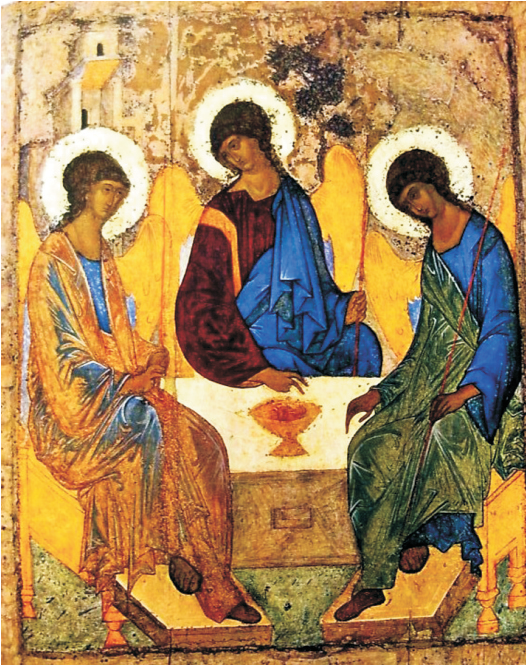
Is Ketchup a Smoothie? A Sermon on (Not) Understanding the Holy Trinity

Sermon for Trinity Sunday

Service Bulletin:

There are several different kinds of knowledge.

First, there’s book smarts, like knowing that tomatoes are a fruit and not a vegetable.

Then there’s practical wisdom, like knowing that it’s not a good idea to put tomatoes in a fruit salad.

And then there’s philosophy, like wondering whether that means ketchup is technically a smoothie.

Today, we’re going to be talking about that third kind.

Today, we celebrate Trinity Sunday, conventionally known in the Episcopal Church as “associate rector appreciation Sunday” because this is the week that senior rector’s most often take as their vacation. They would much rather leave the explanation of complicated and abstract concepts to those younger clergy who have more up-to-date seminary training. Since we don’t have an associate rector in our parish, and I failed to accurately calculate the week of my vacation, this enviable task has now fallen to me.

So, instead of building up to a conclusion, I’m going to cut straight to the chase. Here’s the main thing I’m going to say about the mystery of the Trinity:

If you think you understand the mystery of the Trinity, you do not understand the mystery of the Trinity; if you do not understand the mystery of the Trinity, you understand the mystery of the Trinity.

Got it? Good. Amen. Let’s all get out of here before the Methodists get the good lunch tables at the diner.

Of course, the problem is that this little riddle leaves us right back where we started, so we end up going around and around until our heads fall off… and that’s the point of the whole thing.

The mystery of the Holy Trinity is the primary Christian concept of God. According to the historical documents of the Anglican theological tradition, “we worship one God in Trinity, and Trinity in Unity, neither confounding the Persons, nor diving the Substance” (The Creed of St. Athanasius, BCP 864). The three Persons of the Godhead are “of one substance, power, and eternity” (Articles of Religion, BCP 867). Don’t worry, I can hear all of you mentally checking out, as we speak.

This is why I started with my main statement: If you think you understand it, you don’t understand it; if you don’t understand it, you understand it. It’s like wondering whether ketchup is a smoothie. The question itself supposed to break your brain, not to break it down, but to break it open and leave you slack-jawed in awestruck wonder at the unknowable mystery of ultimate reality.

The doctrine of the Trinity is not explicitly outlined in the Bible. It gradually came together, over the course of several centuries, as the greatest minds of the early Church contemplated their experience of God. Beginning with the monotheism of the Jewish tradition, the earliest followers of Jesus realized that they were, in some way that they couldn’t understand, experiencing the very presence of the God of their ancestors through this individual human being. How was that even possible? They had no idea; they just experienced it to be true. And then, just as mysterious, they continued to experience this Jesus as a living presence in the midst of their community after his death. How was that even possible? They had no idea; they just experienced it to be true. Their knowing had neither the categorical certainty of book smarts nor the effectiveness of practical wisdom. Their knowing was a knowledge of the heart: more like falling in love than solving a math problem. As the philosopher Blaise Pascal famously said, “The heart has its reasons of which reason knows nothing.”

After almost three hundred years of contemplation, the bishops of the early Church finally settled on the mystery of the Trinity as their non-answer to a question that, by its very nature, can never be answered. Whenever some innovative theologian claimed to have solved the mystery, the bishops of the Church were quick to stand up and pronounce that answer as a heresy, not because they thought that they had a monopoly on the truth, but because they believed that the main thing is to keep the question open.

If you think you understand the Trinity, you do not understand the Trinity; if you do not understand the Trinity, you understand the Trinity.

I love this central commitment of our faith tradition. We don’t claim to have the answers to ultimate questions. We sit in awestruck wonder before the mystery of reality. This is why I like to say that I couldn’t be a Christian, if I wasn’t also an agnostic.

The ultimate unknowability of the mystery of God affords Christians a certain playfulness, when it comes to expressing that mystery in various ways. The language of our tradition tends to default to language that is very personal, very masculine, and very hierarchical. Most of our prayers use words like “Father” and “Lord” to describe the mystery of God, but the witness of our sacred Scriptures point to a wide array of metaphors for expressing our faith in God.

In addition to the exclusively masculine language of Father, the Bible also describes God as a “Mother” (Isaiah 66:3). In addition to the hierarchical language of Lord, the Bible also describes God as a “Servant” (Luke 22:27). In addition to the numerous personal metaphors for God, the Bible also describes God as a “Mighty Rock” (Psalm 62:7), “Living Water” (John 7:38), “Rushing Wind” (Acts 2:2), and “Consuming Fire” (Hebrews 12:29). As I mentioned in a previous sermon, Jesus even compares himself to a chicken in Matthew 23:37.

Therefore, kindred in Christ, since the Bible itself gives us such a wide array of metaphors for the Divine, and since the bishops of the early Church were so doggedly committed to keeping open the question of God’s unknowable nature, we too ought to remain open to exploring a wide variety of metaphors for God.

God is with us always and in all things. Therefore, let us also look for her, for him, for them, for it, always and in all things. How is God like a cloud or a tree? How is God like a chair or a bookshelf?

Jesus, in his parables, often pointed to agricultural metaphors that were common to the everyday experience of ordinary people, when describing the realm of the divine. For Jesus, the realm of the divine was like a woman baking bread (Matthew 13:33), like crops growing in a field (Mark 4:26-29), like a merchant trading in the marketplace (Matthew 13:45-46), like a small seed growing into a great tree (Matthew 13:31-32). This is not an exhaustive list, by any means.

I want to encourage you today to be playful in the many ways that you imagine God to be present in your life. The language we use about God matters, not because we have to be careful to get it right, but because we cannot get it wrong. Everything is potentially a symbol of God, yet nothing fully encapsulates the mystery. Whenever we try to put God in a box, whether that box is Pope-shaped, Bible-shaped, Church-shaped, man-shaped, or colored white, we commit the sin of idolatry and close ourselves off to the great mystery of the divine.

God is with us always, and in all things, therefore let us keep open the question of what God truly is. Let each of us remain humble in our own conceptions of God and tolerant of the expressions of others. As brothers, sisters, and siblings, let us stand side-by-side, following the example of the Bible and the early Church, and maintain a posture of awestruck wonder before the divine mystery that is beyond our understanding.

The Blessing of Babel

Sermon for the Day of Pentecost

Click here for the biblical readings

There are people in this world who enjoy a good fight, but I am not one of them.

I tend to enjoy conversations more when people with differing opinions can come together on some kind of common ground. As a result, I try to look for that common ground whenever I find myself in a debate with someone. I think that, if we can just identify the core values on which we agree, then we will see that we don’t really disagree, and we can work out the minor details of whatever differences we appear to have.

I imagine that I am a typical midwestern Episcopalian in this respect. We are nice people. We don’t go in for loud fights about rigid dogmas. We like everyone to get along. Our liturgical church tradition allows for a great diversity of theological interpretations. After all, we are descended from the Church of England, the land of good manners, so politeness is in our DNA.

Most of the time, this tendency serves us well. There are times, however, when it doesn’t. When I worked as a chaplain, I once had a patient who was a very bitter and bigoted man. He would rant for hours and use all kinds of ethnic slurs against the groups of people he didn’t like.

In particular, he believed that Hispanic people “would never fully integrate into American society” because they were too different from white people. The funny thing, though, is that this patient didn’t realize that I have one parent from Philadelphia and another from San Juan, Puerto Rico. With my light-colored skin and English last name, he assumed that I was just another white guy like him, but in reality, I am half-Hispanic. Our family integrated so well into “American society” that the dividing line between cultures ran right through the middle of my own body.

I could have said something about this to my patient, but I didn’t. This was partially because healthcare chaplains are trained to avoid controversial topics with patients, but it was also because I simply didn’t feel like dealing with it. By keeping silent, I allowed a part of my identity to be erased in the interest of keeping the peace.

I sometimes wonder what would have happened if I had politely mentioned the truth about my ancestry to my patient. Maybe it wouldn’t have changed anything at all, but then again, maybe that might have been an opportunity for the Holy Spirit to open up an avenue for growth in this man. I will never know because he passed away before I got to do another visit with him.

There are all kinds of ways that people build walls of protection around themselves. Sometimes, it takes the form of a hostile attitude that pushes other people away. Sometimes, as in my case, it takes the form of polite silence, with a smile and a nod. Sometimes, as in the case of today’s first reading from the book of Genesis, it takes the form of a literal wall around a great city and its mighty tower.

The legend of the Tower of Babel is a cautionary tale about the downside of human progress. The human race, as we read in the text, settled in the land of Shinar and spoke a single language. According to most traditional interpretations, God felt threatened by human progress, so they punished the people by confusing their languages and scattering them across the face of the earth.

I find this interpretation unsettling. Human progress, after all, is largely a good thing. In the last hundred years alone, humanity has cured diseases, ventured into outer space, and reduced extreme poverty to a fraction of where it was in previous generations. On the other hand, we have also continued to pollute the land, water, and air of our planet, constructed nuclear bombs with the power to destroy entire cities, and committed cold-hearted acts of genocide with industrial efficiency, as we did in the Holocaust. Progress, it seems, is a double-edged sword.

In the beginning of the biblical story, when God first created the heavens and the earth, they invited humanity to “be fruitful and multiply and fill the earth” (Genesis 1:28). But humanity, it seems, had another idea. They preferred to remain stationary, centralize power, and maintain a homogeneous culture in a walled city. This was the opposite of what God intended for the human race. God had made a huge planet for humanity to explore, with all kinds of diverse life-forms and creatures. God meant for the human race to be explorers, but we settled for being settlers in the place where we were.

This is the real reason why God confused the languages of the people of Shinar at the Tower of Babel: not to punish us, but to push us out of the nest and into the wide world. Diversity of language and culture is not a curse, but a blessing. It calls us out of our comfort zones to become the kind of people we were always meant to be.

Fast-forwarding to this morning’s New Testament lesson, from the Acts of the Apostles, we read about the day of Pentecost, when the Holy Spirit descended upon Jesus’ disciples and allowed their message to be heard and understood by people of many languages. Some interpretations of this passage have understood this miracle as a reversal of what happened at the Tower of Babel. The confusion of languages was resolved by the movement of the Holy Spirit.

Once again, though, I find this interpretation unsettling. It is based on the former assumption that what happened at Babel was an act of punishment. But, if I am correct in thinking of the diversification of languages as a blessing, then what happened at Pentecost is a fulfillment of that original blessing. Under the inspiration of the Holy Spirit, the people were able to discern a single message that was being communicated through multiple languages. Underneath the diversity of cultural expressions was a common thread of understanding: One Spirit speaking one message in many different ways. This interpretation of the Tower of Babel and the Day of Pentecost has profound implications for how we practice our faith as Christians today.

We live today in a world that is both more connected and more isolated than ever. Through the miracle of telecommunications, we have the ability to talk to people on the other side of the world in real time. Through the magic of the internet, we have access to a vast supply of information that previous generations couldn’t even dream of. However, our human tendency to gather in homogeneous groups of people who think alike, look alike, pray alike, vote alike, and love alike has led us to seek shelter from the vastness of the universe in echo chambers of people who will only confirm what we think we already know.

Kindred in Christ, I think it is past time for us to reclaim the double blessing of Babel and Pentecost in our own day. The price of remaining isolated in sheltered towers of like-minded individuals is nothing less than the survival of our species itself. As the great American intellectual Benjamin Franklin once said, “We must all hang together, or assuredly we will all hang separately.”

God is once again calling us to discern the voice of the one Spirit speaking in diverse tongues. What this requires of us is that we listen intently to the voices of our neighbors who speak different languages, practice different religions, vote for different candidates, and love different partners than we do. It requires also that we speak courageously, tolerantly, and lovingly from our own perspectives on these issues.

Let us not hide in fear behind walls of hostility or politeness, when it comes to the questions that matter most, but “speak the truth in love” (Ephesians 4:15) so that we might discern the voice of the one Spirit who speaks through many languages. Let us place our faith in God, who inspired St. Paul to write:

“There are varieties of gifts but the same Spirit, and there are varieties of services but the same Lord, and there are varieties of activities, but it is the same God who activates all of them in everyone. To each is given the manifestation of the Spirit for the common good.”

(1 Corinthians 12:4-7)

Beloved kindred, let us not give way to the cynicism of this age that despairs of finding common ground and sets humanity on a common course toward oblivion. Let us instead place our faith in Christ, who came that we “may have life and have it abundantly” (John 10:10). Let us take the risk of speaking our truth and listening with love, that we too might hear the voice of the one Spirit who speaks in many ways.

Amen.

A Prayer for Universal Oneness

Sermon for the seventh Sunday of Easter.

Click here for the biblical readings.

Today’s sermon is going to be a little bit different.

Rather than teach you about the spiritual principles that connect to our gospel reading, I am going to guide you into a meditative experience of those principles in action. If all goes well, you won’t have to have anyone explain these truths for you because you will know them yourself, in the very fiber of your being.

First, a little bit of setup:

Today’s gospel reading forms a kind of climax to the gospel according to St. John. The whole book has been building to this point. It begins with a series of poignant hints that Jesus drops about his true identity. The words he says, the things he does, and the people he meets all gesture toward some mysterious truth that will be revealed later on.

In the next section, Jesus starts to speak more openly about what this truth might be. Most people still don’t get it, but enough of them are scratching their heads enough to stick around and find out.

After that, Jesus begins a very confusing speech on the night before he dies. He seems to be talking in circles about metaphysical ideas that make no sense, even to his closest disciples.

Finally, he stops talking to his disciples altogether and speaks only to God, while the disciples listen in on the conversation.

That is the part of the story where our gospel reading picks up today. Jesus is talking to God and the disciples are listening in. What he says seems to go in circles and makes little sense to the rational mind.

In many ways, this is intentional. The story of John’s gospel starts with a wide view of Jesus and the people who knew him, but then gradually zooms in to Jesus and his disciples, Jesus himself, and finally inside the mind of Jesus to his personal relationship with God, like Father and Son.

Jesus’ words in this passage are mysterious and circular. If you feel dizzy when reading them, that’s good! It means you are paying attention. The mind of Jesus is a baffling place.

What we see, inside the mind of Jesus, is the interconnected web of all existence, going back to the beginning of time itself. He prays, “As you, Father, are in me and I am in you, may they also be in us,” and then, “the glory that you have given me I have given them, so that they may be one, as we are one, I in them and you in me, that they may become completely one.”

It’s meant to be confusing stuff. It’s supposed to leave us reaching for the bottle of Advil because we can’t fit the vastness of divine truth inside our tiny human brains. Any God that we could fully comprehend would not be worthy of name “God” and certainly not worthy of our worship.

So, instead of explaining himself to us, Jesus gives us the briefest of glimpses into his mind, so that we can experience the reality of sacred interconnectedness for ourselves.

The concept of sacred interconnectedness is not unique to Christianity or even to the subject of religion. Our neighbors who practice in the Hindu spiritual tradition believe that the Atman, the individual soul, is essentially one with Brahman, the ultimate reality. In the scientific field of quantum physics, subatomic particles are not separate bits of matter, but fluctuations of energy in a common field. What Jesus realized, along with spiritual masters and brilliant scientists of every time and place, is the truth that separateness is an illusion. What lies at heart of reality is an inexplicable and inexpressible unity. This is why he prays to his Father, in today’s gospel, “that they may be one, as we are one.”

The most fundamental spiritual truth of all reality is not that there is a God up in heaven, but that God can be found here and now, in the space between you and me. That is the truth that we get to glimpse in today’s gospel, and that is the truth that I hope you take away from today’s sermon.

If you are willing, I would like to invite you to join me on this journey into awareness of our fundamental oneness. This is a very personal journey that no one must undertake. The reality of it will remain true, whether you choose to join me or not, whether you choose to use the word “God” or not. This will be a journey of facts, not beliefs, so even those who do not identify as Christian can undertake it.

I invite you to begin by closing your eyes or letting them gently drop to a space right in front of you, if that is more comfortable to you…

Pay attention to the rhythm of your breathing. In and out, in and out…

Feel the weight of your body, sitting in the pew or chair where you are…

Notice the feeling of your feet on the floor, your back on the pew, and any other sensations that appear in your body…

If there are any little twitches or pains, just let them be for now…

Notice any thoughts that pop into your mind and then let them go…

Even if your thought is, “This is stupid,” that’s okay. Just let them come and go…

The goal is not to stop your mind from thinking, but to not be attached to these thoughts, as they come and go…

If you have a thought, just notice it and let it go, like a helium balloon floating off into the sky, and then gently return your attention to the rhythm of your breathing…

Recall the sum total of the events of your life that led you to this moment, where you are sitting in a pew…

Maybe you came here out of longstanding tradition or habit, or maybe you came because you are searching for something deeper in your life and are wondering whether this worship service might contain the answer to what you are searching for…

Consider the processes taking place within your own body at the cellular level…

Consider the millions of micro-organisms that exist in your gut and on the surface of your skin…

Consider the fact that there are more bacterial cells in your body than human cells…

Consider the words of the poet Walt Whitman: “I contain multitudes”…

Without opening your eyes or looking around, imagine the people around you in this room, all of them your fellow worshippers, on a common human journey to understand who we are, where we came from, and where we are going…

Each person’s journey is as unique as your own; no two are alike…

If you are comfortable with it, expand your awareness to the people who are not in this room…

Their life journeys, like ours, are utterly unique, but they share many of the same hopes, fears, and questions…

Now, if you are comfortable with it, consider the ground beneath the floor of this church…

Consider the many life forms that live there…

Imagine their connection to the trees, roots, and grass of the plants outside…

Think about the bodies of those plants absorbing moisture and nutrients from the soil and light energy from the sun…

Think about the flowers and fruits that grow from those plants…

Consider the animals that feed off those flowers and fruits…

Bees, squirrels, and other creatures…

Think about the carnivorous animals that feed on those animals, distributing the sun’s energy into the never-ending circle of life…

Consider what happens when those animals die, how their bodies return to the earth and fertilize the plants, thus beginning the cycle of life again…

Now, if you are comfortable, remember that all life on earth is carbon-based…

In all the universe, there is only one place where a carbon atom can be made: In the heart of a star…

All the carbon in your body once resided inside a star that went supernova, scattering the elements of life into the universe, where they were gathered again on the surface of this planet, and now take the shape that bears your name. This is why we can say, without exaggeration, that you are literally made of stardust…

Some worry that evolution means we are related to monkeys, but I say, “Don’t worry; evolution means that your ancestors are the stars themselves…”

Feel the truth of this scientific fact deep down in your bones, where it is literally true…

Feel the vast network of stars and galaxies that stretches out beyond the bounds of your imagination, reaching light years to the edge of the observable universe (and perhaps beyond), encompassing all of creation at distances that you could not begin to fathom…

Imagine each of those subatomic particles bursting into existence at the moment of the Big Bang, 13.8 billion years ago…

There are parts of your body that are as old as the universe itself…

When time itself began, you were there…

When the atoms of your body were formed in the heart of a star, you were there…

When the asteroid fell that wiped out the dinosaurs 65 million years ago, you were there…

The very same air molecules that you are currently breathing in may have also been inhaled by Abraham Lincoln, the Buddha, or Jesus of Nazareth…

As Martin Luther King, Jr. famously said, “We are all caught up in an inescapable network of mutuality; what affects one directly, affects all indirectly…”

Keeping the cosmic scope of this meditation exercise in mind, I invite you to reconsider the words that Jesus prayed to his Father in today’s gospel:

“[I ask] that they may be one, as we are one.”

Do you get it?

Sermon for the sixth Sunday of Easter

Click here for the biblical readings

It’s always annoying when someone walks into a movie late and asks, “What’d I miss?”

My wife and I share equal blame for this particular crime against convenience. Not wanting to be a burden, one of us will say, on our way to the kitchen, “You don’t have to pause it; this will just take a second!”

Inevitably, the all-important snack retrieval process will take longer than expected and the kitchen-goer will miss some pivotal moment in the plot, leaving the other person with the unenviable task of rewinding the video or explaining what just happened. It would have been easier to just pause it, but we will probably never learn.

Well, I’m sorry to have to tell you this, but that’s exactly what has happened to us in today’s gospel. The editors of the Revised Common Lectionary (i.e. the three-year cycle of biblical readings that our church follows in its Sunday worship) decided to cut out the beginning of the scene that we read this morning. In this scene, Jesus is answering a question posed by one of his disciples, but we never get to hear what the question is!

So, for the sake of clarity, I would like to pause the movie and explain what happened while we were out of the room. (If anyone needs to go to the kitchen for a snack, now would be a good time.)

So, the verses we read this morning come from a section of John’s gospel called “The Farewell Discourse.” It takes place on the night before Jesus dies, just after he washes the disciples’ feet at the Last Supper.

In the Farewell Discourse, Jesus answers three questions from three of his disciples: Thomas, Philip, and Judas. The passage we heard today is from Jesus’ response to the third disciple, Judas. The author of John’s gospel goes out of the way to let us know that this Judas is not the infamous Judas Iscariot, who betrayed Jesus, but another disciple of the same name.

Jesus had just finished explaining, “In a little while the world will no longer see me, but you will see me” (John 14:19). Judas asked in reply, “Lord, how is it that you will reveal yourself to us, and not to the world” (John 14:22)?

Today’s gospel picks up with Jesus’ response to this question:

“Those who love me will keep my word, and my Father will love them, and we will come to them and make our home with them. Whoever does not love me does not keep my words; and the word that you hear is not mine, but is from the Father who sent me” (John 14:23-24).

The context of Judas’ question is important for understanding Jesus’ response.

For centuries, many have wondered: Why do some people seem to “get it” when it comes to matters of faith, and others don’t?

Many potential answers to this question have been suggested. Some say that those who “get it” are those who are able to suspend their faculties of critical thinking and “just believe” without question. I can understand the appeal of this approach for those who aren’t constitutionally inclined toward philosophical discourse, but for those who are, this is a violation of their intellectual integrity. Belief without evidence, for such people, would be like asking any of us to betray our core moral convictions. If faith requires suspension of our moral reasoning, then faith is evil. I can understand why intelligent people of good conscience would reject faith on these grounds.

Others have suggested that the inability of some people to believe in Christ is due to the fact that God chooses some people to be saved and others to be damned. The so-called “elect” are predestined for salvation while the “reprobate” are doomed, no matter what they do, say, or believe. This was the view taken by John Calvin, who inspired the Reformed and Presbyterian traditions of Protestant Christianity. I don’t mean to be too harsh against our brother Calvin (or the Reformed/Presbyterian churches), because they too are our kindred in Christ, but I must protest (pun intended) that such a reliance on the sovereignty of God does violence to the loving character of God, who “desires everyone to be saved and to come to the knowledge of the truth” (1 Timothy 2:4).

The final answer to the objection that some seem to “get it,” when it comes to faith in Christ, while others don’t, comes from the atheists, who say that it is the atheists who fully realize the fact that there is no God, therefore those who believe in God are victims of a mass deception, designed to imprison credulous believers in a jail of their own imagination.

I deeply respect the commitment of said nonbelievers to their intellectual integrity, but I also question whether they have placed too much faith in their lack of faith. True skepticism must become skeptical of itself, if it is to remain true to its core belief in the power of open inquiry. The “maybe not” of the skeptic must also be the “maybe so” of the agnostic, if the principle of free thought is to be maintained.

It should come as no surprise that I reject all three of these explanations, though I can see the individual merits of each. The answer that Jesus gives, in response to Judas’ question in John 14, does little to address the doubts and conclusions of any of these groups.

The answer that Jesus gives is rooted, not in philosophical arguments, but in the principle of love. Jesus says, “Those who love me will keep my word.” Jesus’ word is his command. What is his command? He answers in chapter 15, verse 12: “This is my commandment, that you love one another as I have loved you.” Love for one another is his commandment.

What is the result of his commandment? He says so in today’s gospel: “Those who love me will keep my word, and my Father will love them, and we will come to them and make our home with them” (John 14:23).

To love our neighbor is to love Christ, and to love Christ is to love God, therefore the only way to love God is by loving one another. The New Testament makes this even more plain later on, when it says, in 1 John 4:20, “those who do not love a brother or sister whom they have seen, cannot love God whom they have not seen.”

Therefore, kindred in Christ, the answer to Judas’ question is not knowledge but love. We may never know, with any certainty, whether the basic tenets of the Christian faith are literally true, but we can prove the efficacy of our faith in the way that we treat each other, our neighbors, and even our enemies. I can’t prove to you the fact that Jesus is the Son of God, but I can hopefully demonstrate, in the way that I live my life, the truth that the meaning of life can be found in loving one another the way that Jesus loves us, without condition or proviso.

I dare to proclaim to you this morning that the meaning of life is love itself, and I have come to experience the ultimate expression of love through the life, death, and resurrection of Jesus Christ our Lord. I pray that my actions toward you will be a testimony to this love, and I pray furthermore, that your actions in this life will be a similar testimony to the living love of the risen Christ, who continues to love this world through you.

There is no proof I can offer of the truth of Christ, except the evidence of a life lived in love. I pray that you and I will be faithful in our living witness to the love of Christ. If I am right, then a life lived in love, in the name of Christ, will be all the proof we need.

Amen.

What is this world coming to?

Sermon for the fifth Sunday of Easter

Click here to read the biblical texts.

Breakdowns lead to breakthroughs.

That is a tenet of faith in which I wholeheartedly believe. I believe it because I have lived through it on multiple occasions.

One such occasion occurred when I was about thirty years old and still serving as a pastor in my previous denomination. A local news station in upstate New York, where I lived at the time, wanted to interview me on their morning show because they had heard that I was a clergyman who supported equal marriage rights for couples of the same gender. I gladly did the interview and went home.

Later that night, the hate comments started to appear on the internet. All kinds of people were calling me a “heretic” and a “false prophet.” Some said I should be stripped of my ministry credentials. A rescue mission, where I had been a regular guest preacher for years, called to inform me that I had been banned from speaking in their chapel ever again.

I realized in that moment, as I was hearing so many angry voices shout Bible verses at me, that my understanding of the Bible had shifted dramatically from the perspective I had been raised with. I had come to appreciate the Bible as a collection of voices, reporting on their spiritual experiences, and pointing our way to God, but I no longer “believed in the Bible” as the absolute and infallible authority on historical and doctrinal matters. The people lobbing these hateful comments in my direction believed the Bible to be something fundamentally different from what I believe it to be. Therefore, I could no longer consider myself to be a member of their ideological tribe.

This realization threw me into a mental tailspin. If I no longer believed the Bible to be the literal “word of God,” then what did I believe? Could I still call myself a Christian? Did I even believe in God? Was my faith dying because I had sold out to secular fads, instead of clinging to spiritual truths? These were questions that kept me up at night.

Thankfully, I had a wise spiritual director who guided me through my crisis of faith by listening without judgment and recommending good books like The Dark Night of the Soul by St. John of the Cross. Through my director’s companionship, I came to realize that my faith was not dying, but evolving. I was eventually able to say, “Yes, I am still a Christian, and yes, I believe in God,” even though I now understand both of those things in very different ways than I had before.

That was one of my many breakdowns that later led to a breakthrough. Your personal breakdown might be similar, but then again, it might be very different. I think particularly of my many friends in recovery from addiction who had to “hit rock bottom” before they finally got sober. I think of those who have lost jobs, relationships, or health, through no fault of their own, but simply because life doesn’t always turn out as planned.

In moments like these, it’s very normal and understandable for struggling people to look at life and see only the chaos of disaster and tragedy. Even if the chaos isn’t impacting you personally, it’s easy to simply watch the evening news and wonder, “What is this world coming to?”

I think that’s a great question to ask, so long as we don’t presume the answer before we’ve even finished asking the question: “What is this world coming to?”

Scientists have the beginning of an answer to that question. Many of them have noticed that the universe, over the course of its 13.8 billion year history, seems to be moving in the direction of increased complexity and cooperation. In the beginning, there was only physics. Immediately after the Big Bang, there were lots of elementary particles, which later formed into atoms. Atoms bonded together to form molecules, giving rise to the science of chemistry. On this planet (at least), chemical reactions gave rise to the emergence of biological life in the form of single-celled organisms. Life then evolved to the point of more complex organisms, that had brains. Brains evolved to the point of developing consciousness. Human consciousness developed to the point of organizing itself into small groups. Those small groups organized themselves into large, complex societies with laws, technology, medicine, and artistic expression.

It is, of course, undeniable that the course of history has often been meandering, with many fits, false starts, and backsliding along the way, but if we take a step back to look at the big picture of the universe, we can see objects and organisms organizing themselves into increasingly complex patterns of cooperation. Cosmologist Brian Swimme says, “Four billion years ago, the earth was molten rock; now it sings opera.”

Scientists, by virtue of their profession, do not claim to know for certain whether this evolution of complexity, from atoms to opera, is the result of random chance or intentional design. Their job is just to describe what they see, but humans can’t seem to stop themselves from asking the question. Our brains are neurologically hardwired to search for patterns of cause and effect. When that search for a cause takes us past the limits of pure reason, we naturally begin to engage our imaginations and speak the language of the heart.

About a hundred years ago, there was a paleontologist named Pierre Teilhard de Chardin, who studied the evolution of life in great detail. It just so happens that Teilhard was also a Jesuit priest. He undertook his own search for truth with the head of scientist and the heart of a mystic.

When science could not answer Teilhard’s burning questions about life’s origin and destiny, he found himself meditating on Revelation 21:6, which we heard this morning in our second reading, “I am the Alpha and the Omega, the beginning and the end.”

It seemed clear to Teilhard that “Alpha,” the first letter in the Greek alphabet, was meant to refer to God as the creator of the cosmos. But what did the text mean by saying that God is also the “Omega,” which is the last letter in the Greek alphabet?

Meditating on this question through the lens of his Catholic faith, Teilhard came to believe that, just as the universal Church comprised members from “every tribe, language, people and nation,” so the entire universe itself was being drawn toward eventual unity in the cosmic Body of Christ.

We naturally ask the question in chaotic times, “What is this world coming to?” For Teilhard, with his scientific mind and mystical heart, the answer was, “Christ.” The Church, in his mind, is only the beginning of the unity that will eventually incorporate the entirety of human society, planet Earth, and even the cosmos itself. This, for Teilhard, is what it means to believe that God is both “the Alpha and the Omega, the beginning and the end.”

For us, as people of faith and people of science, it is no small task to trust that the universe is headed in this direction. As we have already noted, there are setbacks and disasters that threaten to overwhelm us with chaos. Moreover, the entire project is so huge that we cannot possibly complete it under our own power.

Today’s reading from the Revelation to St. John paints a picture of the end of history as a beautiful garden city where all things are made new and death is forever swallowed up by life. Our psalm this morning develops that idea even further, envisioning a symphony of praise that incorporates, not only all people, but plants, animals, and cosmic forces as well.

Do we dare to believe in this utopian vision? If so, then how on earth do we get there?

Obviously, the task is too big for us to complete ourselves. We human beings cannot do much to affect the progress of distant stars and galaxies. After all, we even feel helpless to resolve the problems that beset us on this “tiny blue dot” called planet Earth.

So, what can we do and how do we do it? There’s more than one answer to that question, but I think Jesus starts us down the right path when he says in today’s gospel, “Just as I have loved you, you also ought to love one another” (John 13:34).

Obviously, this is a very general statement, even vague, if we leave it undeveloped at the level of pious words and sentimental feelings. But love, as those know who have tried to do it, is always simple but never easy. Love only exists at the level of concrete action. As finite beings, we cannot adequately love the entire universe, but we can make a difference at the local level in the way we treat ourselves, one another, and our fellow creatures on earth. Through our acts of love toward one another, our love for the universe and God takes on flesh and becomes a concrete reality. In short, we love God through our neighbors.

This is the secret to transforming breakdowns into breakthroughs that inch the universe closer to its final destiny of unification in the Body of Christ, as Teilhard understood it.

This love asks much of us. It continually takes us outside of our comfort zones and challenges our previously-held assumptions. We can see the early Christians doing just this in today’s first reading, taken from the Acts of the Apostles. In this passage of Scripture, St. Peter is being called on the carpet by his fellow leaders in the early Church. Up to that point, Christianity had been an entirely Jewish movement. But now, a group of Romans, led by Cornelius the Centurion, had become interested in following the way of Jesus and even began to have mystical visions and other kinds of spiritual experiences. St. Peter saw this happening and decided to go ahead and baptize these non-Jews into the Church, even though that had not first converted to Judaism. It was a controversial decision on St. Peter’s part that almost split the church. After much discussion and debate, the Church decided to extend the boundaries of love to include all people, no matter what their culture or ethnicity of origin. I imagine the council’s eyes going wide with wonder after they heard Peter’s story and said, “Then God has given even to the Gentiles the repentance that leads to life” (Acts 11:18). They had realized, in a flash of spiritual insight, that God’s arms are big enough to embrace the whole world.

Kindred in Christ, we live in a world that often seems to be on the brink of tearing itself apart. I don’t want to minimize the pain that comes with the question, “What is this world coming to?” But I do want to encourage you with the faith that trusts that this universe is indeed going somewhere good. In the language of science, it is proceeding toward patterns of ever-increasing complexity and cooperation. In the language of our faith, the whole creation is being drawn to unity in the cosmic Body of Christ. We cannot get there on our own, but each of us can do our part to love one another as Jesus loves us, and so build up a new world from the ashes of the old.

Amen.

My Sheep Hear My Voice

Sermon for the fourth Sunday of Easter (Good Shepherd Sunday)

Click here for the biblical readings.

Some of you may have seen the classic comedy film Monty Python and the Holy Grail, which came out exactly 50 years ago last month. There is a scene in this movie where King Arthur and his knights have to correctly answer three questions before they will be allowed to cross a bridge. Sir Lancelot the Brave goes first. The gate keeper asks him: “What is your name? (Sir Lancelot.) What is your quest? (To seek the Grail.) What is your favorite color? (Blue.)” After answering correctly, he is sent on his way. Next comes Sir Robin the Not-quite-so-brave-as-Sir-Lancelot. The gatekeeper asks him: “What is your name? (Sir Robin.) What is your quest? (To seek the Grail.) What is the capital of Assyria?” When Sir Robin responds, “I don’t know that,” he is immediately yeeted into the ravine. 

Obviously, having quick, clear, and certain answers was beneficial to King Arthur and his knights in this situation. There are times in life when the same is true for us, as well. Sometimes, it’s just convenient (What’s 5 times 2?). Sometimes, it’s important for solving an immediate problem in a crisis (When your clothes catch fire, what do you do? Stop, drop, and roll). But then there are some questions which simply do not lend themselves to quick, clear, and certain answers. 

For example, let’s consider a philosophical question about the nature of good and evil. The Bible clearly says, “Thou shalt not murder.” Did God command this because murder is wrong, or is murder wrong because God commanded it? (The philosopher Plato explored this question in his dialogue Euthyphro.)

If we say that God forbade murder because it is wrong, then we must admit that there is a force in the universe that is more powerful than God, because God cannot go against what is right. Therefore, God is not almighty. 

But if we then turn around and say that murder is wrong because God commanded it, then God’s will is arbitrary. God could have just as easily commanded, “Thou shalt murder,” and we would be morally obliged to obey it. Therefore, God is not good. 

I won’t get us bogged down in this philosophical question because it’s not the point of this sermon. I only mention it to point out the fact that there are some big questions that do not lend themselves to quick, clear, and certain answers.

Today’s gospel presents us with just such a question. 

The religious authorities come to Jesus and ask, “”How long will you keep us in suspense? If you are the Messiah, tell us plainly.” This is a very big and complicated question.

The concept of a Messiah was actually a fairly recent development in Judaism at the time of Jesus. The word itself simply means “Anointed” and could refer to any prophet, priest, or king who was chosen by God. It was only in the years leading up to Jesus that the title of the Anointed came to refer to a coming leader who would liberate the Jewish people from foreign occupation.

It made sense that the religious leaders of Judea would be wondering about the Anointed in this passage because the text tells us that this conversation takes place during “the festival of the Dedication.” The word “Dedication,” in Hebrew, is “Hanukkah.” 

So, this conversation is happening during the holiday season. [By the way: This fact is worth remembering the next time you hear a fellow Christian getting upset that not everyone says “Merry Christmas” in December. You can tell them that, in John 10:22, Jesus Christ himself celebrates Hanukkah, so we Christians should gladly say “Happy Hanukkah” to our Jewish neighbors.]

The festival of Hanukkah celebrates a time when God raised up the Maccabee brothers to liberate the Jewish people from oppression and genocide. That’s why it makes sense that the religious leaders of Jesus’ time were pressing him to tell them plainly whether he was the Messiah. 

In response to their question, Jesus says, “I’ve already been telling you, but you haven’t been listening.” He goes on to say, “Look at the things I do; my actions speak for themselves.” After that, Jesus says, “My sheep hear my voice.”

We have to unpack that sentence a little bit. First of all, the word “sheep” is a bit of a loaded term these days. Jesus uses the term “sheep” to describe his “flock,” which is the community of believers. There are some ornery people on the internet these days, a few of them claiming to be Christians, who use the word “sheep” to describe docile people who lack critical thinking skills. Given Jesus’ use of the term, I think “sheep” is an inappropriate insult for Christians to use. Also, and much more importantly, I think that insults are an inappropriate thing for Christians to use. So, maybe let’s not do that.

Second of all, there’s the issue of what Jesus meant by, “hear my voice.” 

Obviously, the people physically standing around Jesus in that moment could understand the words that were coming out of his mouth. They could “hear his voice,” in the literal sense, but I think Jesus was talking about a different kind of hearing. 

The kind of hearing that Jesus was talking about is a hearing with the ears of the heart. When we listen closely to someone that we know well, we can sometimes hear the deeper meaning of what’s not being said. My wife can sometimes communicate with me by simply giving me a particular look. I can sometimes figure out when my kids are lying to me, just by looking at their faces. That’s the kind of communication that can happen when two people know each other intimately, and that’s the kind of “hearing” that I think Jesus is talking about in this passage.

Hearing the voice of Jesus is a complicated thing. Some of us imagine that it happens like it does in the movies, when the clouds part, a beam of light shines down from heaven, and a booming voice tells the main character exactly what they’re supposed to do.

The truth is much more subtle that that. Allow me to give a personal example of a time when I think that I may have heard the voice of Jesus.

It happened several years ago, when I was working at a job that I did not particularly enjoy, and to which I was not particularly suited. The voice came, not as a direct command, but as a question.

I kept at the job, day after day, because I thought that I, as a husband and a father, needed to be a provider for my family. One day, as I pulled back into the parking lot after my lunch break, I was trying to steel myself up to back into the office. I kept repeating to myself, like a mantra, “I have to provide for my family! I have to provide for my family!”

It was in that moment, as I sat in my car with my forehead on the steering wheel, that I heard an imaginary voice pop up in the back of my head. I was still repeating, “I have to provide for my family,” and the voice said, “Provide what, exactly?”

That was a really good question. My job was providing a paycheck to my family, but it was also robbing them of my presence and my peace. 

To make a long story short, I decided to leave that job before I had found another. The financial cost was certainly significant to my family, but the fact is that, for the next year when I was out of work, my wife and kids got the best of me. That year changed the way I parent. I went from being an authoritarian rule-maker to the kind of father who listens to the emotional needs of his children. I learned how to cook and clean around the house. My wife began to grow, personally and spiritually, in ways that led to us saying that we are now “in our second marriage to the same person.” 

By the end of that year, I had run a half-marathon, been confirmed as a member of the Episcopal Church, and enrolled in a chaplain training program that shaped my career for the next six years. It was not at all easy, but it was worth it.

The voice I heard was just a simple question in the back of my mind, but the effect was life-transforming. Looking back, I truly believe that I heard the voice of Jesus speaking to me as I rested my head on the steering wheel of my car that day.

The voice of Jesus is not merely contained to the recorded words of a man who lived two thousand years ago. The voice of Jesus is the voice of our risen and living Lord, who continues to speak to us by the power of the Holy Spirit. As the old Sunday School hymn says: 

“He lives! He lives! Christ Jesus lives today! 
He walks with me and talks with me, along life’s narrow way. 
He lives! He lives, salvation to impart. 
You ask me how I know he lives? 
He lives within my heart!”

Kindred in Christ, I want you to know today that Christ Jesus lives today, within your heart. He walks with you and talks with you. The risen Christ is always with us and is always speaking. The only question is: Are we listening? Truly listening with the ears of our hearts?

There is no formula for how to listen to the voice of Jesus with ears of your heart. Each person’s relationship with the risen Christ is deeply personal, therefore it takes as many different forms as there are people in the world. Nevertheless, there are some tips that many have found helpful across the ages, and I would like to share them with you today.

First and foremost, I want to encourage you all to read your Bible and pray every day. There is no better way to grow in your faith, as a Christian. In the Episcopal Church, we have a wonderful resource for doing this well: in the Daily Office of Morning and Evening Prayer, as it is found in the Book of Common Prayer. This systematic way of praying touches on all the major points of the faith and leads you through most of the Bible, once every two years. If you don’t have a Bible or prayer book, please come to see me and I will get you one for free. There are also many online apps and podcasts that do the heavy lifting for you, so all you have to do is press play and listen. 

The Daily Office is a most excellent way to grow in your ability to hear the voice of Jesus, but it isn’t the only one. There are a number of other devotional guides, like Forward Day by Day for example, that provide a way for us to slow down and focus on what matters most. If you have found another source of insight that speaks to you, then by all means, use that. 

There are also several meditation techniques, like mindfulness practices or centering prayer, that can help us to slow down, quiet our racing thoughts,and pay attention to what is happening within us and around us.

Keeping a journal can be a way for us to sort through the scattered events of our days, organizing our thoughts and feelings into a coherent whole. Recording our dreams can provide insight into what is happening in our subconscious mind.

Mutual support groups, like Twelve Step recovery programs, book groups, or Bible studies, can provide us with the opportunity to hear God speaking to us through other people. Likewise, a trusted therapist, spiritual director, mentor, or clergyperson can be a vessel for God to speak truth into your life.

All of these are just suggestions and ideas. The way that God speaks to you will not be exactly like the way God speaks to anyone else. The main thing is that you trust that God is indeed speaking to you, and that you do the best you can to listen to that voice. 

You will never do it perfectly; I promise you that you will mess it up on a daily basis, just as I do, but I also want to encourage you to keep trying. In time, you will learn to hear God’s voice more and more clearly, which will remind you of the promise of Jesus, who said, “My sheep hear my voice,” and “Remember, I am with you always, to the end of the age.”

“People like me aren’t allowed to become pastors”

Sermon for the third Sunday of Easter

Click here for the biblical readings.

Parents, in my experience, have a way of knowing us better than we know ourselves. I know this because I am a parent and because I have parents.
Much to my chagrin, my parents have often been able to finish my sentences, predict my next move, and see a part of my personality that I thought I had hidden well.
I felt particularly cornered one day when my mother aptly pointed out that I suffer from an “over-active conscience”. Little things, small errors in judgment that most people would be able to let go, bothered me to the point of needing to confess to someone. On one such occasion, my father interrupted my tirade of self-loathing to give me one bit of advice. “Son,” he said, “go easy on yourself.” To this day, that’s some of the best advice I’ve ever received.
These scrupulous tendencies in myself brought me to the point where I disqualified myself from serving as a minister in the church. Even as I attended seminary, people would naturally ask me, “Are you planning to pursue a career in ordained ministry?” I would respond, “People like me aren’t allowed to become pastors. And that’s a good thing!”
Because of this experience, I think I have a pretty good idea of how St. Peter felt at the beginning of today’s Gospel reading. This story comes to us from the end of John’s gospel, after Jesus has been raised from the dead. Peter was certainly present for the events which took place around Easter Sunday, but the last time he played a major role in the plot of this story was on the night when Jesus was arrested. Earlier that evening, Peter had expressed his unwavering loyalty to Jesus in no uncertain terms. By the next morning, Peter had publicly denied that he even knew Jesus. He did this, not once, but three times.
This was no minor misstep for Peter. In doing this, he turned his back on his faith; he rejected everything he had come to believe about God through Jesus. But more than that, Peter had also turned his back on his closest friend at a critical moment. According to ancient near-eastern custom, Peter’s infidelity had violated Jesus’ honor. Jesus would be expected to demand vindication for such an offense. Perhaps Peter thought of those words which Jesus had spoken earlier, “Those who are ashamed of me and my words, of them the Son of Man will be ashamed when he comes in his glory and the glory of his Father and of the holy angels.
So Peter was probably not all that surprised when at Jesus’ first appearance after the resurrection, his friend did not address him directly. I can imagine Peter, in his crushing guilt, believing that his denial had purchased his exclusion from the ranks of apostles. He had been reduced from the role of leader to that of spectator. When Jesus commissioned his apostles, saying, “As the Father has sent me, so I send you.” I can see Peter, sitting in a far corner of the room, relieved to see Jesus, excited for his friends, but also sad for himself. I can even imagine Peter saying the same thing I did, “People like me aren’t allowed to become pastors.”
After the events of Easter, Peter has to decide how to get on with the rest of his life. It made perfect sense for him to return to fishing, the only life he knew before Jesus. I find it interesting that six other disciples accompanied Peter in his return to the maritime business. I like to imagine that they went along as Peter’s social support system. Maybe they were hoping to shake Peter out of his paralyzing guilt so that he would come and join them as they sought to preach the Good News about Jesus to the ends of the earth.
Peter, hoping he could forget the past (or at least put it behind him), was finding his old job to be a hollow pursuit on multiple levels. We read that his nets kept coming up empty.
I think this is a comment about something more than the fishing conditions at the Sea of Tiberias. I think we, as the readers of this story, are getting a glimpse inside Peter’s soul at that moment. The fisherman’s life to which he was returning seemed empty and meaningless after his experience of traveling with Jesus. I also imagine that it must have been hard for Peter to work those same shores, remembering the day he met Jesus on that very spot, when Jesus used his boat as an impromptu pulpit.
In this sad moment, the risen Christ makes a sudden reappearance. Jesus encounters Peter in the midst of his daily routine and brings two gifts. First, he brings Abundance. Like the symbol of emptiness, this miraculous catch is a sign to Peter that he is about to find that which he was really seeking (and here’s a hint: it isn’t fish).
As they are gathering the nets, one of the disciples, the one “whom Jesus loved” (identified as John by most biblical scholars), turns to Peter in realization that this catch was no ordinary coincidence. “It is the Lord!” he says. In this moment, John is acting like a true pastor by pointing out God’s presence and activity in Peter’s life. This, by the way, is how pastoral care works. It’s not a clergyperson’s job to tell people what to think or “bring God into their lives,” but to walk with people through the triumphs and struggles of daily life and help them determine for themselves how God is already at work there.
Peter responds to John’s observation immediately. But he does something quite unusual: he puts his coat on just before hopping into the water. I don’t know about you, but I find it’s much easier to swim without being fully clothed. But, like the nets, I take this to be a statement about Peter’s internal state-of-being. He doesn’t want to feel so exposed in front of the one he has let down. Like Adam in the Garden of Eden, Peter wants to cover himself because he feels ashamed. Too often these days (even in the church), God’s children fall victim to this mentality. They assume there is something about themselves that is unacceptable, so they duck and cover. Hiding in the closet, they wear the mask constructed for them by society’s expectations. But, as we will see in a moment with Peter, Jesus has this uncanny ability to pierce the veil of our shame with his love.
Which leads me to Jesus’ second gift: Jesus appears bearing the gift of Acceptance.
When Peter and the disciples finally make it to shore, they find breakfast waiting for them. This is evocative of Jesus’ meal-sharing ministry, which got him in even more trouble than his teaching and healing. Sharing a meal with someone was a powerful statement in the ancient near-east. Eating with someone signified one’s total acceptance of the other person into the family unit. By feeding the multitudes and dining with outcasts, Jesus makes a statement about the scope of his radically inclusive love. In this passage, that love is extended to the disciples, even Peter. By sharing a meal, Jesus is effectively saying that he has rejected Peter’s rejection of him.
Once breakfast is over, Peter is finally ready to come face-to-face with Jesus and talk about the painful events of that night. Jesus uses his words like a surgeon’s scalpel: cutting ever deeper, exposing the source of the pain in order to heal it. It is not an easy soul-surgery for Peter to endure. Jesus asks Peter three times whether Peter loves him. One time for each denial. Each time, Peter affirms that he does love him and Jesus replies, “Feed my sheep.”
Instead of enacting vengeance upon Peter, Jesus asks him to take care of that which is most precious to him: this new community of believers. In verse 16, Jesus uses the term “Shepherd”, which is “Poimaine” in Greek, and will later be translated into a Latin term that is very familiar to us: “Pastor”. Jesus doesn’t punish Peter, he ordains him!
Jesus says to Peter, in effect, “Do you really love me, Peter? If so, then I want you to take that love and give it to the people who need it the most.” Peter now stands before Jesus as a healed and restored person. The shameful hurt of denial has been replaced by the warm embrace of love.
History tells us that Peter did, in fact, take up this call. Peter stands out as one of the great pastors in the early days of the Christian Church. We have stories and letters in the New Testament that bear witness to this fact. I think Peter walked away from that meeting with a newfound faith in the power of love to set things right. In fact, I wouldn’t be at all surprised if Peter had this encounter in mind when he wrote to a group of churches years later, saying to them, “Above all, maintain constant love for one another, for love covers a multitude of sins.”
I went to seminary declaring, “People like me aren’t allowed to become pastors.” I said it as a joke, but my sarcasm was a thin veil covering my felt sense of shame and unworthiness. But it happened that as I heard Jesus’ words to Peter, “Feed my sheep”, I began to notice a new desire rising up within me. I realized that I wanted to feed Christ’s people with his Word, Sacraments, and love. I am being transformed by God’s
radically inclusive love, even as I try to give it out. Like Peter, I find myself being transformed by the warm embrace of a love (God’s love) that covers a multitude of sins (my sins).
I don’t know where you are this morning, in relation to this powerful, transforming love of Christ. Maybe you feel like there is something inside of you that you have to hide from the world? Maybe you feel like you’ve committed some unforgivable sin and Jesus has finally turned his back on you? Maybe you feel the crushing burden of doubt or guilt? If that’s you this morning, I want to encourage you with this Gospel passage. Jesus is coming into your life now with his gifts of abundance and acceptance. He is not coming to punish you, but to heal you and, finally, to commission you into his service.
Maybe you’re here today and you’ve already experienced that healing love of Christ firsthand? If that’s you, then I want to encourage you to take it with you into the world. There are many of our sisters and brothers who are still bound by chains of guilt, fear, and despair. Jesus is calling you this morning to follow him into those dark corners of the world, bringing with you the light and the warmth of his love. One need not be a pastor in order to feed Christ’s hungry sheep. Each of us, regardless of age or occupation, has a call to ministry. There are hurting people who stand in desperate need of love in your own family, neighborhood, and community. Your co-workers, clients, and supervisors need it. If you are still in school, look for that fellow student in the cafeteria or playground who always eats or plays alone. If you are retired, look among your friends and neighbors. None of us has outlived God’s call on our lives. For as long as there is still air in your lungs, God still has plans for your life.
Jesus has a lot of love to give and the hurting people of this world desperately need it. Let’s learn to accept that love for ourselves and then pass it on.
Come on people, let’s feed some sheep.

Extraordinary Claims Require Extraordinary Evidence

Sermon for the Second Sunday of Easter.

The biblical text is John 20:19-31.

Once upon a time, there was an expecting mother. In her womb, there were twins. These twins, as people often do when they spend a lot of time together, liked to talk about various things. One day, a particularly philosophical question came up. One turned to the other and asked, “Do you believe there’s any such thing as life after birth?”

“Never really thought about it,” the other twin said, “but I highly doubt it. We’ve never seen anything outside of this place. No one who leaves ever comes back. I think that, when the time comes for us to be born, we just go through that passage and cease to exist.”

“I disagree,” the first said, “I mean, you’re right that we’ve never seen anything outside of this place, but just look at these eyes, ears, hands, and feet that we’re growing! Why are we growing them, if we’re never going to use them? I bet, after we go through that passage, we’ll find out there’s a whole world outside that we’ve never seen before. I have no idea what it will be like, but I have a hunch our time in this womb is getting us ready for whatever comes next.

“That’s the most ridiculous thing I’ve ever heard,” said the other. “I bet the next thing that you’re going to tell me is that you’re one of those crazy religious people who believes in the existence of Mom!”

“Well, I don’t think I’m crazy,” the first said, “but, as a matter of fact, I do happen to believe in Mom.”

“Oh, really?” The other said, “Then why don’t you enlighten me, if you’re so wise? I’ve been in this womb for almost nine months, but I’ve never seen a ‘Mom’ or any evidence that convinces me to believe there’s any such thing as life after birth. So then, just where is this hypothetical ‘Mom’ that you supposedly believe in?”

“It’s hard to explain,” the first said, “but I think that Mom is everywhere, all around us. Everything we see in this womb is a part of Mom. So, I guess, it’s kind of like… maybe we’re growing inside of her? You said you’ve never seen Mom, but I think we’ve never seen anything other than Mom. I don’t pretend to have the answer, but I suppose it’s just another one of those things we won’t know for sure until after we’re born.”

There are two things I’d like to point out about this little parable, which I have adapted from Catholic priest and author Henri Nouwen. First of all, neither twin in the story is in a position to know, with any certainty, what the full truth of the matter is. The answers to questions about “life after birth” and “the existence of Mom” are pretty obvious to you and me, who have lived outside the womb for most of our existence, but we can imagine how scary it must have been when we were going through the process for the first time. Even now, uncertainty about “life after death” and “the existence of God” makes us nervous. Maybe someday in eternity, we’ll look back on our earthly lives and laugh at how little we knew back then, but today we can only know what we know, which might give us a little sympathy for those unborn twins and their philosophical questions.

The second detail from that story I’d like us to notice is that the presence of doubt has absolutely no bearing on the twins’ status as beloved children of their mother. She will love them just the same, no matter what philosophical conclusions they draw during their time in utero. In the same way, even the oldest among us are still babies in the eyes of God. Our eternal Mother knows full well that human beings are incapable of answering the biggest questions about reality, so she is able to have sympathy for those who struggle honestly with doubt. Just like those babies in utero, each and every one of us will be loved forever, no matter what we come to believe during our brief time on this Earth.

This means that doubt is not a barrier to faith.

This second fact about Nouwen’s parable of the twins is what I want us to keep in mind, as we turn to look at today’s gospel.

The story of St. Thomas’ encounter with the risen Christ is the most thorough treatment of doubt in the New Testament. Our brother Thomas gets an unfair shake when we use his name to make fun of someone for being “a Doubting Thomas.” After all, Thomas was only doing what any of us would have done, if someone came to us with news that seemed unbelievable. For this reason, I like to think of Thomas as “the patron saint of critical thinkers.” The scientist Carl Sagan famously quipped that “extraordinary claims require extraordinary evidence.” I imagine Dr. Sagan applauding when St. Thomas proclaims, “Unless I see the mark of the nails in his hands, and put my finger in the mark of the nails and my hand in his side, I will not believe.”

The most intriguing aspect of this story is not Thomas’ doubt, but Jesus’ response to it. If John’s gospel had been written by modern Fundamentalist Christians, they probably would have said that Jesus couldn’t appear in the upper room until the other disciples had excommunicated Thomas for his skepticism. If Jesus appeared at all, it would probably be on the far side of the locked door, shouting about how Thomas is a “sinner” and is “going to hell,” if he doesn’t change his mind. But that’s not what actually happens in John’s gospel.

In the real version of the story, the text says, “Although the doors were shut, Jesus came and stood among them and said, ‘Peace be with you.’” Thomas’ doubt, for Jesus, was not a reason to stay away, but a reason to come closer. Thomas’ doubt, for Jesus, was not a reason to offer words of judgment, but a reason to offer words of peace. Jesus doesn’t command Thomas to have blind faith, but gives him the extraordinary evidence he’s looking for.

The presence of this passage in our sacred Scriptures should shape the way we deal with doubts, both our own and those of others. It should help us learn how to accept the process of critical thinking as a necessary part of faith. It should lead us, not to retreat from hard questions, but to advance alongside them.

As Episcopalians, we are blessed with abundant spiritual resources to help us on this journey. The Episcopal Church is part of the Anglican theological tradition. One of the things that makes Anglicanism distinct from some other expressions of Christianity is the way in which we think about our faith. Some other churches see their faith as a monolithic statement by a single and infallible authority. For Roman Catholics, it’s the Pope; for Fundamentalist Protestants, it’s the Bible. But the Anglican theological tradition, as far back as Fr. Richard Hooker in the 17th century, has always viewed Christian theology as a three-way dialogue between Scripture, tradition, and reason.

This way of thinking about our beliefs, sometimes called “the three-legged stool,” means that Episcopalians see our religion as a never-ending conversation. Everyone gets to have a seat at the table, but no one gets to stand on the table and yell at everyone else. Unlike some other religious traditions, Episcopalians do not view their leaders as infallible. We honor our ancestors, but we also believe the Church can be wrong. An interpretation that made sense at one time might stop making sense for future generations. A way of life that seemed just and holy in one century might seem abhorrent in another, and vice versa. This doesn’t mean that “anything goes” in Christian faith and practice, but it does mean that Episcopalians are always open to having a conversation about it.

This understanding of the Christian faith means that Episcopalians can be notoriously hard to pin down when someone asks what our church believes. We frequently disagree with each other, sometimes passionately. The late comedian and devout Episcopalian Robin Williams once said, “No matter what you believe, there’s bound to be an Episcopalian somewhere who agrees with you.”

Finally, thinking of the Christian faith as a three-way dialogue between Scripture, tradition, and reason means that The Episcopal Church is a place where you can bring your whole self to church: Protestant and Catholic, conservative and liberal, believer and skeptic. To all these parts of ourselves and each other, the sign outside our churches around the country proclaims the message loud and clear: “The Episcopal Church welcomes you!”

Whoever you are, whatever you believe, however you identify, and wherever you are on your spiritual journey, you are welcome in this sacred space. That is the message that Jesus proclaimed to St. Thomas in today’s gospel. That is the message that The Episcopal Church seeks to embody every day, as it has for hundreds of years. And that is the message that I hope you hear in this sermon today: That you, with all your doubts and fears, are still a beloved child of God, and you are welcome in this place.

Amen.

Where I Stand Is Where I Fall

Sermon for Sunday of the Passion: Palm Sunday.

Click here to read the biblical texts.

Imagine, if you will, a presidential motorcade coming into town. People line the streets, waving American flags. Secret service agents and police officers surround the limousine on all sides, ready to jump into action if there is a problem.

Now, imagine that, on the other side of town, another kind of parade is happening. In this procession, the leader is riding in a little clown car. People still line the streets, cheering. They are playing Hail to the Chief on kazoos. If we saw this silly demonstration, we could easily understand that it was meant to be a parody of the bigger and more serious motorcade happening elsewhere. This was exactly what was happening on Palm Sunday, as Jesus rode into Jerusalem on a donkey.

In Jerusalem, during the time of Jesus, it was customary for the Roman governor to make a military parade through the city during the week before the holiday of Passover. The Roman province of Judea was known for being a troubled place that frequently experienced violent insurrections. The risk of uprising was especially high during the Passover season, when the Jewish people celebrated their deliverance by God from slavery, tyranny, and genocide in Egypt. Governor Pilate’s annual show of force at that time was intended to nip those thoughts in the bud, before people got any bright ideas about acting on them.

Jesus’ triumphal entry, on the other hand, was a deliberate lampoon of the governor’s bravado. He based his demonstration on the words of the prophet Zechariah from the Hebrew Scriptures:

“Rejoice greatly, O daughter Zion! Shout aloud, O daughter Jerusalem! See, your king comes to you; triumphant and victorious is he, humble and riding on a donkey, on a colt, the foal of a donkey” (Zechariah 9:9).

By comparison, Jesus’ gathering was quite small, filled with the most obnoxious riffraff in town, and was obviously poking fun at the powers-that-be. It’s no wonder then that the authorities were anxious that this little demonstration might attract the wrong kind attention from Pontius Pilate and his soldiers. I can hear fear in their voices as they say, perhaps while glancing nervously over their shoulders, “Teacher, order your disciples to stop.” Jesus responds, rather poetically, “I tell you, if these were silent, the stones would shout out” (Luke 19:40). Paraphrasing Jesus’ words, I imagine Jesus shrugging his shoulders and saying, “Yeah, sure… Good luck with that!”

The serious point that Jesus was making with this little demonstration of political theater is that the so-called powers-that-be in this world are not so powerful as they think. They show their strength through competition and violence, but Jesus shows us another way to live.

Our Epistle reading this morning tells us something about how that other way looks. St. Paul tells us that Christ, “though he was in the form of God, did not regard equality with God as something to be exploited, but emptied himself” (Philippians 2:6-7a).

This “emptying” that Paul talks about is the self-giving love that Jesus radiates from every cell of his body. It stands in stark contrast to the competitive systems of domination that tend to rule the world, both in Jesus’ time and ours.

The “way of the world,” as we are socially trained to accept it, is the way of the zero-sum game, where there are winners and losers, us and them, insiders and outsiders. We see it everywhere: in military conflicts, sporting events, political elections, and business deals. We get so accustomed to this way of thinking, it even finds its way into our families, neighborhoods, and churches. But this way of thinking comes with a downside: When left unchecked, it destroys the very communities that it depends on.

Consider, for example, the “Super Chicken” experiment conducted by evolutionary biologist William Muir at Purdue University. Dr. Muir was interested in improving the egg-laying potential of chickens, so he took the top-producing chickens from each coop and put them together in a “super coop,” expecting this coop to out-perform all the others. What he discovered, though, was surprising. The “super coop” did not perform better than the other coops, but worse… much worse, in fact, because the super chickens all killed each other. Dr. Muir did what he did in the name of improving efficiency, but ended up creating an environment full of aggressive and territorial over-achievers.

This doesn’t just happen with chickens, either. Back in the 1990s, there was a very successful company called Enron. This company had a “rank and yank” practice where they would evaluate their employees and fire the bottom 10% of performers each quarter. Like Dr. Muir, they were trying to increase productivity, but created a company culture where competition led to dishonesty. Eventually, the whole company collapsed under the weight of its own cut-throat practices. The Enron company went bankrupt, thousands of people lost their jobs, and the leaders went to jail.

When we make an unholy idol of winning, we end up losing our souls.

When Jesus, the Son of God, came into this world, he didn’t come to win; he came to love. He didn’t come to seize power, but to give his life for others. The paradox is that this is what true power looks like: Not the power to control, but the power to love without limits.

There is a scene in one of my favorite TV shows where the hero is trying to convince his nemesis to join the hero in a worthy cause. The nemesis complains, “But you can’t win!”

And the hero replies:

“Winning? Is that what you think it’s about? I’m not trying to win. I’m not doing this because I want to beat someone, or because I hate someone, or because I want to blame someone. It’s not because it’s fun. God knows it’s not because it’s easy. It’s not even because it works—because it hardly ever does. I do what I do because it’s right. Because it’s decent. And above all—it’s kind. Maybe there’s no point to any of this at all. But it’s the best I can do. So I’m going to do it. And I will stand here doing it until it kills me. Who I am is where I stand. Where I stand is where I fall. Stand with me.”

I can’t help but hear Jesus in those words. Not trying to win, but just doing what is right, decent, and kind, standing in love until it kills him, and inviting us to stand with him. That’s who Jesus is; as Christians, that’s who we believe God is.

Christians imagine God, not as an “old man in the sky,” but as a flowing river of love. The mystery of the Trinity envisions the one God as three persons (i.e. Father, Son, and Holy Spirit), a community, a network of relationships, bound together in perfect love.

Whenever someone is baptized in the name of the Trinity, we are proclaiming our faith that this person, and every person, is caught up in that never-ending flow of love. The Trinity is why we, as Christians, are happy to say, “God is love, and those who abide in love abide in God, and God abides in them” (1 John 4:16). We don’t just attach the adjective “love” to the noun “God,” we go all the way to saying that God is love itself. And love, as we remember from English class, is a verb.

And if love is a verb, and God is love, then God is a verb. God doesn’t just exist; God happens wherever love is happening. If a river were ever to stop flowing, it would cease to be a river and become a lake. In the same way, if God’s love were ever to stop flowing outward in greater and greater circles of community, God would cease to be God.

This is the alternate way of living that Jesus presents to us on Palm Sunday: The way of self-giving love. Jesus does this because that’s who Jesus is, that’s who God is, and that’s who we are called to be.

Jesus didn’t come to win; he came to love. He didn’t ride a war horse; he rode a donkey. He didn’t exploit his power; he emptied himself.

Today, Jesus invites us to stand with him.

So, as we enter Holy Week, let us stand with him, not because we want to beat someone, but because it’s right, because it’s decent, and above all—It’s kind. Maybe it won’t lead to us winning the competitions that the world values so much, but it’s the best that Jesus can do, and he will stand here doing it until it kills him. It’s who Jesus is, and who he is is where he stands, and where he stands is where he falls. We already know from experience that the cut-throat way of the world is doomed to failure, so let us try this other way instead. Let us stand with him in love, through Holy Week and every week, until it kills us. Until that Easter morning when the tomb is opened and even death itself is swallowed up in victory, powerless against the relentless flow of God’s love.