Beholding and Becoming

Sermon for the Feast of All Saints

The text is 1 John 3:1-3.

As a dad to a teenager and a pre-teen, I aim to be “firm but fair” when it comes to media consumption. Like many parents, Sarah and I worry about the amount of sex and violence that our kids are watching on TV. An additional concern, which didn’t exist when I was a kid, is the kind of radical misinformation that can come to our kids through social media and the internet. I know we are not alone in this concern.

A number of years ago, I was listening to an interview with a Muslim scholar who had written a book on Islamic extremism. The news reporter asked this scholar if people should be worried that a new mosque was opening in their city. The scholar said, “No. Research has shown that regular attendance at mosque is a moderating factor, when it comes to extremism.” So, the reporter asked, “Where then are these young people getting radicalized by groups like ISIS and Al Qaeda?” And the scholar answered, “On the internet.”

My wife Sarah and I have regular conversations with our kids about internet safety and how to critically evaluate the supposed “information” to which they are being exposed online. Like any good parents, we want our kids to be smart and safe, so they can live healthy and happy lives in this world where mass media is never more than a few clicks away.

This is not just a problem for parents and kids. After the horrifying terrorist attacks on September 11, 2001, media companies realized they could boost their ratings (and thereby make money) by keeping people glued to their screens with images that provoke fear and rage. Thus began the era of “doom-scrolling” wherein a person can lose hours of time, clicking on article after article and video after video about how the world will come to an end, if the next election doesn’t go the way they want it to go. Political polarization skyrockets as more citizens become convinced that every vote is a “battle for the soul of this country.”

In the world of dietary health, a common maxim is, “you are what you eat.” By this, nutritionists mean to say that the substances we eat eventually get metabolized into the molecules that make up our bodies, so we had better make sure that the food we eat is healthy and nutritious. I would agree with that statement. And I would add that the substance of our mental diet is just as important as the substance of our physical diet. In the same way that the food we eat becomes part of our bodies, so the information we consume becomes part of our minds.

Have you thought about your mental diet? Companies have realized there is a lot of money to be made by stuffing your brain with the junk food of lust, rage, envy, sloth, vanity, arrogance, and greed. (Did you count them? Those are the Seven Deadly Sins and they are the driving forces of our consumer economy.)

What I’m trying to say in all this is that our mental diet matters, at least as much as our physical diet. The information we feed our brains becomes a part of who we are, so we had better make sure that we are feeding our minds with good information that improves our health, as human beings.

St. John the Evangelist, in our Epistle reading this morning, makes just this point. He writes,

“Beloved, we are God’s children now; what we will be has not yet been revealed. What we do know is this: when [Christ] is revealed, we will be like him, for we will see him as he is.”

1 John 3:2 NRSV

Let me unpack that verse. When John writes, “we will see [Christ],” he means more than just the physical act of looking at something. The Greek term he uses is opsometha, which means “to attend to” something. This is more than just a passing glance; this is the act of giving our full attention to the presence of Christ in our midst. In older English translations, this word was rendered as “Behold!” or, in other words: “Hey, pay attention! This is important!” That’s what St. John means when he says, “we will see [Christ] as he is.”

This kind of deep and attentive seeing has a profound effect on a person. In the twenty years that Sarah and I have been in a relationship, we have shaped each other dramatically. I am a different man today than I was twenty years ago because I have been in a relationship with her. I imagine she could say the same thing about me. In some ways, that change has been for the better, and in some ways, it’s been for the worse (but that’s just what we promised to do when we got married). Our intimate relationships change us, as human beings, because we spend so much time paying close attention to one another, really seeing each other, in the way that St. John means it. The point that John is making in this text is that the same thing happens in our personal relationship with Jesus Christ.

When we follow Jesus as our Lord and Savior and really behold him “as he is,” we begin to become “like him” in the ways that really matter. When St. John, the traditional author of today’s passage, first met Jesus, Jesus nicknamed him and his brother James, “sons of thunder,” presumably because of their volatile temperament and boisterous nature. We know they were working-class fishermen who vied for privileged positions in (what they thought was) Jesus’ political revolution. By the end of his three-year journey with Jesus, we find gentle John reclining on Jesus’ bosom at the Last Supper. Later on, when John wrote his gospel, he only names himself as “the disciple whom Jesus loved.” In summing up Jesus’ ministry, John is the one who records the words of the new commandment,

“Just as I have loved you, you also should love one another.”

John 13:34 NRSV

Finally, when John wrote the epistle from which we read this morning, gentle John (formerly a “son of thunder”) is able to honestly utter the famous words,

“God is love, and those who abide in love abide in God, and God abides in them.”

1 John 4:16 NRSV

So profound was the transformation of John’s heart, Christian tradition remembers him as “St. John the Beloved.” By the end of his life, this “son of thunder” was not remembered for his violent temper, but for the fact that Jesus loved him.

As our evangelical kindred are fond of saying, Christian spirituality is “more of a relationship than a religion.” The tricky part is the fact that our present relationship with Jesus Christ as our Lord and Savior is not a flesh-and-blood relationship with a person who can be seen, heard, and felt with our physical senses. We encounter the risen Christ through Scripture, Sacrament, silence, and service.

When we gather for worship each week, we look for a genuine experience of the Real Presence of Christ in the Eucharist. At home, on the other six days of the week, I hope you are spending time each day in prayer and the study of Scripture. I hope that you give your time, talent, and treasure for the building up of the kingdom of God, on earth as it is in heaven. Through these spiritual practices, we deepen our relationship with Jesus Christ as our Lord and Savior. Through that ongoing relationship, we come to resemble Christ more and more, as his light shines through us.

Beloved, we live in a world that tries to tell us who we are by our ability to produce and consume goods in a global economy. The Gospel of Jesus Christ shows us who we really are by revealing our true identity as God’s beloved children. As St. John writes in today’s epistle,

“Beloved, we are God’s children now; what we will be has not yet been revealed. What we do know is this: when he is revealed, we will be like him, for we will see him as he is.”

Beloved, I exhort you this morning to “see [Jesus Christ] as he is,” so that you too might “be like him.” Pay attention to your mental diet.

  • In addition to your weekly attendance at church and reception of the Sacrament, spend some time each day in prayer and the study of Scripture.
  • Whenever you fall into sin, repent and return to the Lord.
  • Proclaim by word and example the Good News of God in Christ.
  • Seek and serve Christ in all persons, loving your neighbor as yourself.
  • Strive for justice and peace, respecting the dignity of every human being.

By living out these vows, which we all made at our baptism and renew with every new baptismal candidate, we will deepen our relationship with Christ and be transformed, day by day, into his likeness. May God bless you in this holy work and reveal the Divine Self to you in the depths of your heart.

Nevertheless, She Persisted…

Sermon for the Thirteenth Sunday after Pentecost (Proper 16, Year A).

The text is Exodus 1:8-2:10.

The phrase that comes to mind when I think about our first reading, from the book of Exodus, is the old adage, “Well-behaved women rarely make history.” The five women in this story were certainly not well-behaved (according to the standards of their time) and they most certainly did make history.

To put their contribution into perspective, I’d like to compare them to a more modern example. If Moses is Martin Luther King, then the women in this story, together, are Rosa Parks. Martin Luther King was the face of the Civil Rights Movement, but there would be no movement without Rosa Parks. The same could be said about the women of this story and their relationship to the rest of the book of Exodus.

First, we have Shiphrah and Puah the Hebrew midwives. When the Pharaoh issued his genocidal proclamation, they just looked at each other and said, “Nah. Not today, Satan!” They knew it was dangerous to go directly against an edict of the Pharaoh, so they made up an excuse to get out of it. They were the first to stand up against this oppression because they were the first to be impacted by it. The risk they incurred was the greatest because no one had dared to go against the Pharaoh like this before.

Next, we have Jochebed and Miriam, Moses’ mother and sister. They too did their part to resist the government-mandated murder of children. Jochebed hid Moses from the authorities for as long as she could and, when the jig was up, technically complied by putting the baby into the river, but only after she had constructed a waterproof basket for him. Miriam, meanwhile, stood close by and kept watch so that her little brother wouldn’t become crocodile food. Who knows? Maybe the plan was for Moses to stay in the river while Miriam kept watch, then for Jochebed to come back and get him later? That way, she could tell the Pharaoh that she complied with the order to “throw the baby into the river,” but the river threw him back!

Finally, we have Thermouthis, the daughter of the Pharaoh. Her story is quite interesting, because she had all the advantages of a privileged upbringing that would normally shelter her from the harsh reality of Hebrew suffering. Not only that, she was in the middle of a very personal moment, having come down to the river to bathe. Just imagine what it would be like to be in her place: You’re in the shower one day when the doorbell rings. Nobody would blame you if you just stayed where you were and said, “It’s not a good time; please come back later.” But just imagine, if you didn’t do that, but threw on a towel and answered the door anyway, only to find that someone had left a baby on your doorstep! My goodness!

It says a lot about the kind of person Thermouthis was, that she answered the door and sprang into action. For all we know, she may have already been secretly opposed to her father’s policy of genocide and was just waiting for an opportunity to act on those feelings?

What the brave African women of this story have in common is the fact that they all lived in the middle of an unjust situation that they were powerless to change. Under those circumstances, any or all of them could have thrown up her hands in the name of despair or cynicism. Each one risked terrible consequences by going against the Pharaoh’s proclamation, but nevertheless, she persisted.

In this way, the women of Exodus remind me of the hobbit Frodo Baggins from Tolkien’s novel The Lord of the Rings.

When the wizard Gandalf explains to Frodo the enormity of the task before him, Frodo says, “I wish it need not have happened in my time.”

Wise old Gandalf replies, “So do I… and so do all who live to see such times. But that is not for them to decide. All we have to decide is what to do with the time that is given us.”

That is the question that was set before these five women of Exodus. They were powerless to change their circumstances, but they were not powerless. They could not stop the genocide, but they did plant seeds that led to the end of genocide and enslavement against the Hebrews.

Mother Teresa of Calcutta is thought to have said, “Not all of us can do great things, but we can all do small things with great love.”

When these women lived, the time was not yet ripe for the liberation of the enslaved Hebrew people. It would be several decades before the baby they saved would stand before the Pharaoh and order him in God’s name, “Let my people go!”

Like Rosa Parks and Mother Teresa after them, the divine calling of these holy women was to do “small things with great love,” and thus set in motion the movement that would put an end to the genocide and bring about the liberation of God’s people.

Of those five women, only Miriam lived long enough to see the result of her efforts. I wonder if Miriam, as she watched the tribes of her people crossing over the Red Sea on dry ground, thought about that day by the river, when Princess Thermouthis picked her baby brother up out of the basket their mother had made. She could not have imagined what would come about as a result of that moment.

There is another story, which happened several thousand years later. It takes place in South Africa, during the reign of the racist Apartheid regime. During that time, there was a law on the books that said people of color had to step off the sidewalk and into the gutter, lifting their hat in respect whenever a white person walked by.

A certain Anglican priest, a white man by the name of Father Trevor Huddleston, hated this law and the rest of the Apartheid system that so brutally degraded God’s people because of the color of their skin. In addition to his many sermons and books against Apartheid, Father Huddleston made it his personal practice to do the exact opposite of what this law required. Whenever he was walking down the street and a person of color was coming the other way, Father Huddleston would step into the gutter and lift his hat in respect.

One day, a young mother and her son were walking down the sidewalk and noticed Father Huddleston coming toward them. Per his usual practice, he stepped aside and lifted his hat as they went by. The little boy, then about five years old, asked his mother, “Mummy, who was that man?”

She replied, “Son, that man is an Anglican priest and furthermore, he is a man of God.”

The little boy would later say, “That was the day I decided that I wanted to be an Anglican priest and furthermore, a man of God.”

That little boy grew up to become Archbishop Desmond Tutu who, along with President Nelson Mandela, would dismantle the Apartheid system and usher South Africa into a new era of equality.

Father Huddleston was not able to end Apartheid by himself, but he was able to do “small things with great love” that made South Africa’s soil ready for the seeds of liberation. In the same way, God used Shiphrah, Puah, Jochebed, Miriam, and Thermouthis to prepare North Africa for the freedom that God intended for the people of Israel.

When we look at our lives in this world today, we can see many things that do not line up with God’s will. We are concerned about gun violence, systemic racism, runaway climate change, erosion of family values, decline in church attendance, and any other number of social issues that are worthy of our attention. All of these are problems that are too big to solve by ourselves or in our lifetimes. As much as we would like to do so, we cannot snap our fingers and make these problems go away. Like the five women of Exodus, we are powerless to change our circumstances, but we are not powerless. We can do “small things with great love,” as Mother Teresa said. We can plant seeds of liberation that may bear fruit in future generations.

Who knows? Maybe the seed you plant today will become the tree that bears fruit for tomorrow. Do not give in to the temptations of despair or cynicism. Do what good you can today and trust God to keep it going in the future. That’s the most that any of us can hope for. In the words of gospel singer Keith Green, “Keep doing your best and pray that it’s blessed; let God take care of the rest.”

Amen.

Walking on Water: A Practical Guide

The biblical text for this sermon is Matthew 14:2233.

Video link below. The sermon starts at 0:24:00.

My favorite activity that my wife and I do with our kids is our regular family prayer ritual. We sing, share our joys and concerns for the day, take a moment of silence, and discuss some short passage of spiritual literature. One night, during this ritual, we were discussing this passage from the gospels, where Jesus and Peter walk on the water together.

My son, then about ten years old, spoke up and said, “Stories like this are why I have a hard time believing in the Bible.”

I sympathized with his skepticism, saying, “Yeah, I can understand that. Jesus walking on the water is something that seems impossible.”

But he surprised me by responding, “Oh, no. That’s not it. Jesus is God, so he can do whatever he wants; it’s Peter walking on the water that I don’t understand!” He explained that Peter is supposed to be a regular person, like any of us, and regular people can’t walk on water.

Admittedly, this threw me for a loop. However, I think my son has raised an interesting point with this observation.

The story of Jesus walking on the water appears in three out of the four gospels in our Bible. Only Luke neglects to mention it. But only Matthew includes the part where Peter gets out of the boat and joins Jesus on the water.

The important point my son raises is this: With a little bit of faith, regular people can do impossible things too.

Peter, by all accounts, is a regular guy. He’s a fisherman on the shore of the Galilean Sea. One day, some itinerant preacher named Jesus borrows his boat to use as a pulpit, all heaven breaks loose, and Peter finds himself swept up in an adventure beyond his wildest imagination. The rest, as they say, is history.

Regular old Peter never expected to find himself in a situation where he would have to do the impossible. Yet, there he was: stuck on a boat in a storm at night, squinting across the water, and trying to figure out whether the spooky figure he saw was a ghost or his best friend who knew how to make a twelve-course meal out of a few loaves and fishes.

In that moment, Peter shouts the only idea that comes to his mind, “Lord, if it is you, command me to come to you on the water.” To his great surprise, Peter hears the mysterious figure say, “Come.”

I don’t know whether to credit the following events to his faith or his impulsivity, but Peter gets out of his boat in the middle of a raging storm. He takes a few brave steps toward Jesus, but the wind and waves remind him of the stupidity of what he’s doing. He gets scared and down he goes.

The scenes of which this story reminds me are the old roadrunner-and-coyote cartoons where the coyote chases the roadrunner off the cliff, but doesn’t begin to fall until the moment when he looks down. The coyote, who never speaks, holds up a sign that says, “Help” and plummets once again to his doom at the bottom of the cliff. Peter is the coyote in this moment.

Thankfully, for Peter’s sake, the roadrunner he’s chasing in this moment is Jesus Christ himself. He cries out, “Lord, save me” and Jesus obliges.

The next words out of Jesus’ mouth sound like a stern rebuke, but I like to imagine him laughing hysterically as he says, “You of little faith, why did you doubt?” Peter may be a knucklehead, after all is said and done, but he’s Jesus’ knucklehead.

What is the message we can take from this week’s gospel reading? On the most practical level, we could say, “Always wear proper safety equipment when participating in dangerous water sports.” Not bad advice, but I think it falls short of the deeper spiritual meaning of this passage.

In life, we often face impossible situations. The metaphorical wind and waves of this world frequently threaten to overwhelm us. When this happens, the most cynical among us are tempted to look at storm itself and conclude, “This is a dog-eat-dog world and you’ve got to get it while the getting is good. It’s eat-or-be-eaten and my only job is to make sure that I’m not the one who’s being eaten.”

People who think this way tend to look for concrete assurances of their security and prosperity. They feel at ease when the stock market is performing well and their preferred political party is winning elections. They get nervous when the opposite is true. When I say this, I’m not picking on any particular group of people because I see people of all ideologies falling into this temptation, from time to time. If I’m perfectly honest, I have to admit that I’m guilty of it myself. Like St. Peter and Wile E. Coyote, I too have paid too much attention to the wind and the waves, held up my little sign that says “Help,” and then fallen into the depths of despair.

This cynical way of looking at the world sees chaos and competition as the fundamental facts of reality. People who think this way are not wrong. Chaos and competition certainly are facts with which we have to contend in this life, but they are not the whole story. The cynics’ reduction of reality to chaos and competition is a naïve point-of-view that fails to account for the fuller picture of the world, as God created it.

Scientists in the field of evolutionary biology are beginning to wake up to the fact that cooperation plays at least as big a role in the development of life as competition. Similarly, they are discovering that the evolution of life as a story of increasing complexity, consciousness, and creativity in the midst of chaos and competition. As people of faith, we have a tremendous opportunity to bear witness to the hand of God at work in the scientific story of the origin and development of life. This, in part, is why I believe it is so important for Christians to be supportively involved in the work of science. Cooperation, complexity, consciousness, and creativity are at least as central to the evolution of life as chaos and competition.

In the heart-language of the Christian tradition, we could say it like this: Jesus is with us in the midst of the wind and waves of this life.

So then, what are we to do? The story of Peter’s failure in today’s gospel makes it clear: Keep your eyes on Jesus.

Now, arguably, this is more difficult for those of us who live two thousand years after the flesh-and-blood Jesus walked this Earth. We don’t get to hear the sound of his laughter or see the sparkle in his eyes when he tells us that God will care for us in the same way that God cares for the birds of the air and the lilies of the field.

Unlike Peter, we cannot keep our eyes on Jesus, in the physical sense.

What we can do is stay engaged with the spiritual practices that have been handed down to us through two millennia of Church history. By coming to church this morning, you have already taken the first step in that direction. By singing the hymns, participating in the liturgy, hearing the Scriptures, and receiving the Sacraments, you are already dedicating an hour of your week to keeping your eyes on Jesus. The question is what to do with the other six days.

I’d like to encourage you to take some time, every day, to dedicate yourself to some spiritual practice. Prayer, meditation, Bible study, and spiritual reading are not just for priests; anyone can do them and everyone should. Here in the Episcopal Church, we have a wonderful tool for this work in the Daily Office of the Book of Common Prayer. If you already say the Offices of Morning and Evening Prayer, congratulations! You are already well on the way to keeping your eyes on Jesus. If this practice is new to you and you don’t know where to start, then I would recommend beginning with An Order for Compline on page 127 of the prayer book. The directions are clear and uncomplicated, without much flipping around to find psalms and readings. Start by saying the Office of Compline each night at bedtime. Once you’ve gotten the hang of it, you can look at the Offices of Morning and Evening Prayer, which offer a much more robust diet of liturgy and Scripture. As time goes by, you will find the words of prayer and Scripture melding themselves with your heart and transforming you from the inside out.

If this practice doesn’t appeal to you, or if you want to expand your spiritual practice beyond the Book of Common Prayer, there are any number of spiritual books at your local bookstore; find one that speaks to you and go from there. Watch an instructional YouTube video on contemplative prayer or mindfulness meditation. If you have some time after church today, I will be leading a workshop on how to pray the Anglican Rosary at our adult formation class. All of you are cordially invited to attend.

Friends, kindred in Christ, I encourage you this day to keep your eyes on Jesus as you weather the storms of this life. Stay engaged with the spiritual practices of our Christian tradition. Keep praying, keep reading, keep sharing, keep serving, and above all keep loving and knowing that you are loved. Keep your eyes on Jesus. This is how you will know that Jesus is with you in the storms of this life and we will weather this storm together.

Amen.

The Overview Effect

Sermon for the Seventh Sunday of Easter, Year A.

The text is John 17:1-11.

Almost fifty-five years ago, something happened to planet Earth that had never happened before. The exact date was Christmas Eve 1968. On that day, astronauts Frank Borman, Jim Lovell, and Bill Anders (crew of the Apollo 8 spacecraft) became the first humans to travel to the moon. Their mission was not to land on the surface, but simply to circle the moon and take pictures. Of all the photos snapped on that trip, one stands out among the others.

At about 3:40pm, Bill Anders was taking scheduled photographs of the lunar surface when he looked up and exclaimed, “Oh my God! Look at that picture over there! There’s the Earth coming up. Wow, that’s pretty.”

Commander Borman ordered back, “Hey, don’t take that, it’s not scheduled.”

Thankfully for the rest of us, astronaut Anders did not seem particularly keen on following orders that day; he lifted his camera and captured what nature photographers consider to be “the most influential environmental photograph ever taken.”

Image credit: Earthrise. Taken by Bill Anders on December 24, 1968. Public Domain.

The photo itself was quickly published after Apollo 8’s return to Earth. In it, we can see the gray horizon of the lunar surface and, floating just above it, a tiny blue marble that contains everything we’ve ever known and everyone we’ve ever loved.

Anders’ photo itself left people around the world breathless, but any astronaut would tell you that the photograph does no justice to the experience of actually seeing that sight with your own eyes. Psychologists have interviewed returning astronauts over the past several decades and recorded their personal thoughts and feelings after seeing the Earth from space. They call it “The Overview Effect” and describe it like this:

“The thing that really surprised me was that [the Earth] projected an air of fragility. And why, I don’t know. I don’t know to this day. I had a feeling it’s tiny, it’s shiny, it’s beautiful, it’s home, and it’s fragile.” (Michael Collins, Apollo 11)

“[It’s an] explosion of awareness… [an] overwhelming sense of oneness and connectedness… accompanied by an ecstasy… an epiphany.” (Edgar Mitchell, Apollo 14)

The Overview Effect is powerful because it is, in scientific terms, what we would call, in theological terms, a mystical experience. According to early 20th century philosopher William James, an experience can be described as “mystical” if it is given (not produced by the observer), transient (not lasting forever), noetic (having some kind of content or message), and ineffable (indescribable). The Overview Effect meets all four of these criteria, even though it is natural, not supernatural, in its essence.

The main thing that astronauts struggle with in the Overview Effect is how impossible it is to describe to people who have not gone to outer space and seen it for themselves. In this morning’s reading from John’s gospel, we hearers encounter a similar difficulty when listening in on Jesus’ high priestly prayer to his Father in heaven.

Jesus speaks this prayer during Holy Week, just after the Last Supper on Maundy Thursday, mere hours before he is arrested and crucified by the Roman authorities. Up to this point in John’s gospel, Jesus has dropped various hints about his identity as God’s Son, but now he is speaking plainly about who he is. The only problem is that Jesus is using human words to describe a reality that is inherently beyond human understanding. He might have better luck describing nuclear physics to a Doberman!

So, as we eavesdrop on Jesus’ prayer to the Father, it sounds to us like he is talking in circles: “Glorify your Son so that the Son may glorify you… I glorified you on Earth… glorify me in your own presence with the glory that I had in your presence before the world existed… All mine are yours, and yours are mine… I am no longer in the world, but they are in the world, and I am coming to you.” He goes on and on like this for quite a while. If you listen to the whole thing, you start to get dizzy after a few verses. I don’t blame you.

What Jesus is doing here is putting words to something that is, by its very nature, beyond all words. He is pulling back the curtain of this world so that we can get the briefest glimpse of the reality he lives in on a daily basis. In simpler terms, Jesus is showing us how he sees the world.

It’s not all that different from the way that astronauts saw the Earth from space. Down on the ground, people tend to be consumed by conflicts that seem to be of utmost importance, when seen up close. Up in orbit, an astronaut doesn’t see national borders, skin colors, or religions. The astronaut only sees the big picture of this little planet, suspended in space by a thread. In its obvious smallness and fragility from space, it becomes painfully obvious that all the Earth is one.

Now, Jesus was not an alien who came down from outer space (although I’m sure there are people on the internet who would debate me on that), but he did reach the same conclusion as astronauts through his own spiritual awareness. The path is different, but the destination is the same: “We are one.”

Jesus prays that his followers “may be one,” as Jesus and his Father are one. The oneness of Jesus and his Father was the hot topic of debate during the first several centuries of Church history. Bishops, popes, and priests spilled a lot of ink and spent a lot of time debating what this actually means. At the Council of Nicaea, the debate became so intense that St. Nicholas (yes, THAT St. Nicholas) slapped another priest for disagreeing with him about the nature of Christ. (SIDE NOTE: In my career as a Presbyterian and an Episcopalian, I’ve been in a lot of tense church meetings, but never one so bad that Santa Claus punched a guy.)

Based on this story, it’s safe to say that the oneness of Jesus and his Father was very important to the early Christians. Eventually, the Church came up with the doctrine of the Trinity to describe the relationship between God the Father, God the Son, and God the Holy Spirit. What we Christians believe, in some way that defies rational explanation, is that Jesus and the Father are one. Christians call Jesus “the Son of God” because of family resemblance. It’s the same as when we look at a baby and say, “She favors her mother!” To see Jesus is to see God. The resemblance is not physical, but spiritual. When Christians say that Jesus is the Son of God, we mean that God is the kind of person that Jesus was.

When Jesus prays, “that they may be one, as we are one”, he is inviting us all into the dynamic mystery of the Holy Trinity. In some way that defies rational explanation, we are joined together in that same divine unity of spirit. All distinctions of race, nationality, gender, language, sexual orientation, politics, and social class disappear. We are all one in Christ. As our patron, St. Paul, famously wrote in Galatians 3:28, “There is no longer Jew or Greek, there is no longer slave or free, there is no longer male and female; for all of you are one in Christ Jesus.”

What the astronauts observed fifty years ago from space, Jesus revealed two thousand years ago in spirit: “We are one.” The discoveries of science and the revelation of the Bible are unanimous, in this respect.

The oneness we all enjoy, as beloved children of God, is the central fact of our existence. Our central task, as Christians, is to celebrate and activate this oneness in our daily lives. When we gather to pray, sing hymns, hear the Scriptures, and celebrate the Eucharist, we are actualizing the fact of unity, as Jesus revealed it in the first century. When we live in this world as Jesus lived, healing the sick, feeding the hungry, and welcoming the outcast, we are embodying the divine truth that astronaut Bill Anders saw when he snapped his famous photo of the Earth from space.

Jesus prayed to his Father that his followers “may be one, as we are one.” When astronaut Bill Anders saw the Earth rising above the lunar horizon, he heard the answer to Jesus’ prayer.

May we, in our lives, become the answer to Jesus’ prayer. May we look past our sad divisions of race, religion, politics, and economics. May we do our level best to tend this garden that God has given us. May we live as beloved children of God in a world that would divide us by any other criteria. May we be one, as Jesus and his Father are one.

May it be so. Amen.

Top image credit: Astronaut Tracy Caldwell Dyson in the Cupola on the International Space Station. Photo by NASA. Public domain.

Divine Validation

Sermon for the Sixth Sunday of Easter, Year A.

Link to text: Acts 17:22-31

[TW: Discussion of suicide and self-harm.]

Many years ago, I was going through a particularly rough time, psychologically speaking. My self-esteem was at an all-time low, I felt trapped in a situation that I couldn’t see my way out of, and I didn’t think anyone would take me seriously if I spoke up about how miserable I was. Eventually, my mental health deteriorated to the point where I was regularly contemplating suicide.

[Since you can see that I’m still here, I obviously didn’t act in any final way on those self-destructive impulses, and I’m very glad today that I didn’t. If you, or someone you know, is struggling with thoughts of suicide or self-harm, I strongly urge you to reach out to someone you can trust: friends, family, clergy, or therapist. If you can’t think of anyone you know, call 988 on your phone. This is the number for the new Suicide & Crisis Lifeline launched last year by the federal government. This Lifeline, the biggest project of its kind, exists to help people get immediate help in a mental health crisis.]

At the height of my own struggle, I finally spoke up during a prayer meeting at my church. I didn’t go into much detail, but simply said I was “going through a hard time.” Honestly, I wasn’t even sure what I was asking for, but thought it might be nice to hear someone say a prayer for me. The pastor leading the service surprised me by telling the group that I am “a very unselfish person.” His brief compliment, in that moment, took my breath away. I didn’t think of myself in that way (frankly, I still don’t), but those kind words gave me something I didn’t realize I needed: Validation.

Validation, in the sense that I’m using the word here, is about the basic human need to know that we matter and we belong. People go about trying to meet this need in all kinds of ways. Some seek validation in their professional or academic accomplishments; others seek it in their money or possessions; some seek it in their family roles or relationship status. The options are nearly limitless.

One place where I see this human need for validation in our world today is in the online world of social media. With every narcissistic selfie, every envious like, every enraged tweet, and every hormonal swipe-right, we are building a digital temple of idols to our ongoing search for validation. We desperately need to know that we matter and we belong, so we look for that assurance in the never-ending data stream of the internet. Like Athens in Paul’s day, social media is a marketplace of ideas. In some ways, the internet has united human beings with the ability to share information faster than anyone else in recorded history. In other ways, its carefully cultivated algorithms have made us more misinformed, divided, depressed, and angry than ever. We come to these platforms seeking the validation of our human dignity, but settle for the cold reassurance that we are right and everyone else is wrong. Each click fills our brains with a momentary rush of dopamine (the “feel-good” chemical in our brains) but leaves our hearts starved for the validation that comes from genuine relationships.

St. Paul the Apostle, in today’s first reading from the book of Acts, seems to recognize this universal human need for validation. The story opens with Paul teaching on Mars Hill in the famous city of Athens. Athens had been home to Socrates, Plato, Aristotle, and many other well-known Greek philosophers. It was the intellectual capital of ancient Europe, much like Harvard or MIT might be today.

By speaking his message in Athens, St. Paul was very intentionally bringing Christian faith into the marketplace of ideas in his time. One of the things I love most about this story is the way that Paul engages in dialogue, as a Christian, with intelligence, respect, and compassion. Paul doesn’t try to defeat his opponents with forceful rhetoric; instead, he offers them validation by affirming their deepest concerns and aspirations.

He says to them, “Athenians, I see how extremely religious you are in every way.” From there, he goes on to describe his experience of visiting their city and equates their “altar to an unknown god” with his own faith in the one God of Jewish and Christian tradition. Later on, he even quotes two Greek philosophers directly: Epimenides, who said, “in [God] we live, and move, and have our being,” and Aratus, who said, “we too are [God’s] offspring.” Both Epimenides and Aratus wrote these lines about the Greek deity Zeus, but Paul applies them to his God.

By doing this, Paul demonstrated that he could understand and appreciate the thought of pagan philosophers, even though they didn’t share his beliefs. It would have been so easy for Paul to berate the Athenians with insults about how ignorant and superstitious they were, but he offers them validation instead. He looked deep into their hearts, past their surface-level disagreements, and said to them, in effect, “I see who you are and what you’re trying to do here. You are searching for God, and the God you are searching for is not far away. In fact, God is right here, within us and all around us, just as your own philosopher Epimenides has said: ‘In God we live, and move, and have our being.’”

St. Paul’s method of respectfully and intelligently validating the Athenians is very much in keeping with the core message of the Christian Gospel. As Christians, we believe that Jesus, the Living Word of God, “took on flesh and dwelt among us.” In Christ, God validates humanity by becoming one of us and meeting us right where we are. Jesus came into this world offering validation to lonely, hurting, and sinful people who are, for all their brokenness, still beloved children of God.

This affirmation is not limited to human beings, either. In Christ, God validates the entire universe by incorporating elementary particles from the Big Bang and DNA molecules from life’s evolution into the incarnate flesh of the Divine Son. As that most well-known Bible verse says, “God so loved the cosmos (Greek for “world”) that he gave his only Son” (John 3:16). The Christian Gospel is all about God’s validation of who we are, as beloved offspring of the Divine.

Kindred, this message of validation has the power to change our lives. If we believe that God truly validates the dignity of who we are, in our deepest selves, then we can find, in that faith, the strength to give that same validation to ourselves. We can stop abusing ourselves with words like, “I shouldn’t feel that way.” Instead, we can practice radical self-validation by asking ourselves questions like, “Why do I feel this way?”

The difference between those two statements is subtle, but important. First of all, that second statement is a question, which means we are cultivating curiosity about ourselves, instead of passing judgment. The question assumes there is an important message in whatever feelings we feel.

If we’re feeling depressed or anxious, our body may be trying to tell us that we are overwhelmed and need to rest or ask for help. If we’re feeling angry, it might be because our dignity is being attacked, so we need to set up healthy boundaries to protect our sense of self-respect. These are just examples. You’ll have to search your own feelings in a given situation to discern the message those feelings are trying to send you. The point is that, by asking a question instead of passing judgment, we are practicing radical self-acceptance and thereby coming into agreement with God’s validation of who we are, as beloved offspring of the Divine.

The second step of coming into agreement with Divine validation is to extend our radical self-acceptance toward radical acceptance of others. This is exactly what St. Paul does in his validation of the Athenians. Christians today can find, in Paul’s message, a helpful strategy for engaging in intelligent and respectful dialogue with science, philosophy, and other religions. These things are not enemies of faith, but products of the human mind in its God-given quest for truth and meaning.

As Christians, we might not agree with everything said by our neighbors of other faiths, but if we look deep enough, we might find significant points where we do agree, and those points of agreement might lend new insight to our own faith, as well as cultivate goodwill in our relationships with our neighbors. Let us remain open to these new insights, as they come.

In my own aforementioned experience of validation, from all those years ago, I discovered new strength for living. Across the year that followed my interaction with the pastor at that prayer meeting, I started making some necessary changes in my life, with the help of my family. I switched schools to a smaller environment where I felt less overwhelmed, I got myself into counseling and on medication that stabilized my mental health, and I started exploring my spirituality in a deeper way than ever before. Validation gave me the strength to change for the better in ways that self-criticism never could. May the same be true for you as you practice radical acceptance with yourself and with everyone you meet in the validating and unconditional love of God in Christ Jesus our Lord. Amen.

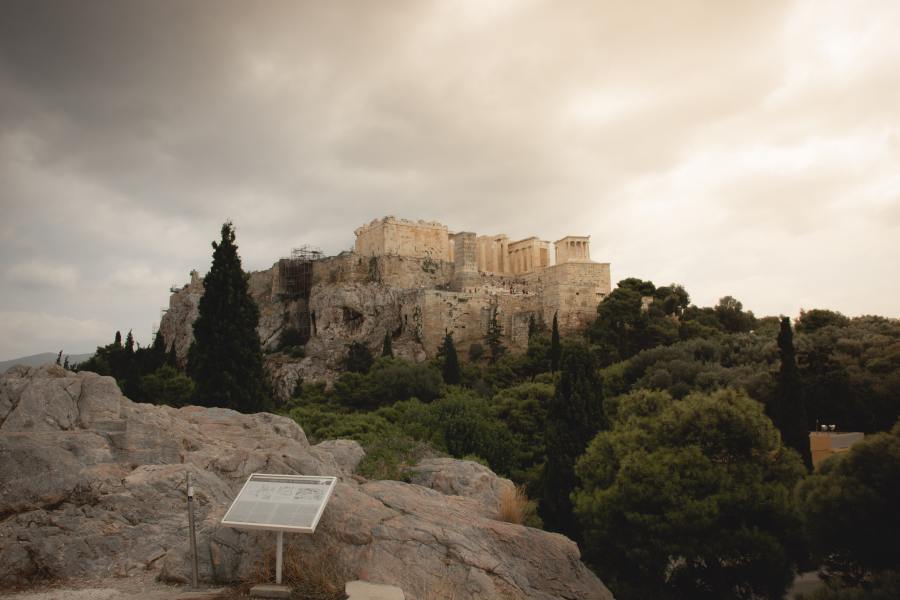
Image: Ruins of the Areopagus (Mars Hill) in Athens, Greece. Photo by Daniel Nouri.

The Language of the Heart

Sermon on John 14:1-14.

Imagine with me, if you will, that you are a kid on a playground. You’re having a fine time running around on a lovely day. Then you decide that you’d like to feel the sun on your face and the wind in your hair, so you start to make your way over to the swings. Just then, the biggest kid in the neighborhood steps in front of you, blocking your path.

The big kid says, “Just where do you think you’re going?”

“I’m headed to the swings,” you reply.

“Is that so?” he says, “Well, here’s the thing: Those are my swings. If you want to play on them, you’ve got to get through me first. Let’s find out just how tough you are!” And he puts up his fists.

Now, most of us can understand exactly what’s going on in this situation: The big kid is being a bully. As parents, that’s the moment when we would probably step in and say, “Hey now, that’s not nice! These swings belong to everyone, so anyone can play on them. Why don’t you take a step back and let the smaller kids go play on the swings?”

As grownups, we wouldn’t just stand by and let that kind of bullying happen to our kids on a playground. So then, why do we just accept it when certain kinds of Christians do it to other people? In my job, I spend a lot of time on the highway. I regularly see religious billboards with messages trying to convert people to Christianity. A common Bible verse that appears on these billboards is John 14:6, which we just heard in our gospel reading this morning. In this verse, Jesus says, “I am the way, and the truth, and the life. No one comes to the Father except through me.”

Now, I’m not going to speak against this verse itself; it’s part of our sacred scriptures and I love it. What I am going to speak against is the fact that some of our fellow Christians use this Bible verse as a threat. When Christians post these words of Jesus, out of context, on their billboards and church marquees, they are sending the implied message that no one can have a genuine spirituality unless it looks like theirs. That’s a problem. In a country where Christians already make up a majority of the population, that’s bullying.

More than that, it’s a misrepresentation of the Gospel of Jesus Christ. The word “Gospel” means “good news”, and those who post these billboards think they’re just “preaching the good news”, but frankly, I can see nothing “good” about it. The real Jesus didn’t threaten people with hellfire and damnation. The real Jesus fed the hungry and healed the sick. The real Jesus welcomed outcasts and forgave sinners. The real Jesus got himself in trouble for hanging out with the wrong kind of people. The real Jesus is more likely to be found at the Stonewall Inn than the National Cathedral.

[SIDE NOTE: If you don’t know what the Stonewall Inn is, then please watch the award-winning documentary The Stonewall That Didn’t Fall by Cadence Phillips, a parishioner at St. Paul’s Episcopal Church in St. Joseph, Michigan. This documentary recently won first place in the state and has been nominated to represent Michigan in the National History Day film competition in Washington, DC. Cadence is currently trying to raise $1,000 for the trip to Washington.
Please consider donating here:
https://gl.me/u/6zDcfFX7MQmv
You can watch the film here:
https://bit.ly/stonewallstate
Thanks in advance for your support!]

Now that we’ve talked about what Jesus didn’t mean in that verse, let’s talk about what he did mean when he said, “I am the way, and the truth, and the life. No one comes to the Father except through me.”

First of all, it’s important for you to know that biblical scholars generally agree that these words were never spoken by the historical person, Jesus of Nazareth. There was a literary convention in the ancient world that feels foreign to our own. It was a common cultural practice, in the ancient Mediterranean, for students of a great teacher to honor their mentor by writing in their mentor’s name. The idea was that they were continuing their teacher’s thought where the teacher left off, so any credit for brilliance would be given to the original mentor and not the student. Outside of the Bible, we can see this happening in the writing of the great philosopher Plato, who wrote most of his Dialogues in the name of his mentor Socrates. There is little debate among modern scholars that most of Plato’s ideas come, not from Socrates, but from Plato himself (even though he writes in the name of Socrates). It is the same with the author of John’s gospel and the historical Jesus of Nazareth.

When John puts these words into Jesus’ mouth, “I am the way, and the truth, and the life. No one comes to the Father except through me”, he is not committing forgery, but honoring the teacher who changed his life. The author, in this verse, is telling the readers of his gospel what Jesus meant to him.

This is a problem for us readers in the modern world, who value accuracy above all else, but it was not a problem for ancient readers, who understood that biography was more about “who this person was” than “what actually happened”. If we were to describe what the author of John’s gospel was trying to do, in modern terms, we might say that he was “speaking the language of the heart”.

Let me describe what I mean by “language of the heart” by way of analogy. Imagine a married couple, out to dinner on their wedding anniversary. One of them raises a glass to the other and says, “Sweetheart, you are the most wonderful person in the world and I am the luckiest person in the world. There’s no one else for me. I love you with all my heart. Happy anniversary!” Now, we would all agree that this person was speaking from the heart. So, imagine how inappropriate it would be if the waiter were to interrupt the speaker in that moment and say, “Now wait just a minute, Buster! You can’t possibly say that your partner is the most wonderful person in the world because you haven’t met all the people in the world! For all you know, there could be another person out there, more wonderful than your partner, so you shouldn’t say such inaccurate things on your anniversary!”

If you were sitting at a nearby table, you would be perfectly justified in standing up and saying to that waiter, “Hey now, that’s not nice! This person was talking to their partner on their anniversary. You had no right to interrupt them. In fact, you have no right to pass judgment on their relationship at all!”

When it comes to the language of the heart, most of us would agree with the philosopher Blaise Pascal, who said, “The heart has its reasons, of which reason knows nothing.”

This is also how it works, when it comes to Christian faith in our Lord and Savior Jesus Christ. We owe no one an explanation when we say, “Jesus, you are the way, and the truth, and the life.” We are speaking the language of the heart, just like that couple out to dinner on their wedding anniversary. This is what the author of John’s gospel was trying to say when he put those words into Jesus’ mouth. Using the cultural conventions of his time, he was trying to express his love for the man who had changed his life for the better.

In our day, let us also be just as exuberant in our praise of Jesus Christ as our Lord and Savior. Let us proclaim to the world the good things he has done for us, not only in our words, but in our deeds. If Jesus is our way, our truth, and our life, then let us strive to become the kind of people that Jesus was. When we see the hungry, let us feed them. When we see the sick or injured, let us heal them. When we meet the outcast and sinners, let us welcome and befriend them. May we, like Jesus, get ourselves in trouble for hanging out with queers and freaks. When the bullies of this world come hunting for us, may they find more of us in Stonewall than they find in cathedrals. That’s how they’ll know we are there because we are following Jesus, and they’ll know we are Christians by our love.

Image credit: Billboards Portrush by Willie Duffin, CC BY-SA 2.0 https://creativecommons.org/licenses/by-sa/2.0, via Wikimedia Commons

Doubt is Not a Barrier to Faith

Sermon on John 20:19-31.

Once upon a time, there was an expecting mother. In her womb, there were twins. These twins, as people often do when they spend a lot of time together, liked to talk about various things. One day, a particularly philosophical question came up. One turned to the other and asked, “Do you believe there’s any such thing as life after birth?”

“Never really thought about it,” the other twin said, “but I highly doubt it. We’ve never seen anything outside of this place. No one who leaves ever comes back. I think that, when the time comes for us to be born, we just go through that passage and cease to exist.”

“I disagree,” the first said, “I mean, you’re right that we’ve never seen anything outside of this place, but just look at these eyes, ears, hands, and feet that we’re growing! Why are we growing them, if we’re never going to use them? I bet, after we go through that passage, we’ll find out there’s a whole world outside that we’ve never seen before. I have no idea what it will be like, but I have a hunch our time in this womb is getting us ready for whatever comes next.

“That’s the most ridiculous thing I’ve ever heard,” said the other. “I bet the next thing that you’re going to tell me is that you’re one of those crazy religious people who believes in the existence of Mom!”

“Well, I don’t think I’m crazy,” the first said, “but, as a matter of fact, I do happen to believe in Mom.”

“Oh, really?” The other said, “Then why don’t you enlighten me, if you’re so wise? I’ve been in this womb for almost nine months, but I’ve never seen a ‘Mom’ or any evidence that convinces me to believe there’s any such thing as life after birth. So then, just where is this hypothetical ‘Mom’ that you supposedly believe in?”

“It’s hard to explain,” the first said, “but I think that Mom is everywhere, all around us. Everything we see in this womb is a part of Mom. So, I guess, it’s kind of like… maybe we’re growing inside of her? You said you’ve never seen Mom, but I think we’ve never seen anything other than Mom. I don’t pretend to have the answer, but I suppose it’s just another one of those things we won’t know for sure until after we’re born.”

There are two things I’d like to point out about this little parable, which I have adapted from Catholic priest and author Henri Nouwen. First of all, neither twin in the story is in a position to know, with any certainty, what the full truth of the matter is. The answers to questions about “life after birth” and “the existence of Mom” are pretty obvious to you and me, who have lived outside the womb for most of our existence, but we can imagine how scary it must have been when we were going through the process for the first time. Even now, uncertainty about “life after death” and “the existence of God” makes us nervous. Maybe someday in eternity, we’ll look back on our earthly lives and laugh at how little we knew back then, but today we can only know what we know, which might give us a little sympathy for those unborn twins and their philosophical questions.

The second detail from that story I’d like us to notice is that the presence of doubt has absolutely no bearing on the twins’ status as beloved children of their mother. She will love them just the same, no matter what philosophical conclusions they draw during their time in utero. In the same way, even the oldest among us are still babies in the eyes of God. Our eternal Mother knows full well that human beings are incapable of answering the biggest questions about reality, so she is able to have sympathy for those who struggle honestly with doubt. Just like those babies in utero, each and every one of us will be loved forever, no matter what we come to believe during our brief time on this Earth.

This means that doubt is not a barrier to faith.

This second fact about Nouwen’s parable of the twins is what I want us to keep in mind, as we turn to look at today’s gospel.

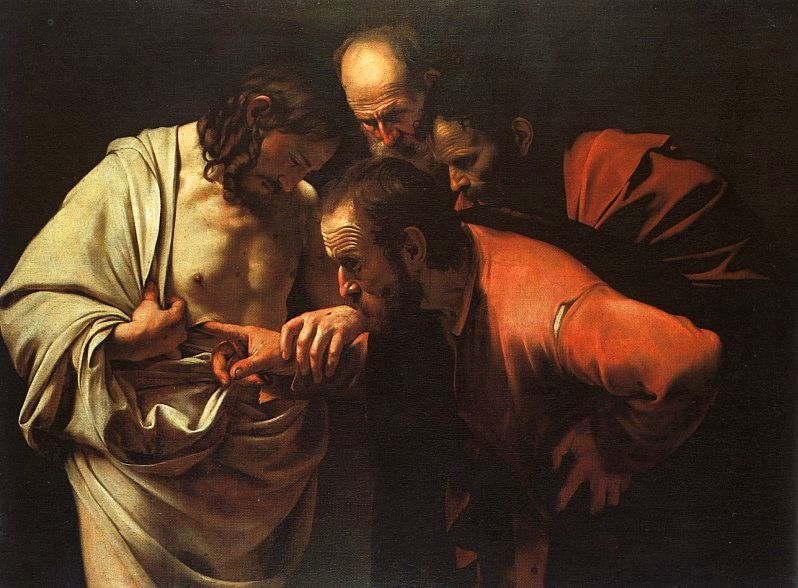
The story of St. Thomas’ encounter with the risen Christ is the most thorough treatment of doubt in the New Testament. Our brother Thomas gets an unfair shake when we use his name to make fun of someone for being “a Doubting Thomas.” After all, Thomas was only doing what any of us would have done, if someone came to us with news that seemed unbelievable. For this reason, I like to think of Thomas as “the patron saint of critical thinkers.” The scientist Carl Sagan famously quipped that “extraordinary claims require extraordinary evidence.” I imagine Dr. Sagan applauding when St. Thomas proclaims, “Unless I see the mark of the nails in his hands, and put my finger in the mark of the nails and my hand in his side, I will not believe.”

The most intriguing aspect of this story is not Thomas’ doubt, but Jesus’ response to it. If John’s gospel had been written by modern Fundamentalist Christians, they probably would have said that Jesus couldn’t appear in the upper room until the other disciples had excommunicated Thomas for his skepticism. If Jesus appeared at all, it would probably be on the far side of the locked door, shouting about how Thomas is a “sinner” and is “going to hell,” if he doesn’t change his mind. But that’s not what actually happens in John’s gospel.

In the real version of the story, the text says, “Although the doors were shut, Jesus came and stood among them and said, ‘Peace be with you.’” Thomas’ doubt, for Jesus, was not a reason to stay away, but a reason to come closer. Thomas’ doubt, for Jesus, was not a reason to offer words of judgment, but a reason to offer words of peace. Jesus doesn’t command Thomas to have blind faith, but gives him the extraordinary evidence he’s looking for.

The presence of this passage in our sacred Scriptures should shape the way we deal with doubts, both our own and those of others. It should help us learn how to accept the process of critical thinking as a necessary part of faith. It should lead us, not to retreat from hard questions, but to advance alongside them.

As Episcopalians, we are blessed with abundant spiritual resources to help us on this journey. The Episcopal Church is part of the Anglican theological tradition. One of the things that makes Anglicanism distinct from some other expressions of Christianity is the way in which we think about our faith. Some other churches see their faith as a monolithic statement by a single and infallible authority. For Roman Catholics, it’s the Pope; for Fundamentalist Protestants, it’s the Bible. But the Anglican theological tradition, as far back as Fr. Richard Hooker in the 17th century, has always viewed Christian theology as a three-way dialogue between Scripture, tradition, and reason.

This way of thinking about our beliefs, sometimes called “the three-legged stool,” means that Episcopalians see our religion as a never-ending conversation. Everyone gets to have a seat at the table, but no one gets to stand on the table and yell at everyone else. Unlike some other religious traditions, Episcopalians do not view their leaders as infallible. We honor our ancestors, but we also believe the Church can be wrong. An interpretation that made sense at one time might stop making sense for future generations. A way of life that seemed just and holy in one century might seem abhorrent in another, and vice versa. This doesn’t mean that “anything goes” in Christian faith and practice, but it does mean that Episcopalians are always open to having a conversation about it.

This understanding of the Christian faith means that Episcopalians can be notoriously hard to pin down when someone asks what our church believes. We frequently disagree with each other, sometimes passionately. The late comedian and devout Episcopalian Robin Williams once said, “No matter what you believe, there’s bound to be an Episcopalian somewhere who agrees with you.”

Finally, thinking of the Christian faith as a three-way dialogue between Scripture, tradition, and reason means that The Episcopal Church is a place where you can bring your whole self to church: Protestant and Catholic, conservative and liberal, believer and skeptic. To all these parts of ourselves and each other, the sign outside our churches around the country proclaims the message loud and clear: “The Episcopal Church welcomes you!”

Whoever you are, whatever you believe, however you identify, and wherever you are on your spiritual journey, you are welcome in this sacred space. That is the message that Jesus proclaimed to St. Thomas in today’s gospel. That is the message that The Episcopal Church seeks to embody every day, as it has for hundreds of years. And that is the message that I hope you hear in this sermon today: That you, with all your doubts and fears, are still a beloved child of God, and you are welcome in this place.

Amen.

Empty Tombs and Chaos Muppets

Sermon on John 20:1-18.

       On this glorious Easter Sunday, the most sacred day in our spiritual tradition, I very much want you to know, dear kindred in Christ, that there are, basically, two kinds of muppet: Chaos Muppets and Order Muppets.

       Order Muppets are those devoted characters who are just trying to do their job, keep it together, and maintain some shred of sanity. Order Muppets include characters like Scooter, Bert from Sesame Street, and (the greatest muppet of all-time) Kermit T. Frog.

       Meanwhile, the Chaos Muppets, like Ernie, Miss Piggy, and (my personal favorite) Animal are constantly on the verge of blowing everything up with their shenanigans (sometimes literally).

       Now, it’s important to remember that neither kind of muppet is inherently evil. The world of The Muppets is based on friendship and balance. A great example is the duo Bert and Ernie from Sesame Street. Bert (the Order Muppet) is steadfast and meticulous. Ernie (the Chaos Muppet) is a whimsical free spirit who, in the words of Henry David Thoreau, wants “to live deep and suck out all the marrow of life.” Ernie sometimes needs Bert to help him stay focused and get things done; Bert sometimes needs Ernie to help him relax and enjoy the little things of life. These best friends need each other and help each other, even though they are very different.

       As human beings, I think there is a bit of the Chaos Muppet and the Order Muppet in each of us, but one or the other will tend to be more dominant, based on our personality and circumstances. I, for example, have frequently been typecast as a Chaos Muppet. This is largely due to the fact that I live with Attention Deficit Hyperactivity Disorder (“ADHD” for short). This condition, which affects a little less than 1 in 10 people, is a developmental disorder that affects the way by brain functions.

In scientific terms, my brain produces less dopamine and more reuptake transport proteins than the average brain does. This structural difference results in an interruption of the reward pathway and an overall increase in executive dysfunction and emotional dysregulation.

In plain English, that means that I cannot feel as good as other people, and when I do, it doesn’t last as long. You know that satisfied feeling you get when you finally get the house clean or finish a project ahead of schedule? I literally can’t feel that.

On the outside, it sometimes looks like I am impulsive, undisciplined, and oversensitive. On the inside, I know that I’m working as hard as I possibly can, but it doesn’t seem to be good enough. In short, ADHD makes me into a Chaos Muppet.

       Now, I’m not telling you about my ADHD because I want your sympathy. I’ve lived with this for my whole life and I’m honestly fine with it. I’ve done years of medication, talk therapy, and research to manage the way my particular brain works. I’ve hit a lot of speed bumps of life’s road, but at 43, I’m pretty happy with where I am and who I am today.

I’m telling you all this because living with ADHD is about learning how to embrace life’s chaos and work with it. Your chaos might be different from mine. It might be related to your job, school, relationships, medical problems, or grief. I can’t list all of the potential causes, but I’d bet dollars to donuts that each person in this room feels some kind of stress in their life that is threatening to tear them apart at the core. That’s the call of the chaos.

       When I look at our gospel reading this Sunday, it’s the chaos that stands out to me most. Everybody is running back and forth, jumping to conclusions, disagreeing with each other, and trying like heck to figure out what’s really going on. Mary Magdalene comes to the tomb and finds it open, immediately decides that she knows what’s happened (without even checking to look inside), and then she runs back to Peter and John to announce her conclusion. Peter and John then run back to the tomb, look inside, and come to their own conclusion (without any direct evidence, I might add), and then run back to their house. Mary Magdalene, meanwhile, has also run back to the tomb, still clinging to her original interpretation, and collapses in an emotional mess.

       This is where things start to get interesting (and more than a little funny) because, while Mary is still standing there, in the midst of a mental breakdown, angels appear to her. Normally, you’d think this would be enough to snap her out of it, but it doesn’t work. So then, she turns around and Jesus himself is standing right in front of her, but Mary is still so hyperfocused on this thing she’s afraid of, she can’t recognize the obvious truth, even though it’s literally standing right in front of her!

It’s not until Jesus says her name, “Mary!” that she finally pauses long enough to realize what’s actually going on.

       I find it very interesting that the thing that brings Mary back to reality is the sound of her own name, spoken back to her by someone who loves her. There’s something very powerful in that. When Jesus speaks Mary’s name, he is bringing her back to the awareness of who she really is. Behind and between the letters of her name are the years of shared history, in which Jesus and Mary had traveled and worked together. This was the voice of someone who saw her, knew her, and loved her more than anyone else ever could. By speaking her name in that moment, Jesus grounded Mary in the reality of her true self.

       Practicing the Pause is good medicine when we feel so overwhelmed by the stress of life that we begin to lose our bearings on reality.

  • Sometimes, like Mary, the Pause is given to us by someone who loves us.
  • Sometimes, it feels like we are alone, so we have to speak our own name to ourselves.
  • Sometimes, we see a miracle so amazing, it takes our very breath away.
  • Sometimes, all we see is this ordinary world, but we notice some detail or perspective that piques our curiosity enough to bring us back from the edge of catastrophe.

       Either way, the effect is the same: We are drawn out from the momentary crisis and rooted firmly in the truth of who we are. Like Mary Magdalene, we begin to see through the swirling clouds of chaos and begin to realize the creative possibilities emerging from the depths of reality.

       For me, the emergence of these creative possibilities happened much more slowly than it did for Mary Magdalene. In the swirling chaos of life with ADHD, I spent decades floating from job to job, relationship to relationship, and church to church. At this point, I’m beginning to learn how to be more grounded in the truth of who I am and the creative possibilities that are still emerging from that truth.

Recently, I’ve learned that the neurological differences that made me a very bad administrator can also make me a very good hospice chaplain.

  • I’m finding that my emotional sensitivity, which made personal relationships so difficult in the past, can also give me the compassion to sit with dying people in the final moments of their lives.
  • I’m finding that my unfocused wandering, which has made me late for work on more than one occasion, can also give me the mental flexibility to jump from topic to topic with hospice patients from a wide variety of religious backgrounds.
  • I’m finding that my inability to feel the satisfaction that other people feel at solving problems can also give me the patience to sit with someone in a terminal situation where there is no solution other than the imminent finality of death.

These are just a few of the creative possibilities that are emerging for me from my life with ADHD (even though I’m still a Chaos Muppet).

       I asked you earlier to think about the stressors and chaos in your own life. Where does the Chaos Muppet vex the Order Muppet within you? Now, let’s turn that around. Like Mary Magdalene, let’s pause at the sound of our own name. If you were to rest in the full acceptance of who you are, what creative possibilities might emerge for you, from the chaos of your life?

       As we begin to discover our own answers to that question, we will experience, with Mary Magdalene, what it feels like to have Resurrection energy flowing through our bodies. We will, each Chaos Muppet and each Order Muppet, in our own unique ways, live out the truth of the oldest Christian creed: “The Lord is risen indeed! Alleluia!”

A Fresh Set of Eyes

Dr. Dave Wilson

Sermon on John 9:1-41.

I’d like to begin this morning by telling you about Dr. Dave Wilson. For almost a decade, Dave has been one of my closest friends (a “bromance,” if you will). In the moments when he’s not presiding over a Dungeons & Dragons campaign or spending quality time with his kids, Dave works as a professor of physics at Kalamazoo College. More specifically: Dave is a physicist who studies viruses.

       “Now, wait just a minute,” you might ask, “wouldn’t that make him a virologist?”

       “No,” Dave would respond, “I am a physicist who studies viruses.”

       Now, that might sound kind of ridiculous, at first, until you realize just what Dave has managed to accomplish, as a physicist who studies viruses. Several years ago, Dave made a groundbreaking discovery that is currently changing the way virologists practice their science.

       What Dave has discovered is a particular internal structure to certain types of viruses, called spherical viruses. This structure appears because of the way that particular atoms and molecules bond to form proteins in the shape of a sphere, with little hook-like protrusions sticking out. These “hooks” are the way in which these viruses latch onto the cells in your body and feed off of them, thus making you sick.

       Dave’s discovery of an internal structure to these viruses opens up new avenues of study for traditional virologists, who are now using this information to develop new kinds of antiviral medicine and even exploring ways in which viruses might be used to help fight cancer. (For those who might be wondering, the virus that causes COVID-19 is exactly this kind of spherical virus.)

       When Dave first started sharing the results of his discovery with fellow scientists, some of the leading virologists in the world looked at his findings and smacked their foreheads in wonder.

       “It was right in front of us the whole time,” they said, “we can’t believe we didn’t notice it before!”

       What it took for this new discovery to come to light was a fresh set of eyes. It took a physicist, looking at the problem from a fresh point-of-view, to notice the truth that had been hiding in plain sight all along. I tell you this story because “the need for a fresh set of eyes” is central to understanding the meaning of this morning’s gospel.

       In this passage, Jesus gets himself into trouble, not for the first time, by questioning traditional assumptions of his religion.

       Most pertinently, he questions his culture’s traditional beliefs about the nature of suffering. The prevailing belief of that time, which continues among many religious believers today, was that suffering happened as the result of divine punishment for misdeeds. This is why Jesus’ disciples ask, at the beginning of this passage, “Rabbi, who sinned, this man or his parents, that he was born blind?” Jesus, on one the few occasions when he answers a question directly, responds in the negative. I will follow the Rev. Carrie Bail’s suggestion that we alter the punctuation of our English translation.

       “Neither,” Jesus says, “Neither this man nor his parents sinned; he was born blind. [PERIOD] So that God’s works might be revealed in him, [COMMA] we must work the works of the One who sent me while it is day; night is coming when no one can work. As long as I am in the world, I am the light of the world.”

       What Jesus does so brilliantly in this encounter is shift the direction in which his disciples are looking for the meaning of suffering. The disciples, by their question, reveal their assumption that the meaning of suffering can be found by looking to the past. Jesus, by his response, opens their minds to the possibility that the meaning of suffering might be created by looking to the future.

       No one can fully understand why bad things happen to good people. When tragedy strikes, our evolutionary programming kicks in to help us identify a cause, in hopes that we might be able to prevent such tragedy from befalling us. This strategy, while sometimes useful, sadly leads us to blame the victim when the unthinkable happens.

  • “What was she wearing?”
  • “Why didn’t he look both ways before crossing the street?”
  • “Why didn’t you go to the doctor sooner?”

On the many occasions when no immediate cause can be found, we resort to empty platitudes.

  • “Everything happens for a reason.”
  • “The Lord works in mysterious ways.”
  • “Heaven must have needed another angel.”

These phrases, I’ve noticed, tend to comfort the bystanders of tragedy more than the victims. We say them to make ourselves feel better, rather than the people we are trying to help. Even if we could somehow figure out all the causes of a particular tragedy, that knowledge would do nothing to remedy the present situation or alleviate the suffering of those already affected.

       Jesus, thankfully, gives his disciples a fresh set of eyes for looking at the problem of suffering. Instead of looking for past causes of present crises, Jesus looks to future responses. The question, for Jesus, is not, “Why did this happen,” but “what will we do next?” The first question looks for the meaning of suffering in the past; the second question creates the meaning of suffering in the future.

       We know from the story what happens next: Jesus opens the eyes of the man born blind. I’m not going to spend much time talking about the miracle itself because I don’t think that’s the actual point of this gospel. The real point is not how Jesus changed the way one person saw two thousand years ago, but how Jesus changes the way we see today.

       The miracle caused quite a controversy in Jerusalem. The day on which Jesus performed this act happened to be Shabbat, the traditional day of rest in Judaism. The respectable members of the congregation took offense at this timing because they thought it violated their time-honored traditions. After a very long and drawn-out debate, they excommunicated the man born blind from their synagogue because he refused to join the authorities in their denunciation of Jesus.

By this action, the gospel tells us, the authorities prove themselves to be the ones who are truly blind, while the formerly-blind man sees the goodness of Jesus more clearly than anyone. Jesus tells his listeners, in the final words of this passage, that the failure of the authorities to recognize goodness is rooted in their firm conviction that they already know the answers to every question they ask.

       This is a problem that afflicts people in our age, as well. Social psychologists recognize a phenomenon known as “the Dunning-Kruger effect,” wherein people who know very little about a given subject tend to have more confidence in their so-called knowledge than the actual experts do. Actual experts, who have studied a subject in depth, tend to be more aware of the complexities involved with their chosen subject, and therefore tend to have more humility about their conclusions. This means that those who shout loud and talk fast are most likely to be heard, while those who consider carefully and take their time are more likely to offer genuine insight, but less likely to be heard.

       The best way to get unstuck from the Dunning-Kruger effect, according to Jesus, is to practice the Zen Buddhist principle of shoshin (“Beginner’s mind”). In the cultivation of beginner’s mind, Buddhist practitioners are taught to let go of their preconceived judgments and ideas in order to see themselves and their world with a new set of eyes. This discipline of beginner’s mind applies, not only to those who are new to Zen Buddhist practice, but even more so to those masters who have practiced this form of meditation for many years. The most experienced spiritual masters, like Jesus and the Buddha, are able to see reality clearly by greeting each new moment with fresh eyes and the absence of judgment. This is what it means to truly see.

       The contemplative practices of the Christian mystical tradition offer us ways to cultivate beginner’s mind in our own lives. Taking time to pause in prayer and meditation, we create space in which we can disentangle ourselves from the reactive need for quick and easy answers. In its place, we plant seeds of wonder and peace that grow into wisdom and healing.

       When we let go of our arrogant impulse to possess all the right answers, we open ourselves to the fullness of reality in the present moment. Like my friend Dave Wilson, we gain the ability to bring fresh perspective to a situation and discover truths that were hiding right under our noses. Like Jesus, we open the door to new ways of seeing, opportunities for healing, and paths to a meaningful future.

       May it be so for us. May we pause long enough and often enough to question our assumptions and gain insight. May the seeds of peace we plant grow into fruits of discovery, healing, and a meaningful future. May it be so, today and always. Amen.

More Than These

Sermon on Matthew 4:1-11.

Today marks the first Sunday in our church’s journey through the 40 days of Lent. Christians have traditionally thought about this season as a time for “repentance” in preparation for the Feast of Easter. For many people, the word “repent” conjures up the mental image of a televangelist shouting through the TV screen in Elizabethan English: “REPENT of thy sins, for the end of days draweth nigh!”

If we were somehow able to ask that preacher, through the TV, what he thinks the word “repent” means, he would probably say it means to fall on our knees and grovel before the Almighty, wallowing in guilt for our many transgressions. For many people, both inside and outside the church, that’s what the word “repent” means. There’s only one problem with this definition: That’s not what the word “repent” means.

In the New Testament, which was written in Greek, the word that gets translated as “repent” is metanoia. If we break this word down into its constituent parts, we get meta, which literally means, “change,” and noia, which means, “mind.” So, the word “repent,” in its original meaning, actually means, “to change your mind” or “to think differently.” “Thinking differently,” rather than “wallowing in guilt,” is the definition of “repentance” I’d like us to keep in mind as we begin our journey through Lent, toward Easter.

In today’s gospel, Jesus invites us to think differently about who we are, as human beings. This story, ostensibly about Jesus’ temptation by the devil in the wilderness, is also a story about all of us. The temptations that the devil puts before Jesus are not mainly about moral evil, per se, but the instinctive draw to identify with one part of our nature instead of the whole people we were created to be.

In the first temptation, the devil says to Jesus, “If you are the Son of God, command these stones to become loaves of bread.” Now, I think we can all agree there’s nothing morally wrong with making bread. After all, if Jesus had the power to do so, wouldn’t he use it to end world hunger? The deeper meaning of this temptation becomes clear when we see it as a symbol of the human instinct for survival.

According to evolutionary brain science, the basic survival instinct is located in the brain stem and cerebellum. This part of our brains, called “the reptilian brain,” evolved earlier than any other part. The reptilian brain is concerned with the three S’s: Safety, Sustenance, and Sex.

Safety is the fight or flight response. If you’re alone at night and hear a loud noise behind you, your stomach will probably jump. In that moment, adrenaline will start coursing through your body, preparing you to run fast or fight hard, depending on what the situation requires. You’ll be scanning the area for the cause of the noise because this is the instinct God gave you in order to keep yourself safe from danger.

Sustenance is the craving you have for sugars, fats, and salts. These items were rare in the time before McDonald’s existed, so our evolutionary ancestors developed a craving to consume as much of them as possible. This instinct kept them alive through the lean times, so they generously passed them down to us.

Sex, of course, is the way in which we pass our genetic material to the next generation. Without reproduction, a species is in danger of immediate extinction, so God gifted us with this natural desire in order to continue to the story of humanity for another generation.

Safety, sustenance, and sex are all very normal and natural parts of our humanity. But they, by themselves, cannot create the kind of abundant life that God intends for us. If we live only by the power of these basic instincts, we will quickly tear ourselves apart and damage our capacity for human flourishing, so God gave us additional instincts to hold our animal urges in check. This is why Jesus quotes the Torah, in response to the devil, “It is written, ‘One does not live by bread alone, but by every word that comes from the mouth of God.’ “ He was saying that there is more to life than the gratification of our natural impulses.

In the second temptation, the devil takes Jesus to the pinnacle of the Temple in Jerusalem. He says to Jesus, “If you are the Son of God, throw yourself down; for it is written, ‘He will command his angels concerning you,’ and ‘On their hands they will bear you up, so that you will not dash your foot against a stone.’ “ This symbolizes the drive that humans have for affection and esteem.

The pinnacle of the Temple was the most public place in Judaism at that time. If Jesus performed a death-defying miracle in that place, the crowd would surely see it and give him their undivided attention, not to mention their admiration. In scientific terms, this is the social instinct, corresponding to the brain’s limbic system, which evolved tens of millions of years ago in the first mammals. This part of the brain holds our more basic instincts in check. For example, if I eat all the food without sharing, mate with whoever I want, or kill anyone who makes me angry, I run the risk of being kicked out of my family group. The social instinct balances out my selfishness and makes it possible for us to live in groups and families.

The problem is that this instinct, by itself, causes problems like jealousy, people-pleasing, and codependency. If we live our whole lives according to our need to be liked, we end up compromising on things that really matter and divide ourselves into tribes that battle for supremacy. There is more to life than being admired. This is why Jesus quotes the Torah a second time, “Again it is written, ‘Do not put the Lord your God to the test.’ “

In the final temptation, the devil takes Jesus to the top of a high mountain and shows him all the kingdoms of the world. He said to Jesus, “All these I will give you, if you will fall down and worship me.” This is the temptation to power, which corresponds with the most recently evolved part of the human brain: the neocortex.

The neocortex is the computer part of the brain. This is where we do all the things we think of as “thinking.” We make calculations and predictions, envision hypothetical scenarios, and develop plans for action. Humans have an amazing ability, more than any other animal, to recognize patterns of cause and effect. We can formulate universal moral values that transcend our basic instincts and tribal loyalties. Through the power of reason, human beings have cured diseases, explored the solar system, and developed systems of political and economic organization that govern the whole planet.

But, here too, there is a dark side. Those same rational abilities have also given us the power to deceive ourselves, manipulate others, create weapons of mass destruction, and develop social systems that privilege the greed of the few over the needs of the many.

Jesus says “No” to all of that;
Jesus says “No” to racism and sexism;
Jesus says “No” to homophobia and transphobia;
Jesus says “No” to socialist oppression and capitalist exploitation;
Jesus says “No” to mass extinction;
Jesus says “No” to men who use their positions of power in order to take sexual advantage of the women who work for them;
Jesus says “No” to unarmed black men being gunned down by police officers;
Jesus says “No” to churches who tell their teenagers they are going to hell for being gay or trans;
Jesus says “No” to immigration systems that put children in cages;
Jesus says “No” to countries who build nuclear bombs when their schools can’t afford textbooks;
Jesus says “No” to a world where children die of malaria, for lack of a 25 cent vaccination.
Jesus says “No” to all of that.
Jesus says, “Away with you, Satan! for it is written, ‘Worship the Lord your God, and serve only him.’ “

All of these temptations lead us back to one question: “Who are you?” When the devil approaches Jesus with these temptations, he begins with a challenge, “If you are the Son of God…”

Bear in mind that, in the passage immediately before the one we read today, Jesus was baptized by John in the River Jordan. When “he came up from the water,” the Scriptures say, “suddenly the heavens were opened to him and he saw the Spirit of God descending like a dove and alighting on him. And a voice from heaven said, ‘This is my Son, the Beloved, with whom I am well pleased.’ “

Jesus was able to resist the devil’s temptations to identify with his survival instincts, his need for social status, and his desire for power because he knew who he really was, as God’s beloved Son. The very same thing is true of you, today.

You, whoever you are, are the beloved child of God.
You are more than a bundle of cravings for rage, lust, and gluttony;
you are the beloved child of God.
You are more than your need for social esteem and affection;
you are the beloved child of God.
You are more than your desire for power and control;
you are the beloved child of God.

All of these are parts of you that deserve to be welcomed with compassion, but none of them gets to dominate the whole,
because you are more than these things;
you are the beloved child of God.

Any inner voice that tempts you to believe otherwise is the original liar from the pit of hell. Don’t listen to that voice. Listen instead to Jesus, who says, “You are the beloved child of God. Worship the Lord your God and serve only him.”