Laughing at Ourselves

Sermon for Proper 25, Year C

Click here for the biblical readings

As I was coming up with an opening illustration for this week’s sermon, it occurred to me that the one thing you’re probably learning about your new rector this year is that he watches way too much TV. But then again, maybe that’s just something I’m learning about myself. Anyway, what came to my mind this week was a scene from an episode of the famous sitcom The Office.

And in this scene, the boss was on his way to a very important meeting when he slipped and fell into a koi pond. When he got back to the office, soaking wet, he tried making up all kinds of stories to hide his embarrassment about what really happened. But the thing is that all his rationalizations and excuses just made people laugh at him more.

Later on, when he finally admitted the truth about what happened and started poking fun at himself, people’s laughter started turning into compassion. Instead of making up jokes at his expense, they said, “You know, Michael, that’s really the kind of thing that could have happened to anybody.”

I find that moment in the scene very fascinating. It’s like the situation itself was calling for laughter, no matter where it came from. If Michael couldn’t laugh at himself, then the universe was going to make sure that somebody was laughing about it. But when Michael finally did learn how to laugh at himself, the laughter became a gateway to mercy and understanding. It’s as if laughter had this secret power to unlock the doors of compassion in our hearts.

How like life! When we as human beings stand on the firm bedrock of safe and supportive relationships, we gain the ability to laugh at ourselves. And that kind of laughter, rather than tearing us down or pushing us farther apart, has the ability to build us up and pull us closer together — provided that our relationships do, in fact, stand on that solid ground of safe and supportive love.

As a Christian, I do believe that the entire universe stands on just such a solid ground. When we say each week in the Nicene Creed that we believe that Christ will return in glory to judge the living and the dead, I imagine that judgment not as a verdict in a courtroom, but more like a funny story told around the Thanksgiving table. The embarrassment is there, but so is the love. And that love gives us the power to laugh at ourselves.

That’s how I imagine the final judgment of the living and the dead — not as a sentence to hellfire and damnation, but as a side-splitting laugh at ourselves. Because we learn from Scripture that God is both just and merciful. The one who judges us is also the one who knows and loves us best.

In today’s gospel, we get a glimpse of that justice and mercy in action. Jesus tells a parable about a Pharisee and a tax collector. Pharisees, as we know, were very educated and religious people — upstanding citizens and pillars of their community. Tax collectors, on the other hand, were the scum of the earth: bottom feeders, liars, and traitors to their own people.

The Pharisee in this story is doing exactly what we would expect an upstanding citizen to do — holding his head up high in church, listing his accomplishments, and thanking God that he is not like other people, especially this tax collector here. The tax collector, meanwhile, is standing at the back of the church, looking down at his shoes, and the only prayer he can manage to get out is, “God, be merciful to me, a sinner.”

It’s the tax collector, according to Jesus, who went down to his home justified that day, despite his lack of religious or moral qualifications.

Now, what I find interesting about this passage is that at no point does Jesus say that the Pharisee is not justified. Our English translation says that the tax collector went down to his home justified instead of the Pharisee. But the Greek word translated as instead of in our English Bibles is actually the word para, which literally means alongside. So another way that we might translate this verse from the Greek is to say that the tax collector went down to his home justified alongside the Pharisee, not instead of.

And I really like that. Because if I’m really honest with myself, then I have to admit that there is both a Pharisee and a tax collector within me. Like the Pharisee, I too have the capacity to act like a self-righteous windbag. And like the tax collector, I too have the ability to act like a selfish dirtbag. And if I’m being really, really honest, I’m often doing both at the exact same time.

So it’s very comforting for me to be able to read this story as one where both the Pharisee and the tax collector go down to their home justified alongside each other — because most days, both of those guys are coming home with me.

Several years ago, I had a job interview at the hospice agency where I ended up working for several years before I came here. The interview went really well. I came home all excited and ready to talk about it. But then I walked through the door, and my wife Sarah had just had a disaster of a day. Things were stressful at her job, the kids were acting out, and she needed to unload about all of it.

At the end of the night, we went to bed, and she had forgotten to ask me how my interview went. One part of me was seething — this is the Pharisee part of my brain. Except I was imagining him as more like a tough guy from New Jersey. And he said, “Here’s what you’re gonna do. You’re gonna get that job, and you’re gonna work there for like six months, until one day she asks you, ‘Hi, honey, how was the hospital today?’ And you’re going to be like, ‘Lady, I ain’t worked there in six months! But what do you care?’ And then she’s gonna feel real bad about it. Forget about it.”

So that was one voice in my head — the Pharisee from New Jersey. I decided I should name him Carl. So that’s Carl.

The other part of me was not from New Jersey, but rather from the Midwest. So obviously, he was a nice guy, because we Midwesterners are nice people. And this part of me was saying, “Oh, don’t you know, Sarah’s really busy, and she’s worried about a lot of really important things. You’re not that important, so you should just keep your yapper shut. Remember that you love each other and just get back to your darn life.”

I didn’t give that voice a name, but it was more like the tax collector side of me. That’s the part that just wants to stand in the back, look down at my shoes, and make myself small and invisible.

But let’s be honest: if I was to listen to either of these voices by itself and do what it says, would either one lead me toward having a more honest and loving relationship with my wife? No, it wouldn’t.

So instead, I took a deep breath and imagined myself sitting at a table with both of these guys. I let each one have their say, and even wrote out what they said in a journal. Because the thing is, each part of me was actually trying to help me — they just weren’t being very helpful in the way that I needed at that moment.

So I heard them out, listened with compassion, and tried to understand where each one was coming from. And what I ended up doing was sitting down with Sarah the next day and saying, “Hey, I’m sorry you had such a rough day yesterday, but I had that really big job interview with hospice, and it hurt my feelings when you didn’t ask me about it.”

And Sarah, my wonderful wife, said, “Oh my gosh, you’re right. I’m sorry. Please tell me — how did it go?” And I did tell her about it, against the advice of the Midwest nice guy, because I am important to her, even though she does have a lot of other really important things to worry about.

And I also went against the advice of Carl from New Jersey and his elaborate ruse about working a job for six months without telling my wife, because obviously that plan would not have worked — but mostly because I didn’t actually want her to feel bad. I just wanted my wife to take an interest in my life and the things that are important to me and to our family. Which, of course, she does. We all just have bad days sometimes.

I tell this story as a personal illustration of the Pharisee and the tax collector that exist within each of us — because they both do. That’s why I’m glad that the text of Jesus’ parable can be translated as, “The tax collector went down to his home justified alongside the Pharisee.”

At the end of the day, it was neither the religious and moral observance of the Pharisee nor the humility of the tax collector that justified each of them in the eyes of God. It was God’s own mercy that supported them both. The only difference between them is that one of them recognized that truth and the other did not. But they both needed it, and they both got it — whether they realized it or not, whether they deserved it or not.

Kindred in Christ, the same thing is true for each and every one of us today. We stand in right relationship with God not because we deserve it by virtue of our righteous deeds or our honest confession, but simply because we need it, and it is there. We stand in right relationship with God because God loves us, whether we realize it or not, whether we believe in God or not.

We receive love because God is love. And that is the central truth not only of our faith but of our entire existence. And that love is what gives us the ability to laugh at ourselves — when we trip over our own shoelaces, or when we strut around like a bunch of pompous and self-righteous Pharisees, or when we betray our moral values and closest relationships like the tax collector did. Beneath all of that, the central truth holds firm: you are loved, whether or not you realize it, whether or not you deserve it, whether or not you believe in it. It’s still true — for you and for everyone else in this hurting world.

My prayer for you today is that you would come to know this truth more fully for yourself, and that knowing it will make it easier for you to reflect that same love onto the faces and into the lives of the people around you.

Your Faith Has Made You Whole

Sermon for Proper 23, Year C

Click here for the biblical readings.

Navigating the diverse world of religious beliefs can be an enlightening, if tricky, experience, even when one is already an active participant in a particular faith community. Visiting another community for the first time can feel disorienting. Up until last week, I had been to Protestant, Catholic, and Orthodox church services. I had visited a synagogue and even served as a guest preacher in Unitarian Universalist services, but until recently, I had never been to a mosque.

That changed a little over a week ago when I attended Friday prayer services at the American Muslim Society of Coldwater with my friend, Pastor Scott Marsh, of the Coldwater United Methodist Church. Pastor Scott and I meet regularly for mutual support and to discuss joint ministry opportunities in service to the wider Coldwater community.

One concern that we share is for our Muslim neighbors in our beautiful city, most of whom are also Yemeni immigrants. In spite of the fact that there are differences of skin color, religion, and language between these, our neighbors, and the predominantly light-skinned, Christian, and English-speaking population of Coldwater, Pastor Scott and I wanted to send a message of friendship and support from the Christian clergy of this town.

We were concerned that the negative and hostile rhetoric against immigrants and Muslims that seems to predominate in present-day news media was causing our neighbors to feel unsafe and unwelcome in our community. What we discovered instead surprised us greatly, but I will return to that in a moment.

What I want to emphasize right now is the sense of awkwardness that Pastor Scott and I felt as newcomers in a religious space, even though both he and I are trained professionals in the sphere of religion. For once, we did not stride into the room with the confidence of leaders, but with the tentativeness of visitors. We were unaccustomed to the practice of taking off our shoes at the door. We didn’t understand a word of the sermon or the liturgy, which was entirely in Arabic. We were vulnerable outsiders, cut off from the usual trappings of familiarity that make us feel comfortable in the religious spaces where we lead.

This experience of isolation and fragmentation is common in modern society. We, the people of the digital age, for whom the traditional structures of faith and family seem to be eroding away in the relentless stream of data that comes through the internet, are frequently left feeling like strangers in a strange land. We feel cut off from the sources of meaning that sustained our ancestors for generations. In the wake of constant change, this sense of alienation is understandable—and it relates directly to today’s gospel.

In the story that we read this morning, Jesus encounters a group of similarly alienated people. The text tells us that they were lepers, although that term is a bit of a misnomer. Leprosy, in the modern sense, refers to a condition known as Hansen’s disease, but in the ancient world it could refer to one of any number of infectious skin diseases that required those who suffered from them to be quarantined from the general population. Their isolation from the rest of society was not a matter of moral purity but of public health.

The Torah required that people suffering from skin disease keep their distance from everyone else and loudly announce their condition whenever an uninfected person drew near. This was the isolated state of the ten people whom Jesus encountered in today’s reading. Moreover, the reading particularly focuses on one person who was even more isolated than the rest because he was a Samaritan—and thus regarded as a heretic and a half-breed by his Jewish neighbors.

So this person, like many of us in the modern age, was cut off from all the familiar sources that gave life meaning in the ancient world. These ten people, and this one Samaritan in particular, cried out to Jesus for mercy from the depths of their isolation and despair.

Jesus, in turn, reconnected them to the roots of their tradition, where they might find meaning. He said, “Go, show yourselves to the priest.” And the text says that as they went, they were made clean. This was all well and good for most of them, but not for the Samaritan. For him, there was no option of showing himself to the priest because he was not Jewish but a Samaritan, and thus unable to enter the temple and complete the ritual of purification prescribed by the Torah.

So what was he to do? He did the only thing he could think of—he turned around, returned to the presence of Jesus, fell at his feet, and thanked him. Upon seeing this, Jesus asked a very interesting series of questions. He said, “Were not ten made clean? But the other nine—where are they? Was none of them found to return and give praise to God except this foreigner?”

I find those to be very interesting questions. Upon hearing them, many of us consider them to be rhetorical questions. The answer, we think, is obviously no. No, no one but this foreigner returned to give praise to God. But that doesn’t sit well with a careful reading of the text.

After all, Jesus had told the ten to go show themselves to the priests, hadn’t he? Presumably, they were doing exactly what Jesus had asked them to do—visiting the priests in the temple and giving thanks to God for their healing, as prescribed in the Torah that their ancestors had followed for generations. The only reason one of them came back to thank Jesus personally was because that person was legally unable to enter the temple under the traditional laws of the Torah.

What I wonder is whether Jesus’s question was not rhetorical but authentic. What if he actually wanted us to consider where the other nine had gone? What if Jesus wanted to show us that there is more than one way to give thanks to God when we are grateful for the good things that God has done for us? What if the diversity of praise is the very thing that Jesus wants to highlight for us in today’s gospel?

Kindred in Christ, I believe that is exactly what is happening in today’s reading. After asking these three poignant questions, Jesus turns to the Samaritan ex-leper and says, “Get up and go on your way. Your faith has made you well.”

The first thing I notice about this sentence is the part where Jesus says, “Go on your way.” It reminds me of the Fleetwood Mac song from the 1970s: You Can Go Your Own Way. He doesn’t tell the Samaritan to convert to Judaism or to start following the laws of the Torah. He says, “You can go your own way.”

And immediately after this, I find it most fascinating that he refuses to take credit for his own miracle. He doesn’t say, “I have made you well.” He says, “Your faith has made you well.” He gives credit not to the giver of the gift but to the receiver. Isn’t that interesting?

To me, that says that Jesus isn’t interested in building a name for himself because Jesus doesn’t have an ego to bruise. I mean, come on—the guy works a miracle and then refuses to take credit for it. Who does that? Only the kind of person who is more interested in helping people than getting credit for it.

Jesus said to the man, “Your faith has made you well.” And there’s something else that’s interesting to me about that. Our translation, the New Revised Standard Version, renders that last phrase as “Your faith has made you well,” but other translations have rendered it differently. Some say, “Your faith has saved you,” or “Your faith has healed you.” But this is one of the very rare instances where I think the 17th-century King James Version actually renders it best. The King James Version says, “Thy faith hath made thee whole.”

And I really like that, because that’s what faith actually does for us. Whether or not faith can cure people of physical ailments or preserve their immortal souls for bliss in the afterlife, faith, we know, has the power to make us whole.

Humans are meaning-making machines. Evolution has hardwired us to look for patterns and connections in the world around us. When we see two unrelated events that seem to be related to one another, we instinctively look for some kind of causal connection between them. We can’t help it—it’s just the way we were made.

Our faith is not a system of beliefs that we cannot prove scientifically, but the means through which we are able to put together the fragmented pieces of our lives into one coherent whole. Like Jesus said to the man in today’s gospel, our faith makes us whole.

Kindred in Christ, that is the good news coming to us through today’s gospel. That is how we can take the fragmented parts of our life and the alienated people in our society and weave them together into one coherent unit—not because we look alike or talk alike or pray alike, but because we have been brought together into one family by the God who loves us all, regardless of our skin color, or ethnic background, or language, or even our religious beliefs. Our faith has made us whole.

When Pastor Scott and I went to the mosque on the Friday before last, we entered that building as strangers and outsiders. We didn’t speak the language. We didn’t share their specific beliefs. And these two white guys didn’t even look like anyone else in that room. But I want to tell you how we received a welcome of radical hospitality and joy and love. We got a tour of the beautiful new facility that they are building for the worship of God and for service to our community.

They spoke to us about members of their faith community who have been in Coldwater longer than either Pastor Scott or I have been on this earth. Kindred in Christ, I want to tell you today, with both embarrassment and joy, that Pastor Scott and I went to that mosque to extend hospitality, but instead we received it. We went there to offer welcome, but instead we were welcomed.

They surrounded us with the loving arms of Allah, which is simply the Arabic word for God. Friends, Pastor Scott and I learned something that day. We discovered, like the Samaritan in today’s gospel, that our faith has made us whole—not an Episcopal faith, or a Methodist faith, or a Muslim faith, but faith in that mystery which transcends all names and categories, including the categories of existence and nonexistence. Faith in God, or Allah, or love, or any other name that you may choose to give this mystery.

It was faith that brought us together. It was faith that united us across the boundaries of our many differences. It was our faith that made us whole.

Amen.

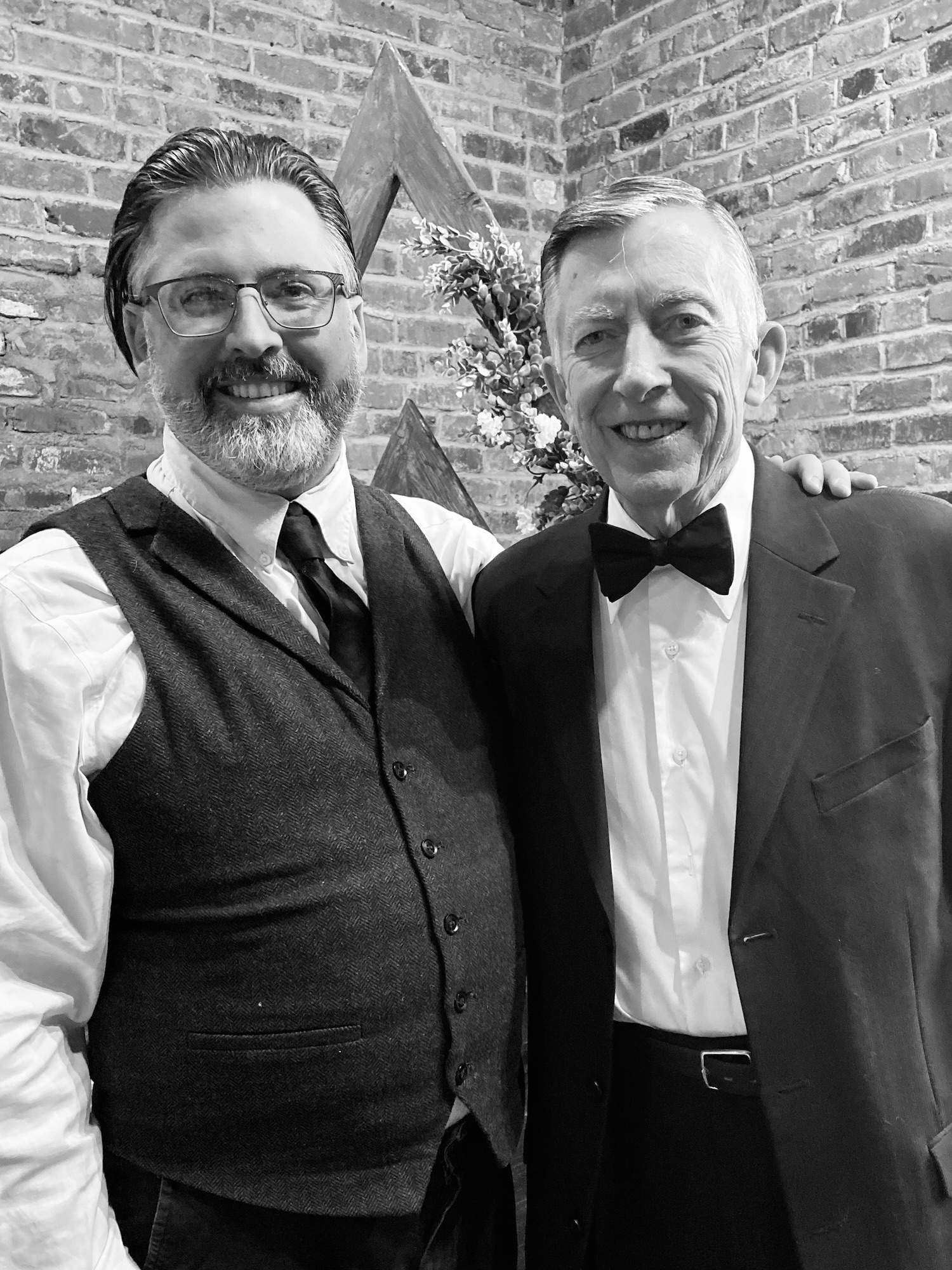
Fr. Barrett, Pastor Scott, Dr. Ali, and a longtime member of AMS Coldwater (also named Ali)

Lost & Found

Sermon for Proper 19, Year C

Click here for the biblical readings

I don’t usually like to toot my own horn, but I’m going to make an exception in this case, because when it comes to the subject of getting lost, I am something of an expert. According to my extensive personal experience, there are at least three ways in which I tend to get lost.

First, I know where I am and where I want to be, but I don’t know how to get there. Physically speaking, this is a pretty common experience for a lot of people. This is why we have GPS—or in the old days, these funny little pieces of paper called maps. Of course, the hardest thing about maps was that you could never quite figure out how to fold them right. So by the end of it, you would need a map for figuring out how to fold a map.

Spiritually speaking, this is why we have our spiritual practices: prayer, meditation, the reading of Scripture, and, of course, the seven sacraments. These things are like a map for the spiritual journey that we are all on—a journey from self-centeredness to reality-centeredness, as philosopher John Hick calls it.

The second way of getting lost is when we know where we want to go and how to get there, but we don’t have a clear idea of where we actually are. Physically speaking, this reminds me of a photo I saw this week of a sign in the Salzburg airport that says, “Sorry, this is Austria, not Australia. Need help? Press the button.”

Spiritually speaking, this is like the scribes and Pharisees in today’s Gospel reading. They saw themselves as good, righteous, decent citizens, offended that Jesus was hanging out with tax collectors and sinners. In their inflated sense of self-righteousness, these religious leaders mistakenly believed that they were morally and spiritually superior to the people Jesus was choosing to spend time with. They forgot that they, too, were sinners who needed grace just as much as everybody else.

The third way of getting lost is when we know where we are and how we want to travel, but we have no idea—or the wrong idea—of where we’re going. This would be like somebody who sets out from Coldwater to travel to Rochester, New York, but ends up in Rochester, Minnesota.

Spiritually speaking, this reminds me of people who think that their religious lives are only about getting their ticket stamped for the afterlife instead of trying to make this world a better place. It also reminds me of people who think that the spiritual life is about gaining some kind of mystical knowledge that makes them superior to others. Finally, it reminds me of those so-called Christian nationalists who see their religion as a means through which they can gain power and thereby force their will or beliefs on others. These people might have a clear sense of who they are and how they are living, but their final goal is very different from what Jesus Christ envisioned as the ultimate purpose of the spiritual path he taught.

So then, these are just a few examples of the many ways in which I tend to get lost in life, both physically and spiritually.

The theme of getting lost figures rather prominently in today’s Gospel reading. Here we listen to Jesus tell two stories about things that got lost: a sheep and a coin. Both are stories Jesus told in response to the religious leaders of his day getting upset about the kind of people he was hanging out with.

The scribes and Pharisees were educated and observant people who cared deeply about their faith and about how they thought it ought to be practiced. In contemporary terms, they would be like clergy or seminary professors. The tax collectors and sinners, on the other hand, were somewhat less respectable in the eyes of polite society. They were the riff-raff, the outcasts—the freaks and the geeks, if you will. But even more than that, they were people who, in the eyes of their neighbors, were not just sketchy but actually scary.

If we were to search for modern equivalents that would have the same emotional impact tax collectors had on Jesus’ audience, we might have to replace tax collector with sex offender or meth cook or gang member. Tax collectors and sinners were a rough crowd not just because of how they looked, but because of how they lived. These were genuinely scary people to Jesus’ audience. So it makes sense that polite, upstanding citizens would be disturbed by Jesus’ choice to spend time with them.

The shocking part of the good news Jesus proclaimed is that God’s love extends even to these most despicable human beings. And Jesus doesn’t flinch from saying it.

What I would like us to notice is the emotional tone of the words. The text says that the Pharisees and scribes were grumbling, but the emotional term Jesus uses—no fewer than five times—is some variation of the word joy or rejoice. The shepherd rejoices when he finds the lost sheep. The phrase rejoice with me is repeated twice. Jesus says there is joy in heaven and among the angels at the finding of what was lost.

Modern psychologists tell us people need about 5.6 positive compliments to balance out each negative criticism in order to be emotionally healthy. In this passage, Jesus actually comes close to that, with five repetitions of joy compared to one mention of grumbling. That’s kind of cool.

What this tells us about how Jesus sees the world is that unconditional love is the foundational fact of all reality. And that fact can be a source of joy when we learn to embrace it for ourselves and for others.

But this is easier said than done. Many of us find it hard to accept the gift of unconditional love, because there’s nothing we did to earn or deserve it. That makes it harder to extend love to others, because we can hardly believe it for ourselves.

Jaye Brix, a trans woman and former pastor, points out:

Many of us were taught a theology that prioritizes retribution over transformation. It’s not about making things right; it’s about who deserves to be punished. Someone needs to pay. So, when someone who holds a theology of retribution hears the words, “You hurt me,” they don’t hear, “Let’s fix it.” They hear, “You are a bad person.”

The fear that accompanies this theology causes people to look for any way to avoid guilt, because in their world guilt doesn’t mean growth; it means punishment. And who among us hasn’t felt the fear that being wrong might lead to being unloved?

According to Jesus, this is not a fear we need to carry any longer, because the good news he proclaims is that love is the foundational fact of all reality—and it applies equally to each of us. Believing this good news, trusting in the foundational fact of love, frees us from the power of fear that turns guilt into shame.

I like to tell my kids when they mess up that regret is a wonderful teacher. It means you’ve grown as a human being. It means you care about what is right. If you didn’t care, you wouldn’t feel guilty. Guilt, then, is not a sign that you are a bad person, but actually a sign that you are a good person. The only kind of person who truly lives with no regrets is a psychopath.

Kindred in Christ, I want to encourage you this morning with the good news that all of us get lost—at some time or another, in one way or another. Therefore, none of us can claim moral superiority over anyone else. What we can do, because unconditional love is the foundational fact of our existence, is learn to practice the art of radical self-acceptance and then extend that acceptance to those around us—even people we don’t like, people we disagree with, and people who scare us.

If God is love, as Scripture says, then the single greatest act of worship we can offer is to find joy in accepting that love for ourselves and extending it to everyone else. This is the heart of the Gospel. It is who we are, and it is what we are called to do as Christians on this earth.

Amen.

Pardon Our Dust

Sermon for the Tenth Sunday after Pentecost.

Click here for the biblical readings.

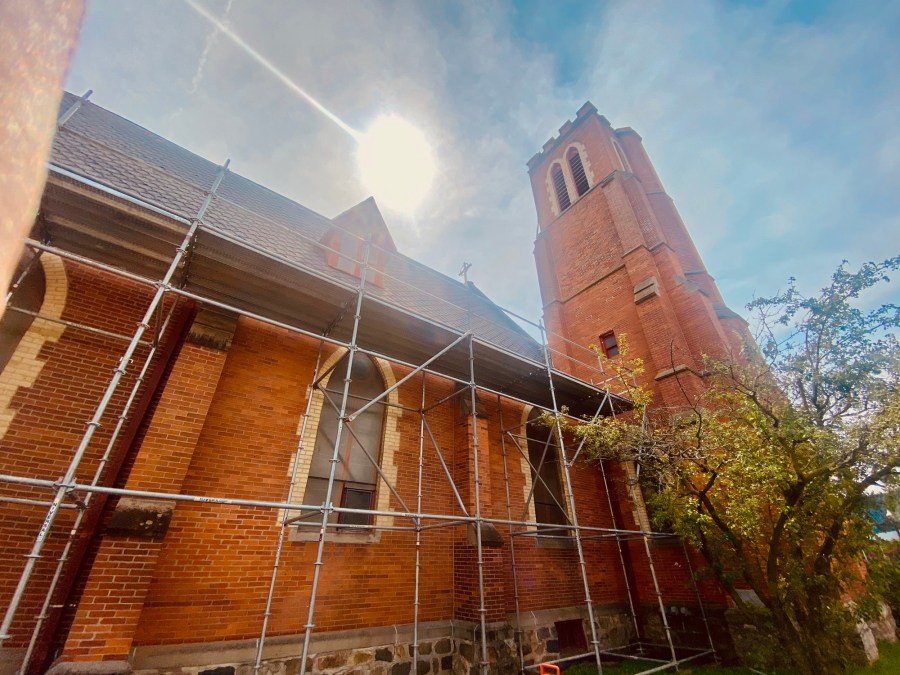
If you’ve been at the church building at all for the past couple of weeks, you’ve probably noticed that things have been a little different: You can see the scaffolding and the workers walking around on top of it. You can hear the sound of hammers and machinery. I’ve received multiple phone calls from people asking where to park or which entrance to use. There is no getting around the fact that this roof restoration process has been disruptive to our normal routines, as a church.

And yet… it’s absolutely necessary. Our building is more than just a lovely addition to the downtown historic district; this building is a tool that God has lent our church, so that we can do the work of ministry: Loving and serving our Coldwater neighbors in the name of Christ. Restoring the roof is practicing good stewardship over that which we have borrowed from God, just like we might take extra good care of a car or a book that we had borrowed from a friend.

Nevertheless, the process of caretaking has been especially disruptive to our normal routines for these past few weeks…

People tend to not like disruption in their daily routines. It’s inconvenient (we are creatures of habit, after all). It gets in the way of our plans (although, as they used to say, “If you want to give God a good laugh, tell him your plans”).

Disruption can come to our lives in many forms: the loss of a job, the breakup of a relationship, accidents, illness, or death. Sometimes, it’s even a happy occasion, like getting married, having a baby, graduation, or retirement. It’s good stuff, but it’s still disruptive to our regular routines.

As creatures of habit, we tend to see disruption as a problem and peace as a solution, but Jesus (in today’s gospel, at least) seems to see it the opposite way.

Jesus asks his disciples, “Do you think that I have come to bring peace to the earth?” And then, he answers his own question, “No, I tell you, but rather division!”

Now, this is where we might say, if we were present at this conversation, “Now wait just a minute, Jesus! Aren’t you supposed to be the Prince of Peace? At Christmastime, aren’t we supposed to say, ‘Peace on Earth and goodwill to all’?”

And Jesus would respond, “Yes, but what exactly do you mean by ‘Peace’?”

Peace is a good thing, but it is often misunderstood by those who would rather settle for normalcy than challenge the status quo. We sometimes try to “keep the peace” by avoiding uncomfortable conversations, inconvenient truths, and important decisions. That kind of “peace” is no peace at all, according to Jesus. That kind of (so-called) peace is toxic.

Dr. Martin Luther King, Jr. said that peace, “is not the absence of conflict, but the presence of justice.” Justice, as Dr. King meant it, is fair and harmonious relationships between people. It has less to do with punishment and more to do with what St. Paul meant by the word “righteousness” in his epistle to the Romans. Peace, as Jesus meant it, is what happens when people address old patterns of behavior, become aware of unconscious habits of thinking, and seek to make amends for the mistakes of the past. Peace upends our lives and refuses to leave us as it found us. Peace asks something of us. Peace, as Jesus Christ intends it, is disruptive.

That’s why Jesus says, in today’s gospel, that he has not “come to bring peace to the earth… but rather division.” Jesus disrupts our false illusions of peace in order to bring us closer to true peace, which can be found in right relationships between God, our neighbors, and ourselves. Sometimes, disruption is necessary in order to bring us into the good life that God intends for us.

Here’s the thing I want us to carry away from this sermon today:

When Jesus stirs up the dust in our lives, it’s not to tear us down; it’s to make us stronger, so we can join him in building something even better.

The mess in our lives, just like the mess in our church building this week, is not a sign of failure; it is a sign of God at work.

I have found this principle to be true in my own life:

When I was a kid, my Uncle Hutch was a spiritual leader in our family. He was a United States Army chaplain who served in the first Gulf War and later as a commercial chaplain for truck drivers in South Carolina. He is a very tall, wise, and kind-hearted man who I have always looked up to, both literally and figuratively.

Whenever we would gather at his house for Thanksgiving dinner, Uncle Hutch would lead the prayer. Whenever someone in the family was getting married, Uncle Hutch would officiate the service. Whenever one of us needed spiritual counsel, we would call Uncle Hutch.

In recent years, Uncle Hutch’s health has begun to decline. Now in his eighties, his spirit is stronger than ever, but his physical body is showing the inevitable signs of age. As this has happened, without anyone making an official proclamation, I have noticed the family roles that were previously assigned to Uncle Hutch now gradually falling to me.

I have to admit that this prospect is daunting. First of all, I am keenly aware that my personal views on various matters differ somewhat from those of my family. Lastly, and far more significantly, how could I possibly fill the shoes of a man of God that I have admired since the day I was born?

The task seems impossible to me.

When I called my Aunt Faith to ask permission to share this story today, she told me that none of us can ever “fill the shoes” of another person. The best we can do is to “follow in their footsteps” in our own particular way, even if our way differs somewhat from the way in which the original person would walk it.

The shift in family roles has certainly been disruptive, to say the least, but I must also admit that it has led to some of the most deep and honest conversations with my family that I have ever had. Whenever significant events happen, good or bad, I have become the one that my family members call to seek comfort and advice. I still don’t feel up to the challenge, but I try my best to meet it to the best of my limited ability. I can only trust God’s Holy Spirit to fill in the blanks where my personal wisdom is most definitely lacking.

It is in moments like these that I ask the age-old question, “What would Jesus do,” or, secondarily, “What would Uncle Hutch do,” to respond to the problems that are presented to me.

The shift in family roles has most definitely been disruptive to my felt sense of peace, but I can also see how it has been part of God’s work in the life of my family.

Kindred in Christ, I put it to you today that the disruptions in our lives are not problems, but the very solutions that we have been seeking to the questions that beset us. The God we believe in, revealed through the person of Jesus Christ, is a God who asks tough questions and leads us through the desert of conflict, in order to bring us to the true peace that consists of right relationship between God, our neighbors, and ourselves.

Let us not shy away from tough questions and gravitate toward easy answers, but sit in the tension that leads to “the peace that passeth all understanding.” Let us hang upon our hearts a sign that says, “Pardon our dust” while we wait in the confidence that God is not done with us yet, but is still working to bring us to the fullness of peace in Christ Jesus our Lord.

As a tangible sign of our faith in God’s work in our lives, I would like to invite to the front of the church Mr. Mike Woodhouse, manager of Sheriff Goslin Roofing Company, and any members of his crew who are present with us today.

These people have been hard at work on the roof of this historic building. I would like to introduce them to you so that you can thank them and join me in a special blessing over their work, as well as a prayer for their safety while they lovingly restore the roof of this building.

Let us pray.

Loving God, you have gifted these workers with the skill and the will to work for the restoration of this church building, which you have lent to us for the purpose of continuing the work of Jesus Christ on this Earth, by loving you with our whole heart, soul, mind, and strength, and loving our neighbors as ourselves. In Christ’s most holy Name, we bless the labors of these workers and pray for their safety from dangers seen and unseen, that the goodness they create with their hands may be matched by the sincerity of our hearts. We ask these things and bless these workers in the Name of the Father, and of the Son, and of the Holy Spirit. Amen.

Kindred in Christ, these workers are a symbol to us of the good work that God is doing in each of our lives. May each and every one of us come to acknowledge this work and bless the disruptions, not as a problem to be solved, but as the means through which God is bringing each of us, in our own time, to the fullness of peace that can be found in Jesus Christ our Lord.

Amen.

What Matters Most (Rooted & Rising, Week 4 of 4)

Sermon for the eighth Sunday after Pentecost (Proper 13, Year C)

Click here for the biblical readings.

I’d like to tell you about a guy named Alcibiades.

He lived a long time ago, in ancient Greece, way before Jesus was even born. And he was an absolute rock star in his day. He was good-looking, well-liked, and tremendously successful. 

He rose to prominence in the city-state of Athens as a student of Socrates, a politician, and a military commander. One night, during a fit of drunken debauchery, Alcibiades and his friends defaced several statues of the god Hermes. This caused an outrage among the respectable citizens of Athens, so Alcibiades turned tail and escaped to their rival city of Sparta. 

Now, Sparta was the kind of place where they raised their kids like Navy SEALS, so Alcibiades traded his Athenian Gucci for Spartan camouflage and put his strategic skills to use for the sworn enemy of Athens. It would be like the football coach at U of M stealing their playbook and going to coach for MSU!

While living in Sparta, Alcibiades once again got himself in trouble by getting a little too “up close and personal” with the wife of a local politician, so he went on the run yet again and found himself in Persia. While living there, he used his influence to get himself back to Athens, but even that didn’t last long. He ended up dying in exile, without any friends or allies.

Alcibiades was the kind of guy who could charm the ice off an igloo. Socially, he was like a chameleon, who could change his colors to suit whatever environment he was in. He could be anyone you wanted him to be. Anyone, that is, except himself. 

We’ve all probably known someone like that: Someone who takes on a completely new personality, based on who they’re dating. If I’m being truly honest, I can even find a bit of Alcibiades in myself. In fact, I’ve already done it in this very sermon! 

A moment ago, I made a sportsball reference… but I don’t actually follow any sports! I only said it because I thought it would resonate with you. In fact, I had to Google, “Who is U of M’s rival” before I wrote that sentence. So yes, we all do it. We are all guilty of hiding or changing who we are because we think it will make us look more appealing to the people we are with. It’s a universal human phenomenon.

Today is the final week in our summer series on the book of Colossians. In the first week, we talked about how we are rooted in love, even when cynicism, fear, and indifference tell us otherwise. In the second week, we talked about how our true self is found in the connection and interdependence we have through Christ. Last week, we talked about how we are already whole and complete in Christ, not through effort but through grace. Today, we are going to talk about what we can let go of, precisely because we are rooted in love, connected in Christ, and saved by grace.

In short, what we can let go of is the insecurity that leads us to put on all kinds of fake masks to impress the people around us.

It’s this fundamental insecurity, this fear that something in us is missing or broken, that leads people to divide themselves into competing groups, point fingers at others, and generally tear one another to shreds in order to make themselves look (and feel) better. The author of Colossians calls this insecurity the “old self” and points to examples like, “fornication, impurity, passion, evil desire, and greed.”

Then they keep going: “anger, wrath, malice, slander, and abusive language.”

If I were to hold onto this list of moral vices and keep a tally, while watching the daily news and the commercials between segments, I would probably be able to check off each one (multiple times) by the end of the first hour. Some might say this is because America is a hopeless den of sin, but I say that we do these things simply because we are insecure people who don’t know how deeply we are all loved and cherished by the God who made us.

Kindred in Christ, love speaks the truth about who you really are. Colossians says that your true self is “hidden with Christ in God.”

That word, hidden (Gk. kekryptai), doesn’t mean “lost,” but “protected.” It’s like a seed that has been planted in the ground, waiting to grow into a tree. The text goes even farther than that, saying that “Christ is all and in all.” The Bible lists no exceptions to that rule. Finally, the author of Colossians says, “When Christ who is your life is revealed, then you also will be revealed with him in glory.” 

That word, glory (Gk. Doxa) means “radiance” or “inherent worth.” I look at the faces in this congregation today and I see people who are radiant and inherently worthy of love.

I find these words to be profoundly mystical and amazing. According to this passage of Scripture, Christ “is your life” and “Christ is all and in all.” There are no exceptions listed. In fact, the author goes to great lengths to specifically say that there are no exceptions. In Christ,

“there is no longer Greek and Jew, circumcised and uncircumcised, barbarian, Scythian, slave and free.”

All dividing lines of social class, ethnicity, and religion are rendered obsolete in Christ. We could add to that list things like sexual orientation, political party, immigration status, or any of the other categories that divide people today. None of them matter anymore, when we begin to look at ourselves and each other through the loving eyes of Christ. Christ “is our life.” Christ “is all and in all.” You don’t have to take my word for it; it’s right there inthe Bible!

Friends, the fact that you are unconditionally loved by God is the fundamental truth of your existence. It is who you are. Nothing else matters. 

I recently saw an internet meme. I don’t know who originally said it, but I 100% agree with it: “You will never look into the eyes of someone who God does not love.” 

Anglican author C.S. Lewis said it a little more eloquently:

“There are no ordinary people. You have never talked to a mere mortal. Nations, cultures, arts, civilizations—these are mortal, and their life is to ours as the life of a gnat.”

This truth applies, not just to others, but to the person you face in the mirror as well. Christ “is your life.” Christ “is all and in all.” Everything else is just window dressing, so we can let it fall away.

Your job title, your salary, your academic diplomas, your number of online followers, and the number on your bathroom scale are all figments of the collective imagination that we can let go of in the light of God’s immortal love. You are loved. This is the only truth that matters in the end.

When I worked as a hospice chaplain, in the years between my ordained ministry as a Presbyterian minister and an Episcopal priest, I had the solemn privilege of sitting with many people in their final days and hours of life. In all that time, I never heard a single person brag about their net worth or their worldly possessions. 

What I heard them say, again and again, is four things. And I’m not the only one to notice these four things that people say at the end of life. Dr. Ira Byock, a palliative care physician who works with dying people, noticed people saying these same four things and wrote about them in a book called, The Four Things That Matter Most.

The four things that matter most, the things that people say on their deathbed, are: 

  • I forgive you,
  • Please forgive me,
  • Thank you, and
  • I love you.

At the end of our lives, when all of our worldly accomplishments and artificial categories are being stripped away by our impending death, the four things that matter most are: I forgive you, please forgive me, thank you, and I love you.

Dr. Byock asks,

“What would it be like if we said these things, not just when we are dying, but throughout the entirety of our lives?”

Our faith gives us the power to do just that.

The purpose of the Christian faith is not to get us ready for heaven after we die, but to enable us to live in heaven, at least in part, before we die. 

If we live our lives in the belief that we are loved by God, we will have the power to let go of the made-up categories that divide us on this Earth. We will be able to “strip off the old self,” as the author of Colossians says, and live in the reality of our true self, which is Christ: beloved and loving, rooted and rising in love. Just as Jesus Christ was during his time on Earth, so are we in our time. 

You are loved in abundance; therefore, give love in abundance. This is the central truth of the Christian faith. This is the truth that I hope you have heard during our summer sermon series on the book of Colossians, and it is the truth that I hope you will give to the world for the rest of your days.

Amen.

The Scandalous Gospel of Grace (Rooted & Rising, Week 3 of 4)

Sermon for the Seventh Sunday after Pentecost (Proper 12, Year C)

A man walks into his doctor’s office and says, “Doc, I’ve got a terrible, piercing headache that just won’t go away. Can you help me?”

The doctor says, “Sure. Let me ask a few questions, just to get a medical history. Do you smoke?”

“No way,” the man says, “That’s a disgusting habit!”

“Ok,” says the doctor, “How many drinks of alcohol would you say you have in a week?”

“Zero,” the man says, “I’m a teetotaler, always have been!”

“Ok,” says the doctor, “Do you eat a lot of junk food?”

“None,” the man says, “Fresh vegetables are all I eat.”

“Ok,” says the doctor, “Do you watch a lot of TV?”

“No sir,” the man says, “The only thing I do for entertainment is sit at home and read my Bible.”

“Ok,” says the doctor, “I think I see the problem here. My prescription for you is a large pizza, a good movie, and Extra Strength Tylenol because, if I was as uptight as you are, my head would hurt too!”

I borrowed this story from songwriter Rich Mullins, who borrowed it from author Brennan Manning.

In one of his more famous books, Brennan wrote:

 “The trouble with our ideals is that if we live up to all of them, we become impossible to live with.”

Brennan Manning, The Ragamuffin Gospel, p. 74

Many people have never heard of Brennan Manning. He’s one of those spiritual authors who has a very niche market. He’s not an academic scholar. He’s a little too “Jesusy” for liberal and secular types, but he’s also too broad-minded for conservative and religious types. In short, Brennan Manning’s writing has something to offend everyone. If I were to sum up Brennan’s writing in a single phrase, it would be: “The Scandalous Gospel of Grace.” And scandalous it most certainly is…

Brennan got his start in ministry as a Roman Catholic priest. After several years, he burned out and sought treatment for alcoholism. In sobriety, he left the priesthood and got married. For the rest of his life, he traveled, wrote, and spoke about the unconditional love of God for sinners and “ragamuffins,” as he liked to call them.

I first encountered Brennan’s writing in college, when I was at the peak of my own religious zealotry. If you asked those who knew me, they would tell you that I was “on fire for Jesus.” But if you asked one of the few people who knew me well, they could tell you that I was a young man who struggled to believe in the gospel that he preached. I gave lip-service to belief in a loving God, but secretly worried that this same God was gleefully waiting to punish me for every sinful thought, word, and deed, no matter how small. It was during this time of my life that I first read the books of Brennan Manning.

At first, I scoffed at what he had to say, but I also couldn’t bring myself to throw his books away. I read them again and again, sensing that there was something important for me to hear in these words, but not knowing what it was. As it turns out, what I needed to hear was the kind of truth that could only be spoken by someone who had been knocked flat on his butt by failure, and could only be heard by someone else who had also been knocked flat on his butt by failure.

Today is not the day when I will get into the details of my particular story, but stay tuned: I’m sure you’ll hear it eventually. The reason why I’m telling you this much today is to emphasize the fact that this is not a story about me or Brennan Manning, but a story about the scandalous grace of God. The truth that Brennan Manning preached is the scandalous truth that each and every one of us is loved and accepted unconditionally, regardless of whether or not we deserve it.

To those who have not experienced abject failure, the scandalous gospel of grace sounds like a bunch of hippy-dippy, flower-child, peace and love crap. But to those who have reached the end of their rope, those whose “cheese is sliding off their cracker,” as Brennan used to say, the scandalous gospel of grace is the final lifeline between broken people and the bottomless pit of despair.

Don’t just take my word for it; ask any recovering alcoholic or addict. There are several of these saints living among us today. If you don’t want to do that, just ask St. Paul and his followers, who wrote the epistle reading we heard this morning.

Today is the third in our four-week sermon series on the New Testament book of Colossians. In the first week, we looked at the opening of the letter, where the author, writing in Paul’s name, gives thanks for the ways in which the virtues of faith, hope, and love counter the forces of cynicism, fear, and indifference. Last week, we talked about Christ as the invisible network that connects us all. Today, we are getting into the nitty-gritty of life in the real world, where we are constantly bombarded by messages that we are not good enough. These lying messages tell us that we had better get on-board with their program, which promises success and happiness, so long as we follow the author’s instructions to the letter.

What I love most about today’s reading from Colossians is how it calls out those false promises for the malarkey that they are.

Colossians says, “See to it that no one takes you captive through philosophy and empty deceit, according to human tradition, according to the elemental spirits of the universe, and not according to Christ.”

What the author was talking about in this verse was two opposing controversies that were plaguing the Church at Colossae in the time when this letter was written. On one side was a group of very traditional religious people who said, “Jesus was Jewish, and all his apostles were Jewish, therefore any non-Jewish converts to Christianity must first convert to Judaism and follow the laws of the Torah.” On the other side were the non-Jewish converts to Christianity, who were influenced by the teachings of the Greek philosopher Plato, who said that salvation from corrupt physical existence comes from learning the secret knowledge of the spiritual realm, which is diametrically opposed to the realm of physical existence.

The people of the Church in Colossae wanted the author of this epistle to settle the argument and tell them which side was right. As it turns out, the correct answer was: “Neither.” Neither side was right in the culture war that afflicted the Colossian Christians.

The truth of Christ was based, not on the pious observance of traditionally religious people, nor on the esoteric philosophy of educated people, but on the unconditional love of Jesus, which reaches all people who call out from the depths of despair.

Colossians says, “Do not let anyone disqualify you,” and I really like that. Do not let anyone disqualify you, not the liberal philosophers, not the conservative clergy, not even yourself. Do not let anyone disqualify you, because you have already been qualified by the scandalous grace of God, who has welcomed everyone in the embrace of unconditional love.

At the beginning of this reading, the author of Colossians says, “As you have received Christ Jesus the Lord, continue to live your lives in him, rooted and built up in him and established in the faith, just as you were taught, abounding in thanksgiving.”

Pay special attention to the first and last words of that sentence: “As you have received,” and, “abounding in thanksgiving.”

The key word in the first part is, “received.” Note that it specifically does not say, “achieved.” An achievement is something we earn by effort, like an academic diploma. By contrast, a gift is something that we receive, like a Christmas present. The proper response to a free gift is gratitude, which is why the sentence ends, “abounding in thanksgiving.”

There is nothing that we Christians did to earn our salvation, therefore there is nothing we can do to lose it. Our only role is to receive it with thanksgiving. As the Protestant reformers are so fond of saying, we are “saved by grace alone.” Our faith and our works are nothing but a grateful response to the amazing grace that has been so lavishly bestowed upon us by God.

In a way, every single one of us is an “illegal immigrant” in the kingdom of God, insofar as we have been brought into God’s good graces “outside of the law,” by the unconditional love of Jesus Christ, who proved his love for us “while we were still sinners” by dying for us, as the Scriptures say in Romans 5:8.

Kindred in Christ, we are saved by grace, not because of our spiritual knowledge or religious observance, but because each and every one of us is loved, unconditionally, by the God who made us. God’s love transcends every category that divides us, whether that be race, gender identity, ethnicity, nationality, sexual orientation, political affiliation, economic status, or religion. God’s grace is universal.

You are loved. Full stop. No addendum. No provisos. No “quid pro quo.”

You are loved. This is the scandalous gospel of grace. There is nothing you did to earn God’s grace, therefore there is nothing you can do to lose it.

God loves you. This is the foundational truth of the Christian religion, and it is the ditch in which I am willing to die. If you have a problem with that, take it up with God, not me.

Amen.

Rooted: Choosing Deep Connection Over Quick Fixes

Sermon for the sixth Sunday after the Epiphany.

Delivered at St. Mark’s Episcopal Church, Coldwater.

Click here for the biblical readings.

Imagine, if you will, a shrub in the desert: surviving, pelted by sand, scorched by the sun, and praying for rain. Now imagine a tree by a river: well nourished, with deep roots, surrounded by green.

The prophet Jeremiah uses this dual-image to describe two ways of living: the way of self-sufficiency and the way of trust.

In order to understand what Jeremiah means by this, it would be helpful to have a little bit of historical background:

Jeremiah lived about 600 years before the time of Jesus. During his lifetime, the Babylonian Empire had become a regional super-power under the reign of King Nebuchadnezzar.

After a series of military victories, Nebuchadnezzar asserted his dominance over Judean politics by deposing the descendants of King David from the throne and replacing them with Zedekiah, a puppet ruler of his own choosing.

Now, after a while, “King” Zedekiah got a bit too big for his britches. He started listening to a group of so-called prophets who filled his head with nationalistic delusions of grandeur. They told him that, since they were the “chosen people,” they could rise up and throw off the yoke of Babylonian dominance.

In order to accomplish this feat, Zedekiah had entered into secret negotiations with the nation of Egypt to provide military assistance for this coup. Jeremiah warned the king that this would be a very bad idea and would not pan out the way he thought. Jeremiah realized that their national life was founded on their covenant with God. Faithfulness to this way of living would result in peace and prosperity for the people, while unfaithfulness would result in struggle. Jeremiah believed that the current state of Babylonian dominance (to which this puppet king owed his position) was the result of unfaithfulness to the covenant. He advised King Zedekiah and the Judean people to accept the fact of Babylonian rule and improve their situation by focusing on their spiritual lives.

The false prophets, on the other hand, told Zedekiah to rise up against Babylon, that he could rely on supernatural favor to strengthen his hand to do whatever he wanted, simply because they were “the chosen people.” The false prophets got the king’s attention because they told him what he wanted to hear. Meanwhile, Jeremiah got himself arrested and thrown in prison because he dared to speak an inconvenient truth.

In 587 BCE, Jeremiah’s prediction would prove to be correct. The Zedekiah went ahead with his Egyptian alliance and rose up against Nebuchadnezzar. When the Babylonian army showed up to quash the rebellion, the Egyptians turned tail and fled, leaving the Judeans to face the Empire alone. The Babylonian army ransacked Jerusalem, burned the temple to the ground, and hauled the upper-class leaders away into slavery. Jeremiah’s point-of-view was vindicated, but it was a complete disaster for the people, especially those who bought into the king’s nationalistic delusions of grandeur.

This disaster is what Jeremiah was warning the people about when he said:

“Cursed are those who trust in mere mortals and make mere flesh their strength, whose hearts turn away from the Lord. They shall be like a shrub in the desert, and shall not see when relief comes. They shall live in the parched places of the wilderness, in an uninhabited salt land.”

Jeremiah 17:5-6

According to Jeremiah, the way of political maneuvering and raw force would lead only to a shallow and desperate life. A life founded on moral and spiritual principles, on the other hand, would lead to flourishing and peace in time. “Trusting in God” is a longer and more circuitous route, but it leads to a stronger foundation for peace, security, and prosperity. Jeremiah writes about this kind of life:

“Blessed are those who trust in the Lord, whose trust is the Lord. They shall be like a tree planted by water, sending out its roots by the stream. It shall not fear when heat comes, and its leaves shall stay green; in the year of drought it is not anxious, and it does not cease to bear fruit.”

Jeremiah 17:7-8

I have encountered the way of the shrub in the desert in my own life. As a parent of teenagers, my kids frequently come to me with big asks: “Can I stay up late? Can I go out with my friends on a school night? Can I have money for this or that thing?” Most of these requests are simple Yes or No questions.

My first instinct is usually to take the authoritarian route and put my foot down with a firm, “No.” When they ask why, I am tempted to respond, “Because I said so.” Of course, when I’m feeling tired or just want to avoid a meltdown, I might take the permissive route and say, “Sure. Fine. Whatever.”

The problem with both of these approaches is that they both keep us on the surface of the conversation. Neither one really digs down to the root of the matter. My wonderful wife is the one who taught me how to slow down and ask the deeper questions about the kids’ needs. Instead of snapping to Yes or No, I have gradually been learning how to pause and say, “What’s going on? What about this is important to you?” We often end up listening, negotiating, and compromising before reaching a final decision.

I find that it takes more time and more work, but the rewards are greater because it helps me to really pay attention to my kids as human beings, understanding their unique needs, hopes, and fears. In the end, we still have to come to a Yes or No decision, but how we get there is at least as important as the answer itself.

The way of the shrub in the desert, like the way of the quick Yes or No, is a life turned in on itself. Grounded in one’s ability to exert control, it has shallow roots, clinging desperately to the dry sand and praying for rain to come.

We can see examples of this kind of shallow existence all around us. We spend hours on our devices, seeking quick validation from the number of likes on our posts and getting angrier and angrier about the news fed to us in echo chambers of social media. At work, we climb the corporate ladder without regard for who gets stepped on. In the economy, we seek instant gratification with fast fashion and planned obsolescence. In politics, we treat democracy like a spectator sport, alternately cheering and jeering, depending on which party is temporarily on top. All of these are examples of the “shrub-mentality,” and all of us participate in it, at least sometimes. The shrub-mentality not inherently evil, but it is shallow and brittle.

The way of the tree by the river, on the other hand, is a life nourished by deeply-rooted connection. It takes more time and more work to cultivate, but our patience pays off in greater resilience and flexibility. Jeremiah’s vision of the tree by the river is an image of the abundant life that God intends for all people. The way to this life is neither quick nor easy, but the journey is worthwhile.

As members of a faith community, we have been given a particular set of “gardening tools” for cultivating the life that God intends.

First, we have our core values, like faith, hope, and love (see I Corinthians 13). When we consciously identify these values and say them out loud, we set ourselves on the path to fulfilling them. They are, if you will, the “seeds” we plant in our spiritual garden.

Next, we have our spiritual practices, like prayer, worship, service, and especially the Scriptures and the Sacraments. These are like the spades, rakes, hoes, and watering cans that we use to help the “seeds” grow. The more we make use of them, the healthier our garden will be.

Finally, we have each other. As the old adage goes: “Many hands make light work.” Mutual relationships of care, support, and accountability are like the richly tilled soil in which our garden grows. The work is long and hard, but it becomes more doable when we do it together.

Kindred in Christ, the question that the prophet Jeremiah puts before us today is this: “How deep are our roots?”

Are we clinging to the surface, hoping for rain, like a shrub in the desert? Or are we watering the seeds of our core values, tilling the soil of mutual relationships, and using the tools of our spiritual practices?

That tree by the river can be you. That tree can be us: Deeply rooted, with green leaves, and branches full of fruit. Even in the midst of struggle, we can continue to live the life that God intends for us: A community rooted, connected, and flourishing.

As Jeremiah said to his people:

“Blessed are those who trust in the Lord.”

“They shall be like a tree planted by water.”

“They shall not fear when heat or drought comes.”

“They shall never cease to bear fruit.”

May it be so.

Amen.

You Are What You Eat: Communion as Living Sacrifice

Sermon for the Feast of the Presentation of Our Lord.

Delivered at St. Mark’s Episcopal Church in Coldwater, MI.

Click here for the readings.

The other day, I realized something unusual about narcissism: It’s the only illness in the world that you’re happy to have.

This is true: Psychologists don’t even do clinical tests for narcissism anymore; they just ask, “Are you a narcissist?” If they say, “Yes,” believe them! That doesn’t happen with any other disease. Can you imagine someone coming back from the doctor like, “What’s got two thumbs and Stage IV Cancer? This guy!” It just doesn’t make sense.

Clinical narcissists, on the other hand, lack the basic self-awareness to realize that their condition is debilitating. They are so pathologically focused on their own needs, they don’t even realize it’s a problem. They act like the biggest jerks while pretending to be the greatest person who has ever lived. They wind up alone when what they really want is to be loved.

Very few people are narcissists at the clinical level, but all of us have that tendency within us. We all have moments of selfishness. So, before I go labeling other people as narcissists, I need to take a look in the mirror and realize: Sometimes it’s me.

What I miss, when I’m acting selfish, is the fundamental truth that I cannot create a full and meaningful life for myself if my only goal is to create a full and meaningful life for myself. My life, and yours, only has meaning when we look at it in context, as one small part of a greater whole. That fundamental truth resides at the heart of today’s gospel.

Today, we celebrate the Feast of the Presentation. In today’s gospel, we heard about the infant Jesus undergoing the Jewish rite of Pidyon Haben, also known as, “Redemption of the Firstborn.” This custom, commanded in the Torah (see Exodus 13, Numbers 3:40-51), serves a reminder to the Jewish people that our lives are not our own, but belong to Adonai our God. Forty days after the birth of a firstborn male baby, the parents would present themselves, with the child, in the Jerusalem Temple. In ancient times, they would offer an animal sacrifice or monetary donation as a symbolic payment for the child, who belongs to God.

When the infant Jesus underwent this ritual, two mysterious elders appeared, Anna and Simeon, who began to proclaim wondrous things about this child’s Messianic destiny as “the consolation of Israel” and “the redemption of Jerusalem.” Joseph and Mary came to present their baby at the Temple, according to custom, but they left with something much greater: confirmation that this baby was the long-expected Messiah of the Jewish people.

Human sacrifice, as we typically understand that term, has never been a normative practice of Jewish or Christian religion. It was fairly common, however, in various cultures during biblical times. When God initially commands Abraham to sacrifice his son Isaac in Genesis 22, it would have seemed normal to people in the Ancient Near East. They would say, “Yeah, that’s what gods do: They demand that you sacrifice your children in exchange for prosperity.” It seemed normal to them. The shocking part of that story, for the people of that time, is the part where Abraham’s God stops the sacrifice before it happens. This would have seemed like a revolutionary new idea to them. Later on, in the New Testament era, St. Paul continued this line of thinking in his epistle to the Romans: “I appeal to you, therefore, brothers and sisters, by the mercies of God, to present your bodies as a living sacrifice, holy and acceptable to God, which is your spiritual worship” (Romans 12:1).

The term “sacrifice,” as understood in the Jewish and Christian traditions, is not about physical killing. The Latin roots of the word, sacra ficia, literally mean “to make holy.” When something is sacrificed, its individual existence takes on new meaning in the context of a greater whole. That is exactly what happened with the infant Jesus in today’s gospel, and it is what happens with all of us when we are called upon to make sacrifices in our own lives.

In our liturgy of the Eucharist, we have a regular part called, “The Offertory.” In some churches, they call it, “passing the plate.” In practical terms, this is where we all chip in to keep the lights on and programs running at the church, but it’s also much more than that. The spiritual meaning of the Offertory is that we are presenting the fruits of our life and labor to the Lord, who is the original source of these good gifts. In some parishes, it is still common practice for the people to say together the words of I Chronicles 29:14 when the Offering is presented at the altar: “All things come of thee, O Lord, and of thine own have we given thee.”

More important than the collection plate are the elements of bread and wine, which are brought to the altar at this time. Wheat and grapes are fruits of the Earth, which have been shaped by human labor into bread and wine. Our monetary offerings are a symbolic addendum to these primary elements. Really, it is the Earth itself, and our own selves, that we place on the altar as a living sacrifice to God. Standing in the place of Christ, the priest receives these offerings, blesses and consecrates them, and offers them back to us as the Body and Blood of Christ, which we then receive into our own bodies. In this act of Communion, we come into a deeper awareness of the true meaning of our lives. Because of the wheat and the grapes, we are in Communion with the Earth; because they have been shaped into bread and wine, we are in Communion with all human labor; because all people are welcome around this altar, rich and poor, black and white, male and female, gay and straight, cis and trans, Republican and Democrat, native and immigrant, we are in Communion with each other; because these consecrated elements are the Body and Blood of Christ, we are in Communion with God.

Dieticians are fond of saying to their patients, “You are what you eat.” This statement is never more true than when you come forward to receive Communion in Church. Whenever I administer Communion, I always give an opportunity for eye-contact (NOTE: Some people are not comfortable with that, and that’s perfectly okay; just know that it’s there, if you want it). I hold up the consecrated host between us and say, “The Body of Christ, the bread of heaven.” Notice that I do not say, “This is the Body of Christ,” but just, “The Body of Christ.” Question: Am I talking about the bread or the person whose eyes I am looking into? It’s intentionally ambiguous. The answer, of course, is, “Both.” You are what you eat.

Through this act of sacrifice, we too are “made holy” and sent forth to be the hands and feet of Jesus in the world. We say, in our Post-Communion Prayer, “Loving God, we give you thanks for restoring us in your image and nourishing us with spiritual food in the Sacrament of Christ’s Body and Blood. Now send us forth a people, forgiven, healed, renewed; that we may proclaim your love to the world and continue in the risen life of Christ our Savior.”

What we receive back, in Communion, is infinitely greater than that which we give up. We offer bread and wine; we receive Christ’s Body and Blood. We offer ourselves; we receive God. Our lives take on new meaning when we set aside our narcissistic desires and see them instead as part of the greater whole.

Kindred in Christ, I invite you this day to consider your lives from a Eucharistic point-of-view. When you gather with your neighbors around this altar to receive the Sacrament, meditate on these words of St. Paul in Scripture: “It is no longer I who live, but it is Christ who lives in me” (Galatians 2:20). “Let the grace of this Holy Communion make us one body, one spirit in Christ” (BCP 372), overcoming our narcissistic tendencies, petty squabbles, and unhappy divisions. May we, through Christ, and with Christ, and in Christ, come to understand our individual lives as parts of the greater whole of God’s life. And, in so doing, may we become the fulfillment of Christ’s prayer, that we all “may be one, as [he and his Father] are one” (John 17:22).

Amen.