The Real Legacy of the English Reformation

Reblogged from The Liturgical Theologian.

Cranmer was responsible for the first piece of liturgy written in English (the Great Litany of 1544), much of the Book of Homilies, the inclusion of the Great Bible in parishes around the nation, and the 1549 and 1552 Books of Common Prayer. These landmarks insured one thing: a common language for the faith and worship of the Church in England. Every parish in the country would now read the same Bible, hear the same homily, and pray the same prayers in the exact same language…

…What then is the true legacy of the English Reformation? A common Bible and a common prayer book in a common language for a common people.

Click here to read the full article

Star Trek made me a moral person (reblog)

This is a reblog from Samantha Field, an author who has quickly become a new favorite of mine in the blogosphere. Samantha writes with a rare combination of personal vulnerability and razor-sharp insight. After you’ve read this one, I highly recommend perusing other articles on her site. Enjoy!

Star Trek, in many ways, is a modern morality play. There’s more nuance, more shades of grey, more complicated human realities, but what it does best is feature people with all their flaws and beauties struggling to make the world a better place. Sometimes, they fail. As Chakotay learns in “The Year of Hell,” sometimes even your best and purest motives are wrong. In Star Trek, though, winning is defined not by typical notions of success and wealth and power, but by understanding. When characters learn more about themselves– like Data learning about fear in Star Trek: Generations– or about other people, nations, planets, and species, that’s what the show considers a success.

Click here to read the full article.

Wearing the Collar

Reblogged from Anglican Pastor

When I was in discernment for the priesthood – and even before formal discernment had begun – my spiritual director asked me wonderfully probing questions.  “Why do you feel a need for ordination?  What can you do with a collar that you can’t do without one?”  The answers are many and this is not the place to explore them.  But I do realize now, even if I didn’t fully then, that a priest is called in a unique way to be a public witness to the presence of Christ, not just in the parish, but in the world.  In a nominally Christian culture that is, in reality, increasingly secular or pagan, the simple wearing of a collar is a countercultural act of Gospel proclamation.  With no words necessary, the collar nonetheless testifies to the mystery of faith:  Christ has died.  Christ is risen.  Christ will come again.  As a priest, I have this great opportunity; it is something I can do with the collar that I can’t do as easily without it.  This will inform my decision about wearing the collar this afternoon.

Click here to read the full article

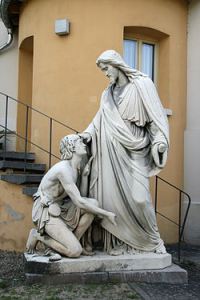
The Blind Man Who Could See

andrewmarrosb's avatarImaginary Visions of True Peace

Bartimaeus

The story of Jesus healing the blind man Bartimaeus is considered by many Bible scholars to be the closing bookend of what is called an inclusio. An inclusio is a literary device where two passages echo each other in such a way as to create bookends for the material in between them. In this portion of Mark, the two echoing stories involve the healing of a blind man. The material between these two stories is the journey to Jerusalem. The first healing (Mark 8: 22-26) takes place at Bethsaida. The second takes place as Jesus arrives at Jericho, the last stop before arriving in Jerusalem. In the intervening material the journey is punctuated by Jesus’ three predictions of his passion coupled with the incomprehension of his disciples. Each of these predictions is also accompanied by disputes among the disciples as to who is the greatest.

The blindness of the two…

View original post 404 more words

Anglicanism and the Benedict Option

Reblogged from Anglican Pastor

The Anglican spiritual theologian Martin Thornton once remarked that “the genius of St Benedict cannot be confined within the walls of Monte Cassino or any other monastery.” In continuing a discussion of the so-called Benedict Option, and what it means for Anglicans, my suspicion, and what is becoming my conviction, is that we Anglicans hold to a tradition which is not only well-suited to the Benedict Option, but which is the very thing itself. To be sure, there are Anglicans who would never in a million years consider themselves as such, but one can hardly deny the Benedictine character of Anglicanism, in her Prayer Book, in her mission, or in even the unique spiritual tradition of the English people. In the Middle Ages, England was often referred to as the “land of the Benedictines,” dotted as it was with monasteries, typically tied to the cathedral cloisters, following the Rule.

Click here to read the full article

I Am a Mainline Protestant Under the Age of 35. Yes, We Exist.

By Olivia Whitener

Reblogged from Sojourners.

I am a Mainline Protestant under the age of 35. Yes, we exist.

I spend (most of) my Sunday mornings sitting in a pew at an Evangelical Lutheran Church in America congregation, singing old hymns, and reciting the Lord’s Prayer which I have had memorized since before I went to school.

At age 22, I make an effort to get my dose of word and sacrament before heading to brunch on Sunday mornings. Though I love the beach, I found greater joy in singing songs and leading Bible studies at a mainline church camp during my recent summers.

I love the sound of an organ.

Unlike 35 percent of my age-group peers, I hold much of my identity in my Christian tradition. But while many are losing hope in the church as a community and institution, I experience a place where I can struggle alongside others and find support. There are many ways the church has failed us; religion is often used to justify gross injustices, leaving many feeling abandoned by the place where I have found a home. And sometimes being a Christian and being a member of a worshipping community is hard, because it is another responsibility on our shoulders and it requires us to give back.

It isn’t always convenient, but here’s why I stay…

Click here to read the full article

Living In Between: Adventures of a Presbyterian pastor on a Jesuit campus

Reblogged from Presbyterians Today

By the Rev. Abby King-Kaiser

Protestants prioritize the Word, Scripture. We take it very seriously. So seriously. Worship thus centers on the Word. Even the formal ways we talk about worship usually relates back to the Word. Catholic Mass, on the other hands, centers on the sacrament. The altar is the centerpiece, and much of the rest of worship, prayer, and even a faithful life, flows from the sacrament. It even changes the way we talk about encounters with God.

This doesn’t mean that Communion isn’t essential for Presbyterians (though the infrequency of its celebration in some of our congregations may raise questions to that effect) or that Catholics are unconcerned about Scripture. It’s just a question of where our emphasis lies.

Perhaps we can learn from each other.

Click here to read the full article

Why the Filioque Sucks: An Explainer

The Filioque was added to the Nicene Creed unnecessarily and without due ecclesiastical process. Also, it messes with the orthodox expression of the mystery of the Trinity and rearranges it into a hierarchical ladder. Is it any wonder then, that pneumatology has become such a widely neglected discipline in western theology?

There is an aesthetically pleasant balance that emerges sans Filioque, with the Son “eternally begotten” and the Spirit “eternally proceeding” from the Father.

Another orthodox source I was reading recently pointed out that God the Father is always described in the Scriptures as the the source of the Godhead. Christ is called “the Son of God” and the Holy Spirit is “the Spirit of God”, but the Father is never called “the Father of God”, but simply “the Father”.

Anglicans have called for the removal of the Filioque from all future Prayer Book revisions since the 1978 Lambeth Conference. In the Presbyterian Church (USA)’s Book of Confessions, the Nicene Creed is included with the Filioque, but a note is made regarding the controversy. The decision to keep it in appears to be based on the historical fact that Presbyterianism draws its theological heritage from the western (i.e. Roman) stream of Christianity, which is where the Filioque originated.

Nevertheless, the 1989 Presbyterian Hymnal places parentheses around the relevant words, like so:

I believe in the Holy Spirit, the Lord, the Giver of Life, who proceeds from the Father (and the Son).

This is how I print the Creed in my church bulletin. It marks the controversy and gives those who know their history the option of not reciting the Filioque. I print the words, even though I personally disagree with their inclusion, because that is how the Creed appears in our Book of Confessions.

I’m with the Dean on this one. You can read his thoughts and decide for yourself.

Reglogged from the Crusty Old Dean.

We, in the West, many of whom have been coddled by establishment and cultural hegemony, can shrug more easily at whether words matter or not.  As the Egyptian Coptic Bishop Bishoy put in in the news release that prompted this whole blog post, “As a church that has been persecuted for most of its existence, our faith and faith issues are exceptionally important.”

Click here to read the full article.

Early Warning Signs Of Adult Onset Calvinism

Reblogged from the Blazing Center.

Don’t get too steamed up over this. It’s satire.

Approximately 1 out of every 4 Christians will encounter adult onset Calvinism (commonly known as AOC) during their life, either personally or in someone close to them. It can be a scary thing to encounter, especially if you’re not familiar with the symptoms. The person you once knew and loved is suddenly a completely different person.

Don’t panic.

It gets better.

To help you navigate the treacherous waters of AOC, I’ve listed the possible symptoms you may encounter.

Click here to read the full article.
My favorite:

  • Inevitably arriving at the conclusion that John Calvin was not that strong of a Calvinist. At least, not as strong as you are.

New Book by W. Bradford Littlejohn

Source: My Book is Now Published!

W. Bradford Littlejohn, author of The Mercersburg Theology and the Quest for Reformed Catholicity, has published a new book on the classic Anglican theologian, Richard Hooker.

Based on Littlejohn’s areas of interest, I suspect that he and I could have some lively conversations atop Hadrian’s Wall, wandering in the borderland of Anglican and Reformed.

If you find yourself in similar territory, you are cordially invited to pull up a three-legged stool and join us for this book discussion!