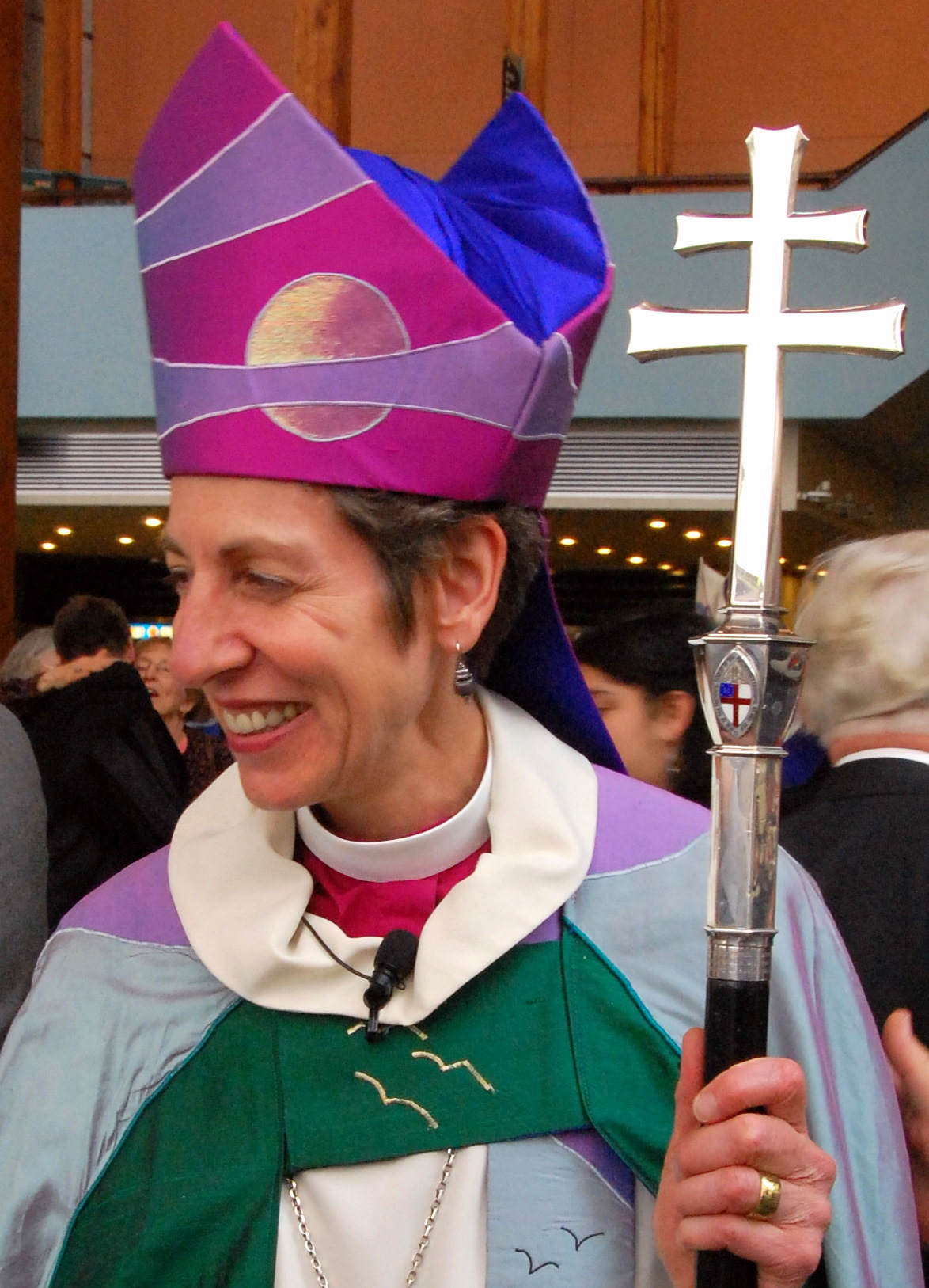
 Here is a YouTube video of the Most Rev. Katharine Jefferts-Schori (Presiding Bishop of the Episcopal Church) offering wise and wonderful words about the religious diversity in which we live.

Here is a YouTube video of the Most Rev. Katharine Jefferts-Schori (Presiding Bishop of the Episcopal Church) offering wise and wonderful words about the religious diversity in which we live.
Here is some practical advice for all you single fellas that also provides some erudite analysis of gender inequality as applied to safety concerns. Kind of depressing that things are this way, but they are what they are. So, here are some tips for navigating the minefield.
Z (my daughter): Daddy, where is Jesus?
Me: Well, he’s kind of everywhere.
Z: Is Jesus inside you?
Me: Yes.
Z: And me? And Mommy? And Adam? And Andrew?
Me: Yes
Z: And Elmo?
Me: …

It’s been a rough half-century for folks in the mainline Protestant denominations. The numbers are undeniable. We are smaller than we were in the 1950s and 60s. Everybody seems to have a pet theory about why this is happening.
Extremists on one side are convinced that this decline in numbers is caused by fanatical adherence to superstitious dogmas that have been rendered irrelevant by philosophical, scientific, and technological advancement. Extremists on the other side are convinced that the wrath of God is smiting our denominations with death because they have bowed down to the heresies of the modern world. I want to say the same thing to extremists on both sides:
“Shut up and sit down. This kind of talk isn’t helpful.”
While these voices tend to be the loudest, I find more often that they are in the minority. Most folks in our churches identify themselves as moderates who tend to lean to one side of the spectrum or the other.
In spite of rampant conspiracy theories to the contrary, I find that most moderates on both sides are compassionate and intelligent believers who are essentially saying the same thing:
“I want to stay faithful to the core values of my faith, but I’m afraid that my denomination is becoming a place where I won’t be able to do that.”
We’ve all been through this before. American mainline Protestant churches have split over the abolition of slavery, biblical literalism, the ordination of women, and (most recently) same-sex marriage.
My own denomination, the Presbyterian Church (USA), which I will abbreviate as PC(USA), is currently wrestling with the recent creation of a group that calls itself the Evangelical Covenant Order of Presbyterians (ECO). ECO is a group that has come together out of its founders’ desire to have a denominational community with shared theological values and a commitment to evangelical mission in the world outside the walls of the church. They believe the PC(USA) has drifted from its core theological roots and become too inwardly and institutionally focused. They see the PC(USA)’s recent decision to allow for the ordination of non-celibate lesbian, gay, bisexual, and transgendered (LGBT) people and this summer’s upcoming vote on same-sex marriage as symptoms of the larger and deeper theological problem.
Just to be clear about where I stand, let me lay all of my cards out on the table. Those who know me or follow this blog will already know this, but I’ll say it again for the sake of any newcomers and first-time readers. I identify as a theologically liberal Presbyterian. I am a vocal advocate for LGBT equality in church and society. I am not a part of ECO. In fact, I probably represent much of what they think is wrong with the PC(USA).
The PC(USA) itself does a fairly good job at holding the middle ground in this debate. They follow the example of Karl Barth and other Neo-orthodox theologians of the 20th century. How do I know the denomination does this? Because it frustrates folks on both sides. Liberals think it’s too conservative and conservatives think it’s too liberal.
Liberals and conservatives have their own unique ways of vying for greater power in the decision-making process. Liberals tend to invest in taking hold of regional and national positions of authority in the councils (formerly known as governing bodies) of the denomination. They, in the tradition and spirit of historic liberalism, tend to put their trust (too much trust, I would say) in the amendment of large-scale human institutions. The heroes of this bunch tend to be Moderators of our General Assembly and professors at our denominational seminaries. In science-fiction terms, they see themselves as the United Federation of Planets (Star Trek).
Conservatives, on the other hand, love to cast themselves in the role of the oppressed underdog. They see themselves as heirs of the American Revolution and the Protestant Reformation. Their heroes tend to be the pastors of large and wealthy congregations. They tend to idolize their pastors and demonize the denomination. As one elder screamed (yes, screamed) during a recent meeting in our area, “The PC(USA) just wants more of our money so they can keep spreading their lies!” In science-fiction terms, they see themselves as the Rebel Alliance, fighting the Sith-dominated Galactic Empire (Star Wars).
In reality, both sides are delusional. The PC(USA) is not the United Federation of Planets and ECO is not the Rebel Alliance. It’s pretty obvious to me that we’re essentially dealing with two different religious traditions under the roof of one denomination. This leaves us with two options. We can either: (A) Organize our denominational life together in such a way that leaves room for both parties to coexist, or (B) Peacefully part ways in a spirit that is consistent with our highest shared values.
As a liberal, I will primarily direct my critical comments toward the members of my own party. But before I do that, I want to invite any conservatives and evangelicals to listen in and witness one liberal who is not a demon-possessed heretic that wants to invade your church, seize your building, fire your pastor, and force you into compliance with my wicked homosexual agenda. Are you ready? Let’s go.
I am a liberal who supports the creation of ECO. My reasons for doing so are primarily biblical in nature. I was reading Genesis 13 the other day, where the nomadic caravans of Abram and Lot are traveling together through the Promised Land, but have achieved critical mass in regard to the land’s ability to support both groups. Conflict began to brew. Abram then takes the moral high ground,
Let there be no strife between you and me, and between your herders and my herders; for we are kindred. Is not the whole land before you? Separate yourself from me. If you take the left hand, then I will go to the right; or if you take the right hand, then I will go to the left.
Abram even lets Lot have his first choice of the land. There is a recognition that division is necessary, but a complete rejection of backbiting and contentiousness. Here is an example of a person of faith who can declare “Separate yourself from me” and “we are kindred” in the same paragraph.
In the same way, our denominational landscape is being strained in the attempt to support both liberals and evangelicals. It is clear that there are many among us who no longer wish for our caravans to sojourn together. As heirs of Abram’s covenant, why can’t we do with each other what Abram did with Lot? Who among us will take the moral (i.e. relational) high ground?
In this moment, I would call upon my fellow liberals to step up to the plate. You have invested much energy in securing positions of power for yourself at the presbytery and General Assembly levels. Use the power afforded you by those positions to walk like Jesus, who said,
You know that the rulers of the nations lord it over them, and their great ones are tyrants over them. It will not be so among you; but whoever wishes to be great among you must be your servant.
I would venture to say that we should support the creation of ECO, let these congregations and presbyteries go their own way, and find a way to send them off with a parting blessing: their buildings, investments, and pensions. Let’s leave a legacy that will provide an open door for reconciliation in some future generation.
Institutional division is not necessarily a church schism. We can part ways and remain true to each other on multiple levels. After Abram and Lot part ways, the relationship between them continues to grow faithfully. Abram fights for Lot, rescues him from danger, and prays earnestly for his well-being. Let’s learn how to do the same for each other. Enough of all this backbiting crap.
Listen, we don’t really need their numbers and their money. Their presence will not hold back the tide of mainline decline. We are still shrinking, no matter what. This is a subject for another blog post, but I see mainline decline as a good thing.
My point is that we might best guard the “peace, unity, and purity of the church” by allowing people to go their own way, even if we happen to disagree with where they are going. We made a vow to guard the “peace, unity, and purity” of the church, not necessarily the denomination. We should be careful to distinguish between the two.
Liberal Presbyterians: be ye not afraid of ECO. Support its creation. Send them off with a blessing. Like Abram and Lot, let there be no strife between them and us; for we are kindred.
 Here’s a link to a fantastic article by Ashley Judd that was sparked by recent discussion about her appearance.
She does an incredible job of shining the light where it belongs: on structural injustice in the sexist orientation of our society.
She also offers the best three-sentence summary of patriarchy that I have ever read. This is a much needed contribution to contemporary conversations on gender where the related-but-separate problems of misogyny and sexism are so often confused for one another.
Judd’s words:
“Patriarchy is not men. Patriarchy is a system in which both women and men participate. It privileges, inter alia, the interests of boys and men over the bodily integrity, autonomy, and dignity of girls and women.”
Special thanks to my friend and congregant, Jaime Dudajek-Burgdoff, for posting this article on Facebook.
This is a follow up to the previous post.
It’s a video of Tanya Luhrmann, author of When God Talks Back, giving a lecture at a Vineyard Scholars’ Conference in 2011.
Many thanks to Jon Stovell for providing the link!
Here is a link to a really interesting article on NPR.
Well worth a read:
I want to read this book now.
 The Presbyterian Church (USA) is in the process of publishing a new hymnal! It’s due to be out in 2013.
OK, I realize that most of you just rolled your eyes at me, but I’m still excited about it.
Today, the contents of said hymnal have been made public for the first time. Here is a link to the page:
I’ve only given the list a brief once-over, but here’s my initial “best and worst” (one of each):
Best: Gather Us In by Marty Haugen
Love this song. Don’t know why it wasn’t in the last one. Good tune, good lyrics, reaches across the theological divide. Good pick, committee!
Worst: Kum Ba Yah
Seriously? Who is still singing this? If it’s you, then STOP. Right now. I mean it. Maybe I watch too much Walking Dead, but I’m convinced that this song is an infected zombie who has risen up to feast upon the flesh of the living.
The only way to stop it is to shoot it…
in the head…
without mercy.
OK, I said I was only going to do one of each, but someone once told me that you should give two compliments for every criticism, and this hymnal deserves it:
Another Best: Glory to God, Whose Goodness Shines On Me
A great new Gloria Patri that Katie Boardman pulled out for us at a Presbytery meeting last year. More rhythmic and energetic than our classic plodder, you might actually believe that the people who sing this are glad they’ve been redeemed.
That’s all for now! Since the contents were released today, I’m sure the Presbyterian Internet (do we have one of those?) will be abuzz with everybody whining about what they don’t like. With that in mind, say a prayer for the committee that put it together. I’m guessing they might be feeling rather anxious, since all their hard work is going on display.
With that in mind, let me be among the first to thank and congratulate the Presbyterian Committee on Congregational Song for their hard work and the fine product they’ve given us!
For more on the theological rationale used by the committee, check out this document:
 Rene Girard is a mythology scholar and theologian who has made a name for himself by naming what is potentially one of the most terminal spiritual diseases in western, capitalistic society: Envy.
According to Girard, humans perpetually compete with one another in an attempt to imitate certain models of appearance, behavior, and status. This constant competition would quickly degenerate into an anarchic “war of all against all” were it not for periodic episodes of “scapegoating” where the hostile energy of the community is directed toward a chosen outsider (individual or group) who is subsequently “sacrificed” for the good of the group. The sacrifice of the scapegoat temporarily releases the pent-up tension and allows this cycle, which Girard calls “the cycle of mimetic violence,” to begin again.
One could easily point to the scapegoating of Jews during the Third Reich as an example of cycles of mimetic violence in action.
I got to see this phenomenon take place firsthand on a citywide scale in Vancouver during the buildup to the 2010 Olympics. City legislators passed the notorious “Safe Streets Act” which made it illegal to panhandle anywhere within 30 feet of businesses, residences, or bus stops. In a west coast urban center of two million, is there anywhere in the city that meets these criteria?
Poverty was thus outlawed in pre-Olympic Vancouver.
In a culture that has made an unholy idol of success, failure is criminal.
Here is a link to an NPR article that documents a similar process going on in Hungary. The primary difference is that Hungary itself seems to be in a state of economic failure and the powers that be would like to attach blame to those who are least likely to have caused the collapse and least likely to defend themselves in the event of a large-scale attack: the homeless.
I find this to be an appropriate article to post this Easter weekend, as we remember the ignominious death of another sacrificial scapegoat who was unjustly made to endure the wrath of a political-religious system that could not imagine another way of being human…


 Hopping Hadrian's Wall