God is a Relationship

Click here to read the bulletin, including Scripture readings

Whatever else we want to say about God, we can at least say this:

God is all about relationships.

We can see that in the natural universe:

The relationship between our planet and our star is so finely tuned. If the earth were just a little closer to or farther out from the sun, or if it was just tilted a little more on its axis, life as we know it would be impossible.

The biosphere is so delicately balanced, the extinction of just a few species from the food chain can upset an entire ecosystem. A pastor friend tells me that, if bees continue to disappear (as they have been doing), we humans have only two years of life left.

We humans can share a special relationship with each other, when two people can come together in a special, intimate way that actually creates life.

We can see that God is all about relationships by looking at our Scriptures as well.

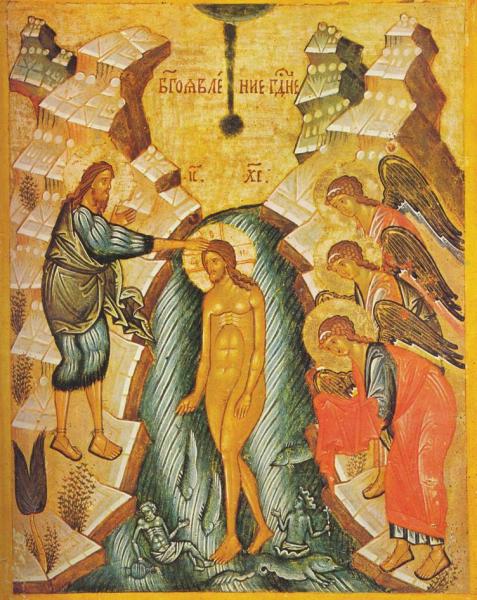
We can see it in today’s gospel: in the relationship between Christ and St. John the Baptist.

In the very first sentence of this reading, we see that Christ takes the initiative:

“Jesus came from Galilee to John at the Jordan”

And then the text says that John, after a brief conversation, gives his consent. This is very important because real relationships can only exist where consent is freely offered between two parties.

After that, the baptism takes place and something amazing happens:

“just as [Jesus] came up from the water, suddenly the heavens were opened to him”

I take this to mean that Christ could see into eternity, into the heart of everything; he could see how it all hangs together. And in that vision, Jesus sees the Spirit descend upon him like a dove and hears a voice say, “This is my Son, the beloved”.

Note the three figures in this vision: First, there is Jesus, the Son of God. Then there is the Spirit of God, the Holy Spirit. Finally, there is the voice (presumably God the Father), saying, “This is my Son”. Father, Son, and Holy Spirit.

This is the first place in Scripture where the Holy Trinity appears.

For Christians, the Trinity is our core concept of God. The word itself never appears in Scripture (that was worked out a few centuries later by the Church Fathers and Mothers), but here is where we see the three persons together for the first time. We believe in one God who is three Persons. Not three Gods, not one God known in three ways, but one God in three Persons. The relationship between John and Christ actually opens a window, through which we can see the relational, Triune nature of God.

I know this sounds rather abstract, but let me bring it down to earth: God is a relationship. As St. John the Beloved put it in his first epistle, “God is love”. Relationships matter to God because God is a relationship. God is love itself.

This is good news for us in this world, where our relationships are in such trouble. Our broken relationships, at the personal and political levels, are often characterized by exploitation, manipulation, oppression, poverty, and violence.

There is nothing new about this. We can see it plainly on the news and in many of our families. It didn’t begin with Twitter, or the internet, or television, or the 1960s, or the sexual revolution. It began all the way back at the beginning, when our relational God created us to be in relationship with God and each other. But we withheld our consent. We broke relationship with God, and soon our relationships with each other began to break down as well.

But God never broke relationship with us. God came among us in the person of Jesus Christ to redeem the world and restore us to right relationship with God and each other.

That is why the Church today, as Christ’s Body on earth, calls Christians to tend to our relationships with family, neighbors, strangers, and even enemies. We are called to live the truth that relationships matter because God is a relationship.

God is love. This is why Jesus sums up all the commandments of the Bible in a single word: Love. Love God with all your heart and your neighbor as yourself. Love God, love your neighbor, love yourself. Likewise, St. Paul writes, “love is the fulfilling of the law” (Romans 13:10).

St. John again:

“God is love, and those who abide in love abide in God, and God abides in them.” (1 John 4:16)

In other words, where there is love, there is God.

Whenever we swallow our pride and say “I’m sorry” to the spouse we’ve been fighting with, that is an act of worship to God. Whenever we are at a restaurant, and the waiter comes by with a refill, and we look up to meet that person’s eyes and say “thank you”, that is an act of worship. Whenever we march for justice and listen to the voices of the poor and oppressed, that is an act of worship.

Whenever we feed the hungry, clothe the naked, welcome the stranger, or visit the sick and incarcerated, we are not just serving our neighbors, but Christ himself. Christ was very explicit about this:

“Truly I tell you, just as you did it to one of the least of these who are members of my family, you did it to me.” (Matthew 25:40)

God is a relationship, therefore relationships matter. God is love, therefore love is the fulfilling of the law. This is the truth that Christ and St. John the Baptist are driving home to us, through their relationship, in today’s gospel.

May we be the Christians who honor our relationship with God by honoring our relationships with each other in the world.

Outsmarted by Babies and Dreams

Click here to read the bulletin, including Scripture texts.

I was leading a Bible study earlier this week where one of the participants asked why God doesn’t just part the heavens and come down, saying, “Hey everybody, I’m here! This is absolute proof, so you’d better believe in me!”

I thought this was a great question. Why doesn’t God do that? It would certainly make some things easier. We wouldn’t have to wrestle so much with our faith. When refuted, we could simply point back to the absolute proof and blow our opponents’ arguments out of the water. Everything would become totally clear.

But I also wonder: What would be the cost of such certainty? We already know we live in a world where the strong dominate the weak, where history is written by the winners, and where winners often win by violence and manipulation. We lament this sad state of affairs, but fail to imagine any viable alternative.

Could things ever be any different?

At least one person has imagined so.

The poet in our psalm this morning spends his/her time imagining a different kind of ruler from the ones who tend to seize power on the global scene. The psalmist dreams instead of a ruler who governs by the power of gentleness and divine justice, rooted in the natural ebb and flow of creation itself. This dream is voiced as a prayer for the king:

“May he be like rain that falls on the mown grass, like showers that water the earth.”

That is a very gentle, life-giving image. It makes me think of sitting on my back porch in the spring time, watching the rain fall and the flowers beginning to sprout up after a long winter. Could that be a model for sound government?

The psalmist thinks so:

“May he defend the cause of the poor of the people, give deliverance to the needy, and crush the oppressor.

For he delivers the needy when they call, the poor and those who have no helper.

He has pity on the weak and the needy, and saves the lives of the needy.

From oppression and violence he redeems their life; and precious is their blood in his sight.”

That might sound like a utopian pipe-dream, bound to end in disappointment, but the psalmist sees a different kind of outcome:

“May all kings fall down before him, all nations give him service.”

In a world governed by the power of violence, this dream might seem unattainable, but we Christians, who accept these words as sacred Scripture, are duty-bound to take them seriously as part of God’s Word. In God’s universe, it is right that makes might, not the other way around. If we really believed otherwise, why would we bother coming to church on Sunday?

This is no utopian pipe-dream or abstract principle for us Christians. We believe that this idea took on flesh and came to fulfillment in the person of Jesus Christ. St. Paul refers to this as “the mystery of Christ” in today’s epistle:

“In former generations this mystery was not made known to humankind, as it has now been revealed to his holy apostles and prophets by the Spirit: that is, the Gentiles have become fellow heirs, members of the same body, and sharers in the promise in Christ Jesus through the gospel… so that through the church the wisdom of God in its rich variety might now be made known to the rulers and authorities in the heavenly places.”

In Paul’s vision, God wins the victory, not by dominating or destroying Gentile enemies, but by including them as friends in the redemption that Christ won for the world. This, in Paul’s mind, subverts the dominant paradigm of the powers-that-be.

The way of God’s kingdom stands in stark contrast to the powers of the world, like King Herod, who we read about in today’s gospel.

Herod vies for power, using all the means at his disposal. When he perceives a threat to his power, he gathers the scholars and clergy as part of his military and political intelligence program. He manipulates people with lies and fake displays of piety. When, at last, he is outsmarted by babies and dreams, he unleashes the full force of the military in a campaign deliberately designed to destroy innocent lives in the interest of maintaining his position.

The good news is that his plan fails miserably. God intervenes through unorthodox means, using pagan philosophers to subvert the diabolical schemes of this tyrant. Jesus, the one child Herod sought to kill, escapes unharmed and grows up to become the greatest personality in human history, not to mention the central figure in God’s plan to redeem the world.

The good news for us in this is that the ancient dreams of poets and prophets are coming true. There is a deeper justice in the universe that trumps the demonic schemes of powerful people. “Survival of the fittest” and “might makes right” do not have the last word in the order of life. By contrast, God seems to be saying to us in these texts that history is written by the losers, the weak ones, and the vulnerable, because history’s last word is written by the God who chose to become vulnerable in the infant Christ.

Sure, God could have parted the heavens and come down with irrefutable evidence to demand faith and obedience from the human race, but this would have been at odds with God’s actual plan for the world. In point of fact, God did come to earth, not as a ruler, but as a baby. God does not force the divine will upon us from without, like any other human tyrant, but influences us from within, respecting our freedom and inviting us to cooperate with the way of gentleness and vulnerability.

St. Teresa of Calcutta famously taught us that “Not everyone can do great things, but everyone can do small things with great love.” This is the way of God’s will in the world. It is the way that Christ invites us to follow.

The power of Jesus resides, not in inflicting pain, but in offering healing; not in pronouncing judgment, but in forgiveness; not in threatening deprivation, but in feeding hungry people with abundance; not in dealing death, but by rising to new life from the grave.

King Herod was not the last ruler who felt his power being threatened by Jesus. At the end of his life, Jesus stood before the Roman governor Pontius Pilate, who seemed to succeed where Herod had failed. He handed Jesus over to be tortured and crucified for crimes he did not commit.

They thought Jesus was a terrorist, plotting to overthrow the Roman government. Little did they know, Jesus’ real goal was far more dangerous: he was (and still is) plotting the overthrow of the entire world system of power based on endless cycles of violence.

Jesus brought those cycles to an end in himself by absorbing the violence of this world without retaliating. He allowed himself to bear the weight of our sin and be dragged into hell. But then, on the third day, he demonstrated the gentle power of God by tearing open the gates of hell and emerging victorious from the tomb. He undid the power of violence by showing it to be futile in the end.

We Christians are invited to share in this victory by walking in this world as Jesus walked. St. Paul tells us, “the Spirit of him who raised Jesus from the dead dwells in you” (Rom. 8:11). We are the members of Christ’s body, his hands and feet on earth today.

In times such as these, the greatest temptation is for Christians to give in to the demonic spirits of despair and cynicism. We think that violence of word or sword is the only way to guarantee peace and justice in life. We “study war” in our political and personal lives. We mistakenly come to believe that the only way to get ahead is by stepping on the backs of our neighbors and enemies.

Friends, I would humbly suggest to you today that there is another way. It is the way of gentleness and forgiveness, the way Jesus and the cross. While it is true that this way is likely to lead to crucifixion and death, it is also true that it leads even further into resurrection and the eternal life abundant that Christ promises for all who trust in him and walk in his ways.

Praying the Monastic Office (Reblog)

Article by Sr. Cintra Pemberton OSH originally posted by the Conference of Anglican Religious Orders in the Americas (CAROA).

Psalm 62 says: “For God alone my soul in silence waits; from God comes my salvation.” This is the prayer in my heart, said over and over, as I sit in the darkened chapel each morning before Matins. The time seems to fly by some days and drag by on others, but it’s essential life-giving time nevertheless. As I sit alone in the silence, sometimes I feel the presence of the angels. I can hear them singing in some faraway place, calling me to join my voice with theirs, and when the time comes later in the day, I will try to do just that…

Click here to read the full article

Christmas Victor

Click here to read the biblical text.

As we gather here this morning to celebrate the mystery of the Incarnation in Word and Sacrament, we are also nearing the end of 2016. And there are many among who say, “Good riddance!”

It is only too easy for those of us who follow current events to hang our heads in despair at the state of things in the world. We hear of “wars and rumors of wars” at home and abroad. Our hearts break at the plight of refugees crossing our borders, break again as members of the powerful elite use these families as scapegoats for their politics of fear, and then break yet again as an act of terrorism in Berlin seems to lend momentary credibility to the argument that compassion is foolish.

Looking at the world on this Christmas morning, it appears that the cosmic forces of darkness and chaos are winning. We few who gather in church to tell stories, sing songs, and break bread appear to be the most pitiful of fools. Given the facts at hand, it is only understandable if we find ourselves asking the questions: Are just “whistling in the dark” after all? Are we really alone in a universe that came about as a random accident? Is the faith we proclaim nothing more than a charming tale we tell ourselves in order to sleep easier at night?

The modern world would answer “Yes” to all of the above. It would add: “It’s a dog-eat-dog world out there; you’ve got to look out for number one; money talks; might makes right.” The world says that the only truth is facts, and the facts say that we are on our own. I say the world is lying.

The Church tells a very different story in today’s gospel. We say:

“In the beginning was the Word, and the Word was with God, and the Word was God. He was in the beginning with God. All things came into being through him, and without him not one thing came into being.”

What we mean by this is that the world belongs to God, who made it.

Christians believe in one God as Trinity: Three persons in relationship (Father, Son, and Holy Spirit). For us, God is a relationship. Based on this, we understand the universe to be a network of relationships (galaxies, solar systems, ecosystems, nations, and families) existing within the larger relationship of the Trinity, as a baby grows in her mother’s womb.

But here’s the thing about relationships between persons: they have to be freely chosen. And we humans chose to break relationship with God our creator.

John’s gospel says it like this:

“He was in the world, and the world came into being through him; yet the world did not know him. He came to what was his own, and his own people did not accept him.”

Once we had broken relationship with God, our relationships with each other began to deteriorate as well. In seeking to become masters of the universe, we became slaves in bondage to each other, to corrupt systems, our own desires, and the powers of darkness and chaos beyond our control.

The good news is that our Creator was not content to leave us in this sad state of affairs. Even though we had broken relationship with God, God never broke relationship with us. God came to live among us in the person of Jesus Christ. John says:

“And the Word became flesh and lived among us, and we have seen his glory, the glory as of a father’s only son, full of grace and truth.”

As the only-begotten Son of God the Father, Jesus is the fullest expression of the divine image in a human face. Living among us, Jesus loved us: healing the sick, feeding the hungry, forgiving sinners, welcoming strangers, and raising the dead.

But we sinful humans could not stand to look at such holiness. Through the powers of religion and politics, we betrayed, denied, mocked, rejected, tortured, and killed the Son of God by crucifixion: anything just to shut him up and make him go away.

But God wasn’t having any of that nonsense. Like the tired mother of a toddler throwing a temper-tantrum, God rejected our rejection, raising Jesus from the dead and proving, once and for all, that God’s love is stronger than the power of death itself.

“What has come into being in him was life, and the life was the light of all people. The light shines in the darkness, and the darkness did not overcome it.”

Through the incarnation, life, death, and resurrection of Jesus Christ, the door has been opened for us to freely re-enter a harmonious relationship with the Triune God and each other. John says it like this:

“to all who received him, who believed in his name, he gave power to become children of God, who were born, not of blood or of the will of the flesh or of the will of man, but of God.”

The resurrection of Jesus Christ is the exclamation point at the end of a sentence that began with the incarnation. Christmas marks the beginning of a revolution that will never end until the entire universe is restored to right relationship with God.

The Church, far from an institution of civil religion that upholds the societal status quo, is an underground movement that preaches the Gospel of Jesus Christ as an alternative orthodoxy to the lies of this world system.

We are unashamed to speak the truth that the emperor wears no clothes. We are unafraid to expose the dark powers:

  • of tyranny, oppression, injustice, stigma, exploitation, violence;
  • of racism, sexism, ableism, classism;
  • of xenophobia, homophobia, transphobia;
  • and every other -phobia and –ism that plagues the human heart.

We are not afraid to name these lies and exorcise these demons from our midst.

The Church of Jesus Christ is a revolutionary movement:

  • The Bible is our manifesto, the Sacraments are our weapons of peace, and the Cross is our only flag.
  • Our only aim is the final reconciliation of the entire universe with the justice and mercy of God.
  • The resurrection is our decisive victory, and the incarnation is our beachhead.

For this reason, let the dark powers of this broken world tremble with fear when they hear us utter the words, “Merry Christmas!”

Preaching Nativity

On Monday, I received the following from a Presbyterian ministerial intern in Indiana:

(It bears noting that I am neither trained, certified, nor practicing as a spiritual director, although I am considering a move into that area of ministry for the future. I am a fellow pastor plodding along through the swamp of ministry, making it up as I go along. Nevertheless, I am flattered that my colleague thinks of me in this capacity. Perhaps it was a providential misnomer for me to file away for discernment purposes?)

So as a spiritual director I could use some advice. Looking at preaching Christmas Day, what should be a very happy holy day, I feel so drained. Between the election, the evil in Aleppo, Russian aggression and expansion, hate crimes, etc. this year seems so dark and I find myself wondering if a baby in a manger was enough, was God made flesh enough or should he have come as conquerer? Where is the good news that God will come again, and how can God reconcile all those innocent who will suffer in this world how can God really bring justice to all this that satisfies those persecuted? Any thoughts on how to pray or seek God’s wisdom or hope in Christmas Day? Hopefully this isn’t heresy.

Here is my response:

Been thinking about this one since yesterday. If it’s heresy, then you’d better save me a seat in hell… preferably one by the bar, where we can hear the good bands.

The gospel says Christ was born in a stable. Have you ever smelled a stable? It ain’t pretty.

If Christmas can’t be celebrated in the midst of shit, then it shouldn’t be celebrated at all. If the mystery of the Incarnation doesn’t matter in the midst of a world that has gone to shit, then it doesn’t matter.

St. Augustine of Hippo was big on the idea that the Fall was the ruining of a perfect paradise. But I much prefer the earlier interpretation of St. Irenaeus of Lyons, who saw Eden as the raw material from which God would shape the future, in cooperation with us. According to Genesis, humanity is basically just mud that was slopped together until God breathed into (“in-spired”) it with the breath of life.

When the Holy Spirit overshadowed Mary the Theotokos at the Annunciation, she gave her whole human nature to the Christ: and not just hers, but all of human history, glory and gore alike. (This, by the way, is why I can’t sign on with the Roman doctrine of the Immaculate Conception of Mary… what Christ did not become, he did not redeem.)

Divinity came screaming into the world like an animal, in a stable that smelled like shit, as the unexpected pregnancy of a scandalized, working class, unwed, teenage-mom refugee in a backwater hick-town of a riotous occupied country.

Because of that, I can never make it through this line of the Christmas hymn by Episcopal priest Phillips Brooks without choking up:
“Yet in thy dark streets shineth the everlasting Light.
The hopes and fears of all the years are met in thee tonight.”

Was that enough? No, of course not.

That’s why the baby had grow up, get lost in Jerusalem at his Bar Mitzvah and mouth off to his parents, almost get thrown off a cliff by his home synagogue after his first sermon for preaching inclusion of the goyim, build an underground movement of hookers and thugs, undermine traditional religious values and the authority of the political establishment, and ultimately be executed as a terrorist.

He simultaneously exposed and endured the violence inherent in the system. If they realized what he was really trying to do, they would have crucified him twice.

And after all that, he committed the most revolutionary act of all by tearing open the gates of hell and making death itself come unraveled.

After the Resurrection, God stood face-to-face with faithless disciples and breathed on them once again, saying, “Receive the Holy Spirit.” It was Genesis all over again, a new creation. “Behold, I am making all things new.”

These Apostles were then sent out into the world, where they passed that Spirit on by laying their hands on the heads of bishops, who in turn passed her on, by the power of touch again, to priests, who stretched out their hands to call that same Spirit upon water, bread, and wine in order to baptize and feed people with the Body and Blood of Christ, making them “partakers of the divine nature,” as St. Peter wrote. And these Christians were then blessed and sent out to the ends of the earth to make disciples of all nations.

And so it went on, for two thousand years, until you came along. The Holy water hit your head, God’s Blood started flowing in your veins, and your cells began to metabolize the Body of Christ. But the irony is that he is the one who is digesting you.

So then, on Christmas morning, bombs will be falling on Aleppo, Russia will be beginning military maneuvers on the Polish border, and Klansmen will be screaming, “Heil Trump!” And Christ will step out of the stable and into the pulpit, and she will open her mouth and say… ?

Answering that final question, my interlocutor replied:

“Be not afraid.”

[All statements have been shared with the permission of the author.]

The Anxious Bench

John Grebe, OCC's avatarMercersburg Mystic

“An Anxious Bench may be crowded where no divine influence whatever is felt. A whole congregation may be moved with excitement, and yet be losing at the very time more than is gained in a religious point of view. Hundreds may be carried through the process of anxious bench conversion, and yet their last state may be worse than the first. It will not do to point us to immediate visible efforts, to appearances on the spot, or to glowing reports struck off from some heated imagination immediately after. Piles of copper, fresh from the mint, are after all something very difference from piles of gold.” ~ John Williamson Nevin, The Anxious Bench

“Vows and pledges that spring from excitement rather than reflection are considered fanatical, and as such neither rational nor free; and thought in certain cases men may seem to be strengthened and supported by them in the…

View original post 589 more words

By Nheyob (Own work) [CC BY-SA 3.0 (http://creativecommons.org/licenses/by-sa/3.0)], via Wikimedia Commons

Carpenter, Interrupted

Click here to read the bulletin, including the biblical text.

Introduction

They say, “If you want to give God a good laugh, tell him your plans.”

I’ve been looking around this week for the original source of that quote. I can’t find a definitive answer. Some say it was from a comedian like Woody Allen or Lily Tomlin. Others chalk it up to an old Yiddish proverb: “We plan; God laughs.”

Personally, I like to imagine that it comes from St. Joseph the Worker, husband to the Blessed Virgin Mary and guardian of the child Jesus. Even if he did not utter these exact words himself, I think he would certainly smile and nod his head at their meaning. He knows, better than most, what it means to have one’s plans interrupted by God.

Exegesis

Today’s gospel is all about being interrupted.

It opens with Mary and Joe, a nice Jewish couple about to begin their life together as husband and wife. Then, all of a sudden, their plans are interrupted with the news that Mary was going to have a baby.

This was a big deal. Not only is having a first child a huge moment for any couple, but this situation was complicated by the fact that Mary and Joe were not yet officially married. Even worse, Joe was certain that he was not the father.

This was heartbreaking news. All of his plans for the future were suddenly thrown up into the air. In most cultures, a scenario like this would almost certainly be the subject of town gossip, but in first century Palestine, it was also a death sentence. Joseph could legally have Mary tried and executed, but he opts for a more gentle approach instead. He decides to resolve the matter quietly by breaking off the engagement and moving on with his life. All in all, it was the honorable thing to do for a man both fair and kind in the midst of a crisis.

That’s when God interrupts Joe’s story.

As Matthew tells it, an angel visited him in a dream, telling him not to be afraid because everything was happening as part of God’s plan. Joe, remarkably, listens to this dream and the wedding is still on, despite the public ridicule he would doubtless receive from friends and relations.

It takes a special kind of faith to be that open to God’s interruption in one’s life. We humans are creatures of routine and ritual. We like things done the same way every time. When things don’t go according to plan, we have a tendency to get frustrated. We don’t like being interrupted.

This tendency of ours is especially apparent when it comes to matters of faith and morality. We want to believe that God is unchanging. We like the comfort of knowing that what’s right is right and what’s true is true, for all time and forever. We depend on our religious institutions to always stay the same, meeting in the same place, singing the same songs, and telling the same stories, from cradle to grave, and continuing long after we are gone.

So, what are we to do then with stories like this one, when God interrupts, not only one family’s personal expectations, but also their foundational sense of right and wrong? Why would God, in bringing Christ the Son into the world, expose the Holy Family to danger and disgrace, and even violate the boundaries established by divine law in the Torah?

In that sense, our familiar Christmas story is profoundly disturbing. But in another sense, it is deeply comforting for all of us whose lives rarely go according to plan and often fail to live up to our most deeply held values.

The first thing this story tells us is that God is able to work with people whose lives are less than perfect.

The second (and more important) lesson this story tells us is that sometimes those imperfections and interruptions are the very things that God can use to bring good into the world. Sometimes, the interruption is the main point with God.

Whether it’s an unexpected pregnancy, a medical diagnosis, a lost job, a broken relationship, a personal failure, a missed opportunity, or any other unfortunate event, all of it is material that God is using to bring forth new life and freedom into the world.

Conclusion

That was the story for Mary and Joe and their unexpected pregnancy. The miracle born of their less-than-perfect circumstance was no less than Jesus Christ himself.

In the same way, I believe that Christ is being born into the world through each and every one of us, each day.

You might be tempted to look at your life, with all its imperfections and interruptions, as wasted time and space. But I would invite you, challenge you, dare you even, as we move from Advent into the Christmas season, to look at your life with the eyes of faith. God is doing something wonderful with your life. Christ is being born into the world again today, even through you.

God’s will for your life is for you to see the image of Christ in yourself and those around you. No person or situation is so bad that God can’t work with it. And God, as St. Paul writes in his letter to the Romans, causes “all things [to] work together for good for those who love God, who are called according to his purpose.”

This is the good news of Christmas: that God enters into this broken world, as it is, through us, as one of us, and brings good out of it for God’s own glory and praise.

St. Matthew writes in his gospel, “Now the birth of Jesus the Messiah took place in this way.” Not some other way that might have seemed more ideal, but “in this way.”

This is how God worked through Mary and Joe in their less-than-perfect situation and it is how God is working in you and through you, no matter how bad your life might seem today.

Accepting the Embrace of God – Lectio Divina (Reblog)

Article by Luke Dysinger OSB

A VERY ancient art, practiced at one time by all Christians, is the technique known as lectio divina – a slow, contemplative praying of the Scriptures which enables the Bible, the Word of God, to become a means of union with God.   This ancient practice has been kept alive in the Christian monastic tradition, and is one of the precious treasures of Benedictine monastics and oblates.  Together with the Liturgy and daily manual labor, time set aside in a special way for lectio divina enables us to discover in our daily life an underlying spiritual rhythm.  Within this rhythm we discover an increasing ability to offer more of ourselves and our relationships to the Father, and to accept the embrace that  God is continuously extending to us in the person of his Son Jesus Christ.

Click here to read the full article

The Cold and Dark Season

This week’s sermon from North Presbyterian, Kalamazoo

Click here to see the bulletin of the liturgy, including the biblical text

After an unseasonably mild autumn, it’s finally beginning to feel like winter here in Michigan. The nights are getting longer and the weather is getting colder.

I love that the Church’s celebration of Advent happens to coincide with the onset of winter in the Northern Hemisphere. I take it as an apt metaphor for my spiritual life.

In spite of the commercial holiday hype, I have always been more of an Advent person than a Christmas person. Advent is about waiting in the darkness and the cold for God to show up, and when God finally does show up (at Christmas), it doesn’t look how I expected. Those expecting the “King of kings and Lord of lords” are met with a refugee baby born into poverty in a backwater village of an occupied country. It’s not what anyone expected, yet this is how God chooses to come to us.

I strongly suspect that I am not alone when I describe my spiritual life as “waiting in the darkness and the cold.” Popular conceptions of faith and spirituality focus on feelings of serenity, unshakeable commitment, and an immediate sense of God’s presence through dramatic events like visions and miracles.

But most who have seriously tried to live the life of faith will tell you that it’s not much like that at all. In fact, it’s mostly just a struggle. There’s an awful lot of waiting around involved, and in the internal space created by that waiting comes pouring all the junk of my ego, old habits, and false perceptions of myself. It’s not fun or particularly peaceful.

The benefits and blessings are certainly there for those who persevere, but they are often much more slow and subtle than we would like. So, why on earth would anyone put themselves through the trouble?

Because, to quote the novelist Gertrude Stein, “there’s a there there.” There really is something to it. One might call it “the peace that passeth understanding” or the presence of the Holy Spirit. This presence is often subtle and unexpected. Don’t blink, or you’ll miss it. Most of the time, I’m not able to accurately identify what God has been working in my life until after the fact. Looking back, I can sometimes put the pieces together and go, “Oh yeah… there’s a there there!”

Spirituality is a process that takes time to grow. I think that’s why Christ compares faith to a mustard seed: it’s not much to look at in the beginning and it doesn’t sprout all at once, but give it time and you will begin to see that it is a living, breathing, growing thing. It requires patience and a willingness to keep an open mind. The good news is that Christ is an experienced farmer who understands the slow, subtle ways of growth and refuses to give up on his struggling crops.

That is the lesson that St. John the Baptist is learning in today’s gospel.

John, as we know from last week, was a revolutionary prophet and a dangerous radical. He was among the first to correctly identify his cousin Jesus as “the Lamb of God, who takes away the sins of the world.” He understood the purpose of his whole ministry as preparing the way for the Christ.

Unlike the apostles and the crowds, John understood that the Messiah’s liberation of God’s people would be more spiritual than political. But he himself also had a few preconceived notions about what this would look like that turned out to be a little off-base. John believed that the Christ would finally come to “set things straight” in Israel. He would cleanse the people of their sin and get them back on track to having a healthy relationship with God. These notions were confirmed, in his mind, at Jesus’ baptism in the Jordan River. Here, finally, was the in-breaking of the Messianic age. Now things would really start to change… except they didn’t… at least, not right away.

Jesus turned out to be a more gentle Messiah than the one John was imagining. He led with grace, accepting sinners as they were and trusting that grace to do its slow, subtle work in their lives. He kept company with a rough crowd and seemed to condone their unseemly activities by his relative silence.

To make matters worse, things were not going particularly well for John. After speaking out against the personal life of the local puppet king, John was arrested and thrown into prison. Didn’t Jesus realize how bad things were getting? Wasn’t he going to do something about all this injustice? Wasn’t Jesus supposed to be the one who would baptize “with the Holy Spirit and fire”? So… where was that fire, already?

St. John the Baptist, like so many of us in this long, cold, and dark “Advent of the soul” (as my friend Renee calls it), was struggling with his faith. Let’s take a look at what he does about it:

When John heard in prison what the Messiah was doing, he sent word by his disciples and said to [Jesus], “Are you the one who is to come, or are we to wait for another?”

And how does Jesus respond to this question? With characteristic gentleness. He doesn’t berate or upbraid John for his lack of faith. In fact, he compliments him. He says to the crowd:

“What did you go out into the wilderness to look at? …A prophet? Yes, I tell you, and more than a prophet… Truly I tell you, among those born of women no one has arisen greater than John the Baptist”

Jesus praises his friend and cousin. John’s doubt does not reduce Jesus’ opinion of him one iota.

Too many of us feel afraid to engage with faith in the midst of doubt. We have this bizarre notion that doubt is the antithesis of faith, so it couldn’t possibly belong at church or in our conversation with Jesus. But I reject that idea outright.

Doubt is what makes faith possible. Without it, faith is nothing more than a blind acceptance of ideas that don’t ask anything of us. I don’t put much faith in the Law of Gravity because I simply accept it as a fact. It requires no imagination or personal commitment on my part. Faith in Christ, on the other hand, is of an entirely different order. Because I struggle with doubt in this area of my life, I have to dig deep and risk the very essence of my being on this mystery. It’s like doing a trust-fall exercise off the edge of the Grand Canyon. I have to give my whole heart, soul, mind, and strength to it. That’s why it matters to me, more than anything else in this world. None of that would be possible for me without the simultaneous presence of doubt. In the words of Episcopal priest Fr. John Westerhoff, “The opposite of faith is not doubt, but certainty.”

Christ understands this reality, which is why he is then able to be so gentle with John.

And John, for his part, does the perfect thing: he goes to Jesus with his doubts and asks the honest question that is on his mind.

Those of us, like myself, who find faith to be a constant struggle have a good friend in St. John the Baptist. He shows us how to come to Christ with our doubts and incorporate them into our faith and spirituality. Christ, for his part, is not scared of us or our struggles with doubt. Christ has the grace to accept us, not just in spite of our doubts, but with them. That is the good news that Christ has for us in today’s gospel.

And with that good news comes a call to respond:

Christ loves us just as we are, and loves us too much to allow us to stay that way.

After complimenting John (“Truly I tell you, among those born of women no one has arisen greater than John the Baptist”), Jesus invites him and us, by extension, to take the next step of faith:

“yet the least in the kingdom of heaven is greater than he.”

Now matter how much Christ loves us, and no matter how far we have come in the life of faith, there is always room to grow. There is always a next step to take in faith. That is what Christ is inviting us to do today: Not to be perfect or pretend that we don’t struggle with doubt, but simply to take that one, small, next step toward God.

Jesus has some very specific advice to John for how to do this:

“Go and tell John what you hear and see: the blind receive their sight, the lame walk, the lepers are cleansed, the deaf hear, the dead are raised, and the poor have good news brought to them. And blessed is anyone who takes no offense at me.”

Jesus invites John to open his eyes, ears, heart, and mind to what is happening around him. He asks him to pay attention. John, as we know, had some pretty specific ideas about what he thought the Messiah would be and do. When he didn’t see those things happening, his doubt momentarily got the better of him. The things he thought God should be doing were not getting done.

So Jesus very gently redirected his attention to the things that were getting done. It’s not as though Jesus was simply sitting down and twiddling his thumbs all day. Far from it:

“the blind receive their sight, the lame walk, the lepers are cleansed, the deaf hear, the dead are raised, and the poor have good news brought to them.”

God was doing something different from what John thought God would do, but that didn’t mean that God wasn’t doing something. Jesus invites John to take the next step of faith by setting aside his own preconceived notions and keeping an open mind. That’s what faith looks like in the midst of doubt.

Here in this Advent season, I believe Christ is inviting you and me to do the same thing.

It is so easy to stumble into old patterns of doubt and despair when life doesn’t go the way we think it should. We look around at the way things are in our personal lives/families/church/country/world and can’t help but wonder whether something has gone wrong. In the darkest and coldest times, it may even seem like God is absent. We may wonder, like John, whether this Jesus guy might not be everything he’s cracked up to be. We question whether the Christian life is worth all the effort.

In those moments, Christ comes to us with all the love and acceptance he gave to his friend John. He invites us to look around at all the good that is happening, instead obsessing over the things we wish were happening. It might feel like Advent, but the truth is that Christmas is already here: God is with us, meeting us in the cold and dark seasons of the soul, working for the good in our lives and world, and loving us with a love that will not let us go.