
Sermon for Proper 7, Year A
Genesis 21:8-21
In today’s first reading, we got to hear about some of the people of God: Abraham and Sarah, our ancestors in faith, whom we’ve been meditating on these last several weeks.
But today, unfortunately, God’s people are not acting very much like God’s people.
We heard last week about Abraham and the incredible hospitality he showed to the three mysterious visitors on his doorstep. This week, we’re seeing very much the opposite.
The central figure in this story is the woman whose name we are told is Hagar.
This is her backstory:
Hagar was an enslaved woman from northern Africa. And her name was not actually Hagar. “Hagar,” in Hebrew, literally translates as “the foreign thing.” Abraham and Sarah took her humanity away and replaced her name with a label: “the foreign thing.”
She was a person who understood what it meant to be demeaned, to be told that she was less than, to be treated as property.
We know also, from the stories we’ve read up to now, that God had promised Abraham that he would have many descendants, that he would become the father of a great nation, and that his descendants would be a blessing to all the families of the earth.
As we’ve also noted, Abraham and Sarah were in their nineties, past the age when Sarah could naturally bear children.
So, Sarah came up with a plan.
She said, “Look, I’m probably not going to be able to have any babies in my nineties. So why don’t you take this woman that we have enslaved, get her pregnant, and have a baby with her? That can be the means through which God will make of us a great nation.”
Hagar, you may notice, did not have any say in that process. She did not have any autonomy over her own body. She became pregnant by Abraham and gave birth to Ishmael without her consent.
Later on, God miraculously enabled Sarah to get pregnant and give birth to another son, Isaac, which brings us to today’s reading.
Sarah sees her son Isaac and Hagar’s son Ishmael—both sons of Abraham—playing together and suddenly becomes consumed by jealousy.
She says, “I want to make sure that this other boy, Ishmael, does not inherit along with my son. So, Abraham, you’d better cast them out into the desert.”
Abraham is distressed about this. He feels bad. But ultimately, he goes along with what Sarah says. And Hagar and her son Ishmael are sent into the desert with only a little bit of water, presumably to die.
So God’s people were not acting in a very godly manner in their treatment of Hagar. This is a story of their failure as the people with whom God was in relationship. But God is more faithful than Abraham and Sarah.
God cares about human dignity. God recognizes that Ishmael also was a son of Abraham.
When they are out in the desert and the water runs out, Hagar puts her son Ishmael under a bush and walks away. She just can’t bear to watch him die.
The text says that God heard the voice of the child crying out and met them there.
God said, “Hagar, this is not where your story ends.”
And God opened her eyes to show her a well of water, from which she was able to fill the waterskin and give her son a drink.
They managed to survive, moved back to Egypt, and from there Ishmael grew up, became a “wild ass of a man,” as Scripture says, and went on to have many descendants.
So we can see that, yes indeed, Abraham became the father of many nations: through Ishmael and Isaac.
What strikes me about this story is how God took care of people, even those who had been cast out by God’s people.
This reminds me of a story about a young man named Kenneth.
Kenneth was an African American man who was dating a young woman named Dorothy. This was during the 1940s, when Jim Crow segregation laws were in force. Dorothy was an Episcopalian, and she invited her new boyfriend to come to church with her one Sunday.
Now, The Episcopal Church is a predominantly white church.
So Kenneth was concerned about how it would feel to be in this church where people looked so different from him, and where, legally, people at that time were expected to remain separate.
He decided not to receive Communion that first Sunday he was there. But he watched as Dorothy came up and knelt at the altar rail for Communion.
Kenneth wondered, “What’s going to happen here?”
According to the laws of the land at that time, people of color and people of lighter skin were not allowed to drink from the same water fountain, much less the same chalice at the celebration of the Holy Eucharist.
So what was this priest going to do?
He saw the priest come to the people before her:
“The Blood of Christ, the Cup of Salvation.”
“The Blood of Christ, the Cup of Salvation.”
And then he came to Dorothy and lowered the common cup:
“The Blood of Christ, the Cup of Salvation.”
Kenneth, watching this from the pew, was astonished.
He said to himself, “A church that allows black people and white people to drink from the same cup understands something about the Gospel, and I want to be a part of that.”
And that’s exactly what happened.
Kenneth ended up joining the Episcopal Church. He and Dorothy got married and had children.
And their son grew up to become the first person of color to serve as Presiding Bishop of The Episcopal Church: The Most Reverend Michael Curry.
God provided a well for those who had been excluded and cast out when the people of God failed to live up to their calling.
And the name of the well that God provided, in the case of Kenneth and Dorothy, was The Episcopal Church.
We have the privilege of being a center of care and rest for so many people who have felt cast off and cast out by other churches—whether it is because of the color of their skin, or maybe because they ask too many tough questions, or maybe because of their gender identity or sexual orientation.
I’ve noticed that people who feel excluded often end up coming to the Episcopal Church. I am one of them, as are 70% of currently practicing Episcopalians in the United States. We found a place of rest, a well of water in the midst of a spiritual desert.
What a privilege that we get to share, as God’s people!
And yet, there are still ways in which we can continue to take the next step toward becoming a welcoming refuge for others who have been cast out, or who feel cast out, for any number of reasons.
Many of our fellow parishioners here at St. Mark’s, and in many Episcopal churches, are people in recovery from the disease of alcoholism.
The Episcopal Church, from the earliest days of the Alcoholics Anonymous movement, has been a supporter of that work.
To this day, including here in our own parish, twelve-step recovery groups continue to meet because we, as a church, believe in supporting people in their recovery from a disease they did not choose and against which they are fighting with tremendous courage.
One way in which we have an opportunity to take the next step in supporting them is in the choice of the elements we use when we celebrate our most central ritual: the Sacrament of the Eucharist.
It has been a longstanding tradition to use wine, which of course contains alcohol.
And that is something that can be potentially dangerous for our brothers and sisters who are in recovery. Someone spoke to me recently and said:
“When you lift the cup on Sunday and bless it as the Blood of Christ, I look at that and I think: what’s in that cup, to me, is poison. Why would anyone bless poison?”
That question really stayed with me.
Starting today, we’re going to do something a little bit different:
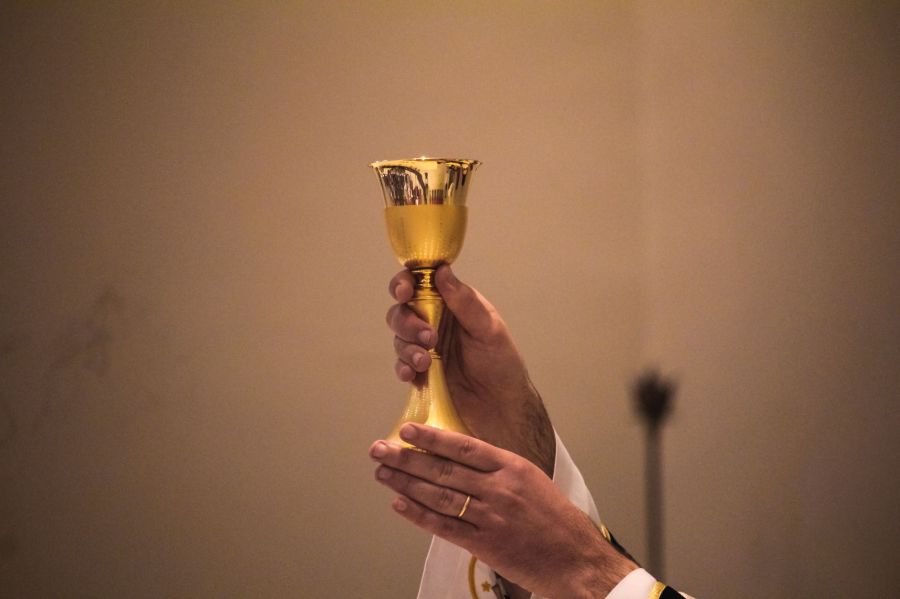
We are going to be using alcohol-free wine.
It’s a way that we can continue to be a well in the desert, a place of safety, a place of refuge.
I know it’s going to require something of us, because it’s a change in the way we’ve done things for a long time. And I know that we Episcopalians are not big fans of change. But you know what we are big fans of?
Loving people the way Jesus does.
And if Jesus knew there was something in the midst of his community that was harming the people he came to save, I think Jesus would do whatever he could to make his community a safer and more welcoming place for all people.
So beginning today, we are going to be using de-alcoholized wine in the celebration of the Eucharist, while we explore our long-term options for how to do this in a sustainable way.
For those of you who are in recovery: I invite you to consider, in your own mind and heart, what is best for you in your own recovery.
If even de-alcoholized wine feels too triggering for you, I want to encourage you to protect your sobriety, first and foremost.
Up to now, many of these folks have chosen to receive only the Bread and not the Cup.
Theologically, we believe that receiving just the Bread is full participation in the Communion of Christ’s Body and Blood.
But psychologically, we also know that receiving one element and not the other can sometimes feel less complete.
I just want you all to know that the option is available, should you choose it.
It is my hope that we, here in The Episcopal Church, may continue in God’s faithfulness to Hagar and to people throughout history from all nations—to be “a well in the wilderness,” and a church where absolutely everyone is welcome to participate fully in the life of the Body of Christ.

