Sermon for Trinity Sunday
Genesis 1:1-2:4a
I’ve got this phone. You may have one similar to it. And this thing tracks a lot of my data.
It can tell me how many steps I’ve taken today. It can tell me how much screen time I had last week (answer: too much). It can even track my weight and my blood pressure, so my doctor can keep an eye on it. It can tell me how productive I’ve been by checking things off a to-do list.
It knows a lot about me.
But it doesn’t really know me in the way that my family and my friends do.
There’s a big difference between knowing about someone or something and knowing them as a person.
We experience this in other parts of our lives, too.
At work, there are all kinds of productivity trackers. Even here at our church, where I work, once a year I’ve got to gather statistics: What was the attendance like on Sunday? How much came in through the offering plate? How many weddings and funerals did we do this year?
This data is useful.
But there’s a lot about this church that that data can’t tell me.
Can it tell me how much you love God and love each other?
The answer to that is no.
Same thing with the government. Every ten years it takes a census and writes down things like our ethnicity, our gender, our age, our address, how many people are in our household—lots of data points.
But they can’t really capture the essence of you and your family.
It’s just data.
The data is useful.
But it’s tempting sometimes to reduce complex, mysterious human beings to data.
Data points can’t capture who you are, because people are not statistics. People are not cogs in a machine.
The ancient Jewish people in the sixth century BCE understood intimately what it felt like to be treated as parts of a machine.
What had happened to them was that they had a war with the Babylonian Empire, which was the great superpower of that day, and they lost.
And the elite and the leaders among the people were taken off as slaves in Babylon.
And the Babylonians did their best to erase who they were—erase their religion, erase their culture, erase their language.
But here’s the thing:
The Jewish people resisted.
They accepted the fact that they had lost the war and were now obligated to work as a slave class.
But they did not accept the conclusion of the empire—that they were just cogs in a machine, that they were just property.
And our first reading today, from Genesis chapter 1, is a statement about that.
It is not a science book about the origin of life.
It is a poem about the meaning of life.
It is a song of human dignity in the face of oppression.
The language we hear in the text is very rhythmic and repetitive.
“God said, “Let there be light,” and there was light. And God saw that it was good. And God called the light day and the darkness night. And there was evening and there was morning, the first day.”
And that pattern repeats itself again and again for each of the six days.
Now, there’s a form of language that uses a lot of repetition and rhythm: Poetry.
Within that poem, if we read carefully, we see something really fascinating happening.
There is a thematic match-up between the first six days:
- Day one and day four.
- Day two and day five.
- Day three and day six.
In those first three days, God creates a habitat in which beings will dwell.
And in the second group of three days, God creates beings to live in those habitats.
- On day one, God creates light and darkness.
Match that up with day four, and God creates the sun, the moon, and the stars. - On day two, God creates the sky and the sea.
And on day five, God creates the fish and the birds, which live in the sea and the sky. - On day three, God creates the land and the vegetation.
And on day six, God creates the animals and the humans.
In each case, there’s a habitat and the beings that live in that habitat.
And the interesting thing about those beings is that they’re all Babylonian deities.
Except that, in this story, they’re not called gods and goddesses.
The sun and the moon, for example, were major features of Babylonian religion.
The Babylonians were telling the Jewish people, “You’d better bow down. Our gods are stronger than your God because we beat you in the war.”
And the Jewish people say, “No.”
These are not gods at all.
In the language of the text, they’re literally just “the big light” and “the little light.”
They’re not even given proper names.
According to the view of humanity that the Babylonian Empire held, humans were created to be servants of the gods. Humanity existed for them.
But in this biblical passage, the Jewish storytellers say:
Actually, we are created to be stewards of creation.
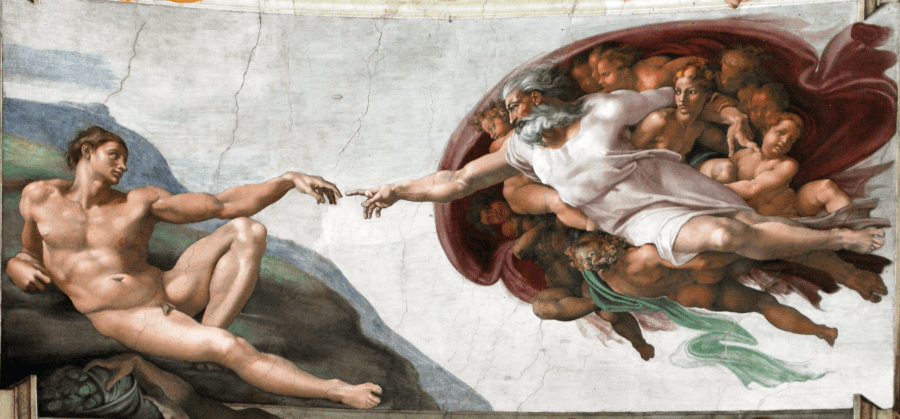
God made us in the divine image and said, “Rule over and care for” all these other creatures.
So it’s exalting human dignity above these so-called deities.
And finally, most of all, is the last day of creation, the seventh day, which came to be known as the Sabbath.
“On the seventh day, God rested and sanctified a day of rest for all creatures.”
Just imagine the Jewish people who were working as an enslaved class in Babylon at that time.
Their culture is being erased.
Their faith is being erased.
But they practice the Sabbath.
A day of rest, one day a week, when everybody goes on strike.
They say, “Six days a week we will do our jobs. We will work hard for you.
But one day a week, we all stop working.
And we’re going to take that time to pray, to be with our families, and to remember that we are not your machines.
We are not your property.
We are the beloved children of God.
That is who we are.
You cannot erase that from us.”
That’s powerful.
It gets me every time.
And it makes this message so meaningful.
This is a poem about human dignity.
It’s about people who refuse to be dehumanized, who refuse to be pushed aside and reduced to productivity statistics.
No matter what data was collected about them, they knew they were always going to be more than that.
Their faith gave them the strength to make it through that season known as the Babylonian Exile.
To endure.
To resist the erasure of who they were.
And to remember their own human dignity.
And when they would go back to their work, they would go back in a new way.
They weren’t serving merely the Babylonians who won the war.
They said, “Our daily lives are about serving God and each other.”
And that’s a much more meaningful way to work.
I can think of several examples—one from history and three that are a little closer to home.
First is the historical example: Dr. Jonas Salk.
He was the doctor who invented the polio vaccine.
And this obviously was a dramatic scientific accomplishment.
But the interesting thing is that he refused to patent it.
He could have made a lot of money.
But after he invented this vaccine, he said, “This belongs to humanity.”
This vaccine was going to be distributed freely to the world, to eradicate polio and ease the suffering of human beings.
That is holy and human work.
That’s a historical example from the past.
But we don’t just have to look at history to find examples of meaningful work that honors human dignity.
Chris Russell runs a game every other Sunday night at a comic shop here in town.
I’m part of this game.
It’s very silly. A bunch of nerds get together and pretend to be the crew of a spaceship, and we have a grand old time.
It’s a fun hobby.
But let me tell you something:
It is so much more than just a game.
The place where we meet is so much more than just a local business.
This is a place where people have formed a community of support.
Many of the members of this group have been through crises—hospitalizations, family members passing away.
Time and again, the members of this group have gathered around each other to offer support, helping one another buy cars, find jobs, and get through difficult times.
It’s become so much more than just a comic book shop.
It’s become something deeply holy and deeply human.
I think also of Patti Fosdick and Joanne Grigg, who took a shoe store on Chicago Street and turned it into an animal rescue.
A place where cats who have no home can receive care.
Where they can be introduced to families.
Where they can be there for anybody who wants to come in on a random Friday, and play with them, and feel a little better.
Through caring for animals, they too are doing holy and human work.
This is a sacred thing.
The last example I’ll mention is our dearly beloved departed sister, Mary Dally.
She worked for decades in our local schools.
And yes, she had a job to do.
There were children to educate and benchmarks to meet.
But the essence, the soul of her work as a teacher in this town, was the way she loved multiple generations of students.
The week that she passed away, I was having lunch over at the diner, and the waitress said, “You know, I was one of Mary’s students. And years later, my daughter was too.”
The testimony to her holy and human work came during her funeral service, when this church was standing room only.
All of these are snapshots from our local community of people living from that essence of human being that God gives us—the image of God.
And I think it can lead us as we go about our lives and our work.
Yes, our data continues to be collected.
It’s useful.
But I invite you to consider the essence and soul of who you are as God’s child.
Your soul, loving the souls of other people—is a part of God’s work in this world.
When God had made the world, he didn’t say, “This is very productive.”
He said, “It is very good.”

