Touching Grass

Sermon for Proper 17, Year C

Click here for the biblical readings

When I was a kid, growing up in the 80s and 90s, Nintendo was a big part of my life. I spent a lot of time perfecting my fine motor skills with games like Super Mario Brothers and Street Fighter II. The only problem was that I developed a bad habit of losing my temper at the TV screen whenever things weren’t going my way in the game. When my poor mother would hear me screaming from the next room, she knew it was time to come in and tell me to turn off the game and go play outside.

Now that I have teenagers of my own, I’ve noticed that their generation has coined a new phrase to deal with this exact situation. When someone is showing signs of having become too wrapped up in drama on the internet, their friends will say to them, “Go touch grass.”

In previous generations, parents might have worried that the mention of “grass” indicated that their kids were engaging in, shall we say, a bit of “recreational chemistry.” But, in present day terms, “touch grass” means temporarily unplugging from the virtual world in order to get back in touch with actual reality. If you’ve been online too long, you need to go touch grass. It’s the same thing that my mother was trying to tell me, back in 1992.

In a way, “touch grass” is also the same point that Jesus is trying to make in today’s gospel. When people are getting too wrapped up in “playing the game” of social hierarchies, they sometimes need to turn it off, reengage with reality, and maybe even go outside and literally “touch grass.”

Whether or not we happen to be of the online generation, we all have a tendency to get wrapped up in silly games that sometimes stress us out. The technology is new, but human nature remains just the same as it ever was. At school, there is a pecking order that dictates who gets to sit at the “cool kids’ table.” At work, certain voices are more likely to be listened to in a meeting. In our neighborhoods, people scramble to “keep up with the Joneses,” while forgetting that everyone is a “Jones” to someone else. The game of social hierarchies is crazy-making. That’s why all of us need to periodically turn it off, go outside, and touch grass.

That’s how we remember that the essence of the good life is not about competition, but communion. It’s not about beating each other, but being together.

In today’s gospel, Jesus is enjoying a meal at someone’s house on the Sabbath day. This is an important detail. In the gospel according to St. Luke, the Jewish concept of Sabbath, the day of rest, comes up repeatedly. For Jesus, the day of rest was not a day of religion, rules, and rituals, but a weekly reminder of the way life is meant to be. Many of Jesus’ healing miracles took place on the Sabbath. People were restored on this day, not only to physical health, but also to their rightful place as equal partners in their community.

A significant part of the Sabbath, for our Jewish neighbors today as well as back then, is the common meal. In Jesus’ time, the seating chart at these meals was very important. The right kind of people had to have the right seat at the right supper in the right house. The whole thing was a game about reinforcing social hierarchies (much like the “cool kids’ table” in every school cafeteria).

At first glance, it seems like Jesus is teaching strategic etiquette for getting the right place at the right table, but what he’s actually doing is subverting the social order by encouraging people not to play the game of social hierarchies. For Jesus, the big Sabbath meal is a symbol of reality, as seen from a spiritual point of view. The most honorable guests, in God’s eyes, are those who willingly take a lower position in order to make space for others at the table.

From the point of view of the Christian spiritual tradition, this parallels nicely with the mystery of the Incarnation, where the Divine Source of all Being “became flesh and lived among us” (John 1:14) in the person of Jesus the Christ.

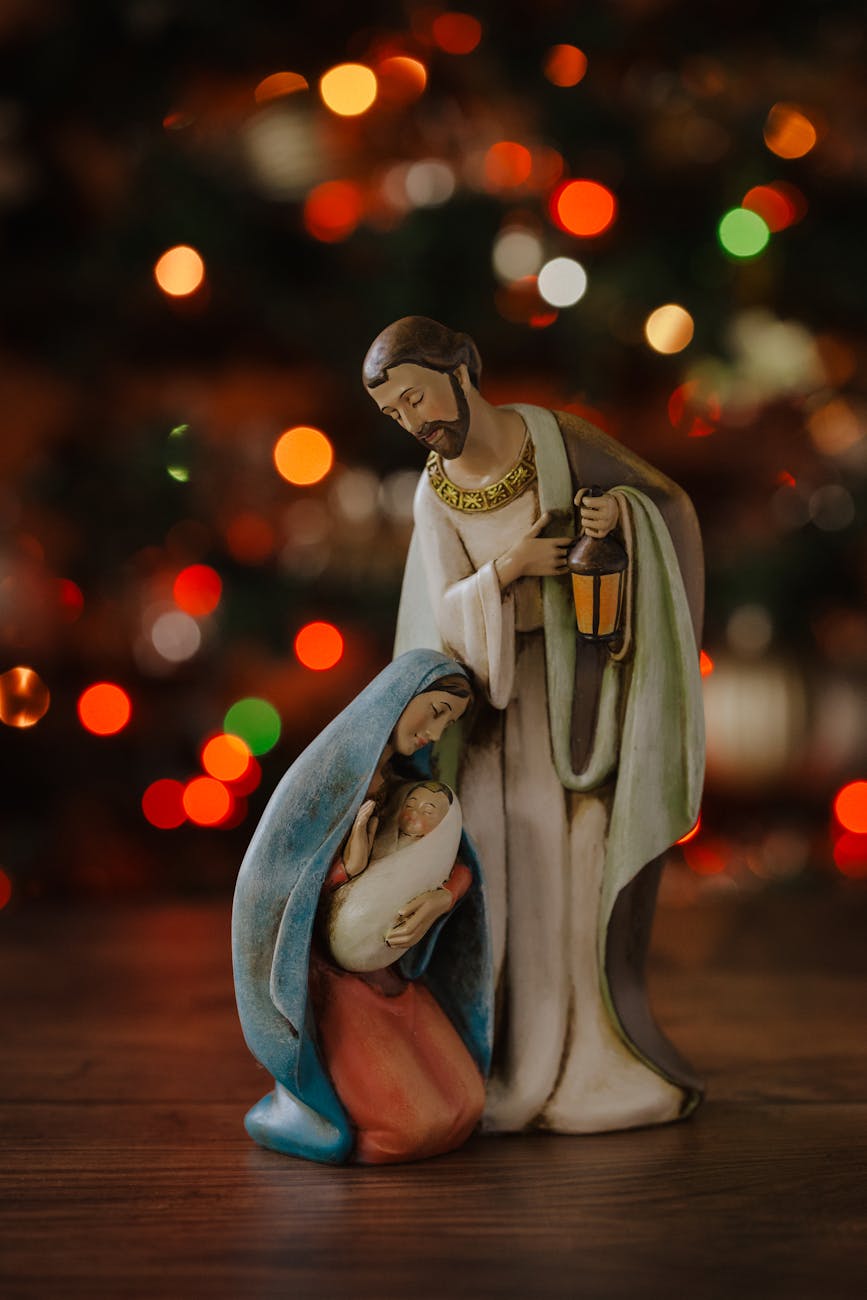
In Christ, according to the Christian tradition, God’s own self took the lowest place by being born to an impoverished refugee couple, in an occupied country, in the feeding trough of a stable outside of an overfull inn. In today’s terms, it would happen in the parking lot of a run-down motel, somewhere in the West Bank of Palestine.

From the point-of-view of the powers-that-be, such a baby would be nothing more than another mouth to feed, a nameless statistic in the latest news about the latest airstrikes, and a drain on national resources. But, from the Divine point of view, such a birth marks the coming of salvation and liberation into the world. This is the truth that Christians proclaim every time we celebrate Christmas.

Kindred in Christ, this is what it means to “take the lowest place.” It means becoming vulnerable and standing with the most disenfranchised people on earth. In Christian terms, this is what it means to save the world. Jesus the Christ didn’t do it by climbing the social ladder, but by intentionally taking the “lowest place” among humanity. We who claim to be the people of Jesus must follow suit, as the Scriptures say in 1 John 2:6, “whoever says, ‘I abide in him,’ ought to walk just as he walked.”

Dear kindred in Christ, our Lord invites us to “touch grass” because that is exactly what God did in the mystery of the Incarnation. Jesus the Christ took the lowest place among humanity in order to exalt humanity to the “right hand” of God, “in the heavenly places, far above all rule and authority and power and dominion, and above every name that is named, not only in this age but also in the age to come” (Ephesians 1:20-21).

Friends, our Lord asks this of us because he knows that real life is not about beating each other, but being together.

When I think about this way of being together, what comes to mind is Crescent Comics and Games, which sits just a few yards from our church’s front door, on Chicago Street. This establishment is a prime example of a “third place,” as described by Ray Oldenburg in his 1989 book, The Great Good Place.

A “third place,” according to Oldenburg, is different from a “first place” (the home), and a “second place” (the workplace), because it is a place where people can come and be human, without the expectation of monetary participation. Third places are important because they provide space for people to hang out, converse, and figure out who they are, without having to make a purchase or prove their monetary worth.

Other examples of third places include places of worship, public libraries, community centers, and internet chat rooms. They are absolutely essential for functional democracies, but they are becoming increasingly rare in our consumer-oriented society.

Crescent Comics and Games is a for-profit business, but it also functions as a third place because people come there to play games, even if they don’t buy anything from the shop. Logan and Colleen, the owners of this shop, have intentionally made their business a place of welcome for everyone in Coldwater. Those who play games in their store are welcome to make a purchase, but it is not required for participation in the games that take place there. That is why I ultimately consider their shop to be a third place in our beautiful town.

The kinds of games that people play there are manifold. Most significant to me are the role-playing games, one of which is run by our own parishioner and cameraman, Chris Russell.

Here’s the thing to understand about role-playing games: They aren’t about winning or losing. In role-playing games, the players work together to overcome a common challenge and tell a story that is greater than any one of the individual players present. The story is the thing that matters most, and the players either succeed or fail together. I can think of no greater parallel to the Church than this. We, the people of faith, are called together by Christ, not to compete with one another, but to work together in service to a Grand Story that is greater than any one of us.

Kindred in Christ, I believe that the Church is called to be a third place, like Crescent Games and Comics, in our community today. We ought to be a place where people from every walk of life can come and know that they will find a friendly face and a safe shelter from the storms of life.

This is what Jesus the Christ meant when he encouraged his followers to “take the lowest place” in the social hierarchy of Sabbath suppers in his day.

I pray that our church might be a “third place” where every person in our city can come to touch grass, find safety, hospitality, and love in the name of Jesus Christ our Lord, who taught his followers that real life is not about beating each other, but being together.

Amen.

God Don’t Make No Junk

Sermon for Proper 16, Year C

Click here for the biblical readings

Once upon a time, there was a big family, who all lived together in a big house. Each member of this family had a special, magical gift. One was very strong, one could talk to animals, another had powers of healing, and another could control the weather. But then there was another member of the family, Bruno, who could see visions of the future that no one else wanted to see. His gift made people uncomfortable, so the rest of the family banished him from the family. Whenever anyone asked about him, the family would say, “We don’t talk about Bruno.”

But here’s the thing: Poor Bruno didn’t just go away when he was banished; he stayed in the house and lived in the walls, where no one could find him. Eventually, his ominous visions of the future started coming true. Finally, the family realized that they needed Bruno’s help because his visions provided the wisdom they needed to fix their problems. In the end, they saved their family and their house, not by getting rid of Bruno, but by bring him out of the walls and reintegrating him into the life of their family.

The story I have just told you is the plot of the Disney movie Encanto. You may or may not have seen it. But even if you haven’t seen it, I think its story rings true for most of us in the real world.

Many of us, in our families or neighborhoods, can think of people who we would rather not acknowledge or talk about. They make us feel awkward or angry with their unusual ways. We would rather just pretend that they didn’t exist at all, but the thing is that we can’t ever really get rid of them. We can push them out of sight and out of mind, but they are never truly gone.

If we’re honest, we can admit that the reason why such people make us so uncomfortable is that they remind us of truths within ourselves that we would rather not acknowledge. But if we’re truly honest, we can even admit that each one of us has a “Bruno” within ourselves: Some part of us that we wish wasn’t there, because it makes us uncomfortable.

These unwelcome parts of ourselves often get pushed to the side, or even banished into the unconscious parts of our minds, because we would simply rather not deal with the inconvenient truths that they present us with. But the fact is, for us just as much as for the family in the movie Encanto, we can never truly be set free until we recognize these banished parts of ourselves and welcome the truthful message they bring us. This is a story about every single one of us, and it is also the story of today’s gospel.

The woman that Jesus encounters in today’s gospel is a person who knows what it’s like to be pushed aside and forgotten. As a woman, she was already banished to the far corners of the synagogue. The men were the ones who could stand in the center and lead the assembly in singing praises to God.

In addition to her gender, this woman also had some kind of psychosomatic ailment that kept her “bent over” and “quite unable to stand upright” for almost twenty years. On a metaphorical level, this illness made the woman present herself to the world as something less than what she truly was. Her story makes me think of people I know who feel like they are defective or less than their peers because of some quality about themselves that they think will be perceived as unacceptable to the people around them. Her story makes me think also about those parts of myself that I would rather hide from the world because they make me feel ashamed. Like the family in Encanto, I would much rather push those parts of myself out of sight and out of mind, hoping that the world will never find out about the secret that I am so desperately trying to hide. But Jesus doesn’t play that game.

When Jesus encounters this woman, he invites her to come stand in the center of the synagogue. He proclaims to her, “Woman, you are set free from your ailment,” and then reaches out and lays his hands upon her. It is not lost on me that this laying on of hands is the same gesture that a bishop performs during the ordination of a priest. Jesus is ordaining and empowering this woman to stand up and claim her true identity in the midst of the people of God. I think it is no coincidence, therefore, that the woman in this story immediately straightens up to her full stature and begins praising God.

It is also no surprise, at that point, that the managers of that religious institution suddenly become indignant and begin to argue about the petty minutiae of religious law, even though they have literally just witnessed a miracle taking place. But Jesus is having none of their hypocrisy; he calls it out for what it is. Jesus would rather risk blasphemy by breaking the rules than keep the rules and sacrifice the real needs of human people. This is the kind of Savior that Jesus Christ is: with us, for us, in us, and through us. He breaks religious rules for the sake of human needs, and he invites us to do the same.

I remember a time, early in my ministry, when I was the pastor of First Presbyterian Church of Boonville, New York. It was a small, traditional church in a small, traditional town. At that time, the Presbyterian denomination was in the process of revising its official stance on the ordination and marriage of LGBTQ+ people in the church. One prominent member of the church, a man named Rick, came to me and told me that he was gay. He said that, in light of the changes happening in their denomination, he wanted to come out of the closet to his church family. Whether they loved him or hated him, he wanted them to know him as he truly was.

I told Rick that, since I was still new at the church, I couldn’t predict how the parishioners would respond, but I would proudly stand beside him as his pastor, no matter what. So, we planned a church supper to discuss the changes that were then happening in our denomination. At the end of the conversation, I invited Rick to the front of the room to tell his story.

After he finished talking, there was a long moment of silence. I held my breath as I waited to hear how the church would respond. You could have heard a pin drop in that room.

The first person to speak up was a longtime member of the church who very rarely said a word, good or bad.

“Well,” she said, “God don’t make no junk!”

What happened next, I can only describe as a “Tidal Wave Group Hug.”

The entire mob of people of the church rushed to the front of the room, covering Rick with their tears and their love. His elderly aunt said, “I’m so proud you’re my nephew!”

And I was never so proud to be their pastor as I was in that moment.

From that day on, First Presbyterian Church of Boonville became a bastion of civil rights for LGBTQ+ people in upstate New York. They embodied the all-inclusive and unconditional love of Jesus Christ in a way that I would not have thought possible for such a small church in such a small town. They did it because they loved their friend Rick, and because they followed their Lord and Savior Jesus Christ, who called them to love their neighbors as themselves.

Kindred in Christ, this is what it looks like when a community of believers lives out the call to be the hands and feet of Jesus Christ in this world. This is what it looks like when the Church, following in the footsteps of her Lord, invites marginalized people into the center of our collective life, lifts them up, and empowers them to sing God’s praises in our midst.

My question to you today is this: What happens when it’s your turn? What happens when those parts of yourself that you have ignored, repressed, or banished get invited to stand up straight in the center of the room and lead the chorus of God’s praise? What happens then?

[QUICK DISCLAIMER: To my wonderful and beautiful introverts in the room: I know you feel terrified by what I just said. I just heard all of your blood pressures go up simultaneously. Please don’t worry; I won’t make you stand at the front of the room. To you, I would ask the following: What happens when that one person you love the most feels so invigorated by your presence that THEY go to the front of the room and sing God’s praise? Afterwards, they turn to you with a subtle wink and silently mouth the words, “Thank you.” What happens then?]

Well, I’ll tell you what happens then: The kingdom of God comes on Earth, as it is in Heaven. The followers of Jesus begin to act more and more like their Lord and Savior. “The power of love overcomes the love of power,” as Jimi Hendrix once said, and the world understands anew the meaning of those old words: “Jesus loves me, this I know…”

Kindred in Christ, the Spirit of Jesus is among us today, just as the physical Jesus was present with that woman in today’s gospel, setting you free to stand up straight and sing God’s praises. Let us sing those praises together and empower our neighbors to stand and sing with us, so that they too might know the love that sets us free.

Amen.

Pardon Our Dust

Sermon for the Tenth Sunday after Pentecost.

Click here for the biblical readings.

If you’ve been at the church building at all for the past couple of weeks, you’ve probably noticed that things have been a little different: You can see the scaffolding and the workers walking around on top of it. You can hear the sound of hammers and machinery. I’ve received multiple phone calls from people asking where to park or which entrance to use. There is no getting around the fact that this roof restoration process has been disruptive to our normal routines, as a church.

And yet… it’s absolutely necessary. Our building is more than just a lovely addition to the downtown historic district; this building is a tool that God has lent our church, so that we can do the work of ministry: Loving and serving our Coldwater neighbors in the name of Christ. Restoring the roof is practicing good stewardship over that which we have borrowed from God, just like we might take extra good care of a car or a book that we had borrowed from a friend.

Nevertheless, the process of caretaking has been especially disruptive to our normal routines for these past few weeks…

People tend to not like disruption in their daily routines. It’s inconvenient (we are creatures of habit, after all). It gets in the way of our plans (although, as they used to say, “If you want to give God a good laugh, tell him your plans”).

Disruption can come to our lives in many forms: the loss of a job, the breakup of a relationship, accidents, illness, or death. Sometimes, it’s even a happy occasion, like getting married, having a baby, graduation, or retirement. It’s good stuff, but it’s still disruptive to our regular routines.

As creatures of habit, we tend to see disruption as a problem and peace as a solution, but Jesus (in today’s gospel, at least) seems to see it the opposite way.

Jesus asks his disciples, “Do you think that I have come to bring peace to the earth?” And then, he answers his own question, “No, I tell you, but rather division!”

Now, this is where we might say, if we were present at this conversation, “Now wait just a minute, Jesus! Aren’t you supposed to be the Prince of Peace? At Christmastime, aren’t we supposed to say, ‘Peace on Earth and goodwill to all’?”

And Jesus would respond, “Yes, but what exactly do you mean by ‘Peace’?”

Peace is a good thing, but it is often misunderstood by those who would rather settle for normalcy than challenge the status quo. We sometimes try to “keep the peace” by avoiding uncomfortable conversations, inconvenient truths, and important decisions. That kind of “peace” is no peace at all, according to Jesus. That kind of (so-called) peace is toxic.

Dr. Martin Luther King, Jr. said that peace, “is not the absence of conflict, but the presence of justice.” Justice, as Dr. King meant it, is fair and harmonious relationships between people. It has less to do with punishment and more to do with what St. Paul meant by the word “righteousness” in his epistle to the Romans. Peace, as Jesus meant it, is what happens when people address old patterns of behavior, become aware of unconscious habits of thinking, and seek to make amends for the mistakes of the past. Peace upends our lives and refuses to leave us as it found us. Peace asks something of us. Peace, as Jesus Christ intends it, is disruptive.

That’s why Jesus says, in today’s gospel, that he has not “come to bring peace to the earth… but rather division.” Jesus disrupts our false illusions of peace in order to bring us closer to true peace, which can be found in right relationships between God, our neighbors, and ourselves. Sometimes, disruption is necessary in order to bring us into the good life that God intends for us.

Here’s the thing I want us to carry away from this sermon today:

When Jesus stirs up the dust in our lives, it’s not to tear us down; it’s to make us stronger, so we can join him in building something even better.

The mess in our lives, just like the mess in our church building this week, is not a sign of failure; it is a sign of God at work.

I have found this principle to be true in my own life:

When I was a kid, my Uncle Hutch was a spiritual leader in our family. He was a United States Army chaplain who served in the first Gulf War and later as a commercial chaplain for truck drivers in South Carolina. He is a very tall, wise, and kind-hearted man who I have always looked up to, both literally and figuratively.

Whenever we would gather at his house for Thanksgiving dinner, Uncle Hutch would lead the prayer. Whenever someone in the family was getting married, Uncle Hutch would officiate the service. Whenever one of us needed spiritual counsel, we would call Uncle Hutch.

In recent years, Uncle Hutch’s health has begun to decline. Now in his eighties, his spirit is stronger than ever, but his physical body is showing the inevitable signs of age. As this has happened, without anyone making an official proclamation, I have noticed the family roles that were previously assigned to Uncle Hutch now gradually falling to me.

I have to admit that this prospect is daunting. First of all, I am keenly aware that my personal views on various matters differ somewhat from those of my family. Lastly, and far more significantly, how could I possibly fill the shoes of a man of God that I have admired since the day I was born?

The task seems impossible to me.

When I called my Aunt Faith to ask permission to share this story today, she told me that none of us can ever “fill the shoes” of another person. The best we can do is to “follow in their footsteps” in our own particular way, even if our way differs somewhat from the way in which the original person would walk it.

The shift in family roles has certainly been disruptive, to say the least, but I must also admit that it has led to some of the most deep and honest conversations with my family that I have ever had. Whenever significant events happen, good or bad, I have become the one that my family members call to seek comfort and advice. I still don’t feel up to the challenge, but I try my best to meet it to the best of my limited ability. I can only trust God’s Holy Spirit to fill in the blanks where my personal wisdom is most definitely lacking.

It is in moments like these that I ask the age-old question, “What would Jesus do,” or, secondarily, “What would Uncle Hutch do,” to respond to the problems that are presented to me.

The shift in family roles has most definitely been disruptive to my felt sense of peace, but I can also see how it has been part of God’s work in the life of my family.

Kindred in Christ, I put it to you today that the disruptions in our lives are not problems, but the very solutions that we have been seeking to the questions that beset us. The God we believe in, revealed through the person of Jesus Christ, is a God who asks tough questions and leads us through the desert of conflict, in order to bring us to the true peace that consists of right relationship between God, our neighbors, and ourselves.

Let us not shy away from tough questions and gravitate toward easy answers, but sit in the tension that leads to “the peace that passeth all understanding.” Let us hang upon our hearts a sign that says, “Pardon our dust” while we wait in the confidence that God is not done with us yet, but is still working to bring us to the fullness of peace in Christ Jesus our Lord.

As a tangible sign of our faith in God’s work in our lives, I would like to invite to the front of the church Mr. Mike Woodhouse, manager of Sheriff Goslin Roofing Company, and any members of his crew who are present with us today.

These people have been hard at work on the roof of this historic building. I would like to introduce them to you so that you can thank them and join me in a special blessing over their work, as well as a prayer for their safety while they lovingly restore the roof of this building.

Let us pray.

Loving God, you have gifted these workers with the skill and the will to work for the restoration of this church building, which you have lent to us for the purpose of continuing the work of Jesus Christ on this Earth, by loving you with our whole heart, soul, mind, and strength, and loving our neighbors as ourselves. In Christ’s most holy Name, we bless the labors of these workers and pray for their safety from dangers seen and unseen, that the goodness they create with their hands may be matched by the sincerity of our hearts. We ask these things and bless these workers in the Name of the Father, and of the Son, and of the Holy Spirit. Amen.

Kindred in Christ, these workers are a symbol to us of the good work that God is doing in each of our lives. May each and every one of us come to acknowledge this work and bless the disruptions, not as a problem to be solved, but as the means through which God is bringing each of us, in our own time, to the fullness of peace that can be found in Jesus Christ our Lord.

Amen.

The Scandalous Gospel of Grace (Rooted & Rising, Week 3 of 4)

Sermon for the Seventh Sunday after Pentecost (Proper 12, Year C)

A man walks into his doctor’s office and says, “Doc, I’ve got a terrible, piercing headache that just won’t go away. Can you help me?”

The doctor says, “Sure. Let me ask a few questions, just to get a medical history. Do you smoke?”

“No way,” the man says, “That’s a disgusting habit!”

“Ok,” says the doctor, “How many drinks of alcohol would you say you have in a week?”

“Zero,” the man says, “I’m a teetotaler, always have been!”

“Ok,” says the doctor, “Do you eat a lot of junk food?”

“None,” the man says, “Fresh vegetables are all I eat.”

“Ok,” says the doctor, “Do you watch a lot of TV?”

“No sir,” the man says, “The only thing I do for entertainment is sit at home and read my Bible.”

“Ok,” says the doctor, “I think I see the problem here. My prescription for you is a large pizza, a good movie, and Extra Strength Tylenol because, if I was as uptight as you are, my head would hurt too!”

I borrowed this story from songwriter Rich Mullins, who borrowed it from author Brennan Manning.

In one of his more famous books, Brennan wrote:

 “The trouble with our ideals is that if we live up to all of them, we become impossible to live with.”

Brennan Manning, The Ragamuffin Gospel, p. 74

Many people have never heard of Brennan Manning. He’s one of those spiritual authors who has a very niche market. He’s not an academic scholar. He’s a little too “Jesusy” for liberal and secular types, but he’s also too broad-minded for conservative and religious types. In short, Brennan Manning’s writing has something to offend everyone. If I were to sum up Brennan’s writing in a single phrase, it would be: “The Scandalous Gospel of Grace.” And scandalous it most certainly is…

Brennan got his start in ministry as a Roman Catholic priest. After several years, he burned out and sought treatment for alcoholism. In sobriety, he left the priesthood and got married. For the rest of his life, he traveled, wrote, and spoke about the unconditional love of God for sinners and “ragamuffins,” as he liked to call them.

I first encountered Brennan’s writing in college, when I was at the peak of my own religious zealotry. If you asked those who knew me, they would tell you that I was “on fire for Jesus.” But if you asked one of the few people who knew me well, they could tell you that I was a young man who struggled to believe in the gospel that he preached. I gave lip-service to belief in a loving God, but secretly worried that this same God was gleefully waiting to punish me for every sinful thought, word, and deed, no matter how small. It was during this time of my life that I first read the books of Brennan Manning.

At first, I scoffed at what he had to say, but I also couldn’t bring myself to throw his books away. I read them again and again, sensing that there was something important for me to hear in these words, but not knowing what it was. As it turns out, what I needed to hear was the kind of truth that could only be spoken by someone who had been knocked flat on his butt by failure, and could only be heard by someone else who had also been knocked flat on his butt by failure.

Today is not the day when I will get into the details of my particular story, but stay tuned: I’m sure you’ll hear it eventually. The reason why I’m telling you this much today is to emphasize the fact that this is not a story about me or Brennan Manning, but a story about the scandalous grace of God. The truth that Brennan Manning preached is the scandalous truth that each and every one of us is loved and accepted unconditionally, regardless of whether or not we deserve it.

To those who have not experienced abject failure, the scandalous gospel of grace sounds like a bunch of hippy-dippy, flower-child, peace and love crap. But to those who have reached the end of their rope, those whose “cheese is sliding off their cracker,” as Brennan used to say, the scandalous gospel of grace is the final lifeline between broken people and the bottomless pit of despair.

Don’t just take my word for it; ask any recovering alcoholic or addict. There are several of these saints living among us today. If you don’t want to do that, just ask St. Paul and his followers, who wrote the epistle reading we heard this morning.

Today is the third in our four-week sermon series on the New Testament book of Colossians. In the first week, we looked at the opening of the letter, where the author, writing in Paul’s name, gives thanks for the ways in which the virtues of faith, hope, and love counter the forces of cynicism, fear, and indifference. Last week, we talked about Christ as the invisible network that connects us all. Today, we are getting into the nitty-gritty of life in the real world, where we are constantly bombarded by messages that we are not good enough. These lying messages tell us that we had better get on-board with their program, which promises success and happiness, so long as we follow the author’s instructions to the letter.

What I love most about today’s reading from Colossians is how it calls out those false promises for the malarkey that they are.

Colossians says, “See to it that no one takes you captive through philosophy and empty deceit, according to human tradition, according to the elemental spirits of the universe, and not according to Christ.”

What the author was talking about in this verse was two opposing controversies that were plaguing the Church at Colossae in the time when this letter was written. On one side was a group of very traditional religious people who said, “Jesus was Jewish, and all his apostles were Jewish, therefore any non-Jewish converts to Christianity must first convert to Judaism and follow the laws of the Torah.” On the other side were the non-Jewish converts to Christianity, who were influenced by the teachings of the Greek philosopher Plato, who said that salvation from corrupt physical existence comes from learning the secret knowledge of the spiritual realm, which is diametrically opposed to the realm of physical existence.

The people of the Church in Colossae wanted the author of this epistle to settle the argument and tell them which side was right. As it turns out, the correct answer was: “Neither.” Neither side was right in the culture war that afflicted the Colossian Christians.

The truth of Christ was based, not on the pious observance of traditionally religious people, nor on the esoteric philosophy of educated people, but on the unconditional love of Jesus, which reaches all people who call out from the depths of despair.

Colossians says, “Do not let anyone disqualify you,” and I really like that. Do not let anyone disqualify you, not the liberal philosophers, not the conservative clergy, not even yourself. Do not let anyone disqualify you, because you have already been qualified by the scandalous grace of God, who has welcomed everyone in the embrace of unconditional love.

At the beginning of this reading, the author of Colossians says, “As you have received Christ Jesus the Lord, continue to live your lives in him, rooted and built up in him and established in the faith, just as you were taught, abounding in thanksgiving.”

Pay special attention to the first and last words of that sentence: “As you have received,” and, “abounding in thanksgiving.”

The key word in the first part is, “received.” Note that it specifically does not say, “achieved.” An achievement is something we earn by effort, like an academic diploma. By contrast, a gift is something that we receive, like a Christmas present. The proper response to a free gift is gratitude, which is why the sentence ends, “abounding in thanksgiving.”

There is nothing that we Christians did to earn our salvation, therefore there is nothing we can do to lose it. Our only role is to receive it with thanksgiving. As the Protestant reformers are so fond of saying, we are “saved by grace alone.” Our faith and our works are nothing but a grateful response to the amazing grace that has been so lavishly bestowed upon us by God.

In a way, every single one of us is an “illegal immigrant” in the kingdom of God, insofar as we have been brought into God’s good graces “outside of the law,” by the unconditional love of Jesus Christ, who proved his love for us “while we were still sinners” by dying for us, as the Scriptures say in Romans 5:8.

Kindred in Christ, we are saved by grace, not because of our spiritual knowledge or religious observance, but because each and every one of us is loved, unconditionally, by the God who made us. God’s love transcends every category that divides us, whether that be race, gender identity, ethnicity, nationality, sexual orientation, political affiliation, economic status, or religion. God’s grace is universal.

You are loved. Full stop. No addendum. No provisos. No “quid pro quo.”

You are loved. This is the scandalous gospel of grace. There is nothing you did to earn God’s grace, therefore there is nothing you can do to lose it.

God loves you. This is the foundational truth of the Christian religion, and it is the ditch in which I am willing to die. If you have a problem with that, take it up with God, not me.

Amen.

Jesus & the Wood Wide Web (Rooted & Rising Series, Week 2 of 4)

Sermon for the Sixth Sunday after Pentecost (Proper 11, Year C)

Rooted & Rising series, Week 2

In 1919, just after the end of the first World War, the Irish poet W.B. Yeats penned the following lines:

“Things fall apart; the centre cannot hold;
Mere anarchy is loosed upon the world…
The best lack all conviction, while the worst
Are full of passionate intensity.”

W.B. Yeats, The Second Coming

Yeats was lamenting the spirit of his own time, when crowns, creeds, and customs seemed to be drowning in the rising tide of modern advancement. Yeats expressed concern about what new thing would rise to take the place of traditional social values. As it turned out, his concern was justified.

The years following the composition of this poem saw the rise of Communism in Russia, where the Soviets overthrew one iron-fisted regime, only to replace it with another that was just as oppressive. In Germany and Italy, fascist dictators seized power and manipulated their citizens into committing unspeakable acts of genocide. Even W.B. Yeats himself flirted with similar authoritarian movements in his own native Ireland.

When things seem to be falling apart, it is only natural to want to grab onto some source of comfort that promises to maintain a sense of normalcy. The temptation to watch out for in such moments is the temptation to force solutions through the exercise of raw power.

Strongmen take that opportunity to exert their will over the people by scapegoating those who dissent or differ from familiar norms. They claim that, by electing their party to office, impeaching the president, deporting immigrants, and somehow stopping people from being gay or trans, they can lead the country back into some imaginary golden age that never really existed.

The Stalinist purges of Soviet Russia and the book burnings of Nazi Germany have this faith in common. Hitler came to power by promising to protect Germany from the threat of Communism. Stalin came to power by claiming to save Russia from Fascism. This should tell us that the problem is not “right vs. left” and the solution will not be some kind of Satanic compromise between Hitler and Stalin. The problem is much deeper and simpler than that.

What these dangerous ideologies have in common is a shared faith in the power of power itself. They both claim that the solution to the problem of social disintegration is more control over people. The epistle to the Colossians disagrees with that conclusion.

Today’s epistle reading forms the theological core of the book of Colossians. Biblical scholars sometimes refer to this passage as “The Hymn of the Cosmic Christ.” In this passage, the author is talking about Jesus, but not the carpenter from Nazareth who started a grassroots movement on the back roads of Galilee. The Jesus that this passage talks about is Jesus as the early Church began to see him in the years after his death. In the eyes of these first Christians, Jesus was more than just a man who started a movement; he was an icon of the meaning of life itself.

The text says:

“[Jesus Christ] is the image of the invisible God, the firstborn of all creation; for in him all things in heaven and on earth were created, things visible and invisible, whether thrones or dominions or rulers or powers, all things have been created through him and for him. He himself is before all things, and in him all things hold together.”

Colossians 1:15-17

The Jesuit priest and paleontologist Pierre Teilhard de Chardin, one of my personal heroes, takes this passage very seriously. He says that Christ, when looked at through the lens of faith, is the Ground, Guide, and Goal of the entire universe. In the New Testament book of Revelation, the Cosmic Christ says, “I am the Alpha and the Omega, the beginning and the end” (Revelation 21:6). Therefore, the solution to the problem of disintegration is not an increase of control, but an increase of connection. This flies in the face of every partisan ideology that human beings have thus far conceived. In continuity with the historical Jesus of Nazareth, the Cosmic Christ says that the answer is not to “get rid of those people,” but to “love your neighbor as yourself.”

So, I’ll say it again: the solution is not more control, but more connection.

To illustrate this solution, I’d like to take you into the forest, beneath the apparently separate existence of individual trees. Underneath the surface, scientists have discovered something that stretches between the root systems of these individual trees. It’s called the mycelium.

The mycelium is a vast communication network of fungus that connects the trees to one another. Through it, trees are able to share information and resources with one another. Older trees send nutrients to younger trees through the mycelium. Trees infected by parasites send warnings to their neighbors about the infection. What’s even more amazing is that this network is even able to send messages between trees of different species. For this reason, scientists have begun referring to the mycelium as the “Wood Wide Web.”

If you go walking in the forest today, you probably won’t be able to see it with your eyes. It lives beneath the surface of the ground. The most you might be able to see is the fruit of the Wood Wide Web, which takes the form of mushrooms, but these are not the web itself; they are but the fruit of it.

In the same way, humans cannot directly see the Cosmic Christ “in whom all things hold together,” but we can see the fruit of the Spirit, which is “love, joy, peace, patience, kindness, generosity, faithfulness, gentleness, and self-control” (Galatians 5:22-23). Millennia before the invention of computers, these moral principles kept human beings connected to each other around the world. It’s amazing to realize that modern technology is still trying to catch up to what the Holy Spirit revealed centuries ago.

The Cosmic Christ has always existed. Today’s epistle reading calls the Christ, “the firstborn of all creation,” that existed, “before all things.” Spiritual author Richard Rohr writes, “Christ is not Jesus’ last name.” He describes “Christ” as “another name for every thing.”

Christianity is not the first or the only spiritual tradition to recognize this all-pervasive presence in the universe. Greek philosophers talked about the Logos as the organizing principle of the cosmos (in fact, that’s where we get the word logic from). Similarly, Chinese philosophers spoke of the Tao as the un-nameable flow of nature. Hindus and Buddhists refer to this mystery as Dharma. For our Jewish neighbors, the Torah is not just the first books of the Hebrew Bible, but the divine Teaching that has been woven into the very fabric of creation.

Logos, Tao, Dharma, Torah, Christ. One song, with different lyrics, but the same music.

For Christians, the ineffable mystery of the Cosmic Christ is revealed through the historical Jesus of Nazareth and the traditions that rose up around him. Most notably, we encounter the presence of Christ in the Sacrament of the Holy Eucharist. In this mystery, the fruits of the Earth, which have been shaped by human labor into bread and wine, are received by the priest, consecrated as the Body and Blood of Christ, and then given back to the people, who receive the Body of Christ into their own bodies. It’s like the dieticians are always fond of telling us: “You are what you eat!” In this case, you are the Body of Christ.

The grace of this Sacrament has profound implications for how we are to live our common life, as members of the Body of Christ in this fragmented world, where things so often fall apart. To us is given the faith that “all things hold together” in Christ, not by the force of human will, but by the grace of God’s all-inclusive love.

When you, the members of the Church, come down the center aisle to receive Communion each Sunday, I know the particular struggles that many of you bring with you. Most of the time, they are questions to which I don’t know the answer and problems to which I don’t have the solution, but I choose to believe that the moment I look you in the eye and place the Body of Christ into your hand is an important starting point, from which we can begin to form those answers and solutions together.

W.B. Yeats wrote, “Things fall apart; the centre cannot hold,” but we, the members of Christ’s Body, dare to defy Mr. Yeats by proclaiming that the center does hold. The center holds, not by forcing control, but by receiving Communion with God and each other. We need not rely on the empty promises of self-proclaimed saviors of any political party because the truth is that we already have a Savior who has promised to give us all things necessary as we “seek first the kingdom of God and his righteousness” (Matthew 6:33).

Kindred in Christ, our Communion is our connection. Beginning with the Sacrament, it extends outward to small and large acts of mutual aid between ourselves and our neighbors.

The offer of free childcare to a single mother, the ride to the doctor for a cancer patient, the quick phone call to check in with an elderly shut-in, and the shoulder to cry on for a grieving widow are all powerful acts of love that have the power to change the world. Not all at once, but slowly and surely.

These things don’t make for good television or headlines. They won’t win elections or solve the big problems of the world, but they still matter. They matter in the eyes of God. And I know, for a fact, that they also matter in the eyes of those for whom you care.

Last week, I made reference to the words of Samwise Gamgee from the Lord of the Rings films, based on the books by J.R.R. Tolkien. Today, I would like to do the same thing again, quoting this time from the wizard Gandalf. Once again, this line comes from the movies, but does not actually appear in the books.

Gandalf says, “Some believe it is only great power that can hold evil in check, but that is not what I have found. It is the small everyday deeds of ordinary folk that keep the darkness at bay. Small acts of kindness and love.”

Friends, I invite you to go out into the world this week, looking not for self-proclaimed saviors from the right or the left, who promise in vain to exert their control over the world and hold it together by force, but looking for the already-present Christ, in whom everything holds together by the gentle power of love.

As Christians, we do not place our faith in the empty promises of any politician, party, or platform; we accept Jesus Christ as our only Lord and Savior, and it is to Christ that we will be faithful unto death and beyond.

Amen.

From Cynic to Samwise (Rooted & Rising Series, Week 1 of 4)

Sermon for the fifth Sunday after Pentecost (Proper 10, Year C)

Back in the 1990s, we used to have a famous TV show called Seinfeld. On that show, there was a character named George Costanza, played by Jason Alexander. If you’ve never seen the show, all you need to know is that George was a miserable and selfish little man.

One day, during a child’s birthday party, George noticed that a small fire had broken out in the kitchen. Rather than reach for a fire extinguisher, George screamed at the top of his lungs, “Fire! There’s a fire!” Naturally, the whole room of kids erupted into chaos at that moment. And George, rather than calmly directing people to the nearest exit, proceeded to shove the kids to the ground and step over them as he ran out of the apartment.

Later, when the parents of those children confronted George about his selfish behavior, George proceeded to defend his actions and twist the facts, claiming that he was not a coward, but a hero and a leader. George was cynical, fearful, and completely indifferent to the needs of other people.

After his pathetic attempt at self-justification, a firefighter stepped up and asked George, “How do you live with yourself?”

George replied, “It ain’t easy.”

If you’ve seen the show, or even if you only know George through the story I’ve just told, you’re probably shaking your head in disgust right now. But the truth is that there is a little bit of George Costanza in each of us. In the very least, I am absolutely sure there is in me.

When I turn on the daily news, I often feel terrified at what this world is becoming. In a vain attempt at self-protection, I take up the shield of sarcasm and fasten the breastplate of cynicism over my heart. And then, when I am thoroughly suited up, I turn a blind eye and an apathetic heart to the suffering of those around me. I pretend that, if I can’t feel it, it isn’t real.

Fear, cynicism, and indifference claim to be the defenders of human life, but in reality, are the enemies of the human spirit. Thankfully, there is a better way to defend both our lives and our souls from the onslaught of danger that the world sends our way.

Scientists have recently discovered that biological evolution is far less random and competitive than they previously thought. To be sure, random mutation and competition still play a role, but they are not the only factors that matter. As it turns out, evolution seems to be moving in a direction: toward greater and greater complexity of life. Single-celled bacteria gave rise to multi-cellular organisms. These multi-cellular organisms formed complex ecosystems and organized societies, which leads to the second stunning realization: That cooperation is at least as important to the progress of life as competition. We previously thought that evolution was only about “survival of the fittest,” but it turns out that it is also about “survival of the friendliest.” A single Neanderthal hunter cannot bring down a wooly mammoth by himself, but a cooperative hunting party can! It’s like they say: Give a man a fish and he’ll eat for a day; teach a man to fish and he’ll eat for a lifetime; teach a community to fish and everybody eats! We can do more together than any of us can separately.

This is not just a biological fact; it’s also a biblical truth.

Today’s epistle reading, from the New Testament book of Colossians, shows us how to counter the negativity of cynicism, fear, and indifference with the theological virtues of faith, hope, and love.

To begin with, we need to look at the context in which the book of Colossians was written. The author claims to be St. Paul the Apostle, but was probably just a student of his, writing in his name. This was a common practice in the ancient world.

In today’s world, we would call that forgery, but the ancient Greco-Roman world called it respect. It was common for a student to write in their teacher’s name as a way of saying, “Anything I know, I owe to my teachers, so I give all credit to them.” The great Greek philosopher Plato did the very same thing in relation to his teacher, Socrates. Modern historians have a hard time distinguishing between the sayings of Socrates and the sayings of Plato because the student wanted to give all honor and respect to the teacher who taught him everything he knows. It’s a beautiful sentiment, but one that also creates problems for modern historians who value accuracy over honor. Unfortunately, the ancient world does not play by modern rules, so we have to work with what we have. The author of the epistle to the Colossians was probably a student of St. Paul who loved their teacher very much and wanted to preserve his legacy for future generations.

The letter itself was probably written sometime after the year 80 CE, about 20 years after St. Paul is thought to have died. St. Paul himself wrote as if he was expecting Jesus to return and the world to end sometime before next Tuesday, so he didn’t bother too much with setting up sustainable systems of church government that could last for several generations. The author of Colossians, on the other hand, writes as if they expect to be here on this earth for a while, so they’d better figure out a way to live that is consistent with their Christian values, but also realistic for the world they have to live in.

It’s kind of like those times when you’re going out to dinner with your kids, and they want to bring their iPad into the restaurant, but you know that you’re about to be seated, so you tell them to leave it in the car. But then, after you check in with the greeter, you learn that there is a thirty-minute wait to be seated, so you begin to consider letting the kids get their iPads from the car. That’s what the author of Colossians is thinking about.

Thankfully, the author of Colossians is wise and knows how to compromise with reality without sacrificing the core ideals of their faith. They don’t start by complaining about what’s wrong, but by pointing to what’s right.

The author, writing in Paul’s name, says, “In our prayers for you we always thank God, the Father of our Lord Jesus Christ, for we have heard of your faith in Christ Jesus and of the love that you have for all the saints, because of the hope laid up for you in heaven.”

The author starts with thanksgiving for what is already there. Namely: faith, hope, and love. These three moral values are the antitheses of cynicism, fear, and indifference. Taken together, they form the polar opposite of everything that George Costanza stands for in Seinfeld. The author is not trying to instill these values in the Colossians, but giving thanks that they are already present.

What the author does pray for is an increase in wisdom, patience, and joy for the Colossians, so that they might remain faithful to what they already believe to be true.

Throughout this passage, the author repeatedly returns to the agricultural image of “bearing fruit.” They envision the spiritual life as a tree that is both rooted in love and rising to bear the fruit of love in the world.

Over the next three weeks, we are going to stick with this agricultural metaphor of being “Rooted and Rising in Love,” as we explore the epistle to the Colossians and consider what these ancient writings might mean for us today.

For now, I would like to invite you to consider the negative example of George Costanza from Seinfeld, as a person who is consumed by cynicism, fear, and indifference and acts accordingly in relation to his fellow creatures in the world.

On the other hand, I would also like to invite you to consider the positive example of another fictional character from literature: Samwise Gamgee from J.R.R. Tolkien’s The Lord of the Rings. Samwise, or Sam (as he is known to his friends), is the exact opposite of George Costanza in many ways. You need not have read The Lord of the Rings novels or seen the movies to understand what Sam is like. Unlike George Costanza, Sam is not concerned with his own self-preservation, but wants only to support his friend, Frodo the Ring Bearer. When his friend is in danger, Sam rises to protect him. When his friend is hurting, Sam rises to comfort him. When his friend falters in the task that has been given to him, Sam rises to carry him toward its completion.

In all things, Sam is Rooted and Rising in Love. He embodies the wisdom, patience, and joy that the author of Colossians prays for in the readers of this epistle.

In the film version of The Lord of the Rings, Frodo declares, “I can’t do this, Sam,”

And Sam then says to his friend:

“I know. It’s all wrong. By rights we shouldn’t even be here. But we are. It’s like in the great stories, Mr. Frodo. The ones that really mattered. Full of darkness and danger they were. And sometimes you didn’t want to know the end. Because how could the end be happy. How could the world go back to the way it was when so much bad had happened. But in the end, it’s only a passing thing, this shadow. Even darkness must pass. A new day will come. And when the sun shines it will shine out the clearer. Those were the stories that stayed with you. That meant something. Even if you were too small to understand why. But I think, Mr. Frodo, I do understand. I know now. Folk in those stories had lots of chances of turning back only they didn’t. Because they were holding on to something… That there’s some good in this world, Mr. Frodo. And it’s worth fighting for.”

Kindred in Christ, that’s the message that the author of Colossians means for us to hear today. Over the next few weeks, we will unpack that message in greater detail.

Until then, I want to encourage you to hold on to these words from Samwise Gamgee. Hold onto them when you read the news headlines and are tempted to give in to the demons of cynicism, fear, and despair. Hold onto them in those moments when George Costanza seems wiser than Sam Gamgee. Hold onto them because the truth of the gospel of Jesus Christ trumps the sinful despair of this world.

Hold onto what the author of Colossians knew, what Sam Gamgee knew, and what you know to be true. Don’t be deceived by the lies of this world, which is passing away. Hold onto the truth that is eternal, the truth that holds you in the strong arms of love itself. Hold onto the truth of Jesus in the midst of the lies of this world, so that you too might be “rooted and rising in love.” Hold onto it because it is already holding onto you with a love that will not let you go.

Amen.

You Are Loved, Now Act Like It!

Sermon for the fourth Sunday after Pentecost (Proper 9, Year C)

Click here to read the biblical texts.


When I was in the seventh grade, I used to get picked on a lot. And I mean a lot. It was a hard time for me. Like many teenagers, I was lanky, awkward, and definitely didn’t have much in the way of social skills. Eventually, things got so bad that the vice principal of my school sat down with my parents and gently suggested that I take karate lessons for self-defense.

So I did. I signed up for a local dojo, and it turned out to be a great experience. I got active, I made a few friends, and I really liked my teacher: Shihan Jessie Bowen. He was a fifth-degree black belt and the founder of the school. On the dojo wall was a picture of him shaking hands with action movie star Chuck Norris. For a twelve-year-old boy, that’s about as cool as it gets!

I, on the other hand, was very much not Chuck Norris. I was barely good enough to show up to beginner-level sparring class. So you can imagine how much anxiety I felt when, one night at the end of class, Shihan Bowen called me up to fight him—one-on-one—in front of the entire group.

It was a five-point sparring match. We danced around each other. He threw a kick; I dodged. I lunged; he parried. Somehow, by sheer grace or fate or dumb luck, I managed to land the final point. I had beaten Shihan Bowen—Grand Master and founder of the school—by one point!

I couldn’t believe it. For the first time in my life, I felt powerful. I was used to being the one getting pushed around in hallways. But now, something I did made an impact on the world around me. I wasn’t invisible. I wasn’t powerless. I was victorious.

It wasn’t until almost fifteen years later that the truth of the situation finally dawned on me: Shihan Bowen was a grown man—a martial arts master. I was a twelve-year-old novice. Obviously: He let me win.

But here’s the thing: it still mattered. That moment changed something inside me. I stood a little taller after that match. I walked a little differently in the world. For the first time, I had tasted what empowerment felt like. And even though it was a gift, it was a gift that stayed with me.

Shihan Jessie Bowen
Image Source: LinkedIn.com

This week’s gospel reading from Luke is all about that kind of empowerment. Jesus sends out seventy of his followers in pairs—no supplies, no money, no backup plan—just each other and a blessing of peace. He tells them to cure the sick, cast out demons, and proclaim the nearness of God’s kingdom.

This isn’t the first time Jesus does this. Back in the previous chapter of Luke’s gospel, he sent out twelve disciples with a similar mission. But here, the number is bigger. And in Scripture, numbers always mean something. The number twelve symbolized the twelve tribes of Israel—Jesus sending out the Twelve was like saying, “This mission I’m on? It’s not just about me. It’s for all of God’s chosen people.”

The number seventy, on the other hand, is the number of nations named in Genesis, chapter 10. In the ancient Jewish imagination, it represented the whole world. So when Jesus sends out the Seventy, it’s not just an expansion in logistics—it’s a cosmic statement: “This isn’t just about me, and it’s not just for Israel. It’s for everyone. Every nation. Every people. Every one of you.”

This is Jesus deputizing the Body of Christ.

He empowers them. Just like Shihan Bowen empowered me. They go out, they do the things he told them to do, and they come back ecstatic, saying, “Lord, even the demons submit to us in your name!”

You can almost hear the excitement: “We did it! We really did it! It worked!”

But then Jesus does something surprising. He doesn’t throw a party. He doesn’t say, “Great job, team!” Instead, he says, “Do not rejoice in this, that the spirits submit to you, but rejoice that your names are written in heaven.”

It’s kind of a buzzkill, isn’t it? It’s like scoring the winning goal and having your coach say, “That’s fine, but it’s not the point.”

But actually—it’s a beautiful moment of truth. By saying, “Your names are written in heaven,” Jesus is reminding them, and us, that their worth does not lie in their victories or their usefulness. Their worth lies in their belovedness.

Jesus is saying, “Do not rejoice in what you can do for God. Rejoice in who you are in God.”

That’s the heart of the gospel. Everything else flows from that.


You see, we live in a world that constantly tells us our value depends on what we accomplish. Your job title, your productivity, your bank account, your social media following—those are the metrics that define worth in our culture.

But the gospel tells us otherwise.

You are not the sum of your successes. On the other hand: You are also not the sum of your failures. You are not defined by the worst thing you’ve ever done. You are not your resume. You are not your criminal record. You are a beloved child of God, cleverly disguised as an accountant, or a teacher, or a retiree, or a sleep-deprived parent, or a seventh grader in a sparring match.

Your name is already written in heaven. That’s not just a metaphor for some far-off afterlife. It’s a present-tense truth about your identity right now.

What you can do flows out naturally from who you are. Empowerment comes from belonging. Jesus doesn’t say, “Go do this so that God will love you.” He says, “You are already loved. Now go act like it.”

Your identity—the deep, unshakeable truth that you are loved—is what empowers you to go out into the world and do the work of healing, reconciling, casting out the demons of hatred and despair, proclaiming peace, and planting flags of hope in a broken world.

In psychological terms, we might call this “self-efficacy”—the belief that you can take meaningful action, that your choices matter, that you are not powerless in the face of overwhelming odds.

That belief doesn’t just come from inside your head. It comes from the heart of God. You are internally anchored and outwardly faithful. Your power comes from your belovedness.


That’s why this passage ends not with fireworks but with a steady, grounding reminder. It’s not about demons submitting. It’s about walking through the world knowing your name is already written in love.

And from that place, you go.

You go to meet whatever lies ahead—not because you have to prove your worth, but because you carry it with you.


In 1955, a seamstress named Rosa Parks decided not to give up her seat on a segregated bus. A young pastor—only 26 at the time—named Martin Luther King Jr. joined the cause. Together, they sparked the Montgomery Bus Boycott, one of the early fires in the movement for civil rights.

At the end of that long protest, someone asked an elderly woman if she was tired after walking instead of riding the bus for over a year. She famously said, “My feets is tired, but my soul is rested.”

That’s what it looks like to be loved and to act like it. Tired feet. Rested soul. Internally anchored. Outwardly faithful.

Not everyone is called to make history. But all of us are called to make peace. To bear one another’s burdens. To plant a flag of love in our corner of the world.


So where is Jesus sending you?

You might not be called to march in Montgomery or cast out demons on command. But there is still injustice to confront. Still healing to offer. Still Good News to proclaim.

You might be called to speak peace in a family dispute.
To walk gently with someone in grief.
To show up for someone who thinks they don’t matter.
To bring your quiet presence to a place aching for hope.
To speak your “yes” or your “no” with courage and clarity.

And maybe most of all: to believe again that your life matters, and that your presence, however small it seems, makes a difference in the unfolding of the kingdom of God.

You don’t have to be dramatic. You don’t have to win.

You just have to show up.

Show up with your name written in heaven. Show up with nothing but love in your pocket. Show up knowing that even when the demons don’t flee and the healing doesn’t come, even when the sermon flops and the email goes unanswered, you are still loved.

That’s your true power.
That’s your unshakeable dignity.
That’s how you make a difference in the world.

One act of faithful presence at a time.

Amen.

Is Ketchup a Smoothie? A Sermon on (Not) Understanding the Holy Trinity

Sermon for Trinity Sunday

Service Bulletin:

There are several different kinds of knowledge.

First, there’s book smarts, like knowing that tomatoes are a fruit and not a vegetable.

Then there’s practical wisdom, like knowing that it’s not a good idea to put tomatoes in a fruit salad.

And then there’s philosophy, like wondering whether that means ketchup is technically a smoothie.

Today, we’re going to be talking about that third kind.

Today, we celebrate Trinity Sunday, conventionally known in the Episcopal Church as “associate rector appreciation Sunday” because this is the week that senior rector’s most often take as their vacation. They would much rather leave the explanation of complicated and abstract concepts to those younger clergy who have more up-to-date seminary training. Since we don’t have an associate rector in our parish, and I failed to accurately calculate the week of my vacation, this enviable task has now fallen to me.

So, instead of building up to a conclusion, I’m going to cut straight to the chase. Here’s the main thing I’m going to say about the mystery of the Trinity:

If you think you understand the mystery of the Trinity, you do not understand the mystery of the Trinity; if you do not understand the mystery of the Trinity, you understand the mystery of the Trinity.

Got it? Good. Amen. Let’s all get out of here before the Methodists get the good lunch tables at the diner.

Of course, the problem is that this little riddle leaves us right back where we started, so we end up going around and around until our heads fall off… and that’s the point of the whole thing.

The mystery of the Holy Trinity is the primary Christian concept of God. According to the historical documents of the Anglican theological tradition, “we worship one God in Trinity, and Trinity in Unity, neither confounding the Persons, nor diving the Substance” (The Creed of St. Athanasius, BCP 864). The three Persons of the Godhead are “of one substance, power, and eternity” (Articles of Religion, BCP 867). Don’t worry, I can hear all of you mentally checking out, as we speak.

This is why I started with my main statement: If you think you understand it, you don’t understand it; if you don’t understand it, you understand it. It’s like wondering whether ketchup is a smoothie. The question itself supposed to break your brain, not to break it down, but to break it open and leave you slack-jawed in awestruck wonder at the unknowable mystery of ultimate reality.

The doctrine of the Trinity is not explicitly outlined in the Bible. It gradually came together, over the course of several centuries, as the greatest minds of the early Church contemplated their experience of God. Beginning with the monotheism of the Jewish tradition, the earliest followers of Jesus realized that they were, in some way that they couldn’t understand, experiencing the very presence of the God of their ancestors through this individual human being. How was that even possible? They had no idea; they just experienced it to be true. And then, just as mysterious, they continued to experience this Jesus as a living presence in the midst of their community after his death. How was that even possible? They had no idea; they just experienced it to be true. Their knowing had neither the categorical certainty of book smarts nor the effectiveness of practical wisdom. Their knowing was a knowledge of the heart: more like falling in love than solving a math problem. As the philosopher Blaise Pascal famously said, “The heart has its reasons of which reason knows nothing.”

After almost three hundred years of contemplation, the bishops of the early Church finally settled on the mystery of the Trinity as their non-answer to a question that, by its very nature, can never be answered. Whenever some innovative theologian claimed to have solved the mystery, the bishops of the Church were quick to stand up and pronounce that answer as a heresy, not because they thought that they had a monopoly on the truth, but because they believed that the main thing is to keep the question open.

If you think you understand the Trinity, you do not understand the Trinity; if you do not understand the Trinity, you understand the Trinity.

I love this central commitment of our faith tradition. We don’t claim to have the answers to ultimate questions. We sit in awestruck wonder before the mystery of reality. This is why I like to say that I couldn’t be a Christian, if I wasn’t also an agnostic.

The ultimate unknowability of the mystery of God affords Christians a certain playfulness, when it comes to expressing that mystery in various ways. The language of our tradition tends to default to language that is very personal, very masculine, and very hierarchical. Most of our prayers use words like “Father” and “Lord” to describe the mystery of God, but the witness of our sacred Scriptures point to a wide array of metaphors for expressing our faith in God.

In addition to the exclusively masculine language of Father, the Bible also describes God as a “Mother” (Isaiah 66:3). In addition to the hierarchical language of Lord, the Bible also describes God as a “Servant” (Luke 22:27). In addition to the numerous personal metaphors for God, the Bible also describes God as a “Mighty Rock” (Psalm 62:7), “Living Water” (John 7:38), “Rushing Wind” (Acts 2:2), and “Consuming Fire” (Hebrews 12:29). As I mentioned in a previous sermon, Jesus even compares himself to a chicken in Matthew 23:37.

Therefore, kindred in Christ, since the Bible itself gives us such a wide array of metaphors for the Divine, and since the bishops of the early Church were so doggedly committed to keeping open the question of God’s unknowable nature, we too ought to remain open to exploring a wide variety of metaphors for God.

God is with us always and in all things. Therefore, let us also look for her, for him, for them, for it, always and in all things. How is God like a cloud or a tree? How is God like a chair or a bookshelf?

Jesus, in his parables, often pointed to agricultural metaphors that were common to the everyday experience of ordinary people, when describing the realm of the divine. For Jesus, the realm of the divine was like a woman baking bread (Matthew 13:33), like crops growing in a field (Mark 4:26-29), like a merchant trading in the marketplace (Matthew 13:45-46), like a small seed growing into a great tree (Matthew 13:31-32). This is not an exhaustive list, by any means.

I want to encourage you today to be playful in the many ways that you imagine God to be present in your life. The language we use about God matters, not because we have to be careful to get it right, but because we cannot get it wrong. Everything is potentially a symbol of God, yet nothing fully encapsulates the mystery. Whenever we try to put God in a box, whether that box is Pope-shaped, Bible-shaped, Church-shaped, man-shaped, or colored white, we commit the sin of idolatry and close ourselves off to the great mystery of the divine.

God is with us always, and in all things, therefore let us keep open the question of what God truly is. Let each of us remain humble in our own conceptions of God and tolerant of the expressions of others. As brothers, sisters, and siblings, let us stand side-by-side, following the example of the Bible and the early Church, and maintain a posture of awestruck wonder before the divine mystery that is beyond our understanding.

The Blessing of Babel

Sermon for the Day of Pentecost

Click here for the biblical readings

There are people in this world who enjoy a good fight, but I am not one of them.

I tend to enjoy conversations more when people with differing opinions can come together on some kind of common ground. As a result, I try to look for that common ground whenever I find myself in a debate with someone. I think that, if we can just identify the core values on which we agree, then we will see that we don’t really disagree, and we can work out the minor details of whatever differences we appear to have.

I imagine that I am a typical midwestern Episcopalian in this respect. We are nice people. We don’t go in for loud fights about rigid dogmas. We like everyone to get along. Our liturgical church tradition allows for a great diversity of theological interpretations. After all, we are descended from the Church of England, the land of good manners, so politeness is in our DNA.

Most of the time, this tendency serves us well. There are times, however, when it doesn’t. When I worked as a chaplain, I once had a patient who was a very bitter and bigoted man. He would rant for hours and use all kinds of ethnic slurs against the groups of people he didn’t like.

In particular, he believed that Hispanic people “would never fully integrate into American society” because they were too different from white people. The funny thing, though, is that this patient didn’t realize that I have one parent from Philadelphia and another from San Juan, Puerto Rico. With my light-colored skin and English last name, he assumed that I was just another white guy like him, but in reality, I am half-Hispanic. Our family integrated so well into “American society” that the dividing line between cultures ran right through the middle of my own body.

I could have said something about this to my patient, but I didn’t. This was partially because healthcare chaplains are trained to avoid controversial topics with patients, but it was also because I simply didn’t feel like dealing with it. By keeping silent, I allowed a part of my identity to be erased in the interest of keeping the peace.

I sometimes wonder what would have happened if I had politely mentioned the truth about my ancestry to my patient. Maybe it wouldn’t have changed anything at all, but then again, maybe that might have been an opportunity for the Holy Spirit to open up an avenue for growth in this man. I will never know because he passed away before I got to do another visit with him.

There are all kinds of ways that people build walls of protection around themselves. Sometimes, it takes the form of a hostile attitude that pushes other people away. Sometimes, as in my case, it takes the form of polite silence, with a smile and a nod. Sometimes, as in the case of today’s first reading from the book of Genesis, it takes the form of a literal wall around a great city and its mighty tower.

The legend of the Tower of Babel is a cautionary tale about the downside of human progress. The human race, as we read in the text, settled in the land of Shinar and spoke a single language. According to most traditional interpretations, God felt threatened by human progress, so they punished the people by confusing their languages and scattering them across the face of the earth.

I find this interpretation unsettling. Human progress, after all, is largely a good thing. In the last hundred years alone, humanity has cured diseases, ventured into outer space, and reduced extreme poverty to a fraction of where it was in previous generations. On the other hand, we have also continued to pollute the land, water, and air of our planet, constructed nuclear bombs with the power to destroy entire cities, and committed cold-hearted acts of genocide with industrial efficiency, as we did in the Holocaust. Progress, it seems, is a double-edged sword.

In the beginning of the biblical story, when God first created the heavens and the earth, they invited humanity to “be fruitful and multiply and fill the earth” (Genesis 1:28). But humanity, it seems, had another idea. They preferred to remain stationary, centralize power, and maintain a homogeneous culture in a walled city. This was the opposite of what God intended for the human race. God had made a huge planet for humanity to explore, with all kinds of diverse life-forms and creatures. God meant for the human race to be explorers, but we settled for being settlers in the place where we were.

This is the real reason why God confused the languages of the people of Shinar at the Tower of Babel: not to punish us, but to push us out of the nest and into the wide world. Diversity of language and culture is not a curse, but a blessing. It calls us out of our comfort zones to become the kind of people we were always meant to be.

Fast-forwarding to this morning’s New Testament lesson, from the Acts of the Apostles, we read about the day of Pentecost, when the Holy Spirit descended upon Jesus’ disciples and allowed their message to be heard and understood by people of many languages. Some interpretations of this passage have understood this miracle as a reversal of what happened at the Tower of Babel. The confusion of languages was resolved by the movement of the Holy Spirit.

Once again, though, I find this interpretation unsettling. It is based on the former assumption that what happened at Babel was an act of punishment. But, if I am correct in thinking of the diversification of languages as a blessing, then what happened at Pentecost is a fulfillment of that original blessing. Under the inspiration of the Holy Spirit, the people were able to discern a single message that was being communicated through multiple languages. Underneath the diversity of cultural expressions was a common thread of understanding: One Spirit speaking one message in many different ways. This interpretation of the Tower of Babel and the Day of Pentecost has profound implications for how we practice our faith as Christians today.

We live today in a world that is both more connected and more isolated than ever. Through the miracle of telecommunications, we have the ability to talk to people on the other side of the world in real time. Through the magic of the internet, we have access to a vast supply of information that previous generations couldn’t even dream of. However, our human tendency to gather in homogeneous groups of people who think alike, look alike, pray alike, vote alike, and love alike has led us to seek shelter from the vastness of the universe in echo chambers of people who will only confirm what we think we already know.

Kindred in Christ, I think it is past time for us to reclaim the double blessing of Babel and Pentecost in our own day. The price of remaining isolated in sheltered towers of like-minded individuals is nothing less than the survival of our species itself. As the great American intellectual Benjamin Franklin once said, “We must all hang together, or assuredly we will all hang separately.”

God is once again calling us to discern the voice of the one Spirit speaking in diverse tongues. What this requires of us is that we listen intently to the voices of our neighbors who speak different languages, practice different religions, vote for different candidates, and love different partners than we do. It requires also that we speak courageously, tolerantly, and lovingly from our own perspectives on these issues.

Let us not hide in fear behind walls of hostility or politeness, when it comes to the questions that matter most, but “speak the truth in love” (Ephesians 4:15) so that we might discern the voice of the one Spirit who speaks through many languages. Let us place our faith in God, who inspired St. Paul to write:

“There are varieties of gifts but the same Spirit, and there are varieties of services but the same Lord, and there are varieties of activities, but it is the same God who activates all of them in everyone. To each is given the manifestation of the Spirit for the common good.”

(1 Corinthians 12:4-7)

Beloved kindred, let us not give way to the cynicism of this age that despairs of finding common ground and sets humanity on a common course toward oblivion. Let us instead place our faith in Christ, who came that we “may have life and have it abundantly” (John 10:10). Let us take the risk of speaking our truth and listening with love, that we too might hear the voice of the one Spirit who speaks in many ways.

Amen.

A Prayer for Universal Oneness

Sermon for the seventh Sunday of Easter.

Click here for the biblical readings.

Today’s sermon is going to be a little bit different.

Rather than teach you about the spiritual principles that connect to our gospel reading, I am going to guide you into a meditative experience of those principles in action. If all goes well, you won’t have to have anyone explain these truths for you because you will know them yourself, in the very fiber of your being.

First, a little bit of setup:

Today’s gospel reading forms a kind of climax to the gospel according to St. John. The whole book has been building to this point. It begins with a series of poignant hints that Jesus drops about his true identity. The words he says, the things he does, and the people he meets all gesture toward some mysterious truth that will be revealed later on.

In the next section, Jesus starts to speak more openly about what this truth might be. Most people still don’t get it, but enough of them are scratching their heads enough to stick around and find out.

After that, Jesus begins a very confusing speech on the night before he dies. He seems to be talking in circles about metaphysical ideas that make no sense, even to his closest disciples.

Finally, he stops talking to his disciples altogether and speaks only to God, while the disciples listen in on the conversation.

That is the part of the story where our gospel reading picks up today. Jesus is talking to God and the disciples are listening in. What he says seems to go in circles and makes little sense to the rational mind.

In many ways, this is intentional. The story of John’s gospel starts with a wide view of Jesus and the people who knew him, but then gradually zooms in to Jesus and his disciples, Jesus himself, and finally inside the mind of Jesus to his personal relationship with God, like Father and Son.

Jesus’ words in this passage are mysterious and circular. If you feel dizzy when reading them, that’s good! It means you are paying attention. The mind of Jesus is a baffling place.

What we see, inside the mind of Jesus, is the interconnected web of all existence, going back to the beginning of time itself. He prays, “As you, Father, are in me and I am in you, may they also be in us,” and then, “the glory that you have given me I have given them, so that they may be one, as we are one, I in them and you in me, that they may become completely one.”

It’s meant to be confusing stuff. It’s supposed to leave us reaching for the bottle of Advil because we can’t fit the vastness of divine truth inside our tiny human brains. Any God that we could fully comprehend would not be worthy of name “God” and certainly not worthy of our worship.

So, instead of explaining himself to us, Jesus gives us the briefest of glimpses into his mind, so that we can experience the reality of sacred interconnectedness for ourselves.

The concept of sacred interconnectedness is not unique to Christianity or even to the subject of religion. Our neighbors who practice in the Hindu spiritual tradition believe that the Atman, the individual soul, is essentially one with Brahman, the ultimate reality. In the scientific field of quantum physics, subatomic particles are not separate bits of matter, but fluctuations of energy in a common field. What Jesus realized, along with spiritual masters and brilliant scientists of every time and place, is the truth that separateness is an illusion. What lies at heart of reality is an inexplicable and inexpressible unity. This is why he prays to his Father, in today’s gospel, “that they may be one, as we are one.”

The most fundamental spiritual truth of all reality is not that there is a God up in heaven, but that God can be found here and now, in the space between you and me. That is the truth that we get to glimpse in today’s gospel, and that is the truth that I hope you take away from today’s sermon.

If you are willing, I would like to invite you to join me on this journey into awareness of our fundamental oneness. This is a very personal journey that no one must undertake. The reality of it will remain true, whether you choose to join me or not, whether you choose to use the word “God” or not. This will be a journey of facts, not beliefs, so even those who do not identify as Christian can undertake it.

I invite you to begin by closing your eyes or letting them gently drop to a space right in front of you, if that is more comfortable to you…

Pay attention to the rhythm of your breathing. In and out, in and out…

Feel the weight of your body, sitting in the pew or chair where you are…

Notice the feeling of your feet on the floor, your back on the pew, and any other sensations that appear in your body…

If there are any little twitches or pains, just let them be for now…

Notice any thoughts that pop into your mind and then let them go…

Even if your thought is, “This is stupid,” that’s okay. Just let them come and go…

The goal is not to stop your mind from thinking, but to not be attached to these thoughts, as they come and go…

If you have a thought, just notice it and let it go, like a helium balloon floating off into the sky, and then gently return your attention to the rhythm of your breathing…

Recall the sum total of the events of your life that led you to this moment, where you are sitting in a pew…

Maybe you came here out of longstanding tradition or habit, or maybe you came because you are searching for something deeper in your life and are wondering whether this worship service might contain the answer to what you are searching for…

Consider the processes taking place within your own body at the cellular level…

Consider the millions of micro-organisms that exist in your gut and on the surface of your skin…

Consider the fact that there are more bacterial cells in your body than human cells…

Consider the words of the poet Walt Whitman: “I contain multitudes”…

Without opening your eyes or looking around, imagine the people around you in this room, all of them your fellow worshippers, on a common human journey to understand who we are, where we came from, and where we are going…

Each person’s journey is as unique as your own; no two are alike…

If you are comfortable with it, expand your awareness to the people who are not in this room…

Their life journeys, like ours, are utterly unique, but they share many of the same hopes, fears, and questions…

Now, if you are comfortable with it, consider the ground beneath the floor of this church…

Consider the many life forms that live there…

Imagine their connection to the trees, roots, and grass of the plants outside…

Think about the bodies of those plants absorbing moisture and nutrients from the soil and light energy from the sun…

Think about the flowers and fruits that grow from those plants…

Consider the animals that feed off those flowers and fruits…

Bees, squirrels, and other creatures…

Think about the carnivorous animals that feed on those animals, distributing the sun’s energy into the never-ending circle of life…

Consider what happens when those animals die, how their bodies return to the earth and fertilize the plants, thus beginning the cycle of life again…

Now, if you are comfortable, remember that all life on earth is carbon-based…

In all the universe, there is only one place where a carbon atom can be made: In the heart of a star…

All the carbon in your body once resided inside a star that went supernova, scattering the elements of life into the universe, where they were gathered again on the surface of this planet, and now take the shape that bears your name. This is why we can say, without exaggeration, that you are literally made of stardust…

Some worry that evolution means we are related to monkeys, but I say, “Don’t worry; evolution means that your ancestors are the stars themselves…”

Feel the truth of this scientific fact deep down in your bones, where it is literally true…

Feel the vast network of stars and galaxies that stretches out beyond the bounds of your imagination, reaching light years to the edge of the observable universe (and perhaps beyond), encompassing all of creation at distances that you could not begin to fathom…

Imagine each of those subatomic particles bursting into existence at the moment of the Big Bang, 13.8 billion years ago…

There are parts of your body that are as old as the universe itself…

When time itself began, you were there…

When the atoms of your body were formed in the heart of a star, you were there…

When the asteroid fell that wiped out the dinosaurs 65 million years ago, you were there…

The very same air molecules that you are currently breathing in may have also been inhaled by Abraham Lincoln, the Buddha, or Jesus of Nazareth…

As Martin Luther King, Jr. famously said, “We are all caught up in an inescapable network of mutuality; what affects one directly, affects all indirectly…”

Keeping the cosmic scope of this meditation exercise in mind, I invite you to reconsider the words that Jesus prayed to his Father in today’s gospel:

“[I ask] that they may be one, as we are one.”