
Book Review: How We Learn to Be Brave

I wrote the following book review for my diocesan magazine in late 2023. Reposting now because of the increased interest in Bishop Budde’s book.


Edgar Budde, Mariann. How We Learn to Be Brave: Decisive Moments in Life and Faith.(New York: Avery, Penguin Random House LLC, 2023) 
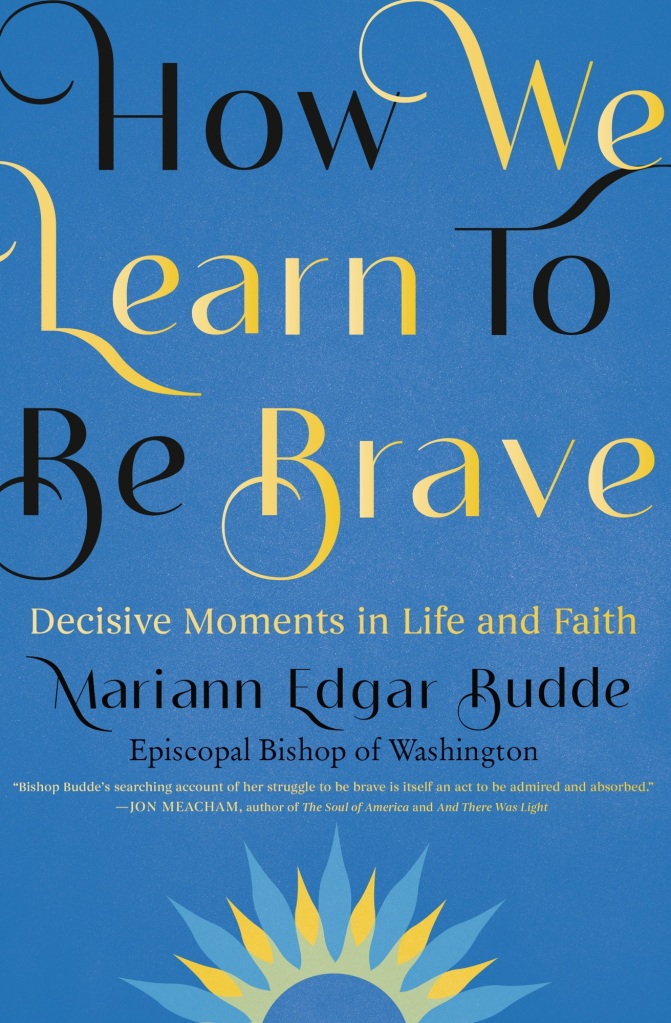
How We Learn to Be Brave: Decisive Moments in Life and Faith is the third and most recent book by the Rt. Rev. Dr. Mariann Edgar Budde, the ninth and current bishop of the Episcopal Diocese of Washington. Published earlier this year, this book was inspired by the teargassing of protesters to make room for a political photo-op outside St. John’s Episcopal Church, Lafayette Square on June 1, 2020. This event, and the ecclesiastical response to it, propelled Bishop Budde and The Episcopal Church into the center of public attention for the first time since Presiding Bishop Michael Curry preached at the royal wedding of 2018. 

The book begins with an account of the events of June 1 from Bishop Budde’s point-of-view. After the initial retelling, the author occasionally refers to the events of that day, but the main thrust of the book has significantly more breadth and depth. As the title indicates, this is not a book about political grandstanding; it is a book about bravery.  

Part memoir, part history, and part theological treatise, this book focuses on the virtue of courage as a choice that we make. Bishop Budde writes: 

Decisive moments involve conscious choice, impressing their importance upon us as we experience them, for we know that we’re choosing a specific path of potential consequence. In a decisive moment, no matter how we got there, we no longer see ourselves as being acted upon by the slings and arrows of fortune or fate, but as ones with agency. We’re not on autopilot; we’re not half-engaged. We are, as they say, all in, shapers of our destiny, and cocreators with God. (xviii) 

Across the chapters that follow, Bishop Budde explores the various kinds of decisions to which the virtue of courage may call us. There are chapters on Deciding to Go, Deciding to Stay, Deciding to Start, Accepting What You Do Not Choose, Stepping Up to the Plate, The Inevitable Letdown, and The Hidden Virtue of Perseverance. 

Each chapter includes an autobiographical vignette and an historical profile to illustrate the particular theme. While the book is intended for a larger audience, the author does not shy away from biblical, liturgical, and theological references particular to Christians. Most (though not all) of the historical profiles are of prominent Episcopalians whose names are easily recognizable, even though their Episcopal faith may not be as widely-known. Historical examples include Franklin and Eleanor Roosevelt, Supreme Court Justice Thurgood Marshall, Jonathan Myrick Daniels, and the Rev. Dr. Pauli Murray. Contemporary Episcopal voices cited by the author include Dr. Brené Brown, the Rev. Dr. Kelly Brown Douglas, and Rachel Held Evans. The author makes a special point of highlighting examples from the lives of women and people of color.  

When it comes to the autobiographical sections, the author does not shy away from experiences of personal failure and disappointment. This spiritual reflection on the virtue of courage is not a self-congratulatory polemic. There are many times in life when courage calls us to take responsibility for our mistakes. Bishop Budde describes personal experiences of such moments with an abundance of honesty and humility. 

My primary criticism of the book is a relatively small and forgivable one. There are times when the several examples of historic Episcopalians come across as advertisements for our denomination. As a reader, it seemed like the author was implying, “Look at all these cool Episcopalians! Don’t you want to be one too?” A greater religious diversity among historical examples would have decreased my sense of evangelistic pressure and increased the book’s appeal to a wider audience. That being said, I think this fault is minor because the Episcopalians the author cites are indeed examples of the virtue she is expounding. Furthermore, since the author is an Episcopal bishop, I can’t really blame her for wanting to highlight the denomination she serves. 

All in all, I think this book will appeal to parish book groups and individuals looking for personal development. Its language is accessible to readers without a theological education and its spiritual dimension is broad enough to include people who do not identify as religious. Finally, though I must admit some personal bias on this point, I think this book would be an excellent choice for Episcopalians in the process of discernment and formation for ordained ministry.  

Courage, like love, is more choice than feeling. We blaze the trail of God’s call by putting one foot in front of the other, falling down, getting up, changing direction, and starting again. How We Learn to Be Brave gives ample inspiration, encouragement, and guidance for that process. 

By Ozma1981 - Own work, CC BY-SA 3.0, https://commons.wikimedia.org/w/index.php?curid=9986942

Of Rocks and Pointy Hats

This is now the umpteenth time I have tried to write this article and started over. It always ends up being too long, too abstract, or too complicated to communicate its message effectively. We’ll see if this one works, so here goes…

What I want to do here is set out, as plainly as possible, the convictions that led me to the point of being confirmed in The Episcopal Church. This is a risky career move for me. I have served as a minister of Word and Sacrament in the Presbyterian Church (USA) for several years. Being confirmed by the bishop is regarded by the Presbyterian Book of Order as an “act of renunciation”, whereby my ordination in that denomination is rendered null and void. In other words, confirmation was a point of no return for me. If things didn’t work out, I could not simply turn around and seek another pastoral call in a Presbyterian congregation. Therefore, I had to be sure that this was the right move for me.

And I eventually came to the conclusion that it was.

My journey to The Episcopal Church began fifteen years ago, during my senior year at Appalachian State University. I had recently fallen out with the charismatic fellowship that I had attended through my undergrad years. I loved the immediate experience of the divine that the charismatic movement emphasizes, but became disillusioned with the theological narrowness and lack of scholarly depth I found there.

I knew I loved liturgical worship, based on my experience of the Jewish Siddur and semi-regular attendance at Roman Catholic Mass, but each of those traditions presented me with a theological gap I could not cross with integrity. Around that time, I picked up a copy of The Book of Common Prayer from a local religious bookstore and fell in love. I visited the local Episcopal parish and finally felt like I had found what I was looking for.

At this point, I had already set in motion my plans to attend an evangelical seminary in western Canada. While there, I would meet, fall in love with, and marry a woman who was preparing for ministry in the Presbyterian Church. Her little congregation welcomed me with open arms and quickly adopted me into the family. It wasn’t the church I had planned on joining, but I figured it was the best way to support my new wife in her ministry.

There’s a lot that I will skip over at this point, for the sake of brevity, but I eventually joined my wife in the Presbyterian ministry. I figured the Reformed tradition was “pretty close” to Anglicanism and intended to make the best of things as an unusually high church Presbyterian. The nineteenth century Mercersburg theologians, John W. Nevin and Philip Schaff, were most helpful to me in this endeavor. I considered Mercersburg theology my “Rosetta stone” for translating what I believe about the Gospel into terms that Reformed Protestants could understand. At the time, I thought the differences between Reformed and Anglican Christianity were mainly cosmetic and political in nature, but I eventually came to realize that those surface variations overlie two related-but-distinct theological structures in the hearts and minds of believers.

In academic terms, the primary difference between the Reformed and Anglican traditions is ecclesiological. Translation for those who speak plain English: Presbyterians and Episcopalians have very different ideas about the definition of the word Church.

To illustrate the difference, let’s look at a particular passage of Scripture that has great import for Reformed and Anglican Christians alike, but is interpreted in vastly different ways by each of the two traditions.

The passage in question is Matthew 16:13-20:

“Now when Jesus came into the district of Caesarea Philippi, he asked his disciples, “Who do people say that the Son of Man is?” And they said, “Some say John the Baptist, but others Elijah, and still others Jeremiah or one of the prophets.” He said to them, “But who do you say that I am?” Simon Peter answered, “You are the Messiah, the Son of the living God.” And Jesus answered him, “Blessed are you, Simon son of Jonah! For flesh and blood has not revealed this to you, but my Father in heaven. And I tell you, you are Peter, and on this rock I will build my church, and the gates of Hades will not prevail against it. I will give you the keys of the kingdom of heaven, and whatever you bind on earth will be bound in heaven, and whatever you loose on earth will be loosed in heaven.” Then he sternly ordered the disciples not to tell anyone that he was the Messiah.”

Presbyterians and other Reformed Protestants come from a confessional tradition. Christians in the Reformed tradition believe that Simon Peter’s confession of faith in Jesus as “the Messiah, the Son of the living God” is the “rock” on which Christ builds his Church. The Church, according to Reformed theology, is the spiritual fellowship of all believers who make the same confession of faith in Jesus Christ and are thereby reborn to new life by the power of the Holy Spirit.

Roman Catholic theologians, on the other hand, are adamant that the “rock” referred to in this passage is Peter himself, whose name translates literally as “rock”. They have gone so far as to carve the words of this passage into the dome above the altar of St. Peter’s Basilica in Vatican City: “TU ES PETRUS”. This passage forms the bedrock of Roman arguments for Apostolic Succession and Communion with the bishop of Rome as essential marks of the Catholic Church.

Anglicans, in true via media fashion, have declared that the truth lies somewhere in the middle. The Catechism in the 1979 Book of Common Prayer describes the apostolic nature of the Church as consisting of “the teaching and fellowship of the apostles” (p.854). We affirm the importance of Peter’s confession, but also acknowledge that person-to-person fellowship with the apostles themselves (through their successors, the bishops) forms a vital part of our communion with the Catholic Church.

Concerning Peter himself, Anglicans see him as a spokesperson and stand-in for the rest of the apostles. We stand with Eastern Orthodox Christians and early patristic testimony that the bishop of Rome deserves a certain honor as primus inter pares (“first among equals”) in the collegial fellowship of bishops, but does not exercise “universal jurisdiction” over other dioceses or bear the charism of personal infallibility when speaking ex cathedra.

For Anglicans, the importance of the episcopal office is firstly sacramental, not governmental. The bishop, as a successor to the apostles in college with other bishops, is a symbol of the unity of the Church across space and time. At confirmation, baptized believers make their public profession of faith in the presence of their bishop and receive the laying on of hands as a way of expressing the unity of the Catholic Church as God’s means for extending the kingdom of heaven on earth and transmitting the anointing of the Holy Spirit within the ecclesial community. For the same reason, bishops are further entrusted with the ministry of ordaining priests and deacons.

Anglicans, along with Orthodox and Roman Catholic Christians, insist that exercise of episcopal ministry within the Church must be personal because God’s redemption of the world in Jesus Christ is likewise personal. About this personal quality, and its importance to the Christian gospel, I will say more in the next article…

(Reblog) God Loves Chutzpah

“Jesus doesn’t need any more admirers — he needs disciples willing to get into some Gospel trouble on God’s behalf.”

Sermon by the Rt. Rev. Gene Robinson at All Saints Church, Pasadena
Celebration of Ministries Sunday, September 22, 2013.
Readings: Amos 8:4-7 and Luke 16:1-13.

For more about the work and witness of All Saints Church visit our website: http://www.allsaints-pas.org | Follow us on twitter @ASCpas

(Reblog) On gay bishops, what a difference a decade makes

By Bishop Gene Robinson

Reblogged from the Washington Post:

Twenty or 30 years ago, most Americans would have told you they didn’t know anyone gay.  By that, they would have been claiming not to know anyone who openly and proudly disclosed their sexual orientation – and certainly not in the ranks of the clergy.  Now, is there any family in America left who doesn’t know some family member, co-worker or former classmate to be gay?  And once they know someone gay, know their relationships and their families, people are simply not willing to believe all the awful things said about us – especially by religious institutions.

Every denomination, no matter how clear and unwavering their condemnation of homosexuality and homosexual relationships, is struggling with this societal and religious issue.  A substantial majority of Roman Catholic laity in America now support marriage equality – a momentous step beyond mere acceptance of homosexual people.  Mormons and evangelicals are softening their language about gay people at a minimum; some are reassessing their traditional stances and moving toward greater acceptance.

Religious institutions of all stripes are asking this big question:  Could the church have gotten it wrong in using a few verses of scripture to condemn homosexual people, just as it got it wrong about using isolated verses to justify slavery and the denigration/subjugation of women?  More and more religious people and institutions are moving toward a “yes” in response to that question.  The church has misunderstood God’s will before, but over time, we get it right.  I believe that this is one of those moments.

Click here to read the whole article