
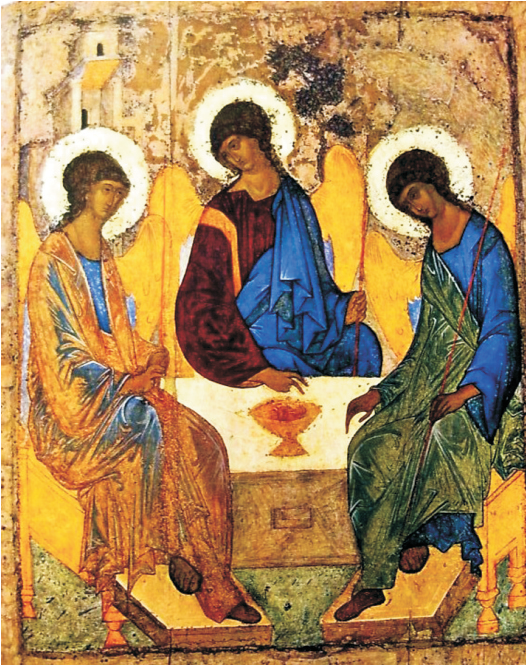
Is Ketchup a Smoothie? A Sermon on (Not) Understanding the Holy Trinity

Sermon for Trinity Sunday

Service Bulletin:

There are several different kinds of knowledge.

First, there’s book smarts, like knowing that tomatoes are a fruit and not a vegetable.

Then there’s practical wisdom, like knowing that it’s not a good idea to put tomatoes in a fruit salad.

And then there’s philosophy, like wondering whether that means ketchup is technically a smoothie.

Today, we’re going to be talking about that third kind.

Today, we celebrate Trinity Sunday, conventionally known in the Episcopal Church as “associate rector appreciation Sunday” because this is the week that senior rector’s most often take as their vacation. They would much rather leave the explanation of complicated and abstract concepts to those younger clergy who have more up-to-date seminary training. Since we don’t have an associate rector in our parish, and I failed to accurately calculate the week of my vacation, this enviable task has now fallen to me.

So, instead of building up to a conclusion, I’m going to cut straight to the chase. Here’s the main thing I’m going to say about the mystery of the Trinity:

If you think you understand the mystery of the Trinity, you do not understand the mystery of the Trinity; if you do not understand the mystery of the Trinity, you understand the mystery of the Trinity.

Got it? Good. Amen. Let’s all get out of here before the Methodists get the good lunch tables at the diner.

Of course, the problem is that this little riddle leaves us right back where we started, so we end up going around and around until our heads fall off… and that’s the point of the whole thing.

The mystery of the Holy Trinity is the primary Christian concept of God. According to the historical documents of the Anglican theological tradition, “we worship one God in Trinity, and Trinity in Unity, neither confounding the Persons, nor diving the Substance” (The Creed of St. Athanasius, BCP 864). The three Persons of the Godhead are “of one substance, power, and eternity” (Articles of Religion, BCP 867). Don’t worry, I can hear all of you mentally checking out, as we speak.

This is why I started with my main statement: If you think you understand it, you don’t understand it; if you don’t understand it, you understand it. It’s like wondering whether ketchup is a smoothie. The question itself supposed to break your brain, not to break it down, but to break it open and leave you slack-jawed in awestruck wonder at the unknowable mystery of ultimate reality.

The doctrine of the Trinity is not explicitly outlined in the Bible. It gradually came together, over the course of several centuries, as the greatest minds of the early Church contemplated their experience of God. Beginning with the monotheism of the Jewish tradition, the earliest followers of Jesus realized that they were, in some way that they couldn’t understand, experiencing the very presence of the God of their ancestors through this individual human being. How was that even possible? They had no idea; they just experienced it to be true. And then, just as mysterious, they continued to experience this Jesus as a living presence in the midst of their community after his death. How was that even possible? They had no idea; they just experienced it to be true. Their knowing had neither the categorical certainty of book smarts nor the effectiveness of practical wisdom. Their knowing was a knowledge of the heart: more like falling in love than solving a math problem. As the philosopher Blaise Pascal famously said, “The heart has its reasons of which reason knows nothing.”

After almost three hundred years of contemplation, the bishops of the early Church finally settled on the mystery of the Trinity as their non-answer to a question that, by its very nature, can never be answered. Whenever some innovative theologian claimed to have solved the mystery, the bishops of the Church were quick to stand up and pronounce that answer as a heresy, not because they thought that they had a monopoly on the truth, but because they believed that the main thing is to keep the question open.

If you think you understand the Trinity, you do not understand the Trinity; if you do not understand the Trinity, you understand the Trinity.

I love this central commitment of our faith tradition. We don’t claim to have the answers to ultimate questions. We sit in awestruck wonder before the mystery of reality. This is why I like to say that I couldn’t be a Christian, if I wasn’t also an agnostic.

The ultimate unknowability of the mystery of God affords Christians a certain playfulness, when it comes to expressing that mystery in various ways. The language of our tradition tends to default to language that is very personal, very masculine, and very hierarchical. Most of our prayers use words like “Father” and “Lord” to describe the mystery of God, but the witness of our sacred Scriptures point to a wide array of metaphors for expressing our faith in God.

In addition to the exclusively masculine language of Father, the Bible also describes God as a “Mother” (Isaiah 66:3). In addition to the hierarchical language of Lord, the Bible also describes God as a “Servant” (Luke 22:27). In addition to the numerous personal metaphors for God, the Bible also describes God as a “Mighty Rock” (Psalm 62:7), “Living Water” (John 7:38), “Rushing Wind” (Acts 2:2), and “Consuming Fire” (Hebrews 12:29). As I mentioned in a previous sermon, Jesus even compares himself to a chicken in Matthew 23:37.

Therefore, kindred in Christ, since the Bible itself gives us such a wide array of metaphors for the Divine, and since the bishops of the early Church were so doggedly committed to keeping open the question of God’s unknowable nature, we too ought to remain open to exploring a wide variety of metaphors for God.

God is with us always and in all things. Therefore, let us also look for her, for him, for them, for it, always and in all things. How is God like a cloud or a tree? How is God like a chair or a bookshelf?

Jesus, in his parables, often pointed to agricultural metaphors that were common to the everyday experience of ordinary people, when describing the realm of the divine. For Jesus, the realm of the divine was like a woman baking bread (Matthew 13:33), like crops growing in a field (Mark 4:26-29), like a merchant trading in the marketplace (Matthew 13:45-46), like a small seed growing into a great tree (Matthew 13:31-32). This is not an exhaustive list, by any means.

I want to encourage you today to be playful in the many ways that you imagine God to be present in your life. The language we use about God matters, not because we have to be careful to get it right, but because we cannot get it wrong. Everything is potentially a symbol of God, yet nothing fully encapsulates the mystery. Whenever we try to put God in a box, whether that box is Pope-shaped, Bible-shaped, Church-shaped, man-shaped, or colored white, we commit the sin of idolatry and close ourselves off to the great mystery of the divine.

God is with us always, and in all things, therefore let us keep open the question of what God truly is. Let each of us remain humble in our own conceptions of God and tolerant of the expressions of others. As brothers, sisters, and siblings, let us stand side-by-side, following the example of the Bible and the early Church, and maintain a posture of awestruck wonder before the divine mystery that is beyond our understanding.

James Luther Adams

James Luther Adams (1901-1994) was a prominent Unitarian Universalist Christian whose theology shaped (and continues to shape) the liberal religious tradition.

In honor of the anniversary of his passing today, the Unitarian Universalist Christian Fellowship posted one of his sermons on their website, from which the following was excerpted:

The liberal Christian outlook is directed to a Power that is living, that is active in a love seeking concrete manifestation, and that finds decisive response in the living posture and gesture of Jesus of Nazareth. In a world that has with some conscientiousness turned against this kind of witness and its vocabulary, the effect of this witness will in a special way depend upon the quality of its costingness in concrete action and upon its relevance to the history that is in the making. To say this is only to say that the truly reliable God is the Lord of history and also that our sins will find us out. Yet, this Lord of history has given us a world in which the possibility of new beginnings is ever present along with the judgment that is always upon us. To this Lord of history Jesus responded with his message and demonstration of hope in concert with sacrifice.

Click here to read the full sermon

(Reblog) The Problem With Assuming Liberal Christians Hate the Bible

Image
Gutenberg Bible. Image by Raul654. Retrieved from Wikimedia Commons.


by Derek Penwell

Reblogged from Huffington Post

Liberal Christians aren’t liberal in spite of the Bible, but because of it. They don’t pursue justice for LGBT people because they haven’t read Scripture, but precisely because they have. And in the arc of the narrative of God’s interaction with humanity, liberal Christians find a radical expansiveness, an urgent desire to broaden the embrace of God’s hospitality to include those whom the religious big shots are always kicking to the sidelines.

Click here to read the full article

(Reblog) Book Review – A Time to Embrace: Same-Sex Relationships in Religion, Law, and Politics (second edition)

Image
Saints Sergius and Bacchus, companions and martyrs. Click the link on the picture to learn more about their lives.


Reblogged from the Presbyterian Outlook:

A Time to Embrace by William Stacy Johnson

Reviewed by Melissa Kirkpatrick

Johnson lays out the historical context of same-sex relationships from what we know of the practices in Rome and in Greece at the time of Paul, when such relationships were hardly consensual, to the scholarly work of the Middle Ages, where there is much evidence that profoundly close same-sex relationships (which may or may not have been sexual) went unquestioned by the church. What is clear in this history is that there was never a single way of approaching or dealing with same-sex relationships across time or place or faith.

Click here to read the full article


Why Be A Christian?

Maria, sister of Lazarus, meets Jesus who is going to their house (1864). By Nikolai Ge. Image Retrieved from Wikimedia Commons.

My favorite part of our church’s mission statement is the part at the end where we declare that we are “open to all and reaching out to the world in love.”  I like to remind you of those words at the beginning of worship every Sunday because they speak volumes about who we are and what we do in this community.  The world at large desperately needs to hear this message about a community that is truly “open to all”.  So many other groups and organizations, even churches, divide themselves from one another along ideological lines.  Here in this church, it is my privilege to be a pastor to so many people from so many different political and religious backgrounds.  I can testify from experience that the Spirit who binds us together is deeper and broader than any one set of ideas or opinions.  This is a church that has been built from the heart up, not from the mind down.

Almost everywhere else you can go in the world, the exact opposite is true.  Most people want to know if you agree with them before they enter into a relationship with you.  But we are different.  We’ll move over and make room for you in the pew no matter who you are, where you’ve been, or what you think.  We’ll just keep on telling you that we love you, God loves you, and there’s nothing you can do about it!

Yup, we’re “open to all and reaching out to the world in love”.  I want you to know this morning how rare and unique that is, especially for a church.  I personally believe that this part of our identity is the key to our future as a church.  This commitment to openness is what makes us different from so many other Christians, who make people pass some kind of dogma test before they’ll accept them.

Recently, I was engaged in an intense discussion with one of these “other Christians”.  This person said to me, “You think it’s okay, in God’s eyes, for people to practice other religions.  So then, why would anyone want to be Christian if it’s not the one and only true religion?”  I thought that was a great question.  Why would anyone choose to be Christian if they could also choose to be Buddhist, Jewish, or Muslim?

I was reminded of this conversation when I read this week’s gospel passage from the lectionary.  It’s the story of a woman named Mary of Bethany, who knelt at Jesus’ feet, anointing them with expensive perfume and wiping them with her hair.  This was an incredible act of affection and devotion toward Jesus.  Mary obviously loved and cared about him very much.

That got me thinking: if I was in Mary’s place, what is it about Jesus that would make me fall down on my knees in love and devotion?  What is it about Jesus that makes me want to commit my life to him?  Why am I a Christian?

I think this is a question that each and every one of us should ask.  Whether you’ve just started coming to church or you’ve been here your whole life, you’ve decided to be here for a reason.  We owe it to ourselves and the world to know what that reason is.  I can’t answer that question for you.  But what I can do is tell you why I’ve decided to be a Christian.  I hope that my answer to this question might help you answer it for yourself.

So here’s what Christian faith means to me.  This is what has driven me, like Mary of Bethany, to kneel down before the feet of Jesus and offer him all that I have and all that I am:

For me, being a Christian is all about love.  Love is what I have experienced in and through the person Jesus of Nazareth.  When religious scholars quizzed Jesus about the most important part of the Bible, he told them it all comes down to love: “Love God with all your heart, soul, mind, and strength” and “Love your neighbor as yourself”.

Jesus embodied love in the way he lived his life.  He broke bread with tax collectors, Jews who sold their own people out to the Romans in order to make a quick, dishonest buck.  He pardoned the sin of a woman caught in adultery when the rest of her village was ready to stone her to death.  He nurtured relationships with Samaritans, the ethnic and religious rivals of the Jews, and saw the best in them.  He praised the faith of a pagan Roman soldier.  He reached out and touched a leper, who had been shunned and exiled from society because of his disease.  Finally, he spoke words of forgiveness to his executioners as they waited for him to die.  This is love.

Love, he said, is the first duty of any religious person.

When he wasn’t around, Jesus called upon his followers to love each other in his place.  Any good deed rendered unto the most despised and forgotten members of society, Jesus said in Matthew 25, he would count as service rendered unto him.  “Truly I tell you,” he said, “just as you did it to one of the least of these who are members of my family,you did it to me.”

The love that shone through Jesus came to have a profound impact on his followers.  The apostle Paul declared that, if it wasn’t for love, all his words, knowledge, and faith would be meaningless.  John the Beloved went so far as to let Jesus’ example of love redefine his idea of God: “God is love,” he said, “and those who abide in love abide in God, and God abides in them.”

What I learned through Jesus is that God is not some angry judge, sitting high up on a cloud, hurling down lightning bolts at people he doesn’t like.  No, God is that dynamic energy of love that flows out from within us.  God works through persuasion, not coercion.  This divine love takes on an infinite variety of forms, depending on the person and the situation.  As we open ourselves up to this love more and more, we are continually filled with God’s Spirit, and we begin to resemble Jesus.  Love, then, is the measure of our faith, not religious dogma.

Through Jesus, I learn how to love and I learn that I am loved.  Jesus didn’t just teach people about love, he didn’t just point to love.  No, Jesus embodied love in his very being and person.  Love shone through his every word and deed.  That’s what I mean when I praise Jesus as the Son of God and the Incarnation of God: Jesus is the embodiment of divine love who invites me to do and be the same, in whatever imperfect and limited way that I am able.

This is what takes my breath away when it comes to Jesus.  This is why I want to fall down at his feet and offer everything I have and all that I am, so that I might be part of that love too.  This is the kind of God that I can believe in.

For me it is no contradiction to believe that the dynamic God of love I discovered in Jesus can be active in the lives of people from every time, place, culture, and religion.  I hear the voice of this God whispering to me in the pages of the Bible and singing to me in the clouds at sunset.  Jesus has opened my eyes, ears, mind, and heart to experience the presence of God in all things.  For this, I am amazed and give thanks.  What else can I do but collapse to my knees before Jesus and worship?

That is why I am a Christian.  It has nothing to do with creeds, dogmas, or being the one and only true religion.  It has everything to do with love.  I hope and pray that the people around me will experience through me, in some degree, the love I have received through Jesus (whether they recognize it by that name or not).

How about you?  Why are you here in church today?  If you call yourself a Christian, why do you choose that label for yourself?  I want to encourage each and every one of you to answer that question for yourself today.  Something has brought you here.  You are not sitting in this church by accident.  It is therefore incumbent upon you to ask yourself: Why?

In your imagination, put yourself in Mary of Bethany’s place: kneeling at the feet of Jesus, offering the very best of what you have and who you are.  What has brought you here?  Even as you acknowledge and respect the faith of others who are different, something about this faith and this person, Jesus, has captured your attention.  What is it?

Answer that question for yourself and don’t be afraid or ashamed to share your answer with the world.  There are people out there who need to hear what you have to say.  Go out there today and tell them.

“Preach the gospel always… use words when necessary.”

May your words and your deeds say to the people of this world: “I love you, God loves you, and there’s nothing you can do about it.”

Cultivating an Abandoned Place

Here is an article from UU World magazine about a new friend of mine.

Ron is the director of the Unitarian Universalist Christian Fellowship.  His ministry in Turley, Oklahoma bears some resemblance to our community vision at St. James Mission in Utica.  I’m getting to know Ron via Facebook and had one phone conversation with him.  A lovely guy committed to a unique ministry.  This article is a couple of years old, but that doesn’t diminish its fabulous-ness in the least.

From the article:

Robinson, who identifies himself as a Unitarian Universalist Christian, and who is executive director of the UU Christian Fellowship, a denominational organization of UU Christians, said that in Turley he presents “classic Universalist Christianity.” He added, “It’s definitely a liberation theology—the three ‘R’s: relocating to where people are struggling, redistribution of goods and justice, and reconciliation. We do the first two pretty well and we need to be a lot better at the third.”

He said the Unitarian part of Unitarian Universalism “doesn’t fit as well culturally with what we’re trying to do because people here identify it more with wealth and education. Universalism gives us our best connection.” He added that when people in Turley press him whether he is Christian, he says, “‘Yes, but you don’t have to be a Christian to be in our church.’ Then if people have more questions, I talk about following Jesus and ‘deeds, not creeds.’ People get that. If they ask, ‘Do you believe in heaven and hell?’ I respond, ‘I trust God’s love is for all time. The details we don’t know. You’re free to believe in heaven and stay and work with us.’”

Could a church become missional in a place like Turley without a Christian persona? Robinson believes it could. “A lot of the missional churches are not claiming Christianity today because of the ways it has been identified as bigoted, boring, critical, or irrelevant, and so many churches are now casting their faith in terms like ‘following Jesus’ rather than connecting to an institutional church. I think that question about whether you’re Christian, particularly for the younger generation, is becoming less important. Having said that, I do think that what you do have to have is a sense of the transcendent—a belief in something beyond yourself even if you only name it the human spirit.”

The liberal church brings a needed perspective to missional work, he noted, by its affirmation of diverse religions, sexual orientations, genders, and ethnicities. “That means we can channel our energies not into opposing these issues, but into the creation of relationships and communities of all kinds that reflect core progressive values.”

Click here to read the full article

The Call to High Adventure

Vida Dutton Scudder. Image is in the public domain.

Vida Dutton Scudder (1861-1954) was a professor at Wellesly College, a member of the Socialist party, and a prominent activist in the Episcopal Church.  She was involved in the Social Gospel movement, the campaign for labor rights, the equality of women, and (eventually) pacifism.  She helped to organize the Women’s Trade Union League, the Episcopal Church Socialist League, and joined the Society of the Companions of the Holy Cross.  Vida and her partner, Florence Converse, lived together for 35 years, from 1919 until Vida’s death in 1954.  She is celebrated in the Episcopal Church’s calendar of saints: her feast day is on October 10.

Earlier today, as I was reading Diana Butler Bass’s book A People’s History of Christianity, I came across an amazing prediction of Scudder’s that Butler Bass took from Scudder’s 1912 book Socialism and Character.  In this passage, Scudder prophesies the advent of mainline church decline, which eventually started to happen in the latter half of the 20th century.  I was amazed at how closely Scudder’s views resemble my own, except that she was writing a full century before I started thinking about it.  Listen to what Scudder has to say:

One certitude is forced on us : it is unlikely that Christianity will retain so nominally exclusive a sway as it has hitherto done in western Europe. In all probability, the day of its conventional social control is passing and will soon be forgotten. The time will come when the Christian faith will have to fight for right of way among crowding antagonists as vigorously as in the times of Athanasius and Augustine.

And in thoughts like these all genuine Christians must rejoice. Without the call to high adventure, the faith has never flourished.


Recommended Reading on Liberal Christianity

Here is a link to an excellent annotated bibliography of several popular-level primers on Liberal (a.k.a. ‘Progressive’) Christianity.  For those who wonder what we’re all about, I’d say this is a good place to start.  If your looking for one book to begin with, I’d recommend the one at the very top: Marcus Borg’s The Heart of ChristianityIt’s concise and well-written for folks on a non-academic level.

20 Books on Progressive Christian Spirituality

It’s an article on the website Spirituality & Practice, which I found by hanging around at Abundance Trek, which is just one of the blogs kept up by my friend, John Wilde.  There are many people in this world who strive to be unique individuals who defy all conventional categories; John is one of the very few souls who actually accomplishes it.  How like Jesus…