Hope First

Sermon for the second Sunday of Christmas

The biblical text is Jeremiah 31:7-14.

Sermon recording:

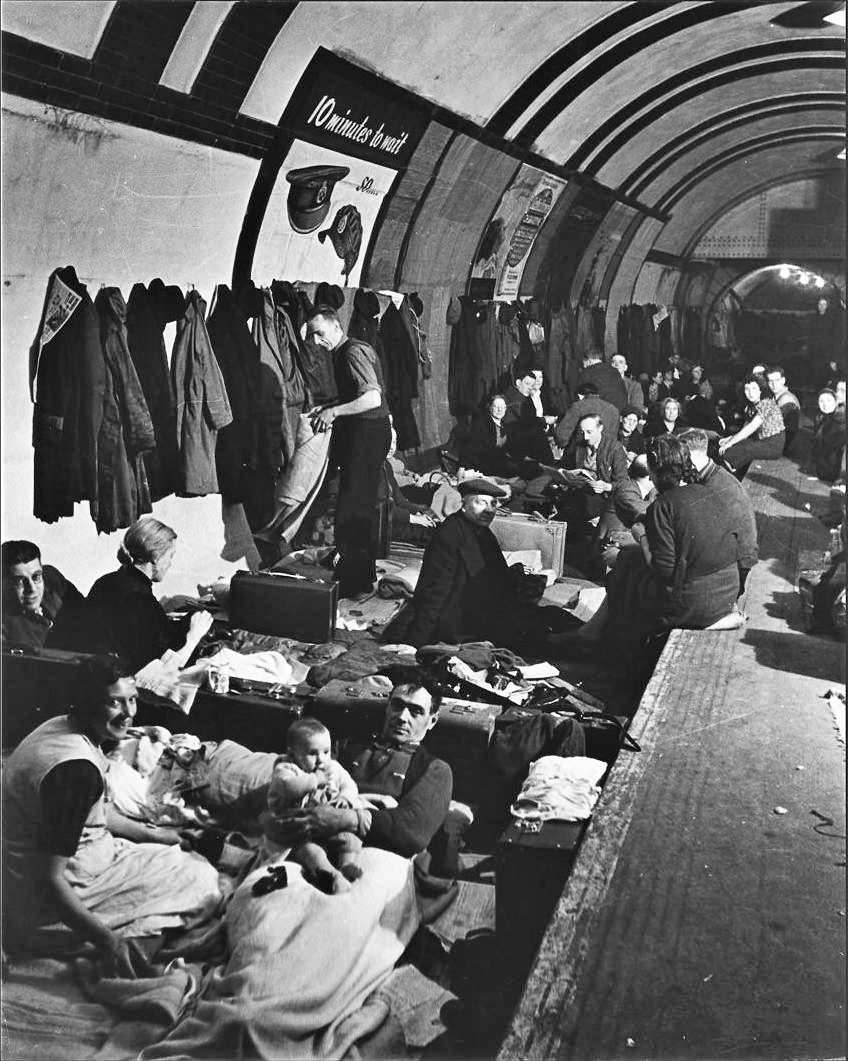
In September 1940, at the height of World War II, the German Luftwaffe began a sustained bombing assault on the British capital that eventually became known as the London Blitz.

As the city burned above them, the people of London gathered and slept in the underground subway tunnels for safety.

And yet, even as the city was being bombed night after night, something remarkable happened: Concerts continued, drama troupes put on plays, teachers taught classes, and an inter-shelter darts league formed. One pianist, Myra Hess, organized daily concerts at the National Gallery. People would come on their lunch breaks, not because the war was over, not because things were safe again, but because something in them knew this mattered.

They didn’t sing because the bombing had stopped.
They sang because without beauty, without meaning, without joy, they wouldn’t survive the bombing at all.

And that human instinct — to cling to hope before everything is fixed — is exactly what we hear in today’s reading from the prophet Jeremiah.

This passage comes from one of the bleakest books in the Bible. Jeremiah is not an easy prophet. He doesn’t offer quick comfort. He doesn’t soften his message. He spends much of the book warning his people — the people of Judah — that a crisis is coming.

For the first large section of the book, Jeremiah is doing one hard thing over and over again. He is speaking the truth about his nation’s injustice, exploitation, and unfaithfulness to God’s covenant, even though he knows the king won’t listen. He keeps telling the truth anyway, even though it gets him ignored, mocked, threatened, and eventually imprisoned.

And the truth he speaks is this:
“If we have lost faith in the core principles that make us who we are as a nation, then no amount of wealth, power, or political strategy will be able to shelter us from the consequences of our own actions.”

Jeremiah is not speaking as an outsider. He is speaking as a concerned citizen. He loves his people. That’s why he tells the truth.

Later in the book, the tone shifts again. By that point, his warnings have gone unheeded. The moment of truth has come and gone. The disaster Jeremiah spoke about has arrived. Jerusalem has fallen to the Babylonians. The people have been carried off into exile.

So, for Jeremiah and the people of Judah, the question is no longer, “How do we avoid this?”
The question is, “How do we live now that it’s here?”

That final section of Jeremiah is about acceptance — not resignation, but the sober recognition that what’s done is done, and all that remains is to make the best of it.

But right in the middle of those two sections, between the warnings and the acceptance, we get a third section that scholars call the Book of Consolation. Chapters 30 through 33. This is the section where today’s first reading comes from.

What’s striking about the Book of Consolation is that Jeremiah offers hope before the exile is resolved. Consolation comes before acceptance. Not because everything is okay, but because Jeremiah knows that, without hope, the people will not be able to survive what lies ahead.

Listen again to the imagery Jeremiah uses. This is not quiet, private reassurance. This is public celebration. Singing. Shouting. Gathering. Grain, wine, and oil. A watered garden.

And notice who’s invited:
The visually impaired.
The mobility impaired.
Those who are pregnant.
Those in labor.
The people who cannot move quickly. The people who cannot carry much. The people who are exhausted, vulnerable, and easily left behind.

If you step back and picture it, what Jeremiah is describing looks less like a church service and more like a street party.

This is not a party for the strong. This is not a celebration of victory or success. This is a gathering that moves at the pace of the most vulnerable. No one is told to wait until they’re healed. No one is told to come back later when they’re stronger.

Everyone belongs.

Jeremiah even says, “I will give the priests their fill of fatness” — as a priest myself, I’m trying not to take that one personally.

But the most important thing to notice is this: the party happens before anything is fixed.

The exile is still real. The losses are still fresh. The future is still uncertain. And yet — the singing continues.

Just like the music during the Blitz, this isn’t a celebration because the danger is gone. It’s a celebration because without joy, without meaning, people won’t make it through what’s coming.

What’s fascinating is that psychology tells us something very similar.

Viktor Frankl, who survived the Nazi concentration camps, noticed that people didn’t endure suffering because it stopped. They endured because they found a reason to keep going. Meaning came first. Relief came later — if it came at all.

Or as Frankl famously put it, those who have a “why” to live can bear almost any “how.”

In other words, hope comes before acceptance. Without it, people collapse.

Developmental psychology tells us something similar from the very beginning of life. Erik Erikson wrote that hope is the first human virtue, formed not through explanation or reasoning, but through trust.

You don’t argue a baby into trust.

You don’t sit down with a newborn and say, “Now listen here, if you’ll just consider the evidence, you’ll see that you have been fed and changed, that your parents love you very much, and that it’s in everyone’s best interest that you lay down and go to sleep…”

Obviously, you don’t do that. You hold them.

Trust comes before understanding. Hope comes before explanation.

That explains why Jeremiah doesn’t wait until the exile is over to offer hope. He offers it first — because without it, the people won’t survive the truth they’re about to face.

The kind of hope Jeremiah is talking about is not mere optimism or denial, but something tougher.

I read a Tweet online that illustrates this kind of hope perfectly. It was written by someone named Matthew @Crowsfault and says:

“People speak of hope as if it is this delicate, ephemeral thing made of whispers and spider’s webs. It’s not. Hope has dirt on her face, blood on her knuckles, the grit of the cobblestones in her hair, and just spat out a tooth as she rises for another go.”

I absolutely love that. That’s the kind of hope you need when you’re living in exile.

And that kind of hope matters not just for us as individuals, but for us as communities.

When communities come under strain, they tend to split into two instincts. Some respond by saying the only faithful thing to do is expose every failure, until there’s nothing left but despair. Others respond by saying the only faithful thing to do is protect what’s good, even if it means refusing to see what’s broken.

Jeremiah refuses both extremes.

He loves his people too much to flatter them — and too much to abandon them.

That’s why hope comes first. Accountability without hope turns into cynicism. Hope without accountability turns into denial. Jeremiah offers hope not to erase the truth, but to make it possible for the people to face it.

And this isn’t just about nations or communities. It’s about individual lives, too.

I once read about a mother whose child was born with a severe and terminal disease. There were no long-term plans. No grand ambitions. None of the milestones people usually imagine for their children.

From the outside, many would have called that situation hopeless.

But the mother wrote about discovering a different kind of hope — not hope that things would be different, but hope rooted in love, presence, and fierce attention to the life in front of her. She described learning to delight in small moments, celebrate what was real, even though the future looked nothing like what she had imagined.

That’s the hope Jeremiah is pointing toward.

Not hope that skips over suffering.
Not hope that waits for everything to be resolved.
But hope that shows up anyway — and holds us together while the story is still unfinished.

The music during the Blitz didn’t stop the bombs. But it reminded people who they were.

Jeremiah’s street party didn’t end the exile. But it reminded the people that their story wasn’t over, that God wasn’t done with them, that life itself still carried the possibility of renewal.

So the invitation in this passage is not to pretend that everything is fine. It’s to accept the fact that things are pretty messed up and practice hope anyway. To create moments of joy. To notice what is good and celebrate what is being born, even though the ending is still unclear.

Kindred in Christ, as you look around at our troubled world today, gape in horror at the latest news reports, and wonder what it’s all coming to, I dare you to practice hope as a spiritual discipline.

Not a vague optimism that everything will work out fine, not a distraction from the real problems that we are facing, but a defiant commitment to keep hoping in the face of despair. An unshakable faith that God is not done with us yet, so we owe it to ourselves and each other to keep holding on and keep looking for opportunities to do what good we can, where we can, with whomever we can, and for as long as we can.

Like the people who lived through the London Blitz, we too have a need to sing before the war is over.
We too have a need to gather before the exile ends.
We too have a need to hold tightly onto one another, not because everything is okay, but precisely because it isn’t!

Because hope isn’t what comes after we heal the world.
Hope is what makes healing the world possible.

Amen?

The Light by Which We See

Sermon for Christmas Eve, Year A.

The text is John 1:1-14

I have a small confession to make:

I am not very good at returning text messages.
Or emails.
Or remembering meetings I genuinely meant to remember.

I see a message come in, I think, I’ll get back to that, and then life happens—another email, another conversation, another thing that needs attention—and suddenly it’s two days later and I’m apologizing.

It’s not because I don’t care.
It’s usually because I’m trying to care about too many things at once.

Some days my mind feels like an internet browser—nineteen tabs open, three of them frozen, and I have no idea where the music is coming from.

And living like that can feel exhausting—like I’m always moving, always trying to keep things from dropping.

When life feels like that, God can start to feel like just one more thing to manage—one more idea to keep track of—rather than a presence we actually encounter.

And I don’t think it’s just me that feels that way.

Most of us know what that scattered feeling is like—not because we don’t care, but because we’re trying to care about too many things at once.

We live in a world that keeps asking for our attention, and it doesn’t often slow down enough for us to catch our breath.

So we miss things, forget things, and drop balls without meaning to.

And over time, that constant commotion can start to wear us down.

We arrive at nights like this—Christmas Eve—exhausted. Looking for something meaningful and hopeful, but not always sure where to look anymore.

And when life feels fragmented like that, God can begin to feel distant—
not absent, exactly, but more like an abstract idea.

Something we talk about, or remember from another season of life, rather than something alive and near.

Underneath the candles and the carols, there’s a quiet question many of us carry:

Is there anything that truly holds all of this together?
And does it still have room for me?

Tonight’s Gospel has an answer for those questions.

John doesn’t begin his Christmas story with a baby in a manger. He begins with a claim about reality itself.

“In the beginning,” he says, “was the Word.”

Before anything existed—before stars or stories or people—there was a deep coherence to the universe.
A living wisdom.
A pattern that held everything together.
John calls it the Word.
The Greek term is Logos.

And what’s striking is that John doesn’t describe this Word as something we can point to or look at directly. Instead, he talks about it the way we talk about light.

We don’t actually see light itself.
We see by it.

Light makes everything else visible. Without it, the world dissolves into darkness—not because things stop existing, but because we can no longer perceive them.

John says God is like that.

Not one more object in the universe, not a thing alongside other things, but the light by which everything else becomes visible.

The same is true of the deep order of the cosmos.
We don’t see it directly either.
But we see its effects everywhere—
in galaxies and nebulae, in atoms and molecules, in the astonishing emergence of life itself.

Reality is not random noise.
It has structure.
It has pattern.

And John dares to say that this coherence, this life-giving order, this light—is not distant from God.

It is God’s own life at work in the world.

Which makes what John says next so startling:

“The Word became flesh and lived among us.”

Every religious tradition has its own way of speaking about how the sacred meets the world. Some find God through sacred texts. Some through law, or wisdom, or prayer, or practice.

What is distinctive about Christianity is not that we claim more of God—but that we claim God met us in a person.

Not finally as an idea to master, but as a life to encounter.

The light that makes all things visible did not stay abstract. The wisdom that shaped the universe did not remain distant.

It took on flesh.
It moved into our neighborhood.
It became a human life.

And because of that, Jesus is not where we stop looking for God—it’s where we start.

Jesus becomes the lens, not the limit.

In him, we see what divine life looks like when it is lived in human form—in compassion and courage, in mercy and truth, in love given freely.

And once we have seen that light in Jesus, we begin to recognize it everywhere else.

The world itself becomes sacramental—charged with presence, thick with meaning, alive with grace.

Which is why the miracle of Christmas is not that God once came to visit us.

It’s that God, in Christ, showed the world what it always had the capacity to be.

As we learn to look at the world through the lens of Jesus, the clutter and commotion of life’s busyness begin to fade into the background, and what truly matters becomes clearer.

I saw that kind of shift happen in real time just this past week.

Debi Wright—who has graciously given me permission to share this—stopped by the church on a Friday afternoon to take care of something quick in the kitchen.

At least, that was the plan.

We met in the hallway, exchanged a few words, and she asked me to pray for her father-in-law, who was nearing the end of his life.

And so we sat down.
And we talked for a while.

I won’t share any details about that conversation—that’s private. What I will say is that it was an honor to sit with her as she paused, paid attention to what she was carrying, and noticed where God was meeting her in the middle of it.

There was nothing to fix.
No answers to offer.
Just presence.

When the conversation ended, Debi said how meaningful it had been. And I joked that sometimes God makes my schedule for me.

But afterward, I realized something:
That moment wasn’t a disruption of my day. It was the whole point of my day.

That’s what John is pointing to in tonight’s Gospel.

God doesn’t come to us as one more thing to manage, or another responsibility to juggle.

God comes to us in flesh—in human lives, in moments of attention, in presence we didn’t plan for.

And what that is slowly teaching me is that faith may not be about doing more or holding everything together, but about learning how to notice where—and when—the light is already shining.

So this is where Christmas leaves us.

Not with another task to complete, or one more thing to add to already full lives, but with an invitation to see things in a new way.

Because God came to us in flesh, we come to expect God in the flesh of this world—in one another, in ordinary moments, in lives that are fragile, complicated, and real.

Christmas trains our eyes.

It teaches us not simply to look for the light, but to look through it—not only in carols and candles, but in conversations we didn’t plan for, in moments of deep presence, in love that shows up quietly and refuses to leave—even when it interrupts our plans.

So as we leave this place tonight—as we step back into busy lives and open calendars—we go trusting that the light John speaks of is still shining in the darkness, and the darkness has not overcome it.

The light of Christ shines not just in heaven, but here.
Within us.
Among us.
And even through us.

May we learn to notice that light this Christmas, and follow where it leads us in the coming year.

Amen?

Your Greatest Gift is You

Preaching on the Feast of the Holy Name of Our Lord at St. Luke’s Episcopal Church, Kalamazoo, MI.

Click here to read Luke 2:15-21

Your greatest gift to the world is you.

Do you hear me in that?

Your greatest gift to the world, the Church, or your family is you.

This is an important truth that we are in grave danger of losing in the world. We live in a world that measures the “worth” of human beings in terms of the money they earn, the possessions they own, the positions they hold, or the degrees on their wall.

In a negative sense, this world judges people based on categories like race, ethnicity, nationality, gender identity, and sexual orientation. We dismiss the ideas of our fellow human beings because they come from someone of a different political party or religious tradition. We project all our self-hatred and insecurity onto people who live with a disability, mental health diagnosis, or criminal record.

When we meet new people at cocktail parties, our first question is usually something like: “So, what do you do?” I would be far more interested to ask, “So, who are you, really? What makes you tick? What thrills/hurts you? What brings you enough hope to get out of bed in the morning?” (And that’s probably the reason why I don’t get invited to many cocktail parties…)

Truth is always inconvenient. Someone has said, “The truth will make you free, but not before it’s done with you.” As broken people living in a broken world, we are not predisposed to face the honest truth about who we really are. We are afraid that we are nobody, or that we are so ugly, stupid, and boring that no one could possibly love us, if they were to see us as we really are. So, we hide. We try to cover ourselves with the paltry fig leaves of our accomplishments and failures, thinking that we have successfully tricked the world into believing that this nobody is somebody, but secretly fearing that the truth about our inner nothingness might one day be found out.

Brothers and sisters, I come to you this morning with good news that these deep fears of ours are entirely unfounded. Beneath the tattered rags of the false identities we have constructed for ourselves is not an ugly emptiness, but the glory of the Divine Image that has been revealed and redeemed for us by our Lord Jesus Christ.

Today the Church celebrates the Feast of the Holy Name of our Lord. Today’s gospel recalls the eighth day after the Nativity, when the infant Messiah was brought to be initiated into the community of God’s chosen people through the rite of circumcision. Today is the day when the name of Jesus was first spoken out loud to the world.

There is tremendous power in a name. Names tell us something about who we are. Doctors put a lot of energy into diagnosis: accurately naming an illness in order to treat the patient. Parents know that if you raise a child, calling names like “bad, stupid, ugly, and worthless”, that child will grow up believing those things about him/herself and acting accordingly. In the Bible, names are of the utmost importance: the patriarch Jacob is given the new name Yisrael, meaning “he wrestles with God” after struggling all night for a blessing from an angel. Avraham, the exalted ancestor of Jews. Christians, and Muslims, is so-named because he is “the father of many nations.” Jesus names his disciple Petros because he is the “rock” upon which the Church will be built.

In today’s gospel, our Lord is given the name Jesus, Yeshua in Hebrew, which means “salvation, deliverance, or liberation” because he is destined to free God’s people from slavery to sin. The name of Jesus was not an arbitrary label attached to this person after-the-fact, but was first whispered into the Blessed Virgin Mary’s heart at the Annunciation by the angel Gabriel. At that time, the angel said of Jesus:

“He will be great, and will be called the Son of the Most High, and the Lord God will give to him the throne of his ancestor David. He will reign over the house of Jacob forever, and of his kingdom there will be no end.” (Luke 1:32-33 NRSV)

The Holy Name of our Lord is a statement about who Jesus is. Behind and beyond the rough exterior of an uneducated, working-class carpenter, born in the parking lot of a Motel 6, in a backwater town of an occupied country, deeper than all of that: we can see with the eyes of faith the Son of God, the Savior of the world.

As millennia have gone by, the Church has continued to ponder the full meaning of Jesus’ identity. Bishops and theologians have met repeatedly in great Councils, endlessly tossing the question back and forth while the answer eludes them. After two thousand years, all the Church can really say is that the mystery of Jesus’ identity is a question that can never be answered. He is fully human and fully divine in a way that transcends human understanding. Anytime people have stood up and claimed to have the final solution to this problem, the Church has been quick to tell them they are wrong. Christian orthodoxy is not a matter of holding tightly to unquestionable answers; Christian orthodoxy is a matter of standing in reverent awe before unanswerable questions.

Even after all these years, the unanswerable question of Jesus’ identity continues to haunt and bless the Church on earth. We can never claim to fully understand it, but we can give testimony to our experience of it. And we express this experience in poetry, story, ritual, and song: that in the Incarnation of Jesus Christ, eternity has become embodied in time, heaven has taken up residence on earth, and divinity and humanity are now one.

Jesus reveals the mystery of his identity to us by entering into full solidarity with the human condition. In today’s gospel, Jesus enters into solidarity with the people of Israel through the rite of circumcision, which Jews today call a bris. The closest equivalent to this rite of initiation in the Christian tradition is the sacrament of baptism, which Jesus would also receive later in life, at the hands of his cousin John.

In baptism, we Christians receive our identity. That is, we learn who we really are in Christ. The water is an outward and visible sign of the washing away of the false identities we construct for ourselves. In the Church, we are no longer presidents or panhandlers, no longer grad students or gangstas, no longer trust-fund babies or crack babies, no longer doctors or drag queens. In baptism, all of these constructed identities are washed away: “We renounce them.”

In baptism, we are stripped of our fig leaves and stand naked before our Creator.

And this, brothers and sisters, is the Good News: that underneath the stained and tattered rags of ego is not the ugly nothingness we feared. In the moment of baptism, we stand beside the font, dripping and shivering like a toddler fresh out of the bathtub, and hear the voice from heaven saying to us what it said to Jesus at his baptism: “You are my Son (Daughter), the Beloved, with you I am well pleased.” (Luke 3:22)

Brothers and sisters, this is the truth about who we really are. This is the truth that God reveals to us by taking on our humanity and dwelling among us in the life, death, and resurrection of Jesus Christ. I dare you today to allow this truth to soak into the marrow of your bones. Allow it to transform you from the inside out. Allow it to turn upside-down the way you look at the world.

In baptism, Jesus liberates us from all our false, constructed identities. If you wash away everything you have, every one of your accomplishments and failures, everything you’ve ever done, everything that’s ever been said about you, what would be left? Only a mysterious voice from heaven saying, “You are my Child, the Beloved.”

The poet Gerard Manley Hopkins once wrote, “The world is charged with the grandeur of God.” Jesus gives us eyes to see it. Jesus gives us the ability to see ourselves and our world through the eyes of God. This is how St. Paul is able to say, in his second letter to the Church in Corinth:

“From now on, therefore, we regard no one according to the flesh; even though we once knew Christ according to the flesh, we know him no longer in that way. So if anyone is in Christ, there is a new creation: everything old has passed away; see, everything has become new!” (2 Corinthians 5:16-17)

This is why we make the promise, in our Baptismal Covenant, to “seek and serve Christ in all persons” and “respect the dignity of every human being”. We promise this because Christ is in all persons and every human being has an eternal dignity that deserves to be respected. You reflect the image and likeness of God in a way that is utterly unique, that has never been seen before in all of history, and never will be again. Without you, and without each and every person around you today, some small part of God would remain unknown forever.

And that is why I tell you today, brothers and sisters, that your greatest gift to the world is you.

Christmas Victor

Click here to read the biblical text.

As we gather here this morning to celebrate the mystery of the Incarnation in Word and Sacrament, we are also nearing the end of 2016. And there are many among who say, “Good riddance!”

It is only too easy for those of us who follow current events to hang our heads in despair at the state of things in the world. We hear of “wars and rumors of wars” at home and abroad. Our hearts break at the plight of refugees crossing our borders, break again as members of the powerful elite use these families as scapegoats for their politics of fear, and then break yet again as an act of terrorism in Berlin seems to lend momentary credibility to the argument that compassion is foolish.

Looking at the world on this Christmas morning, it appears that the cosmic forces of darkness and chaos are winning. We few who gather in church to tell stories, sing songs, and break bread appear to be the most pitiful of fools. Given the facts at hand, it is only understandable if we find ourselves asking the questions: Are just “whistling in the dark” after all? Are we really alone in a universe that came about as a random accident? Is the faith we proclaim nothing more than a charming tale we tell ourselves in order to sleep easier at night?

The modern world would answer “Yes” to all of the above. It would add: “It’s a dog-eat-dog world out there; you’ve got to look out for number one; money talks; might makes right.” The world says that the only truth is facts, and the facts say that we are on our own. I say the world is lying.

The Church tells a very different story in today’s gospel. We say:

“In the beginning was the Word, and the Word was with God, and the Word was God. He was in the beginning with God. All things came into being through him, and without him not one thing came into being.”

What we mean by this is that the world belongs to God, who made it.

Christians believe in one God as Trinity: Three persons in relationship (Father, Son, and Holy Spirit). For us, God is a relationship. Based on this, we understand the universe to be a network of relationships (galaxies, solar systems, ecosystems, nations, and families) existing within the larger relationship of the Trinity, as a baby grows in her mother’s womb.

But here’s the thing about relationships between persons: they have to be freely chosen. And we humans chose to break relationship with God our creator.

John’s gospel says it like this:

“He was in the world, and the world came into being through him; yet the world did not know him. He came to what was his own, and his own people did not accept him.”

Once we had broken relationship with God, our relationships with each other began to deteriorate as well. In seeking to become masters of the universe, we became slaves in bondage to each other, to corrupt systems, our own desires, and the powers of darkness and chaos beyond our control.

The good news is that our Creator was not content to leave us in this sad state of affairs. Even though we had broken relationship with God, God never broke relationship with us. God came to live among us in the person of Jesus Christ. John says:

“And the Word became flesh and lived among us, and we have seen his glory, the glory as of a father’s only son, full of grace and truth.”

As the only-begotten Son of God the Father, Jesus is the fullest expression of the divine image in a human face. Living among us, Jesus loved us: healing the sick, feeding the hungry, forgiving sinners, welcoming strangers, and raising the dead.

But we sinful humans could not stand to look at such holiness. Through the powers of religion and politics, we betrayed, denied, mocked, rejected, tortured, and killed the Son of God by crucifixion: anything just to shut him up and make him go away.

But God wasn’t having any of that nonsense. Like the tired mother of a toddler throwing a temper-tantrum, God rejected our rejection, raising Jesus from the dead and proving, once and for all, that God’s love is stronger than the power of death itself.

“What has come into being in him was life, and the life was the light of all people. The light shines in the darkness, and the darkness did not overcome it.”

Through the incarnation, life, death, and resurrection of Jesus Christ, the door has been opened for us to freely re-enter a harmonious relationship with the Triune God and each other. John says it like this:

“to all who received him, who believed in his name, he gave power to become children of God, who were born, not of blood or of the will of the flesh or of the will of man, but of God.”

The resurrection of Jesus Christ is the exclamation point at the end of a sentence that began with the incarnation. Christmas marks the beginning of a revolution that will never end until the entire universe is restored to right relationship with God.

The Church, far from an institution of civil religion that upholds the societal status quo, is an underground movement that preaches the Gospel of Jesus Christ as an alternative orthodoxy to the lies of this world system.

We are unashamed to speak the truth that the emperor wears no clothes. We are unafraid to expose the dark powers:

  • of tyranny, oppression, injustice, stigma, exploitation, violence;
  • of racism, sexism, ableism, classism;
  • of xenophobia, homophobia, transphobia;
  • and every other -phobia and –ism that plagues the human heart.

We are not afraid to name these lies and exorcise these demons from our midst.

The Church of Jesus Christ is a revolutionary movement:

  • The Bible is our manifesto, the Sacraments are our weapons of peace, and the Cross is our only flag.
  • Our only aim is the final reconciliation of the entire universe with the justice and mercy of God.
  • The resurrection is our decisive victory, and the incarnation is our beachhead.

For this reason, let the dark powers of this broken world tremble with fear when they hear us utter the words, “Merry Christmas!”

The Reason for the Season

Merry Christmas!

I still say Merry Christmas to you because the celebration of Christmas in the Christian Church (unlike the rest of society) lasts for an entire season, and not just a day. The last vestige of this tradition in our cultural consciousness is the song The Twelve Days of Christmas. That’s how long the liturgical season of Christmas lasts.

Note: In case anyone’s wondering, today is the tenth day of Christmas, wherein the anonymous “true love” gives “ten lords a-leaping,” according to the song.

The Christmas holiday seems to come and go so quickly in its secular, materialistic celebration. Celebrating it as a season (as indeed it was meant to be) is one way that Christians can make the joy last and (hopefully) let the spiritual significance of Christmas sink a little deeper into our souls.

Last Sunday, Rev. Bill Dodge spoke about making Christmas last, not by savoring the nostalgia, but by looking forward to take hold of the promises that God has laid up for us in Christ. Today, I would like to pick up on the heels of where my mentor left off and talk about the reason why Christmas happened in the first place. My hope is that if we can answer this question adequately, we might be in a better position to understand the meaning of Christmas and keep it in our hearts all year long.

Why was Jesus born?

There are several theories that propose an answer to this question. First, there are those who think the meaning of Jesus’ life was his message. “He came as a great teacher,” they say, “to show us how to love thy neighbor as thyself and do unto others as you would have them do unto you.” Now, there is certainly a degree of truth in this idea. Jesus was, after all, a great teacher. However, he is hardly the first great teacher to walk the earth. Others have come from all corners of creation to enlighten the world with their wisdom. As a teacher, Jesus is one among many. Furthermore, scholars of comparative religion will tell you that many of the truths he taught were also devised by others. The Golden Rule, for example, is so-named because of how often it appears in the various philosophical and religious traditions of the world. There is nothing unique about Jesus if we relegate the significance of his life to his words alone.

There are others who claim that the meaning of Jesus’ life can be found in his death on the cross. “He came to die,” they say, “His blood paid the price for the sins of the world, so that those who believe in him can go to heaven when they die.” This theory is the one most commonly associated with traditional Christian teaching. However, I find it just as incomplete as the theory that Jesus was nothing more than a great teacher. If we believe the only reason Jesus was born was so that he could die on the cross, then we can conveniently ignore everything that came before and after that event: not only his teaching, healing, confronting, and forgiving, but also his resurrection, ascension, and eventual return. If he only came to die, then we can conveniently dispense with reading the remainder of the Bible and rest assured that our sins are forgiven and our eternal destiny secure.

So then, why was Jesus born? Why was it that Jesus, the Word of God Incarnate, “became flesh and made his home among us,” as it says in this morning’s gospel?

St. Paul gives us a better answer in this morning’s epistle:

“God revealed his hidden design to us, which is according to his goodwill and the plan that he intended to accomplish through his Son. This is what God planned for the climax of all times: to bring all things together in Christ, the things in heaven along with the things on earth.”

Jesus Christ, in the mystery of his Incarnation, “bring[s] all things together in [himself], the things in heaven along with the things on earth.”

This is a central theme of the Christian faith. If we miss it, we are dangerously close to missing the whole point of Christianity itself. Jesus, the Divine Word, crossed the divide between heaven and earth so that he might also bridge the gap between God and humanity. And precisely because he has done this, he also bridges the many other gaps that divide us on earth: the gap between races, genders, social classes, political parties, nations, and even the various denominations and religious traditions. This is why Paul is able to say, in another place, “There is neither Jew nor Greek; there is neither slave nor free; nor is there male and female, for you are all one in Christ Jesus.”

When people begin to realize our oneness in Christ, all of those petty distinctions lose their meaning. In place of those divisions, we come to see the truth, as Paul did, that:

“Christ is just like the human body—a body is a unit and has many parts; and all the parts of the body are one body, even though there are many. We were all baptized by one Spirit into one body, whether Jew or Greek, or slave or free, and we all were given one Spirit to drink. Certainly the body isn’t one part but many… If one part suffers, all the parts suffer with it; if one part gets the glory, all the parts celebrate with it. You are the body of Christ and parts of each other.”

It is not too much of stretch to say that this healing of divisions in Christ applies even to the breached relationship between human beings and the earth. We read in Colossians that “[Christ] existed before all things, and all things are held together in [Christ].” Therefore, Paul has no problem saying to us in today’s epistle that God’s plan is “to bring all things together in Christ, the things in heaven along with the things on earth.” This promise includes all human beings, as well as all things animal, vegetable, and mineral. God’s plan even includes planets, stars, and galaxies. When St. John tells us in his gospel that “God so loved the world that he gave his only Son, so that everyone who believes in him won’t perish but will have eternal life,” the word he uses for world is cosmos; so it’s not just the world of people that Christ came to save, but the entire universe.

Paul calls this work “the ministry of reconciliation” in his second letter to the Corinthians. It begins with God reconciling the cosmos to himself in Christ and continues as God then invites each and every one of us to participate in the reconciliation of broken relationships through Christ. This, by the way, is why we are rightly able to call ourselves catholic Christians, as we say in the Apostles’ and Nicene creeds. The word catholic means one, and we are indeed one in Christ: having been brought together and reconciled to God, each other, and the cosmos. We form part and parcel of the one Body of Christ, the holy catholic Church.

This ministry of reconciliation matters now more than ever in the world. Human technology has advanced to the point where we have now sent spacecraft to the edge of our solar system. Humans have stood on the moon and snapped photographs of the entire earth at once. Telephones have made it possible to communicate instantaneously with people on the other side of the planet. The internet gives our brains instantaneous access to massive amounts of information.

But what have we done with all this knowledge and power? We have used it, not to unite, but divide ourselves even further. We use our rockets to launch missiles at our enemies’ cities. We use our computers to anonymously abuse each other in comment threads. We access only those bits of information that confirm our previously-held opinions and demonize our opponents in the worst-possible light. We use our telephones to stay connected to the latest headlines, but we are utterly disconnected from the person standing next to us in line or even lying next to us in bed. We are lost.

But we are not without hope, for the purpose of Christmas still holds true, two thousand years after it was first revealed to us. St. Paul said it best: “This is what God planned for the climax of all times: to bring all things together in Christ, the things in heaven along with the things on earth.”

This is what God intends for us, and God will not rest until this ministry of reconciliation is accomplished in us. The reconciliation of broken relationships is the mission of the Church catholic. How do we participate in this mission? In two ways: by receiving the gift of reconciliation from God and by sharing that grace with our neighbors.

First of all, we receive reconciliation from God through the ministry of Word and Sacrament. We listen for the Word of God in the Scriptures, as they are read and preached. We are washed clean and grafted into Christ in baptism. When we celebrate the Eucharist together, we ask the Holy Spirit to bless us and the elements of bread and wine, so that our physical eating and drinking might be a spiritual Communion in the Body and Blood of Christ. And then, as we receive the Body of Christ, we become the Body of Christ: we are made one with God and one with each other in Christ.

Once we have received God’s grace in Word and Sacrament, we are sent back out to be the hands and feet of Christ in the world. Our job is to do today what Jesus did when he was on earth: heal the sick, feed the hungry, welcome the stranger, forgive our enemies, open blind eyes, and bring new life to those who are dead inside.

Just as Jesus Christ bridged the gap between heaven and earth in his Incarnation, so we his Church are also called and empowered by the Holy Spirit to continue his work in the world by bridging the infinitely smaller gaps between us and our neighbors. This is the work to which North Church has given itself over the years. Ever since four teenagers snuck off into the woods with stolen hymnals, the members of this congregation have been continually drawn toward the least, the last, the lost, and the loneliest people in our society. We had our beginnings in a time when this country was divided and at war with itself, and ever since then, we have not ceased to reach across the gaps that divide “us” from “them.” In the middle of the last century, we reached out to our neighbors who are hungry and homeless through ministries of service and compassion. In a time of racial division (much like our current time), the pastors of this church took a dangerous and unpopular stand in favor of equality and desegregation. The Rev. Margaret Towner, the first woman to be ordained a pastor in the Presbyterian Church, has preached from this pulpit. We have stood up for the rights of the poor and the oppressed, we have spoken out against violence, and spoken up for expanded public transportation and equal marriage rights for our gay and lesbian brothers and sisters. For the last 27 years, we have especially dedicated ourselves to fighting the stigma that is heaped upon people who live with mental illness. Every Sunday at worship and every Thursday at the Togetherness Group, Christian hands and hearts reach out across that divide and the demonic spell of isolation is broken, even if only for a moment. This is the work of the Church, the work of Christmas, and it is our work.

St. Paul says, “This is what God planned for the climax of all times: to bring all things together in Christ, the things in heaven along with the things on earth.” Brothers and sisters, that is why Christmas happened; that is the reason for the season. So may we, the people of the Church, keep our hand to that plow and Christmas in our hearts all year and every year from now until the end of the age.

A Long Time Ago in a Galilee Far, Far Away?

Tonight we gather again to hear the Christmas story: the story of angels and shepherds; the story of Mary and Joseph; the story of Jesus who was born in manger. It is one of the most beloved stories in all of human history. It is a beautiful story.

But it feels sometimes feels removed from real life. We hear about the angels singing, “Glory to God” and “Peace on Earth” but this Earth often seems to be quite devoid of peace. We enjoy the warm glow of the Nativity Scene and the Hanukkah Menorah in a city park, but that stands in stark contrast to the biting chill of the wind on our faces. Our world feels very different from the world we imagine when we hear the Christmas story. It seems sometimes like tonight is the one night a year when we take a break from harsh reality and pretend to believe in magical things like angels and Saviors. We tell and retell this imaginary story from “a long time ago in a Galilee far, far away.” We cross our fingers and hope against hope that our telling of this story will somehow spark the imagination of our hearts and carry us through to next Christmas, when we will come to church and hear the story once again.

But here’s the thing: our world is not a different world from the one into which Christ was born. It is the same world. The shepherds who saw the angels were poor workers. They were despised and distrusted by respectable society. They knew the struggle of making a living, the pang of hunger, and the sting of rejection. Mary and Joseph were refugees, hustled around like cattle being counted and finally forced to flee for their lives from violence and tyranny in their homeland. Mary, his fiancée, was an unwed teenage mother. We hear that Jesus was born in a stable; have you ever smelled a stable?

The Christmas story is not something that happened “long ago” or “far away.” It is the story of how God comes to meet us: and the time when God comes to meet us is now; the place where God comes to meet us is this place, with all its problems, messes, and stinky smells.

I think the reason why we tend to get so romantic and nostalgic about our Christmas story each year is because we don’t like this world we’re living in. We want to change it. We want to believe that it can become better. We think, “Maybe if we just try harder, or close our eyes and pray harder, the wish will come true and the magic of Christmas will come alive forever!” But, obviously, that hasn’t happened yet. The world we are left with now is still the same weary world into which Jesus was born two thousand years ago.

Some might take that fact as a sign of cynicism or despair, but I don’t. I see it as a grand opportunity. If the world into which Christ was born is this world (so we say), and if Christ is alive forever (so we also say), and if Christ has promised, “I myself will be with you every day until the end of this present age” (so we also also say), then the place and time where God comes to meet us is here and now. God lives within and around us in this world. If we don’t see God, it is not because God isn’t here, but because we, in the hardness of our hearts, are refusing to look.

We wish we could change this weary old world and make it into what it ought to be. But obviously, we can’t. This world is what it is and things are the way they are. We have no control over those circumstances. But that doesn’t mean that change is impossible.

First of all, the loving power that spoke the universe into existence now lives, breathes, loves, and works in each and every one of us. That truth alone is no small cause for hope. Secondly, the power of God is able to change us.

Tonight’s epistle reading tells us, “The grace of God has appeared, bringing salvation to all people.” I love that. Let’s break it down: It begins with grace. The “unmerited favor” of God, the love God gives us in abundance whether we deserve it (or want it) or not. This work of transformation begins, not with our best efforts, but with God’s decision to love us beyond our own capacity for self-destruction.

And this grace, we are told in the reading, “educates us so that we can live sensible, ethical, and godly lives right now by rejecting ungodly lives and the desires of this world.” Grace is our teacher. God’s grace changes us from the inside out. Grace gives us the power to envision a life we never thought possible. We may not have the power to change the world, but we have the power to live changed lives, not by virtue of our own strength and wisdom, but because the love of God is able to change us as we live our lives in this world.

My hope, my prayer for all of us this Christmas, is that we would come to trust this silent and invisible power of God’s grace so much that we will live changed lives in the midst of this weary world. And I further hope that we, in the words of Mahatma Gandhi, will “be the change we wish to see in this world.”

The time and place where God lives is not “a long time ago in a Galilee far, far away,” but here and now, in this place, at this time. God meets us here and now, in the messy, stinky problems of this world as we know it. God meets us in the little things, like refugee babies born in stables, and works in us through those little things to change the world into what it ought to be.

God Is With Us (in the little things)

Do you ever get scared?  I get scared sometimes.  I get scared of all kinds of things:

What if I get sick?  What if we run out of money?  What if I lose my job?  What if my marriage falls apart?  What if something happens to one of my kids?

What if this election doesn’t turn out the way I think it should?  What if the stock market crashes again?  What if essential relief and education programs get their funding cut by policy makers?

We live lives surrounded by fear.  The famous philosopher (and sometimes crankyperson) David Hume once went on a rant about all the things in this world that scare us.  First, he said, there are our natural enemies: those things that threaten our physical existence (i.e. predators, disasters, diseases).  Then there are our societal enemies: tyranny, oppression, injustice, inequality, violent rebellion.  Next you have our internal enemies: guilt, shame, fear.  Finally, as if all that weren’t enough, we have our own imaginary enemies that we make up ourselves: superstitions, taboos, mythical monsters.

Surrounded by so many enemies and things to be scared of on all sides, life hardly seems worth living, says Hume.  Why then do we go on?  Why don’t we just end it all?  Well, says Hume, because we’re scared of that too.  Death is the ultimate enemy to fear because no one knows for sure what lies on the other side of it.  And so, because we are ultimately afraid of death, Hume says, “We are terrified, not bribed, into the continuance of our existence.”

Now, this is a pretty dark portrayal of reality (David Hume was kind of famous for that), but I think he has a point in noticing that we live our lives surrounded by fear.  There’s always something to be worried about or afraid of.  This is the way it’s always been.

Way back in the 8th century BCE, there was a Jewish king named Ahaz who had a lot to be scared of.  His reign had been fraught with constant conflict.  Two of his enemies, the Ephraimites and the Arameans, had joined forces and were threatening to lay siege to the city of Jerusalem.  Ahaz was understandably scared out of his gourd.  The most sensible thing he could think of to do was to seek out support from a bigger, meaner bully down the block.  Back then, the biggest, meanest kid in town was the Assyrian Empire.

This, by the way, is the same rationale that leads some people, especially teenagers and young adults, to join gangs: they’re looking to garner a sense of safety when they feel like no one else cares about them.  But, as is so often the case with these kinds of things, there is a hefty price to pay and very little safety after all.  In King Ahaz’s case, he and his people would pay dearly for whatever protection they received from Assyria.  Having sacrificed freedom for security, they were no longer in charge of their own house.  The people of Judah paid tribute to the Assyrians and owed them allegiance, even to the point of worshiping Assyrian deities in the place of the Jewish God.  Because of fear, Ahaz lost sight of who he was and what he was supposed to stand for in the world. 

It didn’t have to be this way.  Isaiah the prophet, who was a pretty insightful dude, saw the bad end coming and tried to warn Ahaz.  He said, “These troubles are only temporary.  It’s not worth selling your soul in order to ensure your survival.  Have a little faith!”  He pointed to a pregnant woman and said, “You see this young woman?  By the time her baby grows up and is old enough to walk and talk, these conflicts will be nothing more than a distant memory.  Look at this woman and remember her.  Let her baby be a sign to you that God is with you, therefore you don’t need to be afraid.”

This was a powerful message.  And it’s one that has endured for thousands of years, even though its intended audience didn’t listen to a word of it.  Isaiah told Ahaz to look for God, not in grandiose displays of power or guarantees of success, but in the little things of this world.  The sign of God’s presence was that little baby, whose name would be Immanuel, which is Hebrew for “God is with us.”

Over seven hundred years after Isaiah first spoke these words, the early Christians would look back at them and say, “Hey, you know what?  Isaiah’s prophecy kind of reminds us of Jesus!  He wasn’t very powerful or successful by this world’s standards, but when we looked at him, we got that hunch that maybe “God is with us.”  Besides, Jesus taught us to look for God in the little things as well: in the birds of the air and the flowers of the field, in farmers sowing seeds and bakers baking bread. Jesus got us looking at all those little things in life that most people never pay attention to.  Because of him, we know that God is with us, just like Isaiah tried to tell Ahaz with that little boy Immanuel.”

I love that.  God is with us in the little things.  As we live our lives, surrounded and overwhelmed by fear, we often forget to pay attention to those little, everyday signs that God is with us.  Like Ahaz, we can sometimes be quick to lose sight of who we are and what’s really important, especially when we’re afraid.  It’s in those moments of overwhelming anxiety that we most need to take a step back, take a deep breath, and look… really look at ourselves, our lives, and our world.  We need to pay attention to those little things, the things we’re too busy for, the boring, ordinary things that happen every day, the things that don’t seem all that important: babies, bread, birds, flowers, seeds… because those places are the places where God meets us.

There may be no grandiose sign, no light from heaven, no singing angels.  There will be no guarantees of security or success.  Just the little things, little signs of Immanuel, that God is with us.  All we are promised from these encounters is a renewed perspective on who we are what life is all about.  The strength we find in these encounters is the strength to stand by our core values and central beliefs, come what may.  God is with us in the little things of this world to remind us that some things in life are more important than success or survival, therefore we don’t need to live in fear.  Fear is not the foundation of reality.  Deeper than fear, deeper still than the natural, societal, internal, and imaginary enemies who surround us on every side, at the very heart of reality, we have a friend who is always with us… a love that will not let us go.  My esteemed, late colleague, the Rev. Fred Rogers (host of the children’s TV show Mr. Rogers’ Neighborhood) said it best:

“I believe that at the center of the universe there dwells a loving spirit who longs for all that’s best in all of creation, a spirit who knows the great potential of each planet as well as each person, and little by little will love us into being more than we ever dreamed possible. That loving spirit would rather die than give up on any one of us.”

With a God like this on our side, what do we have to be afraid of?

Immanuel, God is with us, even (especially) in the little things.  This is the message that Isaiah tried to deliver to King Ahaz, although Ahaz wasn’t willing to hear it.  This is the message we are meant to take with us from the Christmas season.  The question for us is: are we willing to listen?

Immanuel, God is with us.  Do not be afraid.

O Come, All Ye Faithless

December 24, 2002

I was alone in a bar on Christmas Eve.  Freshly graduated from college, returned to my hometown, and in a state of spiritual free-fall as I came to realize that I was no longer a fundamentalist, but did not yet know whether there was another way to practice my faith (as it turns out, there is… thank God).  In that season of darkness and doubt, I could not honestly celebrate Christmas as one of the “faithful, joyful, and triumphant.”  I decided that I needed a Christmas carol for people like me… grubby shepherds, unsanitary stable-dwellers, and all who make their way home “by another way.”

I procured a piece of paper and a pen, then rewrote the old hymn in a more applicable light.  This would be a hymn I could sing with honesty.

I played it for friends over the years, who circulated the lyrics.  Eventually, I found out that a Methodist congregation in Johannesburg, South Africa had made it part of their regular Christmas Eve liturgy.  I offer it now to anyone who does not/cannot feel “faithful, joyful, and triumphant” on this Christmas day: sinners, doubters, drunks, junkies, queers, screw-ups, freaks, geeks, weirdos, skeptics, loonies, rejects, and failures… It is for those like us that Christ is born.

O Come, all ye faithless, beat-up, and defeated,
come ye, O come ye to Bethlehem.
Come and behold him, born the friend of sinners:
O come let us adore him, Christ the Lord!

Sing, choirs of vagrants, sing in desperation;
sing, all ye denizens of streets below:
Glory to God!  Glory in the highest!
O come let us adore him, Christ the Lord!

Yea, Lord, we greet thee: born this dreary evening.
Jesus, to thee be all glory given.
Hope for the hopeless, now in flesh appearing.
O come let us adore him, Christ the Lord!

The Work of Christmas

When the song of angels is stilled,
When the star in the sky is gone,
When the kings and princes are home,
When the shepherds are back with their flock,
The work of Christmas begins:
to find the lost,
to heal the broken,
to feed the hungry,
to release the prisoner,
to rebuild the nations,
to bring peace among the brothers,
to make music in the heart.

-Rev. Dr. Howard Thurman

The Glory Around You

Angels Appearing Before the Shepherds.  By Henry Ossawa Tanner (1910)
Angels Appearing Before the Shepherds. By Henry Ossawa Tanner (1910)

There are two ways of not seeing something.  One way is for the object in question to be so far away that our eyes can’t distinguish it from the surrounding environment.  This is what happens when we try to look for distant stars and galaxies with the naked eye.  We can squint as hard as we like but, without the help of the Hubble Space Telescope, we still won’t be able to see the millions of galaxies that surround us in every direction.  They’re just too far away.

The other way of not seeing something is for the object in question to be so close up that there’s no way for us to see all of it at once.  Such is the case with our own galaxy.  We are part of it.  It’s all around us.  If someone were to ask you where our galaxy is, you wouldn’t be wrong at all to say, “it’s right here” without pointing to anything in particular.

When it comes to thinking about invisible things like the reality of God, most modern philosophers have argued for the first option: God, if there is a God, is simply too distant from our everyday reality to be seen or experienced directly.  From one point of view, this was a most useful idea.  It helped modern thinkers to move beyond the old mythical and superstitious ideas about God as “the old man in the sky” inherited from their ancient and medieval ancestors.  This was a good thing.  It needed to happen, especially once science began to debunk so many of the old superstitions.  In place of “the old man in the sky,” modern people began to think of God as a kind of cosmic clockmaker: a rational mind which was responsible for the machine-like order we observe in creation.  The Creator, according to this way of thinking, designed the laws of nature, built the universe, set it in motion, and then sat back to run under its own steam.  Compared to ancient mythologies, this idea of God seems very plausible, rational, and consistent with the discoveries of science.

On the other hand, this way of thinking has also made God seem more remote and distant from the concerns of everyday life.  God, according to the modern mind, doesn’t exist in this universe.  Some would say that God doesn’t even care about us or creation.  “The clockmaker may have got everything started,” so they say, “but hasn’t been seen or heard from since.”  The clockmaker idea of God might be more rational and less superstitious than “the old man in the sky,” but it doesn’t inspire our hearts toward worship and devotion.  The clockmaker God is little more than a mental concept that can be either accepted or rejected without consequence.  It didn’t take long for modern philosophers to dismiss the clockmaker concept itself as irrelevant and unnecessary.  Like the distant galaxies, such a God was simply too far away to be seen or experienced by human beings.

In recent years, those of us who still feel drawn toward worship have come to realize that both the “old man in the sky” and the “clockmaker” ideas of God are wholly inadequate.  Neither one captures the essence of what we mean when we use the word “God.”  In contrast to the modern thinkers who say that God is too far away to be seen, we say that God is close: so close, in fact, as to be all around us… too close and too big to be fully seen and understood by any one person.  The Bible tells us that we “live, and move, and have our being” in God.  God is like our own Milky Way galaxy: if someone were to ask, “Where is God?” it makes perfect sense to say, “Right here!  All around us!  We exist in God!”

For me, this idea of God being all around us, too close to be fully seen, is expressed most beautifully in the story of Christmas.  That story begins in a fairly mundane way: with regular, working class people being pushed around by the powers that be.  This has been the story of humankind in every age of history.  In this case, the Roman emperor wanted an accurate count of the population in occupied territories for tax purposes, so people Mary and Joseph were shuffled around like cattle and treated like animals to the extent that they even ended up sleeping and giving birth in a stable like animals.  Likewise, we see shepherds working the night shift.  Two thousand years of nostalgia and Christmas pageants have romanticized the shepherding profession, but it was a despised and disgusting job in the first century.  No one liked shepherds, no one trusted them, and everyone saw them as little better than the animals they tended.  Yet, it was to this band of ragamuffins that the angels came.  No outsider or passer-by could have known that the pathetic, mundane scene playing itself out before them was one of the most significant and miraculous moments in all of human history.  Even the key players themselves were shocked and amazed as “the glory of the Lord shone around them” and the heavens themselves seemed to break out in song.

The God that Mary, Joseph, and the shepherds encountered that night was neither “the old man in the sky” nor “the clockmaker.”  Theirs was an incarnate deity who “took on flesh and dwelt among” them.  They experienced this God in “the glory” that “shone around them.”  Contrary to the conclusions of modern philosophers, their God was too close to be seen, not too far away.

God is here.  God is all around us.  I can’t point to one place, or time, or thing and say “this and this alone is God” because the God I believe in can’t be so easily contained or limited.  We “live, and move, and have our being” in God, whose glory can be seen, shining all around us, if only we have the eyes to see it.  Like so many mystics and sages before us, we can see the glory of God shining in the wonders of creation, in the discoveries of scientists, in the guidance of teachers, in the healing of medical professionals, in the courage of those who risk their lives for others, and in the compassion of those who help the suffering.

The glory of the Lord is shining around us tonight, no less than it did for those shepherds on the first Christmas Eve, if only we have eyes to see it.  The poet Girard Manley Hopkins wrote, “The world is charged with the grandeur of God” and St. Augustine of Hippo reminded us that “God is closer to us than our own hearts.”

The task of the believer in all this is to take these momentary flashes of glory and learn to see them, not as random, isolated events, but as parts of a whole, individual threads in a great tapestry, woven through the ages.  That’s what Mary, the mother of Jesus, was doing that night when it says in the text that she “treasured all these words and pondered them in her heart.”  She didn’t let her moment of glory just pass her by, she grabbed hold of it and kept it with her.

In the same way, if we want to become the kind of people who can see the glory of God shining around us, then we need to start paying attention.  We need to find those little moments of joy, wonder, peace, and compassion in a day and remember them.  Maybe for you it’s the silvery beauty of snow on tree branches or the golden light of an Adirondack sunset.  Maybe it’s as insignificant as someone generously giving you the right of way instead of cutting you off in traffic.  Wherever you see these little moments of glory, don’t let them escape before you give thanks for them.  If you find it helpful for you, try keeping a daily journal of thanksgiving where you keep a record of these little happenings.  Develop this into a habit and I think you might be surprised at how easy it eventually becomes for you to call these moments to mind.  If that journal idea isn’t exactly your style, don’t worry about it.  Find whatever works for you, but find something.  Don’t let this life pass you by without seeing the glory around you.  Like Mary did: treasure these things and ponder them in your heart.  As you do this, may the glory of the incarnate mystery of God in whom we “live, and move, and have our being,” shine around you and become ever more real to you.