
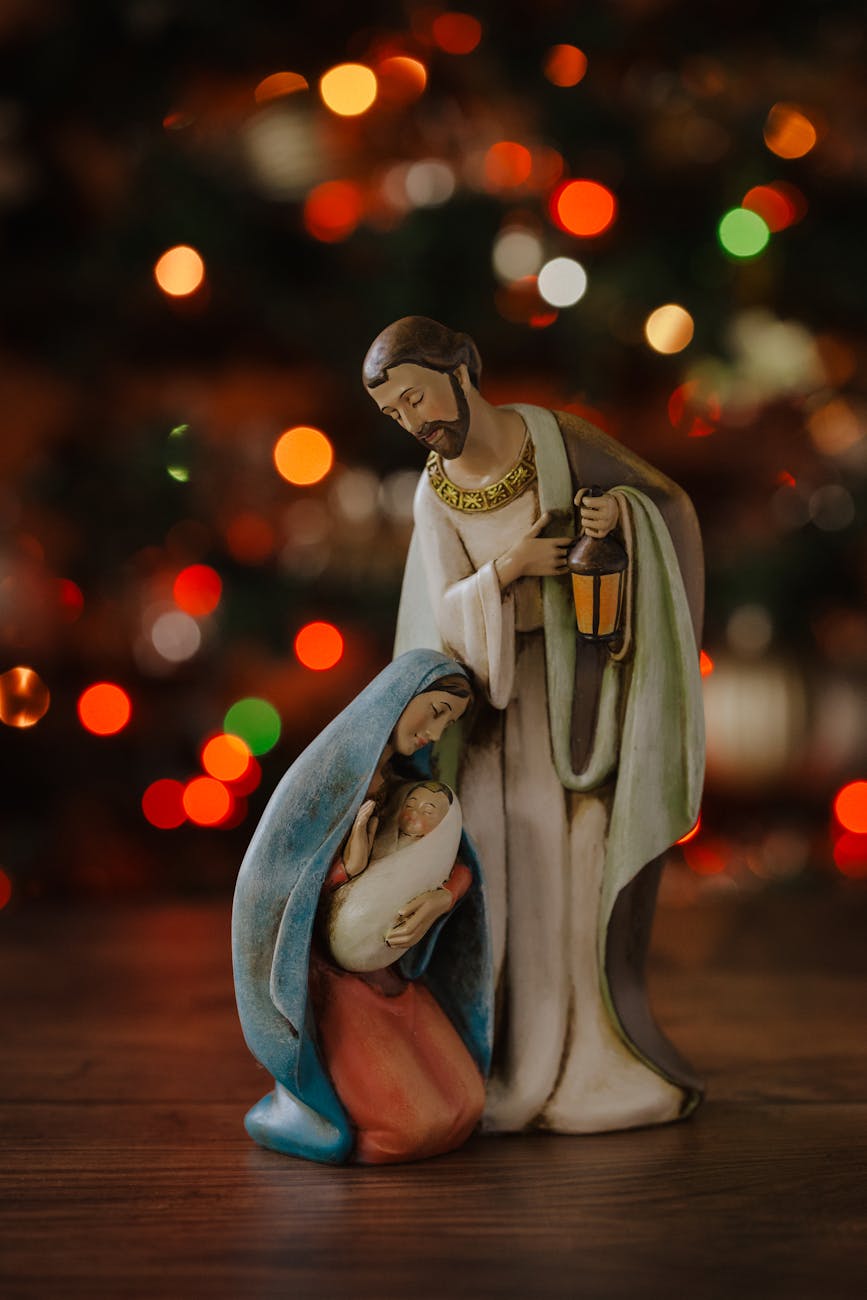
Sermon for the fourth Sunday of Advent, Year A.
When my wife and I were in seminary, there was this Chinese restaurant that we liked to eat at. And at this restaurant, there was this spicy peanut noodle soup that I absolutely adored. But of course, we couldn’t eat there all the time because we were a couple of broke seminary students. So I decided, I’m going to try to figure out how to make this at home.
So I looked up some recipes, bought some ingredients, and decided I was just going to try and wing it. We had the noodles and the vegetables, of course. But the real kicker was chili oil, milk, and peanut butter. That’s how you got that nice sauce.
So, I was putting it all together and I thought to myself, “The peanut flavor in that soup was pretty strong, and this doesn’t seem like a lot of peanut butter. I better add some more to be safe.” So I did.
But what I ended up with was not so much soup as soggy clumps of peanut butter laced with noodles. And of course, it was completely inedible.
I got myself in over my head. And I learned that day that enthusiasm cannot make up for the fact that I have no idea what I’m doing.
It’s funny when the stakes are low.
It’s harder when they’re not.
Sometimes in life, we get in over our heads with something that really matters, and still, we have no idea what we’re doing. We care, but we’re clueless.
Most painful of all are those times when we get in over our heads with something that’s happening to someone we love, and we have no control over the outcome. We want to step in, help out, take charge, and fix it. We figure if we’re smart enough, committed enough—if we just love them enough—we can manage the outcome and stop the situation from getting messy.
But real life doesn’t work that way. Other people’s lives are not problems to be solved, no matter how much we love them. We can’t control who they are, what they go through, or how their story ends. It’s their life. They have to live it—even if we’re pretty sure we could do a better job living it for them.
All we can really do is show up and stand with them while they go through it. And that gap—that gaping chasm between love and control—is one of the most uncomfortable places a human being can stand.
And it’s exactly where St. Joseph is standing in today’s Gospel.
The story begins with our buddy Joe finding out that his fiancée, Mary, is pregnant. And for reasons that were probably explained to you in biology class, Joe is pretty sure that he is not the father. So, what’s a guy supposed to do in a situation like that?
The text of Scripture tells us that Joseph was a righteous man. And that’s important. He’s not reckless, cruel, or indifferent. He’s just a guy trying to do the right thing in a situation that he didn’t choose and doesn’t understand.
He’s caught between the competing goods of compassion and law, love and responsibility, mercy and obligation. He’s hit the limit of what he can manage. And it’s there, in the stunned silence of that moment, that God finally gives him the answer he’s looking for.
It’s not a full explanation or a long-term strategy, or even a promise that everything’s going to work out okay. What it is is something much quieter and more grounding.
The first thing Joe hears is his name: “Joseph, son of David.” Before he’s told what to do, he’s reminded who he is. Identity before instruction.
Joe is reminded that he’s not just some working-class bumpkin. He’s the descendant of kings. In modern language, we might render “Joseph, son of David” as “Joe Davidson.” And we can imagine his dad saying to him, “Hey, Joe. Buck up there, kiddo. I know you’ll figure this out, because you’re no chump. You’re a Davidson. And I believe in you.”
We all need to hear that sometimes.
The second thing the angel does for Joe is name what he’s feeling. The angel says, “Do not be afraid to take Mary as your wife.” And that’s important too.
So often, in the midst of a crisis, it’s easy to get caught up in what’s happening on the outside and forget to pay attention to what’s happening on the inside. The problem is, when we do that, we’re still being controlled by our emotions—it’s just happening unconsciously. So we’re just reacting.
The better way is to pause, take a breath, and pay attention to what’s happening inside, so we can choose to respond from our deepest morals and values rather than just reacting emotionally. We have to be aware of our emotions before we can do that.
And that’s what the angel does for Joseph. He’s not shaming it. He’s just naming it. “Joe, you’re afraid. Anybody would be in your shoes. But now that you know that, you don’t have to let it control you.”
Fear is not failure. It’s just a part of life. But if you can stay aware of it, Joe, you can stay awake and stay present with yourself and with Mary, because she needs you right now. She doesn’t need you to fix it. She needs you to show up and listen and stay engaged with her while this important thing that God is doing is still working itself out in her life.
Joe, that’s your job. That’s your role in all this. Don’t try to manage the mystery. Just stay present to it. Because what’s coming to birth through her is nothing less than Emmanuel, which is Hebrew for “God is with us.”
And that’s true. God is with us—here and now. Not after everything makes sense. Not after the crisis has passed. Not after the fear goes away, but right here and right now. In the mess. In the uncertainty.
Later on, when Joe woke up from the dream where all this happened, he woke up to a world where nothing had changed—and yet, everything had changed. The future was still unclear. The risk was still real. And poor old Joe still didn’t have the answer to the big questions.
But what he did have was the next step. The choice to relinquish control over the story and just show up in it instead.
And that kind of faithfulness is not the kind of thing you can learn overnight. It takes a lifetime.
For me personally, the place where I’ve had to learn that lesson over and over again is with my family, and especially my kids. They say that parenting doesn’t come with an instruction manual, and boy, they’re right.
Just when I think I’ve got one stage of my kids’ lives figured out, they go ahead and move on to the next one, where once again I find out that I have no idea what I’m doing.
The first time it hit me, I was standing in a hospital parking lot the day after my first child was born, and my task was to install a car seat for the first time. It hit me that I was now responsible for the life of another human being, and I was in way over my head.
I understand when people say they don’t feel ready to have kids, because the truth is, you’re never ready. You just take it as it comes and do the best you can. So I wedged my knee into that hard plastic, yanked the seatbelt through the loops, and did what I guess was an okay job—because we made it home from the hospital in one piece.
It was the first time, but certainly not the last time, that I felt that sense of panic.
As time went on and the kids grew up, we dealt with new challenges as they came to us—homework, friendships, drama, dating, breakups. Each stage of life offered something new that my wife and I were not prepared for. Our responsibility kept increasing, and our certainty never quite caught up.
This week, that same child for whom I installed the car seat told us that what he wants to do over his Christmas break is take a day trip to Chicago by himself. He showed us his plan of where he wants to go and what he wants to do. He’s got all the train schedules and the phone numbers. He’s ready, but his mother and I are not. And yet, we are taking that leap of faith anyway.
What faithfulness often looks like in real time is not confidence or control, but the choice to stand alongside a life that is unfolding at its own pace and in its own way. It takes courage. And I’ll let you know how it goes, because I don’t know yet.
Earlier this week, many of us read about another act of courage and faithfulness that took place during the massacre at Bondi Beach, Australia, where several of our Jewish neighbors had gathered to celebrate the first night of Hanukkah. In the midst of the carnage, a Muslim man named Ahmed al-Ahmed, “in the name of conscience and humanity,” ran toward the shooter and wrestled the gun away from him, taking five bullets in the process.
He did it to protect people of a different faith and culture from his own—people he didn’t even know. And in so doing, Ahmed al-Ahmed demonstrated to the rest of us that the faith of Joseph is still alive in the world today: the courage not of control, but of presence; the courage to step toward life even when the outcome is unclear.
That kind of courage is real, and it is still available to us today.
Kindred in Christ, there are moments in life when all of us are asked to stand alongside people we love in situations we cannot control.
Where is that happening for you today?
How are you being asked to protect without possessing, to care without controlling?
Where might faithfulness look less like fixing and more like staying?
Joseph shows us how faithfulness sometimes means showing up when walking away would be much easier and much safer. Joseph shows us how courage sometimes means staying engaged when we cannot manage the outcome of events.
That is the courage and the faith that St. Joseph holds before us in today’s Gospel.
May we also have the grace to recognize that courage when it is asked of us, trusting that God is with us even when the way forward is not yet clear.
Amen?


 Hopping Hadrian's Wall