Reviewing The Divine Office Hymnal

I’m taking a deep dive into my church nerdery today. More specifically, I’m diving deep into a particular subset of church nerdery to which I am obsessively devoted: The Divine Office (a.k.a. The Daily Office or The Liturgy of the Hours).

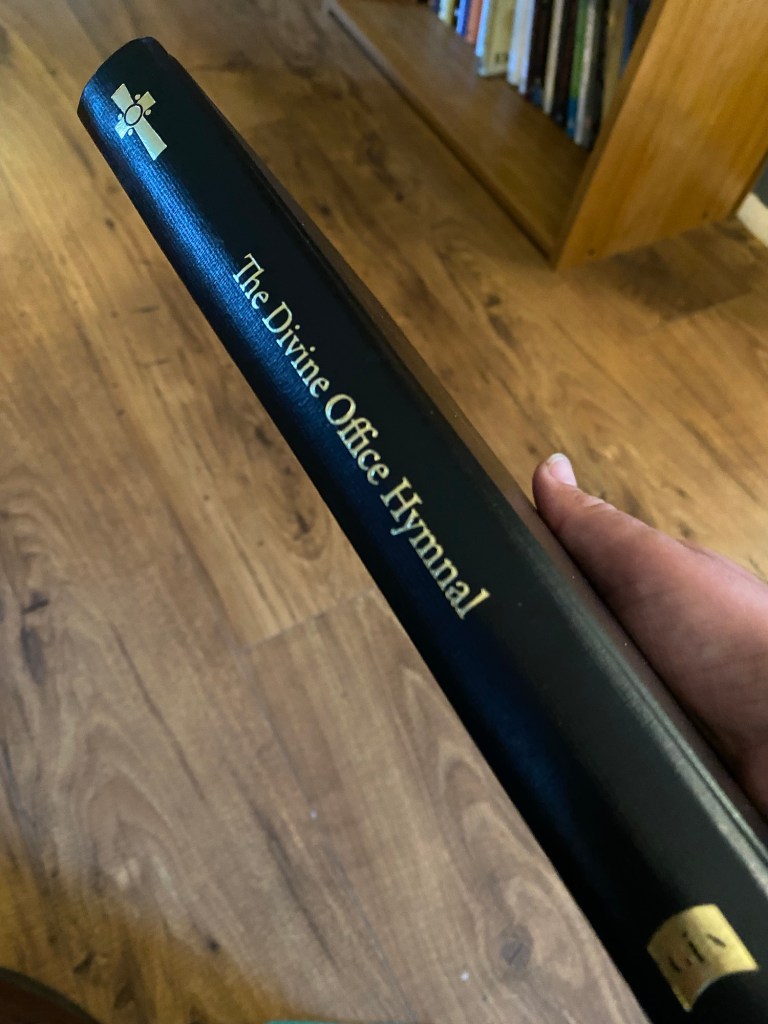
The Divine Office Hymnal arrived in today’s mail. It is part of the Roman Catholic Church’s ongoing update to their Liturgy of the Hours in English. Promulgated by the USCCB in 2022 and published by GIA in 2023.

The hardcover is simple and elegant; the binding is solid.

On the inside, there are sparse illustrations that are lovely and do not interfere with the flow of the music. I particularly like the one on the title page.

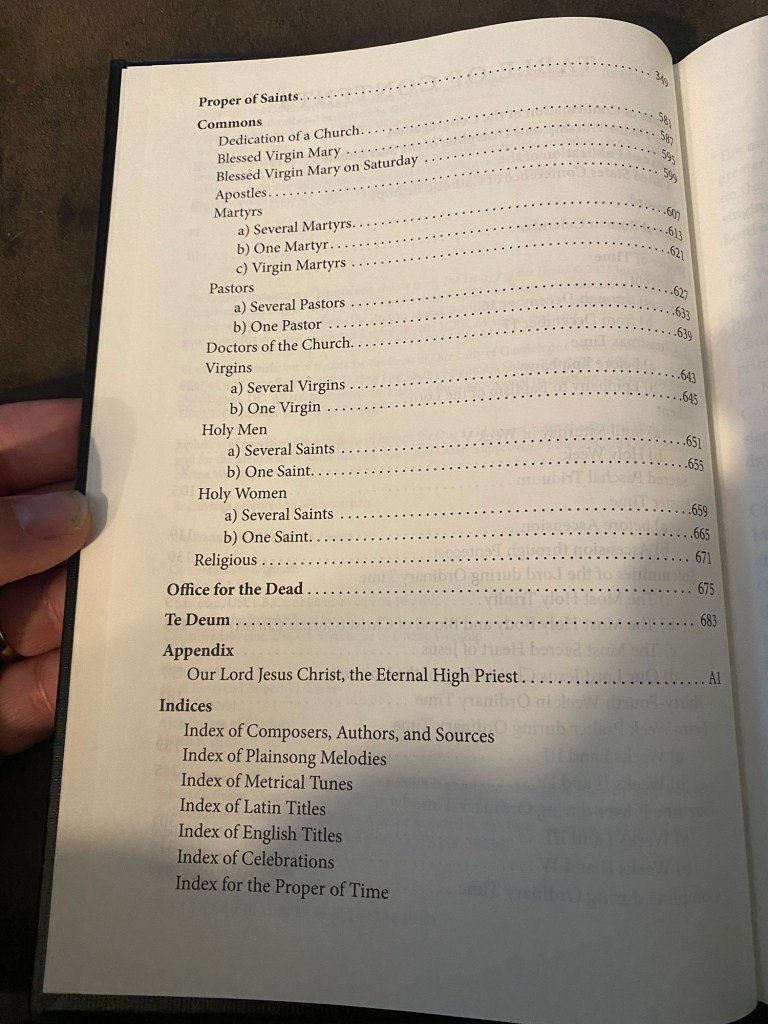
The contents include a calendar of saints (Roman), hymns for all major seasons and saints, including a 2-week cycle for Ordinary Time. There are separate indices for metrical and plainsong tunes, as well as English and Latin first lines, which is helpful.

The hymns included are the traditional Office hymns, each offered with a metrical melody (odd numbers) and a plainsong melody (even numbers). I like this much more than the hymn offerings in the previous American edition of the LOTH. The musical layout is easy to read and follow. Text size is good. All music is in modern 5-line notation, rather than Gregorian neumes. This will be a turnoff for some, but I personally don’t mind. The English translations are decent and probably more accurate than Newman’s more familiar translations, they fit the meter well, but don’t often rhyme.

In form and style, this hymnal bears the most resemblance to the now out-of-print Lumen Christi Hymnal, but is greatly expanded. Included in this version are hymns for the Office of Readings and the Little Hours, which were lacking in Lumen Christi. An English Te Deum is included for the Office of Readings, but the translation is different from the ICEL one I am familiar with from the Episcopal Book of Common Prayer.

What I would have liked to see, which aren’t in The Divine Office Hymnal, are settings for the Marian Antiphons after Compline. These are readily available in other resources, like The Parish Book of Chant, so their omission here is only a minor problem.

All in all, it looks like GIA has done a good job of putting together a very useful resource for USCCB’s long-awaited update of the Liturgy of the Hours. Since it contains only hymns, it will also be quite useful for Christians in other denominations, like me (Episcopal), who also pray the Daily Office.

The price is also very reasonable, at $25 (before S&H).

I give The Divine Office Hymnal a thumbs-up and would recommend it.

Walking on Water: A Practical Guide

The biblical text for this sermon is Matthew 14:2233.

Video link below. The sermon starts at 0:24:00.

My favorite activity that my wife and I do with our kids is our regular family prayer ritual. We sing, share our joys and concerns for the day, take a moment of silence, and discuss some short passage of spiritual literature. One night, during this ritual, we were discussing this passage from the gospels, where Jesus and Peter walk on the water together.

My son, then about ten years old, spoke up and said, “Stories like this are why I have a hard time believing in the Bible.”

I sympathized with his skepticism, saying, “Yeah, I can understand that. Jesus walking on the water is something that seems impossible.”

But he surprised me by responding, “Oh, no. That’s not it. Jesus is God, so he can do whatever he wants; it’s Peter walking on the water that I don’t understand!” He explained that Peter is supposed to be a regular person, like any of us, and regular people can’t walk on water.

Admittedly, this threw me for a loop. However, I think my son has raised an interesting point with this observation.

The story of Jesus walking on the water appears in three out of the four gospels in our Bible. Only Luke neglects to mention it. But only Matthew includes the part where Peter gets out of the boat and joins Jesus on the water.

The important point my son raises is this: With a little bit of faith, regular people can do impossible things too.

Peter, by all accounts, is a regular guy. He’s a fisherman on the shore of the Galilean Sea. One day, some itinerant preacher named Jesus borrows his boat to use as a pulpit, all heaven breaks loose, and Peter finds himself swept up in an adventure beyond his wildest imagination. The rest, as they say, is history.

Regular old Peter never expected to find himself in a situation where he would have to do the impossible. Yet, there he was: stuck on a boat in a storm at night, squinting across the water, and trying to figure out whether the spooky figure he saw was a ghost or his best friend who knew how to make a twelve-course meal out of a few loaves and fishes.

In that moment, Peter shouts the only idea that comes to his mind, “Lord, if it is you, command me to come to you on the water.” To his great surprise, Peter hears the mysterious figure say, “Come.”

I don’t know whether to credit the following events to his faith or his impulsivity, but Peter gets out of his boat in the middle of a raging storm. He takes a few brave steps toward Jesus, but the wind and waves remind him of the stupidity of what he’s doing. He gets scared and down he goes.

The scenes of which this story reminds me are the old roadrunner-and-coyote cartoons where the coyote chases the roadrunner off the cliff, but doesn’t begin to fall until the moment when he looks down. The coyote, who never speaks, holds up a sign that says, “Help” and plummets once again to his doom at the bottom of the cliff. Peter is the coyote in this moment.

Thankfully, for Peter’s sake, the roadrunner he’s chasing in this moment is Jesus Christ himself. He cries out, “Lord, save me” and Jesus obliges.

The next words out of Jesus’ mouth sound like a stern rebuke, but I like to imagine him laughing hysterically as he says, “You of little faith, why did you doubt?” Peter may be a knucklehead, after all is said and done, but he’s Jesus’ knucklehead.

What is the message we can take from this week’s gospel reading? On the most practical level, we could say, “Always wear proper safety equipment when participating in dangerous water sports.” Not bad advice, but I think it falls short of the deeper spiritual meaning of this passage.

In life, we often face impossible situations. The metaphorical wind and waves of this world frequently threaten to overwhelm us. When this happens, the most cynical among us are tempted to look at storm itself and conclude, “This is a dog-eat-dog world and you’ve got to get it while the getting is good. It’s eat-or-be-eaten and my only job is to make sure that I’m not the one who’s being eaten.”

People who think this way tend to look for concrete assurances of their security and prosperity. They feel at ease when the stock market is performing well and their preferred political party is winning elections. They get nervous when the opposite is true. When I say this, I’m not picking on any particular group of people because I see people of all ideologies falling into this temptation, from time to time. If I’m perfectly honest, I have to admit that I’m guilty of it myself. Like St. Peter and Wile E. Coyote, I too have paid too much attention to the wind and the waves, held up my little sign that says “Help,” and then fallen into the depths of despair.

This cynical way of looking at the world sees chaos and competition as the fundamental facts of reality. People who think this way are not wrong. Chaos and competition certainly are facts with which we have to contend in this life, but they are not the whole story. The cynics’ reduction of reality to chaos and competition is a naïve point-of-view that fails to account for the fuller picture of the world, as God created it.

Scientists in the field of evolutionary biology are beginning to wake up to the fact that cooperation plays at least as big a role in the development of life as competition. Similarly, they are discovering that the evolution of life as a story of increasing complexity, consciousness, and creativity in the midst of chaos and competition. As people of faith, we have a tremendous opportunity to bear witness to the hand of God at work in the scientific story of the origin and development of life. This, in part, is why I believe it is so important for Christians to be supportively involved in the work of science. Cooperation, complexity, consciousness, and creativity are at least as central to the evolution of life as chaos and competition.

In the heart-language of the Christian tradition, we could say it like this: Jesus is with us in the midst of the wind and waves of this life.

So then, what are we to do? The story of Peter’s failure in today’s gospel makes it clear: Keep your eyes on Jesus.

Now, arguably, this is more difficult for those of us who live two thousand years after the flesh-and-blood Jesus walked this Earth. We don’t get to hear the sound of his laughter or see the sparkle in his eyes when he tells us that God will care for us in the same way that God cares for the birds of the air and the lilies of the field.

Unlike Peter, we cannot keep our eyes on Jesus, in the physical sense.

What we can do is stay engaged with the spiritual practices that have been handed down to us through two millennia of Church history. By coming to church this morning, you have already taken the first step in that direction. By singing the hymns, participating in the liturgy, hearing the Scriptures, and receiving the Sacraments, you are already dedicating an hour of your week to keeping your eyes on Jesus. The question is what to do with the other six days.

I’d like to encourage you to take some time, every day, to dedicate yourself to some spiritual practice. Prayer, meditation, Bible study, and spiritual reading are not just for priests; anyone can do them and everyone should. Here in the Episcopal Church, we have a wonderful tool for this work in the Daily Office of the Book of Common Prayer. If you already say the Offices of Morning and Evening Prayer, congratulations! You are already well on the way to keeping your eyes on Jesus. If this practice is new to you and you don’t know where to start, then I would recommend beginning with An Order for Compline on page 127 of the prayer book. The directions are clear and uncomplicated, without much flipping around to find psalms and readings. Start by saying the Office of Compline each night at bedtime. Once you’ve gotten the hang of it, you can look at the Offices of Morning and Evening Prayer, which offer a much more robust diet of liturgy and Scripture. As time goes by, you will find the words of prayer and Scripture melding themselves with your heart and transforming you from the inside out.

If this practice doesn’t appeal to you, or if you want to expand your spiritual practice beyond the Book of Common Prayer, there are any number of spiritual books at your local bookstore; find one that speaks to you and go from there. Watch an instructional YouTube video on contemplative prayer or mindfulness meditation. If you have some time after church today, I will be leading a workshop on how to pray the Anglican Rosary at our adult formation class. All of you are cordially invited to attend.

Friends, kindred in Christ, I encourage you this day to keep your eyes on Jesus as you weather the storms of this life. Stay engaged with the spiritual practices of our Christian tradition. Keep praying, keep reading, keep sharing, keep serving, and above all keep loving and knowing that you are loved. Keep your eyes on Jesus. This is how you will know that Jesus is with you in the storms of this life and we will weather this storm together.

Amen.

Evening Prayer for Sunday of Easter 2

The Invitatory and Psalter

O God, make speed to save us.
O Lord, make haste to help us.

Glory to the Father, and to the Son, and to the Holy Spirit: as
it was in the beginning, is now, and will be for ever. Amen.
Alleluia.

Phos hilaron

O gracious light,
pure brightness of the everliving Father in heaven,
O Jesus Christ, holy and blessed! 

Now as we come to the setting of the sun,
and our eyes behold the vesper light,
we sing your praises, O God: Father, Son, and Holy Spirit. 

You are worthy at all times to be praised by happy voices,
O Son of God, O Giver of Life,
and to be glorified through all the worlds.

The Psalm or Psalms Appointed

111    Confitebor tibi

1              Hallelujah!
I will give thanks to the LORD with my whole heart, *
in the assembly of the upright, in the congregation.

2              Great are the deeds of the LORD! *
they are studied by all who delight in them.

3              His work is full of majesty and splendor, *
and his righteousness endures for ever.

4              He makes his marvelous works to be remembered; *
the LORD is gracious and full of compassion.

5              He gives food to those who fear him; *
he is ever mindful of his covenant.

6              He has shown his people the power of his works *
in giving them the lands of the nations.

7              The works of his hands are faithfulness and justice; *
all his commandments are sure.

8              They stand fast for ever and ever, *
because they are done in truth and equity.

9              He sent redemption to his people;
he commanded his covenant for ever; *
holy and awesome is his Name.

10           The fear of the LORD is the beginning of wisdom; *
those who act accordingly have a good understanding;
his praise endures for ever.

112    Beatus vir

1              Hallelujah!
Happy are they who fear the Lord *
and have great delight in his commandments!

2              Their descendants will be mighty in the land; *
the generation of the upright will be blessed.

3              Wealth and riches will be in their house, *
and their righteousness will last for ever.

4              Light shines in the darkness for the upright; *
the righteous are merciful and full of compassion.

5              It is good for them to be generous in lending *
and to manage their affairs with justice.

6              For they will never be shaken; *
the righteous will be kept in everlasting remembrance.

7              They will not be afraid of any evil rumors; *
their heart is right;
they put their trust in the Lord.

8              Their heart is established and will not shrink, *
until they see their desire upon their enemies.

9              They have given freely to the poor, *
and their righteousness stands fast for ever;
they will hold up their head with honor.

10           The wicked will see it and be angry;
they will gnash their teeth and pine away; *
the desires of the wicked will perish.

113    Laudate, pueri

1              Hallelujah!
Give praise, you servants of the LORD; *
praise the Name of the LORD.

2              Let the Name of the LORD be blessed, *
from this time forth for evermore.

3              From the rising of the sun to its going down *
let the Name of the LORD be praised.

4              The LORD is high above all nations, *
and his glory above the heavens.

5              Who is like the LORD our God, who sits enthroned on high, *
but stoops to behold the heavens and the earth?

6              He takes up the weak out of the dust *
and lifts up the poor from the ashes.

7              He sets them with the princes, *
with the princes of his people.

8              He makes the woman of a childless house *
to be a joyful mother of children.

At the end of the Psalms is sung or said

Glory to the Father, and to the Son, and to the Holy Spirit: *
as it was in the beginning, is now, and will be for ever. Amen.

The Lessons

One or two lessons, as appointed, are read, the Reader first saying

A Reading (Lesson) from ________________.

After each Lesson the Reader may say

Here ends the Reading.

Magnificat

Luke 1:46-55

My soul proclaims the greatness of the Lord,
my spirit rejoices in God my Savior; *
    for he has looked with favor on his lowly servant.

From this day all generations will call me blessed: *
    the Almighty has done great things for me,
    and holy is his Name.

He has mercy on those who fear him *
    in every generation.

He has shown the strength of his arm, *
    he has scattered the proud in their conceit.

He has cast down the mighty from their thrones, *
    and has lifted up the lowly.

He has filled the hungry with good things, *
    and the rich he has sent away empty.

He has come to the help of his servant Israel, *
    for he has remembered his promise of mercy,

The promise he made to our fathers, *
    to Abraham and his children for ever.

Glory to the Father, and to the Son, and to the Holy Spirit: *
    as it was in the beginning, is now, and will be for ever. Amen.

The Apostles’ Creed

I believe in God, the Father almighty,
    creator of heaven and earth.

I believe in Jesus Christ, his only son, our Lord.
    He was conceived by the power of the Holy Spirit
      and born of the Virgin Mary.
    He suffered under Pontius Pilate,
      was crucified, died, and was buried.
    He descended to the dead.
    On the third day he rose again.
    He ascended into heaven,
      and is seated at the right hand of the Father.
    He will come again to judge the living and the dead.

I believe in the Holy Spirit,
    the holy catholic Church,
    the communion of saints,
    the forgiveness of sins,
    the resurrection of the body,
    and the life everlasting. Amen.

The Prayers

The Lord be with you.
And also with you.

Let us pray.

Our Father in heaven,
    hallowed be your Name,
    your kingdom come,
    your will be done,
        on earth as in heaven.
Give us today our daily bread.
Forgive us our sins
    as we forgive those
        who sin against us.
Save us from the time of trial,
    and deliver us from evil.
For the kingdom, the power,
    and the glory are yours,
    now and for ever. Amen.

Suffrages B

That this evening may be holy, good, and peaceful,
We entreat you, O Lord.

That your holy angels may lead us in paths of peace and
goodwill,
We entreat you, O Lord.

That we may be pardoned and forgiven for our sins
and offenses,
We entreat you, O Lord.

That there may be peace to your Church and to the whole
world,
We entreat you, O Lord.

That we may depart this life in your faith and fear,
and not be condemned before the great judgment seat
of Christ,
We entreat you, O Lord.

That we may be bound together by your Holy Spirit in
the communion of [________ and] all your saints,
entrusting one another and all our life to Christ,
We entreat you, O Lord.

A Collect for the Presence of Christ

Lord Jesus, stay with us, for evening is at hand and the day
is past; be our companion in the way, kindle our hearts, and
awaken hope, that we may know you as you are revealed in
Scripture and the breaking of bread. Grant this for the sake
of your love. Amen.

A Collect for Mission

Keep watch, dear Lord, with those who work, or watch, or
weep this night, and give your angels charge over those who
sleep. Tend the sick, Lord Christ; give rest to the weary, bless
the dying, soothe the suffering, pity the afflicted, shield the
joyous; and all for your love’s sake. Amen.

Let us bless the Lord.
Thanks be to God.

From Easter Day through the Day of Pentecost “Alleluia, alleluia” may
be added to the preceding versicle and response.

Lex Orandi

FullSizeRender(5)

Here, at long last, is a big project I have been working on this year:

Lex Orandi: An Ordo for the Divine Office based on the Rule of St. Benedict and the Book of Common Prayer (pdf file)

It is not a complete breviary that stands on its own, but a guide for praying the Office in a manner similar to the monks at St. Gregory’s Abbey, Three Rivers.

While not an exact replication of the Liturgy of the Hours at St. Gregory’s, Lex Orandi has been adapted to fit the schedules of people who live outside the monastery, but still want to pattern their prayer life after the Benedictine spirit.

While Abbot Andrew Marr​ and the brothers have helped me in this project and granted permission to reprint select portions of their Office (e.g. the Confraternity Prayers), Lex Orandi is an independent publication that has not been authorized or endorsed by St. Gregory’s Abbey, Three Rivers. Its use is not required.

Thank you to the community of St. Gregory’s Abbey, Three Rivers for your friendship, support, and guidance in this labor of love. It is my joy to make it available online for free to anyone who wishes to use it.