
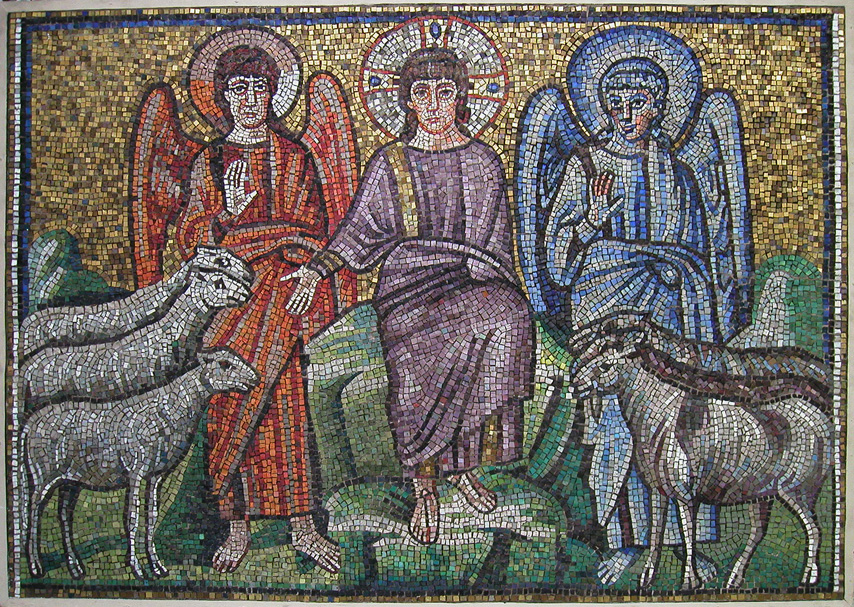
Sermon for Christ the King Sunday, Year A
When I was in high school, my parents, pastors, and other grownups I knew from church were pretty consistent in their spiritual advice to us teenagers. They told us that we should simply “read the Bible and do what it says,” which sounded like really fantastic advice… at least, that’s what the grownups at church thought until my friends and I actually started actually reading the Bible and trying to do what it said.
The problem was that the grownups didn’t specify exactly which part of the Bible they wanted us to read and obey first, so my friends and I picked the parable of the Sheep and the Goats from Matthew 25: the very passage we heard in today’s gospel.
We read this story about Jesus commanding his followers to feed the hungry & thirsty, welcome the stranger, clothe the naked, and visit the sick and imprisoned. And then, to really drive the point home, he said to them, “Truly I tell you, just as you did it to one of the least of these who are members of my family, you did it to me.”
It seemed to us that what Jesus had said was pretty clear, and we noticed that there were some homeless guys asking for money on the highway by our school, so we figured that Jesus wanted us to go invite them to lunch, which we did.
What resulted from that encounter was one group of well-fed homeless guys, who were happy to share their life stories with a group of awkward teenagers, and a group of very confused church teachers who were scratching their heads and wondering where it all went wrong.
When they encouraged us to study the Bible, they figured it would inspire us to do our homework, eat our vegetables, and basically just be good kids. But Jesus, as it turned out, had other plans.
Of course, that doesn’t mean that we got it right and our teachers got it all wrong. In fact, we eventually realized something very important that we had missed when we first started buying lunch for homeless guys:
As good Christian kids who imagined themselves as missionaries, we thought it was our God-given duty to bring Christ to the poor of the world, in order to save their souls.
But if you look closely at this passage in Matthew 25, you realize, as I eventually did, that I had been understanding this passage completely backwards from the way that Jesus intended it.
I was understanding it backwards in two ways:
- In thinking that I was bringing Christ to the world.
- In thinking that I was doing it in order to save their souls.
Let’s take a look at that first backward understanding: That I was bringing Christ to the world.
That’s not what Jesus says in this passage. He says, “I was hungry… thirsty… a stranger… naked… sick and… in prison.” Later on, he gets even more specific about exactly where he factors into this evangelistic equation when he says, “Truly I tell you, just as you did it to one of the least of these who are members of my family, you did it to me.”
Jesus isn’t with the missionaries bringing charitable services to the poor of the world; he is with the poor themselves. My friends and I weren’t bringing Christ to the homeless men outside our school; they were bringing Christ to us. That’s the first way in which I was understanding this passage backwards.
My second backwards understanding of the Parable of the Sheep & the Goats was in assuming that I was bringing Christ to the poor in order to save their souls. The folly of my assumption can be clearly seen in the last part of this passage.
This is a parable of the Final Judgment, which takes place at the Second Coming of Christ. The righteous sheep, who had done the things that Jesus had told them to do, “inherit the kingdom prepared for them from the foundation of the world, but the accursed goats, who did not care for the poor as Jesus commanded, are told to “depart from Jesus into the eternal fire prepared for the devil and his angels.”
So, there are souls being saved when Christians practice the Works of Mercy as Jesus commanded them, but it’s not the souls of the poor. Jesus is already with them. The souls being saved are our own.
So then, this was my backwards understanding of Matthew 25 that I was operating under as a well-intentioned teenager who was trying to practice his Christian faith:
My friends and I had mistakenly thought that we were bringing Christ to the poor of the world, in order to save their souls, but the truth that we eventually realized by studying the teachings of Jesus was that it is the poor of the world who bring Christ to us, in order to save our souls.
This is the same pattern that we encounter in the Eucharist. In this sacred mystery of our faith, Christ comes to us through the ordinary elements of bread and wine. By the action of the Holy Spirit, they become for us his Body and Blood, which we receive into our own bodies.
This Sacrament trains the eyes of our hearts to find Christ in this place, so that we can go out into the world and find him everywhere else.
In every moment and every encounter of our lives, Christ is coming to save us.
When we come forward to receive his Body and Blood in the Eucharist, that is Christ coming to save us.
When we pass the Peace to our neighbor in church, that is Christ coming to save us.
When we hear the news that a friend is sick, that is Christ coming to save us.
When our workday is interrupted by a phone call from the jail or a homeless person asking for money, that is Christ coming to save us.
Christ saves us, not only by forgiving our sins and securing place in heaven for us, but also by getting us unstuck from our own self-centeredness in this world. He calls upon us to satisfy the physical hunger of our poorest neighbors, so that they can satisfy the spiritual hunger in us.
Kindred in Christ, our Lord Jesus invites us this morning to reconsider our backwards understanding of the mission of the Church. He offers himself to us, not only in the Sacrament of his Body and Blood, but also in the bodies of ordinary people who lack adequate food, water, shelter, clothing, healthcare, and freedom. He asks those who have these things to share with those who don’t, to save not only them but us as well.
Let us open the eyes and ears of our hearts and minds today, so that we might be ready to receive him when he comes again in glory, and “inherit the kingdom prepared for us from the foundation of the world.”

