
Sermon for the Fifth Sunday in Lent
I was thinking this week about the moment when I realized that I wanted to ask my wife to marry me.
Growing up, I had always been told that when I met “the one,” I would “just know”—and that all the love in my heart would cancel out whatever fear or anxiety I had.
But the funny thing is that when the moment finally came, I realized that the love I had for Sarah did not, in fact, cancel out my fear about the future.
Neither did my fear about the future cancel out my love for Sarah.
I held love in one hand, and fear in the other, and both were true in the same place at the same time.
Many of you who are married or partnered will know exactly what I’m talking about.
And many of you will also have experienced that same reality in other places—some of which are a lot more difficult.
I’m thinking of places like hospital rooms,
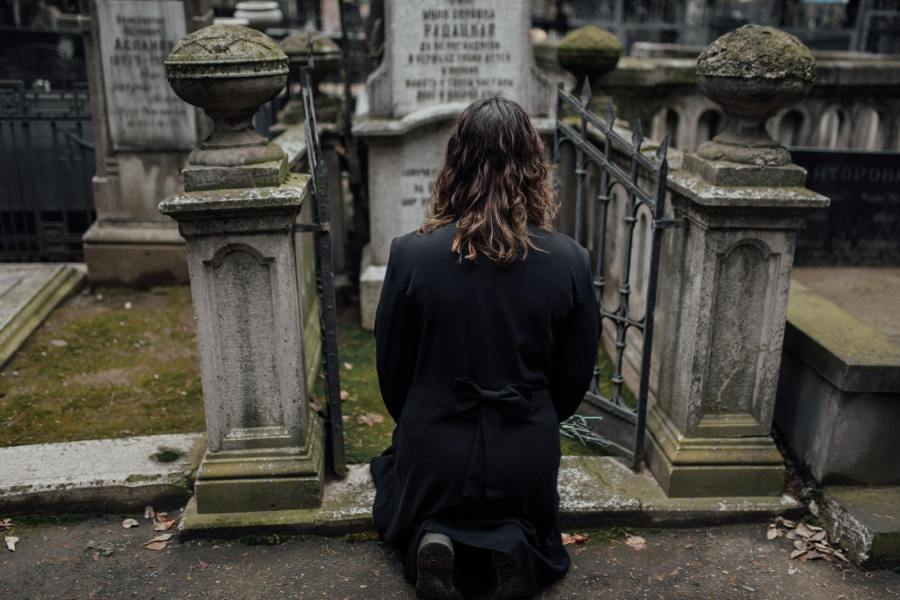
at gravesides,
and in that middle-of-the-night phone call—
where we’re holding love in one hand
and loss in the other,
and both are equally true in the same place at the same time,
neither one canceling out the other.
If you’ve ever been in that place, first of all, I’m sorry. I wish no one would have to go through anything like that.
And second of all, you’re not alone.
Because that place is exactly where today’s Gospel meets us.
In this Gospel, the sisters Mary and Martha are coping with the loss of their brother Lazarus—holding their grief in one hand and their trust in Jesus—even as they struggle to understand him—in the other.
The raising of Lazarus is one of the best-known—and least understood—passages in John’s Gospel.
It’s a passage that makes me mad, because as a former hospice chaplain, I really wish Jesus had not raised Lazarus from the dead, but had simply comforted Mary and Martha in their grief and assured them that death is a part of life, and we will get through this together.
Instead, Jesus—ignoring my opinions, as usual—goes ahead and raises Lazarus from the dead, while proclaiming, “I am the resurrection and the life. Those who believe in me, even though they die, will live, and everyone who lives and believes in me will never die.”
Later on, Jesus makes me mad again by saying, “Did I not tell you that if you believed, you would see the glory of God?”
I’ll be honest: I hate those verses—because if they mean what they sound like they mean…
And I’m not being flippant or disrespectful toward Jesus or dismissive of the scriptures…
I hate those verses because I, as a loving and caring priest, would not dare to dare to tell a grieving family that their loved one died due to the family’s lack of faith. That would be the pinnacle of cruelty.
As a hospital and hospice chaplain, I sat at the deathbeds of literally hundreds of people. I saw miracles of the human spirit that defy my imagination—but not once did I see a deceased person rise up and begin walking around again.
Every single person who died under my care stayed dead.
I offered prayers and comfort to their families. I officiated funerals and memorial services for the departed. But not once did I dare to say, “Lazarus, come out,” and expect to see their departed loved one getting up out of the coffin.
The human experience of the finality of death is what makes this passage seem so offensive to those of us who have lost loved ones—and those who care for those who have lost loved ones, too.
Jesus really seems to have backed himself into a corner on this one.
And those of us who minister in his name are left wondering how he’s going to talk himself out of it.
Thankfully, Jesus is a much smarter man than I am.
And the way he talks himself out of it… is that he doesn’t.
Jesus, in his divine wisdom, lets the paradox stand.
He holds the tension between faith and grief and refuses to allow one to cancel out the other.
On the faith side, he says, “I am the resurrection and the life. Those who believe in me, even though they die, will live, and everyone who lives and believes in me will never die.”
Jesus knows who he is and what he is about to do, and yet that knowledge does not stop him from being fully present with those who weep for the loss of their loved ones.
The Scriptures are crystal clear in telling us that divine omniscience and omnipotence are not barriers to the human love that knows how to “weep with those who weep,” as St. Paul says in Romans 12:15.
It is from this incarnational union of the fully divine and fully human that we get the words of the shortest verse in the Bible: John 11:35—“Jesus began to weep.” Other translations render it in an even shorter and more memorable form: “Jesus wept.”
This verse has been a favorite memory verse of confirmands over the years because of its brevity. As the shortest verse in the Bible, it is also the easiest to memorize.
But I would not be quick to dismiss it, because it contains a profound spiritual truth that lies at the heart of today’s Gospel.
Jesus wept because Jesus loves.
Jesus loves people who are hurting. Jesus loves us when we are at our worst and at the end of our ropes.
In the midst of the impassable chasm of death—between the way things are and the way they ought to be—Jesus loves.
Whatever we do with this biblical text—whether we take it literally or figuratively—the central truth remains: Jesus wept because Jesus loves.
When Jesus says, ‘I am the resurrection and the life,’ he is not promising that we will avoid death.
He is claiming that even death cannot separate us from the life of God.
Love is the only way to bridge the gap between the way things are and the way they should be.
Love is the tar that keeps our heels glued in place, between the realities of life and death.
Our faith in the resurrection power of God to overcome the power of death does not negate our sorrow at the fact of death in this present age.
Grief is not a failure of faith. It is the inevitable consequence of choosing to love.
When we know that life, in its present form, is not yet eternal, “grief,” as author Jamie Anderson says, “is just love with no place to go.”
That’s why grief is not a problem to be solved. It’s not a sin or a lack of faith. It is the inevitable consequence of those who choose to love in spite of the reality of death.
Today’s Gospel teaches us that those who love will not escape grief. But those who grieve need not grieve without hope, for death will not have the final word.
The paradox of grief and faith can hold both extremes together because they are bound together with the unbreakable bonds of divine love, which transcends death.
Kindred in Christ,
If the Gospel is true, then our calling from God is not to choose between grief and faith, but to learn how to hold both together in the same place at the same time.
Jesus calls us to love wholeheartedly, even though we know it will cost us.
Jesus calls us to grieve honestly, but not “as others do who have no hope” (1 Thessalonians 4:13).
Above all, Jesus calls us to trust—stubbornly—that love is never wasted.
Because if Jesus really is the resurrection and the life, as he said he is, then grief is not a sin, and death does not have the final word.
When we grieve, we are not doing something wrong. We are doing something deeply human—and deeply divine:
We are choosing to love in a world where the work of love is not yet finished.
Amen?

.jpg)




 Hopping Hadrian's Wall