Extraordinary Claims Require Extraordinary Evidence

Sermon for the Second Sunday of Easter.

The biblical text is John 20:19-31.

Once upon a time, there was an expecting mother. In her womb, there were twins. These twins, as people often do when they spend a lot of time together, liked to talk about various things. One day, a particularly philosophical question came up. One turned to the other and asked, “Do you believe there’s any such thing as life after birth?”

“Never really thought about it,” the other twin said, “but I highly doubt it. We’ve never seen anything outside of this place. No one who leaves ever comes back. I think that, when the time comes for us to be born, we just go through that passage and cease to exist.”

“I disagree,” the first said, “I mean, you’re right that we’ve never seen anything outside of this place, but just look at these eyes, ears, hands, and feet that we’re growing! Why are we growing them, if we’re never going to use them? I bet, after we go through that passage, we’ll find out there’s a whole world outside that we’ve never seen before. I have no idea what it will be like, but I have a hunch our time in this womb is getting us ready for whatever comes next.

“That’s the most ridiculous thing I’ve ever heard,” said the other. “I bet the next thing that you’re going to tell me is that you’re one of those crazy religious people who believes in the existence of Mom!”

“Well, I don’t think I’m crazy,” the first said, “but, as a matter of fact, I do happen to believe in Mom.”

“Oh, really?” The other said, “Then why don’t you enlighten me, if you’re so wise? I’ve been in this womb for almost nine months, but I’ve never seen a ‘Mom’ or any evidence that convinces me to believe there’s any such thing as life after birth. So then, just where is this hypothetical ‘Mom’ that you supposedly believe in?”

“It’s hard to explain,” the first said, “but I think that Mom is everywhere, all around us. Everything we see in this womb is a part of Mom. So, I guess, it’s kind of like… maybe we’re growing inside of her? You said you’ve never seen Mom, but I think we’ve never seen anything other than Mom. I don’t pretend to have the answer, but I suppose it’s just another one of those things we won’t know for sure until after we’re born.”

There are two things I’d like to point out about this little parable, which I have adapted from Catholic priest and author Henri Nouwen. First of all, neither twin in the story is in a position to know, with any certainty, what the full truth of the matter is. The answers to questions about “life after birth” and “the existence of Mom” are pretty obvious to you and me, who have lived outside the womb for most of our existence, but we can imagine how scary it must have been when we were going through the process for the first time. Even now, uncertainty about “life after death” and “the existence of God” makes us nervous. Maybe someday in eternity, we’ll look back on our earthly lives and laugh at how little we knew back then, but today we can only know what we know, which might give us a little sympathy for those unborn twins and their philosophical questions.

The second detail from that story I’d like us to notice is that the presence of doubt has absolutely no bearing on the twins’ status as beloved children of their mother. She will love them just the same, no matter what philosophical conclusions they draw during their time in utero. In the same way, even the oldest among us are still babies in the eyes of God. Our eternal Mother knows full well that human beings are incapable of answering the biggest questions about reality, so she is able to have sympathy for those who struggle honestly with doubt. Just like those babies in utero, each and every one of us will be loved forever, no matter what we come to believe during our brief time on this Earth.

This means that doubt is not a barrier to faith.

This second fact about Nouwen’s parable of the twins is what I want us to keep in mind, as we turn to look at today’s gospel.

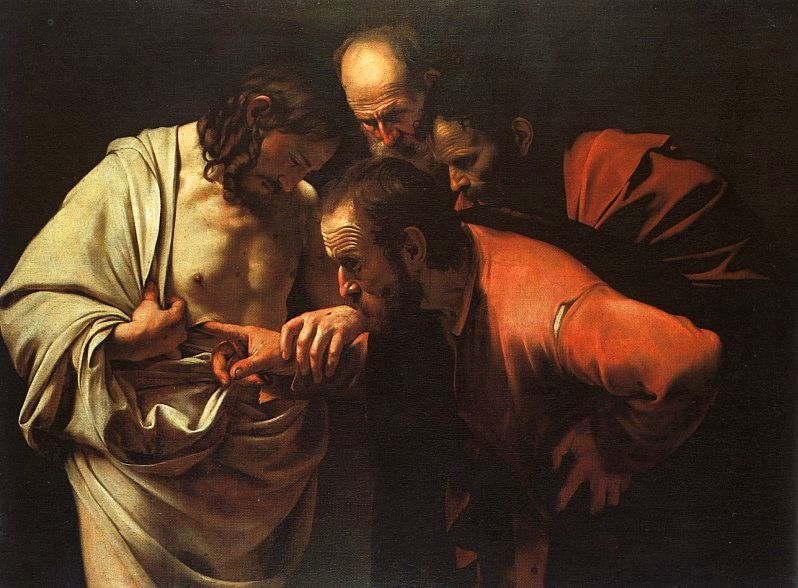
The story of St. Thomas’ encounter with the risen Christ is the most thorough treatment of doubt in the New Testament. Our brother Thomas gets an unfair shake when we use his name to make fun of someone for being “a Doubting Thomas.” After all, Thomas was only doing what any of us would have done, if someone came to us with news that seemed unbelievable. For this reason, I like to think of Thomas as “the patron saint of critical thinkers.” The scientist Carl Sagan famously quipped that “extraordinary claims require extraordinary evidence.” I imagine Dr. Sagan applauding when St. Thomas proclaims, “Unless I see the mark of the nails in his hands, and put my finger in the mark of the nails and my hand in his side, I will not believe.”

The most intriguing aspect of this story is not Thomas’ doubt, but Jesus’ response to it. If John’s gospel had been written by modern Fundamentalist Christians, they probably would have said that Jesus couldn’t appear in the upper room until the other disciples had excommunicated Thomas for his skepticism. If Jesus appeared at all, it would probably be on the far side of the locked door, shouting about how Thomas is a “sinner” and is “going to hell,” if he doesn’t change his mind. But that’s not what actually happens in John’s gospel.

In the real version of the story, the text says, “Although the doors were shut, Jesus came and stood among them and said, ‘Peace be with you.’” Thomas’ doubt, for Jesus, was not a reason to stay away, but a reason to come closer. Thomas’ doubt, for Jesus, was not a reason to offer words of judgment, but a reason to offer words of peace. Jesus doesn’t command Thomas to have blind faith, but gives him the extraordinary evidence he’s looking for.

The presence of this passage in our sacred Scriptures should shape the way we deal with doubts, both our own and those of others. It should help us learn how to accept the process of critical thinking as a necessary part of faith. It should lead us, not to retreat from hard questions, but to advance alongside them.

As Episcopalians, we are blessed with abundant spiritual resources to help us on this journey. The Episcopal Church is part of the Anglican theological tradition. One of the things that makes Anglicanism distinct from some other expressions of Christianity is the way in which we think about our faith. Some other churches see their faith as a monolithic statement by a single and infallible authority. For Roman Catholics, it’s the Pope; for Fundamentalist Protestants, it’s the Bible. But the Anglican theological tradition, as far back as Fr. Richard Hooker in the 17th century, has always viewed Christian theology as a three-way dialogue between Scripture, tradition, and reason.

This way of thinking about our beliefs, sometimes called “the three-legged stool,” means that Episcopalians see our religion as a never-ending conversation. Everyone gets to have a seat at the table, but no one gets to stand on the table and yell at everyone else. Unlike some other religious traditions, Episcopalians do not view their leaders as infallible. We honor our ancestors, but we also believe the Church can be wrong. An interpretation that made sense at one time might stop making sense for future generations. A way of life that seemed just and holy in one century might seem abhorrent in another, and vice versa. This doesn’t mean that “anything goes” in Christian faith and practice, but it does mean that Episcopalians are always open to having a conversation about it.

This understanding of the Christian faith means that Episcopalians can be notoriously hard to pin down when someone asks what our church believes. We frequently disagree with each other, sometimes passionately. The late comedian and devout Episcopalian Robin Williams once said, “No matter what you believe, there’s bound to be an Episcopalian somewhere who agrees with you.”

Finally, thinking of the Christian faith as a three-way dialogue between Scripture, tradition, and reason means that The Episcopal Church is a place where you can bring your whole self to church: Protestant and Catholic, conservative and liberal, believer and skeptic. To all these parts of ourselves and each other, the sign outside our churches around the country proclaims the message loud and clear: “The Episcopal Church welcomes you!”

Whoever you are, whatever you believe, however you identify, and wherever you are on your spiritual journey, you are welcome in this sacred space. That is the message that Jesus proclaimed to St. Thomas in today’s gospel. That is the message that The Episcopal Church seeks to embody every day, as it has for hundreds of years. And that is the message that I hope you hear in this sermon today: That you, with all your doubts and fears, are still a beloved child of God, and you are welcome in this place.

Amen.

Where I Stand Is Where I Fall

Sermon for Sunday of the Passion: Palm Sunday.

Click here to read the biblical texts.

Imagine, if you will, a presidential motorcade coming into town. People line the streets, waving American flags. Secret service agents and police officers surround the limousine on all sides, ready to jump into action if there is a problem.

Now, imagine that, on the other side of town, another kind of parade is happening. In this procession, the leader is riding in a little clown car. People still line the streets, cheering. They are playing Hail to the Chief on kazoos. If we saw this silly demonstration, we could easily understand that it was meant to be a parody of the bigger and more serious motorcade happening elsewhere. This was exactly what was happening on Palm Sunday, as Jesus rode into Jerusalem on a donkey.

In Jerusalem, during the time of Jesus, it was customary for the Roman governor to make a military parade through the city during the week before the holiday of Passover. The Roman province of Judea was known for being a troubled place that frequently experienced violent insurrections. The risk of uprising was especially high during the Passover season, when the Jewish people celebrated their deliverance by God from slavery, tyranny, and genocide in Egypt. Governor Pilate’s annual show of force at that time was intended to nip those thoughts in the bud, before people got any bright ideas about acting on them.

Jesus’ triumphal entry, on the other hand, was a deliberate lampoon of the governor’s bravado. He based his demonstration on the words of the prophet Zechariah from the Hebrew Scriptures:

“Rejoice greatly, O daughter Zion! Shout aloud, O daughter Jerusalem! See, your king comes to you; triumphant and victorious is he, humble and riding on a donkey, on a colt, the foal of a donkey” (Zechariah 9:9).

By comparison, Jesus’ gathering was quite small, filled with the most obnoxious riffraff in town, and was obviously poking fun at the powers-that-be. It’s no wonder then that the authorities were anxious that this little demonstration might attract the wrong kind attention from Pontius Pilate and his soldiers. I can hear fear in their voices as they say, perhaps while glancing nervously over their shoulders, “Teacher, order your disciples to stop.” Jesus responds, rather poetically, “I tell you, if these were silent, the stones would shout out” (Luke 19:40). Paraphrasing Jesus’ words, I imagine Jesus shrugging his shoulders and saying, “Yeah, sure… Good luck with that!”

The serious point that Jesus was making with this little demonstration of political theater is that the so-called powers-that-be in this world are not so powerful as they think. They show their strength through competition and violence, but Jesus shows us another way to live.

Our Epistle reading this morning tells us something about how that other way looks. St. Paul tells us that Christ, “though he was in the form of God, did not regard equality with God as something to be exploited, but emptied himself” (Philippians 2:6-7a).

This “emptying” that Paul talks about is the self-giving love that Jesus radiates from every cell of his body. It stands in stark contrast to the competitive systems of domination that tend to rule the world, both in Jesus’ time and ours.

The “way of the world,” as we are socially trained to accept it, is the way of the zero-sum game, where there are winners and losers, us and them, insiders and outsiders. We see it everywhere: in military conflicts, sporting events, political elections, and business deals. We get so accustomed to this way of thinking, it even finds its way into our families, neighborhoods, and churches. But this way of thinking comes with a downside: When left unchecked, it destroys the very communities that it depends on.

Consider, for example, the “Super Chicken” experiment conducted by evolutionary biologist William Muir at Purdue University. Dr. Muir was interested in improving the egg-laying potential of chickens, so he took the top-producing chickens from each coop and put them together in a “super coop,” expecting this coop to out-perform all the others. What he discovered, though, was surprising. The “super coop” did not perform better than the other coops, but worse… much worse, in fact, because the super chickens all killed each other. Dr. Muir did what he did in the name of improving efficiency, but ended up creating an environment full of aggressive and territorial over-achievers.

This doesn’t just happen with chickens, either. Back in the 1990s, there was a very successful company called Enron. This company had a “rank and yank” practice where they would evaluate their employees and fire the bottom 10% of performers each quarter. Like Dr. Muir, they were trying to increase productivity, but created a company culture where competition led to dishonesty. Eventually, the whole company collapsed under the weight of its own cut-throat practices. The Enron company went bankrupt, thousands of people lost their jobs, and the leaders went to jail.

When we make an unholy idol of winning, we end up losing our souls.

When Jesus, the Son of God, came into this world, he didn’t come to win; he came to love. He didn’t come to seize power, but to give his life for others. The paradox is that this is what true power looks like: Not the power to control, but the power to love without limits.

There is a scene in one of my favorite TV shows where the hero is trying to convince his nemesis to join the hero in a worthy cause. The nemesis complains, “But you can’t win!”

And the hero replies:

“Winning? Is that what you think it’s about? I’m not trying to win. I’m not doing this because I want to beat someone, or because I hate someone, or because I want to blame someone. It’s not because it’s fun. God knows it’s not because it’s easy. It’s not even because it works—because it hardly ever does. I do what I do because it’s right. Because it’s decent. And above all—it’s kind. Maybe there’s no point to any of this at all. But it’s the best I can do. So I’m going to do it. And I will stand here doing it until it kills me. Who I am is where I stand. Where I stand is where I fall. Stand with me.”

I can’t help but hear Jesus in those words. Not trying to win, but just doing what is right, decent, and kind, standing in love until it kills him, and inviting us to stand with him. That’s who Jesus is; as Christians, that’s who we believe God is.

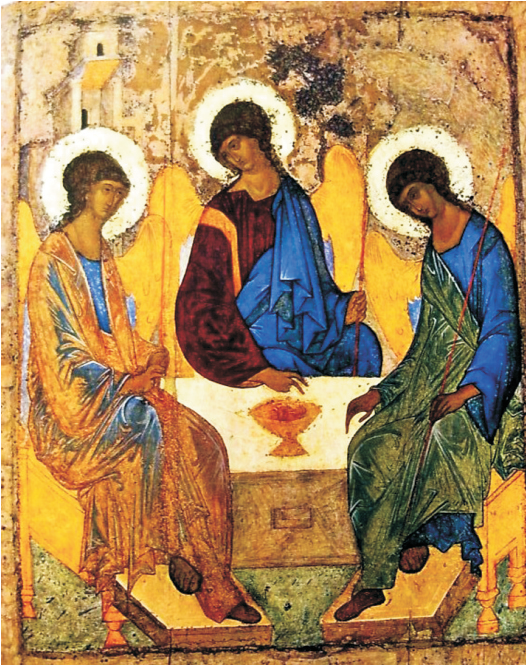
Christians imagine God, not as an “old man in the sky,” but as a flowing river of love. The mystery of the Trinity envisions the one God as three persons (i.e. Father, Son, and Holy Spirit), a community, a network of relationships, bound together in perfect love.

Whenever someone is baptized in the name of the Trinity, we are proclaiming our faith that this person, and every person, is caught up in that never-ending flow of love. The Trinity is why we, as Christians, are happy to say, “God is love, and those who abide in love abide in God, and God abides in them” (1 John 4:16). We don’t just attach the adjective “love” to the noun “God,” we go all the way to saying that God is love itself. And love, as we remember from English class, is a verb.

And if love is a verb, and God is love, then God is a verb. God doesn’t just exist; God happens wherever love is happening. If a river were ever to stop flowing, it would cease to be a river and become a lake. In the same way, if God’s love were ever to stop flowing outward in greater and greater circles of community, God would cease to be God.

This is the alternate way of living that Jesus presents to us on Palm Sunday: The way of self-giving love. Jesus does this because that’s who Jesus is, that’s who God is, and that’s who we are called to be.

Jesus didn’t come to win; he came to love. He didn’t ride a war horse; he rode a donkey. He didn’t exploit his power; he emptied himself.

Today, Jesus invites us to stand with him.

So, as we enter Holy Week, let us stand with him, not because we want to beat someone, but because it’s right, because it’s decent, and above all—It’s kind. Maybe it won’t lead to us winning the competitions that the world values so much, but it’s the best that Jesus can do, and he will stand here doing it until it kills him. It’s who Jesus is, and who he is is where he stands, and where he stands is where he falls. We already know from experience that the cut-throat way of the world is doomed to failure, so let us try this other way instead. Let us stand with him in love, through Holy Week and every week, until it kills us. Until that Easter morning when the tomb is opened and even death itself is swallowed up in victory, powerless against the relentless flow of God’s love.

An Impact Beyond the Intent

Photo credit: Enrique López-Tamayo Biosca, CC BY 2.0 https://creativecommons.org/licenses/by/2.0, via Wikimedia Commons

Sermon for the Fifth Sunday in Lent.

Click here to read the biblical texts.

Back before my wife Sarah and I had started dating, we were in that awkward stage where we were both noticing each other, but neither one had worked up the courage to make a move, so we just kept dancing around the subject. One night, Sarah invited me to a party at her house, and we ended up talking on the couch long after everyone else had left. It was getting late, Sarah reached forward for her drink on the coffee table, I unconsciously stretched, and she accidentally sat right back into the spot where my arm was. Sarah was like, “That was smooth! Can we talk about this?” On the outside, I played it very cool and calm, but on the inside, I was like: “AAAAAAAAAAAAAAAAAAAAAAHHHHHHHHHHHHHH!!!!!!!!!!!!!!”

Anyway… to make a long story short: It went pretty well and we’ve been married for 20 years.

The moral of the story is that our actions sometimes have an impact beyond what we intended them to have. That was certainly the case with St. Mary of Bethany in today’s gospel.

Mary’s anointing of Jesus happens at a very important turning point in the larger story of John’s gospel. Up until this point, Jesus had been dropping hints about his true identity, but from this point forward, he would begin to speak more openly as the story moved toward its climax with his crucifixion and resurrection.

In the chapter just prior to this one, Jesus raised Mary’s brother Lazarus from the dead. This miracle, according to John, was the catalyst that caused the religious leaders to begin plotting to have Jesus killed. As this part of the story begins, Jesus is having dinner at the home of Lazarus, Martha, and Mary. The memory of Lazarus’ death and resurrection was very fresh. Mary would have been deeply moved by the miracle she had just witnessed. Not only had Jesus turned her grief into joy, he had also rescued Mary and Martha from a life of poverty and degradation, which would have absolutely happened to two unmarried women who no longer had a man to speak for them in their patriarchal society. Jesus had saved, not one life, but three lives in his raising of Lazarus from the dead. Mary probably felt that she owed Jesus her life at this point.

As a sign of her gratitude, the text tells us that Mary took “a pound of costly perfume.” The Greek word for “costly perfume” is myrrh, which was used for burial rituals. It is quite likely that Mary had bought this perfume to use for her brother’s funeral, which was no longer necessary, thanks to Jesus. By breaking it open and pouring it on Jesus’ feet, she was expressing her relief and gratitude for what Jesus had done for her and her family.

This, all by itself, would have been a powerful statement, but Jesus gives it an even greater significance that Mary herself could not have known. Jesus says, “She bought it so that she might keep it for the day of my burial.”

Jesus knew, whether through supernatural clairvoyance or just an insightful hunch, that his own death was impending. Mary’s act of devotion meant more than she could possibly have known. Just as Mary honored Jesus with her gratitude, Jesus honored Mary with the knowledge of what her gesture truly meant to him.

The moral of this story is the same as the one I told about my wife and me: Our actions sometimes have an impact beyond what we intended them to have.

Our individual lives are a part of a larger story. Like ripples in a pond, God’s grace expands the meaning of what we do to cosmic significance. If, as Jesus says, even the hairs on our head are numbered, then surely no small act of goodness or kindness goes unnoticed by the God who made the universe.

My favorite modern example of an action that has a greater impact than its intent is the story of Fr. Trevor Huddleston, an Anglican priest who ministered in South Africa in the early twentieth century. Fr. Huddleston was an outspoken activist against the apartheid policies that discriminated against people of color in South Africa. One of the many racist laws on the books at that time was that, whenever a darker-skinned person passed a lighter-skinned person in the street, the darker-skinned person had to step off the curb into the gutter and lift their hat in deference to the lighter-skinned person. Fr. Huddleston, who was himself a lighter-skinned person, thought this racist law was absolutely ridiculous. So, he made it his regular practice that, whenever he passed a person of color in the street, he would step off the curb and lift his hat in a gesture of respect to this fellow child of God. Technically, this was an act of civil disobedience against South African law, but Fr. Huddleston practiced this as an act of divine obedience to the higher law of God, which says that all people are created equal.

One day, Fr. Huddleston was walking down the street and saw a little boy and his mother coming his way. As was his usual practice, he stepped off the curb and lifted his hat in a gesture of respect as they walked by. The boy and his mother were people of color. The little boy asked his mother, “Mummy, who was that man?” And the mother replied, “Son, that man is an Anglican priest, and furthermore, he is a man of God.”

The little boy, telling this story years later, said, “That was the day that I decided I too wanted to be an Anglican priest, and furthermore, a man of God.” That little boy grew up to be Archbishop Desmond Tutu, who helped President Nelson Mandela dismantle the satanic apartheid system that kept God’s beloved children in chains for so many years. It is possible that Fr. Huddleston might have had no memory of that particular day, in which he acted with the same integrity that inspired his actions every day. Like St. Mary of Bethany, Fr. Huddleston could certainly not have known that his simple act of stepping off a curb would have a ripple effect that would eventually lead to the undoing of the twisted system against which he was protesting.

Kindred in Christ, I invite you today to consider how your own simple acts of compassion and courage may have a similar ripple effect on the world in which we live. One never knows when a word of kindness or a gesture of gratitude may have an impact far bigger than its intent. Many such acts are known to God alone, but rest assured that they are known. Jesus says, in his Sermon on the Mount, “When you give alms, do not let your left hand know what your right hand is doing, so that your alms may be done in secret, and your Father who sees in secret will reward you” (Matthew 6:3-4).

Dr. Martin Luther King, in his Letter from a Birmingham Jail, wrote, “We are caught in an inescapable network of mutuality, tied in a single garment of destiny. Whatever affects one directly, affects all indirectly.”

As witnesses of the gospel of Jesus Christ, I want to encourage you this day to speak up whenever one of our siblings in Christ has offered some small word or deed that has impacted your day. It is quite possible that the giver of this gift is unaware of what it meant to you. Be quick to offer thanks to them, and to God for them.

If you are on the receiving end of such recognition, I invite you to listen with ears of your heart, giving thanks to God, who has multiplied the impact of your small gift to mean more than you intended.

Dearly beloved, our lives are not our own and they are not lived alone. It is up to us to enlighten our neighbors with knowledge as they have enlightened us with the love of Christ in their hearts. Who knows whether that grateful acknowledgement might be the very encouragement needed by a weary soul who is secretly despairing of life itself? By adding our small gesture of thanks to the common wealth, we may provide the necessary means by which a life might be saved.

Like St. Mary of Bethany, our actions have an impact far beyond their intent. Let us remember this fact and draw strength from it. May we trust that our lives matter more than we know.

Amen.

The Prodigal Father

Sermon for the fourth Sunday in Lent.

Click here to read the biblical texts.

In his brief novel, The Great Divorce, Anglican author C.S. Lewis writes about an imaginary bus tour of heaven and hell. One of the many interesting things about this book is how he imagines hell. For Lewis, hell is not a realm of fire and brimstone where the wicked are eternally tortured for their sins on earth. Instead, he depicts hell as a place where people live in huge mansions and get whatever they want, whenever they want it. Sounds like heaven, doesn’t it? Well, the catch is that, with so much space and instant gratification available, people don’t need each other, so they just pack up and move farther away whenever anyone upsets them for even the slightest of reasons. This leaves vast tracts of empty cities where no one roams. Instead, everyone has locked themselves inside their own mansions and pace the empty halls alone all day, muttering about their “rights” and complaining that everything bad that has ever happened to them is not their fault. The real kicker is that the gates of this hell aren’t even locked; people can get up and go to heaven any time they want, except that nobody wants to. They would much rather stay stuck in their mansions, totally alone, and utterly convinced of their own self-righteousness. The souls of the damned in The Great Divorce bear a striking resemblance to the elder son in today’s gospel reading. I begin today’s sermon with this story because I too have a tendency to act like the self-righteous elder son in Jesus’ parable.

Here is my honest confession: Earlier this week, someone greatly offended me with something they said.

(PLEASE NOTE: If you are hearing this and wondering whether it was you, I want you to be assured that it was not. It had nothing to do with anyone in this room, this parish, or this town. I won’t tell the whole story here because it’s not important to this sermon. All you need to know is that my feelings were hurt and I was very angry about it).

I spent much of the week stewing in my self-righteous indignation, replaying the conversation over and over in my head, and losing sleep over it.

When I sat down to write this sermon, I read the passage and froze stiff when I got to the part about the elder son. I realized that, after my week of angry pouting, I could not, in good conscience, stand in this pulpit on Sunday morning and preach about the good news of God’s amazing grace without being a complete and total hypocrite (because that’s exactly how I’ve been acting). Like the elder son in Jesus’ parable, I wanted my enemies to be punished for what they had done to me; I wanted the scales of justice to be set right, only to realize, when I was confronted by the words of Jesus in Scripture, that I am, as my mother used to say, “full of bologna.”

“Holding onto resentment,” as the Buddha once said, “is like drinking poison and waiting for someone else to die.” That was me this week.

What struck me so hard is that Jesus’ parable of the prodigal son is not really about the prodigal son. It has more to do with the elder son. Jesus tells this story in response to a group of upstanding and religious citizens who were offended that Jesus was “hanging out with the wrong crowd.” In response to their complaints, Jesus tells three stories. The first and second stories are about a lost sheep and a lost coin, respectively. The third and final story was about a lost son who ran home with his proverbial tail between his legs after going on a bender and waking up face-down in a pigsty.

The part of the story we know best begins with the younger son asking his father for his share of the family inheritance. Normally, this sum of money would only be given out after the father had died, so this request was the equivalent of the younger son saying to his father, “You’re dead to me.” I can only imagine the pain that the father felt in that moment. But, instead of berating his son for saying something so stupid, the father honors the request and divides his wealth between his two sons.

As we know from the story, the younger son squandered his inheritance by partying hard until the money ran out and he fell on hard times. When he finally hit rock bottom, the younger son came to his senses and decided to return home. It’s important to note that this decision was not based on any sense of remorse for his actions, but out of the base desire for self-preservation. The younger son concocted a rehearsed speech, through which he hoped to con his way back into his father’s good graces.

When the younger son gets within sight of his family home, Jesus tells us, in what I think is one of the most comforting passages in the entire Bible, that “while he was still far off,” his father got up and ran to meet him. I love this verse so much. The father did not wait for the son to make it all the way home, but ran to him “while he was still far off.” This verse should be a great comfort for those of us who realize that, even after years of following Jesus, we are still very far away from where we ought to be, spiritually.

The father was not standing on the front porch with arms crossed, tapping his foot and waiting for his son to finally crawl his way up the driveway. No, Jesus says that “while he was still far off, his father saw him and was filled with compassion; he ran to him and put his arms around him and kissed him.”

The younger son, probably taken aback by this extravagant display of affection, nevertheless starts into his rehearsed speech, but his father doesn’t let him finish. He interrupts the speech with an enthusiastic call to start a party. This interruption should call into question everything that Christians have come to believe about the proper order of confession and forgiveness. The father does not wait to see if his son is sincere about his change of heart. He does not even let him finish his prepared speech.

(I wonder what it would be like if the priests in our church were to interrupt the congregation’s prayer of confession during the Sunday service and pronounce the absolution before they had even finished!)

The son is already forgiven before he even finishes confessing his sins, so great is his father’s love for him. So great is God’s love for you and me, as well, according to Jesus.

God does not forgive us because we repent; God forgives us before we repent. God’s amazing grace is what gives us the strength to repent and amend our lives in the first place.

So, a celebration ensues at the house. But, as we know, all is not well with the elder son, who had stayed home to work dutifully on his father’s farm. We learn a lot from the elder son’s reaction to the news that his brother had returned home. Unlike the father, the elder son was not happy to see him. We learn even more about the elder son’s misconceptions about who his father is.

He says to his father, “Listen! For all these years I have been working like a slave for you.” This is our first clue that something is off about the elder son’s perception of his relationship with his father: he thinks of himself as a slave, not a son. He thinks that his father is only interested in obedience, not love. He sees their relationship as merely transactional, not personal. He assumed, quite wrongly, that their relationship would end if the son was not perfectly submissive to the father’s power. The younger son’s return to a celebration would have completely upended the elder son’s faith in a morally-balanced world.

The next thing the elder son says is, “I have never disobeyed your command; yet you have never given me even a young goat so that I might celebrate with my friends.” Now, this is a very puzzling statement. Earlier in the story, Jesus remarked how the father had “divided his property between [his two sons],” at the younger son’s request. Presumably then, the elder son would have already received his share of the family estate which, according to the inheritance laws of that time, would have been a double-portion of that which was given to his younger brother. So, when the father tells his eldest son, “All that is mine is yours,” he was not just speaking metaphorically or hyperbolically; he meant it literally. The fact that the elder son still sees himself as a slave, who has never received anything from his father, is incontrovertible proof that the elder son has entirely misjudged the character of his father.

In the end, this is not actually a parable about a lost son, but about two lost sons. The younger wandered away and wasted what had been given to him; the elder stayed home and forgot that he had been given anything at all. The elder son, by Jesus’ account, is the one who is in the more spiritually precarious position.

The real story, however, is not about either of the sons, but about the father. The father comes out to meet both of his lost sons where they are, in the midst of their self-made mess. Traditionally, this story has been known as “the parable of the prodigal son.” The word “prodigal” comes from a Latin word meaning “lavish or extravagant.” The most lavish and extravagant thing in this parable, as I see it, is not the younger son’s wastefulness, but his father’s graciousness and love toward both of his sons. For this reason, I would like to suggest that we rename this story, “the parable of the prodigal father.”

Kindred in Christ, the good news of this story is that our Father in heaven, as revealed in his Son Jesus Christ, loves us more than we deserve, more than we expect, and even more than we understand. God’s amazing grace and unconditional love annihilates all of our manufactured misconceptions about who God is and who we are, in relation to God.

The truth is that we are loved and we are forgiven by God. Full stop. No provisos, addenda, or quid pro quo. It is a free gift; we did not earn it, so we cannot lose it. Nothing is required.

The only thing God requests of us, out of love, is that we trust in that love and pass it along to others, through our words and actions. Even this meager request is more for our benefit than God’s.

In a world torn by self-righteous violence, the humble testimony of those who know that they are loved, in spite of our best efforts to prove otherwise, has the power to undo the shackles of our own self-righteousness and liberate us from the hell of our own making.

May each of us trust that we are forever held by this love and do our best to demonstrate it to others, to the end that they too might join us in proclaiming the good news of God’s amazing grace.

The Gardener Who Never Gives Up

Sermon for the Third Sunday in Lent.

Click here for the biblical readings.

Hi, my name is Barrett and I make poor life choices.

Back in 2013, my family and I moved from upstate New York to western Michigan. We figured it would take a couple of days to pack up our stuff, load the truck, and get on the road. After all, we had made a similar move just a few years earlier, coming from the west coast of Canada to New York.

What we failed to account for, though, is that our previous move involved two broke seminarians in a one-room apartment. Everything we owned fit in the back of a modest U-Haul. Over the course of the intervening years, we had amassed a much larger collection of furniture, books, and kids (with all their accompanying accoutrements). A couple of days and a U-Haul wouldn’t be nearly enough to get the job done this time.

A visitor to my house asked, “Hey, aren’t you moving to Michigan next week?”

“Sure,” I said, “I figure I’ll just throw some stuff in boxes and hit the road.”

My friend very wisely took that opportunity to gently talk some much-needed sense into me, “Listen, you’ve got a lot more stuff in this house than you did when you got here. I don’t think a couple of days is going to be enough time.” Thank God for good friends, because this blessed soul organized a whole cadre of neighbors who descended upon my messy house for the entire week that it took the lot of us to get things packed and cleaned before moving day. In the end, everything came together right on time, but there’s no way it would have if it hadn’t been for the love of these people who rescued me from the mess of my own making. All in all, the stakes were relatively low in this crisis, but I was very grateful for the community that made a safety-net for me, when I needed it.

For other people, the stakes aren’t so low and a safety-net is not always there when they need it. Most of us have made regrettable decisions, of one kind or another, in our lives. Tragedy often strikes when unfortunate circumstances combine with our poor choices to leave us in a real pickle. Some of our unhoused neighbors, for example, could tell us heart-rending tales of woe about how they ended up living on the street, through no fault of their own. Others who have never experienced housing insecurity might be tempted to dismiss such stories as mere excuses. “The poor are poor,” some might say, “because of their own fault. If they had made better choices, they wouldn’t be in this mess.”

Thinking this way is tempting because it provides a false sense of security. Some might think, perhaps unconsciously, that they can protect themselves from disaster by being smart enough, good enough, or careful enough. But the reality is that life is rarely so simple. All of us have known good and hardworking people who nevertheless suffer hardship. The scary fact is that all of us are more vulnerable than we would like to think. Moralizing about the causes of disaster will not protect us when bad things happen to good people, especially since good people are also prone to making mistakes, from time to time.

So then, the real question for us Christians is not, “Why are the poor poor,” but, “What will we do about it?” That is the question that Jesus addresses in today’s gospel.

At the opening of the passage, Jesus talks about two terrible events that had happened in recent memory for his listeners. The first was a violent attack on worshipers at the temple by the Roman governor Pontius Pilate. The second was a building collapse in which eighteen people had been killed. Jesus answers the question about blame in a very straightforward manner: “Do you think that they were worse offenders than all the others living in Jerusalem? No, I tell you.”

Jesus typically asks more questions than he answers and often responds to questions with figurative stories, but this is one of the few times when he gives a direct and unequivocal answer: Did these people deserve what happened to them? No, they did not.

What he says next, however, almost undermines what he just said. Jesus says, “Unless you repent, you will all perish just as they did!” In this moment, Jesus almost sounds like an old-timey southern preacher, screaming through a megaphone while standing on streetcorner soap box. But that’s not what Jesus intends.

It helps to understand that the word “repent” has very little to do with feeling guilt or fear. The Greek word translated as “repent” is “metanoia,” which literally means, “change your mind.” Likewise, the word used for “perish” is not just referring to physical death, which eventually happens to everyone, but spiritual death. The best definition of “perishing,” in the spiritual sense, was given by Dr. Martin Luther King when he said, “Our lives begin to end the day we become silent about things that matter.”

Jesus’ warning about “perishing” is about this kind of spiritual death that we are in danger of experiencing, if we do not change our way of thinking about the misfortunes that befall our fellow human beings.

What then is the alternative that Jesus recommends we follow? To answer this, we need to look at the parable Jesus tells in the next part of the passage. It’s the story of a fig tree that is not performing as expected. The owner of the field wants to tear up the tree and throw it away to make room for other, more productive plants. But the gardener recommends patience and care instead. He says, “Sir, let it alone for one more year, until I dig around it and put manure on it.” He recommends that more attention, not less, be given to the plant. He doesn’t give up, but gets involved. God, according to Jesus, is more like the gardener than the owner of the vineyard.

Jesus presents us with the image of a God who does not give up on us, but is willing to get the divine hands dirty with hard work. The implication is that, if God doesn’t give up on us, then neither should we give up on each other.

What I find most interesting about this parable is the unresolved ending. We, the audience, don’t get to find out how the story ends. Did the owner agree to the gardener’s suggestion? Did the extra effort pay off, in the end? Jesus doesn’t say, so we just don’t know. The open ending of this parable does not leave us with certainty, but with hope. There are no guarantees in this life, but the stance of getting involved, rather than giving up, is the best hope we have for making a future that is better than the status quo we are enduring at this moment. The ending of this parable is Jesus’ way of telling us, “The ball is in your court. What are you going to do?”

When I failed to adequately plan for my big move from New York to Michigan, my friends could have easily shrugged their shoulders and said, “Well, that’s just what happens when you fail to plan ahead!” They could have rightly left me stewing in a mess of my own making. I am so grateful they did not do that. Out of their great love for me, they made my problem their problem and turned a moment of crisis into a moment of grace.

Kindred in Christ, the uncertainties of life and imperfections of human nature mean that we are all in the same boat together. We can choose to give up on each other and say, “It’s every man for himself,” or we can get involved with each other, get our hands dirty, and lean into the hope that we can make a better next year than we had last year.

In Matthew 25:31-46, Jesus gives us some practical advice on the kinds of things we can do to show up for each other. The Church has traditionally called them, “The Corporal Works of Mercy.” They are: To feed the hungry, to give water to the thirsty, to shelter the homeless, to visit the sick, to visit the imprisoned, and to give alms to the poor.

Like the gardener’s suggestions in Jesus’ parable, the Corporal Works of Mercy are not a guaranteed plan of social reform; they are a list of virtues that Christians ought to be practicing, for their own sake. We cannot solve the world’s problems, nor can we protect ourselves from the dangers of calamity and our own stupid mistakes, but we can show up for each other in a spirit of care and concern, willing to get our hands dirty with the kind of work that Jesus Christ calls us to do. By following Jesus, and practicing the virtues he taught us, we bear witness to the loving presence of the God who does not give up on us, who gets involved in helping each of us clean up the messes of our own making, and gives us hope for a better tomorrow than we had yesterday.

Friends, our God does not give up on us, so let us not give up on each other. Let us work together in hope, because it is a hope worth working for. Amen.

Out of the Ashes

Sermon for Ash Wednesday

Click here for the biblical readings

On Labor Day 1973, my mom and dad, then newly married, were in an apartment fire. Dad was the first in the building to wake up and smell smoke. He ran down the hall, banging on doors to alert the neighbors. Mom, meanwhile, took a quick glance around the room for anything essential. Thinking to herself, “The only thing I can’t replace is my wedding pictures,” she grabbed the album and ran. When I called Mom this week to ask permission to share this story, she recounted the story to me again: “So, there was your mother, without wallet or car keys, standing outside in nothing but her checkered nightgown, clutching a photo album!”

Sudden brushes with mortality have a way of reminding us about what really matters. The crisis itself wakes us up to what is most important. Too often, we humans have a tendency to get overly attached to our creature comforts, bad habits, and pet projects. We often miss the forest for the trees, when it comes to evaluating our priorities in life. Sudden crises can sometimes be useful in helping us clear out the junk and rediscover who we truly are.

In the penitential season of Lent, the Church provides us with a way to consciously engage in this kind of self-reflection without going through the inconvenience of a sudden crisis. During these forty days, we can intentionally choose to recognize and let go of the extra clutter in our souls and refocus our attention on what really matters.

Spiritual writer Richard Rohr, calls this, “the spirituality of subtraction.” He says that, often, the true task of our spiritual practices is not to add something that we need in our lives, but to help us let go of what we don’t need. The season of Lent is a good time to practice “the spirituality of subtraction.”

Lent is about getting underneath the cluttered surface of life and rediscovering the “the treasure hidden in the field” of our lives. Today’s Scripture readings give us a few hints about how to do that.

In the first reading, from the Hebrew Scriptures, the prophet Joel tells the people, “Rend your hearts and not your clothing. Return to the LORD, your God, for he is gracious and merciful, slow to anger, and abounding in steadfast love” (Joel 2:13). In ancient Hebrew culture, the tearing of one’s clothes was an outward sign of grief or penitence. Joel is encouraging the people to go deeper than the outward gesture and focus instead on the inner meaning of sorrow.

Jesus, in a similar fashion, warns the people in today’s gospel, “Beware of practicing your piety before others in order to be seen by them” (Matthew 6:1). The point of almsgiving, fasting, and prayer, according to Jesus, is not to make us look good and pious in front of our neighbors, but to help us reorient our hearts toward God.

Almsgiving, fasting, and prayer are all traditional practices associated with the season of Lent. In a world economy based on greed, self-indulgence, and power, the practices of almsgiving, fasting, and prayer are like cloths that we use to wipe away the extra grime on the surface of a mirror, so that we can then see our true reflection smiling back at us once more. In order for these cleaning tools to be effective, we have to stop caring what others think about us and face the honest truth about who we are.

Many of us live with an unspoken fear that, underneath our collected junk of ego-centric debris, there is no true self. We think, “Who am I without this job/degree/car/house/status/money/relationship?” Sometimes, it can even be a negative thing that we have nevertheless come to identify with: “Who am I without this trauma/rage/illness?” We worry that, if we let go of these things, there will be nothing left of us.

The hardest spiritual truth to believe, the biggest leap of faith to take, is to let ourselves become skeptical of our delusion there will be nothing left of us when the debris of our egos has been swept away.

Lent is, traditionally, the time when new converts to the faith prepare themselves to receive the Sacrament of Baptism. For those who have already been baptized, it is a time when Christians prepare themselves to renew that covenant at Easter Vigil. In Baptism, each of us hears again the message that was proclaimed by God over Jesus, at his baptism: “You are my [Child], the beloved; with you I am well pleased” (Mark 1:11). Beloved children of God is who we truly are, whether we realize it or not, whether we believe it or not. The spiritual exercises of Lent are tools given to help us return to this most central truth of our lives.

The message of Jesus, in today’s gospel, is that there is something there, waiting to be rediscovered. In fact, Jesus says, what you find underneath all that junk is who you authentically are, as the beloved child of God. St. Paul writes, in the New Testament, “Set your minds on the things that are above, not on the things that are on earth, for you have died, and your life is hidden with Christ in God. When Christ who is your life is revealed, then you also will be revealed with him in glory” (Colossians 3:2-4).

Christ is our life. Christ is our true self, fully present, though hidden under the clutter of our fragile egos.

Kindred in Christ, Lent is a time when we can return to awareness of this central truth. Lent is a time for letting go of those things that no longer serve us, or our true purpose in life. Lent is a time when we can rediscover what really matters and who we truly are as beloved children of God.

I encourage you, during these forty days of almsgiving, fasting, and prayer, to do what my mother did on the night of that apartment fire: Take a glance around the room of your life, to think about what really matters and what cannot be replaced, so that you can then let go of what matters less. Like my mom, you may find yourself standing outside on a cold night, without wallet or car keys, but safe, alive, and holding on to what really matters.

May it be so, and may you rediscover who you truly are as the beloved child of God.

The Way We See Things Matters

Sermon for the Last Sunday after the Epiphany.

Click here for the biblical readings.

The way we see things matters.

For example, when I worked as a hospice chaplain, one could say that I was a highly trained professional, providing expert care for my patients’ spiritual needs. On the other hand, one could also say that I was simply “heaven’s UPS guy,” making special deliveries to the pearly gates. It depends on how you look at it.

The way we see things matters.

One could see the world as a battleground between us and them, the haves and the have-nots, the fit and the unfit, or the good guys and the bad guys. What matters, according to this worldview, is ensuring that our side wins and the other side loses.

One could see the world as a meaningless conglomeration of matter and energy that is ultimately indifferent to the needs and wants of human beings. What matters, according to this worldview, is imposing our will and our ingenuity onto the chaos and forcing it to satisfy our desires.

The Christian worldview does not see the world in either of these ways. As Christians, we follow the guidance of our Lord and Savior Jesus Christ, who teaches that our Father in heaven “makes his sun to rise on the evil and on the good, and sends rain on the righteous and on the unrighteous” (Matthew 5:45). Later on, Jesus says, “Look at the birds of the air; they neither sow nor reap nor gather into barns, and yet your heavenly Father feeds them” (6:26) and, “Consider the lilies of the field, how they grow; they neither toil nor spin, yet I tell you, even Solomon in all his glory was not clothed like one of these” (28-29).

Jesus sees the universe as a good place that is constantly being created and cared for by God. According to the creation stories in the book of Genesis, which Jesus grew up reading, God created a wonderfully good universe, formed humankind in the divine image, and placed us in the world in order to help care for this beautiful place. Anyone who has read the account of the life and teachings of Jesus in the gospels knows that Jesus is not blind or indifferent to the complicated realities of conflict and suffering, but he regards all of that as secondary to the central truth of a good God who created a good world and continues to sustain it in love.

The fourteenth century English mystic, Julian of Norwich, was the first woman to write a book in English. While lying sick in bed and near death, Julian describes her own experience of the kind of worldview that Jesus wanted to instill in his followers.

Julian writes that God,

“showed me something small, no bigger than a hazelnut, lying in the palm of my hand, and I perceived that it was as round as any ball. I looked at it and thought: What can this be? And I was given this general answer: It is everything which is made. I was amazed that it could last, for I thought that it was so little that it could suddenly fall into nothing. And I was answered in my understanding: It lasts and always will, because God loves it; and thus everything has being through the love of God.”

(Julian of Norwich, Showings, IV)

The way that Julian and Jesus see the world is very different from the way that nationalists, terrorists, and other fanatics see the world. For Julian and Jesus, there is no struggle between us and them, no cosmic indifference to suffering, because there is only the God whose name is Love.

The way we see things matters.

In today’s gospel, we get to see the beginning of the Christian worldview taking root in the minds of Jesus’ disciples, Saints Peter, James, and John. We read that Jesus takes these three friends up a mountain and there, far away from the bustling crowds, “the appearance of his face changed, and his clothes became dazzling white” (Luke 9:29). While this might sound like the beginning of a commercial for laundry detergent, no sales pitch was forthcoming. The gospel writers preserved this story in order to express the way they saw Jesus. For them, Jesus was more than just a good man or a wise teacher; he was full of divine radiance. In later centuries, the bishops of the Church would develop this experience into the doctrine we now know as the divinity of Christ.

One of the things that makes Christianity unique among the religions of the world is that we find God in a person. In Judaism and Islam, Moses and Muhammad are respected as prophets who proclaim the divine message. In the Buddhist tradition, Siddartha Gautama is the enlightened sage who reveals the Eight-fold Path. In Christianity, on the other hand, Jesus Christ does not reveal the message, but is the message itself. Christians find God in Jesus and, through Jesus, we find God everywhere else.

This is why Jesus refers so frequently to nature in his parables. When people ask him to tell them about the kingdom of God, he says, “Do you see those crops growing in the field? Do you see that woman baking bread? Do you see that farmer sowing seed?” Jesus invites us to “consider the lilies of the field” and “the birds of the air” as reminders of God’s presence. For Jesus, all of these mundane occurrences are revelations of the divine.

The way we see things matters.

If our worldview is shaped by the class warfare of Marxist communism or the market forces of industrial capitalism, we will see the world as an endless fight for survival. If our worldview is shaped by (so-called) Christian nationalism or (so-called) Islamic terrorism, we will see the world as a battleground over who is right and who is wrong. But when our worldview is shaped by the Gospel of Jesus Christ, our Transfigured Lord will show us a transfigured world that glows brightly with the radiance of God.

I think about the story of the Transfiguration whenever I am outside in the evening and happen to catch those glorious moments near sunset, when all the trees and buildings seem to be shining with a golden light. I feel like I have to stop and make the sign of the cross because it seems like God is granting us a moment, however brief, when we get to see the world the way God sees it all the time.

I think also of another moment of transfiguration, that took place on a busy streetcorner in Kentucky. It was recorded by a 20th century monk named Thomas Merton.

He writes:

“In Louisville, at the corner of Fourth and Walnut, in the center of the shopping district, I was suddenly overwhelmed with the realization that I loved all those people, that they were mine and I theirs, that we could not be alien to one another even though we were total strangers. It was like waking from a dream of separateness… This sense of liberation from an illusory difference was such a relief and such a joy to me that I almost laughed out loud… I have the immense joy of being [human], a member of a race in which God Himself became incarnate. As if the sorrows and stupidities of the human condition could overwhelm me, now I realize what we all are. And if only everybody could realize this! But it cannot be explained. There is no way of telling people that they are all walking around shining like the sun.”

(Merton, Conjectures of a Guilty Bystander, p. 156-157)

What does this vision of the Transfiguration look like, when we live it out on a day-to-day basis?

Earlier this week, one of our parishioners at St. Mark’s came into the office and shared a very meaningful, true story with me. It stands out as a reminder of what life could be like, if we tried to see the world the way Jesus sees it. I share that story now with her permission.

Our parishioner is an elderly lady who had been feeling sick all week. After several days, she finally felt well enough to go to the grocery store for supplies. Upon returning home, she was struggling to unload the groceries from her car in the bitter cold. As it happened, a mailman was driving by at that exact moment. When he saw the lady struggling, he parked his truck, got out, and carried the groceries into the house for her. It was a relatively small gesture of neighborly kindness, but it meant the world to this lady. She thanked him profusely, and was absolutely floored by the next thing he said:

“Well ma’am,” the mailman said, “I just figured that’s what Jesus would do.”

This response blew me away. This is what life could be like, if we saw the world the way Jesus sees it.

Kindred in Christ, the way we see things matters.

I encourage you this week to draw inspiration from the great spiritual masters like Jesus Christ, Thomas Merton, Julian of Norwich, and that mailman from Coldwater, Michigan. I invite you to become followers of Jesus, to see the world the way he sees it, full of divine glory. I invite you to look at your fellow beings on this Earth, not as enemies to be defeated, but as neighbors to be loved.

May this Christlike way of seeing transfigure you from the inside out and lead you out to transfigure this world in the name of the God whose name is Love, and in the name of the Love whose name is God.

Amen.

Loving Hard in a Hard World

Sermon for the Seventh Sunday after the Epiphany.

Delivered at St. Mark’s Episcopal Church, Coldwater

Click here for the biblical texts.

Sermon recording:

Photo credit: Image of Archbishop Desmond Tutu by Elke Wetzig (Elya), CC BY-SA 3.0 http://creativecommons.org/licenses/by-sa/3.0/, via Wikimedia Commons

There is no manuscript this week. Here is my outline:

I. Introduction – “I love Jesus, but sometimes he makes me mad.”

1.                 “That’s not what I said”

(1)                You be nice to me and I’ll be nice to you
(2)                I’ll try to be nice to people who aren’t nice to me, but there’s a limit
(3)                Be nice to terrorists and racists, approve whatever they do
  • Being nice doesn’t enter into it
    • Nice is a tool
(4)                Like your enemies

II. What Jesus actually said:

1.                 “Love your enemies.”

(1)                Love is a choice, not a feeling

2.                 “Turn the other cheek”

(1)                Cultural context: Walter Wink
  • Insult, not injury
    • Open right hand only
      • Left hand too degrading (used for sanitation purposes)
        • Turning face gets nose in the way, assailant liable for damages
        • Closed hand (fist) reserved for equals
(2)                Nonviolent resistance
  • Make them hit you like an equal
    • Take the power back, but don’t return violence for violence

III. The heart of the Gospel

1.                 In a hard world of violence, God loves even harder

(1)                Radical love, impractical love, offensive love

2.                 When humanity turned away from God and fell into sin, God did not turn away from us.

(1)                God took on flesh and dwelt among us in the person of Jesus Christ, who taught and demonstrated love in every moment of his life
(2)                When the political and religious powers-that-be tried to shut Jesus down, he spoke up and acted out even louder
(3)                When that didn’t work, they unleashed all their powers of hate and violence at Jesus in order to silence the voice of love, once and for all
(4)                But even that didn’t work, because Love Itself cannot be contained, even by death, which is why Jesus rose from the grave on Easter morning, conquering the power of death, and bursting open the gates of hell from the inside
  • Easter Sunday is the biggest jailbreak of all time

3.                 Eucharistic Prayer D in the Book of Common Prayer sums it up beautifully (p. 373)

“When our disobedience took us far from you, you did not abandon us to the power of death. In your mercy you came to our help, so that in seeking you we might find you. Again and again you called us into covenant with you, and through the prophets you taught us to hope for salvation. Holy God, you loved the world so much that in the fullness of time you sent your only Son to be our Savior. Incarnate by the Holy Spirit, born of the Virgin Mary, Jesus lived as one of us, yet without sin. To the poor he proclaimed the good news of salvation; to prisoners, freedom; to the sorrowful, joy. To fulfill your purpose Jesus gave himself up to death; and, rising from the grave, destroyed death, and made the whole creation new.”

The Book of Common Prayer, p. 373-374

IV. As Gospel people, we ought to love with the same wild and reckless abandon: radical, impractical, offensive

1.                 Archbishop Desmond Tutu, Truth and Reconciliation Commission

(1)                Mother of murdered son, to his murderer:

“I am very full of sorrow. So I am asking you now – come with me to the place where he died, pick up in your hands some of the dust of the place where his body lay, and feel in your world what it is to have lost so much. And then I will ask you one thing more. When you have felt my sadness, I want you to do this. I have so much love, and without my son, that love has nowhere to go. On turning to the policeman she said ‘So I am asking you from now on – you be my son, and I will love you in his place.”

2.                 On a smaller, more personal/local scale

(1)                Nonviolent Communication Strategies (Marshall Rosenberg)
  • “When you did ____.”
  • “I felt ____.”
  • “Because I value/need/want ____.”
  • “I request that you ____.”

V. Conclusion

“Goodness is stronger than evil,
Love is stronger than hate,
Light is stronger than darkness,
Life is stronger than death.
Victory is ours,
Victory is ours,
Through God who loves us.”

Prayer by Archbishop Desmond Tutu