The Amazing Grace People

Sermon for the Third Sunday after the Epiphany.

St. Mark’s Episcopal Church,
Coldwater, MI

The biblical text is Luke 4:14-21. Click here to read.

In the 2001 movie Shrek, the titular ogre tries to explain to his friend, the donkey, how ogres are complex beings.

“Ogres are like onions,” says he.

The donkey replies, “Why? Because you smell bad?”

Shrek: “No.”

Donkey: “Because you make people cry?”

Shrek: “No… because we both have layers. Onions have layers; ogres have layers. You get it.”

Just like ogres and onions, today’s gospel also has layers. Specifically, it has three layers: Jesus, Isaiah, and Jubilee. We are going to have to unpack each of those layers in order to fully appreciate what Jesus is saying in this passage of Scripture.

In the first layer, we have Jesus preaching a sermon at the synagogue in his hometown of Nazareth. This would have been very exciting for the people of that town. Many of our parishioners at St. Mark’s will remember the late Bishop Tom Shaw, who grew up in this parish and later became a monk, a priest, and a bishop in The Episcopal Church. We still keep a candle burning in his memory between the pulpit and the altar. Imagine how exciting it would be for Bishop Shaw to come back and say Mass here, at the parish church where he grew up. That’s how big a deal it would have been for the people of Nazareth when Jesus came home to preach.

This story is also a big deal in the gospel according to Luke because the author uses it as Jesus’ inaugural address at the beginning of his ministry. In the same way that a president’s inaugural address sets the tone for that president’s term of office, this sermon is Luke’s way of setting the tone for the rest of Jesus’ ministry.

So, what is the tone that Luke is trying to set? To understand that, we need to look at the second layer of this passage: Isaiah.

The passage of Scripture that Jesus read in the synagogue comes from the book of Isaiah, chapter 61. The prophet, in this section of Isaiah, is writing to the Jewish people as they return from a half-century of exile. In 587 BCE, the Babylonians invaded the southern kingdom of Judah and hauled their leaders away as slaves. During the next 50 years, the Babylonians tried to do to the Jewish people what white settlers did to indigenous tribes in North America: They displaced the people from their homeland and tried to erase their culture by outlawing the speaking of their language and the practice of their religion.

Thankfully, the early Jews resisted this attempt at forced assimilation. They pushed back against their enslavers, wrote down their ancestral stories in the Torah, taught those stories to their children, and went on strike once a week, on the Sabbath, to remind themselves and their captors that they were not the property of the Babylonians, but beloved children of God. After two generations of resistance, the Persians conquered the Babylonians and allowed the Jews to return home and rebuild.

Isaiah 61 was written as the Jews were beginning that process of rebuilding after the Babylonian Exile. During this time, the people were looking for some kind of inspiration to guide them in that process. The prophet provided that inspiration by looking even further back into Israel’s history. When Isaiah talks about “good news to the poor,” “release to the captives,” and “the year of the Lord’s favor,” he is talking about the year of Jubilee, which leads us to the third and final layer of this story.

The year of Jubilee was prescribed as one of God’s laws in the Torah. It appears in chapter 25 of the book of Leviticus. According to this law, there was to be a general amnesty of debts, once every fifty years. All debts would be forgiven, all enslaved people would be freed, and all land would return to its original owners. Practically, this would mean doing a hard reset on the economy. It would interrupt patterns of generational poverty and allow a fresh start, so that grandchildren were not still paying for the mistakes of their grandparents. Spiritually, the year of Jubilee communicated to the ancient Israelites that their God was a God of fresh starts and new beginnings. The God of Israel is, not just a God of law, but also a God of mercy. Compassion and forgiveness were established as foundational principles in the Torah, which is why Isaiah pointed to them as foundational principles of the new society that Jews were rebuilding after their return from slavery and exile in Babylon. The people had just been through a horrible period of collective trauma, so the prophet wanted to ensure that their new society would be a safe place to heal from that trauma. That’s why Isaiah pointed to the year of Jubilee as the model for what this new society would look like. The ancient prophet Isaiah understood what the 21st century prophet, Archbishop Desmond Tutu, also understood: that “there is no future without forgiveness.”

This brings us back to the first layer of our story: the layer of Jesus. Jesus appeals to the prophet Isaiah, who appeals to the year of Jubilee, to establish the fact that the foundational principle of God’s kingdom on Earth is the principle of mercy.

Mercy is the driving force behind everything that Jesus says and does. He demonstrated mercy by healing the sick and feeding the hungry. He showed mercy by welcoming tax collectors and sinners. He taught mercy by saying, “Blessed are the merciful, for they will receive mercy” (Matthew 5:7) and “Truly I tell you, just as you did it to one of the least of these brothers and sisters of mine, you did it to me” (Matthew 25:40). Finally, Jesus embodied mercy in his death on the cross, praying for his executioners, “Father, forgive them, for they do not know what they are doing” (Luke 23:34).

The reason why the author of Luke’s gospel has Jesus quote this passage from Isaiah, who refers to the year of Jubilee, in his first sermon, is to establish the fact that mercy is foundational principle of Jesus’ ministry on Earth. Therefore, if mercy is the driving principle behind Jesus’ ministry, then it ought to be the driving principle behind the Church’s mission as well.

Mercy is, and ought to be, an unsettling topic. Mercy takes away any sense of power from those who need and receive it. Mercy is shocking to those who still cling to their illusions of control. Mercy is offensive to the self-righteous, but, in the words of the late author (and Episcopalian) Rachel Held Evans, “What makes the gospel offensive is not who it keeps out, but who it lets in.”

Scripture and history are rife with examples of people for whom the mercy of Jesus became the central fact of their life. St. Paul the Apostle was transformed, by God’s mercy, from a persecutor of the Church to its first theologian. He writes, “I am the least of the apostles, unfit to be called an apostle, because I persecuted the church of God. But by the grace of God I am what I am, and his grace toward me has not been in vain” (I Corinthians 15:9-10). In the same way, the Rev. John Newton, who began his career as the captain of a slave ship, later experienced the mercy of God, repented of his sin, and became an Anglican priest. He dedicated the remainder of his life to ending the Atlantic slave trade and penned the most famous hymn in all of Christian history: “Amazing grace! How sweet the sound, that saved a wretch like me! I once was lost but now am found, was blind but now I see.”

According to Luke, in today’s gospel, mercy lies at the heart of everything Jesus does, therefore it ought to lie at the heart of everything the Church does in his Name. As receivers and conduits of God’s mercy, we are, and ought to be, the “Amazing Grace People.” The world ought to look at us with shock and awe when they see how indiscriminately we lavish the mercy of God upon those who deserve it least. As sinners, saved by grace, we ought to be offensive in our witness to the mercy of our Lord and Savior Jesus Christ.

Mercy was the driving force behind the year of Jubilee in Leviticus 25; mercy was the foundational principle of the new society that the prophet was rebuilding in Isaiah 61; mercy was the theme of Jesus’ ministry in the gospel according to Luke; and mercy is the Church’s reason for existing today.

Kindred in Christ, we have opened the Scriptures and examined Church history to wrap our minds and hearts around this overarching theme of God’s mercy. One question still remains: Where does this leave us, today? Will we be Christians or not? Will we risk everything to be conduits of God’s shocking and offensive mercy or not?

Thankfully, because of you “Amazing Grace People,” I don’t have to look very far to find an answer to that question.

Last Friday, I had the privilege of touring and speaking with the staff of Tommy’s House, which you may already know as a transitional residence for women recovering from the disease of addiction. The director of Tommy’s House, a parishioner in our congregation, explained to me how Tommy’s House provides a safe and supportive environment for its residents, helps them get back on their feet, and empowers them to begin new lives, beyond the shackles of chemical dependency.

During the tour, one of the staff members (who had previously been a resident in their program), asked me, “Why is it that, wherever we go, we always find that it’s the Episcopal churches in a city that open their doors to our Twelve Step recovery meetings?”

What a great question! There are two answers.

First, Episcopalians were there when the Twelve Steps were invented. Bill Wilson, the original author of the Twelve Steps, had a spiritual mentor named Fr. Samuel Shoemaker, who was an Episcopal priest. Bill W. often referred to Fr. Shoemaker as “the co-founder of Alcoholics Anonymous.” Fr. Shoemaker, of course, denied this allegation and gave full credit back to Bill. The fact remains, however, that The Episcopal Church was there when it happened and continues to be recognized as a safe space for Twelve Step recovery meetings.

The second, and more spiritually significant, reason why Episcopal churches are frequently known as reliable hosts for AA and NA meetings is because we are an “Amazing Grace People.” We believe that God is a God of second chances. We understand that a finite sinner cannot out-sin the mercy of an infinite God, therefore we are “the Amazing Grace People.”

Friends, I send you into the world this week in full assurance of the infinite mercy of God, which easily overwhelms the finite number of your sins. May the mercy of God be the foundation of your new life, from this day forward, just as it was for Isaiah, Jesus, and all who continue to minister in his holy Name. And “May the grace of our Lord Jesus Christ, and the love of God, and the fellowship of the Holy Spirit, be with us all evermore. Amen” (II Corinthians 13:14).
Book Review: How We Learn to Be Brave

I wrote the following book review for my diocesan magazine in late 2023. Reposting now because of the increased interest in Bishop Budde’s book.


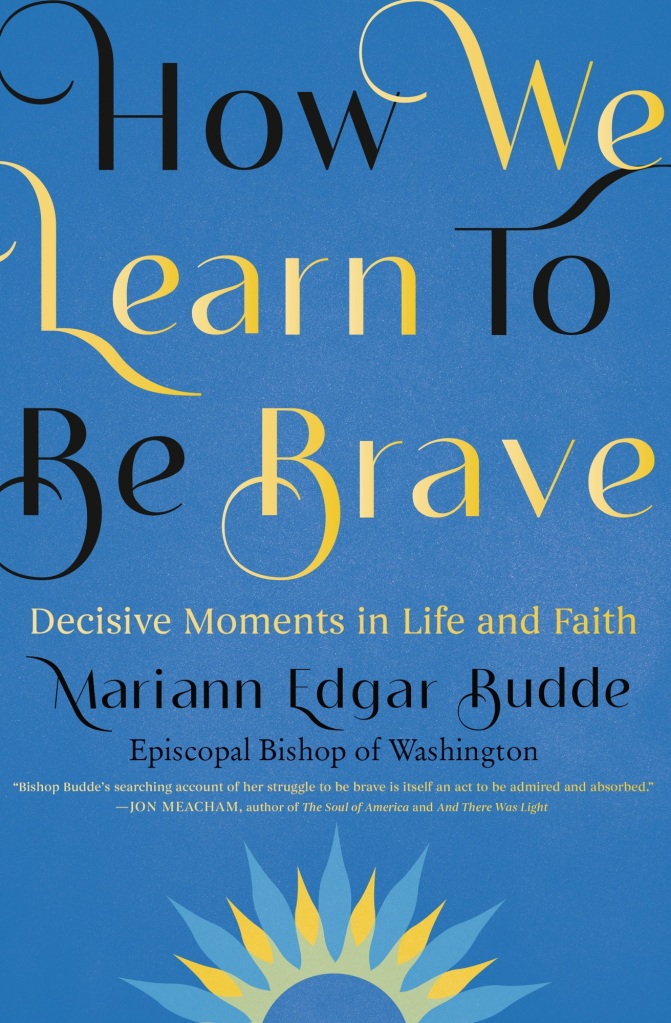
Edgar Budde, Mariann. How We Learn to Be Brave: Decisive Moments in Life and Faith.(New York: Avery, Penguin Random House LLC, 2023) 

How We Learn to Be Brave: Decisive Moments in Life and Faith is the third and most recent book by the Rt. Rev. Dr. Mariann Edgar Budde, the ninth and current bishop of the Episcopal Diocese of Washington. Published earlier this year, this book was inspired by the teargassing of protesters to make room for a political photo-op outside St. John’s Episcopal Church, Lafayette Square on June 1, 2020. This event, and the ecclesiastical response to it, propelled Bishop Budde and The Episcopal Church into the center of public attention for the first time since Presiding Bishop Michael Curry preached at the royal wedding of 2018. 

The book begins with an account of the events of June 1 from Bishop Budde’s point-of-view. After the initial retelling, the author occasionally refers to the events of that day, but the main thrust of the book has significantly more breadth and depth. As the title indicates, this is not a book about political grandstanding; it is a book about bravery.  

Part memoir, part history, and part theological treatise, this book focuses on the virtue of courage as a choice that we make. Bishop Budde writes: 

Decisive moments involve conscious choice, impressing their importance upon us as we experience them, for we know that we’re choosing a specific path of potential consequence. In a decisive moment, no matter how we got there, we no longer see ourselves as being acted upon by the slings and arrows of fortune or fate, but as ones with agency. We’re not on autopilot; we’re not half-engaged. We are, as they say, all in, shapers of our destiny, and cocreators with God. (xviii) 

Across the chapters that follow, Bishop Budde explores the various kinds of decisions to which the virtue of courage may call us. There are chapters on Deciding to Go, Deciding to Stay, Deciding to Start, Accepting What You Do Not Choose, Stepping Up to the Plate, The Inevitable Letdown, and The Hidden Virtue of Perseverance. 

Each chapter includes an autobiographical vignette and an historical profile to illustrate the particular theme. While the book is intended for a larger audience, the author does not shy away from biblical, liturgical, and theological references particular to Christians. Most (though not all) of the historical profiles are of prominent Episcopalians whose names are easily recognizable, even though their Episcopal faith may not be as widely-known. Historical examples include Franklin and Eleanor Roosevelt, Supreme Court Justice Thurgood Marshall, Jonathan Myrick Daniels, and the Rev. Dr. Pauli Murray. Contemporary Episcopal voices cited by the author include Dr. Brené Brown, the Rev. Dr. Kelly Brown Douglas, and Rachel Held Evans. The author makes a special point of highlighting examples from the lives of women and people of color.  

When it comes to the autobiographical sections, the author does not shy away from experiences of personal failure and disappointment. This spiritual reflection on the virtue of courage is not a self-congratulatory polemic. There are many times in life when courage calls us to take responsibility for our mistakes. Bishop Budde describes personal experiences of such moments with an abundance of honesty and humility. 

My primary criticism of the book is a relatively small and forgivable one. There are times when the several examples of historic Episcopalians come across as advertisements for our denomination. As a reader, it seemed like the author was implying, “Look at all these cool Episcopalians! Don’t you want to be one too?” A greater religious diversity among historical examples would have decreased my sense of evangelistic pressure and increased the book’s appeal to a wider audience. That being said, I think this fault is minor because the Episcopalians the author cites are indeed examples of the virtue she is expounding. Furthermore, since the author is an Episcopal bishop, I can’t really blame her for wanting to highlight the denomination she serves. 

All in all, I think this book will appeal to parish book groups and individuals looking for personal development. Its language is accessible to readers without a theological education and its spiritual dimension is broad enough to include people who do not identify as religious. Finally, though I must admit some personal bias on this point, I think this book would be an excellent choice for Episcopalians in the process of discernment and formation for ordained ministry.  

Courage, like love, is more choice than feeling. We blaze the trail of God’s call by putting one foot in front of the other, falling down, getting up, changing direction, and starting again. How We Learn to Be Brave gives ample inspiration, encouragement, and guidance for that process. 

Do Whatever He Tells You: A Practical Guide for Turning Water into Wine

Sermon for the second Sunday after the Epiphany, Year C.

Delivered at St. Mark’s Episcopal Church, Coldwater.

Click here to read the biblical passage.

“The key to the perfect wedding day is imperfection.”

That’s the one piece of advice I give to every couple who asks me to officiate their wedding. So long as both parties arrive at the ceremony safely, say their vows in front of an officiant and witnesses, and sign the license, it qualifies as a successful wedding. Everything else is extra. You can bank on some kind of hiccup with the DJ, the catering, or the dress. At my own wedding, the pre-recorded entrance music cut out while my wife was still halfway down the aisle, so she had to walk the rest of the way in silence. It was still a lovely day and a successful wedding.

In biblical times, however, things weren’t so simple. Weddings back then were week-long affairs that involved the entire town. The ceremony was a reaffirmation of the social bonds that held their community together; the couple served as a sacred symbol of God’s covenant with the people of Israel.

Furthermore, wine itself was an important symbol of blessing and joy, so it’s absence would have undoubtedly be interpreted as a bad omen for the new couple.

Running out of wine during such an auspicious occasion would have brought permanent shame on the family. This level of shame, more than mere embarrassment, would lead to the entire family being cut off from the community and not allowed to participate as functioning members of society. The closest thing our culture has to this kind of shaming is when a celebrity gets ‘cancelled’ for acting inappropriately with staff or fans. The difference is that the stakes were much higher: Firstly, because the people involved were regular, working-class folks and, secondly, because the bar for getting ‘cancelled’ was much lower than it is today. The shame of running out of wine at a wedding would have absolutely ruined the family involved.

Knowing this cultural background helps us understand the urgency in Mary’s voice when she informs Jesus, “They have no wine.”

Jesus’ curt response, then, seems shocking: “Woman, what concern is that to me and to you?”

This is a sentence that requires some explanation. At first glance, it sounds rude and dismissive, like a teenager who has just been asked to clean his room (“Ugh… whatever, bruh!”), but a careful examination of the language reveals a very different tone.

First of all, the term “woman” was a term of respect, much like “ma’am” or “madam” would be today. Since our culture uses different words for respect, I would personally not recommend calling your wife, partner, or mother, “woman.” (If you would like to test this hypothesis for yourself, I invite you to do so, and I will happily come to visit you in the hospital afterward.)

Second of all, the comment “what concern is that to me and to you” is meant to be more reassuring than dismissive. If Jesus had been Australian, he might have said, “No worries, mate!” In America, we might say, “No problem. Piece o’ cake!” That phrase is used in other parts of Scripture when a minor issue does not present a barrier to a relationship between two people. In essence, what Jesus is saying here is, “Don’t worry, ma’am. Everything is fine.”

Of course, this response is also shocking, albeit in a different way. Given what we just learned about weddings and wine in ancient Galilee, it would have been perfectly understandable if Mary had said, “What do mean, Jesus?! Everything is not fine! This is a real crisis!” But Mary doesn’t do that. Instead, she calmly turns to the servants and says, “Do whatever he tells you.”

The rest of the story plays out as we read it in today’s gospel. The servants follow Jesus’ instructions and a miraculous transformation ensues. Symbolically, the joy and abundance of life is restored to an even greater level than where it was before.

I’d like to think that I would have the same quiet confidence as Mary during a catastrophe, but I’m not 100% sure that I would. (Then again, maybe that’s why God chose her, instead of me, to be Jesus’ mother.) I’ve been known to indulge in more than my fair share of “doom-scrolling.” Like so many of us, I frequently feel overwhelmed by the crushing pressure of crises, in my life and in the world, that I can do nothing to fix. Mary’s plea to Jesus, “They have no wine,” has often escaped my own lips as a cry for justice, freedom, or hope, sometimes for others and sometimes for myself. When I imagine Jesus telling me, “Don’t worry, sir, everything is fine,” I want to shout back at him, “No it isn’t! We’re in a real crisis, here!”

It is then, when I find myself in times of trouble, that I need Mother Mary to come to me, speaking words of wisdom: “Do whatever he tells you.”

When I hear those words from Mary, I think of the things that Jesus has always told everyone to do: Feed the hungry, clothe the naked, give to the poor, welcome the stranger and the outcast, visit the sick and incarcerated, and love your neighbor as yourself. There is so much wrong in this world that I have no power to fix or control. What I do have power over is my own choices. I can choose to give in to despair and cynicism, or I can choose to be the kind of person that Jesus was by doing the kinds of things that Jesus told me to do.

The popular author (and dedicated Episcopalian) Brené Brown refers to this power-to-choose as “micro-dosing hope.” She says:

“I have no access to big hope right now, however, I am asking myself how I can support the people around me. The people on my team, in my community. How can I make sure that, in the maelstrom of my emotions, I stay committed to courage, kindness, and caring for others regardless of the choices made by others? Doing the smallest next right thing is hard, but sometimes it’s all we’ve got.”

There is a particular community of Christians that has been practicing this principle for more than a millennium: the Benedictine Order of monks and nuns. They were founded in the early sixth century by St. Benedict of Nursia as a community committed to round-the-clock prayer. Every three hours, starting in the middle of the night, they would stop whatever they were doing and chant psalms in the church. Their practice forms the basis for the Daily Offices of Morning and Evening Prayer, which we use in The Episcopal Church today.

The Benedictine commitment to a life of prayer also opened their hearts to the practice of radical hospitality. Whenever strangers would present themselves at the monastery gates, the monks and nuns would welcome them as if it was Christ himself knocking at their door.

Over a thousand years later, the monks and nuns of the Order of St. Benedict continue to live by their rule of prayer and hospitality. In fact, they have a community just 30 minutes away from here by car: St. Gregory’s Abbey of Three Rivers. This small group of Episcopalians has lived by the Rule of St. Benedict since their founding in 1939. [NOTE: Your current rector is an oblate of St. Gregory’s Abbey. If you would like to know what that means, please feel free to ask me after the service or stop by my office sometime.]

[Click here to learn more about St. Gregory’s Abbey, Three Rivers.]

This dual-commitment to prayer and hospitality led the Benedictines to establish sustainable communities with adequate food, shelter, healthcare, and education. The stability of the monasteries made it possible for the Benedictines to preserve the cultural treasures of Western Europe, even as the Roman Empire was collapsing around them.

The entire goal of Benedictine monasticism is to become the kind of person that Jesus was by doing the things that Jesus told people to do. The monks did not set out to save civilization, but the miracle is that they ended up doing so, almost by accident.

This historical example presents us with a possibility for how we too might transform “water into wine” by putting the teachings of Jesus into practice in our own lives. Beyond voting in elections and writing letters to our elected officials (both of which we should absolutely be doing), there is little we can do to directly effect the biggest problems of the world. We can, however, “do whatever Jesus tells us” by putting into practice the things he taught his disciples. We can take care of each other and the most vulnerable people in our community by feeding the hungry, caring for the sick, sheltering the homeless, welcoming the outcast, and loving our neighbors as ourselves. Each of us can choose to be the kind of person that Jesus was.

This, I believe, is the secret for making it through tough times. In the days to come, I pray that each of us (myself included) will understand the reassuring words of Jesus: “Don’t worry ma’am/sir/friend, everything is fine.” I pray that each of us (myself especially) will heed the advice of Mary: “Do whatever he tells you.” I pray, most of all, that we will become the kind of people that Jesus was: Transforming the water of crisis into the wine of hope.

May it be so. And “may the God of peace give us peace at all times in all ways” (II Thessalonians 3:16).

It’s Not About Me!

Sermon for the first Sunday after the Epiphany: Baptism of the Lord

Click here for the Scripture readings.

“It’s not about me.”

That is St. John the Baptist’s message to the people in today’s gospel.

Allow me to explain:

Judea, in the time of John the Baptist, was a very tense place to live. Approximately 170 years before John’s time, about as long ago as the American Civil War is from our time, a revolutionary hero named Judas Maccabee overthrew a foreign tyrant who had tried to forcibly eradicate Jewish culture. For the next century, the Jewish people enjoyed a period of semi-independence under the leadership of the Maccabee family, known as the Hasmonean dynasty. Over time, the Hasmoneans themselves became entrenched in their power and gradually fell out of favor with the people. When the Romans conquered the region, they hand-picked King Herod and his sons to be puppet rulers who, while powerful due to their allegiance to Rome, were almost universally despised by the common people.

In their vexation, the Jewish people remembered the golden days of Kings David and Solomon, when Israel was prosperous and free. They dreamed of a future time when God would send an “Anointed One” (Heb. Mashiach/Messiah; Gk. Christos/Christ) who would liberate the nation from foreign domination and restore the people to spiritual purity.

When John the Baptist started his movement in the Judean countryside, people began to get excited. He was a priest, by lineage, but he didn’t act like any other priest they knew. He was young, charismatic, and energetic (though some wondered, “What’s up with that hair?”). Most of all, he was unafraid to speak his mind and call out the corruption he saw in the ruling elites. As word spread and this grassroots movement picked up speed, the people began to speculate that John might be the anointed leader they had been hoping for.

This scene is an excellent example of the psychological concept of transference. Transference is what happens when people project their own hopes or fears onto another person. If you’ve ever fallen in love, then you know what I’m talking about. You spend all day thinking about this person and will gush about them to anyone who asks: “Oh, they’re so wonderful; they’re so perfect; they’re my whole world; they’re my everything!” If you’ve never had that experience yourself, just listen to love songs on the radio and I promise you: You’ll hear it. The way infatuated people sometimes talk about their beloved almost makes that person seem like some kind of deity.

We don’t just do this with our romantic partners; we do it with political and religious leaders too. Parishioners or constituents think a particular leader embodies everything right (or everything wrong) with the world. Once again, our projections elevate a person to the level of a deity (or a demon) in our own eyes. Neither of these things is true, of course. Our partners, presidents, and priests are neither angels nor devils. They are ordinary human beings, fabulous and flawed, just like the rest of us.

The problem with projecting our hopes and fears onto others is twofold. First, as I already said, it stops us from seeing them as real human beings, which they are. Second, projecting onto others prevents us from doing our own inner work of self-awareness and self-improvement.

Let’s try an exercise: To find out where you are making projections in your own life, I invite you to think about someone who brings up big feelings for you. Please don’t say any names out loud (especially if that person is sitting next to you). This is just between you and God.

  • This could be anyone…
  • The feelings could be good or bad…
  • Think about what qualities, in that person, evoke these big feelings in you…
  • Now (and this is where you have to be very honest), ask yourself: “Where do I see those same qualities in myself?”

When we project our feelings onto other people, we unconsciously assume (in the case of positive projections): “If I could just be in a relationship with this person, or elect that candidate, or attend this church, then I would automatically possess the qualities I admire in them.”

Conversely, in the case of negative projections, we unconsciously assume: “If I could just get rid of this partner, president, or priest, or if I could somehow fix them, then I would no longer have to be reminded of the things I don’t like about myself.” That’s the danger that comes with projecting our feelings about ourselves onto other people.

Of course, the same thing holds true when other people project their feelings onto us. Sometimes, their projections help us to see something we need to work on in ourselves. But other times, all we can do is step back, take a deep breath, and say, “It’s not about me.”

Other people are neither angels nor demons; they’re just people. Of course, it’s perfectly normal to have opinions about them, to agree or disagree with them, and work together to solve problems in our relationship or society. But the fact remains that our fellow human beings are unique individuals, in their own right and on their own journey, and no one can do our inner work for us.

John the Baptist, in today’s gospel, understood this truth. He saw clearly the hopes and fears that people were projecting onto him, speculating whether he might be their long-awaited Messiah, and he denied it outright.

“It’s not about me,” he said, in effect, “but one who is more powerful than I is coming, and I’m not even worthy to untie his shoes.” The people pointed to John with their hopes and fears and John, very wisely, pointed them back toward Jesus. That is the first duty of every faithful leader in the Church. Furthermore, pointing to Jesus is everyone’s duty to their fellow Christians.

The Risen Christ, the Incarnate Word of God, who lives in our heart of hearts, loves us unconditionally, and knows us better than we know ourselves, is the only one qualified to guide our inner work.

John said, when people came to him with their projected hopes and fears, “It’s not about me; it’s about Jesus. Jesus is the one you’ve been waiting for, not me. I baptized you with water; he will baptize you with fire. His winnowing fork is in his hand, to bring you the clarity you need in order to sort out the wheat from the chaff (the good from the bad) in your own soul.”

To borrow a rhetorical image from the Buddha, John the Baptist is “a finger pointing to the moon.” So long as people are looking at the finger, they’re looking at the wrong thing; they need to look where the finger is pointing. John, the faithful prophet, is pointing them to Jesus.

Kindred in Christ, my prayer for you this week is that each of you would look to the presence of the living Christ in your heart of hearts, that you would know yourself to be fully known and loved for the fabulous and flawed human being that you are, and that you would go forth in the blessed assurance of that love to extend the same grace to your fellow fabulous and flawed human beings.

I pray that you will be you, so that I can be me, and we can be us together, giving glory to God, whose power, working in us, can do infinitely more than we can ask or imagine. Glory to God from generation to generation in the Church, and in Christ Jesus for ever and ever. Amen.

Courage Is A Choice

Sermon for the Fifth Sunday in Lent.

The text is John 12:20-33.

A bride, just a few days before her wedding to a wonderful person who she loves very much, gets a bad case of “cold feet.”

A college freshman, having worked hard to graduate from high school and longed for the freedom that comes with adult life, feels terribly homesick during her first month at school.

A doctor, looking forward to retirement after many years of practicing medicine, wonders to herself, “How can I possibly leave this amazing job behind?”

These are all examples of very normal hesitancy that arises naturally when human beings are faced with a major change in life. Almost everyone, to some degree or another, will experience something like this hesitancy at some point in their life. It’s normal and it’s healthy because it means that one is thinking hard about these big moments in life and taking their importance seriously.

When such moments arise, it’s like your own soul is checking in with you to ask, “Are you sure?” It doesn’t necessarily mean that you’re about to make the wrong decision, but the weight of this decision is enough to make one stop and consider the consequences. Any good carpenter can tell you that it’s wisest to live by the maxim, “Measure twice; cut once.” Such moments can feel uncomfortable, but I would be more worried about someone who had never had second thoughts about anything.

In today’s gospel, Jesus Christ himself has just such a moment of hesitancy as he begins the final stage of his earthly ministry, which he knows will lead to his crucifixion and resurrection.

The story opens as Jesus is visiting Jerusalem with massive throngs of pilgrims on their way to celebrate the holiday of Passover. Mixed in with this group are a number of Greek pilgrims.  They weren’t ethnically Jewish, but they had come to believe in and respect the monotheistic faith of Judaism rather than the many gods worshiped by their own people. These Greek pilgrims wanted to take part in the Passover festivities as well, but they were only allowed to go so far.  Jewish law prevented them from entering the great Jerusalem temple. There was one, single area set aside for them at the very farthest back end of the temple. We would call the nosebleed section. They called it the Court of the Gentiles. Unfortunately, even this one distant space had been taken away from them and filled up with all kinds of vendors exchanging foreign currency and selling animals for the ritual sacrifices. Feeling like the odd ones out, these Greek pilgrims were definitely getting the message that there was no place for people like them in God’s holy temple.

In the midst of all this, these Greek pilgrims somehow managed to hear that there was this remarkable new rabbi named Jesus who happened to be in Jerusalem for the festival. They were intrigued by what they heard and wanted to meet him, so they tracked down someone from Jesus’ entourage. They found Philip and said, “Sir, we wish to see Jesus.” I can’t imagine what the look on Philip’s face must have been in that moment. He probably thought, “Why would these foreigners want anything to do with Jesus?” Philip was confused enough that he thought he needed a second opinion, so he went and talked to Andrew, another one of Jesus’ disciples. Even together, they still couldn’t figure out what was going on, so they decided to bring the issue to Jesus himself. Jesus’ reaction to this news probably shocked them even more. He said, “The hour has come.”

What does that mean?  Well, there’s a lot of talk about Jesus’ “hour” at several points in John’s gospel.  Early on, when Mary asks Jesus to show his power by changing water into wine at a wedding, Jesus refuses saying, “My hour has not yet come.”  Later on, when people try to get Jesus to use another Jewish holiday as a publicity platform, Jesus again refuses saying, “My hour has not yet come.”  Finally, when he had enraged one crowd to the point where they tried to kill him, the text notes that they were unsuccessful because “his hour had not yet come.” It was like the whole book had been building toward this big moment that was about to happen. According to Jesus himself, the appearance of these Greek pilgrims was the “hour” he had been waiting for.

But that’s where things get really interesting. That’s the moment where Jesus has his own moment of hesitancy. He says, “Now my soul is troubled. And what should I say: ‘Father, save me from this hour’?”

Jesus Christ, as human as any of us, experiences a moment of hesitation before fulfilling his destiny as the Son of God. The reason for this is twofold. First, Jesus knew that the path of crucifixion and death would be difficult beyond all imagination. No one could blame him for wanting to avoid it. I imagine that Jesus was like Dr. Martin Luther King, who kept on speaking up for civil rights, even though he knew it might eventually get him killed. Second, I think Jesus experienced this moment of hesitancy because he realized that his vision of God’s big family went against the long-established boundaries of his particular culture and religion. The guardians of orthodoxy had whole chapters of Scripture and centuries of tradition in their favor to say that their people were God’s only chosen people, out of all the nations of the Earth.

But Jesus says, “I, when I am lifted up from the earth, will draw all people to myself.” He didn’t say just the people of his nation, his religion, his ethnicity, or his political party. He said, “all people.” Jesus was driven by his conviction that God’s loving arms are big enough to wrap around the whole world. Jesus believed this so strongly that he was willing to stake his life on it, and that’s exactly what he did.

I think of this faith that Jesus had every time I drive by our church’s sign on Napier Avenue that proudly says, “The Episcopal Church welcomes you.” There is no asterisk by that sentence or fine print at the bottom that lists the exceptions to that rule. “The Episcopal Church welcomes you” is an absolute commitment that applies to every human being who walks through our doors and every person that Episcopalians encounter in their life outside this building. When we abide by it, we are following in the footsteps of Jesus himself, who gave his life to make this dream a reality. “The Episcopal Church welcomes you… no exceptions.”

This vision of God’s love is a tall order. It asks everything of us. Therefore, I don’t blame anyone, not even Jesus, for taking a moment of hesitancy to wonder whether they are up to the challenge. The fact that we hesitate means that we are taking the moment seriously.

But the main thing is that we not let our moments of hesitancy stop us from fulfilling the purpose that God has set before us. The virtue of courage is not the same thing as the absence of fear. Courage is not a feeling, but a choice. Courage means that you feel the fear and then do the thing anyway, even if you have to “do it scared.”

That’s what Jesus did. He asked himself the question, “And what should I say: ‘Father, save me from this hour’?” And then he answered his own question, “No, it is for this reason that I have come to this hour. Father, glorify your name.”

And that, in the end, is the point of all this. Jesus staked his life on the welcoming of everyone, not because he was some loosey-goosey liberal, but for the sake of the glory of God. Jesus refused to believe in any God who loved anything less than the entire universe. He did not ask to be spared from the hour of his suffering, but only that the true nature of his loving Father would be made apparent to everyone… no exceptions.

Friends, the message of this sermon is the same as the message of every sermon that deserves to be heard: “Follow Jesus.” Be like Jesus. May the same courage that he demonstrated in his life become apparent in your life. When you face moments of hesitation at the major changes in your life, acknowledge the fear and then move forward in faith. When you encounter people who are different from you, welcome them with the same love that Jesus showed to everyone. Live not for the sake of your own safety and comfort, but for the sake of the glory of God, whose love is big enough to embrace the entire universe. Friends, in an age of fear, choose courage, choose life, choose God, choose to be like Jesus, and remember always: The Episcopal Church welcomes you… no exceptions.

The Language of the Heart

Sermon on John 14:1-14.

Imagine with me, if you will, that you are a kid on a playground. You’re having a fine time running around on a lovely day. Then you decide that you’d like to feel the sun on your face and the wind in your hair, so you start to make your way over to the swings. Just then, the biggest kid in the neighborhood steps in front of you, blocking your path.

The big kid says, “Just where do you think you’re going?”

“I’m headed to the swings,” you reply.

“Is that so?” he says, “Well, here’s the thing: Those are my swings. If you want to play on them, you’ve got to get through me first. Let’s find out just how tough you are!” And he puts up his fists.

Now, most of us can understand exactly what’s going on in this situation: The big kid is being a bully. As parents, that’s the moment when we would probably step in and say, “Hey now, that’s not nice! These swings belong to everyone, so anyone can play on them. Why don’t you take a step back and let the smaller kids go play on the swings?”

As grownups, we wouldn’t just stand by and let that kind of bullying happen to our kids on a playground. So then, why do we just accept it when certain kinds of Christians do it to other people? In my job, I spend a lot of time on the highway. I regularly see religious billboards with messages trying to convert people to Christianity. A common Bible verse that appears on these billboards is John 14:6, which we just heard in our gospel reading this morning. In this verse, Jesus says, “I am the way, and the truth, and the life. No one comes to the Father except through me.”

Now, I’m not going to speak against this verse itself; it’s part of our sacred scriptures and I love it. What I am going to speak against is the fact that some of our fellow Christians use this Bible verse as a threat. When Christians post these words of Jesus, out of context, on their billboards and church marquees, they are sending the implied message that no one can have a genuine spirituality unless it looks like theirs. That’s a problem. In a country where Christians already make up a majority of the population, that’s bullying.

More than that, it’s a misrepresentation of the Gospel of Jesus Christ. The word “Gospel” means “good news”, and those who post these billboards think they’re just “preaching the good news”, but frankly, I can see nothing “good” about it. The real Jesus didn’t threaten people with hellfire and damnation. The real Jesus fed the hungry and healed the sick. The real Jesus welcomed outcasts and forgave sinners. The real Jesus got himself in trouble for hanging out with the wrong kind of people. The real Jesus is more likely to be found at the Stonewall Inn than the National Cathedral.

[SIDE NOTE: If you don’t know what the Stonewall Inn is, then please watch the award-winning documentary The Stonewall That Didn’t Fall by Cadence Phillips, a parishioner at St. Paul’s Episcopal Church in St. Joseph, Michigan. This documentary recently won first place in the state and has been nominated to represent Michigan in the National History Day film competition in Washington, DC. Cadence is currently trying to raise $1,000 for the trip to Washington.
Please consider donating here:
https://gl.me/u/6zDcfFX7MQmv
You can watch the film here:
https://bit.ly/stonewallstate
Thanks in advance for your support!]

Now that we’ve talked about what Jesus didn’t mean in that verse, let’s talk about what he did mean when he said, “I am the way, and the truth, and the life. No one comes to the Father except through me.”

First of all, it’s important for you to know that biblical scholars generally agree that these words were never spoken by the historical person, Jesus of Nazareth. There was a literary convention in the ancient world that feels foreign to our own. It was a common cultural practice, in the ancient Mediterranean, for students of a great teacher to honor their mentor by writing in their mentor’s name. The idea was that they were continuing their teacher’s thought where the teacher left off, so any credit for brilliance would be given to the original mentor and not the student. Outside of the Bible, we can see this happening in the writing of the great philosopher Plato, who wrote most of his Dialogues in the name of his mentor Socrates. There is little debate among modern scholars that most of Plato’s ideas come, not from Socrates, but from Plato himself (even though he writes in the name of Socrates). It is the same with the author of John’s gospel and the historical Jesus of Nazareth.

When John puts these words into Jesus’ mouth, “I am the way, and the truth, and the life. No one comes to the Father except through me”, he is not committing forgery, but honoring the teacher who changed his life. The author, in this verse, is telling the readers of his gospel what Jesus meant to him.

This is a problem for us readers in the modern world, who value accuracy above all else, but it was not a problem for ancient readers, who understood that biography was more about “who this person was” than “what actually happened”. If we were to describe what the author of John’s gospel was trying to do, in modern terms, we might say that he was “speaking the language of the heart”.

Let me describe what I mean by “language of the heart” by way of analogy. Imagine a married couple, out to dinner on their wedding anniversary. One of them raises a glass to the other and says, “Sweetheart, you are the most wonderful person in the world and I am the luckiest person in the world. There’s no one else for me. I love you with all my heart. Happy anniversary!” Now, we would all agree that this person was speaking from the heart. So, imagine how inappropriate it would be if the waiter were to interrupt the speaker in that moment and say, “Now wait just a minute, Buster! You can’t possibly say that your partner is the most wonderful person in the world because you haven’t met all the people in the world! For all you know, there could be another person out there, more wonderful than your partner, so you shouldn’t say such inaccurate things on your anniversary!”

If you were sitting at a nearby table, you would be perfectly justified in standing up and saying to that waiter, “Hey now, that’s not nice! This person was talking to their partner on their anniversary. You had no right to interrupt them. In fact, you have no right to pass judgment on their relationship at all!”

When it comes to the language of the heart, most of us would agree with the philosopher Blaise Pascal, who said, “The heart has its reasons, of which reason knows nothing.”

This is also how it works, when it comes to Christian faith in our Lord and Savior Jesus Christ. We owe no one an explanation when we say, “Jesus, you are the way, and the truth, and the life.” We are speaking the language of the heart, just like that couple out to dinner on their wedding anniversary. This is what the author of John’s gospel was trying to say when he put those words into Jesus’ mouth. Using the cultural conventions of his time, he was trying to express his love for the man who had changed his life for the better.

In our day, let us also be just as exuberant in our praise of Jesus Christ as our Lord and Savior. Let us proclaim to the world the good things he has done for us, not only in our words, but in our deeds. If Jesus is our way, our truth, and our life, then let us strive to become the kind of people that Jesus was. When we see the hungry, let us feed them. When we see the sick or injured, let us heal them. When we meet the outcast and sinners, let us welcome and befriend them. May we, like Jesus, get ourselves in trouble for hanging out with queers and freaks. When the bullies of this world come hunting for us, may they find more of us in Stonewall than they find in cathedrals. That’s how they’ll know we are there because we are following Jesus, and they’ll know we are Christians by our love.

Image credit: Billboards Portrush by Willie Duffin, CC BY-SA 2.0 https://creativecommons.org/licenses/by-sa/2.0, via Wikimedia Commons

Doubt is Not a Barrier to Faith

Sermon on John 20:19-31.

Once upon a time, there was an expecting mother. In her womb, there were twins. These twins, as people often do when they spend a lot of time together, liked to talk about various things. One day, a particularly philosophical question came up. One turned to the other and asked, “Do you believe there’s any such thing as life after birth?”

“Never really thought about it,” the other twin said, “but I highly doubt it. We’ve never seen anything outside of this place. No one who leaves ever comes back. I think that, when the time comes for us to be born, we just go through that passage and cease to exist.”

“I disagree,” the first said, “I mean, you’re right that we’ve never seen anything outside of this place, but just look at these eyes, ears, hands, and feet that we’re growing! Why are we growing them, if we’re never going to use them? I bet, after we go through that passage, we’ll find out there’s a whole world outside that we’ve never seen before. I have no idea what it will be like, but I have a hunch our time in this womb is getting us ready for whatever comes next.

“That’s the most ridiculous thing I’ve ever heard,” said the other. “I bet the next thing that you’re going to tell me is that you’re one of those crazy religious people who believes in the existence of Mom!”

“Well, I don’t think I’m crazy,” the first said, “but, as a matter of fact, I do happen to believe in Mom.”

“Oh, really?” The other said, “Then why don’t you enlighten me, if you’re so wise? I’ve been in this womb for almost nine months, but I’ve never seen a ‘Mom’ or any evidence that convinces me to believe there’s any such thing as life after birth. So then, just where is this hypothetical ‘Mom’ that you supposedly believe in?”

“It’s hard to explain,” the first said, “but I think that Mom is everywhere, all around us. Everything we see in this womb is a part of Mom. So, I guess, it’s kind of like… maybe we’re growing inside of her? You said you’ve never seen Mom, but I think we’ve never seen anything other than Mom. I don’t pretend to have the answer, but I suppose it’s just another one of those things we won’t know for sure until after we’re born.”

There are two things I’d like to point out about this little parable, which I have adapted from Catholic priest and author Henri Nouwen. First of all, neither twin in the story is in a position to know, with any certainty, what the full truth of the matter is. The answers to questions about “life after birth” and “the existence of Mom” are pretty obvious to you and me, who have lived outside the womb for most of our existence, but we can imagine how scary it must have been when we were going through the process for the first time. Even now, uncertainty about “life after death” and “the existence of God” makes us nervous. Maybe someday in eternity, we’ll look back on our earthly lives and laugh at how little we knew back then, but today we can only know what we know, which might give us a little sympathy for those unborn twins and their philosophical questions.

The second detail from that story I’d like us to notice is that the presence of doubt has absolutely no bearing on the twins’ status as beloved children of their mother. She will love them just the same, no matter what philosophical conclusions they draw during their time in utero. In the same way, even the oldest among us are still babies in the eyes of God. Our eternal Mother knows full well that human beings are incapable of answering the biggest questions about reality, so she is able to have sympathy for those who struggle honestly with doubt. Just like those babies in utero, each and every one of us will be loved forever, no matter what we come to believe during our brief time on this Earth.

This means that doubt is not a barrier to faith.

This second fact about Nouwen’s parable of the twins is what I want us to keep in mind, as we turn to look at today’s gospel.

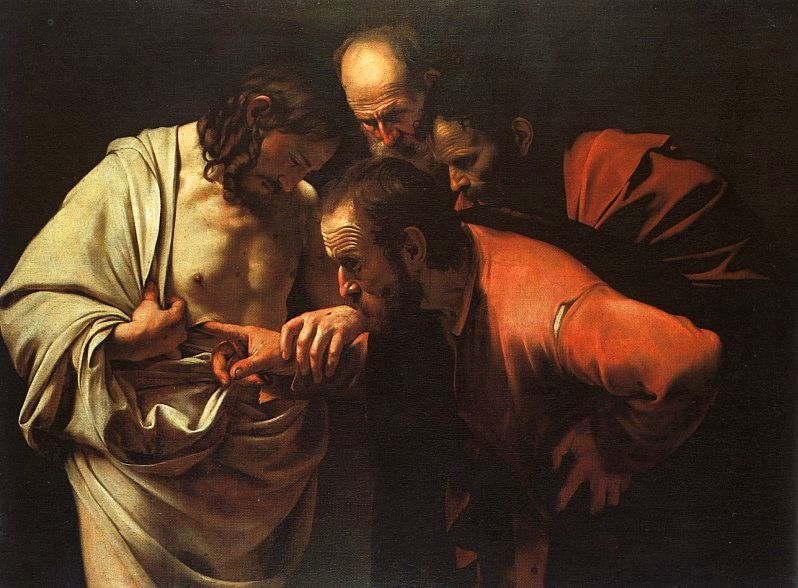
The story of St. Thomas’ encounter with the risen Christ is the most thorough treatment of doubt in the New Testament. Our brother Thomas gets an unfair shake when we use his name to make fun of someone for being “a Doubting Thomas.” After all, Thomas was only doing what any of us would have done, if someone came to us with news that seemed unbelievable. For this reason, I like to think of Thomas as “the patron saint of critical thinkers.” The scientist Carl Sagan famously quipped that “extraordinary claims require extraordinary evidence.” I imagine Dr. Sagan applauding when St. Thomas proclaims, “Unless I see the mark of the nails in his hands, and put my finger in the mark of the nails and my hand in his side, I will not believe.”

The most intriguing aspect of this story is not Thomas’ doubt, but Jesus’ response to it. If John’s gospel had been written by modern Fundamentalist Christians, they probably would have said that Jesus couldn’t appear in the upper room until the other disciples had excommunicated Thomas for his skepticism. If Jesus appeared at all, it would probably be on the far side of the locked door, shouting about how Thomas is a “sinner” and is “going to hell,” if he doesn’t change his mind. But that’s not what actually happens in John’s gospel.

In the real version of the story, the text says, “Although the doors were shut, Jesus came and stood among them and said, ‘Peace be with you.’” Thomas’ doubt, for Jesus, was not a reason to stay away, but a reason to come closer. Thomas’ doubt, for Jesus, was not a reason to offer words of judgment, but a reason to offer words of peace. Jesus doesn’t command Thomas to have blind faith, but gives him the extraordinary evidence he’s looking for.

The presence of this passage in our sacred Scriptures should shape the way we deal with doubts, both our own and those of others. It should help us learn how to accept the process of critical thinking as a necessary part of faith. It should lead us, not to retreat from hard questions, but to advance alongside them.

As Episcopalians, we are blessed with abundant spiritual resources to help us on this journey. The Episcopal Church is part of the Anglican theological tradition. One of the things that makes Anglicanism distinct from some other expressions of Christianity is the way in which we think about our faith. Some other churches see their faith as a monolithic statement by a single and infallible authority. For Roman Catholics, it’s the Pope; for Fundamentalist Protestants, it’s the Bible. But the Anglican theological tradition, as far back as Fr. Richard Hooker in the 17th century, has always viewed Christian theology as a three-way dialogue between Scripture, tradition, and reason.

This way of thinking about our beliefs, sometimes called “the three-legged stool,” means that Episcopalians see our religion as a never-ending conversation. Everyone gets to have a seat at the table, but no one gets to stand on the table and yell at everyone else. Unlike some other religious traditions, Episcopalians do not view their leaders as infallible. We honor our ancestors, but we also believe the Church can be wrong. An interpretation that made sense at one time might stop making sense for future generations. A way of life that seemed just and holy in one century might seem abhorrent in another, and vice versa. This doesn’t mean that “anything goes” in Christian faith and practice, but it does mean that Episcopalians are always open to having a conversation about it.

This understanding of the Christian faith means that Episcopalians can be notoriously hard to pin down when someone asks what our church believes. We frequently disagree with each other, sometimes passionately. The late comedian and devout Episcopalian Robin Williams once said, “No matter what you believe, there’s bound to be an Episcopalian somewhere who agrees with you.”

Finally, thinking of the Christian faith as a three-way dialogue between Scripture, tradition, and reason means that The Episcopal Church is a place where you can bring your whole self to church: Protestant and Catholic, conservative and liberal, believer and skeptic. To all these parts of ourselves and each other, the sign outside our churches around the country proclaims the message loud and clear: “The Episcopal Church welcomes you!”

Whoever you are, whatever you believe, however you identify, and wherever you are on your spiritual journey, you are welcome in this sacred space. That is the message that Jesus proclaimed to St. Thomas in today’s gospel. That is the message that The Episcopal Church seeks to embody every day, as it has for hundreds of years. And that is the message that I hope you hear in this sermon today: That you, with all your doubts and fears, are still a beloved child of God, and you are welcome in this place.

Amen.

What Can Love Do?

Holy Eucharist for Sunday, Proper 25, Year A
St. Luke’s Episcopal Church, Kalamazoo, MI

Matthew 22:34-46

The culture of Jesus’ time and place, much like our own, was no stranger to the perils of partisan conflict. Today’s gospel opens in the middle of an argument between two established schools of Jewish thought: the Pharisees and the Sadducees.

These two communities offer alternative interpretations of Judaism, in much the same way that different denominations offer alternative interpretations of Christianity today. Additionally, because there was no “separation of church and state” in the ancient world, the Pharisees and Sadducees also functioned as something like political parties in Judea. Imagine, if you will, a messy situation where The Episcopal Church functions as the primary meeting of the Democrats, while the Southern Baptists set the platform for the Republicans.

The Sadducees were a smaller group of wealthy elites who centered their worship on the sacrificial rituals of the Jerusalem Temple. Theologically, they accepted only the Torah, the first five books of the Hebrew Scriptures, as divinely inspired and authoritative. They did not believe in destiny, angels, or an afterlife. Politically, they sought friendly and peaceful relations with the occupying Roman government.

The Pharisees, on the other hand, were a somewhat larger group of the lower classes. Their worship emphasized the study of the Torah in synagogues under the tutelage of learned rabbis. In addition to the five books of the Pentateuch, Pharisees also accepted the oracles of the prophets, collections of wisdom literature, and the oral interpretations of rabbinical scholars. They believed that moral purity would reform their national life and convince God to send the Messiah, an anointed king who would liberate their people from foreign occupation and influence. The Pharisees went on to form the foundation of Judaism, as it is practiced today.

Together, the Pharisees and Sadducees were both thoroughly Jewish movements. As joint religious denominations and political parties, they advocated competing agendas for “God and country” in Judea during the time of Jesus.

Our gospel reading for today begins as Jesus is ending a debate with one member of the Sadducee party. A nearby Pharisee, a legal scholar, listens with great interest to this argument. “If Jesus is obviously opposed to the Sadducees,” he thinks, “then maybe he is a member of our party?” With this question in mind, he decides to put Jesus to a little theological test about the Jewish Scriptures.

“Rabbi,” he says, “which mitzvah (commandment) in the Torah is the greatest?”

Jesus responds by ushering his interlocutor into the heart of their shared tradition by referencing the Shema.

The Shema, in Judaism, is the foundational faith statement of monotheism:

“Shema Yisrael:” (Listen, O Israel:)

“Adonai Eloheinu,” (The Lord is our God,)

“Adonai Echad.” (The Lord is ONE.)

This declaration of oneness represents not only the heart of Jewish tradition, but the heart of reality itself, as Jesus and his fellow Jews understand it: That, beneath the unfathomable diversity of beings and events in the universe, is Sacred Oneness.

Mystics, from many different religious traditions, affirm this Oneness in ways that are remarkably similar to one another. Lao-Tzu, the Buddha, Rumi, and Meister Eckhart all describe a state of Non-Duality that includes and transcends all separations: self and other, left and right, light and dark, spiritual and secular. Spirituality, it seems, is the art of unifying opposites in transcendent wonder.

Neurologists have identified those parts of the human brain that allow us to lump together separate objects as parts of a unified whole. Their studies of dedicated monks and nuns have demonstrated that those parts of the brain are particularly active during periods of intense meditation, thus explaining those experiences of peace and unity that mystics have tried to express for millennia.

Physicists, in their study of the beginning of time, have likewise affirmed that the universe seems to have had its beginning in a Singularity of time, space, matter, and energy that exploded some 13.8 billion years ago in a cataclysmic event to which we now refer as the Big Bang.

Jesus’ response to the Pharisee in today’s gospel makes reference to this same Sacred Oneness at the heart of reality itself. The only appropriate response to Sacred Oneness, Jesus declares in the words of the Torah, is Love.

The greatest commandment in the Torah, according to Jesus, is to “love the Lord your God with all your heart, and with all your soul, and with all your mind.” These words, adapted from Deuteronomy 6:5, appear in the Torah immediately after the verse which lays out the Shema for the first time. “The Lord is one,” Jesus says in effect, “and the only appropriate response to Sacred Oneness is love.”

But Jesus doesn’t stop there. For Jesus, love is not just the sappy feeling sensationalized in pop songs and rom-coms. For Jesus, love is not something you feel, but something you do. Love is action. Love is a verb.

This creates a problem: How does one show love to Love Itself? What could mere mortals possibly offer to a God who, by definition, already has and holds everything in the tender embrace of the Divine Self? The answer, according to Jesus, is simple: “You shall love your neighbor as yourself.”

This commandment comes from the Torah as well, from Leviticus 19:18. It comes on the heels of Moses’ teaching about vengeance: “You shall not hate in your heart anyone of your kin… You shall not take vengeance or bear a grudge against any of your people, but you shall love your neighbor as yourself.”

This commandment to love one’s neighbor speaks directly to the problem of partisan conflict, which was as active in Jesus’ day as it is in our own. Mahatma Gandhi famously said, “An eye for an eye and eventually the whole world goes blind.” Desmond Tutu, the Anglican Archbishop of South Africa (who has worshiped in this very church), said similarly, “There is no future without forgiveness.”

The commandment to love receives its most explicit and biting explication later in the New Testament, in the first epistle of St. John, chapter 4:

“God is love, and those who abide in love abide in God, and God abides in them… Those who say, ‘I love God,’ and hate their brothers or sisters, are liars; for those who do not love a brother or sister whom they have seen, cannot love God whom they have not seen. The commandment we have from him is this: those who love God must love their brothers and sisters also.”

Brothers and sisters, I put it to you today that the commandment to love God and to love one’s neighbor are not separate, but a single commandment from our Lord Jesus Christ himself. The Way of Love moves at heart of everything Jesus said and did in his life on Earth. In the venerable words of Presiding Bishop Michael Curry, “If it ain’t about love, it ain’t about God.”

Notice that neither Jesus nor John, neither Mahatma Gandhi nor Archbishop Tutu, neither the Torah nor the Presiding Bishop puts any provisos or exceptions on their joint commandment to love.

I am as aware as each and every one of you that we have the misfortune of living in a moment when love seems more powerless and the people of this country seem more divided than ever.

What can love do when our elderly and most vulnerable neighbors are being stalked by an invisible predator that steals the air from their lungs while their families watch in horror from the other side of a reinforced glass window?

What can love do when the beautiful bodies of our black brothers and sisters are left bleeding in their beds and on the streets, full of bullet holes?

What can love do when temperatures rise and songs of praise to the Author of Life are silenced at the rate of a species every single day? What can love do?

Brothers and sisters, this is the very question that I put before this morning: What can love do?

The answer we give to this burning question is the only response that God is interested in hearing from us. It is the only offering we can make that is worthy of the name Worship.

Love, in all its living and active forms, is the embodied reality that has the power to overcome all the partisan divisions of Jesus’ day and our own. Love is the only appropriate response to the Sacred Oneness that gave birth to the universe.

Let us return to the biblical exhortations of St. John the Beloved, in chapter 3, verse 18 of his first epistle: “Little children, let us love, not in word or speech, but in truth and action.”

As we go out into the world this week, let us honor that Sacred Oneness. In the words of St. John, “let us love, not in word or speech, but in truth and action.”

As we catch ourselves in the mirror while shaving or brushing our teeth, “let us love, not in word or speech, but in truth and action.”

As we relate to family and friends, “let us love, not in word or speech, but in truth and action.”

As we interact with coworkers and classmates, “let us love, not in word or speech, but in truth and action.”

As we converse with neighbors and enemies alike, “let us love, not in word or speech, but in truth and action.”

As we read the news headlines and prepare to head to the polls next week, “let us love, not in word or speech, but in truth and action.”

I close, once again, with these memorable words from Presiding Bishop Curry, which he borrowed from Jesus, who borrowed them from the Torah of his ancestors: “Brothers and sisters: love God, love your neighbor, and while you’re at it… love yourself!”

Your Greatest Gift is You

Preaching on the Feast of the Holy Name of Our Lord at St. Luke’s Episcopal Church, Kalamazoo, MI.

Click here to read Luke 2:15-21

Your greatest gift to the world is you.

Do you hear me in that?

Your greatest gift to the world, the Church, or your family is you.

This is an important truth that we are in grave danger of losing in the world. We live in a world that measures the “worth” of human beings in terms of the money they earn, the possessions they own, the positions they hold, or the degrees on their wall.

In a negative sense, this world judges people based on categories like race, ethnicity, nationality, gender identity, and sexual orientation. We dismiss the ideas of our fellow human beings because they come from someone of a different political party or religious tradition. We project all our self-hatred and insecurity onto people who live with a disability, mental health diagnosis, or criminal record.

When we meet new people at cocktail parties, our first question is usually something like: “So, what do you do?” I would be far more interested to ask, “So, who are you, really? What makes you tick? What thrills/hurts you? What brings you enough hope to get out of bed in the morning?” (And that’s probably the reason why I don’t get invited to many cocktail parties…)

Truth is always inconvenient. Someone has said, “The truth will make you free, but not before it’s done with you.” As broken people living in a broken world, we are not predisposed to face the honest truth about who we really are. We are afraid that we are nobody, or that we are so ugly, stupid, and boring that no one could possibly love us, if they were to see us as we really are. So, we hide. We try to cover ourselves with the paltry fig leaves of our accomplishments and failures, thinking that we have successfully tricked the world into believing that this nobody is somebody, but secretly fearing that the truth about our inner nothingness might one day be found out.

Brothers and sisters, I come to you this morning with good news that these deep fears of ours are entirely unfounded. Beneath the tattered rags of the false identities we have constructed for ourselves is not an ugly emptiness, but the glory of the Divine Image that has been revealed and redeemed for us by our Lord Jesus Christ.

Today the Church celebrates the Feast of the Holy Name of our Lord. Today’s gospel recalls the eighth day after the Nativity, when the infant Messiah was brought to be initiated into the community of God’s chosen people through the rite of circumcision. Today is the day when the name of Jesus was first spoken out loud to the world.

There is tremendous power in a name. Names tell us something about who we are. Doctors put a lot of energy into diagnosis: accurately naming an illness in order to treat the patient. Parents know that if you raise a child, calling names like “bad, stupid, ugly, and worthless”, that child will grow up believing those things about him/herself and acting accordingly. In the Bible, names are of the utmost importance: the patriarch Jacob is given the new name Yisrael, meaning “he wrestles with God” after struggling all night for a blessing from an angel. Avraham, the exalted ancestor of Jews. Christians, and Muslims, is so-named because he is “the father of many nations.” Jesus names his disciple Petros because he is the “rock” upon which the Church will be built.

In today’s gospel, our Lord is given the name Jesus, Yeshua in Hebrew, which means “salvation, deliverance, or liberation” because he is destined to free God’s people from slavery to sin. The name of Jesus was not an arbitrary label attached to this person after-the-fact, but was first whispered into the Blessed Virgin Mary’s heart at the Annunciation by the angel Gabriel. At that time, the angel said of Jesus:

“He will be great, and will be called the Son of the Most High, and the Lord God will give to him the throne of his ancestor David. He will reign over the house of Jacob forever, and of his kingdom there will be no end.” (Luke 1:32-33 NRSV)

The Holy Name of our Lord is a statement about who Jesus is. Behind and beyond the rough exterior of an uneducated, working-class carpenter, born in the parking lot of a Motel 6, in a backwater town of an occupied country, deeper than all of that: we can see with the eyes of faith the Son of God, the Savior of the world.

As millennia have gone by, the Church has continued to ponder the full meaning of Jesus’ identity. Bishops and theologians have met repeatedly in great Councils, endlessly tossing the question back and forth while the answer eludes them. After two thousand years, all the Church can really say is that the mystery of Jesus’ identity is a question that can never be answered. He is fully human and fully divine in a way that transcends human understanding. Anytime people have stood up and claimed to have the final solution to this problem, the Church has been quick to tell them they are wrong. Christian orthodoxy is not a matter of holding tightly to unquestionable answers; Christian orthodoxy is a matter of standing in reverent awe before unanswerable questions.

Even after all these years, the unanswerable question of Jesus’ identity continues to haunt and bless the Church on earth. We can never claim to fully understand it, but we can give testimony to our experience of it. And we express this experience in poetry, story, ritual, and song: that in the Incarnation of Jesus Christ, eternity has become embodied in time, heaven has taken up residence on earth, and divinity and humanity are now one.

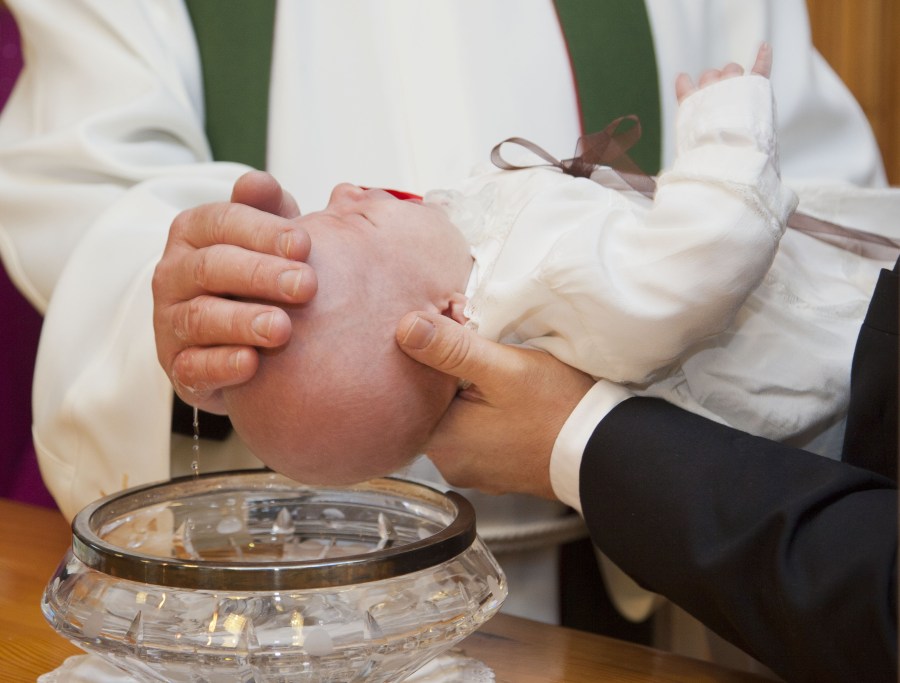
Jesus reveals the mystery of his identity to us by entering into full solidarity with the human condition. In today’s gospel, Jesus enters into solidarity with the people of Israel through the rite of circumcision, which Jews today call a bris. The closest equivalent to this rite of initiation in the Christian tradition is the sacrament of baptism, which Jesus would also receive later in life, at the hands of his cousin John.

In baptism, we Christians receive our identity. That is, we learn who we really are in Christ. The water is an outward and visible sign of the washing away of the false identities we construct for ourselves. In the Church, we are no longer presidents or panhandlers, no longer grad students or gangstas, no longer trust-fund babies or crack babies, no longer doctors or drag queens. In baptism, all of these constructed identities are washed away: “We renounce them.”

In baptism, we are stripped of our fig leaves and stand naked before our Creator.

And this, brothers and sisters, is the Good News: that underneath the stained and tattered rags of ego is not the ugly nothingness we feared. In the moment of baptism, we stand beside the font, dripping and shivering like a toddler fresh out of the bathtub, and hear the voice from heaven saying to us what it said to Jesus at his baptism: “You are my Son (Daughter), the Beloved, with you I am well pleased.” (Luke 3:22)

Brothers and sisters, this is the truth about who we really are. This is the truth that God reveals to us by taking on our humanity and dwelling among us in the life, death, and resurrection of Jesus Christ. I dare you today to allow this truth to soak into the marrow of your bones. Allow it to transform you from the inside out. Allow it to turn upside-down the way you look at the world.

In baptism, Jesus liberates us from all our false, constructed identities. If you wash away everything you have, every one of your accomplishments and failures, everything you’ve ever done, everything that’s ever been said about you, what would be left? Only a mysterious voice from heaven saying, “You are my Child, the Beloved.”

The poet Gerard Manley Hopkins once wrote, “The world is charged with the grandeur of God.” Jesus gives us eyes to see it. Jesus gives us the ability to see ourselves and our world through the eyes of God. This is how St. Paul is able to say, in his second letter to the Church in Corinth:

“From now on, therefore, we regard no one according to the flesh; even though we once knew Christ according to the flesh, we know him no longer in that way. So if anyone is in Christ, there is a new creation: everything old has passed away; see, everything has become new!” (2 Corinthians 5:16-17)

This is why we make the promise, in our Baptismal Covenant, to “seek and serve Christ in all persons” and “respect the dignity of every human being”. We promise this because Christ is in all persons and every human being has an eternal dignity that deserves to be respected. You reflect the image and likeness of God in a way that is utterly unique, that has never been seen before in all of history, and never will be again. Without you, and without each and every person around you today, some small part of God would remain unknown forever.

And that is why I tell you today, brothers and sisters, that your greatest gift to the world is you.

By Ozma1981 - Own work, CC BY-SA 3.0, https://commons.wikimedia.org/w/index.php?curid=9986942

Of Rocks and Pointy Hats

This is now the umpteenth time I have tried to write this article and started over. It always ends up being too long, too abstract, or too complicated to communicate its message effectively. We’ll see if this one works, so here goes…

What I want to do here is set out, as plainly as possible, the convictions that led me to the point of being confirmed in The Episcopal Church. This is a risky career move for me. I have served as a minister of Word and Sacrament in the Presbyterian Church (USA) for several years. Being confirmed by the bishop is regarded by the Presbyterian Book of Order as an “act of renunciation”, whereby my ordination in that denomination is rendered null and void. In other words, confirmation was a point of no return for me. If things didn’t work out, I could not simply turn around and seek another pastoral call in a Presbyterian congregation. Therefore, I had to be sure that this was the right move for me.

And I eventually came to the conclusion that it was.

My journey to The Episcopal Church began fifteen years ago, during my senior year at Appalachian State University. I had recently fallen out with the charismatic fellowship that I had attended through my undergrad years. I loved the immediate experience of the divine that the charismatic movement emphasizes, but became disillusioned with the theological narrowness and lack of scholarly depth I found there.

I knew I loved liturgical worship, based on my experience of the Jewish Siddur and semi-regular attendance at Roman Catholic Mass, but each of those traditions presented me with a theological gap I could not cross with integrity. Around that time, I picked up a copy of The Book of Common Prayer from a local religious bookstore and fell in love. I visited the local Episcopal parish and finally felt like I had found what I was looking for.

At this point, I had already set in motion my plans to attend an evangelical seminary in western Canada. While there, I would meet, fall in love with, and marry a woman who was preparing for ministry in the Presbyterian Church. Her little congregation welcomed me with open arms and quickly adopted me into the family. It wasn’t the church I had planned on joining, but I figured it was the best way to support my new wife in her ministry.

There’s a lot that I will skip over at this point, for the sake of brevity, but I eventually joined my wife in the Presbyterian ministry. I figured the Reformed tradition was “pretty close” to Anglicanism and intended to make the best of things as an unusually high church Presbyterian. The nineteenth century Mercersburg theologians, John W. Nevin and Philip Schaff, were most helpful to me in this endeavor. I considered Mercersburg theology my “Rosetta stone” for translating what I believe about the Gospel into terms that Reformed Protestants could understand. At the time, I thought the differences between Reformed and Anglican Christianity were mainly cosmetic and political in nature, but I eventually came to realize that those surface variations overlie two related-but-distinct theological structures in the hearts and minds of believers.

In academic terms, the primary difference between the Reformed and Anglican traditions is ecclesiological. Translation for those who speak plain English: Presbyterians and Episcopalians have very different ideas about the definition of the word Church.

To illustrate the difference, let’s look at a particular passage of Scripture that has great import for Reformed and Anglican Christians alike, but is interpreted in vastly different ways by each of the two traditions.

The passage in question is Matthew 16:13-20:

“Now when Jesus came into the district of Caesarea Philippi, he asked his disciples, “Who do people say that the Son of Man is?” And they said, “Some say John the Baptist, but others Elijah, and still others Jeremiah or one of the prophets.” He said to them, “But who do you say that I am?” Simon Peter answered, “You are the Messiah, the Son of the living God.” And Jesus answered him, “Blessed are you, Simon son of Jonah! For flesh and blood has not revealed this to you, but my Father in heaven. And I tell you, you are Peter, and on this rock I will build my church, and the gates of Hades will not prevail against it. I will give you the keys of the kingdom of heaven, and whatever you bind on earth will be bound in heaven, and whatever you loose on earth will be loosed in heaven.” Then he sternly ordered the disciples not to tell anyone that he was the Messiah.”

Presbyterians and other Reformed Protestants come from a confessional tradition. Christians in the Reformed tradition believe that Simon Peter’s confession of faith in Jesus as “the Messiah, the Son of the living God” is the “rock” on which Christ builds his Church. The Church, according to Reformed theology, is the spiritual fellowship of all believers who make the same confession of faith in Jesus Christ and are thereby reborn to new life by the power of the Holy Spirit.

Roman Catholic theologians, on the other hand, are adamant that the “rock” referred to in this passage is Peter himself, whose name translates literally as “rock”. They have gone so far as to carve the words of this passage into the dome above the altar of St. Peter’s Basilica in Vatican City: “TU ES PETRUS”. This passage forms the bedrock of Roman arguments for Apostolic Succession and Communion with the bishop of Rome as essential marks of the Catholic Church.

Anglicans, in true via media fashion, have declared that the truth lies somewhere in the middle. The Catechism in the 1979 Book of Common Prayer describes the apostolic nature of the Church as consisting of “the teaching and fellowship of the apostles” (p.854). We affirm the importance of Peter’s confession, but also acknowledge that person-to-person fellowship with the apostles themselves (through their successors, the bishops) forms a vital part of our communion with the Catholic Church.

Concerning Peter himself, Anglicans see him as a spokesperson and stand-in for the rest of the apostles. We stand with Eastern Orthodox Christians and early patristic testimony that the bishop of Rome deserves a certain honor as primus inter pares (“first among equals”) in the collegial fellowship of bishops, but does not exercise “universal jurisdiction” over other dioceses or bear the charism of personal infallibility when speaking ex cathedra.

For Anglicans, the importance of the episcopal office is firstly sacramental, not governmental. The bishop, as a successor to the apostles in college with other bishops, is a symbol of the unity of the Church across space and time. At confirmation, baptized believers make their public profession of faith in the presence of their bishop and receive the laying on of hands as a way of expressing the unity of the Catholic Church as God’s means for extending the kingdom of heaven on earth and transmitting the anointing of the Holy Spirit within the ecclesial community. For the same reason, bishops are further entrusted with the ministry of ordaining priests and deacons.

Anglicans, along with Orthodox and Roman Catholic Christians, insist that exercise of episcopal ministry within the Church must be personal because God’s redemption of the world in Jesus Christ is likewise personal. About this personal quality, and its importance to the Christian gospel, I will say more in the next article…