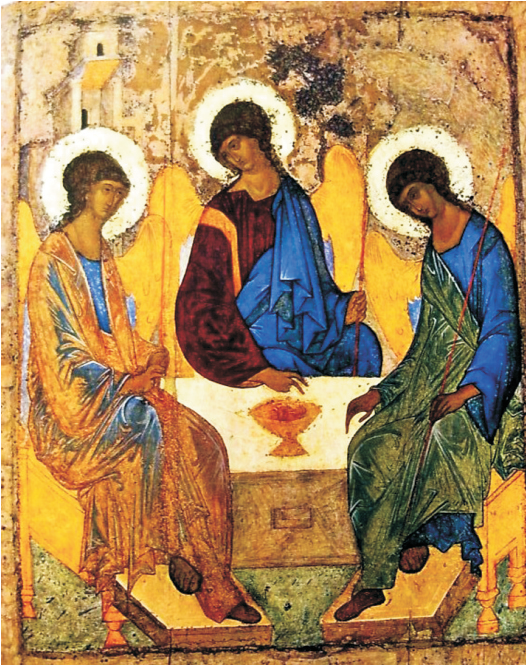
God is a Relationship

Image
Dorothy Day. Image is in the public domain. Retrieved from Wikimedia Commons.

I hear a lot of folks talking lately about how the world isn’t what it used to be.  They’re worried about the decline of human society, the decay of public morals and values, and the emptying of mainline Protestant churches.  For many of these folks, these three series of events are related.  They say, “People just aren’t coming to church anymore, so society is going to pieces.”

A lot of people wonder why this is the case.  There are a lot of theories.  Some say it’s because of the cultural changes that happened during the 60s.  Some say that our country’s tolerance of religious diversity has left people in a state of moral and spiritual confusion.  Others say that our society’s addiction to busy-ness and constant entertainment has distracted people to the point where they just don’t even have time to think about church anymore.

Personally, I think some of these theories have valid points.  And I think the whole truth about the matter is probably bigger and more complex than any single theory can fully explain.  But there’s one theory that stands out to me more than the rest, if only because it’s the one I hear most often from people who don’t come to church.  And here it is (the number one reason most people give for not coming to church): “It’s hypocrisy of Christians who claim to believe that God is love but do not extend that love to other people.”

Isn’t that interesting?  When you actually go and ask people why they don’t come to church, they tell you: it’s not because of diversity, and it’s not because they’re too busy, and it’s not because of the 60s.  It’s because of Christians.  The author Brennan Manning once said, “The greatest single cause of atheism in the world today is Christians who acknowledge Jesus with their lips, and then walk out the door and deny him by their lifestyle.  That is what an unbelieving world simply finds unbelievable.”

As Christians, it seems that we don’t take our theology seriously enough.  We think we can love God with all our heart, soul, mind, and strength without loving our neighbors as ourselves, but Jesus calls FOUL on that play.  He says you can’t have one without the other.  If you try to separate them, you end up with something other than the God revealed in Jesus.

Central to our Christian faith is the belief that God is love.  Did you get that?  God is love.  Most people breeze right by it without thinking and end up with the wrong idea about who God is and how God works in the world.  What they tend to hear is “God is loving” (i.e. “God is basically a nice person”).  In other words, they think that the Old Man in the Sky (who made the world and controls everything that happens) is a nice guy.  But that’s not what the text says.  The text is taken from 1 John 4:16 and it says, “God is love.”

There’s a big difference between being loving and being love.  God is love itself.  God can be found in the dynamic interchange of energy between people who care about each other: family, friends, lovers, even enemies.  Wherever there is love, there is God.  In fact the full text of 1 John 4:16 reads, “God is love and those who abide in love, abide in God, and God abides in them.”  The Creator of the universe is not separate from it.  God is not “out there,” floating on a cloud or in some alternate dimension.  No, God is right here.  As the apostle Paul says in Acts 17, “In [God] we live, and move, and have our being.”  God is within us and all around us, wherever love is found.  God is love.  God is a relationship.

Our ancestors in the early Christian church came up with an interesting way of expressing this truth.  They left us with a kind of puzzle that could never be solved.  And they called it the Trinity.  According to the doctrine of the Trinity, we Christians believe in only one God who eternally exists as three persons: traditionally called Father, Son, and Holy Spirit.  God is both three and one, one and three.  Each person in the God-head is co-equal and co-eternal with the others.  There is no hierarchy or pecking order among them.

The doctrine of the Trinity has always been controversial.  In ancient times, Jews and Muslims accused Christians of being polytheists.  In more recent years, people have identified the sexism inherent in using exclusively male terms to describe the Father and the Son.  In any age, the Trinity comes across as confusing.  Many have tried to solve the puzzle, but all have failed.  So, this morning, I won’t even try to offer an answer to its question.  We’re going to let the mystery stand and focus instead on the implications of that mystery for our lives as Christians.

And just what are those implications?  Well, according to the mystery of the Trinity, our one God exists in a state of relationship between three persons.  In other words, God is a relationship.  God exists, not as an individual entity, but as the dynamic exchange of perfect love between Father, Son, and Holy Spirit.  Because of this, it suddenly makes sense to say that “God is love.”  God is love because God is a relationship.  Wherever love and compassion are established on earth, God is present.  “God is love and those who abide in love, abide in God, and God abides in them.”  That is the practical application of the theological doctrine of the Trinity.  That is where we begin to live what we believe and show ourselves to be either followers of Jesus or just another group of hypocrites.

The only way to faithfully testify to the presence of the Triune God in the world is through acts of love, not supposedly infallible announcements of dogma.  If God is a relationship, then we usher and invite people into greater spiritual awareness by being in relationship with them, regardless of whether or not they ever darken the door of our church.  Moreover, if God is a relationship, then we come close to God, not through dogma and rituals, but by intentionally engaging in relationships with the people and planet around us.

Jesus spoke about this very clearly in Matthew 25 when he said, “Truly I tell you, just as you did it to one of the least of these who are members of my family, you did it to me.”    Offering food to the hungry, clothes to the naked, shelter to the homeless, friendship to the lonely, and justice to the oppressed are not simply good deeds that improve the reputation of the church in the community, they are our best way to participate in relationship with the Triune God.  God is a relationship, so relationships are the places where God is most fully known and experienced.

There is no one I can think of in the last one hundred years who lived this Trinitarian theology more fully than Dorothy Day, a Catholic activist who opened homeless shelters and soup kitchens for the unemployed workers of New York City during the Great Depression.  So remarkable was this woman, she was not content to simply found and fund a charitable agency for the poor, she moved into the shelter and ate the donated food with her clients, who she simply regarded as friends.  In them, Dorothy Day was seeking and serving the Triune God.

She wrote in 1937:

Every morning about four hundred men come to Mott Street to be fed. The radio is cheerful, the smell of coffee is a good smell, the air of the morning is fresh and not too cold, but my heart bleeds as I pass the lines of men in front of the store which is our headquarters. The place is packed–not another man can get in–so they have to form in line. Always we have hated lines and now the breakfast which we serve, of cottage cheese and rye bread and coffee has brought about a line…

The [Pope] says that the masses are lost to the Church. We must reach them, we must speak to them and bring them to the love of God. The disciples didn’t know our Lord on that weary walk to Emmaus until He sat down and ate with them. ‘They knew Him in the breaking of bread.’ And how many loaves of bread are we breaking with our hungry fellows these days–‘ 3,500 or so this last month. Help us to do this work, help us to know each other in the breaking of bread! In knowing each other, in knowing the least of His children, we are knowing Him.

This morning, I want to urge you toward similar action in your own life.  I invite you to participate in the life of the Trinity, to get caught up in the infinite whirlwind of perfect love that flows between the persons.  In that Great Love, incarnated in the myriad little loves that surround us every day, may you find God: not the monolithic “Old Man in the Sky” but the dynamic energy of love that pulses through all creation.  And, through you, may others come to believe in the God who is love.  May they find that God here in our church as they enter into relationship with a community of Christians who really do live as if they believed that “God is love, and all who abide in love, abide in God, and God abides in them.”  May it be so.

(Reblog) When God Is Your Therapist

Another great article from TM Luhrmann.

Reblogged from the NY Times:

I saw that the church implicitly invited people to treat God like an actual therapist. In many evangelical churches, prayer is understood as a back-and-forth conversation with God — a daydream in which you talk with a wise, good, fatherly friend. Indeed, when congregants talk about their relationship with God, they often sound as if they think of God as some benign, complacent therapist who will listen to their concerns and help them to handle them.

Click here to read the full article

(Reblog) God Goes Viral

Reblogged from the Stillspeaking Devotional

Astounded onlookers chalk it up to drunkenness, forgetting that alcohol tends to make one less intelligible, not more.  Besides, if drunkenness produced multi-lingual fluency, a good many college graduates today would be eligible for a job at the U.N. Likewise, Peter dismisses the charge and says “It’s a God thing,” exactly what the prophet Joel meant when he said, “In those days I will pour out my Spirit on all flesh: old people, young people, folk from every place and every walk of life!”

Click here to read the full article

The Great Ends of the Church: The Promotion of Social Righteousness

Image is in the public domain.  Retrieved from Wikimedia Commons.
Image is in the public domain. Retrieved from Wikimedia Commons.

My wife played me a recording this week from an NPR program called This American Life.  The entire episode was about the way kids think and the funny (sometimes profound) things they say.  It was originally broadcast in 2001:

It all began at Christmas two years ago, when my daughter was four-years-old. And it was the first time that she’d ever asked about what did this holiday mean? And so I explained to her that this was celebrating the birth of Jesus. And she wanted to know more about that. We went out and bought a kids’ bible and had these readings at night. She loved him. Wanted to know everything about Jesus.

So we read a lot about his birth and his teaching. And she would ask constantly what that phrase was. And I would explain to her that it was, “Do onto others as you would have them do unto you.” And we would talk about those old words and what that all meant.

And then one day we were driving past a big church and out front was an enormous crucifix.

She said, who’s that?

And I guess I’d never really told that part of the story. So I had to sort of, yeah, oh, that’s Jesus. I forgot to tell you the ending. Well, you know, he ran afoul of the Roman government. This message that he had was so radical and unnerving to the prevailing authorities of the time that they had to kill him. They came to the conclusion that he would have to die. That message was too troublesome.

It was about a month later, after that Christmas, we’d gone through the whole story of what Christmas meant. And it was mid-January, and her preschool celebrates the same holidays as the local schools. So Martin Luther King Day was off. I knocked off work that day and I decided we’d play and I’d take her out to lunch.

We were sitting in there, and right on the table where we happened to plop down, was the art section of the local newspaper. And there, big as life, was a huge drawing by a ten-year-old kid from the local schools of Martin Luther King.

She said, who’s that?

I said, well, as it happens that’s Martin Luther King. And he’s why you’re not in school today. So we’re celebrating his birthday, this is the day we celebrate his life.

She said, so who was he?

I said, he was a preacher.

And she looks up at me and goes, for Jesus?

And I said, yeah, actually he was. But there was another thing that he was really famous for. Which is that he had a message.

And you’re trying to say this to a four-year-old. This is the first time they ever hear anything. So you’re just very careful about how you phrase everything.

So I said, well, yeah, he was a preacher and he had a message.

She said, what was his message?

I said, well, he said that you should treat everybody the same no matter what they look like.

She thought about that for a minute. And she said, well that’s what Jesus said.

And I said, yeah, I guess it is. You know, I never thought of it that way, but yeah. And it is sort of like “Do onto others as you would have them do unto you.”

And she thought for a minute and looked up at me and said, did they kill him, too?

The NPR story ends there, but the answer to the little girl’s question is, of course, Yes.  They did kill Dr. King too, and Oscar Romero, and Dietrich Bonhoeffer, and the prophet Isaiah, and the apostle Paul.  It seems that the treatment inflicted upon Jesus has also been visited on those who stand up for what is true and right in any age.  The apostle Paul himself, before he was beheaded by the Roman state, famously said, “In my flesh I am completing what is lacking in Christ’s afflictions.”  Paul seems to have picked up on the inherent connection that exists between what happened in Christ on the cross and what happens in those whose lives are similarly extinguished by unjust powers.  In the mind of God, these events are not separate: They are one.

Jesus himself articulated a similar sense in Matthew 25 when he said to his followers, “Truly I tell you, just as you did it to one of the least of these who are members of my family,you did it to me.”  The suffering of the hungry, naked, sick, and imprisoned people of this world is one and the same with the suffering of Christ.

We Christians don’t always understand this truth.  At least, we don’t live as if we understood it.  We separate these events in our minds.  We separate the social from the spiritual.  We say things like, “The church shouldn’t get involved in politics.”  While I agree with this statement when it comes to religious institutions endorsing candidates or receiving state funding, I disagree with the idea that our most deeply held beliefs and values should not shape the way we organize our life together.  Politics, on the most basic level, has to do with relationships, and relationships are what Jesus is most interested in.  When someone once asked Jesus about the most important part of the Bible, he said it all comes down to relationships: your relationship with God and your relationship with your neighbors.

The quality of our relationships is the measure of the quality of our religion.  In fact, we read in this morning’s scripture readings how religion should even take a back seat to relationships.  In our first reading, from the book of Amos, the prophet tells the people that Yahweh their God is disgusted with their religious rituals and fed up with their pious posturing.  He says that God isn’t even listening to the sound of your hymns anymore.  Why not?  Because what God really wants is for “justice [to] roll down like waters, and righteousness like an everflowing stream.”  In other words, God listens for the harmony and not the melody.  God wants harmony between people, not just musical notes.  That’s what the words justice and righteousness mean in this passage.  God wanted nothing to do with their religion because their relationships were all out of whack.  There is an inherent connection between the way people behave toward each other and the way they behave toward God.  Injustice toward a neighbor is a sin against God.  The spiritual is political.  The quality of one’s religion is measured by the quality of one’s relationships.

In our New Testament reading, we see Jesus cleansing the Jerusalem temple.  As he drove out the money changers, he shouted, “Is it not written, ‘My house shall be called a house of prayer for all the nations’?  But you have made it a den of robbers.”

He was quoting a passage from the book of Isaiah.  In that section, the prophet was setting forth a vision of the Jewish temple in Jerusalem as an international, multi-cultural center of faith and learning.  People from all over the world, not just Jews, would one day be welcome in the house of God.  The place designated for this activity was the Outer Court, also called the Court of the Gentiles.  It was the only part of the temple where non-Jews were allowed to participate in worship.  It just so happens that this was the very place where the money changers and animal dealers had set up their shops.  They had robbed the Gentiles of their rightful place in God’s house.  And for what?  To make more money.  By placing profit over people, they undermined the legitimacy of their spirituality.  They made the house of God into “a den of robbers”, according to Jesus.  Like Amos, Jesus wanted to see “justice roll down like waters, and righteousness like an everflowing stream.”

Again, the quality of our religion is measured by the quality of our relationships.  What we do for our neighbors, we do for God.  There is a connection between the suffering of people and the suffering of Christ.

This morning, we are continuing with the fifth sermon in a five-week series on the Great Ends of the Church.  We’re asking the question, “Why does our church exist?”  We’ve already given four answers to that question.  We said the Great Ends of the Church are the proclamation of the gospel for the salvation of humankind, the shelter, nurture, and spiritual fellowship of the children of God, the maintenance of divine worship, and the preservation of the truth.  This week, we’re adding a fifth Great End: the promotion of social righteousness.

This one tends to get us into trouble sometimes, because many (including some within the church itself) say “the church shouldn’t get involved in politics.”  They cringe when preachers bring up controversial social issues from the pulpit, preferring instead that preachers would just “stick to the gospel.”

But here’s the thing: a good preacher can’t preach the gospel without getting into relevant social issues.  Any minister who just wants to save individual souls for heaven isn’t preaching the gospel of Jesus.  Jesus said the quality of our religion is measured by the quality of our relationships.  Jesus said, “just as you did it to one of the least of these who are members of my family,you did it to me.”  Jesus drove the money changers out of the Gentiles’ place in the temple and told his followers to leave their offerings at the altar and make peace with their neighbors before coming to worship.  Jesus said that God preferred the compassion of the Good Samaritan over the ritual purity of the priest and the Levite.

No Christian who actually reads the Bible can preach the gospel of Jesus without engaging in the promotion of social righteousness.

Now, as I said before, this doesn’t mean that churches should be endorsing candidates, telling people how to vote, or accepting money and power from the state.  What it does mean is that we should all have a clear enough understanding and a firm enough commitment toward our beliefs and values that we are willing to speak up and act up when the culture around us promotes practices and policies that contradict said values.  Do we believe at all people are made in the image of God?  Then we should have something to say about equal opportunity for all races, classes, and genders in housing, education, and employment.  Do we agree that Jesus had a special place in his heart for poor and outcast people?  Then we should not just make room for them in our hearts, homes, and churches; but we should also re-locate and re-orient ourselves to be where they are: in the slums, bars, and jails of Oneida County.  Do we believe that God loves everyone and never gives up on anyone?  Then neither should we.

These Christian values, if we live them, will inevitably put us at odds with American values.  We will have to go against the grain and the flow of the larger culture in order to hold it to a higher standard.  It will be uncomfortable.  It will make us unpopular.  It might even be dangerous.  But let us remember what our Savior taught us: “If any want to become my followers, let them deny themselves and take up their cross and follow me. For those who want to save their life will lose it, and those who lose their life for my sake, and for the sake of the gospel, will save it.”

People throughout history, from Martin Luther King to the apostle Paul, have followed Jesus on the path of the cross.  Their suffering and his suffering are one in the eyes of God.  They didn’t just preach the gospel, they were the gospel.  And they share in the resurrection life of Christ, who overcomes the bonds of death and proclaims a new reality in our midst, a new community that is overthrowing and replacing the old domination systems of this world: the kingdom of heaven-on-earth.  When the church challenges the unjust practices and policies of the powers-that-be, we show ourselves to be citizens of that kingdom with the saints in light.  The church’s promotion of social righteousness is not separate from the proclamation of the gospel or in addition to it, it is an essential part of it.  Our actions in relationship with our neighbors comprise the text of the silent sermon we preach every day to the people around us.

Forgiving God

I’ve been invited by my friend Jodi Haier, a Methodist pastor, to contribute a column to a soon-to-be published group study book on Forgiveness.  I have permission to publish my contribution here as a foretaste of the upcoming book.  I’ll let you know when the whole study comes out.  Thanks!

I’ve been asked to write this meditation on the subject of Forgiving God.

I have until the end of the month to finish it, but I want to get it done today, not because I’m efficient like that, but because today is April 16, 2013, the day after the bombing of the Boston Marathon.

The main religious question that arises in times like this is: How could a loving, all-powerful God allow something like this to happen?  On days like today, it seems that God owes us an explanation (if not an outright apology) for standing by, silently, while some person(s) blew up the Boston Marathon.

As bizarre as it may sound, I’m going to argue that what we need to do in this moment is forgive God.  What I mean by this is that we need to adjust some of our ideas about who God is and how God works if we’re going to make sense of situations like the bombing of the Boston Marathon.

Now, it just so happens that I am both a pastor and a philosophy professor, so I’ll construct my argument from both of those perspectives.

Philosophically speaking, we’re dealing with the Problem of Evil, which says, “Any two of the following statements can be true at the same time, but not all three: (1) God is all-powerful.  (2) God is good.  (3) Evil exists.”  While many wise believers have tried to solve this problem over the years, none have fully succeeded.  Personally, I choose to remove the first statement: “God is all-powerful.”

I believe God ceased to be all-powerful when free will was created.  God could have made us like robots that always do what they are told, but God chose instead to make conscious beings that can freely choose to love.  It is a logical necessity that, if one can freely choose good, then the capacity for choosing evil must also exist.  God gave us freedom because God wanted love in this world, and there is no love without freedom.

Hence, God’s power is limited.  God is not able to create a free world where the bombing of the Boston Marathon cannot happen.  We have to create that world.  It’s up to us.  We are co-creators with God.

Honestly, I’m not sure that we’ll ever evolve to the point where we have a perfect society.  Something will probably always be wrong.  We cannot control what happens to us, but we can control how we respond.  Will we use our God-given freedom to bring more love or more darkness into the world?  Will our unjust suffering embitter or ennoble us?  Will we stand together or fall apart?

I think we can (and should) forgive God for what happened yesterday by letting go of our idea of an all-powerful deity who controls everything that happens.  That God doesn’t exist.  What we have instead is a loving God who gives us freedom and invites us to be partners in the ongoing creation of the world.

The Presence in the Absence

I don’t know about you, but I sometimes get a bit discouraged when I read the stories and poems of the Bible.  It seems that people back then had a much more immediate sense of God’s presence than we do today.  On almost every page, there are tales of visions, voices, angels, and miracles.  Meanwhile, even the most spiritually-inclined of us today have to rely on powers of reason, conscience, intuition, and imagination when forming our ideas about who God is and how God relates to us.  It’s easy for us to feel left out when we read the Bible because most of us haven’t had the kind of direct and intense mystical experiences described in its pages.  After all, who here has ever walked on water or seen the ocean part in front of them?  My guess is that not many of us have.  If only there was someone in the Bible whose experience of God looked more like ours!  Well, as it turns out, there is just such a person: Esther.

This morning’s first reading comes to us from the book that bears her name.  As a matter of fact, this week is the only week in our church’s three-year lectionary cycle that makes use of the book of Esther, which means that I’ll have to give you a lot of back story in a short amount of time.

The story of Esther takes place during a rather dark period of Jewish history.  In 587 BCE, the kingdom of Judah was conquered by the Babylonian Empire and its elite and aristocratic inhabitants were taken off into slavery, where they lived for the next several generations.  During this time, they struggled to preserve whatever tattered pieces of their culture and religion that they could.  A little while later, the Babylonians themselves were conquered by the Persians.

It is during the Persian occupation that the story of Esther is set.  It’s a story of struggle and survival in the midst of powerlessness.  Esther represents the weakest and most vulnerable members of society.  She was a Jew in a Persian culture, she was a woman, and she was an orphan.  In the ancient world, you really couldn’t get much lower on the social food chain than that.

Through a series of unlikely circumstances, Esther found herself being recruited into the personal harem of the Persian king.  This position would provide her with a modicum of security and comfort, but it came at the price of being an object of desire to be used by someone else.

As the story unfolds, Esther eventually becomes the king’s wife around the same time that a plot is being hatched to commit genocide against the Jewish people.  Due to her position as queen, Esther is in a unique position to save her people.  However, doing so would involve a great deal of personal risk to her.  In Persian culture, it was a capital offense to approach a king without being invited.  This particular king, Ahasuerus, had already demonstrated his willingness to deal harshly with any kind of insubordination, even from his wife.

Esther has a hard choice to make: she can keep silent and allow her people to die in order to save her own life, or she can risk her life in order to save the lives of her people.  It was her cousin and caretaker, a man named Mordecai, who gave her this advice: “Who knows? Perhaps you have come to royal dignity for just such a time as this.”

After hearing these words, Esther decides to take the risk.  Approaching the king unannounced, Esther pleads for her life and that of her fellow Jews.  The king has compassion on her and punishes Haman, the mastermind behind the genocide plot, but is too late to stop the plan from being carried out.  At the last minute, he makes provision for the Jews to defend themselves against their attackers.  The day is saved.

All in all, the book of Esther makes for a great story.  It’s full of intrigue on the one hand and irony on the other.  There are some outright hilarious moments as Haman, the villain, repeatedly sets himself up for failure and humiliation.  This is a story of underdogs winning out over powerful forces of hatred and evil.  Just like it happens in the movies, trust and faithfulness are enough to beat the odds.

There’s only one thing missing from the biblical story of Esther.  Its conspicuous absence sets this story apart from all others in the Bible.  Can you guess what it is?  It’s God.

God is never mentioned in the book of Esther.  Not even once.  This is so unusual for the Bible, where visions, voices, angels, and miracles abound.  All we see here are human beings, caught in a difficult situation, and trying to make the best of it.

I like that.  It gives me hope.  It reminds me of my own spiritual life, where I often have to ask hard questions and figure things out for myself.  It would be most convenient if I could get a visit from an angel every time I had a question or a problem, but that just doesn’t seem to be how God works in my life.  The God I believe in is one who encounters people on the journey of life and gives them the gifts of reason, conscience, intuition, and imagination.  These are the God-given tools with which we all must chart our own course in life, trusting that the path we take will lead us home to our true selves and the Mystery of Being, which we call God.  There are no easy answers or quick fixes in this life.  There is only the journey and the hard choices we must make along the way.

For me, the book of Esther is a brilliant illustration of this principle in action.  God does not show up in any immediate way.  God’s presence is implied.  Mordecai expresses the divine trait of wisdom.  Esther embodies faith and courage.  In the end, the implication is that God has been present and active all along, even though the heavens have been silent and apparently empty.

In the book of Esther, God is the presence in the absence and the voice in the silence.  So it is, I think, in our lives.  Faith, for most of us, grows gradually as we learn to trust in that absent presence and silent voice.  We find God in ourselves and in the people around us.  We feel a tug in our hearts that leads us in the direction of faith, hope, and love.  Those who follow the leading of that tug discover for themselves where that mysterious road goes.

Just like Esther and Mordecai, we can’t tell where the road will take us or whether our efforts will be successful.  All we have in our possession are bits and pieces of some larger puzzle that may or may not be solved at some point in the future.  The best we can do is lay our individual puzzle pieces down onto the table and try to see where they fit into the larger picture of the whole as it gradually comes together.

If you’re here this morning and your experience of faith has largely been an experience of doubt, silence, and absence, I want to encourage you with Esther’s story.  You’re in good company.  Your experience of absence does not necessarily amount to an absence of experience.  God is present and active in your life, whether you realize it or not.

As you struggle along in life, trying to walk by your own inner lamp of reason, conscience, intuition, and imagination, remember that you are not alone.  Others, like Esther and Mordecai, have gone this way before.  More importantly, there is one who walks with you, beside and within, who first gave light to your inner lamp and has promised to keep it burning through all eternity.


Words of Wisdom

The Lamp of Wisdom: sculpture at Waterperry Gardens. Image by Vanderbilt Divinity Library.  Retrieved from http://diglib.library.vanderbilt.edu/act-imagelink.pl?RC=54977 on September 16, 2012.

Church is probably going to feel like an Indiana Jones movie this morning because I’m taking you on a hunt for lost treasure!  We’re going to explore some dangerous and exciting new territory.  There’s bound to be risks aplenty.  The treasure we’re looking for doesn’t belong on a dusty old shelf in some museum; we’re going to put it to good use in our lives, where it can yield a return on our investment.

(OK, that opening was a bit gimmicky, but give me a break, I’ve got to start the sermon somewhere!)

What I’m interested in doing today is exploring one of the lost treasures of the Bible itself.  It sounds weird to hear someone talk about “lost treasures in the Bible”, right?  I mean, isn’t the whole thing right there for us to open and read anytime we like?  Of course it is!  However, there are certain parts of the Bible that have been passed by or ignored over the years.  This usually happens because these passages just don’t fit very well with the big ideas of the people in charge, so they get minimized and pushed aside while other passages take center stage.  Once this has happened for several generations or even a few centuries in a row, most people forget those passages are even there.  But that’s just the thing about the Bible: if you actually read it, it has a way of challenging the status quo and opening you up to new ideas that the powers-that-be might even call “heresy”.

This is exactly what happened with our Protestant ancestors, Martin Luther and John Calvin.  Once they actually got their hands on the Bible itself, it led them to challenge a thousand years of church tradition and authority.  Both of them were eventually excommunicated for preaching this crazy idea that regular people, not just priests and monks, should be able to read the Bible for themselves, in their own native language.  It’s just like Desmond Tutu said in God Has A Dream, the book our congregation read together last summer:

Oppressive and unjust governments should stop people from praying to God, should stop them from reading and meditating on the Bible, for these activities will constrain them to work for the establishment of God’s kingdom of justice, of peace, of laughter, of joy, of caring, of sharing, of reconciliation, of compassion.

This morning, as we open the pages of this dangerously subversive and revolutionary manifesto that we call “the Bible”, we’re going to be searching for a particularly fascinating “lost treasure” that has been hidden in plain sight for thousands of years.  This treasure that I’m talking about is actually a biblical character, like Jesus and Moses.  Her name is Wisdom.

To the ears of us North Americans, talking about Wisdom as a person sounds weird.  We’re used to thinking of Wisdom as a virtue or a concept, like intelligence or compassion.  Wisdom (so we think) is not a person, but a character quality possessed by those of our elders who have lived long and lived well.  We all aspire to be holders of Wisdom in our old age.

But that’s not how the Bible portrays Wisdom.  The Bible sees Wisdom as a person, not a concept.  In this morning’s Old Testament reading, taken from the book of Proverbs, Wisdom is portrayed as a bold and brave woman:

Wisdom cries out in the street;
in the squares she raises her voice.
At the busiest corner she cries out;
at the entrance of the city gates she speaks:
‘How long, O simple ones, will you love being simple?
How long will scoffers delight in their scoffing
and fools hate knowledge?
Give heed to my reproof;
I will pour out my thoughts to you;
I will make my words known to you.

There is so much to love about the scene that is being set here.  First of all, as I’ve already pointed out, Wisdom is portrayed as a person, a woman.  In Hebrew, the language of the Old Testament, the word for Wisdom is Hochma.  In Greek, the language of the New Testament, the word for Wisdom is Sophia.  That’s where we get words like philosophy from.  Philosophy literally means “the Love of Wisdom”.  Sophia also happens to be a very familiar name for women in our culture.  Sarah and I actually considered naming our daughter Sophia, but then we found out that it was the single most popular name for baby girls in 2008, so we decided to name her something more unique to her.  So, for the remainder of this sermon, in order to emphasize the personal and feminine nature of Wisdom, as she is portrayed in the Bible, I will be referring to her by that Greek name: Sophia.

What kind of woman is Sophia?  We learn right away from this passage in Proverbs that she is both unconventional and courageous.  Proverbs says that she “cries out in the streets” and “raises her voice” at “the busiest corner”.  Imagine, if you will, the gender-segregated world of ancient Palestine.  In that culture, a woman’s traditional sphere of influence was limited to the home.  Proper women, so they said at the time, didn’t make their presence known in public, which was the domain of men.  If a woman needed something to get done outside of the home, she had to get it done through a man, like her husband, brother, or father.  There were only two kinds of women who would raise their voices on a busy street corner: prostitutes and desperate women who had suffered such an injustice that they had no other choice but to take matters into their own hands.  Either way, whenever a woman raised her voice in public, people were apt to think the worst.

So, I think it’s extremely significant that when we first meet Sophia, here in the book of Proverbs, she is crying out in the streets.  The fact that she is doing so in that culture meant that something had gone very, very wrong indeed: either something was wrong with her or something had gone wrong with the world.  Her willingness to speak up makes her the kind of person who is able to think outside the box and color outside the lines of what is socially acceptable.  She is this strong, creative, and dynamic presence who raises her voice in order to change things for the better.  In that way, the figure Sophia reminds me of pioneering women like Eleanor Roosevelt or the famous primatologist Jane Goodall.  Both of these women, in the fields of politics and science, respectively, made a lasting difference by trespassing over the borders of what was expected of them from society.  If we were to make a movie about Sophia, I think I would cast someone like Whoopi Goldberg or Kathy Bates in the lead role.

What can we learn about Sophia from looking elsewhere in the Bible?

In Proverbs 8, we meet her again.  Just like before, she is crying out in the street in defiance of public opinion.  She says:

To you, O people, I call,
and my cry is to all that live.
O simple ones, learn prudence;
acquire intelligence, you who lack it…

…I have insight, I have strength.
By me kings reign,
and rulers decree what is just;
by me rulers rule,
and nobles, all who govern rightly.
I love those who love me,
and those who seek me diligently find me.

At this point in the poem, things start to get really interesting.  Up to now, we might still be able to dismiss Sophia as an impersonal concept, symbolically represented as a woman, but listen to what she says later in chapter 8:

Ages ago I was set up,
at the first, before the beginning of the earth…

When [God] established the heavens, I was there,
when he drew a circle on the face of the deep,
when he made firm the skies above,
when he established the fountains of the deep,
when he assigned to the sea its limit,
so that the waters might not transgress his command,
when he marked out the foundations of the earth,
then I was beside him, like a master worker;
and I was daily his delight,
rejoicing before him always,
rejoicing in his inhabited world
and delighting in the human race.

This is most interesting.  Sophia, according to the ancient Hebrew sage who wrote this poem, holds a prominent place in cosmic scheme of things.  Somehow, God works through Sophia in creating and shaping the world.  The natural order we observe in the universe, according to this poem, is the direct result of God’s creative energy working with and through Sophia.  Earlier, she says, “By me kings reign, and rulers decree what is just”.  This means that the ideals of goodness and justice, far from being arbitrary cultural norms, are actually woven into the very fabric of the universe by Sophia herself.  In this sense, she can be compared to that which Chinese philosophers have referred to as the Tao, the fundamental organizing principle of the cosmos.

We can learn even more about the development of the idea of Sophia by looking at the books of the Apocrypha.  While these books, written by Hellenistic Jews in the centuries after the last Jewish prophet and the birth of Christ, were not accepted as sacred Scripture by the Protestant reformers, they are nonetheless helpful for demonstrating the developing thought patterns of the Jewish people in the years leading up to Jesus’ lifetime.  This passage, a meditation on Sophia, comes from chapter 7 of a book called The Wisdom of Solomon:

because of her pureness she pervades and penetrates all things.
For she is a breath of the power of God,
and a pure emanation of the glory of the Almighty;
therefore nothing defiled gains entrance into her.
For she is a reflection of eternal light,
a spotless mirror of the working of God,
and an image of his goodness.
Although she is but one, she can do all things,
and while remaining in herself, she renews all things;
in every generation she passes into holy souls
and makes them friends of God, and prophets;
for God loves nothing so much as the person who lives with wisdom.
She is more beautiful than the sun,
and excels every constellation of the stars.
Compared with the light she is found to be superior,
for it is succeeded by the night,
but against wisdom evil does not prevail.

What I find so fascinating about this passage is that the figure of Sophia is becoming more and more closely associated with God’s own self.  As we move into the New Testament, the apostle Paul refers to Christ as “the Wisdom of God” in his first letter to the Corinthians.  Decades later, someone writing in Paul’s name expanded on this association of Christ with Sophia in the epistle to the Colossians.  Listen for the similarity between this passage about Christ and the one we read earlier from Proverbs 8:

[Christ] is the image of the invisible God, the firstborn of all creation; for in him all things in heaven and on earth were created, things visible and invisible, whether thrones or dominions or rulers or powers—all things have been created through him and for him.

It seems that the early Christians saw Christ as the earthly embodiment of Sophia herself.  More than anyone else in history, Jesus lived a life in harmony with this fundamental organizing principle of the universe.

How can it be then, that such an important figure as Sophia has become one of the “lost treasures” of the Bible?  The answer, I think, comes from the various kinds of cultural momentum and inertia that can be found in people of every place and time.  Christianity itself has grown up in a patriarchal society.  The sad fact is that women’s voices have not counted as much as men’s voices.  When it comes to the metaphors we use to describe God, Christians have embraced images of masculinity and power (e.g. Almighty Father, King of Kings, Lord of Lords, etc.) to the exclusion of more feminine images (e.g. Sophia raising her voice in the marketplace).  Nevertheless, our sacred Scriptures remind us that men and women are both equally made “in the image of God”.  The Bible also gives us several feminine metaphors for God apart from Sophia the Wisdom Woman.  Deuteronomy 32 describes God as an eagle teaching her young to fly.  Isaiah 49 describes God as a mother who could never forget her baby.  Women served as metaphors for God in more than one of Jesus’ parables.  One of my favorite images comes from the Hebrew root of the term that gets translated as “tender mercies”, a character quality that is often applied to God.  In Hebrew, the word for “tender mercies” is rachamim, which comes from the word rechem, which literally means “womb”.  When the Bible tells us that we are the recipients of God’s “tender mercy”, it means to say that we are being nurtured and loved as we grow within the very womb of God.  I like to tie this right back in to the image of Sophia as a metaphor for God.  When I think of God, I have little use for the image of an angry, powerful man with a long white beard who sits on a throne above the clouds, hurling thunderbolts of judgment down to the earth.  That kind of Deity sounds more like Zeus than Jesus.  When I think of God, I prefer to think of Sophia: that brave and beautiful woman who raises her voice for justice in the city streets and carries the earth like a baby on her hip.  That’s the God to whom I have given my heart.

This week, as you go out into the streets where you live, work, and play, I pray that your ears would be open to Sophia’s voice, calling out to you.  Whether you are walking along an autumn trail, sitting in a meeting, milking a cow, or ringing up a cash register, may you become aware in those moments of that same sacred presence that shaped and renews the cosmos.  Like Jesus, may you feel her creative energy pulsing through your veins and granting you the insight you need in order to live a life in total harmony with the universe itself.

In the Fullness of Time

Excerpt from God Has A Dream:

There is a lovely phrase which St. Paul uses in his letter to the new Christian converts in Galatia.  And that phrase is “in the fullness of time.”  Paul speaks about how when Jesus was born it was at just the right time, all the pieces had fallen into place, the antecedents were just right, and it all happened at exactly the right moment.  A little earlier would have been too soon and a little later would have been too late.  When it happened it could not have been at any other moment.

Last year, many of us had a good laugh at the hype created by a fringe religious group who claimed to have exclusive knowledge that the end of the world was coming on May 21, 2011.  As you may (or may not) recall, the day itself came and went without event.  This was by no means the first time someone tried to cash in on apocalyptic hype.  At the turn of the Millennium, there was “much ado about nothing” regarding the Y2K computer bug.  In the 19th century, a man named William Miller made three unsuccessful attempts to predict the end of the world before his followers lost faith in him.  Even before that, at the turn of the previous millennium, Pope Sylvester II trembled in prayer in his church, convinced that the world would come to an end that very night.  Later this year, so we’re told, the Mayan calendar is supposed to run out, leading some people to speculate that this ancient civilization knew something we don’t about the apocalypse.

Predicting the what, where, and when of the end of the world has never failed to be a sensationalistic, money-making pastime for would-be prophets and their paranoid followers.  We Christians have proved to be especially vulnerable to these scam artists, mainly because of the presence of the book of Revelation at the end of the New Testament.  Many claim that this document, when read and interpreted properly, provides a detailed road map for the end of the world.  It’s bizarre and cryptic imagery are said to contain secret messages about the Apocalypse that are meant to be decoded by those with the proper biblical study tools.  The downside of this approach is that every single prediction supposedly “decoded” from the book of Revelation has turned out to be wrong.  God’s plan, it seems, is not so readily available for human review and approval, but that hasn’t stopped people from trying to figure it out anyway.

Many of us might find it easy to laugh at them for their misguided pursuit.  However, I’d like to take a moment to sympathize with them.  My theory is that folks who tend to obsess over this kind of thing are looking for something.  I think they’re looking for a sense of meaning and purpose in life.  They want to believe that God has a plan for the world and that we’re not all just wandering aimlessly through history.  I can relate to that.

The next step that most of these folks take is to apply this concept of God’s plan to their personal lives.  They might say, “Not only does the universe have a destiny, but so do I.  I’m an important part of God’s plan.  Therefore, my life has meaning.”  Like I said before, I can respect that need.  I feel it too.  I think we all do.  But we have to watch out and make sure that we don’t carry this idea too far.

Our ancestors in the Calvinist tradition were famous for believing that God predestines the fate of every single human being.  They believed that some people were destined for eternal bliss in heaven while others were doomed to endless suffering in hell.  What makes the difference, they said, is “unconditional election” by God.  God chose who would be “saved” or “damned” from the beginning of time, and there is nothing that anyone can do or say to change their fate.  What’s more is that there was no way to know with any absolute certainty about which category you were in.  This theological belief, called “double predestination”, caused people a lot of anxiety.

I’ve also seen people take the idea of God’s plan to unhealthy extremes in rather mundane matters.  When I was in high school, I worked in a bookstore that had a section where we sold religiously themed posters.  One day, I was walking through the stacks when I came across a woman who was kneeling on the floor, weeping.  She had two posters laid out on the floor in front of her.  The problem, it turned out, was that she couldn’t figure out which poster God wanted her to buy.  Just like those folks who are obsessed with predicting the end of the world and the early Calvinist belief in double predestination, this person in the bookstore had taken the idea of God’s plan too far.

When I think about the idea of a divine plan for my life or history, I try not to get too hung up on the details of what, when, and where certain things are supposed to happen.  If we occupy our time with those kinds of questions, I think we’re more likely to end up in an unhealthy state of mind.  Rather, when I think about God’s plan, I prefer to ask questions of who, how, and why.

God is far less interested in what you’re doing and more interested in who you’re becoming, how you’re living, and why you do what you do.  These are questions of the heart.  Answering these questions goes a long way in helping us forge a sense of meaning and significance in our lives.  For example, let’s take a young person in school who is trying to decide on a career path.  I don’t think God tends to care very much whether someone decides to become a lawyer, a doctor, or a minister.  Those are questions of what, where, and when.  Of greater concern to God is whether that person wants to become a lawyer in order to just make money or to serve the greater cause of justice.  In God’s eyes, a waitress in a diner with a heart for hospitality is more holy, more in step with God’s plan, than a minister who just likes to hear the sound of his own voice.  Who we are is much more important than what we do.

That’s why I tend to avoid the phrase “God’s plan” when it comes to the events of history.  I much prefer to think of “God’s vision” or “God’s dream” as Desmond Tutu calls it.  God’s dream is a dynamic thing.  It’s always changing and in motion.  God is the ultimate creator of this dream, but has invited each one of us to become co-creators with God and each other.  Archbishop Tutu says it like this:

It has often been said, “What we are is God’s gift to us.  What we become is our gift to God.”  What we become is not about status, it is about love.  Do we love like God, as God so deeply desires?  Do we become like God, as God so deeply desires us to be?

As for the substance of the plan itself, the shape it takes is up to us, and God works with and around what we bring to the table.  Again, in the words of Archbishop Tutu:

There is a wonderful Portuguese saying that God writes straight with crooked lines.  God works through history to realize God’s dream.  God makes a proposal to each of us and hopes our response will move His dream forward.  But if we don’t, God does not abandon the goal, He does not abandon the dream.  God adjusts God’s methods to accommodate the detour, but we are going to come back onto the main road and eventually arrive at the destination.

I love that phrase: “God writes straight with crooked lines.”  To me, it describes so well my experience of life in this world where things don’t always go according to plan.  Accidents happen.  Things don’t always go your way.  Life goes on.  It doesn’t mean that God isn’t present or working in this world and in our lives.  It means that, if we’re going to look for God, we have to look deeper than the level of surface appearances and random events.

When someone gets sick, or an accident happens, or a terrible tragedy overtakes us, people are prone to ask, “Why is God doing this?” or “Why did God allow this to happen?”  I have to be honest with you, I don’t think God had anything to do with it.  The God of love that I believe in is not in the business of causing cancer and car accidents.  I think these things just happen.  The God I believe in is the one who meets us in the middle of these disasters and leads us to respond in a certain way.

One of my favorite examples that I use to illustrate this point is the terrorist attacks of September 11.  Some people said that God allowed those airplanes to crash because God was judging the United States for one reason or another.  I don’t think that’s true.  I don’t see God in that at all.  I see God in those volunteers who climbed the smoldering piles of rubble with buckets in their hands to get the trapped survivors out.  I see God in the police and fire fighters who risked or gave their lives to save others.  That’s where God is.  That’s God’s plan, God’s dream, in action.

I don’t know if there will one day be an apocalyptic end to the world.  I don’t know if there will be a once & for all victory of goodness over evil “in the fullness of time”.  I don’t know if we, or our children, or our grandchildren will ever live in a perfect world.

I don’t know much, but this is what I believe:

When I look out at the stars in the heavens, I see a harmony that human selfishness cannot touch.  We might destroy ourselves and each other someday.  We might even take our whole planet into extinction with us.  But the beauty of nebulae, quasars, and galaxies will still be there.  The impulse toward order and equilibrium will never be gone from our universe.  That same impulse exists in each one of us.  We call it life, we call it justice, and we call it compassion.  I call it God.  As long as there is a universe to exist, God will never stop working within it to shape darkness, death, and chaos into light, life, and love.  As long as we are alive in this world, God will never stop inviting us to join God in this continuing mission.  I close this sermon and end this series by going back to the words of Desmond Tutu himself:

All over this magnificent world God calls us to extend His kingdom of shalom—peace and wholeness—of justice, of goodness, of compassion, of caring, of sharing, of laughter, of joy, and of reconciliation.  God is transfiguring the world right this very moment through us because God believes in us and because God loves us.  What can separate us from the love of God?  Nothing.  Absolutely nothing.  And as we share God’s love with our brothers and sisters, God’s other children, there is no tyrant who can resist us, no oppression that cannot be ended, no hunger that cannot be fed, no wound that cannot be healed, no hatred that cannot be turned to love, no dream that cannot be fulfilled.

Disturbed With the Joy of Elevated Thoughts

Rätikon mountain range in Austria. Image by Böhringer Friedrich

I must confess that I have been hitherto unfamiliar with the poetry of William Wordsworth, but my mind was blown this morning as I came across this passage of his, quoted by Karen Armstrong in The Case for God.  It quite simply set my heart on fire.  I would point to poetry like this if someone asked me to give my definition of the term “God”:

…I have felt
A presence that disturbs me with the joy
Of elevated thoughts; a sense sublime
Of something far more deeply interfused,
Whose dwelling is the light of setting suns,
And the round ocean and the living air,
And the blue sky, and in the mind of man;
A motion and a spirit, that impels
All thinking things, all objects of all thought,
And rolls through all things.