A Well in the Wilderness

Sermon for Proper 7, Year A

Genesis 21:8-21

In today’s first reading, we got to hear about some of the people of God: Abraham and Sarah, our ancestors in faith, whom we’ve been meditating on these last several weeks.

But today, unfortunately, God’s people are not acting very much like God’s people.

We heard last week about Abraham and the incredible hospitality he showed to the three mysterious visitors on his doorstep. This week, we’re seeing very much the opposite.

The central figure in this story is the woman whose name we are told is Hagar.

This is her backstory:

Hagar was an enslaved woman from northern Africa. And her name was not actually Hagar. “Hagar,” in Hebrew, literally translates as “the foreign thing.” Abraham and Sarah took her humanity away and replaced her name with a label: “the foreign thing.”

She was a person who understood what it meant to be demeaned, to be told that she was less than, to be treated as property.

We know also, from the stories we’ve read up to now, that God had promised Abraham that he would have many descendants, that he would become the father of a great nation, and that his descendants would be a blessing to all the families of the earth.

As we’ve also noted, Abraham and Sarah were in their nineties, past the age when Sarah could naturally bear children.

So, Sarah came up with a plan.

She said, “Look, I’m probably not going to be able to have any babies in my nineties. So why don’t you take this woman that we have enslaved, get her pregnant, and have a baby with her? That can be the means through which God will make of us a great nation.”

Hagar, you may notice, did not have any say in that process. She did not have any autonomy over her own body. She became pregnant by Abraham and gave birth to Ishmael without her consent.

Later on, God miraculously enabled Sarah to get pregnant and give birth to another son, Isaac, which brings us to today’s reading.

Sarah sees her son Isaac and Hagar’s son Ishmael—both sons of Abraham—playing together and suddenly becomes consumed by jealousy.

She says, “I want to make sure that this other boy, Ishmael, does not inherit along with my son. So, Abraham, you’d better cast them out into the desert.”

Abraham is distressed about this. He feels bad. But ultimately, he goes along with what Sarah says. And Hagar and her son Ishmael are sent into the desert with only a little bit of water, presumably to die.

So God’s people were not acting in a very godly manner in their treatment of Hagar. This is a story of their failure as the people with whom God was in relationship. But God is more faithful than Abraham and Sarah.

God cares about human dignity. God recognizes that Ishmael also was a son of Abraham.

When they are out in the desert and the water runs out, Hagar puts her son Ishmael under a bush and walks away. She just can’t bear to watch him die.

The text says that God heard the voice of the child crying out and met them there.

God said, “Hagar, this is not where your story ends.”

And God opened her eyes to show her a well of water, from which she was able to fill the waterskin and give her son a drink.

They managed to survive, moved back to Egypt, and from there Ishmael grew up, became a “wild ass of a man,” as Scripture says, and went on to have many descendants.

So we can see that, yes indeed, Abraham became the father of many nations: through Ishmael and Isaac.

What strikes me about this story is how God took care of people, even those who had been cast out by God’s people.

This reminds me of a story about a young man named Kenneth.

Kenneth was an African American man who was dating a young woman named Dorothy. This was during the 1940s, when Jim Crow segregation laws were in force. Dorothy was an Episcopalian, and she invited her new boyfriend to come to church with her one Sunday.

Now, The Episcopal Church is a predominantly white church.

So Kenneth was concerned about how it would feel to be in this church where people looked so different from him, and where, legally, people at that time were expected to remain separate.

He decided not to receive Communion that first Sunday he was there. But he watched as Dorothy came up and knelt at the altar rail for Communion.

Kenneth wondered, “What’s going to happen here?”

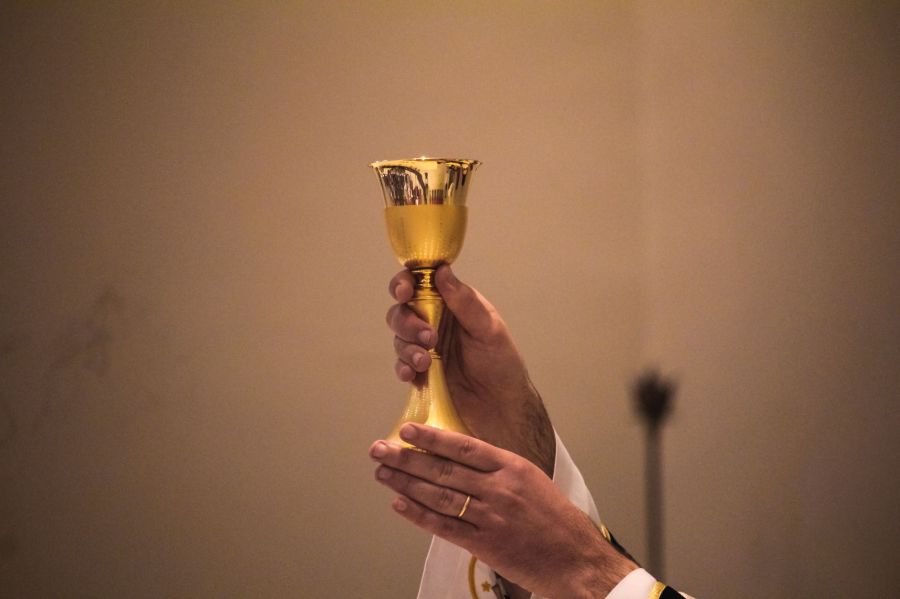
According to the laws of the land at that time, people of color and people of lighter skin were not allowed to drink from the same water fountain, much less the same chalice at the celebration of the Holy Eucharist.

So what was this priest going to do?

He saw the priest come to the people before her:

“The Blood of Christ, the Cup of Salvation.”

And then he came to Dorothy and lowered the common cup:

“The Blood of Christ, the Cup of Salvation.”

Kenneth, watching this from the pew, was astonished.

He said to himself, “A church that allows black people and white people to drink from the same cup understands something about the Gospel, and I want to be a part of that.”

And that’s exactly what happened.

Kenneth ended up joining the Episcopal Church. He and Dorothy got married and had children.

And their son grew up to become the first person of color to serve as Presiding Bishop of The Episcopal Church: The Most Reverend Michael Curry.

God provided a well for those who had been excluded and cast out when the people of God failed to live up to their calling.

And the name of the well that God provided, in the case of Kenneth and Dorothy, was The Episcopal Church.

We have the privilege of being a center of care and rest for so many people who have felt cast off and cast out by other churches—whether it is because of the color of their skin, or maybe because they ask too many tough questions, or maybe because of their gender identity or sexual orientation.

I’ve noticed that people who feel excluded often end up coming to the Episcopal Church. I am one of them, as are 70% of currently practicing Episcopalians in the United States. We found a place of rest, a well of water in the midst of a spiritual desert.

What a privilege that we get to share, as God’s people!

And yet, there are still ways in which we can continue to take the next step toward becoming a welcoming refuge for others who have been cast out, or who feel cast out, for any number of reasons.

Many of our fellow parishioners here at St. Mark’s, and in many Episcopal churches, are people in recovery from the disease of alcoholism.

The Episcopal Church, from the earliest days of the Alcoholics Anonymous movement, has been a supporter of that work.

To this day, including here in our own parish, twelve-step recovery groups continue to meet because we, as a church, believe in supporting people in their recovery from a disease they did not choose and against which they are fighting with tremendous courage.

One way in which we have an opportunity to take the next step in supporting them is in the choice of the elements we use when we celebrate our most central ritual: the Sacrament of the Eucharist.

It has been a longstanding tradition to use wine, which of course contains alcohol.

And that is something that can be potentially dangerous for our brothers and sisters who are in recovery. Someone spoke to me recently and said:

“When you lift the cup on Sunday and bless it as the Blood of Christ, I look at that and I think: what’s in that cup, to me, is poison. Why would anyone bless poison?”

That question really stayed with me.

Starting today, we’re going to do something a little bit different:
We are going to be using alcohol-free wine.

It’s a way that we can continue to be a well in the desert, a place of safety, a place of refuge.

I know it’s going to require something of us, because it’s a change in the way we’ve done things for a long time. And I know that we Episcopalians are not big fans of change. But you know what we are big fans of?

Loving people the way Jesus does.

And if Jesus knew there was something in the midst of his community that was harming the people he came to save, I think Jesus would do whatever he could to make his community a safer and more welcoming place for all people.

So beginning today, we are going to be using de-alcoholized wine in the celebration of the Eucharist, while we explore our long-term options for how to do this in a sustainable way.

For those of you who are in recovery: I invite you to consider, in your own mind and heart, what is best for you in your own recovery.

If even de-alcoholized wine feels too triggering for you, I want to encourage you to protect your sobriety, first and foremost.

Up to now, many of these folks have chosen to receive only the Bread and not the Cup.

Theologically, we believe that receiving just the Bread is full participation in the Communion of Christ’s Body and Blood.

But psychologically, we also know that receiving one element and not the other can sometimes feel less complete.

I just want you all to know that the option is available, should you choose it.

It is my hope that we, here in The Episcopal Church, may continue in God’s faithfulness to Hagar and to people throughout history from all nations—to be “a well in the wilderness,” and a church where absolutely everyone is welcome to participate fully in the life of the Body of Christ.

The Well in the Desert

File:Adi Nes 004.jpg

Have you ever experienced rejection?

If you’ve ever been a sixth-grader at a school dance, chances are you have.

“Eww, I’m not gonna dance with you, you dweeb!”

It’s a hard thing to go through, especially when you’re a kid. Those painful memories stay with you forever. Those of us who have kids of our own or care for other people’s kids know that crestfallen look in their eyes when they come home from school. We remember what it was like to be that age and experience rejection. It’s like our body still remembers the feeling of that knot in the stomach. We didn’t know how to fix it then and we don’t know how to fix it now. The best that any of us can say is that, by the grace of God, we got through it. So, when we see the kids we care about going through it right now, our heart goes out to them. Knowing that we don’t have any way to fix it (or even answers as to why it’s happening), all we can do when we see that look in their eyes is put our arms around them and say, “I’m so sorry.” We know that it’s just puppy love, but it’s real to the puppy. We know that our love for them can’t take away the shame of rejection, but we hope that somehow, it will help them get through it.

If we’re honest, we grown-ups can admit that we still feel that same pain sometimes. It might not come from the same sources (e.g. a twelve-year-old calling me a dweeb today will not phase me much), but there are certain things that other people can say or do that take us right back to feeling like that sixth grader at the middle school dance. It’s like the worst kind of time-travel. People can say things to us like: “I don’t have room in my life for a relationship with you… We don’t feel like you are a good fit for this position… Not tonight, I have a headache.”

It hurts, doesn’t it? And even though we are now adults facing adult situations, the pain we feel is still rooted in that childhood experience of rejection. Our brains may know the difference, but our bodies and our hearts do not. That old pain is still with us: the pain of not being chosen or wanted.

In our first reading this morning, from the book of Genesis, we heard the story of Hagar and her son Ishmael, two of the Bible’s most famous underdogs. They were two people who understood better than most what rejection feels like; what it feels like to be “not chosen” in ways that really matter.

Hagar and Ishmael are not “main characters” in the biblical story by any stretch of the imagination. They are the supporting cast, they are “extras” in someone else’s story. In this part of the book of Genesis, Sarah and Abraham are the main characters; they are God’s “chosen people.” God appeared to Abraham and said to him, “You shall be called the father of many nations. I will bless you and make you a blessing to all the nations of the world.”

Now, there was a problem with this arrangement because Abraham and his wife Sarah were already too old to have kids. And Sarah, being a very rational and practical person, came up with a solution: “I have this slave-girl, Hagar. She’s young enough to bear children. Here, Abraham, you go ahead and have a baby with her, so that God’s promise can come true.”

And this is where things get complicated. At this point, the biblical story almost starts to look like a “reality TV” show. Jealousy and rivalry set in quickly. Hagar and Sarah never seem to get along after this point.

First, Hagar does have a baby with Abraham and names him Ishmael. And Sarah is jealous of Hagar for this. Later on, after Sarah does have a baby against all conceivable odds, she decides that she doesn’t need Hagar anymore, so she tells Abraham to break up with Hagar and send her packing.

It’s interesting to note that Hagar never has a say in anything that happens to her. She is Sarah’s slave: an object who just gets passed around and used like a piece of property that can then be disposed of when she is no longer needed. Sarah and Abraham were the chosen people, but Hagar and Ishmael were leftovers… afterthoughts.

Sarah comes across as pretty heartless in this passage. Abraham fares a little better, but not much. The text says that he is “distressed” (we might say “stressed out”) by Sarah’s demands. After all, Ishmael is his firstborn son. He loads them up with as many supplies as they can carry, but it’s not much: a loaf of bread and a bottle of water. And then he sends them out into the desert, knowing that he will never see them again and they will most likely die there.

Out in the desert, Hagar’s water runs out pretty quickly. And here she is: all alone in the desert with a baby and no water. She’s been used, abused, and eventually abandoned by the people who were supposed to take care of her.

She keeps going for a little while: as long as she can, which is obviously not long in a place like that. But eventually her strength gives out. She knows what will happen next: she and her son will die out here and their bones will probably never be found.

If there is anyone in this story who is lower-down and worse off than Hagar, it’s Ishmael. He is just a baby at this point. He owes his very existence to this twisted situation. He didn’t ask for any of this. You could say that he never even had a decent shot at life. The playing field of opportunity was never really level for him. And now, because Sarah and Abraham, God’s chosen people, were acting so petty and hard-hearted, he was going to die.

This is where Hagar reaches her breaking point. She can’t go on, so she gives up and throws in the towel. Above all, she can’t bear to watch Ishmael die, so she abandons him: she sets him down under a bush and walks away. She can hear him crying behind her, but she won’t turn around. It’s too late for them. It’s over.

And then… in that moment… the moment after all hope is lost, hope finally begins to dawn. That’s when God finally decides to show up in this morbid scene: not alongside the chosen people, but with the rejected ones; not in the city or the camp, but out in the desert; not with the rugged, faithful, positive-thinking overcomers who soldier on no matter what, but with those who have given up and given in to the worst parts of their humanity. As G.K. Chesterton once wrote, “It is only for those who hold on for ten minutes after all hope is gone that hope begins to dawn.”

God shows up in the least likely places. In this story, there is a definite hierarchy among characters: At the top there is Sarah, who just doesn’t care. Next you have Abraham, who is caught in the middle of his two wives and sons. The text tells us that he is “distressed” by what is happening. After that, you have Hagar, who is rejected, abandoned, and heartbroken. And finally, at the very bottom, there is Ishmael, who never asked for any of this. This baby is going to die because God’s chosen people are too hard-hearted to see past their own petty issues. (Sounds like the Church sometimes, doesn’t it?)

And where is God in all this? Sitting on heaven’s throne, objectively evaluating the situation? Does God make excuses for the chosen people, justifying their selfishness, no matter what the cost?

Whose voice does God listen to in the end? Not Sarah’s, not Abraham’s, not the chosen people’s, not even poor Hagar’s. Genesis tells us that “God heard the voice of the boy.” Ishmael. The voice that mattered least. The voice that no one else wanted to hear (not even his own mother, in the end). Ishmael was the least of the least in this situation, the one who even the rejects rejected. He didn’t even have words to form, much less a theology for calling out to God and arranging salvation. The only thing that came out of him was the wordless wail of a child who has just been abandoned by his mother.

Rejection. Ultimate rejection which, in his case, meant certain death. And God heard the voice of the boy. God shows up where the pain is greatest and the hope is gone. In spite of the sacred covenant established with Abraham and continued through Isaac and Sarah, God cannot help but reach out to be with these forgotten folk, particularly this baby boy.

God speaks to Hagar his mother and says, “Don’t be afraid. I’m here. I’m listening. Go, pick up your son and hold him close, because this kid has a future. I will make a great nation of him.”

And then, according to the text of Genesis, God opened Hagar’s eyes and she saw something: a well of water in the desert. Not just a bottle, like Abraham had given her, but a full-on well where she and her son could drink and drink to their hearts’ content.

According to the text and history, God made good on that promise to Hagar and Ishmael. They learned how to survive out in the desert. They made a life for themselves. Ishmael grew up, got married, and became a great bow-hunter.

He even became “a great nation,” as God promised he would: our Muslim neighbors trace their ancestry to Abraham through Ishmael, just as Jews and Christians trace their lineage through Isaac, Abraham’s son by Sarah.

What I take away from this story is God’s special love for the least of the least of the least. God really does seem to have a thing for underdogs. Church teaching has historically referred to this as “the preferential option for the poor.”

God is not neutral or objective when it comes to injustice. God sides with the poor and powerless people of the earth in their suffering. It’s not that God loves some people more than others; it’s that some people need God’s love more than others. God stands in solidarity with the oppressed peoples of this world, therefore we, as God’s people are called to do the same.

I believe the Church is called to be a safe haven for our outcast sisters and brothers. We’ve all heard stories of faith communities rejecting certain people, sending them packing, or kicking them out for one reason or another, perhaps sending them off with a single bottle of water to sustain their faith in the spiritual deserts of this world…

I believe the Church’s call in those moments is to be present with those rejected people, like Hagar and Ishmael in the desert. Rather than turning our heads and walking away because we can’t bear to see their suffering, I believe we are called to hold each other close in the darkest hours, to open the eyes that are blind, and inspire our hurting neighbors to believe in a future for themselves that they would not even dare to imagine.

We are not meant to pass out little bottles of water and then send people on their way. We care called to be that well in the desert, where exhausted travelers and fellow rejects can find rest and build a new life together out of the ashes of their rejection.

This is the kind of ministry that North Church has been doing for over a generation. We are the well in the desert. We stand together today, poised at the brink of an unknown-but-promising future, facing new challenges, ready to pursue new opportunities, and certain of this: that God is with us. We know this because we are the poor, we are the homeless, we are the addicts, we are the disabled, we are the mentally ill, we are often overlooked and outcast, we are the freaks and the geeks, we are the queer, like Hagar and Ishmael, we are the rejected ones: and that’s where God lives. Amen.