

The Last Word

Sermon for Proper 13, Year A

Matthew 14:13-21

When my wife and I argue (and believe me, we do), we don’t usually shout or call names. We do something much more insidious: we commit time abuse. We take an issue and analyze it to death, sometimes into the wee hours of the morning.

We do this because each of us is vying for the last word in the discussion. We don’t just want to win the argument; we want to drop that last bit of wisdom that makes the other person go, “A-ha! I see your point. You’re so wise. I’m so lucky to be married to you.”

Of course, when both of us are trying to get the last word, nobody really wins.

In life, too, we often assume that the last word is the thing that defines everything else. Whether or not this is actually true, we often live as though it is.

Today’s Gospel is a story about what gets the last word. But that fact only becomes clear when we realize that this passage is the second half of a two-part story. The first half happens in the twelve verses immediately preceding the section we heard today. Our lectionary skips over that first half because it is far less pleasant than the one we read this morning.

In the first half of the story, King Herod Antipas holds a luxurious banquet for his courtiers. At this banquet, his stepdaughter performs a dance that delights the guests so much that Herod rashly promises to give her anything she asks. At the urging of her mother, she asks for the head of John the Baptist on a platter.

Matthew tells us that Herod is grieved by the request. But in the end, he gives in because he is afraid of losing face before his guests. Herod allows fear to have the last word. And the final effect of that word is death.

Our Gospel picks up immediately after that story.

Jesus hears that his friend John the Baptist has been murdered.
Understandably, he withdraws by boat to a deserted place to be alone.
If anyone had reason to say, “Not today,” it was Jesus.
But the crowds follow him. And Matthew tells us something very simple:
“He had compassion for them and cured their sick.”

The story that follows is another banquet.
Unlike Herod’s banquet, this one is not held among the privileged elite in luxurious halls of power, but among ordinary people in a deserted place.

Jesus blesses and shares what little is available: five loaves of bread and two fish. When everyone has eaten, twelve baskets of leftovers remain.

At Herod’s banquet, fear has the last word.
At Jesus’ banquet, love has the last word.

Jesus refuses to let his own pain have the last word in how he responds to others.

Herod, tragically, allows fear to become the final voice, and the result is more death.

But for Jesus, love has the last word, and the result is more life than we know what to do with.

This is what Jesus is like.
This is what God is like.
And this is why, from this hillside to the upper room to the empty tomb, love always gets the last word.

Dorothy Day, the Catholic activist who founded houses of hospitality during the Great Depression, was frequently asked whether there was room for one more hungry person at the table.

Her answer was always the same:
“There is room for one more.”
Years later, she titled her memoir of that ministry Loaves and Fishes.
Like Jesus, she trusted that God’s love was greater than human scarcity. She lived as though love, not fear, should have the last word.

Kindred in Christ, every one of us comes to this place carrying something, whether that is grief, anxiety, frustration, or exhaustion.
We cannot always choose what happens to us. But by God’s grace, Christ can slowly reshape how we respond.
He meets us in our own pain.
Not by pretending it isn’t real.
But by refusing to let it have the final word.
And as we are fed at his table, Christ teaches us to let love—not fear, not cynicism, not pain—have the last word in our own lives.

This week, someone will cross your path while you are carrying your own burdens.
Perhaps the invitation of this Gospel is simply this:
Before fear, cynicism, or pain gets the last word…
Remember the One who came ashore grieving, saw the crowd, and had compassion.
He refused to let his own pain have the last word in how he responded to others.
Because in Jesus Christ, love gets the last word.

At Herod’s table, death had the last word.
At Christ’s table, love had the last word.
At Calvary, death seemed to have the last word.
At Easter, love had the last word.

And because love gets the last word, there is always enough grace, enough mercy, and enough room for one more at Christ’s table.
Home By Another Way

Sermon for the Feast of the Epiphany

The text is Matthew 2:1-12.

When I was younger, I used to believe that there was one specific right way, and a whole lot of wrong ways, to practice spirituality. I thought I had to believe all the right doctrines and follow all the rules perfectly, or else God would get mad at me and punish me accordingly.

Now, to be fair to my younger self, there were a few upsides to this way of thinking. For one, it gave me a very strong moral compass, which is a good thing for a young person to have. And number two, it gave me a strong sense of community with others who were trying to practice their spirituality in the same way. And that’s also a good thing.

The downside, however, was that I lived with a constant sense of dread—that if I asked too many tough questions, or failed to live up to my moral code, I would be in deep yogurt with God, who watched everything I did, listened to every word I said, and knew every thought I thunk, and was keeping a meticulous record of all of it, for which I would one day have to answer.

I knew very well just how much I failed to live up to the high standard I set for myself, and I figured that God was looking at me in just the same way—only more so, because God could never forget.

I’ll be honest. Living with that kind of fear, 24 hours a day, seven days a week, was crazy-making. I was told that I needed to trust in God, but the God I believed in—the all-seeing and all-knowing micromanager—wasn’t trustworthy. That kind of God was less like the lover of our souls and more like an abusive ex-boyfriend. No matter how hard I tried, nothing I did would ever be good enough.

I believed these things about God because I thought that’s what it said in the Bible. But then I made one fatal mistake: I actually read the Bible. And what I found there was something more complex, more nuanced, and more loving than the abusive ex-boyfriend I had been in a relationship with up to that moment.

It’s funny, isn’t it, how the Bible is a central source of our theology, but actually reading it can completely wreck that theology?

The gospel for the Feast of the Epiphany is one of those biblical passages that absolutely wrecked my theology. But it didn’t just break me down—it broke me open. This story opened my eyes to the reality that God is both bigger and more loving than all my narrow ideas about God.

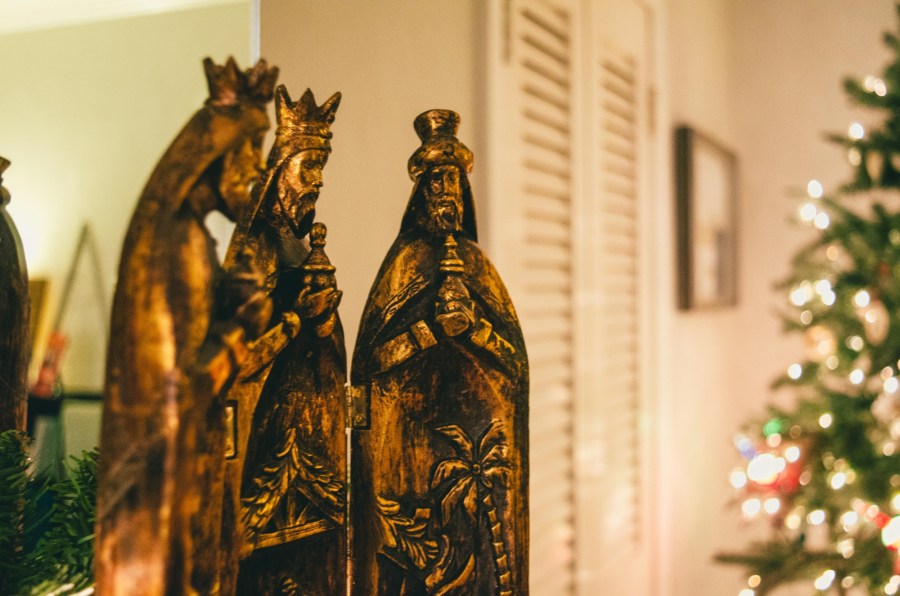
This story—the visit of the magi, or wise men from the East, as our translation renders it—is one of the best-known and least-understood stories in the New Testament. The magi themselves were not Jewish. In all likelihood, they were Persian, from somewhere around the modern-day city of Baghdad in Iraq. The dominant religion in that area at that time was not Judaism, but Zoroastrianism. And these magi were astrologers.

And that’s the first place where the Bible starts to mess with my theology. Because I had always been told that astrology was fake and bad, and that I should stay away from it. But here was this famous story in the Bible, no less, where spiritual seekers are using astrology to find their way to the presence of Jesus. That made me go, wait, what?

And it didn’t stop there. It gets weirder—so hold on to your seats.

These Persian astrologers determined, by practicing their craft, that a great king was being born in the land of Judea, so they figured they should go and pay their respects. And if you’re looking for a newborn king, where else would you go except to the king’s palace in the capital city, right?

So they ring the doorbell and say, “Hey, congratulations.” And King Herod is just standing there like, “What? There’s no newborn king here. What are you talking about?” So he goes and consults with the bishops and the theology professors, and they tell him, “Yeah, it’s not happening here. It’s supposed to happen in Bethlehem, according to the ancient prophecies.”

So Herod sends the magi back out to find this new king—not because he wants to pay his respects, but because he wants to eliminate any possible threat to his power. But the magi don’t know that. So they set out again.

And another really interesting thing happens. The text of Matthew’s Gospel specifically says that the magi didn’t follow the directions the clergy had given them from the Bible. It says that they set out, and they saw the star again, and they followed that instead—and lo and behold, it led them to the exact same place the clergy had told them to go.

They weren’t following the “right” way that was prescribed by the Bible. They were following the light they knew, and it led them to the same place.

It’s hard to be a fundamentalist when you actually read the Bible.

So they get there, to the presence of Jesus, Mary, and Joseph. They pay their respects. They offer their gifts. And just as they’re getting ready to go home, they have a dream. And in this dream, God warns them not to return to Herod, but to return to their own country by another road.

Other translations render this sentence as “they went home by another way.” And I really like that turn of phrase.

The magi were going home by another way—not just at the end of the story, but the whole way through. They were not members of the God Squad in the traditional sense. And they didn’t follow the guidance of the Bible. They walked by the light of their own star and ended up exactly where they needed to be anyway.

That says something to me about the God we believe in today—not the abusive ex-boyfriend god, not the all-knowing micromanager, but one who is not afraid of people who ask questions, make mistakes, and travel by their own light. God was with the magi in ways that broke the rules. And that same God is still with us today and has been all along.

One of the many things that I love about the Episcopal Church is that we have a theological tradition where diversity is baked in. Our theology is not about obedience to a single infallible authority. It’s an ongoing dialogue between scripture, tradition, and reason. There is room in our theology for differing viewpoints, and the God we believe in is bigger than all of it.

No book or person or institution is capable of having the last word, because we believe that word hasn’t been spoken yet.

Like the magi, God is still guiding us closer to the presence of Jesus by many and various paths. So none of us has the right to pass judgment on another, or say with absolute certainty, “You’re wrong, and I am right.”

We might think we’re right, but God is usually standing off to the side with a little smirk, going, “Are you sure about that?”

If God could lead the magi to where they needed to be by the light of a star, then surely it’s no big problem for God to lead you wherever you need to be by means of whatever light you follow—no matter the size of your questions, the severity of your mistakes, or the strangeness of your personal beliefs.

Kindred in Christ, that’s the good news of Epiphany for us. What that good news asks of us is the courage to ask the big questions, the humility to make mistakes, and the confidence to trust that we are still loved, even when we don’t get it right.

That is the light that will lead us home by another way.

Amen?