Hope First

Sermon for the second Sunday of Christmas

The biblical text is Jeremiah 31:7-14.

Sermon recording:

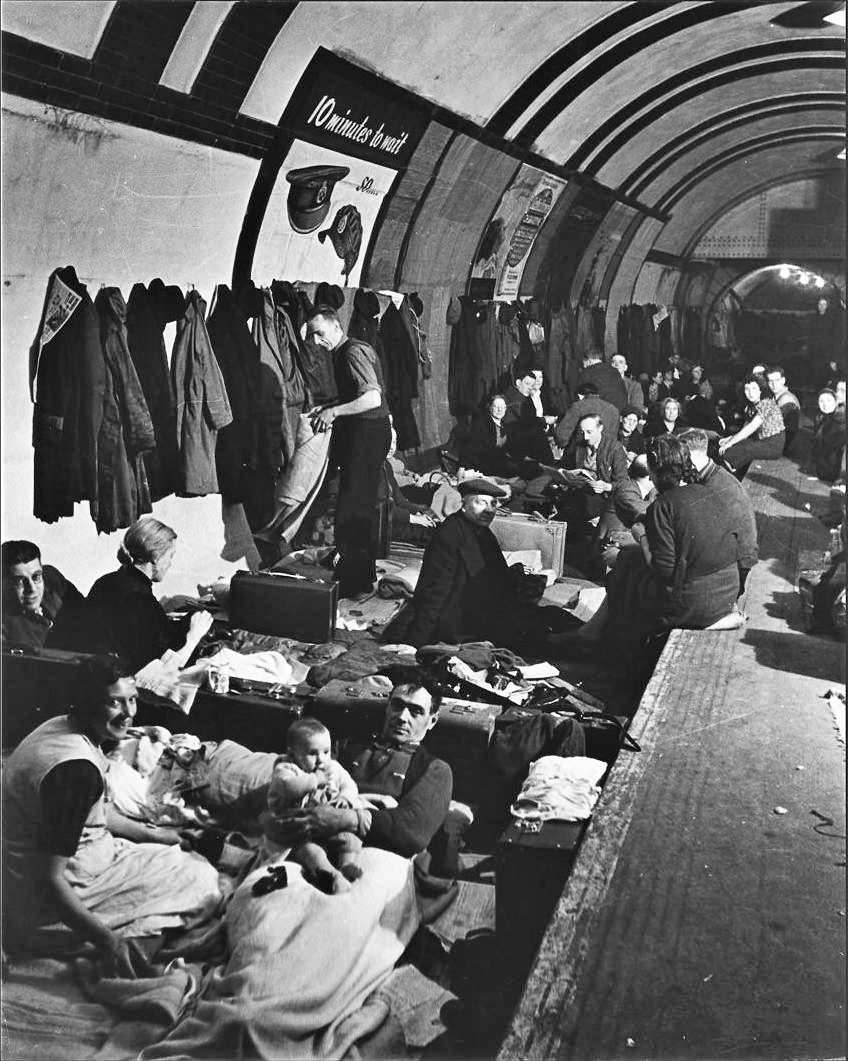
In September 1940, at the height of World War II, the German Luftwaffe began a sustained bombing assault on the British capital that eventually became known as the London Blitz.

As the city burned above them, the people of London gathered and slept in the underground subway tunnels for safety.

And yet, even as the city was being bombed night after night, something remarkable happened: Concerts continued, drama troupes put on plays, teachers taught classes, and an inter-shelter darts league formed. One pianist, Myra Hess, organized daily concerts at the National Gallery. People would come on their lunch breaks, not because the war was over, not because things were safe again, but because something in them knew this mattered.

They didn’t sing because the bombing had stopped.
They sang because without beauty, without meaning, without joy, they wouldn’t survive the bombing at all.

And that human instinct — to cling to hope before everything is fixed — is exactly what we hear in today’s reading from the prophet Jeremiah.

This passage comes from one of the bleakest books in the Bible. Jeremiah is not an easy prophet. He doesn’t offer quick comfort. He doesn’t soften his message. He spends much of the book warning his people — the people of Judah — that a crisis is coming.

For the first large section of the book, Jeremiah is doing one hard thing over and over again. He is speaking the truth about his nation’s injustice, exploitation, and unfaithfulness to God’s covenant, even though he knows the king won’t listen. He keeps telling the truth anyway, even though it gets him ignored, mocked, threatened, and eventually imprisoned.

And the truth he speaks is this:
“If we have lost faith in the core principles that make us who we are as a nation, then no amount of wealth, power, or political strategy will be able to shelter us from the consequences of our own actions.”

Jeremiah is not speaking as an outsider. He is speaking as a concerned citizen. He loves his people. That’s why he tells the truth.

Later in the book, the tone shifts again. By that point, his warnings have gone unheeded. The moment of truth has come and gone. The disaster Jeremiah spoke about has arrived. Jerusalem has fallen to the Babylonians. The people have been carried off into exile.

So, for Jeremiah and the people of Judah, the question is no longer, “How do we avoid this?”
The question is, “How do we live now that it’s here?”

That final section of Jeremiah is about acceptance — not resignation, but the sober recognition that what’s done is done, and all that remains is to make the best of it.

But right in the middle of those two sections, between the warnings and the acceptance, we get a third section that scholars call the Book of Consolation. Chapters 30 through 33. This is the section where today’s first reading comes from.

What’s striking about the Book of Consolation is that Jeremiah offers hope before the exile is resolved. Consolation comes before acceptance. Not because everything is okay, but because Jeremiah knows that, without hope, the people will not be able to survive what lies ahead.

Listen again to the imagery Jeremiah uses. This is not quiet, private reassurance. This is public celebration. Singing. Shouting. Gathering. Grain, wine, and oil. A watered garden.

And notice who’s invited:
The visually impaired.
The mobility impaired.
Those who are pregnant.
Those in labor.
The people who cannot move quickly. The people who cannot carry much. The people who are exhausted, vulnerable, and easily left behind.

If you step back and picture it, what Jeremiah is describing looks less like a church service and more like a street party.

This is not a party for the strong. This is not a celebration of victory or success. This is a gathering that moves at the pace of the most vulnerable. No one is told to wait until they’re healed. No one is told to come back later when they’re stronger.

Everyone belongs.

Jeremiah even says, “I will give the priests their fill of fatness” — as a priest myself, I’m trying not to take that one personally.

But the most important thing to notice is this: the party happens before anything is fixed.

The exile is still real. The losses are still fresh. The future is still uncertain. And yet — the singing continues.

Just like the music during the Blitz, this isn’t a celebration because the danger is gone. It’s a celebration because without joy, without meaning, people won’t make it through what’s coming.

What’s fascinating is that psychology tells us something very similar.

Viktor Frankl, who survived the Nazi concentration camps, noticed that people didn’t endure suffering because it stopped. They endured because they found a reason to keep going. Meaning came first. Relief came later — if it came at all.

Or as Frankl famously put it, those who have a “why” to live can bear almost any “how.”

In other words, hope comes before acceptance. Without it, people collapse.

Developmental psychology tells us something similar from the very beginning of life. Erik Erikson wrote that hope is the first human virtue, formed not through explanation or reasoning, but through trust.

You don’t argue a baby into trust.

You don’t sit down with a newborn and say, “Now listen here, if you’ll just consider the evidence, you’ll see that you have been fed and changed, that your parents love you very much, and that it’s in everyone’s best interest that you lay down and go to sleep…”

Obviously, you don’t do that. You hold them.

Trust comes before understanding. Hope comes before explanation.

That explains why Jeremiah doesn’t wait until the exile is over to offer hope. He offers it first — because without it, the people won’t survive the truth they’re about to face.

The kind of hope Jeremiah is talking about is not mere optimism or denial, but something tougher.

I read a Tweet online that illustrates this kind of hope perfectly. It was written by someone named Matthew @Crowsfault and says:

“People speak of hope as if it is this delicate, ephemeral thing made of whispers and spider’s webs. It’s not. Hope has dirt on her face, blood on her knuckles, the grit of the cobblestones in her hair, and just spat out a tooth as she rises for another go.”

I absolutely love that. That’s the kind of hope you need when you’re living in exile.

And that kind of hope matters not just for us as individuals, but for us as communities.

When communities come under strain, they tend to split into two instincts. Some respond by saying the only faithful thing to do is expose every failure, until there’s nothing left but despair. Others respond by saying the only faithful thing to do is protect what’s good, even if it means refusing to see what’s broken.

Jeremiah refuses both extremes.

He loves his people too much to flatter them — and too much to abandon them.

That’s why hope comes first. Accountability without hope turns into cynicism. Hope without accountability turns into denial. Jeremiah offers hope not to erase the truth, but to make it possible for the people to face it.

And this isn’t just about nations or communities. It’s about individual lives, too.

I once read about a mother whose child was born with a severe and terminal disease. There were no long-term plans. No grand ambitions. None of the milestones people usually imagine for their children.

From the outside, many would have called that situation hopeless.

But the mother wrote about discovering a different kind of hope — not hope that things would be different, but hope rooted in love, presence, and fierce attention to the life in front of her. She described learning to delight in small moments, celebrate what was real, even though the future looked nothing like what she had imagined.

That’s the hope Jeremiah is pointing toward.

Not hope that skips over suffering.
Not hope that waits for everything to be resolved.
But hope that shows up anyway — and holds us together while the story is still unfinished.

The music during the Blitz didn’t stop the bombs. But it reminded people who they were.

Jeremiah’s street party didn’t end the exile. But it reminded the people that their story wasn’t over, that God wasn’t done with them, that life itself still carried the possibility of renewal.

So the invitation in this passage is not to pretend that everything is fine. It’s to accept the fact that things are pretty messed up and practice hope anyway. To create moments of joy. To notice what is good and celebrate what is being born, even though the ending is still unclear.

Kindred in Christ, as you look around at our troubled world today, gape in horror at the latest news reports, and wonder what it’s all coming to, I dare you to practice hope as a spiritual discipline.

Not a vague optimism that everything will work out fine, not a distraction from the real problems that we are facing, but a defiant commitment to keep hoping in the face of despair. An unshakable faith that God is not done with us yet, so we owe it to ourselves and each other to keep holding on and keep looking for opportunities to do what good we can, where we can, with whomever we can, and for as long as we can.

Like the people who lived through the London Blitz, we too have a need to sing before the war is over.
We too have a need to gather before the exile ends.
We too have a need to hold tightly onto one another, not because everything is okay, but precisely because it isn’t!

Because hope isn’t what comes after we heal the world.
Hope is what makes healing the world possible.

Amen?

Staying Awake

Sermon for Advent 1, Year A

Click here for the biblical readings.

We were supposed to gather at church today. Plans were made. Schedules were set. And now a storm has rearranged all of it. The roads aren’t safe. The building is closed. And here we are instead—in living rooms, kitchens, basements—still together, but not in the same place.

It’s not the end of the world. But it is the breaking open of the illusion that everything is under our control. We make our plans. We set our calendars. We line up our routines. And underneath it all is the unspoken hope that if we stay organized enough, life will stay predictable. But life rarely cooperates with our plans.

When Jesus says in today’s gospel, “No one knows the day or the hour,” that planning part of ourselves feels the tension right away. Not knowing feels dangerous. Change feels risky. We want a roadmap. We want signs. We want time to prepare.

But underneath that need for predictability is something even more tender: the fear of what might be revealed if the surface of things were ever to crack. Many of us carry the quiet suspicion that the order we see every day is fragile—that if it gives way, what’s underneath will be dark and dangerous. So we work hard to keep everything looking normal. And when the sense of normal is threatened, fear rises fast.

Most of us know that feeling. A weird sound coming from the car. The boss asking, “Can I see you in my office?” A phone call that begins with, “Your child has been in an accident…” A moment ago everything felt stable, and now suddenly it doesn’t.

That’s what Jesus points to when he talks about the days of Noah. People were eating and drinking, marrying and building their lives. Ordinary life. But ordinary life wasn’t able to hold together. It eventually fell apart, as all things do.

Was it the end of the world? In some ways, yes. It was the end of the world, as they knew it. But Jesus hints at a deeper truth. Not about the end of the world, but about what comes after it.

We often fear that if the surface of life ever falls apart, what comes next will be a nightmare. When our carefully constructed order gives way, what we meet first often feels like chaos. But after that first rush of chaos, there is something else.

Today’s gospel reading only hints at what that might be, but our first reading, from the book of Isaiah, dares to name it:

Isaiah sees the nations of the world gathering together instead of marching against each other. He sees people laying down their weapons because they have learned a better way to live.

Swords become plowshares. Spears become pruning hooks.
What once took life now gives life. What once drew blood now grows bread.

That is the apocalypse beyond the apocalypse. Not just the exposing of what happens when things fall apart—but the unveiling of what is trying to be born. A world no longer organized by fear, but by learning. By shared life. By the slow conversion of violence into nourishment.

We see the same pattern in the natural world all the time. In the hollow of a fallen log, an animal makes her home. From the remnants of a supernova come the building blocks of life itself.

We might wish for a world where everything is under control and nothing is chaotic. We might be afraid that, in reality, nothing is under control and everything is chaos. But the fact of the matter is that neither of those things is ultimately true. Life isn’t completely chaotic, but neither is it completely under control. Life grows in the creative tension between chaos and order. And over time, it keeps leaning toward connection. Toward relationship. Toward more belonging, not less. Faith dares to say that this same love is what’s holding the whole universe together.

That’s why Jesus can say, “Stay awake,” without meaning, “Be afraid.” Staying awake doesn’t mean scanning the horizon for disaster. It doesn’t mean planning for every possible contingency. Staying awake means paying attention to what really matters.

And that kind of waking up doesn’t just happen in dramatic moments. It happens in the small ones. It’s the pause before snapping back at someone. It’s the choice to listen instead of trying to win. It’s the moment when we decide whether we’re going to lead with fear—or with love.

Staying awake isn’t about knowing what’s coming. It’s about choosing how to live in alignment with what really matters.

So—here we are. Not in the same room. Not in the way we expected to be. The storm has interrupted “the best-laid plans of mice and men.” Our illusion of control has already cracked.

And still, beneath it all, we are being held.

Even here, in separate homes. Even on an altered Sunday. Even in uncertainty. Beneath the inconvenience, there is care. Beneath the disruption, there is still connection. Beneath what unsettles us, there is love doing its quiet, steady work.

So our invitation this season is simple. Don’t cling in fear. Don’t shut down in despair. Stay awake to what matters. Choose what grows life. Trust what is deeper than the storm.

Amen?

From Cynic to Samwise (Rooted & Rising Series, Week 1 of 4)

Sermon for the fifth Sunday after Pentecost (Proper 10, Year C)

Back in the 1990s, we used to have a famous TV show called Seinfeld. On that show, there was a character named George Costanza, played by Jason Alexander. If you’ve never seen the show, all you need to know is that George was a miserable and selfish little man.

One day, during a child’s birthday party, George noticed that a small fire had broken out in the kitchen. Rather than reach for a fire extinguisher, George screamed at the top of his lungs, “Fire! There’s a fire!” Naturally, the whole room of kids erupted into chaos at that moment. And George, rather than calmly directing people to the nearest exit, proceeded to shove the kids to the ground and step over them as he ran out of the apartment.

Later, when the parents of those children confronted George about his selfish behavior, George proceeded to defend his actions and twist the facts, claiming that he was not a coward, but a hero and a leader. George was cynical, fearful, and completely indifferent to the needs of other people.

After his pathetic attempt at self-justification, a firefighter stepped up and asked George, “How do you live with yourself?”

George replied, “It ain’t easy.”

If you’ve seen the show, or even if you only know George through the story I’ve just told, you’re probably shaking your head in disgust right now. But the truth is that there is a little bit of George Costanza in each of us. In the very least, I am absolutely sure there is in me.

When I turn on the daily news, I often feel terrified at what this world is becoming. In a vain attempt at self-protection, I take up the shield of sarcasm and fasten the breastplate of cynicism over my heart. And then, when I am thoroughly suited up, I turn a blind eye and an apathetic heart to the suffering of those around me. I pretend that, if I can’t feel it, it isn’t real.

Fear, cynicism, and indifference claim to be the defenders of human life, but in reality, are the enemies of the human spirit. Thankfully, there is a better way to defend both our lives and our souls from the onslaught of danger that the world sends our way.

Scientists have recently discovered that biological evolution is far less random and competitive than they previously thought. To be sure, random mutation and competition still play a role, but they are not the only factors that matter. As it turns out, evolution seems to be moving in a direction: toward greater and greater complexity of life. Single-celled bacteria gave rise to multi-cellular organisms. These multi-cellular organisms formed complex ecosystems and organized societies, which leads to the second stunning realization: That cooperation is at least as important to the progress of life as competition. We previously thought that evolution was only about “survival of the fittest,” but it turns out that it is also about “survival of the friendliest.” A single Neanderthal hunter cannot bring down a wooly mammoth by himself, but a cooperative hunting party can! It’s like they say: Give a man a fish and he’ll eat for a day; teach a man to fish and he’ll eat for a lifetime; teach a community to fish and everybody eats! We can do more together than any of us can separately.

This is not just a biological fact; it’s also a biblical truth.

Today’s epistle reading, from the New Testament book of Colossians, shows us how to counter the negativity of cynicism, fear, and indifference with the theological virtues of faith, hope, and love.

To begin with, we need to look at the context in which the book of Colossians was written. The author claims to be St. Paul the Apostle, but was probably just a student of his, writing in his name. This was a common practice in the ancient world.

In today’s world, we would call that forgery, but the ancient Greco-Roman world called it respect. It was common for a student to write in their teacher’s name as a way of saying, “Anything I know, I owe to my teachers, so I give all credit to them.” The great Greek philosopher Plato did the very same thing in relation to his teacher, Socrates. Modern historians have a hard time distinguishing between the sayings of Socrates and the sayings of Plato because the student wanted to give all honor and respect to the teacher who taught him everything he knows. It’s a beautiful sentiment, but one that also creates problems for modern historians who value accuracy over honor. Unfortunately, the ancient world does not play by modern rules, so we have to work with what we have. The author of the epistle to the Colossians was probably a student of St. Paul who loved their teacher very much and wanted to preserve his legacy for future generations.

The letter itself was probably written sometime after the year 80 CE, about 20 years after St. Paul is thought to have died. St. Paul himself wrote as if he was expecting Jesus to return and the world to end sometime before next Tuesday, so he didn’t bother too much with setting up sustainable systems of church government that could last for several generations. The author of Colossians, on the other hand, writes as if they expect to be here on this earth for a while, so they’d better figure out a way to live that is consistent with their Christian values, but also realistic for the world they have to live in.

It’s kind of like those times when you’re going out to dinner with your kids, and they want to bring their iPad into the restaurant, but you know that you’re about to be seated, so you tell them to leave it in the car. But then, after you check in with the greeter, you learn that there is a thirty-minute wait to be seated, so you begin to consider letting the kids get their iPads from the car. That’s what the author of Colossians is thinking about.

Thankfully, the author of Colossians is wise and knows how to compromise with reality without sacrificing the core ideals of their faith. They don’t start by complaining about what’s wrong, but by pointing to what’s right.

The author, writing in Paul’s name, says, “In our prayers for you we always thank God, the Father of our Lord Jesus Christ, for we have heard of your faith in Christ Jesus and of the love that you have for all the saints, because of the hope laid up for you in heaven.”

The author starts with thanksgiving for what is already there. Namely: faith, hope, and love. These three moral values are the antitheses of cynicism, fear, and indifference. Taken together, they form the polar opposite of everything that George Costanza stands for in Seinfeld. The author is not trying to instill these values in the Colossians, but giving thanks that they are already present.

What the author does pray for is an increase in wisdom, patience, and joy for the Colossians, so that they might remain faithful to what they already believe to be true.

Throughout this passage, the author repeatedly returns to the agricultural image of “bearing fruit.” They envision the spiritual life as a tree that is both rooted in love and rising to bear the fruit of love in the world.

Over the next three weeks, we are going to stick with this agricultural metaphor of being “Rooted and Rising in Love,” as we explore the epistle to the Colossians and consider what these ancient writings might mean for us today.

For now, I would like to invite you to consider the negative example of George Costanza from Seinfeld, as a person who is consumed by cynicism, fear, and indifference and acts accordingly in relation to his fellow creatures in the world.

On the other hand, I would also like to invite you to consider the positive example of another fictional character from literature: Samwise Gamgee from J.R.R. Tolkien’s The Lord of the Rings. Samwise, or Sam (as he is known to his friends), is the exact opposite of George Costanza in many ways. You need not have read The Lord of the Rings novels or seen the movies to understand what Sam is like. Unlike George Costanza, Sam is not concerned with his own self-preservation, but wants only to support his friend, Frodo the Ring Bearer. When his friend is in danger, Sam rises to protect him. When his friend is hurting, Sam rises to comfort him. When his friend falters in the task that has been given to him, Sam rises to carry him toward its completion.

In all things, Sam is Rooted and Rising in Love. He embodies the wisdom, patience, and joy that the author of Colossians prays for in the readers of this epistle.

In the film version of The Lord of the Rings, Frodo declares, “I can’t do this, Sam,”

And Sam then says to his friend:

“I know. It’s all wrong. By rights we shouldn’t even be here. But we are. It’s like in the great stories, Mr. Frodo. The ones that really mattered. Full of darkness and danger they were. And sometimes you didn’t want to know the end. Because how could the end be happy. How could the world go back to the way it was when so much bad had happened. But in the end, it’s only a passing thing, this shadow. Even darkness must pass. A new day will come. And when the sun shines it will shine out the clearer. Those were the stories that stayed with you. That meant something. Even if you were too small to understand why. But I think, Mr. Frodo, I do understand. I know now. Folk in those stories had lots of chances of turning back only they didn’t. Because they were holding on to something… That there’s some good in this world, Mr. Frodo. And it’s worth fighting for.”

Kindred in Christ, that’s the message that the author of Colossians means for us to hear today. Over the next few weeks, we will unpack that message in greater detail.

Until then, I want to encourage you to hold on to these words from Samwise Gamgee. Hold onto them when you read the news headlines and are tempted to give in to the demons of cynicism, fear, and despair. Hold onto them in those moments when George Costanza seems wiser than Sam Gamgee. Hold onto them because the truth of the gospel of Jesus Christ trumps the sinful despair of this world.

Hold onto what the author of Colossians knew, what Sam Gamgee knew, and what you know to be true. Don’t be deceived by the lies of this world, which is passing away. Hold onto the truth that is eternal, the truth that holds you in the strong arms of love itself. Hold onto the truth of Jesus in the midst of the lies of this world, so that you too might be “rooted and rising in love.” Hold onto it because it is already holding onto you with a love that will not let you go.

Amen.

The Gardener Who Never Gives Up

Sermon for the Third Sunday in Lent.

Click here for the biblical readings.

Hi, my name is Barrett and I make poor life choices.

Back in 2013, my family and I moved from upstate New York to western Michigan. We figured it would take a couple of days to pack up our stuff, load the truck, and get on the road. After all, we had made a similar move just a few years earlier, coming from the west coast of Canada to New York.

What we failed to account for, though, is that our previous move involved two broke seminarians in a one-room apartment. Everything we owned fit in the back of a modest U-Haul. Over the course of the intervening years, we had amassed a much larger collection of furniture, books, and kids (with all their accompanying accoutrements). A couple of days and a U-Haul wouldn’t be nearly enough to get the job done this time.

A visitor to my house asked, “Hey, aren’t you moving to Michigan next week?”

“Sure,” I said, “I figure I’ll just throw some stuff in boxes and hit the road.”

My friend very wisely took that opportunity to gently talk some much-needed sense into me, “Listen, you’ve got a lot more stuff in this house than you did when you got here. I don’t think a couple of days is going to be enough time.” Thank God for good friends, because this blessed soul organized a whole cadre of neighbors who descended upon my messy house for the entire week that it took the lot of us to get things packed and cleaned before moving day. In the end, everything came together right on time, but there’s no way it would have if it hadn’t been for the love of these people who rescued me from the mess of my own making. All in all, the stakes were relatively low in this crisis, but I was very grateful for the community that made a safety-net for me, when I needed it.

For other people, the stakes aren’t so low and a safety-net is not always there when they need it. Most of us have made regrettable decisions, of one kind or another, in our lives. Tragedy often strikes when unfortunate circumstances combine with our poor choices to leave us in a real pickle. Some of our unhoused neighbors, for example, could tell us heart-rending tales of woe about how they ended up living on the street, through no fault of their own. Others who have never experienced housing insecurity might be tempted to dismiss such stories as mere excuses. “The poor are poor,” some might say, “because of their own fault. If they had made better choices, they wouldn’t be in this mess.”

Thinking this way is tempting because it provides a false sense of security. Some might think, perhaps unconsciously, that they can protect themselves from disaster by being smart enough, good enough, or careful enough. But the reality is that life is rarely so simple. All of us have known good and hardworking people who nevertheless suffer hardship. The scary fact is that all of us are more vulnerable than we would like to think. Moralizing about the causes of disaster will not protect us when bad things happen to good people, especially since good people are also prone to making mistakes, from time to time.

So then, the real question for us Christians is not, “Why are the poor poor,” but, “What will we do about it?” That is the question that Jesus addresses in today’s gospel.

At the opening of the passage, Jesus talks about two terrible events that had happened in recent memory for his listeners. The first was a violent attack on worshipers at the temple by the Roman governor Pontius Pilate. The second was a building collapse in which eighteen people had been killed. Jesus answers the question about blame in a very straightforward manner: “Do you think that they were worse offenders than all the others living in Jerusalem? No, I tell you.”

Jesus typically asks more questions than he answers and often responds to questions with figurative stories, but this is one of the few times when he gives a direct and unequivocal answer: Did these people deserve what happened to them? No, they did not.

What he says next, however, almost undermines what he just said. Jesus says, “Unless you repent, you will all perish just as they did!” In this moment, Jesus almost sounds like an old-timey southern preacher, screaming through a megaphone while standing on streetcorner soap box. But that’s not what Jesus intends.

It helps to understand that the word “repent” has very little to do with feeling guilt or fear. The Greek word translated as “repent” is “metanoia,” which literally means, “change your mind.” Likewise, the word used for “perish” is not just referring to physical death, which eventually happens to everyone, but spiritual death. The best definition of “perishing,” in the spiritual sense, was given by Dr. Martin Luther King when he said, “Our lives begin to end the day we become silent about things that matter.”

Jesus’ warning about “perishing” is about this kind of spiritual death that we are in danger of experiencing, if we do not change our way of thinking about the misfortunes that befall our fellow human beings.

What then is the alternative that Jesus recommends we follow? To answer this, we need to look at the parable Jesus tells in the next part of the passage. It’s the story of a fig tree that is not performing as expected. The owner of the field wants to tear up the tree and throw it away to make room for other, more productive plants. But the gardener recommends patience and care instead. He says, “Sir, let it alone for one more year, until I dig around it and put manure on it.” He recommends that more attention, not less, be given to the plant. He doesn’t give up, but gets involved. God, according to Jesus, is more like the gardener than the owner of the vineyard.

Jesus presents us with the image of a God who does not give up on us, but is willing to get the divine hands dirty with hard work. The implication is that, if God doesn’t give up on us, then neither should we give up on each other.

What I find most interesting about this parable is the unresolved ending. We, the audience, don’t get to find out how the story ends. Did the owner agree to the gardener’s suggestion? Did the extra effort pay off, in the end? Jesus doesn’t say, so we just don’t know. The open ending of this parable does not leave us with certainty, but with hope. There are no guarantees in this life, but the stance of getting involved, rather than giving up, is the best hope we have for making a future that is better than the status quo we are enduring at this moment. The ending of this parable is Jesus’ way of telling us, “The ball is in your court. What are you going to do?”

When I failed to adequately plan for my big move from New York to Michigan, my friends could have easily shrugged their shoulders and said, “Well, that’s just what happens when you fail to plan ahead!” They could have rightly left me stewing in a mess of my own making. I am so grateful they did not do that. Out of their great love for me, they made my problem their problem and turned a moment of crisis into a moment of grace.

Kindred in Christ, the uncertainties of life and imperfections of human nature mean that we are all in the same boat together. We can choose to give up on each other and say, “It’s every man for himself,” or we can get involved with each other, get our hands dirty, and lean into the hope that we can make a better next year than we had last year.

In Matthew 25:31-46, Jesus gives us some practical advice on the kinds of things we can do to show up for each other. The Church has traditionally called them, “The Corporal Works of Mercy.” They are: To feed the hungry, to give water to the thirsty, to shelter the homeless, to visit the sick, to visit the imprisoned, and to give alms to the poor.

Like the gardener’s suggestions in Jesus’ parable, the Corporal Works of Mercy are not a guaranteed plan of social reform; they are a list of virtues that Christians ought to be practicing, for their own sake. We cannot solve the world’s problems, nor can we protect ourselves from the dangers of calamity and our own stupid mistakes, but we can show up for each other in a spirit of care and concern, willing to get our hands dirty with the kind of work that Jesus Christ calls us to do. By following Jesus, and practicing the virtues he taught us, we bear witness to the loving presence of the God who does not give up on us, who gets involved in helping each of us clean up the messes of our own making, and gives us hope for a better tomorrow than we had yesterday.

Friends, our God does not give up on us, so let us not give up on each other. Let us work together in hope, because it is a hope worth working for. Amen.

Do Whatever He Tells You: A Practical Guide for Turning Water into Wine

Sermon for the second Sunday after the Epiphany, Year C.

Delivered at St. Mark’s Episcopal Church, Coldwater.

Click here to read the biblical passage.

“The key to the perfect wedding day is imperfection.”

That’s the one piece of advice I give to every couple who asks me to officiate their wedding. So long as both parties arrive at the ceremony safely, say their vows in front of an officiant and witnesses, and sign the license, it qualifies as a successful wedding. Everything else is extra. You can bank on some kind of hiccup with the DJ, the catering, or the dress. At my own wedding, the pre-recorded entrance music cut out while my wife was still halfway down the aisle, so she had to walk the rest of the way in silence. It was still a lovely day and a successful wedding.

In biblical times, however, things weren’t so simple. Weddings back then were week-long affairs that involved the entire town. The ceremony was a reaffirmation of the social bonds that held their community together; the couple served as a sacred symbol of God’s covenant with the people of Israel.

Furthermore, wine itself was an important symbol of blessing and joy, so it’s absence would have undoubtedly be interpreted as a bad omen for the new couple.

Running out of wine during such an auspicious occasion would have brought permanent shame on the family. This level of shame, more than mere embarrassment, would lead to the entire family being cut off from the community and not allowed to participate as functioning members of society. The closest thing our culture has to this kind of shaming is when a celebrity gets ‘cancelled’ for acting inappropriately with staff or fans. The difference is that the stakes were much higher: Firstly, because the people involved were regular, working-class folks and, secondly, because the bar for getting ‘cancelled’ was much lower than it is today. The shame of running out of wine at a wedding would have absolutely ruined the family involved.

Knowing this cultural background helps us understand the urgency in Mary’s voice when she informs Jesus, “They have no wine.”

Jesus’ curt response, then, seems shocking: “Woman, what concern is that to me and to you?”

This is a sentence that requires some explanation. At first glance, it sounds rude and dismissive, like a teenager who has just been asked to clean his room (“Ugh… whatever, bruh!”), but a careful examination of the language reveals a very different tone.

First of all, the term “woman” was a term of respect, much like “ma’am” or “madam” would be today. Since our culture uses different words for respect, I would personally not recommend calling your wife, partner, or mother, “woman.” (If you would like to test this hypothesis for yourself, I invite you to do so, and I will happily come to visit you in the hospital afterward.)

Second of all, the comment “what concern is that to me and to you” is meant to be more reassuring than dismissive. If Jesus had been Australian, he might have said, “No worries, mate!” In America, we might say, “No problem. Piece o’ cake!” That phrase is used in other parts of Scripture when a minor issue does not present a barrier to a relationship between two people. In essence, what Jesus is saying here is, “Don’t worry, ma’am. Everything is fine.”

Of course, this response is also shocking, albeit in a different way. Given what we just learned about weddings and wine in ancient Galilee, it would have been perfectly understandable if Mary had said, “What do mean, Jesus?! Everything is not fine! This is a real crisis!” But Mary doesn’t do that. Instead, she calmly turns to the servants and says, “Do whatever he tells you.”

The rest of the story plays out as we read it in today’s gospel. The servants follow Jesus’ instructions and a miraculous transformation ensues. Symbolically, the joy and abundance of life is restored to an even greater level than where it was before.

I’d like to think that I would have the same quiet confidence as Mary during a catastrophe, but I’m not 100% sure that I would. (Then again, maybe that’s why God chose her, instead of me, to be Jesus’ mother.) I’ve been known to indulge in more than my fair share of “doom-scrolling.” Like so many of us, I frequently feel overwhelmed by the crushing pressure of crises, in my life and in the world, that I can do nothing to fix. Mary’s plea to Jesus, “They have no wine,” has often escaped my own lips as a cry for justice, freedom, or hope, sometimes for others and sometimes for myself. When I imagine Jesus telling me, “Don’t worry, sir, everything is fine,” I want to shout back at him, “No it isn’t! We’re in a real crisis, here!”

It is then, when I find myself in times of trouble, that I need Mother Mary to come to me, speaking words of wisdom: “Do whatever he tells you.”

When I hear those words from Mary, I think of the things that Jesus has always told everyone to do: Feed the hungry, clothe the naked, give to the poor, welcome the stranger and the outcast, visit the sick and incarcerated, and love your neighbor as yourself. There is so much wrong in this world that I have no power to fix or control. What I do have power over is my own choices. I can choose to give in to despair and cynicism, or I can choose to be the kind of person that Jesus was by doing the kinds of things that Jesus told me to do.

The popular author (and dedicated Episcopalian) Brené Brown refers to this power-to-choose as “micro-dosing hope.” She says:

“I have no access to big hope right now, however, I am asking myself how I can support the people around me. The people on my team, in my community. How can I make sure that, in the maelstrom of my emotions, I stay committed to courage, kindness, and caring for others regardless of the choices made by others? Doing the smallest next right thing is hard, but sometimes it’s all we’ve got.”

There is a particular community of Christians that has been practicing this principle for more than a millennium: the Benedictine Order of monks and nuns. They were founded in the early sixth century by St. Benedict of Nursia as a community committed to round-the-clock prayer. Every three hours, starting in the middle of the night, they would stop whatever they were doing and chant psalms in the church. Their practice forms the basis for the Daily Offices of Morning and Evening Prayer, which we use in The Episcopal Church today.

The Benedictine commitment to a life of prayer also opened their hearts to the practice of radical hospitality. Whenever strangers would present themselves at the monastery gates, the monks and nuns would welcome them as if it was Christ himself knocking at their door.

Over a thousand years later, the monks and nuns of the Order of St. Benedict continue to live by their rule of prayer and hospitality. In fact, they have a community just 30 minutes away from here by car: St. Gregory’s Abbey of Three Rivers. This small group of Episcopalians has lived by the Rule of St. Benedict since their founding in 1939. [NOTE: Your current rector is an oblate of St. Gregory’s Abbey. If you would like to know what that means, please feel free to ask me after the service or stop by my office sometime.]

[Click here to learn more about St. Gregory’s Abbey, Three Rivers.]

This dual-commitment to prayer and hospitality led the Benedictines to establish sustainable communities with adequate food, shelter, healthcare, and education. The stability of the monasteries made it possible for the Benedictines to preserve the cultural treasures of Western Europe, even as the Roman Empire was collapsing around them.

The entire goal of Benedictine monasticism is to become the kind of person that Jesus was by doing the things that Jesus told people to do. The monks did not set out to save civilization, but the miracle is that they ended up doing so, almost by accident.

This historical example presents us with a possibility for how we too might transform “water into wine” by putting the teachings of Jesus into practice in our own lives. Beyond voting in elections and writing letters to our elected officials (both of which we should absolutely be doing), there is little we can do to directly effect the biggest problems of the world. We can, however, “do whatever Jesus tells us” by putting into practice the things he taught his disciples. We can take care of each other and the most vulnerable people in our community by feeding the hungry, caring for the sick, sheltering the homeless, welcoming the outcast, and loving our neighbors as ourselves. Each of us can choose to be the kind of person that Jesus was.

This, I believe, is the secret for making it through tough times. In the days to come, I pray that each of us (myself included) will understand the reassuring words of Jesus: “Don’t worry ma’am/sir/friend, everything is fine.” I pray that each of us (myself especially) will heed the advice of Mary: “Do whatever he tells you.” I pray, most of all, that we will become the kind of people that Jesus was: Transforming the water of crisis into the wine of hope.

May it be so. And “may the God of peace give us peace at all times in all ways” (II Thessalonians 3:16).

Love in the Past Tense: Grief Without Shame

Sermon for the Feast of All Saints.

The text is John 11:32-44. Click here to read it.

Here is the video of the entire service. The sermon starts at 32:23.

“Jesus began to weep.”

John 11:35

This brief verse, John 11:35, rendered even more concisely in other translations as, “Jesus wept,” is well-known as the shortest verse in our Bible. For that reason, it was a favorite among students at the Christian high school I attended, where our teachers required us to memorize a Bible verse each week.

As a teenager, I liked this verse because it was short, but today, in my middle age, I have found other reasons to love it. I continue to love John 11:35 (“Jesus wept”) because it puts the grief of our fully divine and fully human Lord and Savior on full display and, thereby, it gives us mere mortals permission to grieve, when we feel the need to do so.

Grief is a tricky subject. We pragmatic Americans tend to think of grief as a problem and grieving as an emotional symptom of said problem. When we operate under this misconception, we try to solve the “problem” of grief by making the “bad feelings” go away. This is why so many well-intentioned friends tend to offer so many problematic platitudes like:

  • They’re in a better place;
  • Everything happens for a reason;
  • Heaven needed another angel;
  • God has a plan;
  • It’s not up to us to question the will of the Almighty;
  • Maybe God is trying to teach you a lesson.

If you’ve ever found yourself in a state of grief, and heard this kind of pseudo-theological drivel spat at you by well-intentioned believers, then you too know just how unhelpful such slogans can be. These kinds of “bumper sticker theology” serve to comfort the minds of the bystanders more than the hearts of the bereaved.

Through my years of service as a hospice chaplain, I have come to realize that the beliefs that “grief is a problem to be solved” and “grieving is a feeling” are fundamental errors. Grief is not a problem; it is a process, and grieving is not a feeling; it is a skill. And frankly, speaking as a fellow pragmatic American, grieving is a skill at which we tend to be very, VERY bad.

If we were to look for a culture that is more skilled at the art of grief than our own, I think we need look no further than the Jewish culture of our Lord Jesus. Jewish culture tends to understand the process of grief better than our own. Our Jewish neighbors have, over the course of several millennia, developed a practical approach to mourning that guides people through the process of grief in a systematic way.

During the first stage of grief, between the death of a loved one and their funeral, Jews recognize that people are in an initial state of shock. The bereaved are exempted from performing many of the commandments of the Torah while they process the loss of their loved one. For the first week after the funeral, they are said to be “sitting shiva,” where they are not expected to go to work, leave the house, or even prepare meals. During this time, friends will visit the family to bring food, sit with them, tell stories, and say prayers. Gradually, after this week of sitting shiva, family members will begin to reintegrate into society. There are certain limitations placed on their activity for the first month and the first year after their loss. After that first year, life has more-or-less returned to normal, but they still pause once a year to remember their loved one on the yahrtzeit, the anniversary of their death. Jewish culture understands, better than American culture, that grief is a process and grieving is a skill that must be taught and can be learned.

In today’s gospel reading, we get to see an example of Jesus sitting shiva with his close friends, Mary and Martha, after the death of their brother Lazarus. What’s amazing about this passage is how Jesus meets each of the sisters where they are, according to their distinct personalities. Both sisters begin their conversation with Jesus in the exact same words:

“Lord, if you had been here, my brother would not have died.”

John 11:32

And then, with Martha, the more practical and intellectual of the two, Jesus engages in a theological discussion about resurrection; with Mary, the more emotional and contemplative sister, Jesus says nothing, but simply weeps.

Though we know, from the rest of the gospel story, that Jesus is about to miraculously raise Lazarus from the dead, that knowledge does not stop Jesus from being fully present with these bereaved sisters in their grief. Jesus knows what he is about to do, but he still takes time to meet people where they are.

The most beautiful thing about the Christian faith is our belief that God, in Christ, has entered fully into the human experience, including our experience of grief and death. Divine omnipotence does not create a stoic barrier between us and our feelings, but allows us to enter into them more fully. Real faith enables us to skillfully navigate the troubled waters of grief, charting a steady course between the way things are and the way they ought to be.

When I, as a hospice chaplain, am invited to the bedside of one who has recently died, I notice how often the bereaved family members feel ashamed of their grief. While I stand silently by, they sometimes say to me, “I’m sorry for crying; I know they’re in a better place and I should have more faith, but I just miss them so much!”

Those are the moments when I, as their chaplain, will break my silence by referring to the very Bible verse that inspired this sermon. I say to them, if they are Christian, “When Jesus visited the grave of his friend Lazarus, the Bible very clearly tells us that ‘Jesus wept.’ If it’s okay for Jesus Christ himself to weep at the death of a loved one, then it’s okay for you to do it too.”

As further evidence for my position on this matter, I would cite St. Paul the Apostle, in his first letter to the Thessalonians, chapter 4, verse 13:

“We do not want you to be uninformed, brothers and sisters, about those who have died, so that you may not grieve as others do who have no hope.”

1 Thessalonians 4:13

St. Paul does not say, “so that you may not grieve;” he says, “so that you may not grieve as others do who have no hope.” Grief is a very good and natural part of human life, even for the life of a Christian. Grief, as I like to say, is simply “love in the past tense.” Others have said that grief is just “love with no place to go.” Grief is not a sin. Grief is not a problem to be solved. Grief is a normal process, which we all must go through. Grief is a natural consequence of love, which our Lord Jesus commands us to do.

Kindred in Christ, I want you to hear today that there is no shame in grief; it is simply “love in the past tense.” If you feel sad because you are working through the process of grief, I want you to know that Christ is with you in your grief and this shortest verse of the Bible, “Jesus wept,” is spoken for you this day.

The grief that you experience might be for a loved one who has died; it might also be because of the loss of a job or the end of a relationship. Your grief might be part of coming out of the closet, because you yourself or someone you love is not the person you thought they were. The grief you experience might even be because of something good, like getting married, having a baby, graduating from school, or retiring from a career after many years of faithful service. All of these events are good things, but each of them also involves the end of a previous identity and way of life.

Whatever the source of your grief is today, I want you to know that it is healthy, normal, and good. Jesus Christ does not stand in judgment over you for your grief, but kneels down in the dirt and weeps with you for your loss.

I pray that you will take this mental image with you into your experience of grief. I pray that it will give you the grace to go easy on yourself while you are going through the process of grief. I pray further that your self-acceptance, and your faith in Christ’s acceptance, will give you the wisdom to have mercy on others who are going through their own process of grief.

Through it all, may the peace of God, which passes all understanding, keep our hearts and minds in the knowledge and love of God, and of Jesus Christ, God’s Son, our Lord. And may the blessing of God Almighty, the Father, the Son, and the Holy Spirit, be amongst us and remain with us always.

Amen.

Stardust: A Meditation on Grief

One of the many remarkable truths about nature is that death is often a gateway to new forms of life. My favorite illustration of this process is the most powerful incident of death in the known universe: a supernova.

A supernova is how a star dies. Stars are born as hydrogen atoms are drawn to each other in the cold depths of outer space. These atoms huddle together in the dark until their bodies fuse into one. This fusion gives off a burst of energy that can be felt as heat and light. The end product is a new atom called helium. As more and more hydrogen atoms join the group, they start a chain reaction that results in a giant ball of gas that we call a star. Stars burn for billions of years, constantly making new kinds of atoms. You can look out the window on a clear day and see this process happening right before your eyes.

Eventually, these atoms become too big and heavy for this process to continue. When this happens, the inward pressure of gravity overwhelms the outward pressure caused by fusion and the star implodes. Because every action in physics causes an equal and opposite reaction, the star’s implosion results in a dramatic explosion. In that brief moment of tremendous destruction, the light of a single star outshines the entire galaxy.

I imagine that for you, the loved ones of those who have recently died, the pain of grief feels overwhelming in the same way. The felt absence of the one who died seems to outshine every other concern in life. This feeling is very normal and natural. You might wonder: Can my universe ever be the same again? Can any good possibly come from a loss so great? These questions are also very normal and natural.

Here’s how nature answers those questions:

Can the universe ever be the same again? No. A great star has been lost, just as the unique light of your loved one’s presence has faded from this world. We grieve this incalculable loss with you.

Can any good possibly come from a loss so great? Yes! The new atoms forged in the heart of that star get launched into space, where gravity draws them back together over billions of years. They form new bodies like other stars, comets, and planets. On our planet Earth, these atoms came together in just the right way to allow life to form and grow. Today, in the ground beneath your feet, in the air you breathe, and even in the atoms of your own body, you carry the remnants of these deceased stars. Quite literally, you are made of stardust!

The spiritual traditions of the world have observed this process and expressed it in various ways. Some believe in reincarnation while others believe in resurrection. Some believe that our physical life ends while our spirits live on in some mysterious way. What all of these beliefs have in common is the hunch that death is not just an end, but also a gateway to new life, just like a supernova.

I know that your world will never be the same again after the loss of this precious loved one. I invite you, in this time of overwhelming grief, to be patient and caring with yourselves and each other. May the gravitational forces of love draw you closer together and help you pick up the scattered pieces. May the blinding light of loss plant seeds of new life as it fades. And may you remember always the unchanging truth that fires your life with dignity: You are stardust!

The Unanxious Fig

The text for this week’s sermon is Luke 21:25-36

Do you ever feel anxious about the future?

That’s a silly question, I know. Everybody does.

What do you tend to get anxious about?

For some people, it’s the state of the country or the world-at-large. They wonder, “Where are we going and why are we in this handbasket?” For others, it’s particular circumstances that may or may not be arising in their future. Younger folks tend to ask questions like, “Will I get the job I want? Will I find true love? Will I have kids?” People at the middle of life’s journey ask, “Will I keep this job? Will my kids turn out okay? Will my marriage last?” Sometimes, they even have to jump back to the first set of questions as life, jobs, and relationships don’t turn out exactly as expected. Finally, people in the latter part of life’s journey ask, “What will happen to my spouse/kids/home after I’m gone? Will there be anyone left to care about the things I care about?”

I’m currently at the stage where I worry most about all the many things that need to get done at work or at home. It seems sometimes like there aren’t enough hours in the day for me to keep on top of every task that needs to be completed.

Whatever the object of our anxiety, the process remains the same. Furthermore, there will never come a time when all of our excessive worrying turns out to be the key that unlocks the solution to all of life’s problem. There will never be a day when the headlines on our newspapers read, “Local hero cures anxiety by thinking about it real hard.”

Thankfully for us, the problem of anxiety is nothing new for the human race. Ancient writings reveal that the battle with fear has been waged for thousands, if not millions, of years. In this morning’s gospel reading, Jesus describes a time when “dismay,” “confusion,” and chaos come upon the earth. He says that people will “faint from fear and foreboding of what is coming upon the world.” I don’t know about you, but that sounds like every age of human history to me.

It should be no surprise that doomsday prophets keep popping up in the media, year after year. Because every period of history has felt like the “end times” to those who lived in it.

In response to this “fear and foreboding of what is coming upon the world,” Jesus does something very interesting. If you remember, he has just described the shaking of entire planets and “the roaring of the sea and surging waves.” So, what symbol then does he use to conjure up hope in the midst of chaos and anxiety?

Jesus says, “Look at the fig tree and all the trees. When they sprout leaves, you can see for yourselves and know that summer is near.”

He goes back to one of those small, simple images from nature. This seems to be a favorite teaching strategy of Jesus. He draws his teaching illustrations, not from huge, dramatic happenings, but from the little things of this world. When people asked him to describe the kingdom of heaven, he pointed to flowers and birds, farmers planting crops and workers harvesting them, bakers kneading bread dough and merchants trading in the marketplace. When Jesus points out the fig tree in today’s reading, he’s giving people the smallest glimmer of hope in the midst of big anxiety. I can imagine scared people shouting back at Jesus, “Hey man, what gives? The whole world is coming apart and you want us to look at some little tree?! That’s ridiculous! You’ve got to give us a better sign of hope than that.”

The images Jesus uses are all very ordinary images from everyday life. There’s nothing particularly dramatic or profound about them, yet these little things, according to Jesus, are the things that reflect the glory of God’s kingdom on earth.

Jesus says, “Look at the fig tree and all the trees. When they sprout leaves, you can see for yourselves and know that summer is near. In the same way, when you see these things happening, you know that God’s kingdom is near.”

Jesus points out the sprouting of the fig leaves, not because they are a powerful sign of hope in themselves, but because they indicate a deeper, natural rhythm that pulses at the heart of the universe, like a heartbeat. This rhythm was put there by God. We can even see it with our own eyes if we stop to look… really look.

Day and night, summer and winter, new moon and full moon, childhood and old age, work and rest, breathe in and breathe out. These signs of hope are there. They tells us, in their own quiet way, that this universe is not just some random explosion of chaos into which we humans have accidentally stumbled for a few odd years of existence. The pulse of nature whispers to us that there is a divine plan unfolding within us and around us. The psalmist tells us, in Psalm 19:

Heaven is declaring God’s glory; the sky is proclaiming his handiwork. One day gushes the news to the next, and one night informs another what needs to be known. Of course, there’s no speech, no words—their voices can’t be heard—but their sound extends throughout the world; their words reach the ends of the earth.

Both Jesus and the psalmist are urging us to listen for nature’s silent voice. We can’t hear it with our ears, so we have to listen with our hearts. Unlike some other religious traditions, Christians don’t believe that nature itself is God, but we do believe that the created universe has the capacity to reveal something of God to us, provided that we have the ears to hear.

If we do listen to nature’s message, Jesus promises, we will “know that God’s kingdom is near.” Now, here’s something we’ve done together before. I’m returning to it again (and will continue to do so in the future) as a helpful reminder. The old King James Version of the Bible translates “God’s kingdom is near” as “the kingdom of God is nigh at hand.”

Hold out your hand in front of you. Think about that phrase, “the kingdom of God is nigh at hand.” Heaven is not far away. God is not far away. The place where God lives and reigns is “at hand.” God really is this close to us, “closer to us than our own hearts,” as St. Augustine would say.

Our lives in this universe are not some random accident, they are part of the divine purpose that is unfolding from the heart of all things. Jesus said, “Heaven and earth will pass away, but my words will certainly not pass away.” In other words, the individual, little parts of this universe (i“heaven and earth”) are certainly finite and temporary (“will pass away”), but God’s plan: the purposeful, underlying rhythm of the cosmos (Jesus called it “my words”), is eternal (“will not pass away”).

The image of the fig tree is meant to remind us of God’s plan, so that we might draw hope from it.

This hope we discover when we listen to creation’s heartbeat, according to Jesus, is not simply for our comfort; it asks something of us as well. In response to the nearness of God’s kingdom (manifested in the sprouting fig tree), Jesus gives us a Don’t and a Do.

The Don’t is this: “Take care that your hearts aren’t dulled by drinking parties, drunkenness, and the anxieties of day-to-day life.”

Now, we could easily take this command of Jesus as a simple condemnation of all alcohol (many Christians have done so), but I think that narrow interpretation misses the point that Jesus is trying to make. Jesus is not trying to say that alcohol itself is evil. It’s simply another substance on this earth. What concerns Jesus is our relationship with all the substances of this earth. Jesus is warning us against our very human tendency to want to numb ourselves against all the painful things that can happen in life. And we don’t just do this with alcohol either: we numb ourselves with drinks, food, sex, entertainment, work, even religion. None of these things are bad in themselves, but all of them can act like a drug to keep us from experiencing the true depths of life.

The problem is this: the anesthesia we use to numb ourselves from the pain of life also numbs us against the experience of deep joy and hope. If we refuse to feel the bad, we will not be able to feel the good either. Jesus said in John 10:10, “I came so that [you] could have life—indeed, so that [you] could live life to the fullest.” Staggering through existence in a numbed state until we die is less than the kind of full, rich life that Jesus intends for us.

The Do Jesus gives us is this: “Now when these things begin to happen, stand up straight and raise your heads, because your redemption is near.”

Jesus tells us, his followers, to “stand up straight” when the rest of the world is “faint[ing] from fear and foreboding of what is coming upon the world.” When we see the disturbing reports on the news, when we hear the end-time fanatics prophesying doom and gloom, the believer’s job is to remain still and calm, like the eye of a hurricane. The storm may rage around us, but we remain at peace in the center. We may not be able to do anything to change our circumstances, but we can remind ourselves that there is a divine purpose at work in the unfolding of this universe. Our spiritual disciplines, such as prayer and meditation, help us to stay in touch with that calm center.

When the rest of the world sees this difference in us, it will wonder why we do not fear what it fears. The people around us will ask, “Why aren’t you panicking with us? Don’t you realize the world is coming to an end?” And we can answer in the words of the old hymn:

My hope is built on nothing less than Jesus’ blood and righteousness;
I dare not trust the sweetest frame, but wholly lean on Jesus’ name…

When darkness veils his lovely face, I rest on his unchanging grace;
in every high and stormy gale, my anchor holds within the veil.

On Christ, the solid rock, I stand; all other ground is sinking sand,
all other ground is sinking sand.