
Love Has a Vision

Sermon for Proper 9, Year A

Genesis 24: 34-38, 42-49, 58-67

When people ask my wife and me about how we met, we have to ask them to please be more specific.

Because, here’s the thing: We met twice.

The first time was at a campus ministry conference in western North Carolina in the late 1990s. It was not unlike many of the brief encounters one has at a conference. We shook hands, exchanged pleasantries, established that we had a mutual acquaintance, and compared notes on what we were learning.

Then we said goodbye. And that was that. Or so we thought.

The second time we met was four years later, on a bus in Vancouver, Canada. I was a fresh-faced seminarian, and she was a year ahead of me. She had noticed me around campus and wanted to welcome me to the school. Once again, we exchanged pleasantries and established the same mutual acquaintance as before. In that moment, we both experienced a sudden case of déjà vu.

Hadn’t we had this exact conversation before?

Sure enough, we were the same two people who had met years prior, over three thousand miles away.

What are the odds of that happening?

To make a long story short, we started dating a month later and got married a year and a half after that. So that’s why, when people ask how we met, we have to ask them: “Which time?”

Stories like that raise interesting questions.

Was that God? Was that coincidence? Was it somehow both?

If life is nothing but random coincidence, we might wonder: Does that mean our lives are nothing more than accidents? But if every detail has already been planned out ahead of time, we might wonder something else: Are we really making choices at all, or are we just actors reading from a script someone else wrote?

Somewhere between meaningless accident and a rigid script, people of faith have always looked for another way.

Pastorally, I frequently sit with people who wrestle with this question, not as an abstract philosophy problem, but as a very personal one: “If God has a plan for my life, how do I know if I’m following it correctly?”

People ask this when they are deciding what to do about a job, a relationship, or any number of important decisions. Underneath all those questions is usually a deeper one: “What if I choose wrong?”

And that creates a lot of anxiety because sometimes we imagine God’s plan like a hidden treasure map. Somewhere out there is the one correct answer, the one perfect path, the one thing we are supposed to do. And if we make the wrong turn, we worry that we have ruined the whole story. But what if God’s plan is less about what happens to us and more about who we are becoming?

When I hear the words, “God has a plan,” I like to translate that in my head as: “Love has a vision.”

Scripture tells us that “God is love,” and love’s vision, I think, is less about predicting every event in our lives and more about shaping us into the kind of people we were created to be.

Love’s vision for my life is that I become more loving. Or, to put that in more traditional Christian language: God’s plan for my life is for me to become like Jesus, in my own particular way.

That is exactly the kind of mystery we encounter in today’s reading from Genesis.

The story of Isaac and Rebekah is one of the great romantic “meet-cutes” of the Bible. I like to think of it as Sleepless in Seattle for arranged marriages.

Abraham sends his servant on a mission to find a wife for his son Isaac. The servant prays that God will guide him to the right person, in the right place, at the right time. And then along comes Rebekah.

The amazing thing about Rebekah is that she does not wake up that morning saying, “Today I am going to participate in the divine unfolding of salvation history.” She goes to the well and sees someone who is thirsty, so she gives him water. That’s it.

She sees a stranger in need and does the next loving thing.

The servant sees providence. Rebekah sees a neighbor. And somehow, mysteriously, both are true. Maybe providence looks like ordinary people choosing compassion.

There is no booming voice from heaven. No angel appears to explain the plan. There is simply a person choosing compassion in the moment that is in front of her.

The Church has a word for this process of listening for God’s guidance. It’s called discernment.

Discernment is not easy. It is more art than science. It involves self-awareness, education, paying attention to our intuition, seeking guidance from wise people we respect, committing ourselves to prayer, and studying Scripture. But ultimately, discernment comes down to learning to ask the old question: “What would Jesus do?”

Because we may never know for certain whether God wants us to marry a particular person, take a particular job, or choose a particular path. But we do know the kind of people Jesus calls us to become: compassionate, courageous, and wise.

Yesterday, I got a phone call from one of our long-time parishioners, who has asked to remain anonymous. This person was passing by the church and saw several people and a dog sitting in our memorial garden. Knowing how hot it was outside, this person felt moved with compassion to buy lunch for the people and their dog. And when I heard that story, I immediately thought of Rebekah.

I don’t know whether this parishioner woke up yesterday thinking, “Today I am going to fulfill God’s plan for my life.”

Probably not.

They saw people who were hot and hungry. So they did the next loving thing.

So far as she knew, Rebekah was just being kind to a thirsty stranger and his animals. She could not have known the full story that was unfolding around her.

And maybe that is true for us too. Maybe God’s plan is less like a treasure map and more like a compass. We do not always know where we are going or how to get there. But we know if we are walking in the right direction—the direction of love.

In today’s gospel, Jesus says: “Come to me, all you that are weary and are carrying heavy burdens, and I will give you rest.”

That is who Jesus is: A safe place for the weary. A place of compassion in an often unkind world. And that is who we are called to be.

We may not always know what the future holds. Maybe it’s not even our place to know. But we can trust that whenever we choose compassion, whenever we offer kindness, whenever we become a place of rest for those carrying heavy burdens, we are stepping into love’s vision for our lives.

We are becoming more like Jesus, doing the next loving thing. And maybe, without even realizing it, we are exactly where we need to be.
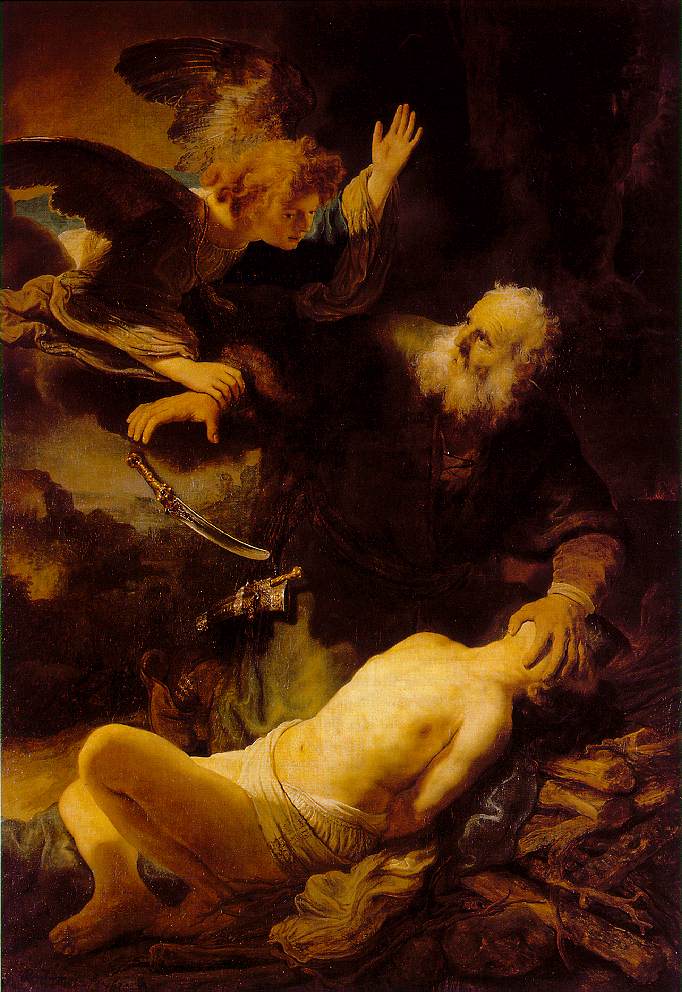
Church, Interrupted

https://i0.wp.com/upload.wikimedia.org/wikipedia/commons/f/f7/Rembrandt_Abraham_en_Isaac%2C_1634.jpg

When you come to church, what kinds of things do you expect to do?

Sing hymns? Say prayers? Read from the Bible? Hear a sermon? Receive Communion?

In our denomination’s Book of Order (part of the Constitution of the Presbyterian Church), we have a list of ‘the Elements of Worship’ and they are:

  • Prayer,
  • the reading and proclaiming of Scripture,
  • Baptism,
  • the Lord’s Supper,
  • Self-offering, and
  • Relating to each other and the world.

All of these things are pretty normal things to have happen during church services. We’ve come to expect them. If there was a church somewhere that said, “We’re not going to pray or read the Bible anymore during our services,” we would wonder about that church (*Side Note: I’m particularly delighted to see that more and more Protestants are including the Eucharist in their list of things that are central to Christian worship).

If there was a church somewhere that didn’t do any of the above things, most of us would probably want to ask, “What then, makes this gathering a Christian church?”

It might be a perfectly good social group, activist organization, or educational institution, but most of us would have a hard time seeing it as a church (as people typically understand the term) unless there was some part of its communal life that was specifically devoted to worship.

It was that way in the ancient world too. People in that culture expected certain elements to be part of their worship experience. One of those elements was sacrifice.

It was widely believed in the ancient world that deities fed off of the sacrifices offered by the people. These sacrifices could be things like bread, wine, animals, or even people. The general idea was: the more precious the thing sacrificed, the more pleased the deity would be. If you really wanted to get on a particular deity’s good side, you sacrificed something really valuable to you. In return, that deity would then grant you favors related to his or her sphere of influence (e.g. fertility, harvest, war, etc.).

To the ancient mind, that’s just how religion worked. They could no more imagine worship without sacrifice than we could imagine a church service without hymns.

Human sacrifice, in particular, was just one of those accepted elements of worship. It sounds horrifying to our 21st century ears, but the idea that God would ask someone to sacrifice their firstborn child was not all that unusual for people in Abraham’s culture. That’s why we don’t hear Abraham raising a fuss when God asks him to sacrifice his son Isaac in this morning’s reading from the book of Genesis. Asking for the life of his firstborn would have sounded like a perfectly normal request for God to make.

Yet, this is a very shocking passage, to ancient ears as well as our own. The shock, for Abraham and the early Jews, was not that God would ask Abraham to sacrifice Isaac, but that God would stop the sacrifice from happening at the last second.

“Wait a minute,” they would have said, “do you mean to tell me that God didn’t want Abraham to sacrifice Isaac in the end? Do you mean to tell me that God actually interrupted the sacrifice and asked for a ram instead? What kind of God would do such a thing?!

It would have been amazing and unheard of for them. It would have upset all their conventional religious ideas in favor of something new that had never been seen before. People in that culture might have even had a hard time imagining how such a religion would work; for them, it would be like church without hymns, or prayers, or the Bible, or Communion: it just wouldn’t feel like church.

Abraham stood at the forefront of a revolution: a radical shift in his culture’s understanding of God. His God would no longer demand human blood in exchange for favors. Only animals would be sacrificed from that point on. This move was a step in a particular direction.

Later on, the early Christians would do away with the practice of animal sacrifice as well, proclaiming that the death of Jesus had put an end to the need for sacrifice altogether. That was a step.

In the sixteenth century, our Protestant ancestors, Martin Luther and John Calvin (among others), started another revolution when they proclaimed that membership in the Church of Christ depended on one’s personal faith, rather than loyalty to the Pope. As we already know, this idea blew people’s minds and shattered their cultural expectations of what church was all about. That was another step.

All of this leads me to wonder: What is our revolution? In what ways is God calling us to be radicals? How will history look back at us and say, “Wow, those really stood at the forefront of a new understanding of God/church/religion”?

Let me be clear that I really do believe they will. I really do think that we live at one of those turning points in history: one of those moments that influences the shape of things to come for centuries. Just like the ancient and medieval ages before it, our modern world is now coming to an end. We’re entering what many academics are calling the postmodern era of history.

As we make this shift and the world is changing around us, we Christians are asking some pretty big questions about things like church, God, and religion. Some of us are questioning old patterns and forms of worship; some of us are questioning old dogmas and concepts of God that were based in assumptions about the universe that people in the 21st century no longer hold; at the end of the iconoclastic modern era, some of us are returning to more ancient and medieval practices with a new set of spiritual eyes. Most of these questions are bound to make us uncomfortable. Like most of our ancestors who lived at similar turning-points of history, people in the postmodern world will probably end up keeping some things from the past while they change other things. That’s just the way life works: nothing stays the same forever, and nothing is totally independent of that which came before it.

Time will not permit for me to talk about all the different questions and changes that might be coming our way in the near-future (I highly recommend the books of theologians like Stanley Grenz and Brian D. McLaren, if you yourself are interested), but there is one current shift that I would like to briefly touch on:

The Christian Church, ever since the days of the Roman emperor Constantine in the 4th century, has long been at the center of Western European and North American society. Even where Christianity wasn’t established as the official state religion, the church (as an institution) nevertheless enjoyed the benefits that come with considerable money and power. Church membership was culturally expected as part of what it meant to be a person of a particular nationality (e.g. English, Italian, or American).

In the past half-century, all of that has begun to change. Our society is becoming more secular. People no longer assume that their neighbors go to church anymore. Neither our pews nor our offering plates are as full as they used to be. The Church has gone from being at the center of society to being out on the edge. Christianity exists in the margins of society at this point in history.

Many people are saddened or even frightened by this shift. Looking at the empty buildings and smaller budgets, they long for the “good old days” when the Church was more culturally central and enjoyed the money and power that came with such privileged status. Some folks even think they might be able to re-create that imaginary Golden Age, if only their church had the right kind of pastor or Sunday School program.

But I don’t think that’s going to happen. Just like Abraham, Jesus, and Calvin, I think we’re living in a time when ideas about God and Church are changing on a radical level. The Church of the future will look very different from the Church of the past.

I see Christianity becoming a religion that exists at the margins, made up of people who live at the margins. I see us becoming a Church of the poor, for the poor, and by the poor: a home for the homeless, a family for the outcast, friends of sinners, a community of prophets that critiques the values of the dominant culture instead of underwriting them.

When I imagine the future, I see a Church full of people like Abraham, who was so open to hearing God’s voice that he was able to stop the sacrifice of his son Isaac at the last possible second. He looked instead at the ram caught in the thicket and imagined, under the guidance of the Holy Spirit, a new way of doing things, a new way of practicing religion, a new way of being Church, and a new way of understanding God that had never been conceived before.

I believe that we, at North Church, already have a head-start on that future. We are already a small church of the poor that exists on the edge of society. I believe we have something special to offer our brothers and sisters in the mainline churches. We are showing them where they are going. In our life together, we are living proof that the future is not all doom and gloom, but light and hope as the Church-at-large returns with its whole to heart, not to the good old days of money and power, but to that which really makes us the Church: our passionate love for God and one another in Jesus Christ our Lord.