Hope First

Sermon for the second Sunday of Christmas

The biblical text is Jeremiah 31:7-14.

Sermon recording:

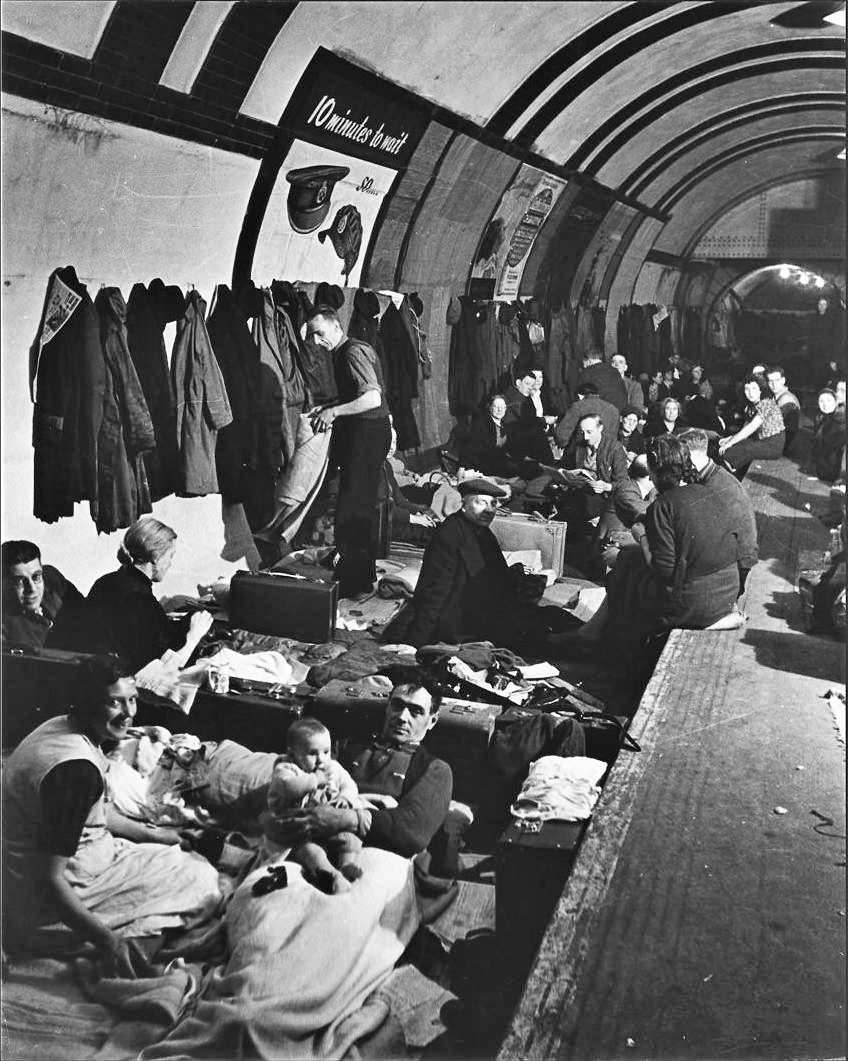
In September 1940, at the height of World War II, the German Luftwaffe began a sustained bombing assault on the British capital that eventually became known as the London Blitz.

As the city burned above them, the people of London gathered and slept in the underground subway tunnels for safety.

And yet, even as the city was being bombed night after night, something remarkable happened: Concerts continued, drama troupes put on plays, teachers taught classes, and an inter-shelter darts league formed. One pianist, Myra Hess, organized daily concerts at the National Gallery. People would come on their lunch breaks, not because the war was over, not because things were safe again, but because something in them knew this mattered.

They didn’t sing because the bombing had stopped.
They sang because without beauty, without meaning, without joy, they wouldn’t survive the bombing at all.

And that human instinct — to cling to hope before everything is fixed — is exactly what we hear in today’s reading from the prophet Jeremiah.

This passage comes from one of the bleakest books in the Bible. Jeremiah is not an easy prophet. He doesn’t offer quick comfort. He doesn’t soften his message. He spends much of the book warning his people — the people of Judah — that a crisis is coming.

For the first large section of the book, Jeremiah is doing one hard thing over and over again. He is speaking the truth about his nation’s injustice, exploitation, and unfaithfulness to God’s covenant, even though he knows the king won’t listen. He keeps telling the truth anyway, even though it gets him ignored, mocked, threatened, and eventually imprisoned.

And the truth he speaks is this:
“If we have lost faith in the core principles that make us who we are as a nation, then no amount of wealth, power, or political strategy will be able to shelter us from the consequences of our own actions.”

Jeremiah is not speaking as an outsider. He is speaking as a concerned citizen. He loves his people. That’s why he tells the truth.

Later in the book, the tone shifts again. By that point, his warnings have gone unheeded. The moment of truth has come and gone. The disaster Jeremiah spoke about has arrived. Jerusalem has fallen to the Babylonians. The people have been carried off into exile.

So, for Jeremiah and the people of Judah, the question is no longer, “How do we avoid this?”
The question is, “How do we live now that it’s here?”

That final section of Jeremiah is about acceptance — not resignation, but the sober recognition that what’s done is done, and all that remains is to make the best of it.

But right in the middle of those two sections, between the warnings and the acceptance, we get a third section that scholars call the Book of Consolation. Chapters 30 through 33. This is the section where today’s first reading comes from.

What’s striking about the Book of Consolation is that Jeremiah offers hope before the exile is resolved. Consolation comes before acceptance. Not because everything is okay, but because Jeremiah knows that, without hope, the people will not be able to survive what lies ahead.

Listen again to the imagery Jeremiah uses. This is not quiet, private reassurance. This is public celebration. Singing. Shouting. Gathering. Grain, wine, and oil. A watered garden.

And notice who’s invited:
The visually impaired.
The mobility impaired.
Those who are pregnant.
Those in labor.
The people who cannot move quickly. The people who cannot carry much. The people who are exhausted, vulnerable, and easily left behind.

If you step back and picture it, what Jeremiah is describing looks less like a church service and more like a street party.

This is not a party for the strong. This is not a celebration of victory or success. This is a gathering that moves at the pace of the most vulnerable. No one is told to wait until they’re healed. No one is told to come back later when they’re stronger.

Everyone belongs.

Jeremiah even says, “I will give the priests their fill of fatness” — as a priest myself, I’m trying not to take that one personally.

But the most important thing to notice is this: the party happens before anything is fixed.

The exile is still real. The losses are still fresh. The future is still uncertain. And yet — the singing continues.

Just like the music during the Blitz, this isn’t a celebration because the danger is gone. It’s a celebration because without joy, without meaning, people won’t make it through what’s coming.

What’s fascinating is that psychology tells us something very similar.

Viktor Frankl, who survived the Nazi concentration camps, noticed that people didn’t endure suffering because it stopped. They endured because they found a reason to keep going. Meaning came first. Relief came later — if it came at all.

Or as Frankl famously put it, those who have a “why” to live can bear almost any “how.”

In other words, hope comes before acceptance. Without it, people collapse.

Developmental psychology tells us something similar from the very beginning of life. Erik Erikson wrote that hope is the first human virtue, formed not through explanation or reasoning, but through trust.

You don’t argue a baby into trust.

You don’t sit down with a newborn and say, “Now listen here, if you’ll just consider the evidence, you’ll see that you have been fed and changed, that your parents love you very much, and that it’s in everyone’s best interest that you lay down and go to sleep…”

Obviously, you don’t do that. You hold them.

Trust comes before understanding. Hope comes before explanation.

That explains why Jeremiah doesn’t wait until the exile is over to offer hope. He offers it first — because without it, the people won’t survive the truth they’re about to face.

The kind of hope Jeremiah is talking about is not mere optimism or denial, but something tougher.

I read a Tweet online that illustrates this kind of hope perfectly. It was written by someone named Matthew @Crowsfault and says:

“People speak of hope as if it is this delicate, ephemeral thing made of whispers and spider’s webs. It’s not. Hope has dirt on her face, blood on her knuckles, the grit of the cobblestones in her hair, and just spat out a tooth as she rises for another go.”

I absolutely love that. That’s the kind of hope you need when you’re living in exile.

And that kind of hope matters not just for us as individuals, but for us as communities.

When communities come under strain, they tend to split into two instincts. Some respond by saying the only faithful thing to do is expose every failure, until there’s nothing left but despair. Others respond by saying the only faithful thing to do is protect what’s good, even if it means refusing to see what’s broken.

Jeremiah refuses both extremes.

He loves his people too much to flatter them — and too much to abandon them.

That’s why hope comes first. Accountability without hope turns into cynicism. Hope without accountability turns into denial. Jeremiah offers hope not to erase the truth, but to make it possible for the people to face it.

And this isn’t just about nations or communities. It’s about individual lives, too.

I once read about a mother whose child was born with a severe and terminal disease. There were no long-term plans. No grand ambitions. None of the milestones people usually imagine for their children.

From the outside, many would have called that situation hopeless.

But the mother wrote about discovering a different kind of hope — not hope that things would be different, but hope rooted in love, presence, and fierce attention to the life in front of her. She described learning to delight in small moments, celebrate what was real, even though the future looked nothing like what she had imagined.

That’s the hope Jeremiah is pointing toward.

Not hope that skips over suffering.
Not hope that waits for everything to be resolved.
But hope that shows up anyway — and holds us together while the story is still unfinished.

The music during the Blitz didn’t stop the bombs. But it reminded people who they were.

Jeremiah’s street party didn’t end the exile. But it reminded the people that their story wasn’t over, that God wasn’t done with them, that life itself still carried the possibility of renewal.

So the invitation in this passage is not to pretend that everything is fine. It’s to accept the fact that things are pretty messed up and practice hope anyway. To create moments of joy. To notice what is good and celebrate what is being born, even though the ending is still unclear.

Kindred in Christ, as you look around at our troubled world today, gape in horror at the latest news reports, and wonder what it’s all coming to, I dare you to practice hope as a spiritual discipline.

Not a vague optimism that everything will work out fine, not a distraction from the real problems that we are facing, but a defiant commitment to keep hoping in the face of despair. An unshakable faith that God is not done with us yet, so we owe it to ourselves and each other to keep holding on and keep looking for opportunities to do what good we can, where we can, with whomever we can, and for as long as we can.

Like the people who lived through the London Blitz, we too have a need to sing before the war is over.
We too have a need to gather before the exile ends.
We too have a need to hold tightly onto one another, not because everything is okay, but precisely because it isn’t!

Because hope isn’t what comes after we heal the world.
Hope is what makes healing the world possible.

Amen?

Rooted: Choosing Deep Connection Over Quick Fixes

Sermon for the sixth Sunday after the Epiphany.

Delivered at St. Mark’s Episcopal Church, Coldwater.

Click here for the biblical readings.

Imagine, if you will, a shrub in the desert: surviving, pelted by sand, scorched by the sun, and praying for rain. Now imagine a tree by a river: well nourished, with deep roots, surrounded by green.

The prophet Jeremiah uses this dual-image to describe two ways of living: the way of self-sufficiency and the way of trust.

In order to understand what Jeremiah means by this, it would be helpful to have a little bit of historical background:

Jeremiah lived about 600 years before the time of Jesus. During his lifetime, the Babylonian Empire had become a regional super-power under the reign of King Nebuchadnezzar.

After a series of military victories, Nebuchadnezzar asserted his dominance over Judean politics by deposing the descendants of King David from the throne and replacing them with Zedekiah, a puppet ruler of his own choosing.

Now, after a while, “King” Zedekiah got a bit too big for his britches. He started listening to a group of so-called prophets who filled his head with nationalistic delusions of grandeur. They told him that, since they were the “chosen people,” they could rise up and throw off the yoke of Babylonian dominance.

In order to accomplish this feat, Zedekiah had entered into secret negotiations with the nation of Egypt to provide military assistance for this coup. Jeremiah warned the king that this would be a very bad idea and would not pan out the way he thought. Jeremiah realized that their national life was founded on their covenant with God. Faithfulness to this way of living would result in peace and prosperity for the people, while unfaithfulness would result in struggle. Jeremiah believed that the current state of Babylonian dominance (to which this puppet king owed his position) was the result of unfaithfulness to the covenant. He advised King Zedekiah and the Judean people to accept the fact of Babylonian rule and improve their situation by focusing on their spiritual lives.

The false prophets, on the other hand, told Zedekiah to rise up against Babylon, that he could rely on supernatural favor to strengthen his hand to do whatever he wanted, simply because they were “the chosen people.” The false prophets got the king’s attention because they told him what he wanted to hear. Meanwhile, Jeremiah got himself arrested and thrown in prison because he dared to speak an inconvenient truth.

In 587 BCE, Jeremiah’s prediction would prove to be correct. The Zedekiah went ahead with his Egyptian alliance and rose up against Nebuchadnezzar. When the Babylonian army showed up to quash the rebellion, the Egyptians turned tail and fled, leaving the Judeans to face the Empire alone. The Babylonian army ransacked Jerusalem, burned the temple to the ground, and hauled the upper-class leaders away into slavery. Jeremiah’s point-of-view was vindicated, but it was a complete disaster for the people, especially those who bought into the king’s nationalistic delusions of grandeur.

This disaster is what Jeremiah was warning the people about when he said:

“Cursed are those who trust in mere mortals and make mere flesh their strength, whose hearts turn away from the Lord. They shall be like a shrub in the desert, and shall not see when relief comes. They shall live in the parched places of the wilderness, in an uninhabited salt land.”

Jeremiah 17:5-6

According to Jeremiah, the way of political maneuvering and raw force would lead only to a shallow and desperate life. A life founded on moral and spiritual principles, on the other hand, would lead to flourishing and peace in time. “Trusting in God” is a longer and more circuitous route, but it leads to a stronger foundation for peace, security, and prosperity. Jeremiah writes about this kind of life:

“Blessed are those who trust in the Lord, whose trust is the Lord. They shall be like a tree planted by water, sending out its roots by the stream. It shall not fear when heat comes, and its leaves shall stay green; in the year of drought it is not anxious, and it does not cease to bear fruit.”

Jeremiah 17:7-8

I have encountered the way of the shrub in the desert in my own life. As a parent of teenagers, my kids frequently come to me with big asks: “Can I stay up late? Can I go out with my friends on a school night? Can I have money for this or that thing?” Most of these requests are simple Yes or No questions.

My first instinct is usually to take the authoritarian route and put my foot down with a firm, “No.” When they ask why, I am tempted to respond, “Because I said so.” Of course, when I’m feeling tired or just want to avoid a meltdown, I might take the permissive route and say, “Sure. Fine. Whatever.”

The problem with both of these approaches is that they both keep us on the surface of the conversation. Neither one really digs down to the root of the matter. My wonderful wife is the one who taught me how to slow down and ask the deeper questions about the kids’ needs. Instead of snapping to Yes or No, I have gradually been learning how to pause and say, “What’s going on? What about this is important to you?” We often end up listening, negotiating, and compromising before reaching a final decision.

I find that it takes more time and more work, but the rewards are greater because it helps me to really pay attention to my kids as human beings, understanding their unique needs, hopes, and fears. In the end, we still have to come to a Yes or No decision, but how we get there is at least as important as the answer itself.

The way of the shrub in the desert, like the way of the quick Yes or No, is a life turned in on itself. Grounded in one’s ability to exert control, it has shallow roots, clinging desperately to the dry sand and praying for rain to come.

We can see examples of this kind of shallow existence all around us. We spend hours on our devices, seeking quick validation from the number of likes on our posts and getting angrier and angrier about the news fed to us in echo chambers of social media. At work, we climb the corporate ladder without regard for who gets stepped on. In the economy, we seek instant gratification with fast fashion and planned obsolescence. In politics, we treat democracy like a spectator sport, alternately cheering and jeering, depending on which party is temporarily on top. All of these are examples of the “shrub-mentality,” and all of us participate in it, at least sometimes. The shrub-mentality not inherently evil, but it is shallow and brittle.

The way of the tree by the river, on the other hand, is a life nourished by deeply-rooted connection. It takes more time and more work to cultivate, but our patience pays off in greater resilience and flexibility. Jeremiah’s vision of the tree by the river is an image of the abundant life that God intends for all people. The way to this life is neither quick nor easy, but the journey is worthwhile.

As members of a faith community, we have been given a particular set of “gardening tools” for cultivating the life that God intends.

First, we have our core values, like faith, hope, and love (see I Corinthians 13). When we consciously identify these values and say them out loud, we set ourselves on the path to fulfilling them. They are, if you will, the “seeds” we plant in our spiritual garden.

Next, we have our spiritual practices, like prayer, worship, service, and especially the Scriptures and the Sacraments. These are like the spades, rakes, hoes, and watering cans that we use to help the “seeds” grow. The more we make use of them, the healthier our garden will be.

Finally, we have each other. As the old adage goes: “Many hands make light work.” Mutual relationships of care, support, and accountability are like the richly tilled soil in which our garden grows. The work is long and hard, but it becomes more doable when we do it together.

Kindred in Christ, the question that the prophet Jeremiah puts before us today is this: “How deep are our roots?”

Are we clinging to the surface, hoping for rain, like a shrub in the desert? Or are we watering the seeds of our core values, tilling the soil of mutual relationships, and using the tools of our spiritual practices?

That tree by the river can be you. That tree can be us: Deeply rooted, with green leaves, and branches full of fruit. Even in the midst of struggle, we can continue to live the life that God intends for us: A community rooted, connected, and flourishing.

As Jeremiah said to his people:

“Blessed are those who trust in the Lord.”

“They shall be like a tree planted by water.”

“They shall not fear when heat or drought comes.”

“They shall never cease to bear fruit.”

May it be so.

Amen.

Balm Threat


I’m calling in a balm threat this morning.

I realize that the pun is terrible.  Please, bear with me and I promise to make it make sense before the end.

What is a balm, anyway?  It’s a healing ointment, like a lotion, that soothes damaged skin or eases the pain of sore muscles.  A balm is something that takes away the pain.  We read about balm this morning in our Old Testament lesson from the book of Jeremiah. 

The prophet Jeremiah was a man who was intimately familiar with pain. Tradition calls him “the weeping prophet” because he lived in a time of such intense suffering.  God called him to be a preacher, but nobody ever listened to his sermons.  He saw that the culture around him was corrupt and destroying itself, but there was nothing he could do about it.  All he could do was keep on preaching and hope that somebody, somewhere, someday might listen.

Jeremiah talked a lot about his pain.  He said, “My joy is gone, grief is upon me, my heart is sick…. For the hurt of my poor people I am hurt, I mourn, and dismay has taken hold of me. Is there no balm in Gilead?”  And there’s that word: balm.  The prophet is asking, “Is there nothing that can ease this pain?” And for Jeremiah, that question went unanswered…

This same question has been on the lips and in the hearts of suffering people in every place and time throughout history: “Isn’t there anything that can easy my pain?” 

Is there no balm in Gilead?”

We can hear it from the patient who has just been told that her insurance company will not cover the cost of the medication she so desperately needs: “Is there no balm in Gilead?”

We can hear it from the unemployed laborer whose temporary assistance benefits may run out before he is able to find a new job: “Is there no balm in Gilead?”

We can hear it from the pregnant teenager, faced with an impossible choice, knowing that she will receive lifelong shame and rejection from society no matter what she decides: “Is there no balm in Gilead?”

We can hear it from the young man who wants nothing more than to love and be loved, but is told by his church that his way of loving is an abomination in the eyes of God: “Is there no balm in Gilead?”

In the American story, this cry has been heard loudest and longest from our African American brothers and sisters, who have suffered under the yoke of slavery, the humiliation of Jim Crow laws, and now the ridiculous accusations of so-called “reverse racism” that tries to put one person’s bitterness on a level with centuries of systemic oppression, as if they were the same thing.  These folks too have asked the hard question, “Is there no balm in Gilead?  Is there nothing that can ease this pain?”

But the enslaved ancestors of these neighbors of ours did something else, something that had never been done before: they answered the question.  In the words of Dr. Martin Luther King, “They looked back across the centuries and they took Jeremiah’s question mark and straightened it into an exclamation point.  And they could sing, ‘There is a balm in Gilead to make the wounded whole.  There is a balm in Gilead to heal the sin-sick soul.’”

Here’s what happened:

When the Europeans enslaved African people, they tried to erase all traces of their home culture in order to keep them subservient to their new masters.  The people were given new names, new clothes, a new language, and a new religion.  The slaves were given Bibles and told to read them.  The slave holders thought that a Christian slave was more likely to be obedient and passive.  But they forgot something; they overlooked a critical truth that their Jewish and Protestant ancestors had passed down to them: If you want to keep people down and depressed, the last thing on earth that you should do is give them a Bible.  Why? Because, as Flannery O’Connor said, “Jesus throws everything off-balance.”

In introducing people to the Bible, the promoters of slavery and racism unwittingly sowed the seeds of their own destruction.  As it says in the Psalms, “They fell into the trap they set.” 

Because you can’t tell people they are “made in the image and likeness of God” and then expect them to let go of their inherent human dignity. 

You can’t tell people that all men and women are brothers and sisters, children of one Father in heaven, and then expect them to believe that they are second-class citizens. 

You can’t tell people that they are members of the body of Christ and temples of Holy Spirit and then expect them to believe that they are some other person’s property.

Those enslaved African ancestors read the Bibles they were given and then, as newly baptized Christians, they reached back across two and a half millennia and straightened Jeremiah’s question mark into an exclamation point.  “There is a balm in Gilead to make the wounded whole.  There is a balm in Gilead to heal the sin-sick soul.”

They discovered, for themselves and for all of us, the secret of that balm: the balm is faith.  It is faith that has the power to heal, save, and make whole.  As Jesus told so many sick, poor, downtrodden, forgotten, and oppressed people in his day, “Your faith has made you well.”

Now, when I say faith, I don’t mean religious observance (e.g. coming to church, reading the Bible, taking communion, etc.).  Religious observance is a good thing (I would even say it’s necessary for growing in faith), but it is not faith itself.  Likewise, when I say faith, I don’t mean a subscription to a set of doctrinal beliefs.  Our systems of theology (e.g. Presbyterian, Catholic, Buddhist, Muslim, etc.) are interpretations of faith, but they are not faith itself.

So, what do I mean by faith? It begins with a heartfelt hunch that there is something: some Presence/Reality/Being/Love at the heart of everything that binds the rest of it together in big embrace, something that, in the words of the late Rev. Forrest Church, is “greater than all, yet present in each.”  Personally, I like the description given by the Jedi Master, Obi-Wan Kenobi in the movie Star Wars: He called it “the Force” and said, “It surrounds us, it penetrates us, it binds the galaxy together.”  Here in this church, we call it “God.”  And we imagine God as a loving Father (or Mother) who is working through us, with us, and in us to build the kingdom of heaven on earth: a place where people “from every nation, from all tribes and peoples and languages” will live together in peace, where they will “beat their swords into plowshares and their spears into pruning hooks,” where “nation shall not lift up sword against nation, neither shall they learn war any more,” a place where “the home of God [will be] among mortals”, where every tear will be wiped away, and “Death will be no more”.  Faith begins with this hunch: with the hope that these things might be true; faith comes to life in us when we commit our whole selves, body, mind, and soul, to living as if they were true; and it ends when these things do come true (and I believe they will).

Faith is the truth that turns the world upside down.  Faith has the power to move mountains… or at least make them into mole-hills.  That’s what faith does: It makes a mole-hill out of a mountain.  Faith changes the way we look at our situation in life so that the big problems don’t seem so big after all and the little we have is more than enough for God.

I read an article this week that illustrated this truth perfectly.  It borrows an image from the Bugs Bunny cartoons I used to watch as a little kid.  You remember Marvin the Martian?  Whenever he would first appear in a sketch, the first thing we would see is a huge, menacing shadow looming over Bugs Bunny.  But then he would turn around and see that the big, scary shadow was coming from a little “pipsqueak with a pop-gun.”  That’s what faith does: It changes our perspective on life, so that we can stop telling God how big our problems are and start telling our problems how big God is.

I said I was calling in a balm threat this morning, and I am: Because faith, the balm of Gilead, is a threat to every sin and sickness of body, soul, or society that would try to keep you down.  The balm of Gilead is a threat to the unenlightened self-interest of every government, corporation, and institution in this world.  The balm of Gilead is a threat to racism, sexism, classism, nationalism, denominationalism, homophobia, and every unjust pride and prejudice, every power and principality, every problem that tries to exalt itself above the glory of God and the dignity of God’s children.  Oh yes: I’m calling in a balm threat today.

Now, I realize that I’m new here.  I don’t know who you are, where you’ve been, what kinds of problems you face, or what kind of pain you carry.  But I believe this: That there is no problem so big that God cannot handle it, that there is no situation or life so messed up that God cannot bring good out of it. 


Sometimes I feel discouraged and think my work’s in vain,
but then the Holy Spirit revives my soul again.

If you cannot preach like Peter, if you cannot pray like Paul,
you can tell the love of Jesus and say, ‘He died for all.’

Don’t ever feel discouraged, for Jesus is your friend,

and if you lack for knowledge, he’ll never refuse to lend.

There is a balm in Gilead to make the wounded whole. 

There is a balm in Gilead to heal the sin-sick soul.