

 Over in Africa, they have a very interesting way of catching monkeys. First, they secure a hollowed-out coconut to the end of a line and make a small hole in one end. Next, they put something small and tasty (e.g. some nuts) inside the coconut. Eventually, a monkey comes along and realizes that there’s a treat inside the coconut. It reaches inside to get the treat. Here’s the catch: the hole in the coconut is only big enough for the monkey’s hand to get through if it is empty. As long as the monkey is holding onto the treat, it can’t get out. If the monkey wanted to, it could let go and get away any time. However, they almost never do that. Instead, they hang on for dear life, even though it means their death.
Letting go is a hard thing to do. Just ask parents who have ever dropped a sons or daughters off at college. You hope that everything you’ve said and done over the past 18 years will be enough to guide them on their way, you draw out the goodbyes for as long as you can, but there’s no stopping that inevitable moment when you just let go, get back into the car, and drive away without them.
Our Buddhist neighbors have a lot to teach us Christians about the art of letting go. Their entire spiritual path is built around that idea. They start with the observation that life is full of suffering. We never suffer, so they say, for the reasons we think we do. We think we suffer because we lack something we want. We say things like this: I wish I had a better job. Why? So I can make more money. Why? So I can buy more expensive things. Why? So I can impress this other person. Why? So she or he will like me. And so on and so forth. Happiness, we think, is always just one step outside of our reach. We think it lies in some other job, object, or person. If I could just have that, then I would be happy.
“No,” the Buddha says, “you won’t be.” Real suffering doesn’t come from your lack of something, but from your desire for it. If you can learn to let go of that inner urge to always be reaching and grabbing for the next big thing, you’ll find real happiness. Along the way, you’ll also begin to find out who you really are inside. We tend to lose sight of that in our endless pursuit of the next big thing. We get lost in the rat race. As we learn to let go, we find ourselves again. The end result of this process is what Buddhists have always called Enlightenment. All of their rituals and meditation exercises are oriented toward this one goal. It’s all about letting go.
The art of letting go factors rather highly in this morning’s reading from the gospel according to Mark. Our story is part of a series of stories that we started talking about two weeks ago on Transfiguration Sunday. It began with the story of a blind man who Jesus had to heal twice. After the first time Jesus touched him, he was beginning to see, but everything was still blurry. After the second time, he could see clearly. We took this as a kind of metaphor for Peter, one of Jesus’ disciples, who was in the process of learning how to see (in a spiritual sense), but wasn’t quite seeing things clearly yet.
In the section just before today’s passage, Jesus asks Peter, “Who do you say that I am?”
Peter boldly replies, “You are the Messiah.”
Then Jesus begins to explain what it means to be the Messiah. He tells his disciples that the Messiah “must undergo great suffering, and be rejected by the elders, the chief priests, and the scribes, and be killed, and after three days rise again.”
At this point, Peter steps in and pulls Jesus aside with some friendly advice. One might say that Peter saw Jesus as the hot new presidential candidate and himself as Jesus’ campaign manager. Peter’s idea of Jesus as the Messiah (or “Christ”) was very different from Jesus’ idea of himself. Peter thought the Messiah was supposed to be part political leader, part military revolutionary, and part spiritual guru: Che Guevara meets Barack Obama meets Dr. Phil. With God on their side, they were supposed to have a meteoric rise to fame and power.
But Jesus, it seemed, had a very different idea of what his life is supposed to be all about. Instead of fame and fortune, he talked about suffering and rejection. This really got under Peter’s skin, so he got up in Jesus’ face about it, but Jesus let him have it right back.
“Get behind me, Satan!” He said, “For you are setting your mind not on divine things but on human things.” In other words, there’s a bigger story going on than the one you see right in front of your face. Jesus knew how he fit into that bigger story because he knew who he was as God’s beloved Son. He would conquer the world, not through violence, but through the power of self-giving love. This was not an insight he could have had if he had been busy selling out to his culture’s idea of what a Messiah should be. But Peter, as it turns out, was having a hard time letting go of that idea. He was holding onto it so tight because he was absolutely convinced that the future security and prosperity of his country depended on it.
Don’t people still do that all the time? If you flip through the various noise news channels on any given day, you’ll find no shortage of people angrily shouting at each other because everyone is convinced that their idea holds the key to peace and plenty in the future. Whenever they stop to take a breather, the audience is instantly swamped with commercials for products that also claim to hold the secret to happiness.
We human beings have this crazy tendency to get so caught up in our own egos, ideas, products, and relationships that we forget who we really are inside. We are God’s beloved children. Our lives are part of a bigger story that has been going on since the beginning of time and will continue until its end. Jesus never forgot that truth. His faith in his identity as God’s beloved Son gave him the strength to resist the temptation to sell out to the popular ideology of his day. Suffering and rejection didn’t scare him one bit because he knew the great Love at the center of the universe that transcends fear and death.
Today, God is inviting you to enter into a greater awareness of that Love by letting go of your attachment to those things, people, or ideas that compete for your trust. Jesus says, “If any want to become my followers, let them deny themselves and take up their cross and follow me. For those who want to save their life will lose it, and those who lose their life for my sake, and for the sake of the gospel, will save it. For what will it profit them to gain the whole world and forfeit their life? Indeed, what can they give in return for their life?”
You are invited to participate in the art of letting go and trust in the Love that is stronger than death. Maybe the thing for you to let go of is an idea, thing, or person. Maybe it’s an old grudge or crush. Maybe it’s an unhealthy attachment to work or a cause you believe in. It can be good things too: like your attachment to your family, church, or system of beliefs. Many of these are wonderful things, but they can’t tell you who you are or give you lasting happiness. Whatever your attachment is, Jesus is inviting you to let it go and rediscover your true identity as God’s beloved child.
It’s not an easy path. Christians call it “the Way of the Cross” for a reason. You will have to face your own fear of mortality. You will have to sacrifice your sense of security. But the promise, as Jesus gives it, is that you can ultimately save your life by letting go of it. That’s what faith in the Resurrection is all about.
None of us does this perfectly. We’re all refusing to let go of something inside that keeps us from embracing who we really are and living the kind of full life that God intends for us. The good news is that our refusal to let go doesn’t change who we are as God’s beloved children; it only keeps us from recognizing the truth about ourselves.
As I was writing this sermon, I got a message about an old college buddy who passed away quite suddenly this weekend. Like all such announcements, it reminded me of the fragility of our biological existence. It also reminded me that the call to let go extends even to letting go of life itself. God asks a lot from us (everything, in fact). I compare it to doing a trust fall off the edge of the Grand Canyon, believing that we are held, as the apostle Paul says, by a reality that is higher, deeper, longer, and broader than we can possible imagine. It is the Love that passes knowledge and the peace surpassing understanding. When we are called upon to trust and let go, whether it’s letting go of some person, thing, or idea that we’re clinging to for happiness and security or letting go of life itself in our final moments, we journey forward in faith, trusting that we are not wandering into the darkness, but are being welcomed into the light. We are not enveloped by oblivion; we are embraced by eternity.
A prayer that I wrote for my friend, Rodney Duke, about ten years ago. Pastors, priests, and ministers: feel free to borrow it for Palm Sunday.
God, may your Holy Spirit ride upon my words into the hearts and minds of this congregation, just as Jesus rode a donkey into Jerusalem; and may that serve as a reminder that you can still use a jackass to reach your people. Amen.

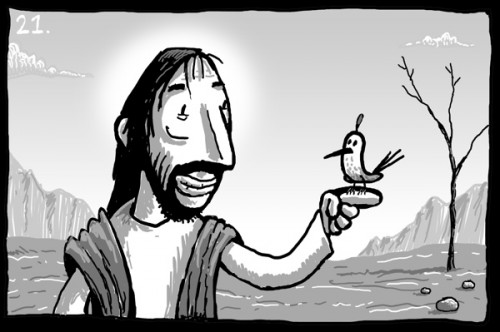
Here is a breathtaking animated short that Annie Grove found online. There is so much subtlety to love. I could go on gushing about it, but I think I’ll let the film speak for itself. Here’s to Lent!
Just keep looking. You’ll get it.

This is a fascinating and sympathetic critique of Occupy Wall Street from ProgressiveChristianity.org

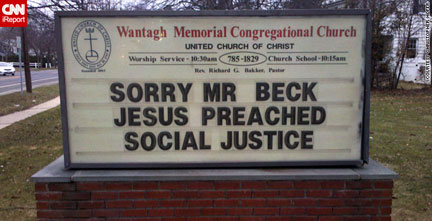 The article linked below reminds me that it was just about a year ago that Glenn Beck issued a call for people to leave churches that espouse “social justice” as part of their faith. He not-so-subtly implied that we’re all a bunch of Commies and Nazis (he’s only half-right).
Looking back, it occurs to me that if any of my congregants were predisposed to accept whatever Glenn Beck says as gospel truth, then they would probably be happier in a different church anyway. Go with God, but go.
As for me and my house, we hope to continue with Jesus’ 2,000 year old “experiment with socialism”.
So long, Mr. Beck. Don’t let the door hit ya where the good Lord split ya. And may I ask: “How insane do you have to be for Fox News to tell you to shut up and get out?”
Here’s the article:
 I had a fascinating exchange with an old college pal this week. I mentioned in an email that I self-identify as a Liberal Christian.
My friend responded, “So, what is a ‘Liberal Christian’? When I hear that, it makes me think it’s a code word for ‘Christians who think they’ve figured out how to be pro-choice Democrats, and still be in-line with the Bible’… Seems like they all listened to U2 also…”
While I’m not a registered member of any political party and my views on abortion do not conform to either pro-life or pro-choice platforms, I had to laugh at myself over the U2 comment. They just so happen to be my favorite band… I guess some stereotypes are true!
After that, I proceeded to this gentle-but-long-winded long-breezed history lecture on 20th century Christians and biblical interpretation. Unwittingly, I fell right into the two habits that most annoy me about Liberal Christianity: Negativity and Elitism.
Negativity
Have you ever noticed that we Liberal Christians spend a lot of time talking about what we don’t believe? We don’t accept Young Earth Creationism. We don’t think the Bible is inerrant. We don’t believe eternal life depends on accepting Jesus Christ as your personal Lord and Savior. We read books with titles like Why Christianity Must Change or Die and Taking the Bible Seriously but Not Literally (both of which happen to be good books, by the way).
Elitism
Along with our tendency to accentuate the negative, it’s also pretty obvious that our churches tend to be populated with college-educated, upper middle-class white folks. We Liberal Christians pride ourselves on being better educated, informed, and enlightened than our Evangelical counterparts. Just as some Evangelicals tend to hide behind walls of biblical literalism, Liberals tend to hide behind walls of intellectual superiority. Even though none of us would put it this way, we consider ourselves to be the “one true church” because we have risen above the naïve superstitions of Catholics and Evangelicals. Despite our claims to open-minded pluralism and tough-minded skepticism, we still claim to be the sole possessors of the “real truth” about Christianity. Despite our lip-service to diversity, our churches tend to be pretty monochromatic. Despite our passion for social justice, I once heard someone say about us, “They’ll bake a casserole for every cause but they won’t go to jail for any cause.” Is this really the legacy left by the Underground Railroad, the Suffragettes, and Martin Luther King?
In response to these tendencies toward Negativity and Elitism, I’d like to see us develop an Affirmative and Common Sense Liberalism.
Affirmative Liberalism
What do we believe as Liberal Christians?
First of all, we believe in freedom. That’s what the word liberal means, after all. We are free to make full use of our minds and hearts as we grow in our faith. We are free to disagree. There should be no litmus test of doctrine among us. Sadly, this is not always the case in practice. There are just as many mean-spirited Liberals as there are Bible-thumping Fundamentalists. I once witnessed an Evangelical ministry candidate in my own denomination being publicly mocked in front of her colleagues by a Liberal pastor who asked whether she thought the Second Coming might involve Jesus returning to Earth “in a rocket ship.” If I am free to question traditional doctrine, others should be free to accept it. We should rejoice with those whose lives are changed, for example, by a charismatic “born again” experience. We have every reason to believe that they have truly encountered the Spirit of the Living God. The difference is that we also believe the same for Gandhi, Buddha, and anyone who has ever scored free swag from the Oprah Winfrey Show. The mark of a truly Christian Liberalism is when we leave room for those who would not leave room for us. Personally, I’m still working on that.
Second, Liberal Christians believe in grace. We are all created, connected, redeemed, and sustained by the absolutely unconditional love of God. No one is exempt from this Good News, regardless of time, place, religion, or sexual orientation. We are all equally God’s children. Full stop. There is no moral standard upon which God’s ultimate approval is based. This does not mean, however, that there are no moral standards. We believe in the fair and equal establishment of liberty and justice for all. It is sometimes necessary to act decisively in correcting behaviors, protecting the innocent, or redressing grievances, but this does not involve a final condemnation or an ultimate devaluing of the whole person. Human parents must enact discipline in order to shape a child’s character, but eternal punishment is inconsistent with God’s purposes as a loving parent. What could make you subject your child to eternal torture without relief? No one is irredeemable. In short, everybody gets into heaven (if there is such a place). Alas, Liberal Christians have often failed on this front as well. One friend of a friend commented that, after leaving her rather Conservative Mennonite church for the United Church of Canada (a prominent Liberal denomination in the Great White North), she was disappointed to find just as much hard-nosed legalism among Liberal Christians. The difference, she noted, was that Liberal Christians made her feel guilty about recycling rather than masturbation. Whenever we are overwhelmed by either unfounded humanistic optimism or righteous indignation, we Liberal Christians should remember to keep this song in our hearts: “’Tis grace has brought me safe thus far, And grace will lead me home.”
Common Sense Liberalism
Watching certain candidates on the presidential campaign trail has reminded me how many people respond to folksy wisdom more than actual data. Conservatives seem to have cornered the market on common sense while Liberals cite academic facts and theories. I refuse to accept the necessity of this arrangement. We too can make pithy bumper stickers. We too can appeal to those beliefs and values that lie deep within the human heart and lead us toward a better world. We too can quote the Bible to support what we have to say. I’ll even do it in the good old King James Version:
Liberal Christians believe that God loves everyone. We believe that all people are created equal in one human family. We believe in fairness. We believe in freedom. We believe that God is a mystery so big that no one can fully understand. We believe in grace. We believe in justice. We believe that diversity makes us stronger.
The term Liberal has become a dirty word in recent years. It is used in the halls of Congress and churches to accuse, demean, and degrade. I want to reclaim the term Liberal, especially as it applies to Christian faith. There are no doubt others who will question my intellectual and moral integrity. That’s fine. They can do that. I’ll try not to argue back. This is just me trying to figure out what I believe and where I fit in the grand scheme of things. I am a Liberal Christian.
“Here I stand. I can do no other.” – Martin Luther at the Diet of Worms
 This week’s sermon from First Pres, Boonville. 2nd of 5 in a series on the Elements of Worship.
Mahatma Gandhi, the great Indian social reformer, once said something quite profound when someone asked him what he thought of Christianity. He said, “I like your Christ but I don’t like your Christians. They are so unlike your Christ.” In a similar vein, the German philosopher Friedrich Nietzsche once said to a group of Christians (in his typically caustic fashion), “Yuck, you make me sick! Because you redeemed don’t look like you’re redeemed!”
While these comments are more than a little bit harsh, I think we Christians have to admit they are also more than a little bit true. For a long time, Christians have held onto a crazy idea that we are the guardians of infallible doctrine and impeccable morals. The end result of this idea is that the rest of the world has come to see Christians, not as messengers of good news and amazing grace, but as “sour-faced saints” with their halos screwed on just a little too tight. Under these circumstances, church becomes little more than a “holy club” for people with an answer for every question and a solution to every problem.
Is this who we’re meant to be? I think not. Consider Nietzsche and Gandhi’s words in reverse: how would you describe someone who “looks like” he or she is “redeemed”? Can you imagine what it would be like to live in moment-to-moment awareness of the truth that within, behind, and beyond the apparently random facts of life there is, at the very heart of the universe, a “Love that will not let me go”?
Christians (in their better moments) believe there has been at least one such life in the course of human history. By this, I am referring of course to the life of Jesus. Folks come out in droves to celebrate with us at Christmas and Easter the beginning and the end of Jesus’ thirty-something years on Earth (and we’re delighted to welcome them on those days). But there are, of course, fifty other Sundays of the year when we celebrate everything that happened in the middle! Jesus’ amazing life is something worth remembering, celebrating, and imitating all year long. There is something so wonderful about the life of Jesus that even Gandhi, a devout Hindu, sat up and took notice.
“I like your Christ, but I don’t like your Christians. They are so unlike your Christ.”
What was it about the life of Jesus that caught Gandhi’s attention? What kind of moment-to-moment awareness of Love’s presence did Jesus live with? One phrase that he liked to use more than any other was “the kingdom of heaven.” For him, this wasn’t some far away realm where angels played harps on clouds, but a very present reality. For Jesus, the kingdom of heaven was very near, “at hand,” closer to every atom than its own nucleus, closer to every person than her own soul. If you asked him to describe it, he would start telling stories about the things he saw around him. Jesus saw heaven everywhere: a farmer sowing seed, a woman baking bread, a merchant buying pearls, a shepherd tending sheep, a woman sweeping her house out, birds that nest, seeds that grow, and flowers that bloom. For Jesus, the question isn’t “where is heaven?” For Jesus, the question is “where isn’t heaven?” This is the kind of life that Jesus lived: a moment-to-moment awareness of the truth that within, behind, and beyond the apparently random facts of life there is, at the very heart of the universe, a “Love that will not let me go.”
“Believe the good news,” he said, “the kingdom of heaven is at hand.”
This week is the second in a five week series of sermons on the elements of worship. We’re looking at who, what, when, and where but also (most importantly) why we do what we do each week in church. Last week, we talked about the Word of God, found in (but not mistaken for) the words of the scriptures, which forms a kind of central fulcrum around which the rest of our liturgy revolves. This week, we’re talking about prayer. In the coming weeks, we’ll cover service, sacrament, and relationship.
I began this week’s discussion on prayer by describing the kind of life that Jesus lived: a life of moment-to-moment spiritual awareness. In doing this, I kind of started at the end. This is the point to which we will return. This moment-to-moment spiritual awareness, demonstrated and embodied in the life of Jesus, is the purpose of all prayer and the final destination of every praying person.
But before we get back to that central point: a few words about what prayer is not. First, prayer is not magic. There are many churches and organizations out there who teach that if you pray for something long enough, hard enough, or in a particular way, you will (or should) always get what you want. Many prominent televangelists and proponents of the so-called “Prosperity Gospel” have made use of this idea as a fund-raising strategy. The most corrupt among them have willingly and knowingly manipulated people into giving up their money as a “seed of faith” in exchange for some sort of miracle. A private investigation of one such organization during the 1990s found that the donations were being sent to a bank where the checks were deposited and prayer requests were simply thrown into the trash.
A further problem with the “prayer is magic” approach is how it deals with the inevitable question: “What happens when we don’t get what we pray for?” This is not so big a deal when we’re talking about some trivial thing that the heart desires, but it becomes a big deal when we’re praying about things that really do matter: What happens when the cancer doesn’t go into remission? What happens when the child isn’t found alive? These are big questions that make a big problem for those who subscribe to the idea that prayer is magic. Sadly, there are those in this group who answer this question by blaming the victim. “Oh well,” they say, “I guess you just didn’t have enough faith.” If you’ve ever had someone say that to you, let me be blunt and tell you that it’s nothing but a load of baloney. It’s a lie from the pit of hell. Don’t believe it. There are many stories in the gospels of Jesus working miracles for people, but never once does he look an individual person in the eye and say, “Go away. You don’t have enough faith.” Don’t take my word for it, go and look it up for yourself.
In response to this obviously destructive idea that prayer is magic, many other folks have adopted the very modern notion that prayer isn’t actually anything at all. They would say that prayer is a placebo. For those who might not be familiar with that term, the Placebo Effect is an event that doctors have noticed during clinical trials of experimental medications. When they’re testing a new drug, they run a test where half of the people are given the real medicine and the other half are given a sugar pill (i.e. placebo) that looks like the real thing but doesn’t actually do anything to your body. Nobody knows which pill they’re getting. What the doctors found is that the patients who received the placebo nevertheless showed signs of improvement. The mind was tricked into believing that it was receiving a new medical treatment that would make the body feel better. So strong was this mental expectation that the body responded by feeling better, even when there was no actual medicine involved. This is known as the Placebo Effect.
Those who view prayer as a placebo see it in the same way. They think that prayer is just a mental exercise that people undertake in order to make themselves feel better. It would be foolish, they say, to think that God would intervene to make a difference in human circumstances. Honestly, the idea that prayer is a placebo makes me just as uncomfortable as the idea that prayer is magic. I have a hard time believing that this universe is a closed and mechanical system with nothing beyond itself. I think that God is real, that God does care about our pain, and that God does make a difference in this world. I feel stuck between unfounded idealism on the one hand and hard-nosed cynicism on the other. I can’t claim to have the final answer to this conundrum, but I have a hunch that the reality of prayer is actually a mystery that somehow encompasses and yet transcends both of ends of the ideological spectrum.
The Presbyterian Book of Order defines prayer as “a conscious opening of the self to God.” I really like that. It reminds me of the first verse from our beloved hymn: “Joyful, joyful, we adore Thee, God of glory, Lord of love; Hearts unfold like flowers before Thee, Opening to the sun above.” While I do believe that prayer can and does make a tangible difference in this life and this world, I don’t see that as the reason why we pray.
Even though it’s become kind of a dirty word (even in church), I have to admit that I like the term religion. It comes from a Latin word that means “to reconnect”. Thanks to online tools like Facebook, people all over the world today are enjoying that feeling of reconnecting with old friends from days gone by. It’s the same way with religious practices. Through them, we find ways to reconnect with God, ourselves, our neighbors, and the universe as a whole.
Now, I should qualify that statement by saying that I don’t believe we are ever completely disconnected from God in an absolute sense. The scriptures tell us that it is in God that we “live, move, and have our being,” that God is “above all, through all, and in all,” and that “from God, through God, and to God are all things.” When we reconnect with God, we are reconnecting with that which is already nearer to every atom than its own nucleus and closer to every person than her own soul. It would be more proper to say that through prayer and other religious practices, we are nurturing our conscious connection with God. Prayer brings us to an awareness of the Reality in which we already live, move, and have our being.
There are many ways that we seek to nurture this conscious reconnection in our public worship. First of all, there are those parts of our service that are explicitly referred to as prayer. In our Call to Worship, we acknowledge God’s presence and invite God to work in us whatever needs to happen in order for us to become the kind of loving and compassionate people that God wants us to be. In our prayer of Confession, we acknowledge our shortcomings and celebrate God’s undying and redeeming love. Confession is not about guilt and fear. Confession is about honesty and trust that God never gives ever up on us. In the prayer for Illumination, as we talked about last week, we ask the Spirit of God to enlighten our hearts and minds so that we can hear, believe, and follow God’s Word. In the prayers of the People, we lift up to God our specific needs and concerns, trusting that God is working in us and in the world to bring peace and wholeness to all. In the prayer of Thanksgiving, we raise a voice of gratitude for all the goodness we see in the world around us and we dedicate our lives to cooperating with God’s work in the world. Finally, we gather all our various prayers into one great prayer that Jesus taught his disciples: the Lord’s Prayer. There is so much to be said here, but time grows short and the hour grows late. I will leave most of that for another sermon on another day. For now, I’ll simply say that this one prayer encompasses all the other forms of prayer that I have already mentioned. We say it by rote week after week, but I encourage you, as an extended meditation exercise, to stop sometime and really think about what you are saying: “Our Father, who art in heaven: hallowed be thy name…”
Not all prayer involves words or speech. Music itself is a form of prayer, even when it is purely instrumental. The preludes, hymns, anthems, offertories, and postludes of our worship service are not provided for your entertainment. They are prayers in themselves. The beautiful arrangement of sound into organized tones called music is meant to guide you and me into and through the present moment to the eternal mystery in which it rests. Can you resonate with the music of the spheres? Can you imagine, during an organ solo, the life-giving harmonies of our delicately balanced solar system? Music, as a form of prayer, leads us beyond ourselves to participate in a larger reality. A theologian once said, “The one who sings prays twice.”
Prayer can also be undertaken in total silence. No words are necessary. Sitting quietly for an extended period of time and focusing on the unconscious rhythm of each God-given breath is a form of prayer. This kind of prayer, called contemplative prayer, lets go of all doing in favor of just being with God in the present moment.
“Prayer is a conscious opening of the self to God.” In its various forms, we reconnect with that which is deepest in us and the universe. We move beyond just “knowing about God” through dogma and theology. We come to “know God” in a direct and mystical sense. Through the regular practice of prayer, our lives begin to look more like Jesus’ life: living in that moment-to-moment spiritual awareness of the Love in which we live, move, and have our being.

 Hopping Hadrian's Wall