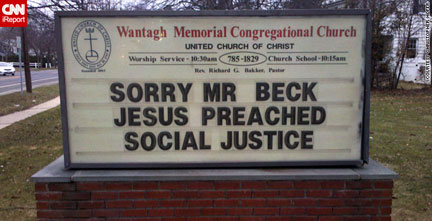
Political Songwriting Revival

Driving to church last Sunday, I heard a new song on the radio called ‘I Get By’.  The artist is Everlast.  Here’s the video:

What struck me about this song is how similar the feel and content is to the old folk tunes by people like Johnny Cash and Woody Guthrie.  Their work was edgy and controversial.  It spoke directly from and to the experience of marginalization.  Compare the Everlast song to these:

The only place where consciously political songwriting has maintained any kind of presence is in hip hop.  Nas is my favorite.  Check it out:

Finally, just because I can’t resist getting theological, here’s one last comparison.  The language is rough and offensive, but there are some pertinent insights, if you have ears to hear:

Jesus Makes Things Complicated

One of my favorite pictures of the Rev. Sarah E. Schmidt-Lee

I’m about to take a huge risk by sharing one of my wife’s sermons with my friends in the blogosphere.  When it comes to preaching, Rev. Sarah Schmidt-Lee blows me out of the water.  This is the woman who made me want to be a preacher.  During our dating and newlywed years, her sermons shaped my spirituality at a very deep level.  So I’m excited to share one of them with you today.  This was preached yesterday (10/23/2011) at Westernville Presbyterian Church.  The text is Matthew 22:34-46.

Have you heard the story about the pastor who asks a group of kids a question during the kids’ conversation: “what has a furry tail, lives in trees and eats nuts.” One of the kids raises his hand and says, “It sounds like a squirrel, but I know the answer is Jesus.” It’s a joke that always makes me cringe a little bit, because it feels a little too close to home—I can’t count the number of times I’ve been in a Sunday School class, either as a child or as a teacher, when I know the answer is supposed to be Jesus, or God, or maybe church or the Bible. It is so tempting to reduce our faith into a series of right answers.


The Pharisees and Sadducees who are interacting with Jesus throughout this section of Matthew seem to approach their faith in a way that assumes there are right answers. Faith or religion seems to be a puzzle and if they have all the right pieces, they can generate the right answers and teach those to people to make them into right—or righteous people.


Or, in the case of these interactions with Jesus, test him to find out if he has the right answers, and hopefully expose that he is wrong.

But Jesus refuses to play the game. He doesn’t see faith and tradition as a puzzle with one right answer. He sees it as open to interpretation—complex and mysterious and hard to pin-down. Instead of giving the “right” answer or “the wrong” answer, Jesus punches holes in all those boxes and challenges these religious leaders to ask better questions.


Last week we read how the Pharisees confronted Jesus with a question about taxes designed to force him into one political camp or another—to test him. After that, the Sadducees confront him with a question about resurrection—a kind of rhetorical question meant to show how illogical it is to believe in the resurrection, but Jesus pokes holes in their logic, leaving them dumbfounded. That’s when the Pharisees come in with their lawyer—the pull out the big guns.


Now, Jesus probably gave them exactly the answer they were hoping he would—it would have been fairly common for people in those days to consider the she’ma—Love the Lord your God with all your heart, soul and strength—the greatest commandment. And if there were any controversy, loving your neighbor as yourself would be the next contender. At first, it may have seemed that Jesus fell straight into their trap—giving a simple answer that they considered the wrong answer. See, it’s likely that this was a trick question to begin with—no law should be more important, or greater than any of the others, because they all come from God—that would be the right answer.


But Jesus seems to anticipate the trick, because after naming the two greatest commandments, he explains why they are the greatest—on these hang all the law and the prophets. Jesus refuses to fall into their trap—none of the other laws are less important, but they depend on these two—these two form the base or the trunk of the tree on which all the other laws hang like fruit. Not the right answer, but not the wrong answer, either, Jesus succeeds again and again at complicating the questions, reframing them.


And now, after this series of interrogations, Jesus turns the table, and he initiates a question: Whose descendant is the Messiah? The Pharisees probably rolled their eyes. Really? Everyone knows that—he is David’s descendant. But Jesus isn’t done. Okaaaay, he continues, if so, why does David refer to the Messiah as Lord—a title reserved for fathers and elders? Shouldn’t it be the other way around? If David is the Messiah’s ancestor, then shouldn’t the Messiah call David, Lord and not the other way around?


Hmmm. The Pharisees don’t have an answer for that. They leave in an embarrassed silence, and never muster up the guts to confront Jesus with questions again. Instead, we know, they plot to have him killed, because Jesus makes things complicated and mysterious, when the Pharisees want clear cut answers.


We may not identify with the questions that are getting tossed around in these confrontations—questions about resurrection, Romans taxes, and Messianic lineage are not particularly hot-button issues in 21st century North America, but the dynamic of the interaction is all too familiar. Just like the Pharisees and Sadducees, 21st century Christians still like clear cut answers, don’t we? We still want faith to boil down to right answers—clear, simple truths that we can teach to our children and use as a litmus test to determine who is right and who is wrong—or at least, who is with us and who is against us.


One of the supposedly clear-cut questions that is used to draw dividing lines in churches and denominations all over the country is the question: What does the Bible teach about same-sex relationships?


I’ll admit that I grew up thinking this question had a clear answer, but then Jesus threw a wrench in things. Through relationships with people God brought into my life, and through watching the ministry of people I grew up thinking shouldn’t be pastors, I began to read the Bible with different questions in mind. I started confronting questions like—why is the church fighting over this issue, and hurting lots of people who are already hurting, when Jesus never talks about it at all? Why aren’t we talking about the things Jesus really did spend most of his time talking about, like how we use our money—how we share our resources—how we treat the poor, outcast, and misunderstood?


And speaking of the outcast and misunderstood—didn’t Jesus spent his time hanging out with people who were kicked out of the religious life of his community—welcoming people who were considered unclean or immoral, because scripture said so? And didn’t Jesus treat those people with dignity and compassion and love?


One of the big eye-openers for me came as Barrett started a mid-week Bible study and communion service in Utica. His goal was to make it a welcoming place for people who did not feel comfortable going to a typical church on Sunday morning. He was really expecting to attract homeless people. We knew from work in Vancouver that a lot of homeless and near-homeless people are intimidated to walk into a church on a Sunday morning because they don’t feel like they can dress appropriately, or they know that they smell bad, or because when they ask for help they are usually asked to leave. And sure enough, we have had some homeless folks involved in the community over the three years we’ve been meeting.


But what neither of us could anticipate was the number of gay and lesbian folks who started showing up—every single one of them with a story of being wounded by a church—stories of being told implicitly, and sometimes explicitly that they didn’t belong at church. And every single one of them has come, longing to be a part of a community of faith—to find a place to belong—a place where they could talk about their experience of God, their love for Jesus, their search for spiritual truth. If Jesus welcomed the outcasts, the people kicked out of the synagogues, then shouldn’t our churches figure out how to do the same? And what does that look like?


These are uncomfortable questions, aren’t they? Jesus makes things more complicated—when we want to boil faith down to clear-cut answers, universal truths and straight-forward moral imperatives, Jesus throws a wrench in the well-oiled machine of our religious institutions and reminds us that faith is about knowing and loving and trusting God, and God is a mystery. We don’t trust in our answers, we trust in the mystery—the huge, complex, unfathomable, frightening mystery of God. Being a Christian is not about having the right answers—it is about loving God and loving neighbor. When we learn to do that, we might even learn to love the mystery—to delight in asking better and better questions—questions that lead us deeper into the mystery of God’s love, rather than simply settling for easy answers.


Link to ‘Notes From a Dragon Mom’

This NY Times article came my way through Facebook and… well, you’ll just have to read it.

This woman’s hard-won wisdom and insight reminds me of Lao-Tzu, Krishna, and Jesus.  I cite these sacred texts below, but I make no claim to have obtained the wisdom.

Notes From a Dragon Mom

Emily and Ronan Rapp

“Therefore the sage produces without possessing, Acts without expectations And accomplishes without abiding in her accomplishments.  It is precisely because she does not abide in them That they never leave her.” – Tao Te Ching

“Therefore without attachment, do thou always perform action which should be done; for by performing action without attachment man reaches the Supreme.” – Bhagavad Gita

“So do not worry about tomorrow, for tomorrow will bring worries of its own.  Today’s trouble is enough for today.” – Matthew 6:34

WWJD?

For those who are uninformed about what Occupy Wall Street is all about, read this article first:

http://www.foxnews.com/opinion/2011/10/14/understanding-occupy-wall-street/

Taken from a Facebook discussion, here’s why I think this joke is relevant:

Let’s look at the setting: The Temple. It’s a fair bet to say that it was in the outer court of the Temple, most likely in the Court of the Gentiles, which is the only section …of the Temple where non-Jews were allowed to worship (it reminds me of the balcony in my wife’s church, where slaves were segregated out and forced to sit apart from the rest of the congregation back in the day). The money-changers came in and set up their business in that section, forcing people to exchange foreign coin for Temple shekel (because the former had images of ‘foreign gods’ on them) in order to buy animals for sacrifice. I should add that this was done for profit.

It’s no accident that Jesus quotes Isaiah 56:7 on his way in: “My house shall be called a house of prayer for all people”. This comes from a larger section of Isaiah where the prophet describes how non-Jews will be welcomed as part of God’s people. God’s wants to be known as the one who “gathers the outcasts”. Going back to Isaiah 2:1-5, God’s ultimate goal is to make Jerusalem into a multi-cultural center for education in agriculture, nonviolence, and spiritual enlightenment.

Jesus knew all of this and was angry that the powers-that-be had taken the one small place that non-Jews had in the Temple (the one place that could fulfill the divine vision), and had taken it away from them in order to keep their profit-making machinery going. Jesus intended to give it back.

So, without the approval of the authorities, he set up an unlawful occupation of the Temple courts. Every day for that last week of his life, Jesus and his followers gathered in that section to teach and learn. He was fulfilling Isaiah’s vision to make Jerusalem a multi-cultural center for education in agriculture, nonviolence, and spiritual enlightenment. The powers-that-be questioned his authority and tried to shut it down, but were unsuccessful. In the end, the text tells us that this was the point where they started the conspiracy to have Jesus killed. He was too much of a threat to their power.

Occupy Wall Street isn’t a perfect reflection of this action. I’m not arguing that it’s particularly Christian in nature. However, it’s appropriate to note the similarities between the two: A powerful populist movement of marginalized people (i.e. “freaks and geeks”) sets up an illegal occupation of a symbolic power-center in protest against profiteering schemes that rob people of their God-given rights.

To the extent that this works, the authorities lash back with violence and death (hence the crucifixion). Or, as Gandhi put it: “First they ignore you, then they laugh at you, then they fight you, and then you win.”

It’s The End Of The World As We Know It (And I Feel Fine)

"What, Me Worry?"

This week’s sermon from First Presbyterian, Boonville.

The text is John 14:1-14.

“Do not let your hearts be troubled.”

These are good words to hear from Jesus on the morning after the end of the world.  According to Harold Camping, president of Family Radio, the Final Judgment of humanity was scheduled to begin last night (May 21, 2011) at 6pm.  Mr. Camping came up with this conclusion using a combination of literal and symbolic interpretations of certain biblical texts and then combining those interpretations with some fancy mathematics.  Judging from the fact that so many of us are still here today, I think we can safely say that Mr. Camping’s calculations were (at least) slightly off.

This is not the first time someone has made such precise predictions about the Apocalypse.  In fact, Mr. Camping himself previously insisted that the end of days would arrive promptly on September 6, 1994.  Before him, there was the very famous case of the Millerites.  This sect of believers followed the teachings of one William Miller, who predicted that Christ would return and the world would end before March 21, 1844.  After this day came and went without incident, the deadline was extended to April 18 and then October 22.  After his third failed prediction, Miller’s followers gave up on him.  However, several of them went on to found the Seventh Day Adventist and Jehovah’s Witness churches in subsequent years.

So yes, apocalyptic enthusiasts are nothing new to Christian history.  In fact, Jesus even warned us to watch out for folks like this.  When the disciples asked Jesus about the end of the world, he told them in Matthew 24,

…if anyone says to you, ‘Look! Here is the Messiah!’ or ‘There he is!’ —do not believe it. 24For false messiahs and false prophets will appear and produce great signs and omens, to lead astray, if possible, even the elect. 25Take note, I have told you beforehand. 26So, if they say to you, ‘Look! He is in the wilderness,’ do not go out. If they say, ‘Look! He is in the inner rooms,’ do not believe it. 27For as the lightning comes from the east and flashes as far as the west, so will be the coming of the Son of Man.

Instead, Jesus comforts his followers with these words from today’s gospel reading:

Do not let your hearts be troubled. Believe in God, believe also in me. 2In my Father’s house there are many dwelling places. If it were not so, would I have told you that I go to prepare a place for you? 3And if I go and prepare a place for you, I will come again and will take you to myself, so that where I am, there you may be also.

When it comes to this “end of the world” business, Jesus is essentially saying, “Don’t worry about it” and “Trust me.”  Nevertheless, there always seems to be someone out there who claims to have the inside scoop on when and how the world is going to end.  They claim to know “the way” to secure one’s eternal destiny in light of the coming devastation.  Well, Jesus had a thing or two to say about that as well.  He reminded his followers they already knew “the way” to God.

“Wait a minute,” one of them said, “what ‘way’ are you talking about, Jesus?  I don’t remember you saying anything about a ‘way’!”

“Sure you do,” Jesus said, “It’s me.  I am the way.”

Now, if you’re still feeling confused as you read this, don’t worry.  It’s supposed to be confusing.  This is another classic example of Jesus talking right over the heads of his disciples.  He uses these cryptic images in order to shake people out of their normal way of thinking.  Jesus wants to expand their (and our) minds to operate on a spiritual level, far above that of ordinary reasoning.

With this famous phrase, “I am the way, and the truth, and the life”, we are venturing into territory that makes Christianity unique among the religions of the world.  In many world religions, there is usually founder or other figurehead who acts a messenger for the Divine.  That person is given a message that will guide the world toward salvation or enlightenment.  Moses received the Torah, Muhammad received the Qur’an, and the Buddha received the Eightfold Path.  In each of these cases, it’s the message, not the messenger, that’s most important.  The unique thing about Christianity is that the messenger is the message.  God is not revealed through a book or a teaching, but through a person, namely, Jesus of Nazareth.  To know Jesus is to know God.  If you want to know what God is like, look at Jesus.

This makes people uncomfortable.  A personal God is too unpredictable and too intimate for most people.  The only way to be in a relationship with a personal God is to come to know, love, and trust that person.  Most people (including Christians) feel much more at ease with a God who can be contained within a body of teaching (like the Bible) or an institution (like the Church).  Protestants do it just as much as Catholics.  So-called “liberal” Christians do it just as much as so-called “conservatives”.

Let me give an example:

Many people in our society are quite familiar with the traditional evangelical presentation of the Christian message: Jesus Christ was born, so they say, in order to die on the cross as a sacrifice for the sins of humankind so that people can go to heaven when they die.  The way to God is through the cross of Christ.

On the other hand, many people are also quite familiar with the progressive and “liberal” presentation of Christianity: Jesus Christ was an inspirational activist and philosopher whose teachings offer humankind a system of ethics that will lead us toward a more spiritually enlightened society.  The way to God is through the teachings of Jesus.

I think both of these perspectives fall short of Jesus’ intention.  Both the cross and the teachings of Christ are of paramount importance in the larger scheme of things, but they are only parts of the whole.  It’s the person of Jesus Christ who is the final revelation of God to humankind.  Jesus is the way.  If we want to get to know God, we must get to know Jesus.

How do we do that?  I don’t have an answer to that question.  Sure, I could hand you a list of activities (like reading the Bible or going to church) that are supposed to help you get to know Jesus, but that would be just another way of putting God into a manageable box that can be unlocked with the right formula.  The fact is that there are as many ways of getting to know Jesus as there are ways of getting to know any other person.

Think about the last time you were really in love or had a crush on someone.  What did you do?  You spent a lot of time thinking about that person.  You hung on his or her every word.  You gazed longingly over your shoulder whenever that person walked by.  You studied every feature on his or her face.  You spent as much time as possible with that person.  Your friends probably got sick and tired of hearing you talk about it.

In the same way, getting to know Jesus is more like falling in love than signing a contract.  The only difference between us and his earliest followers is that we don’t get the luxury of his physical presence with us.  We have to get to know Jesus in other ways.  I can’t tell you how it’s going to happen for you, because it’s different for everybody.  However, I can offer you some ideas about how it might happen.

For some people, getting to know Jesus happens dramatically and suddenly, like falling head-over-heels in love.  For others, it happens gradually over a long period of time, like sharing a cup of coffee with an old friend.  For some people, it happens through conventional channels, like going to church or reading the Bible.  For others, it happens in very surprising and unconventional ways.

My favorite story of an unconventional encounter with Jesus comes from the autobiographical work Traveling Mercies by Anne Lamott.  (I should warn you that this vignette will be edited for content, as Anne is known for being a somewhat foul-mouthed saint.)  This scene opens with Anne living on a houseboat at the end of a dock, deep in the throes of her addiction to alcohol and drugs.  One week prior, she’d had an abortion and was still bleeding profusely.  During this time, she would occasionally visit a Presbyterian church near her house, but would always sneak out before the sermon.  Anne continues:

Several hours later, the blood stopped flowing, and I got in bed, shaky and sad and too wild to have another drink or take a sleeping pill.  I had a cigarette and turned out the light.  After a while, as I lay there, I became aware of someone with me, hunkered down in the corner, and I just assumed it was my [late] father, whose presence I had felt over the years when I was frightened and alone.  The feeling was so strong that I actually turned on the light for a moment to make sure no one was there—of course, there wasn’t.  But after a while, in the dark again, I knew beyond any doubt that it was Jesus.  I felt him as surely as I feel my dog lying nearby as I write this.

And I was appalled.  I thought about my life and my brilliant hilarious progressive friends, I thought about what everyone would think of me if I became a Christian, and it seemed an utterly impossible thing that simply could not be allowed to happen.  I turned to the wall and said out loud, “I would rather die.”

I felt him just sitting there on his haunches in the corner of my sleeping loft, watching me with patience and love, and I squinched my eyes shut, but that didn’t help because that’s not what I was seeing him with.

Finally I fell asleep, and in the morning, he was gone.

This experience spooked me badly, but I thought it was just an apparition, born of fear and self-loathing and booze and loss of blood.  But then everywhere I went, I had the feeling that a little cat was following me, wanting me to reach down and pick it up, wanting me to open the door and let it in.  But I knew what would happen: you let a cat in one time, give it a little milk, and then it stays forever.  So I tried to keep one step ahead of it, slamming my houseboat door when I entered or left.

And one week later, when I went back to church, I was so hungover that I couldn’t stand up for the songs, and this time I stayed for the sermon, which I just thought was so ridiculous, like someone trying to convince me of the existence of extraterrestrials, but the last song was so deep and raw and pure that I could not escape.  It was as if the people were singing in between the notes, weeping and joyful at the same time, and I felt like their voices or something was rocking me in its bosom, holding me like a scared kid, and I opened up to that feeling—and it washed over me.

I began to cry and left before the benediction, and I raced home and felt the little cat running along my heels, and I walked down the dock past dozens of potted flowers, under a sky as blue as one of God’s own dreams, and I opened the door to my houseboat, and I stood there a minute, and then I hung my head and said, “F**k it: I quit.”  I took a long deep breath and said out loud, “All right.  You can come in.”

So this was the beautiful moment of my conversion.

The Harvest is Here

St. Photina, "The Enlightened One". Traditional name for the Samaritan woman at the well. Legend has it that she was martyred after spitting in Emperor Nero's face.

Today’s sermon from First Presbyterian, Boonville.

The text is John 4:5-42.

Over the past few decades a lot has been said and written on the topic of church growth in North America.  Most sources agree that there has been a tremendous decline in membership for older, mainline congregations like ours.  Many popular sources are selling the idea that the key to reversing this trend lies in imitating the worship style and the theological leanings of evangelical mega-churches.  However, I’m not convinced.

Here’s why: I heard about an Episcopal church in Colorado.  This was a small, traditional parish.  Their numbers were dwindling.  Almost all the members left in the pews were grandparents or great grandparents.  There was nothing about this parish that fit the popular model for church growth.  Closure seemed inevitable.

Several of these aging church members felt led to start a youth group.  They were praying for an opportunity to start one.  But even their priest was telling them not to hold their breath over it.  Their big opportunity came one day when that same priest was sitting in a local coffee shop.  He was wearing a clerical collar, which clearly identified him with his profession.

The priest looked up and suddenly, there was a teenager was standing in front of him.  This rough-looking young man was clad in leather and had piercings in every conceivable orifice.  “Hey.”  He said, “Are you one of those ministers who can do funerals without the body there?”  After taking a second to compose himself, the priest asked the teenager to sit down and talk.  As it turns out, he had a friend who had recently died of a drug overdose.  His family lived out of state and had shipped the body back east for burial.  None of his local friends had a chance to grieve their loss.  The priest said yes, their church could certainly have a memorial service for this young man.

The members of the church wanted to get involved too, but they were at a loss as to how to do it.  They had nothing in common with this group of hard-edged, punk rock teenagers.  When they prayed for a youth group, they were thinking of a cadre of nicely-dressed, well-behaved high school students who attended Bible studies and held bake sales.  What were they supposed to do with this motley crew?

After giving it some thought, they could think of only one natural way to relate to these youth: they were all grandparents.  Why not act like it?  On the day of the memorial service, they made their fellowship hall as warm and cozy as possible.  They made tea and hot chocolate.  They set out fresh-baked cookies on hand-crocheted doilies.  And when the youth arrived, everyone agreed to pretend they were their own grandkids.

Most of the youth stuck around for the reception.  Amid a sea of black leather and glinting lip rings, one could see an entire rainbow of artificial hair colors.  The event was such a success, they decided to invite the teenagers back at the same time next week.  To their surprise, most of them came back!  Week after week, the most unlikely relationships formed between these folks in their eighties and this scary-looking group of punk-rock teenagers.  They got the youth group they had been praying for, but it looked nothing like they expected!  Moreover, it bore no resemblance to the trendy programs that are supposed to attract youth to a congregation.

This kind of thing has happened before in Christian history.  In today’s gospel reading, we read about Jesus’ unconventional model for church growth in the most unlikely places.  It happened among a group of Samaritans.

This was the last place where Jesus’ disciples expected to find a warm welcome.  Samaritans and Jews shared common ethnic and religious roots, but the Samaritans were regarded as heretics and half-breeds.  No self-respecting Jew would be caught dead with a Samaritan in public.  Some Jews traveling from Galilee to Judea would go almost a hundred miles out of their way in order to avoid Samaritan territory.  It was bad enough that Jesus had decided to go through Samaria instead.  Did he have to talk to them as well?

As it turns out, these Samaritans gave this Jewish rabbi a warmer welcome than any synagogue.  Even in Jesus’ own hometown, they had tried to throw him off a cliff!  But these half-breed heretics had opened their doors and welcomed Jesus and the disciples with open arms.  When the members of the village heard Jesus speak, they all believed in him.  A church sprang up overnight in this Samaritan village.

What’s even more surprising is that the catalyst for this explosive church growth was not the local mayor or clergyperson, but the village pariah.  It was almost unthinkable that Jesus would even talk to her in the first place.  First of all, she was a Samaritan.  We already talked about the inborn hostility there.  Second, she was a woman.  Nice Jewish boys didn’t talk to women in public (not even their own wives).  Finally, she was even outcast from her own people.  The text tells us that she met Jesus by the well at noon.  In that world without air conditioning, it was ridiculous to go to a well at noon, when the sun was beating down.  Most people would go at sunrise or sunset, when the weather was cooler.  The village well is where people would gather to chat and gossip.  The only reason to go to the well at noon was if you didn’t want to bump into anyone else.

Later in the story, we learn a little more about this person.  We find out that she’d been married five times and was currently living with a man outside of wedlock. Even today, two millennia later, most people who read this story assume that she was a serial divorcee who hopped from relationship to relationship.  But here’s an important detail about ancient Semitic culture: women were not allowed to initiate a divorce.  A husband could divorce his wife for any reason (even if she burned his supper) but a wife had no rights.  She may have been abused and discarded by man after man until she landed in her current situation, where the man she was with didn’t even have the decency to make the relationship legitimate.  We don’t even know that this woman was divorced at all.  In a country with such a low life-expectancy, it’s entirely possible that she was simply widowed five times over.  It seems that she could have landed in her situation through no fault of her own.  Nevertheless, she was still considered “damaged goods” by her neighbors.  Her story would provide ample fuel for the local gossip engine.

Yet, in spite of all these barriers, Jesus chooses this woman to be the agent of transformation in her village.  He engages her in theological conversation.  He effectively ordains her as an evangelist to the village.  Through her, the entire village comes to faith in Christ and opens their arms in welcome to this band of strangers.  Jesus’ model for church growth makes use of the most unlikely people in the most unlikely places.  But, apparently, it works.

What did the disciples think of all this while it was happening?  Well, we read in the text that they were “astonished” at Jesus’ incessant boundary pushing.  It was bad enough that they had to go through Samaria at all, but then Jesus starts talking with this woman, and then they end up spending two days there: eating and sleeping with these untouchable, half-bred heretics!  If their old rabbis ever heard about this, they’d all be kicked out of the synagogue for sure!

Jesus interrupts their astonishment with an invitation.  He tells them it’s time to let go of their expectations and their pre-conceived notions about other people.  Jesus says, “Look around you.  You think the harvest is still a few months off, but I’m telling you that the time for the harvest is now!  So, get out your sickle!”  Jesus tells them it’s time for them to open their eyes and see what God is doing around them (even in this least-expected place).  He wants them to “enter into the labor”, to be part of what they see God doing here and now.  For Jesus, this is the key to effective church growth, not a bunch of fancy programs.  Jesus gets it.  The Samaritans got it.  The disciples were starting to get it.  The Episcopal church in Colorado got it.  What about us?

In spite of what popular sources say, I’m not ready to pronounce our church dead yet.  I think God still has a harvest for us here in Boonville.  It won’t look like the “good old days” all over again.  1955 has come and gone.  Likewise, it won’t look like these evangelical mega-churches.  That’s not who we are as a church or a community (besides, we don’t have the parking space).  It will involve letting go of our old expectations and pre-conceived notions.  The good news is that this is already happening.  You’re already doing it.  When you started your search for a new pastor over a year ago, who would have thought that you would be interested in calling an Episcopal priest with a pony tail?  But here we are!

What other “astonishing” surprises does God have in store for us?  Where is the harvest happening here and now in Boonville?  That’s the question we have to ask ourselves as a church.  I have a few of my own ideas about how we might answer that question.  I see this church as a haven for people who, for whatever reason, have been made to feel unwelcome at other churches in the North Country.

I’m thinking of people like intelligent skeptics who are interested in faith, but have a lot of honest questions about it.  Too many churches out there tell people to “shut up” and “get in line” with traditional doctrine.  I see this church as a place where people can ask their honest questions without fear of rejection.  Maybe we won’t even know the answers, but we can ask those questions together.

Likewise, I also see our church as the kind of place where people who are gay or lesbian can find a welcoming church home.  Too often, people in our society face exile from their churches, their families, and their homes when they “come out of the closet” (which means being honest and open about their attraction to people of the same gender).  Among youth, it’s one of the top causes of suicide and homelessness.  I believe that our church can be a place in the North Country where that doesn’t need to happen.

I envision this church as a haven where people can come, with all their doubts and their differences, and be welcomed as one of “us” rather than one of “them”.  I see this church as a place where people can come looking for belonging, and through that, find themselves believing.  This is the gospel harvest that Jesus has prepared for us.  Are we ready to “look around us” and “enter into the labor” of this harvest?  I think so.