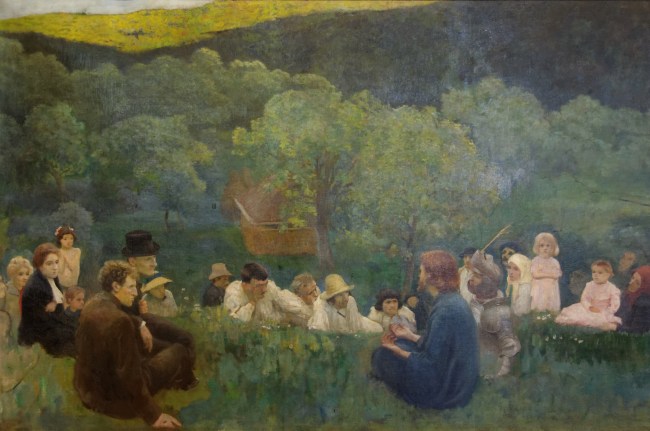
Redefining Success

Image
Károly Ferenczy [GFDL (http://www.gnu.org/copyleft/fdl.html) or CC-BY-SA-3.0-2.5-2.0-1.0 (http://creativecommons.org/licenses/by-sa/3.0)%5D, via Wikimedia Commons

Introduction

What would you say are the marks of a successful church?

Here are some of my ideas for North Church:

  • We’re going to court some billionaire investors. Not donors, but investors. We want to incentivize their giving by promising a lucrative return. Once we have their money, we’re going to make use of it.

  • First of all, because we need to keep them happy (so they’ll keep sending us money), we’re going to turn our upstairs balcony into a skybox where our wealthiest members can observe the service in comfort, with leather recliners and a full wait staff serving champagne and caviar.

  • For our music ministry, we’re going to hire a full-time, paid, professionally trained choir (we already have the best organist in Michigan, so we won’t need a new one of those). Our contemporary worship team will get brand new, state-of-the-art AV equipment.

  • We’re going to get TV cameras so our service can be broadcast live via satellite around the world.

  • We’ll get paid endorsements from celebrities like Derek Jeter (add Christina Hendricks and George Clooney for sex appeal), who will tell everybody how great North Church is.

  • And finally, we’ll need to protect all this new stuff, so we’ll need to get a security force to guard the church. And I’m not thinking just some smiling, helpful rentacops either… I’m talking about SWAT team gear with assault rifles: I want such an overwhelming display of power that nobody will even THINK about messing with our church.

If we had all of those things (i.e. money, fame, and power), we would be a successful church, right? Wrong.

Blessedness

Jesus’ definition of the word success is different from the one accepted by the rest of the world. The world has a very self-centered definition of success, but Jesus presents us with a God-centered definition of success. The word he uses is blessed, which can also mean successful or lucky when you take away the spiritual side of it. That word blessed, by the way, comes from the Latin beatus and is where we get get the word Beatitude from. Blessedness, from the God-centered perspective of Jesus, is quite different from the world’s self-centered idea of success.

Blessed are the poor in spirit, for theirs is the kingdom of heaven.”

The world sees wealth as a sign of success: the Armani tux, the Vera Wang dress, the Italian sports car, the yacht, and the mansion. The world looks at people who have those things and calls them successful/lucky.But Jesus says, “Blessed are the poor in spirit, for theirs is the kingdom of heaven.” The kingdoms of this world (governments, corporations, institutions) cater to the desires of the haves, but the kingdom of heaven (Jesus’ vision of an ideal society) will serve the needs of the have-nots. On the day when God’s dream for this world comes true, no more will Senators and CEOs vote to give themselves raises and go on vacation while the people whose jobs they cut sleep in shelters and line up outside soup kitchens. That’s not going to happen anymore.

Blessed are those who mourn, for they will be comforted.”

The world looks at people who seem to be happy and calls them “successful.” Today is Super Bowl Sunday, the one day a year when people watch TV just as much for the commercials as they watch it for the program. How many people plugging products in those commercials will be average-looking folks, looking bored, and saying, “Meh, I guess this product is okay…”? Not very many, I think. TV commercials are full of beautiful, smiling people who are excited to tell you all about how a particular cleaning solution changed their lives forever. They want us to believe that we’ll be as beautiful and happy as they are if only we buy what they’re selling. The world says that happy people are successful people, but Jesus says, “Blessed are those who mourn, for they will be comforted.” Jesus invites us to not buy into that “cult of happiness.” Jesus doesn’t want us to turn away from the pain of this world, he wants us to look at it and do something about it. That’s what compassion is: Showing up with food or clothes, visiting the shelter, the drop-in, the hospital bed, the courtroom, and the prison cell. That’s the kind of love Jesus showed us and it’s the kind of love he wants us to show others. Wherever there’s pain, there’s Jesus, so that’s where we should be too.

Blessed are the meek, for they will inherit the earth.”

The world says that successful people are tough-minded alpha-dogs who stand their ground and don’t compromise. Those are the big-shots who end up in running the show. The world puts them in charge of things. But Jesus says, “Blessed are the meek (i.e. gentle, flexible), for they will inherit the earth.” I like this one because I read a book by a couple of biologists last year that talks about how competition is not the only driving force behind evolution. They make the case that cooperation plays just as big a role in the ongoing development of life. When God’s dream for this world comes true, the ones in charge will be the ones who know how to work well with others and value relationships more than ideologies.

Blessed are those who hunger and thirst for righteousness, for they will be filled.”

The world believes that truly successful people lack for nothing. They have everything they could ever want. They benefit from the way things are. Insulated by wealth and power, they don’t sense the urgency of the situation or feel the need to challenge the system. But Jesus says, “Blessed are those who hunger and thirst for righteousness (i.e. justice, fairness), for they will be filled.” That last part is especially ominous because history has shown, time and again, that poor people will not stay quiet and submissive forever. If the leaders will not change the system, the people will change the leaders. Jesus has been proven right more than once: “The first shall be last and the last shall be first.”

Blessed are the merciful, for they will receive mercy.”

The world says that successful people know how to give as good as they get. If you hit them, they hit you back. They make an example of you so that others know not to mess with them. That’s the politics of power. But Jesus says, “Blessed are the merciful, for they will receive mercy.” Real power, according to Jesus, comes from knowing that you could rip your enemies to shreds but choosing not to. What’s more is that mercy is contagious: it comes back to you. It stops the cycle of violence from going around and around and escalating until the situation is out of control. The United States and the Soviet Union spend the latter half of the twentieth century with nuclear missiles pointed at each other in the doctrine of Mutually Assured Destruction (MAD). But then the Cold War ended, not with a mushroom cloud, but with a party: people singing and dancing as the Berlin Wall came down. The doctrine of MAD-ness did neither side any good in the end.

Blessed are the pure in heart, for they will see God.”

The world says that successful people are savvy: they know how to read between the lines and close the deal. They’re street-smart; they have guile. Successful people know how the game is played and stay two steps ahead of the competition. These savvy, successful people are sure to see great big dividends on their investments. But Jesus says, “Blessed are the pure in heart, for they will see God.” Savvy, street-smart people see the world for what they can get out of it, but they’re missing a whole other dimension of reality. Those who see the world like Jesus does get to see the hand of God at work in creation. These blessed folks know that they’re not alone and that life has meaning. I like to compare this one to the scene in Star Wars when Han Solo is laughing at Luke Skywalker as he trains to be a Jedi Knight. Luke says, “You don’t believe in the Force, do you?” Han replies, “Kid, I’ve flown from one side of this galaxy to the other, and I’ve seen a lot of strange stuff, but I’ve never seen *anything* to make me believe that there’s one all-powerful Force controlling everything. ‘Cause no mystical energy field controls *my* destiny. It’s all a lot of simple tricks and nonsense.” Han is savvy but Luke is pure in heart. Luke is learning how to see the world through a different set of eyes and so, as Obi-Wan Kenobi said about him, he’s taking his “first steps into a larger world.”

Blessed are the peacemakers, for they will be called children of God.”

The world defines success by winning. Whether it’s trophies on the shelf or notches on the bedpost, the world wants to know about your conquests. This was especially true in ancient Rome, where the empire was built on the doctrine of Pax Romana: world peace through global conquest. They believed that Roman order would prevail over the barbarians of the world by the mighty hand of Caesar. And Caesar himself was worshiped and given a very special title: “The Son of God,” Sol Invictus, “the Unconquerable Sun.” But Jesus says, “Blessed are the peacemakers (not the conquerors), for they will be called children (lit. ‘sons’) of God.”

Blessed are those who are persecuted for righteousness’ sake, for theirs is the kingdom of heaven.”

Finally, the world says that respect is a measure of success. They say a good name is as good as gold. If people listen to what you say, you’re successful. If you get invited to the White House to advise the President on a matter, you’re successful. The world says it’s good to be admired and respected. Those who possess the kingdoms of this world are accorded respect, whether they deserve it or not. But Jesus says, “Blessed are those who are persecuted for righteousness’ sake, for theirs is the kingdom of heaven.” Notice the parallel with the first beatitude. God’s ideal world belongs to the have-nots, the disrespected, the ones without a voice, and those who suffer and die for standing up and speaking out for what’s right. When God’s dream for this world comes true, these are the people we’ll be listening to, not the flattering bootlickers who only tell powerful leaders what they want to hear. We need people of conscience who will “speak the truth in love” to the powerful ones in charge. That’s what prophets do, but they’re almost never listened to or given the respect they deserve. Nevertheless, Jesus calls them “blessed” and commands us to keep doing it.

Conclusion

Jesus redefines success. He takes the world’s self-centered idea of success and replaces it with his own God-centered idea of blessedness. In the mind of Christ, success is not a blessing and blessing does not look like success. God’s blessing is upon the poor and oppressed peoples of this world, the ones without a voice, the ones who weep in the night, and the ones who are literally starving for change. God’s blessing is upon the gentle, the compassionate, the pure in heart, and the peacemakers.God’s blessing is upon those who face the pain of this world and do what they can to make a difference. God’s blessing is upon those who are a blessing. And so it is that I say to you:

May God bless you and make you a blessing, this day and every day. AMEN.

Making Friends With Witches

Image
Photo by Shahmai Network. http://www.shahmai.org/


I just read an article about a fascinating guy, but I’m not going to link to it, seeing how it comes from one of the extremist publications of the religious right.  However, the subject of the article (who is blasted therein) seems like a pretty stand up dude.  His name is Phil Wyman and he’s a pastor in Salem, Mass who was expelled from a Pentecostal denomination for building a ministry with the expressed goal to “make friends with witches and atheists.”

Here’s what Pastor Phil has to say for himself:

“We did something few other Christians in the world were doing… We loved the witches and they loved us back.”

He doesn’t try to convert Wiccans to Christianity because:

“Theology doesn’t work like that. I don’t think I have the capability of converting anyone… I don’t look at the Christian salvation thing as a sales pitch. That’s God’s job. I talk about practical things. Why can’t I just have a regular relationship and talk about the Red Sox?”

Also, he sets up confessional booths on Halloween, but with a twist:

“We didn’t have them confess to us, but rather, we confessed the sins of the Church and apologized for hideous things that had happened, not only down through history but in recent times… That was evidence that we cared.”

Like Pastor Phil, I am one who has repeatedly found himself in committed professional and personal relationships with atheists and pagans.  I have worked hard to win their respect as a Christian who will listen to reason with compassion.  The resulting friendships have been some of the longest and richest of my life.  I have tried to be more Christ-like than Christian and often discovered Christ in them, even though our ideological boundaries don’t line up like one would expect.

In the Bible, Jesus often called his friends and followers to travel beyond the pale of established religion and morality.  He ate with tax collectors and sinners, he touched the untouchable, he traveled through enemy Samaritan territory and gratefully received their hospitality, and he found more faith in one (pagan) Roman centurion than he had seen in all of Israel. 

Jesus was never one to circle his theological wagons.  He never deemed orthodoxy worthy of defense.  He taught that love is the greatest commandment and the quality of one’s religion equals the quality of one’s relationships.

Let’s (Not) Make a Deal

Do you ever feel like everyone wants a piece of you and maybe there’s not enough to go around?

You and I live in a transactional society where everything is quid pro quo: there’s no such thing as a free lunch, you get what you pay for, and you pay for what you get.  This, obviously, is how we do business: a product or service is offered at a fair price that both parties agree on, the exchange takes place, and both parties go their separate ways.  Ostensibly, this is also how we do government: public officials are elected to their positions for a term of service wherein they are authorized to exercise a certain amount of political power over the populace in exchange for their promise to protect the well-being of those they serve.

So, in sectors public and private, our society runs on the idea of transactions.  Life, it seems, is one big game of Let’s Make a Deal.  There are some people who find that thought appealing.  Ayn Rand, for example, is a Russian philosopher whose work is often read and quoted admiringly by members of the so-called Tea Party movement.  She believed that people are selfish by nature and self-interest is the only correct way to make decisions in life.  Charity, compassion, goodness, love, and God are all ridiculous ideas, according to Ayn Rand.  For her, self-interest is the only good and life is one big business transaction.

Personally, I would have a hard time living my life that way.  Business transactions are necessary, useful, and good for those times in which they are appropriate, but they become toxic when the principle of self-interested exchange is applied to the whole of life.  There are times in life when we are called upon to make sacrifices for which we will reap no material reward.  Likewise, we would not be who we are, what we are, and where we are today if it hadn’t been for others who sacrificed for us and gave freely without any thought of seeing a return on their investment.

At the end of the day, when my energy is spent from all my wheeling and dealing, I need to know that I can lean on something deeper and more meaningful than a contract drawn-up in the name of mutual self-interest; I need to lean on some everlasting arms; I need to know that the amazing grace that has brought me safe thus far, through many dangers, toils, and snares, will also lead me home; I need to feel that the house of my soul is built, not on the shifting sands of self-interest, but on the solid rock of Love that is without condition, proviso, or exception.

In our gospel reading this morning, Zacchaeus found that kind of Love, or more accurately: Love found him.  Zacchaeus, we know, was a tax collector.  We talked about them last week.  Tax collectors were some of the most hated people in ancient Israel.  First of all, they were traitors: Jews working for the occupying Roman government.  Second of all, they were liars: they overcharged people on their taxes and kept the extra for themselves.  So, it would have been quite a shocking moment to Rabbi Jesus’ devoutly Jewish audience when he singled out the local tax collector in his search for a place to stay.

This gesture from Jesus was a bold, symbolic statement.  Sharing someone’s home in that culture meant that both parties welcomed and accepted each other as family, without question.  Zacchaeus had done nothing in the way of belief or behavior to deserve such public affirmation from Jesus.  Those respectable folks in the crowd probably wondered whether Jesus realized the kind of message he was sending.  How were sinners like Zacchaeus ever supposed to learn their lesson if they didn’t experience the full sting of rejection from God-fearing society?

That’s the way their minds worked: they had a transactional relationship with their religion.  They gave obedience to the laws of the Torah in exchange for inclusion in the life of society.  They were shocked and offended at the thought that Jesus, as a rabbi and potentially the Messiah, might offer such a radical gesture of acceptance without first requiring that Zacchaeus repent of his old, scandalous ways.

But Jesus doesn’t ask that of Zacchaeus.  He commits an act of civil disobedience and direct action against the morals and values of his culture: Jesus offers acceptance first.  He asks nothing of Zacchaeus.  There is no transaction happening here, no business deal. 

This flies in the face of most traditional religious wisdom (Jewish and Christian), which says that repentance comes first, then forgiveness.  Most folks think that God needs people to do, say, or think certain things before they can reap the rewards of heaven, eternal life, or acceptance in the church community.  However, Jesus seems to take the opposite approach in this passage.  He doesn’t ask Zacchaeus about how many times he’s been to synagogue in the last year, he doesn’t ask about which commandments he had broken or whether he was sorry, Jesus doesn’t even ask whether Zaccheaus believed in him as the Son of God and Messiah.  Jesus simply accepts him as he is.

The amazing thing is that this makes all the difference.  In the light of such unconditional love, which he had probably never experienced before in his entire life, Zacchaeus becomes a changed man.  Something about that kind of grace made him want to pay it forward and pass it on.  Jesus accomplished in one gesture of grace what so many others couldn’t do through years of judgment.

Can you imagine what it would be like if we ran our churches this way?

When I talk to people who don’t come to church about why they’re not interested in Christianity, they often (but not always) express some kind of faith in God and respect for Jesus, but most of them say that they are turned off by hypocritical Christians who are judgmental toward those who don’t believe or behave like them.  In our culture so full of business transactions at every level, people are longing to experience a God and a church who will love them unconditionally and accept them as they are.

This, more than anything else, is the greatest gift we have to offer the world as Christians.  We can follow in the footsteps of Rabbi Jesus, who wasn’t afraid to rise above the culture wars of his day and even go beyond the letter of the Bible in the name of love.  Christ’s is a love that will not wait for you to get your act together and will not let you go once it gets hold of you.  In contrast to conventional, transactional religious wisdom, the deep, deep love of Jesus offers grace and acceptance first, only then does it call forth transformation from within.

When that change comes, it will not look like simple observance of a set of commandments.  Like Zacchaeus, your life will begin to overflow with the kind of radical grace and generosity that was once shown to you and you will make your way out into the world, proclaiming the good news to everyone you encounter: “I love you, God loves you, and there’s nothing you can do about it.”

Be blessed and be a blessing.

Humility, Community, and Jesus

Image

Jesus called his disciples to humility and littleness.  He called them to become like small children, not to seek to prove that they were in the right and that others were wrong.  He called them to be with the poor, those without a voice, and through them to live in communion with him, just as he lived in communion with the Father.  Pride destroys community; humility helps to build it up.  Humility means seeing in the beauty of others the gift of God; it means recognizing the darkness in ourselves, the self-satisfaction behind our good deeds, our longing to take first place.  It means recognizing that we need Jesus to free us from this pride that is inside all of us. 

Humility means accepting our place in the body of a community and respecting the place of others.  It means obeying others and serving them.  Humility means recognizing the importance of doing small things for the community.  Humility also means having the courage of one’s convictions and being fully responsible so that the community can be more loving and true.

By being in communion with Jesus, who is gentle and humble of heart, we can be freed of our tendencies to judge and condemn others, and live humbly with the humble and build with them places of peace and love, places of hope in a wounded world.

-Jean Vanier, The Heart of L’Arche, p.68-69

You Are Set Free

Image

My final sermon at First Presbyterian Church of Boonville, NY:

I would like to say a few words this morning on the subject of freedom.  Specifically, I would like to talk about where freedom comes from and what freedom is for.

A discussion on the subject of freedom is particularly apropos this week as we prepare to celebrate the 50th anniversary of Martin Luther King’s ‘I Have a Dream’ speech, which he delivered on August 28, 1963.  Dr. King’s words represent a great moment in the history of freedom and I will have more to say on them in a moment.

For my biblical text this morning, I will take our reading from chapter 13 of the gospel according to Luke.  This also is a noteworthy text on the subject of freedom.  It begins with the story of a woman who attended a synagogue where Jesus was preaching.  They tell us she was afflicted by “a spirit that had crippled her for eighteen years. She was bent over and was quite unable to stand up straight.”

Let me ask you this morning: how many people do you know who are crippled in spirit?  How many are “bent over” and “quite unable to stand up straight” in our churches and on our streets? 

Let me tell you something: when I hear that women in this country still make only 81 cents for every dollar made by a man, I see people bent over and quite unable to stand up straight.  When I read that there are more African American men in jail than there are in college, I see people bent over and quite unable to stand up straight.  When I see 20% of the population controlling 80% of the resources, wallowing in luxury while millions starve, I see people bent over and quite unable to stand up straight.  When I talk to Americans with foreign-born spouses who long to return home to their country but can’t because the federal government refuses to recognize the legitimacy of a marriage between two partners of the same gender, I see people bent over and quite unable to stand up straight.

This is the reality we live in.  And it is certainly crippling to the human spirit.  Skeptics and cynics believe that there is nothing to be done, that you can’t fight city hall, and these problems are just too big to solve.  But there is another reality that we all live in.  As the apostle Paul says, there is a God in whom we “live, and move, and have our being.”  Jesus has something else to say to those who are crippled in spirit, bent over, and quite unable to stand up.

The Bible tells us what Jesus did.  First, it says that “he saw her”.  Jesus looked at this woman with all the compassion that heaven could muster; he looked at her with a love that knew her name and counted the hairs on her head.  How many times do we just let those statistics just wash over us?  How often do we look the other way or change the channel on those of God’s children who are bent over and quite unable to stand up straight?  We don’t see them, but God does.  And the Bible tells us that the first thing Jesus did for this woman was see her, really see her, as she was.

Next, the text says that he “called her over”.  Not only did he know her name, he spoke it.  He singled her out and drew her close to himself.  He took this no-account, poor, sick woman and brought her to the center of the life of the religious community, the synagogue in which he was preaching.  Jesus interrupted his own sermon to call and empower the least likely and most forgotten member of their church.  The one who sat in the back, trying not to be noticed, found herself suddenly placed at the center of what God was doing in the life of her community.  That’s how God works: taking the people in the margins and placing them in the middle.

Finally, Jesus said to her, “Ma’am, you are set free from your ailment.”  And there’s that word again: Freedom.  Isn’t Jesus’ choice of words here interesting?  He doesn’t say “You are healed of your sickness.”  No, he says, “You are set free from your ailment.”  There is something freeing, even liberating about what Jesus is doing in this person’s life.  Somehow, it’s not just about recovery from a medical condition, it’s about freedom.

There is a great deal about freedom we can learn from this passage.  In fact, I think we have to.  In this age when terms like faith, family, and freedom are tossed around as political buzzwords on the campaign trail, we owe to ourselves as voters and critical thinkers to know what these words really mean, especially the word freedom.

So first, I want to look at where it is that freedom comes from.  It seems that those who hold public office in this country would have the people believe that freedom is a commodity to be regulated and doled out by our leaders as they see fit.  They anoint themselves as champions and defenders of freedom in times of crisis.  They tell us that freedom comes from the barrel of a gun or the platform of a party.  Some would even have us believe that our rights and freedoms ultimately come from the Constitution, but this is not so.

The truth is that Americans do not revere the Constitution because it creates freedom, but we respect it because it recognizes freedom.  In point of fact, it was Thomas Jefferson who identified for us the true source of freedom in the Declaration of Independence, which he wrote.  Jefferson says, “We hold these truths to be self-evident, that all men are created equal and are endowed by their Creator with certain unalienable rights; that among these are life, liberty, and the pursuit of happiness.”

Jefferson is quite clear about the source of our rights and our freedom.  He does not say that “we are endowed by our government”; he does not say that “we are endowed by our military strength”; he does not say that “we are endowed by our Constitution”.  He says that “we are endowed by our Creator” with the unalienable rights to “life, liberty, and the pursuit of happiness.”  That is where freedom comes from.  Freedom comes from God.  Any system of government is at its best when it recognizes said freedom and holds it in high esteem.  Any claim to the contrary amounts to a totalitarian usurpation of the throne of God, which is blasphemy.

This is the truth that emperors and despots the world over have failed to realize throughout history from Pharaoh to Caesar, from Napoleon to Nebuchadnezzar, from Stalin to Hitler, from the Confederacy to Governor George Wallace, and from Monsanto to Halliburton: that freedom is the gift of God to all the world.  We disregard it to our own peril.

Jesus distributed this gift liberally in his encounter with the bent-over woman.  When he calls her to the center of the church, he does not play 20 Questions, he does not ask her anything about her theology or her morality, he does not check her criminal record or her charitable donation history with the synagogue, he does not require her to take a literacy test or present a government-issued photo ID.  No, he simply lays his hand on her and proclaims with the authority of God alone, “Woman, you are set free from your ailment.”

Now, it seems that some folks in the church didn’t like that very much.  One of the leaders of the synagogue was indignant with Jesus.  That happens a lot, by the way: whenever Jesus shows up in church, the preachers and the elders get real uncomfortable (probably because they never know what he’s going to do).  So, they decided real quick that they needed to shut this thing down.  The leader stepped in, saying something about the church bylaws and biblical precedent, but Jesus wasn’t having any of it.  Jesus set him straight pretty quick.  You can’t stop the Spirit, once God gets moving; all you can do is hop on board or get out of the way.  That’s how it is with Jesus: he gives God’s free gift of freedom for all, uninhibited by the religious or social institutions of the day, because freedom comes from God and God gives freely. 

You don’t get freedom from bullets or ballots.  Freedom cannot be legislated.  Freedom is.  Those among us who are truly free know that they are free whether the government chooses to recognize their freedom or not.  That’s the strength that led Christians to continue gathering for worship in communist Russia, even though churches were outlawed and the practice of religion was forbidden.  That’s the faith that led Martin Luther King into jail where he sang hymns of praise to God like Peter and Paul in the New Testament book of Acts.  These people were all free, living in the freedom that God gives, regardless of the government’s recognition of their freedom.

So, that’s enough about where freedom comes from.

Let’s talk a little bit about what freedom is for.  We can see this in the gospel story too.  After Jesus had seen the woman, called her over, and proclaimed her God-given freedom, the text says “immediately she stood up straight and began praising God.”  So you see, she wasn’t just set free from something, she was set free for something.

This is probably the most ignored aspect of the gift of freedom in this country.  We selfish folks tend to think of ultimate freedom as the freedom to be left alone while we do whatever we want, but that’s not what God has in mind.  God’s will is not that we should be set free from tyranny and oppression in order to be left alone; God’s will is that we should be set free in order to be together.  When we are no longer weighed down by the burdens of guilt, fear, injustice, and suffering, we are finally free to love our neighbors as ourselves as we see the image of God in them and they see it in us.

We are freed for love.  Love is the inner law that binds us to one another with chains of affection.  There is no threat of punishment that keeps us in line with the law of love.  It works by persuasion, so that love’s fruit is genuine and free.

In a world so full of injustice and un-freedom, where our brothers and sisters, God’s children, are bound, bent over, and quite unable to stand up straight, we are commanded to love them and work with them until all have obtained God’s promised freedom in equal measure.  This is the gospel.  This is good news in action.  This is the freedom for which Christ has set us free.  We are free to love, free to be loved, and free to live together as God’s beloved children on God’s green earth.

An Unexpected Party

Image
A generic picture of a hobbit by Antoine Glédel. For the sake of argument, let’s just call him Bilbo. Retrieved from Wikimedia Commons.


“Life is what happens while you’re busy making other plans.”

Don’t you hate that?  I sure do.  And what I hate most about it that it rings so true.  There is no plan so perfect, no system so airtight, and no arrangement so ideal that life cannot find some way to mess with it.  Sometimes, I just wish the universe could just leave well enough alone for once.  But, as we all know, that never happens.  Eventually, something comes along to change every circumstance, for better or worse.  Those of us who are invested in the way things are usually have the toughest time adjusting to the new situation (especially when we feel like we were just getting used to the old situation).  Life is frustrating that way.

Of course, we don’t mind sudden and unexpected change so much when it happens to other people.  In fact, we kind of relish it.  I think this is because it makes us feel better about the chaos in our own lives to watch others go through it and survive.  Just think: how many of your favorite books, TV shows, and movies involve plots where the hero is thrust into action against his/her will? 

Lately, I’ve been reading J.R.R. Tolkien’s classic, The Hobbit, with my four year old.  For those who haven’t read it, it’s the story of a hobbit, a little person, named Bilbo Baggins, who lives in a quiet little village in a land called the Shire, where life is simple and no one ever goes on adventures or does anything unexpected.  Hobbits like to eat, drink, work in their gardens, and watch fireworks.  Anything else is far too exciting for them.  Those who seek greener pastures and broader horizons are frowned upon by the rest of hobbit society.

Then, one fine day, a wizard named Gandalf the Grey shows up on Bilbo’s doorstep with a band of rowdy dwarves.  Suddenly, Bilbo finds himself unwittingly thrust into a most dreadful adventure, full of goblins, dragons, lost treasure, and one magic ring (that later proves to be most significant indeed).  He never asked for it and didn’t even really want to go on the trip.  He just wanted to stay home, read books, and smoke his pipe.  But the remarkable thing is that Bilbo only becomes the hero he’s destined to be because of all the unexpected things that happen to him along the way.  Those chaotic changes, for all their inconvenience, enable Bilbo to discover who he is and what he is capable of.  As readers, we can definitely agree that The Hobbit wouldn’t be much of a story without the unexpected changes.  After all, who would bother to read a book or see a movie where the hero never leaves home and never has any problems of any kind?  Nobody, that’s who.

Chaos, change, and conflict drive the plots of our favorite stories.  As it is in fiction, so it is in life.  If our lives didn’t keep getting interrupted by unfair and unwelcome changes, they wouldn’t be very interesting.  We would never learn what we are capable of.  We may hate the change and curse the chaos, but we need them because they make us into the heroes we’re meant to be.

This is what evolution looks like: the unfolding emergence of life through struggle and chaos.  When unexpected change comes, it is not the devil trying to steal your peace, it is God’s way calling you to new adventures of the spirit.

Jesus knew how to embrace the flow of this constantly unfolding process in life.  He talks about it somewhat enigmatically in today’s gospel reading.  He says in the beginning, “I came to bring fire to the earth, and how I wish it were already kindled! I have a baptism with which to be baptized, and what stress I am under until it is completed!”

If you look past the metaphors of fire and baptism, you can see Jesus talking about something that is not yet finished.  He is telling his followers that he is involved in something that is not yet completed.

Going on from there, he elaborates, “Do you think that I have come to bring peace to the earth? No, I tell you, but rather division!”  This is an unusually harsh thing for Jesus to say.  We’re used to thinking of him as the ultimate champion of world peace and family values, but here he talks about conflict and the breaking up of families due to his influence.  What are we supposed to make of that?

What I hear Jesus saying in this passage is that his job is not to uphold the status quo in life or society.  “The way things are/have been” is of little or no interest to Jesus.  His job, as he sees it, is to shake things up.

Understandably, this agenda would have been particularly frustrating to the religious leaders of his day, who saw it as their solemn and sacred duty to maintain the status quo and defend traditional family values.  In the eyes of the people, they were the ones who had all the answers when it came to issues of faith and morals.

But Jesus is challenging their authority.  He makes the claim that their so-called insight is really nothing more than pretense.  “You hypocrites!”  He says, “You know how to interpret the appearance of earth and sky, but why do you not know how to interpret the present time?”

Jesus is exposing their so-called insight as deficient.  They, with all of their sophisticated arguments and developed systems of ethics, really have no special knowledge about the nature of reality beyond that which is available to everyone.  The word hypocrite, which Jesus uses here, is actually the Greek word for actor.  These leaders have built their reputation on pretending to have knowledge and insight.  They keep up appearances and see to it that the show goes on.

The implication is that, if they really had insight, they would be able to see this unfolding process that Jesus was describing in images of fire and baptism.  The truly wise among them would know that growth requires change and change is hard.  If they knew “how to interpret the present time,” as Jesus said, they would be open to interpreting the challenges of the future as opportunities presented by God for our growth and development, our evolution, as people of faith.  But, as it is, these close-minded authorities are simply standing in the way of God’s work with their beliefs, their tradition, and their family values.

This is a hard and enigmatic word that Jesus gives us today.  We mainline Protestants in the 21st century are really not all that different from the Pharisees of the first century.  We too are concerned about preserving what we have, especially when it comes to church, tradition, and family.

There’s nothing wrong with that.  In fact, I think it’s quite admirable to honor the best of what has been handed down to us from previous generations.  However, we have to always keep before us a sense of the renewing nature of faith in each generation.  The challenges that our grandparents faced are not the challenges that we face.  We would do their legacy a disservice if we were simply to repeat and regurgitate what they had passed down to us.

Our task, as believers in this day and age, is to make the Christian faith our own as we reinterpret and apply its message today.  Sometimes, this means doing away with old ways of thinking or doing things.  We have to be open to each new challenge, not as a threat against the integrity of our faith, but as an opportunity presented by God for our growth and development.

Holding this kind of perspective, which I call ‘seeing with the eyes of faith,’ will keep our attention focused where it needs to be: on the unique possibilities presented by each new situation as it arises.  As believers, we are called to face the future with the conviction that we are being loved and led into new beginnings.  That’s what faith is.

Our ancestors had to do adopt this risky perspective in times past.  The earliest Christians found their experience with Jesus to be at odds with traditional Judaism; John Calvin found his study of the Bible leading him to challenge established Catholic doctrine during the Protestant Reformation; other Christians at various times have been led to adopt new ways of thinking and living in relation to issues like the abolition of slavery, the theory of evolution, the ordination of women, and marriage equality for gay and lesbian people.

Change is nothing new for us Christians.  It goes all the way back to the very beginning of our faith, including Jesus himself, if we take today’s passage seriously.  For almost two thousand years, the Spirit of Christ has been kindling a fire in the hearts of people the world over.  This spiritual fire has put them at odds with their peers and mentors, who couldn’t understand that what was happening through them was the work of the Holy Spirit.  If we would honor our ancestors’ legacy, then we must open our hearts to that same inner fire of the Spirit.  We have to look at the constantly changing chaos around us as God’s gift for our evolution.

This church is about to enter into yet another one of these times of change.  After three wonderful years as your pastor, I will soon be moving on to a new call at another church.  I recognize that it’s easy for me to stand here this morning and ask you to embrace change with openness because I know exactly where I am going next and what I will be doing when I get there, while you remain here without so much knowledge.  It might even seem trite or cruel to hear these words from me, but I wouldn’t be your pastor if I didn’t challenge you to look beyond these present circumstances and see, with the eyes of faith, the hand of God leading you into new opportunities as a church.

Whatever the future looks like, it will not look like the past.  I can’t even guess what new realities will emerge for you from the womb of possibility.  What I do know, and what I can tell you is this: If the Holy Spirit is calling me to a new ministry, then the Holy Spirit is also calling you to a new ministry.  The question for you to answer is: what might that new ministry be?  I can’t answer that one for you.  What I can tell you is that the God who has been “our help in ages past” will continue to be “our hope for years to come.”  The same God who loved our ancestors into their new beginnings is faithful to love us into ours.  That much I know.  This much I trust.

My prayer for you, as I prepare to leave next week, is that you, as the Church of Christ, will embrace the challenge of the coming days in the spirit of faith, which looks for opportunities and possibilities.  Silence in yourselves the voices of fear and despair.  This church is neither dead nor dying.  We are alive with potential and bursting at the seams with possibility.  This church is a powder keg, waiting only for the fire of the Spirit to ignite us into explosive new realities. 

Trust this.  Be open to each new opportunity as it comes.  Like Bilbo Baggins, become the heroes you’re meant to be.  Honor the legacy of your ancestors by showing yourselves to be the kind of Christians who “know how to interpret the present time” through the eyes of faith.

Do Not Be Afraid

They say growing up is hard to do.  And I think they’re right.  Because growing up involves change and kids generally like to have a regular, predictable routine.  I remember one time when life interrupted my routine and I had to adjust to a new way of doing things.  It happened at the beginning of fifth grade.  I was having a hard time adjusting to my new classroom, my new teacher, and more challenging homework assignments.

When I finally had all I thought I could handle, I made an appointment to see the school guidance counselor, Mr. Arnold.  I walked into his office with my mind made up.  I had a plan.  I thought I already knew the solution to my problem, so I told him: “Mr. Arnold, this fifth grade stuff is too hard.  I don’t like my teacher, I can’t keep up with the material, and I’m just not happy here.  I’m obviously not ready for this.  I think I just need to back to fourth grade.”

Well, you can imagine what Mr. Arnold’s response was.  When he finally stopped laughing, he told me in no uncertain terms that returning to the fourth grade was not an option.  Then he introduced me to a new word, one that I’ve carried with me ever since.  To be honest, I think he made it up, but it describes so well what I was doing by asking to go back to fourth grade.  Mr. Arnold’s word was awfulizing.  He said, “You’re awfulizing this situation, and no, you can’t go back to the fourth grade.”  And then he explained what he meant by that:  my ten-year-old self was choosing to see only the negative parts of fifth grade and blowing them out of all rational proportion until I convinced myself that the only solution was to go backwards and stay in my old comfort zone.

Growing up is all about facing the future.  We all have to do it: as individuals, as churches, as a society, and we Christians have a choice to make in that regard: we can either face the future with fear or we can face it with faith.

In this morning’s gospel reading, Jesus has a lot to say about the future.  As usual, he’s speaking metaphorically; he’s telling stories.  In the first story, he describes the coming future as a bridegroom coming back home after his wedding.  In the second one, he describes the future as a thief breaking into a house in the middle of the night.  What this says to me is two-fold: first, the future is full of the potential for great joy; second, the future is full of great potential for danger.  Both of these realities are true in the same place, at the same time.  Neither the joy nor the danger outweighs or cancels out the other.  Both are simply true.  That’s how reality is.

The only thing we have to decide is how we will respond to this dual-reality of joy and danger, which the future presents us with.  Again, ours is a choice between facing the future with fear and facing the future with faith.

We already have a pretty good idea of what it looks like to face the future with fear.  We see people do it every day because fear is the easier of the two choices.  When individuals choose fear over faith, it looks like despair, cynicism, sarcasm, and broken relationships.  People give up on themselves and each other in order to lead lives of “quiet desperation” as Thoreau said.  People give up on life because they’re scared that things might not turn out like they’d hoped or planned, so they’d rather just shrivel up and get cold and hard inside while life passes them by.

When whole communities like churches, businesses, or countries choose fear over faith, the consequences are far more dire.  The people in these communities turn inward and get defensive, circling their wagons against the onslaught of a hostile environment.  They build walls and weapons to protect themselves from anyone who might look, think, love, or pray differently than them.  In a world governed by fear, rather than faith, the best defense is a good offense.  It’s kill or be killed, eat or be eaten, so you’d better get it while the getting’s good and do unto others before they do unto you. 

That’s fear.  It gets you nowhere.  Whether we’re talking about people, churches, or countries, living in fear just perpetuates the cycle of violence over and over again for generation after generation until there is nothing left of this world but a smoldering trash heap.

Isn’t that what we see happening on the news every day?  People are scared; they’re hurting each other because they’re scared; they think that will keep them safe, but it won’t.  It’s just going to make the problem worse.  Mahatma Gandhi said, “An eye for an eye, and eventually the whole goes blind.”

But Jesus said there is another way.  We don’t have to choose fear.  We can choose faith instead.  Faith in what?  What is the basis for choosing faith over fear?  Jesus said, “Do not be afraid, little flock, for it is your Father’s good pleasure to give you the kingdom.”

Let’s break that sentence down and take a closer look.  First of all, who is Jesus talking to?  The “little flock.”  Who is that?  Who were the people who liked to hang around Jesus in his day?  The riff-raff, ragamuffins, tax collectors, sinners, outcasts, insignificant people, sick people, and poor people.  In a nutshell: people who don’t matter.  Jesus had a reputation for hanging out with these kinds of folks.  It made all those decent, church-going, uptight upright, law-abiding citizens sick to their stomach to see Jesus eating dinner with that “little flock” because, in that culture, people eating together meant that they accepted each other with no questions asked.  When Jesus did it with the most forgotten and outcast members of his society, he was saying, “I love you and I accept you, just as you are.”

Question: Who occupies that space in our culture today?  Who is the “little flock”?

Let’s keep going.  The next two words I want to look at are “good pleasure.”  What does that mean?  It means, “This is what makes God happy,” and “God gets a kick out of this,” and “This makes God laugh.”  Jesus is saying that God is playing a great big joke on us and here’s the punch line: “…it is your Father’s good pleasure to give you the kingdom.”

What is the active word there?  Is it God’s good pleasure to sell you the kingdom?  Is it God’s good pleasure that you earn the kingdom by how well you behave or by what you believe?  None of the above.  It is God’s “good pleasure to give you the kingdom.”

The active word is give.  It’s a gift, a free gift.  Theology-types have a word for this: grace.  Grace is unconditional love and unmerited favor.  Grace is God’s basic orientation toward us.  We didn’t earn it, so we can never lose it.  Furthermore, because we didn’t earn it, we don’t get to have any say in whether or not God extends that same grace toward anyone else (which she does).  It’s a free gift, given to all without discrimination.

Finally, what is being given?  The kingdom.  This is a very important idea for Jesus.  In fact, it’s the central idea of his ministry.  For Jesus, the kingdom of God (sometimes called the kingdom of heaven) is not some happy place where people go when they die.  No, for Jesus, the kingdom of God is a vision of this present world, not as it is, but as it should be: turned upside down and transformed from the inside out.

So, let’s put it all together now.  What Jesus is saying is that God, ever since the beginning of the world and continuing until its end, has been playing a joke on us.  While we have been fighting with each other in our rat race to protect what we think is ours, God has been working slowly and quietly beneath the surface and under the radar of the powers that be.  What really makes God laugh are those moments when true peace and justice are established on earth, not by the big shots with their bombs, bucks, and bureaucracies, but through the “little” ones, those forgotten lives who don’t matter to the powerful, working in small, local communities to actualize Jesus’ vision of the kingdom of heaven on earth.

That’s who God is, according to Jesus.  That’s how God works in the world: slowly, gently, never stopping, and never giving up.  The kingdom belongs to these little forgotten ones because God has freely given it to them.  That truth, according to Jesus, is our basis for choosing faith over fear when we face the future with all its potential for great joy and great danger.  We can choose to have faith in the laughing God who always works slowly and patiently through the little things of this world in order to turn it upside down and inside out.

God is doing this, God has been doing this for all time, and God will keep doing it for all time.  That’s why Jesus can say, “Do not be afraid, little flock, for it is your Father’s good pleasure to give you the kingdom.”

Facing tomorrow with this kind of faith has a profound effect on the way we live our lives today.  Because we believe it is God’s “good pleasure to give [us] the kingdom,” we are now ready to hear Jesus say, “Sell your possessions, and give alms. Make purses for yourselves that do not wear out, an unfailing treasure in heaven, where no thief comes near and no moth destroys. For where your treasure is, there your heart will be also.”

Fear seeks only to get things for itself; faith wants to give to others.  True believers are those who are able to trust in the reality of this mystery we call God and then live, in grateful response to that mystery, with open and generous hearts toward their fellow creatures.  That is what it means to be the church; that is what it means to possess Jesus’ kingdom of heaven on earth; that is what it means to face the future with faith, rather than fear; and that is all we need in order to turn the world upside down and transform it from the inside out.

Shifting Perspective

Image
The Rich Fool by Rembrandt (1627). Retrieved from Wikipedia.


Grief is an unpredictable thing.  It tends to bring out the best or the worst in people.  Everyone grieves a loss differently, so it’s not up to anyone else to tell another person how they should or shouldn’t cope with a loss.  Some people want to laugh and reminisce about the best and favorite memories of their loved one while others might need to just be sad and have a good cry; some folks need to keep busy while others need to stop and sit down; some might need to be alone while others crave human contact.  All of these are good ways to grieve and the best thing to do whenever someone you care about is grieving is to let that person deal with their loss in whatever way they feel they need to.  You don’t have to say or do anything in particular, just be there for them, hug or give space as needed, and listen when they speak.  After all is said and done, they probably won’t remember what you say, they’ll just remember that you were there for them.

The only exception to this, the only time that grief can go wrong or turn tragic, is when a person allows the pain drive a wedge between those who are left behind.  This can happen in lots of unfortunate ways.  In cases of sudden or early death, someone might start pointing the finger of blame at others, believing that the loss could have been avoided if only the situation had been handled differently.  Even worse, some folks turn really nasty when it comes to dealing with estates and inheritances.  I’ve seen tragic situations where siblings turn against one another over the distribution of property or money in the wake of a parent’s death.  These are the only situations where I, as a pastor, want to intervene and suggest that they find another way to face the pain of loss.

In such situations, the issue at hand is rarely the money or the property itself.  Most of the time, family members are simply overwhelmed with pain and are looking for some place toward which they can direct the energy of their sadness.  In our culture, which glorifies strength and despises weakness, finding something to get angry over feels a lot easier and safer than just admitting that we’re feeling sad or lonely.  So, we hide our grief behind fights over things and never really get to the bottom of what’s really going on in our hearts: the sadness we feel over losing a loved one.  We’ve missed the point entirely and, in the process, damaged or sacrificed our relationships with the ones who might have helped us get through the pain and find our way toward healing together as a family.

The real trick in those moments is to stop, step back, and take stock of what’s really important and what life is really all about.  Is fighting over money or stuff really going to bring back the dead or help us to deal with the pain of loss?  No, not really.  Life is not about getting money or stuff.  In our better moments, we all know that.  But we forget it sometimes when the pain becomes so great that we would rather think about anything other than the fact that we are hurting right now.  I’ve seen this happen more than once and it breaks my heart every time.

In this morning’s gospel reading, the scene opens with just such a situation brewing.  Two brothers have lost their father and a dispute over a contested will has arisen between them.  We don’t know many of the details, but we get the basic outline of the situation as they bring their fight to the rabbi Jesus for a just resolution.

But Jesus, as usual, declines to answer directly the question he’s just been asked.  He says, “Friend, who set me to be a judge or arbitrator over you?”  Once again, Jesus is not conforming to the role that would normally be expected of him as an itinerant rabbi traveling among rural villages.  He continues, “Take care! Be on your guard against all kinds of greed; for one’s life does not consist in the abundance of possessions.”

I hear something deeper in Jesus’ words to these disgruntled siblings.  I hear him saying, in effect, “What you are asking is not what you really need.  You’ve missed the point entirely.”

The key phrase in his response, which is also the central phrase in this entire passage, is, “one’s life does not consist in the abundance of possessions.”

That one word, “life,” is super-important.  Jesus isn’t just talking about life in the sense of biological survival, he’s talking about that rich, full, and meaningful (i.e. abundant) life that God intends for us as human beings.  Jesus is talking about really living and not just getting by.

This is a particularly important (and particularly challenging) message for us to hear in 21st century America.  We live in an extremely wealthy and powerful culture.  Capitalism has given rise to consumerism in our post-industrial society.  Our sole purpose on this earth, it seems, is to produce, buy, and consume products that keep our economy going and growing at any cost.  The American dream is an ideal of security through economic prosperity.  We dream of having a white picket fence and a car in every garage.  We are inundated with literally thousands of advertisements every week, each one insisting that their product is the key to achieving true happiness in life.

Yet, one needs only look at those who occupy the top spots in the heap of consumption.  Celebrity gossip columns give a regular indication that those who “have it all” are NOT actually any happier than the rest of us.  They keep on spending their millions in the “pursuit of happiness,” only to discover that there are some things that money really just can’t buy.  Or, as Jesus put it, “one’s life does not consist in the abundance of possessions.”

For those of us who live in this consumerist society, I think Jesus wants to extract us from the cult of MORE and initiate us into the church of ENOUGH.  And the first step in this process is to step back and really look at who we are and what we’re doing.  The meditation teacher Jon Kabat-Zinn calls this an “orthogonal shift.”  That word, “orthogonal,” comes from geometry, where it refers to a set of lines that run perpendicular to one another.  In the sense that Kabat-Zinn means it, an orthogonal shift is one where we step back and shift perspective in order to get a different point of view on our lives.  Kabat-Zinn says this is like moving from a two-dimensional to a three-dimensional point of view: we rise above the flat level of everyday existence, survival, and concern in order to get a clearer view of the whole chessboard on which our lives are laid out.

This, in a general sense, is what we do every week here in church (and hopefully every day in our private devotional lives): we take an hour to remove ourselves from our culture’s rat race of constant production and consumption and we remind ourselves of where it is that true life, abundant life, is really to be found.  We remember that life is so much more than stuff.

The first thing we realize when we step back, make that orthogonal shift and get a three-dimensional perspective on our two-dimensional world is that we live on a planet of tremendous blessing and abundance.  We are all already spilling over the brim with “enough-ness”.  Most scientists believe that Earth has more than enough resources to safely support life for the number of people who live here, so there’s no real reason why anyone should have to experience starvation.  I won’t bore you with the statistics, but I’ll just encourage you to take your spirituality outside with you.

I mean that literally: take a hike, sit by a river, fish, hunt, or even sit on a park bench for a while.  Just get out there and appreciate the free gifts that Earth has to offer.  From what I’ve seen, those who do so come back with a much deeper sense of gratitude and appreciation for just how lush and green life can be.  That’s one way to make that orthogonal shift and get some perspective.

Another way is to keep a financial journal.  This is a great exercise, and it’s an easy one too, if you’re used to keeping good records.  The thing to do is keep track of every single penny that comes in and goes out of your bank account for a month.  And I don’t just mean balancing your checkbook, I mean really take stock of where and how you spend your money.  At the end of the month, add everything up according to category: rent, food, utilities, entertainment, charity, etc.  Where does your money actually go?  And here’s the hard question: how does that match up with the values you claim to hold as a Christian?  Are you meeting your needs before satisfying your wants?  Would a stranger, looking at this record of your earning and spending, be able to tell what your most deeply held beliefs and values really are?

Both of these exercises can be ways in which Jesus is able to lead us to that point of shifting our habitual perspectives and reminding ourselves that “one’s life does not consist in the abundance of possessions.”

Really living, according to Jesus, is about so much more than that.

One of the interesting things about this gospel passage is that Jesus doesn’t spell out the answer for us.  For example, with those two grieving brothers, Jesus doesn’t explain to them what their problem is or how to fix it.  He simply refuses to get involved in their dispute.  Instead, he challenges them (almost dares them) to make that shift in perspective themselves and see that the real source of their conflict is grief over the loss of their parent that has been misdirected as anger toward each other.

Jesus, in this situation, is drawing the brothers’ attention to the questions they didn’t even think to ask, initially.  He tells a story about a greedy farmer with the same problem.  This farmer had a huge bumper crop one year, but instead of looking to share the wealth, devised ways to build bigger barns to store keep his own massive profits to himself.  This farmer never stops to think about his wider community.  His focus is solely on “my money, my property, and my needs.”  Once again, Jesus doesn’t spell out the answer, but says more in his silence than most people do in a thousand words.

The implication, which would have been crystal clear to Jesus’ audience of hungry peasants and should have been clear to the farmer in the story, is that an abundance of blessing is meant to be shared.  We have a moral and spiritual obligation to care for one another, not just through taxes and donations to social programs, but with our own time, energy, and resources.  That, Jesus implies, is where life, real life, can really be found.

The Old Rugged Cross: Rene Girard and the Resurrection of Substitutionary Atonement

Image
St. Martin’s Cross, Iona Abbey. Image by Colin Smith. Retrieved from Wikimedia Commons.


Friends and commentators from all over the theological spectrum have mentioned that I don’t seem to have given susbstitutionary atonement theory its due in my post from earlier this week, The Wrath of God and the Presbyterian Hymnal.

In that post, I leaned heavily on presenting substitutionary atonement as “cosmic child abuse” (an excellent turn of phrase I’m borrowing from Sarah Sanderson-Doughty).  I wrote:

…penal substitution sets up a scenario where Jesus saves humanity from the rage (not the wrath) of an out-of-control, abusive parent.  When all is said and done, the church gathers around a crucifix and hears, “This is your fault.  Look at what you made God do.  You are so bad and dirty that God had to torture and kill this beautiful, innocent person so that he wouldn’t do the same thing to you.  Therefore, you’d better shape up and be thankful or else God will change his mind and torture you for all eternity.  And don’t forget: this is Good News and God loves you.”  If any human parent did that, he or she would be rightly incarcerated, even if the innocent victim was willing.  If that’s what Christianity is, then you can count me out.

Sadly, this (admittedly extreme) depiction accurately portrays substitutionary atonement as it was presented to me by fundamentalist pastors and teachers I encountered in high school and college. 

However, I realize that thoughtful evangelicals and catholics will cringe at my presentation, since they accept the theory, but not in its “cosmic child abuse” form.  For them, it represents the epitome of love and sacrifice.  I remember seeing an art project made by a teenager that showed one person pushing another out of the path of an oncoming car with John 15:13 written across the top: “Greater love hath no man (sic) than this, that a man lay down his life for his friends.”  For them, substitutionary atonement is precisely the opposite of child abuse: it is the ultimate standard of loving sacrifice, established by Jesus himself, to which every parent, spouse, and friend should aspire.

I understand and respect this angle, but I suspect that many of these more informed and compassionate evangelicals and catholics may not realize what is being propagated in their name.  The heresy of “cosmic child abuse” is alive and well in traditional, orthodox congregations and parishes the world over.  Curious outsiders and wounded insiders are being exposed to violent, hateful theology and end up rejecting Christianity at large based on this misrepresentation.  That’s why I think it is incumbent upon liberals, evangelicals, and catholics alike to think well about what their atonement theology does mean to them and then speak up (loud and often) to counterbalance the voices of violence and hate that dominate public media in Jesus’ name.

With that in mind, I thought I might revisit the subject of substitutionary atonement today and present what I think are some of the more positive contributions it might make to the Christian theological project, writ large.  Sections of this article have been lifted and adapted from my reply to a comment on the previous post.

Many of the New Testament passages dealing with substitutionary atonement center around interpreting the significance of Jesus’ crucifixion through the lens of sacrificial worship in Second Temple Judaism. The use of such a schema made total sense as an apologetic strategy in that time and place (much like Anselm’s strategy made sense in feudal Britain).

Jesus, of course, is presented as the priest and the sacrifice that supersede the Temple cult. The temple authorities claimed exclusive access to God through their rituals and institution. The early Christians, on the other hand, used this priest/sacrifice imagery to legitimate their own Christocentric practice while demonstrating its continuity with traditional Judaism. The language of temple, priest, and sacrifice would have helped the gospel make sense to a first century Jewish mind. Obviously, the strategy worked: Christians and Pharisees were the only forms of Judaism to survive the destruction of the Second Temple in 70 CE. This interpretive schema gave Christians the framework they needed to survive without a standing Temple.

The Pharisees, for their part, had the Torah, the synagogue, and the family home as centers for their faith-practice. They went on to complete the Talmuds and form the basis for modern rabbinic Judaism as we know it today. The Sadducees, Essenes, and Zealots all pretty much died out as movements by the end of the second century.

Substitutionary atonement, understood within the cultural context of Second Temple Judaism, makes total sense as a first century apologetic strategy. It’s actually rather brilliant and obviously effective, given the lasting impact it’s had on the development of Christian atonement theory. The scholastic Anselm further developed the idea susbstitutionary atonement in the 11th century as part of his own brilliant and timely apologetic effort.

My only problem with it is when it is used as the primary or only legitimate atonement theory in our day. Such a narrow focus ignores the multiple other models for salvation presented by scripture and tradition. I fear that a one-sided emphasis on individual guilt and forgiveness through substitutionary atonement is unnecessarily handcuffing our evangelistic efforts by ignoring the many ways in which the gospel might be interpreted, preached, understood, and received by people today.

In addition to priest and purifying sacrifice, Christ can also be embraced as a physician for the sick, a liberator for the oppressed, a light in the darkness, food and drink for hungry souls, or a friend for the lonely. My hope is that Christians today might let these many images take root in our imaginations so that we might be inspired to become more faithful and effective witnesses of Christ in word and deed.

Rene Girard is one writer whose work presents, in my opinion, some rich possibilities for understanding the crucifixion of Jesus as a substitutionary sacrifice.  A Roman Catholic scholar of mythology, Girard identifies patterns of mimetic violence at work in the development of religions and societies.

From birth, human beings are presented with models that we are meant to imitate.  This happens on a primal level with one’s parents and siblings.  As societies grow, our caches of models will grow as well.  Post-industrial consumer capitalism in the Information Age presents us with a greater supply of models than any other culture in the history of the planet.

As imitators of models, we compete with one another.  Over time, our competition grows fierce.  The “war of all against all” (thank you, Hobbes) threatens to unravel the fabric of society and return us to primal chaos.

At this point, according to Girard, a scapegoat is chosen: someone at whom the rest of society can redirect the energy of their internal conflict and self-hatred.  The scapegoat is made to bear the blame for this conflict and is summarily sacrificed.

In the wake of the sacrifice, the mimetic conflict is temporarily relieved and the community enjoys a period of relative peace and stability.  Previously blamed for the violence, the scapegoat is now credited as the source of the temporary peace and is deified as a god.  Girard’s theory is that this is how the deities of classical mythology received their identities.  The cycle of violence then resets and repeats itself.

Applying his theory of mimetic violence to his own Roman Catholic theology, Girard presents Jesus as the willing scapegoat.  Jesus deliberately enters into the cycle of mimetic violence with the intention of stopping it.  He is aware of what is involved in that process and embraces the role of scapegoat.

According to this reading of the atonement, Jesus is still “sacrificed for our sins” but the wrath he is appeasing is not the wrath of God, but the rage of sinful, selfish humans.  He substitutes himself in the place of all other scapegoats who endure the unjust violence of society.

In the resurrection, God intervenes to vindicate the scapegoat, unmasking and disarming the patterns of mimetic violence.  Christians, as followers of Jesus the willing and vindicated scapegoat, are called to side with all future scapegoats and end the cycles of violence and exclusion, even if it means being crucified ourselves.

Rene Girard’s theory presents us with a way of unserstanding susbtitutionary atonement that can redeem it as a viable apologetic strategy in this consumer capitalist society, just as Anselm of Canterbury and the New Testament authors used it in their respective eras.

In this Girardian sense, I am able to reclaim substitutionary atonement and “cling to the old rugged cross”.  I see in Christ’s crucifixion and resurrection the end of all hate and violence.  I look forward to a time when all humanity will “exchange [the old rugged cross] one day for a crown” as cycles of mimetic violence come to an end.

(Reblog) Why Millennials Are Leaving The Church

The Notorious RHE has done it again: hit the nail squarely on the head, Jesus style.

I wouldn’t consider myself a fan and I don’t regularly follow her blog, but just about everything she’s written that’s come my way has struck me as insightful and cutting to the core.  I predict that she’ll be one of the primary voices from my generation that gets remembered and quoted for decades, if not longer.  In short: she’s good.

In this particular piece, I felt like she had a tape recorder going inside my head.  Like her, I exist on the chronological borderline between Gen X and Millennial.  To all you pastors, parents, teachers, and church members who desperately want to know how to attract people my age (33) and younger: THIS IS YOUR ANSWER. Read it and read it well.

Let me say it again in no uncertain terms, just so we’re clear: This is what we’re thinking. This is what we’re looking for. If you really, actually want us in your church (and not just to stroke your ego and pad your pews, but because you’re interested in actually doing ministry with us), then these are the values you need to learn and internalize.  Here are the highlight’s from RHE’s article…

Reblogged from CNN

By Rachel Held Evans

Many of us, myself included, are finding ourselves increasingly drawn to high church traditions Catholicism, Eastern Orthodoxy, the Episcopal Church, etc. precisely because the ancient forms of liturgy seem so unpretentious, so unconcerned with being “cool,” and we find that refreshingly authentic.

What millennials really want from the church is not a change in style but a change in substance.

We want an end to the culture wars. We want a truce between science and faith. We want to be known for what we stand for, not what we are against.

We want to ask questions that don’t have predetermined answers.

We want churches that emphasize an allegiance to the kingdom of God over an allegiance to a single political party or a single nation.

We want our LGBT friends to feel truly welcome in our faith communities.

We want to be challenged to live lives of holiness, not only when it comes to sex, but also when it comes to living simply, caring for the poor and oppressed, pursuing reconciliation, engaging in creation care and becoming peacemakers.

You can’t hand us a latte and then go about business as usual and expect us to stick around. We’re not leaving the church because we don’t find the cool factor there; we’re leaving the church because we don’t find Jesus there.

The emphasis added on that last sentence is mine because that’s ultimately what it comes down to, not just for us, but for every generation.  This is the perennial problem and I’d bet dollars to pesos that you once said the same thing about the church in your parents’ generation and I’m going to hear that same complaint from my own kids one day…

Click here to read the full article