
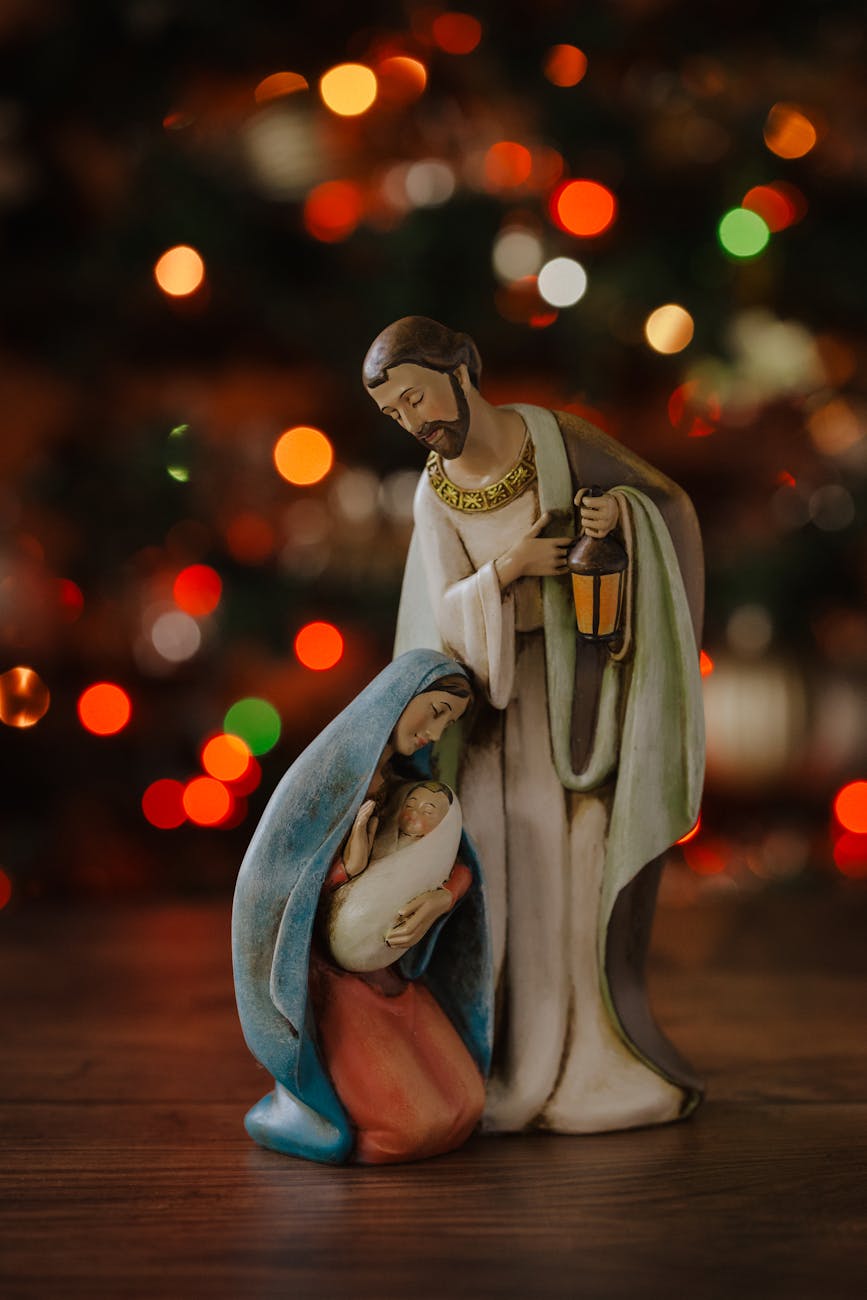
Showing Up When You Can’t Take Control

Sermon for the fourth Sunday of Advent, Year A.

The text is Matthew 1:18-25.

When my wife and I were in seminary, there was this Chinese restaurant that we liked to eat at. And at this restaurant, there was this spicy peanut noodle soup that I absolutely adored. But of course, we couldn’t eat there all the time because we were a couple of broke seminary students. So I decided, I’m going to try to figure out how to make this at home.

So I looked up some recipes, bought some ingredients, and decided I was just going to try and wing it. We had the noodles and the vegetables, of course. But the real kicker was chili oil, milk, and peanut butter. That’s how you got that nice sauce.

So, I was putting it all together and I thought to myself, “The peanut flavor in that soup was pretty strong, and this doesn’t seem like a lot of peanut butter. I better add some more to be safe.” So I did.

But what I ended up with was not so much soup as soggy clumps of peanut butter laced with noodles. And of course, it was completely inedible.

I got myself in over my head. And I learned that day that enthusiasm cannot make up for the fact that I have no idea what I’m doing.

It’s funny when the stakes are low.
It’s harder when they’re not.

Sometimes in life, we get in over our heads with something that really matters, and still, we have no idea what we’re doing. We care, but we’re clueless.

Most painful of all are those times when we get in over our heads with something that’s happening to someone we love, and we have no control over the outcome. We want to step in, help out, take charge, and fix it. We figure if we’re smart enough, committed enough—if we just love them enough—we can manage the outcome and stop the situation from getting messy.

But real life doesn’t work that way. Other people’s lives are not problems to be solved, no matter how much we love them. We can’t control who they are, what they go through, or how their story ends. It’s their life. They have to live it—even if we’re pretty sure we could do a better job living it for them.

All we can really do is show up and stand with them while they go through it. And that gap—that gaping chasm between love and control—is one of the most uncomfortable places a human being can stand.

And it’s exactly where St. Joseph is standing in today’s Gospel.

The story begins with our buddy Joe finding out that his fiancée, Mary, is pregnant. And for reasons that were probably explained to you in biology class, Joe is pretty sure that he is not the father. So, what’s a guy supposed to do in a situation like that?

The text of Scripture tells us that Joseph was a righteous man. And that’s important. He’s not reckless, cruel, or indifferent. He’s just a guy trying to do the right thing in a situation that he didn’t choose and doesn’t understand.

He’s caught between the competing goods of compassion and law, love and responsibility, mercy and obligation. He’s hit the limit of what he can manage. And it’s there, in the stunned silence of that moment, that God finally gives him the answer he’s looking for.

It’s not a full explanation or a long-term strategy, or even a promise that everything’s going to work out okay. What it is is something much quieter and more grounding.

The first thing Joe hears is his name: “Joseph, son of David.” Before he’s told what to do, he’s reminded who he is. Identity before instruction.

Joe is reminded that he’s not just some working-class bumpkin. He’s the descendant of kings. In modern language, we might render “Joseph, son of David” as “Joe Davidson.” And we can imagine his dad saying to him, “Hey, Joe. Buck up there, kiddo. I know you’ll figure this out, because you’re no chump. You’re a Davidson. And I believe in you.”

We all need to hear that sometimes.

The second thing the angel does for Joe is name what he’s feeling. The angel says, “Do not be afraid to take Mary as your wife.” And that’s important too.

So often, in the midst of a crisis, it’s easy to get caught up in what’s happening on the outside and forget to pay attention to what’s happening on the inside. The problem is, when we do that, we’re still being controlled by our emotions—it’s just happening unconsciously. So we’re just reacting.

The better way is to pause, take a breath, and pay attention to what’s happening inside, so we can choose to respond from our deepest morals and values rather than just reacting emotionally. We have to be aware of our emotions before we can do that.

And that’s what the angel does for Joseph. He’s not shaming it. He’s just naming it. “Joe, you’re afraid. Anybody would be in your shoes. But now that you know that, you don’t have to let it control you.”

Fear is not failure. It’s just a part of life. But if you can stay aware of it, Joe, you can stay awake and stay present with yourself and with Mary, because she needs you right now. She doesn’t need you to fix it. She needs you to show up and listen and stay engaged with her while this important thing that God is doing is still working itself out in her life.

Joe, that’s your job. That’s your role in all this. Don’t try to manage the mystery. Just stay present to it. Because what’s coming to birth through her is nothing less than Emmanuel, which is Hebrew for “God is with us.”

And that’s true. God is with us—here and now. Not after everything makes sense. Not after the crisis has passed. Not after the fear goes away, but right here and right now. In the mess. In the uncertainty.

Later on, when Joe woke up from the dream where all this happened, he woke up to a world where nothing had changed—and yet, everything had changed. The future was still unclear. The risk was still real. And poor old Joe still didn’t have the answer to the big questions.

But what he did have was the next step. The choice to relinquish control over the story and just show up in it instead.

And that kind of faithfulness is not the kind of thing you can learn overnight. It takes a lifetime.

For me personally, the place where I’ve had to learn that lesson over and over again is with my family, and especially my kids. They say that parenting doesn’t come with an instruction manual, and boy, they’re right.

Just when I think I’ve got one stage of my kids’ lives figured out, they go ahead and move on to the next one, where once again I find out that I have no idea what I’m doing.

The first time it hit me, I was standing in a hospital parking lot the day after my first child was born, and my task was to install a car seat for the first time. It hit me that I was now responsible for the life of another human being, and I was in way over my head.

I understand when people say they don’t feel ready to have kids, because the truth is, you’re never ready. You just take it as it comes and do the best you can. So I wedged my knee into that hard plastic, yanked the seatbelt through the loops, and did what I guess was an okay job—because we made it home from the hospital in one piece.

It was the first time, but certainly not the last time, that I felt that sense of panic.

As time went on and the kids grew up, we dealt with new challenges as they came to us—homework, friendships, drama, dating, breakups. Each stage of life offered something new that my wife and I were not prepared for. Our responsibility kept increasing, and our certainty never quite caught up.

This week, that same child for whom I installed the car seat told us that what he wants to do over his Christmas break is take a day trip to Chicago by himself. He showed us his plan of where he wants to go and what he wants to do. He’s got all the train schedules and the phone numbers. He’s ready, but his mother and I are not. And yet, we are taking that leap of faith anyway.

What faithfulness often looks like in real time is not confidence or control, but the choice to stand alongside a life that is unfolding at its own pace and in its own way. It takes courage. And I’ll let you know how it goes, because I don’t know yet.

Earlier this week, many of us read about another act of courage and faithfulness that took place during the massacre at Bondi Beach, Australia, where several of our Jewish neighbors had gathered to celebrate the first night of Hanukkah. In the midst of the carnage, a Muslim man named Ahmed al-Ahmed, “in the name of conscience and humanity,” ran toward the shooter and wrestled the gun away from him, taking five bullets in the process.

He did it to protect people of a different faith and culture from his own—people he didn’t even know. And in so doing, Ahmed al-Ahmed demonstrated to the rest of us that the faith of Joseph is still alive in the world today: the courage not of control, but of presence; the courage to step toward life even when the outcome is unclear.

That kind of courage is real, and it is still available to us today.

Kindred in Christ, there are moments in life when all of us are asked to stand alongside people we love in situations we cannot control.

Where is that happening for you today?

How are you being asked to protect without possessing, to care without controlling?

Where might faithfulness look less like fixing and more like staying?

Joseph shows us how faithfulness sometimes means showing up when walking away would be much easier and much safer. Joseph shows us how courage sometimes means staying engaged when we cannot manage the outcome of events.

That is the courage and the faith that St. Joseph holds before us in today’s Gospel.

May we also have the grace to recognize that courage when it is asked of us, trusting that God is with us even when the way forward is not yet clear.

Amen?

Seeing With the Eyes of the Heart

Morpheus, a character from ‘The Matrix’ who introduces people to “the real world” by inviting them take a red pill. “If you take the red pill,” he says, “you stay in Wonderland and I show you just how deep the rabbit hole goes.”

Genesis 50:15-21

Click here to listen to this sermon at fpcboonville.org

Excerpt from God Has A Dream

Dear Child of God, I am sorry to say that suffering is not optional.  It seems to be part and parcel of the human condition, but suffering can either embitter or ennoble.  Our suffering can become a spirituality of transformation when we understand that we have a role in God’s transfiguration of the world.  And if we are to be true partners with God, we must learn to see with the eyes of God—that is, to see with the eyes of the heart and not just the eyes of the head.  The eyes of the heart are not concerned with appearances but essences, as we cultivate these eyes we are able to learn from our suffering and to see the world with more loving, forgiving, humble, generous eyes.

I have to confess that I really get a kick out of those movies and TV shows whose plots are built around the premise that the everyday “normal” world we all inhabit is a hollow fantasy and the “real” world is way more intense and exciting than most people can imagine.  I went to college in the late 90s and the movie that most exemplifies this idea for people my age is The Matrix, starring Keanu Reeves.  In this movie, the “normal” world turns out to be a computer simulation used by evil robots who are trying to control the minds of the human race.  The main character, a regular guy with a boring job in the beginning, turns out to be a hero with super-powers who is destined to save humanity from the robots.

Another example is the TV show Weeds.  This show takes place in sunny, suburban California, where a soccer mom named Nancy is trying to make ends meet for herself and two kids.  But the deep, dark secret is that Nancy is actually selling marijuana.  The show follows Nancy as her life drifts farther and farther away from the world of PTA meetings and white picket fences and into the criminal underworld of gangsters and drug dealers.

What all of these movies and shows have in common is the idea that the “real” world is somehow darker and seedier than the “normal” world.  Wesley Snipe says it like this in the movie Blade: “You better wake up. The world you live in is just a sugar-coated topping! There is another world beneath it – the real world. And if you wanna survive it, you better learn to pull the trigger!”

Sounds pretty intense, doesn’t it?

I think these stories tend appeal to people because they reflect, in a metaphorical way, the experience of disillusionment that everyone goes through in the process of growing up.  When we were young, our parents tried to shelter us from the harsh realities of life.  We do the same for our kids and grandkids.  Are there any good parents who don’t worry about the amount of gratuitous sex and violence their kids see on TV?  I doubt it.  We instinctively want to protect our kids from being exposed to those realities too soon, even though we all know our kids will eventually see them anyway, in spite of our best efforts.

So, why do we try to shield them?  Why, instead, do we bring them to church and enroll them in Sunday school where they can learn the stories of the Bible and the basic beliefs and values of our faith?

There are many out there who argue that we are simply trying to delay the inevitable.  They would say that we are trying to keep our kids locked up in a fantasy world that’s “just a sugar-coated topping” in the words of Wesley Snipe.  They would say that we parents are pining for our lost innocence and therefore trying to prevent that loss from happening to our kids.  Afraid of reality, they say, we try to keep ourselves and our children imprisoned in a fantasy world where everything is fine and everyone is happy all the time.

Religion, according to these folks, is the ultimate enforcer of the fantasy world.  Karl Marx, the philosopher who founded the idea of Communism, called religion “the opiate of the masses.”  Faith in God, he said, was part of the fantasy world.  The real world, according to Marx, was a struggle to the death between the haves and the have-nots.  Religion, he said, was one of the tools that the haves used to keep the have-nots in line.  Similarly, the philosopher Friedrich Nietzsche, who famously declared that “God is dead,” considered virtues like compassion and humility to be part of the morality of the weak.  According to Nietzsche’s thinking, might makes right.  The only real winner is the superman who rises above the masses and imposes his will upon his fellow human beings.  Power, according to Nietzsche, is the only real morality.  It should come as no surprise then, that Nietzsche’s number one fan in the twentieth century was a man named Adolf Hitler.  Nazism was basically just Nietzsche’s philosophy in practice.

Both Marx and Nietzsche (the founders of Communism and Nazism, respectively), as materialist philosophers with a cynical edge, believed they had found the real world beneath the surface of everyday “normal” reality.  Each one thought he possessed the secret knowledge that held the key to history.  And you know what?  They were right… to a point.

They were right in observing that the happy world of easy answers, black & white morality, and “happily ever after” fairy tale endings is ultimately a fantasy constructed by people who want to shield themselves and their kids from the harsh realities of real life.  They were right in observing that many people use religion as a means of enforcing belief in the fantasy, threatening hellfire and damnation to those who question or doubt the fantasy’s validity.  They were right in guessing that truly mature people are those who can face the darkness of reality and see this complicated world for what it really is.  They were right in those things.

But they were also wrong.  They were wrong insofar as they believed that they had fully sounded the depths of reality.  They were wrong insofar as they presumed that this new level of consciousness they had uncovered was the final one.  They were wrong, not because they went too far in their quest for the truth, but because they didn’t go far enough.

As a person of faith, I believe there is another level of reality, of which Marx and Nietzsche were apparently unaware.  The existence of this level of reality can be neither proved nor disproved by philosophy.  Reason can lead us only to the point of possibility, at which point each of us must then freely choose for ourselves what we will accept as the more probable truth.

The world I see beneath the so-called “real” world of harsh realities is characterized by the presence of justice and compassion.  Hindus call this reality “Brahman.”  The ancient Greeks called it “Logos.”  Jews, Christians, and Muslims throughout history have traditionally identified this reality as personal and called it “Adonai,” “Allah,” or “God.”

God, so we say, is the one “from whom, through whom, and to whom” all things come.  It is in God that “we live, move, and have our being.”  For us, God is the mysterious “all in all” at the heart of the universe.  And what is the character of this ultimate reality?  We say that it is love.  “God is love,” as it says in the Bible.  How do we know this to be true?  We don’t, in an absolute sense.  We trust it to be true, however, because of what we have experienced in and through the person Jesus of Nazareth.

Looking at the life of Jesus, we experience something that Christians for millennia have chosen to accept as a revelation of God, the ultimate nature of reality.  Because of Jesus, we choose to believe that God is love.  We see it in the way that he drew our attention to flowers, birds, sunshine, and rain as evidence of God’s providential care.  We hear it in the parables he told about the Good Samaritan and the Prodigal Son.  We feel it in the way he touched the unclean lepers and welcomed outcast sinners to dine at his family table.  Above all, we encounter it in the way that he died: forgiving his enemies and entrusting his spirit to God’s care.  Because of this, we say, “This is love.  This is ultimate reality.  This is what God is like.”  Because of this, the cross of Christ has become the central symbol of our faith.  And, because of this, we refuse to believe that death can have the final word over such love, so we celebrate Easter, the central holiday of our faith.  We tell stories of how, after Jesus’ death, some women came to his grave to pay their respects.  Upon their arrival, they found the tomb empty and the stone rolled away.  Then an angel suddenly appeared and asked them, “Why do you look for the living among the dead?  He is not here.  He is risen.”

Can we prove beyond a shadow of a doubt that these things actually happened?  No.  But we believe them to be true because the love we see in Jesus leads us to believe that “love is strong as death” and is the creative power that gave birth to the universe.  The belief that “God is love” is the ultimate truth that “was from the beginning, that we have heard, that we have seen with our eyes, that we have looked at and touched with our hands” in the person of Jesus.  We can’t prove any of this.  The truth of it can’t be forced on anyone.  It must be freely chosen.

We are free to choose whether we will confine Jesus and his message of love to the annals of history or see him as our living window into the ultimate nature of reality.  This is what Desmond Tutu means when he talks to us about “seeing with the eyes of the heart” in this week’s chapter of God Has a Dream.

This new way of seeing, Tutu says, changes things.  It changes the way we look at Jesus, the way we look at others, the way we look at ourselves, and the way we look at the world.  Archbishop Tutu says:

Many people ask me what I have learned from all of the experiences in my life, and I say unhesitatingly: People are wonderful.  It is true.  People really are wonderful.  This does not mean that people cannot be awful and do real evil.  They can.  Yet as you begin to see with the eyes of God, you start to realize that people’s anger and hatred and cruelty come from their own pain and suffering.  As we begin to see their words and behavior as simply the acting out of their suffering, we can have compassion for them.  We no longer feel attacked by them, and we can begin to see the light of God shining in them.  And when we begin to look for the light of God in people, an incredible thing happens.  We find it more and more in people—all people.

There is another story in the Bible of a person who was able to look past his own disillusionment and “see with the eyes of the heart.”  I’m talking about the story of Joseph, from the Old Testament book of Genesis.  Joseph, you may remember, was his father’s favorite son.  This fact made his brothers green with envy to the point where they faked his death and sold him into slavery.  Later on, Joseph was falsely accused of rape by his boss’ wife and ten thrown into prison to rot.  Much later, after a few providential run-ins with royal officials, Joseph was freed from prison and appointed to what we might call the Vice Presidency of Egypt.  It was at this point in the story, in the midst of a severe famine, that Joseph’s brothers show up again, this time groveling and begging for food, not realizing who they were talking to.  This would have been the perfect opportunity for revenge.  No one would have blamed him for holding a grudge, but that’s not what happened.  In this story, after telling his brothers who he was, Joseph wept with them and forgave them.  He said to them, “Even though you intended to do harm to me, God intended it for good”.

Joseph knew all about disillusionment.  His fairy tale dreams were shattered at an early age.  He was well aware that, beneath the world of his childhood dreams, reality was a lot more complicated.  However, unlike Marx, Nietzsche, and the producers of those movies I mentioned, Joseph never stopped searching for that presence of justice and compassion at the heart of the universe.  I think it’s pretty clear that he must have found, or at least glimpsed, what he was looking for.  Somehow, he was able to look past the darkness and into the light beyond.  This way of seeing with the eyes of the heart brought Joseph to the point where he was able to forgive those who had done such unforgivable things to him.  He was even able to see the hand of providence at work at work in his circumstances, saying, “Even though you intended to do harm to me, God intended it for good.”

Desmond Tutu tells us the story of another modern-day Joseph who was able to overcome injustice and let it shape him for the better.  He writes:

Nelson Mandela spent twenty-seven years in prison, eighteen of them on Robben Island breaking rocks into little rocks, a totally senseless task.  The unrelenting brightness of the light reflected off the white stone damaged his eyes so that now when you have your picture taken with him, you will be asked not to use a flash.  Many people say, “What a waste!  Wouldn’t it have been better if Nelson Mandela had come out earlier?  Look at all the things he would have accomplished.”

Those ghastly, suffering-filled twenty-seven years actually were not a waste.  It may seem so in a sense, but when Nelson Mandela went to jail he was angry.  He was a young man who was understandably very upset at the miscarriage of justice in South Africa.  He and his colleagues were being sentenced because they were standing up for what seemed so obvious.  They were demanding the rights that in other countries were claimed to be inalienable.  At the time, he was very forthright and belligerent, as he should have been, leading the armed wing of the African National Congress, but he mellowed in jail.  He began to discover depths of resilience and spiritual attributes that he would not have known he had.  And in particular I think he learned to appreciate the foibles and weaknesses of others and to be able to be gentle and compassionate toward others even in their awfulness.  So the suffering transformed him because he allowed it to ennoble him.  He could never have become the political and moral leader he became had it not been for the suffering he experienced on Robben Island.

All of us are bound to become disillusioned in the process of growing up.  That much is inevitable.  What is not inevitable is how we will respond to our disillusionment.  Will you halt your search for truth with those cynics who say “God is dead” and “might makes right”?  Or will you continue to follow the living Christ ever deeper into the heart of reality where you can experience firsthand the love of God giving birth to the universe?

My prayer is that we would all choose to see with the eyes of the heart, that we would all come to know this eternal love for ourselves, and that we would all be forever transformed by that experience.