Jesus Makes Things Complicated

One of my favorite pictures of the Rev. Sarah E. Schmidt-Lee

I’m about to take a huge risk by sharing one of my wife’s sermons with my friends in the blogosphere.  When it comes to preaching, Rev. Sarah Schmidt-Lee blows me out of the water.  This is the woman who made me want to be a preacher.  During our dating and newlywed years, her sermons shaped my spirituality at a very deep level.  So I’m excited to share one of them with you today.  This was preached yesterday (10/23/2011) at Westernville Presbyterian Church.  The text is Matthew 22:34-46.

Have you heard the story about the pastor who asks a group of kids a question during the kids’ conversation: “what has a furry tail, lives in trees and eats nuts.” One of the kids raises his hand and says, “It sounds like a squirrel, but I know the answer is Jesus.” It’s a joke that always makes me cringe a little bit, because it feels a little too close to home—I can’t count the number of times I’ve been in a Sunday School class, either as a child or as a teacher, when I know the answer is supposed to be Jesus, or God, or maybe church or the Bible. It is so tempting to reduce our faith into a series of right answers.


The Pharisees and Sadducees who are interacting with Jesus throughout this section of Matthew seem to approach their faith in a way that assumes there are right answers. Faith or religion seems to be a puzzle and if they have all the right pieces, they can generate the right answers and teach those to people to make them into right—or righteous people.


Or, in the case of these interactions with Jesus, test him to find out if he has the right answers, and hopefully expose that he is wrong.

But Jesus refuses to play the game. He doesn’t see faith and tradition as a puzzle with one right answer. He sees it as open to interpretation—complex and mysterious and hard to pin-down. Instead of giving the “right” answer or “the wrong” answer, Jesus punches holes in all those boxes and challenges these religious leaders to ask better questions.


Last week we read how the Pharisees confronted Jesus with a question about taxes designed to force him into one political camp or another—to test him. After that, the Sadducees confront him with a question about resurrection—a kind of rhetorical question meant to show how illogical it is to believe in the resurrection, but Jesus pokes holes in their logic, leaving them dumbfounded. That’s when the Pharisees come in with their lawyer—the pull out the big guns.


Now, Jesus probably gave them exactly the answer they were hoping he would—it would have been fairly common for people in those days to consider the she’ma—Love the Lord your God with all your heart, soul and strength—the greatest commandment. And if there were any controversy, loving your neighbor as yourself would be the next contender. At first, it may have seemed that Jesus fell straight into their trap—giving a simple answer that they considered the wrong answer. See, it’s likely that this was a trick question to begin with—no law should be more important, or greater than any of the others, because they all come from God—that would be the right answer.


But Jesus seems to anticipate the trick, because after naming the two greatest commandments, he explains why they are the greatest—on these hang all the law and the prophets. Jesus refuses to fall into their trap—none of the other laws are less important, but they depend on these two—these two form the base or the trunk of the tree on which all the other laws hang like fruit. Not the right answer, but not the wrong answer, either, Jesus succeeds again and again at complicating the questions, reframing them.


And now, after this series of interrogations, Jesus turns the table, and he initiates a question: Whose descendant is the Messiah? The Pharisees probably rolled their eyes. Really? Everyone knows that—he is David’s descendant. But Jesus isn’t done. Okaaaay, he continues, if so, why does David refer to the Messiah as Lord—a title reserved for fathers and elders? Shouldn’t it be the other way around? If David is the Messiah’s ancestor, then shouldn’t the Messiah call David, Lord and not the other way around?


Hmmm. The Pharisees don’t have an answer for that. They leave in an embarrassed silence, and never muster up the guts to confront Jesus with questions again. Instead, we know, they plot to have him killed, because Jesus makes things complicated and mysterious, when the Pharisees want clear cut answers.


We may not identify with the questions that are getting tossed around in these confrontations—questions about resurrection, Romans taxes, and Messianic lineage are not particularly hot-button issues in 21st century North America, but the dynamic of the interaction is all too familiar. Just like the Pharisees and Sadducees, 21st century Christians still like clear cut answers, don’t we? We still want faith to boil down to right answers—clear, simple truths that we can teach to our children and use as a litmus test to determine who is right and who is wrong—or at least, who is with us and who is against us.


One of the supposedly clear-cut questions that is used to draw dividing lines in churches and denominations all over the country is the question: What does the Bible teach about same-sex relationships?


I’ll admit that I grew up thinking this question had a clear answer, but then Jesus threw a wrench in things. Through relationships with people God brought into my life, and through watching the ministry of people I grew up thinking shouldn’t be pastors, I began to read the Bible with different questions in mind. I started confronting questions like—why is the church fighting over this issue, and hurting lots of people who are already hurting, when Jesus never talks about it at all? Why aren’t we talking about the things Jesus really did spend most of his time talking about, like how we use our money—how we share our resources—how we treat the poor, outcast, and misunderstood?


And speaking of the outcast and misunderstood—didn’t Jesus spent his time hanging out with people who were kicked out of the religious life of his community—welcoming people who were considered unclean or immoral, because scripture said so? And didn’t Jesus treat those people with dignity and compassion and love?


One of the big eye-openers for me came as Barrett started a mid-week Bible study and communion service in Utica. His goal was to make it a welcoming place for people who did not feel comfortable going to a typical church on Sunday morning. He was really expecting to attract homeless people. We knew from work in Vancouver that a lot of homeless and near-homeless people are intimidated to walk into a church on a Sunday morning because they don’t feel like they can dress appropriately, or they know that they smell bad, or because when they ask for help they are usually asked to leave. And sure enough, we have had some homeless folks involved in the community over the three years we’ve been meeting.


But what neither of us could anticipate was the number of gay and lesbian folks who started showing up—every single one of them with a story of being wounded by a church—stories of being told implicitly, and sometimes explicitly that they didn’t belong at church. And every single one of them has come, longing to be a part of a community of faith—to find a place to belong—a place where they could talk about their experience of God, their love for Jesus, their search for spiritual truth. If Jesus welcomed the outcasts, the people kicked out of the synagogues, then shouldn’t our churches figure out how to do the same? And what does that look like?


These are uncomfortable questions, aren’t they? Jesus makes things more complicated—when we want to boil faith down to clear-cut answers, universal truths and straight-forward moral imperatives, Jesus throws a wrench in the well-oiled machine of our religious institutions and reminds us that faith is about knowing and loving and trusting God, and God is a mystery. We don’t trust in our answers, we trust in the mystery—the huge, complex, unfathomable, frightening mystery of God. Being a Christian is not about having the right answers—it is about loving God and loving neighbor. When we learn to do that, we might even learn to love the mystery—to delight in asking better and better questions—questions that lead us deeper into the mystery of God’s love, rather than simply settling for easy answers.


An Open Letter From Desmond Tutu

This is an open letter from Archbishop Emeritus Desmond Tutu to the Presbyterian Church (USA).

Reblogged from Derrick McQueen at Union in Dialogue.

Dear Brother in Christ,

I am writing you with the request that you share these thoughts with my brothers and sisters in the Presbyterian Church (U.S.A.):

It is incumbent upon all of God’s children to speak out against injustice. It is sometimes equally important to speak in solidarity when justice has been done. For that reason I am writing to affirm my belief that in making room in your constitution for gay and lesbian Christians to be ordained as church leaders, you have accomplished an act of justice.

I realize that among your ecumenical partners, some voices are claiming that you have done the wrong thing, and I know that you rightly value your relationship with Christians in other parts of the world. Sadly, it is not always popular to do justice, but it is always right. People will say that the ones you are now willing to ordain are sinners. I have come to believe, through the reality shared with me by my scientist and medical friends, and confirmed to me by many who are gay, that being gay is not a choice. Like skin color or left-handedness, sexual orientation is just another feature of our diversity as a human family. How wonderful that God has made us with so much diversity, yet all in God’s image! Salvation means being called out of our narrow bonds into a broad place of welcome to all.

You are undoubtedly aware that in some countries the church has been complicit in the legal persecution of lesbians and gays. Individuals are being arrested and jailed simply because they are different in one respect from the majority. By making it possible for those in same-gender relationships to be ordained as pastors, preachers, elders, and deacons, you are being a witness to your ecumenical partners that you believe in the wideness of God’s merciful love.

For freedom Christ has set us free. In Christ we are not bound by old, narrow prejudice, but free to embrace the full humanity of our brothers and sisters in all our glorious differences. May God bless you as you live into this reality, and may you know that there are many Christians in the world who continue to stand by your side.

God bless you.

Archbishop Emeritus Desmond Tutu (Cape Town, South Africa)

(Just for fun, I’ll add this video -Barrett)

Sanity Within Disagreement

I’d like to share this sound bite from a fellow Christian with whom I deeply disagree on the issue of LGBT equality in church.  Tony Campolo calls himself a “conservative”, which I guess makes me a “liberal” (whatever that means).

The bottom line is that I believe a loving and committed relationship between two people of the same gender is blessed by God and should be supported by the church.  Tony does not agree with me on this.  He believes that “same-sex erotic behavior” is inherently inconsistent with Christian morality.

However, in spite of our disagreement, I offer this clip from an interview with Tony because I so deeply respect his generosity of heart and mind.  I also appreciate his willingness to leave room in church and society for those who see things differently than he does.

It’s worth noting that he also leaves room for disagreement in his own home and heart: Peggy, his wife of over 50 years, is an active and outspoken advocate for LGBT equality in churches.  The two of them debate publicly on the issue and still manage to live together.  I could learn something from them…

I offer this video to my LGBT friends and fellow “liberal” Christians as living proof that not all “conservative” evangelicals and catholics are ignorant bigots.  Many of them (like Tony Campolo) are willing to speak out and fight for civil rights.

I offer this video to those on the “conservative” end of the spectrum as living proof that having an open heart and open mind toward others does not necessarily entail the sacrifice of one’s personal convictions.

Tony himself said it best in the video:

“I don’t care where you are on the theological spectrum or what your attitudes are on this issue.  When we generate fear and hatred of a group, I think we need to take a good look at ourselves.”

This is what respect in the midst of disagreement looks like.

Thoreau and Pride

H. D. Thoreau

This past Sunday afternoon, I had the honor of preaching at the interfaith worship service for PrideFest in Utica.  My chosen text was a passage from Henry David Thoreau’s famous book, Walden:

We might try our lives by a thousand simple tests; as, for instance, that the same sun which ripens my beans illumines at once a system of earths like ours. If I had remembered this it would have prevented some mistakes. This was not the light in which I hoed them. The stars are the apexes of what wonderful triangles! What distant and different beings in the various mansions of the universe are contemplating the same one at the same moment! Nature and human life are as various as our several constitutions. Who shall say what prospect life offers to another? Could a greater miracle take place than for us to look through each other’s eyes for an instant? We should live in all the ages of the world in an hour; ay, in all the worlds of the ages. History, Poetry, Mythology! — I know of no reading of another’s experience so startling and informing as this would be.

I love Thoreau’s question, “Could a greater miracle take place than for us to look through each other’s eyes for an instant?”  For me, that question sheds light on our culture’s assumption that “truth” is primarily propositional.  We think it can be found in books.

As a book-lover, I fall particularly prone to this assumption!

Because of this, many folks who are active in working for LGBT equality tend to focus their efforts on establishing adequate education and legislation for equal rights in our public institutions.  To be sure, these are important.  We need to be putting time and effort into education and legislation.  Equality will not come without them.

However, I don’t see either education or legislation as the primary catalyst for social change.  For me, the deciding factor is relationships.  It was my close and personal encounters with LGBT friends, roommates, pastors, and colleagues that opened my mind and heart for the first time.  Only after that did I go back and reread the pages of the Bible with a new set of eyes.  Only then did I make phone calls, write letters, speak out to the media, and march with a sign outside my senator’s office.  Before education and legislation, there was relationship.

It began with people who cared about me enough to talk, listen, wait, forgive, and ultimately love me into a new way of thinking.  It was these relationships that led me to experience the miracle of “look[ing] through [an]other’s eyes for an instant”.

These relationships have carried me thus far and I believe they have the power to carry us all forward.  Let’s make every effort to “look through each other’s eyes for an instant”.  Let’s find a friend there.  Ultimately, let’s find the face of God there.

How You Say It

Greetings all!

This has been an amazing few months in my life.  In May, the Presbyterian Church (USA) amended their constitution to allow for the ordination of LGBT deacons, elders, and pastors.  Then, last week, New York became the sixth US state to legalize same-sex marriage.  My wife and I participated in demonstrations both inside and outside our state capitol building.

I also had the opportunity to speak on the local news about the upcoming vote in the senate.

Here is the link to that conversation.

On the Sunday after the vote passed, the same news station surprised us by showing up with cameras in hand at our morning worship service.

Click here to watch the video of the segment they did on our church.

The responses have been myriad and diverse.  Here are some words I would use to describe the responses:

Thankful
Condescending
Cruel
Honest
Self-righteous
Pedantic
Supportive
Confused
Curious
Reaching out
Loving
Combative
Arrogant
Hard-hearted
Compassionate
Hateful
Ignorant

Look carefully at this list.  It would be a mistake to assume that all the “positive” adjectives refer to those who agree with me and all the “negative” adjectives apply to those who think differently.  As a matter of fact, the list is mixed for a reason.  I could use several of these words to describe people on both sides of “this issue” (although I am loathe to call it that).

What speaks the most about us in times like these is how we respond, and not just the content of our response.  I have felt such compassionate support from those who passionately disagree with me.  I have also cringed at the hard-hearted self-righteousness of those who hold views similar to my own.

I will continue to hold onto the views I express in these articles because I believe them to be good and true.  I honestly believe that I am following (however imperfectly) the lead of the Holy Spirit and the message of the Bible as I take the course I have chosen.  I know that not all of you will agree with me.  I won’t ask you to change your mind unless you want to.  I will not enter into a Bible-quoting argument with you unless you truly want to understand how someone can read the Bible differently than you do.

I encourage you all, wherever you stand, to look at the character of your response to others.  Is it in keeping with the Spirit of Christ?  In your words and deeds, are you loving your neighbor as yourself?

What you say does not say so much as how you say it.

It Gets Better

Today’s Sermon from First Presbyterian, Boonville.  We celebrated Ascension Sunday and Youth Sunday.  Today also happens to be More Light Sunday for some churches in the PC(USA).  Visit www.mlp.org to find out more.

My text is Ephesians 1:15-23.

Billy Lucas, Cody Barker, Seth Walsh, Tyler Clementi, Asher Brown, Harrison Chase Brown, Raymond Chase, Felix Sacco, and Caleb Nolt.  These nine names belong to nine teenagers who took their own lives during the month of September 2010.  Nine youths in a single month.  What’s even more shocking is that each one of these nine people were driven to suicide by the same thing: each of them was being bullied and tormented by classmates, roommates, and peers because of their sexual orientation.

This rash of suicides last fall received a lot of attention in the media.  Many people were wondering what caused such a sudden spike in such tragedy.  Personally, I wonder if it was happening around us all along, but we just weren’t paying attention until then.  Whatever the case, the events of last September caught the attention of a journalist named Dan Savage who decided to do something about it.  He launched a video campaign on YouTube to reach out toward other teenagers who might be considering suicide for the same reason.

Dan wanted to send a message of hope to these kids.  He wanted them to see videos of adults who persevered through the bullying and went on to find happiness, health, success, and love in their lives.  The message of the project is that, no matter how hard life might seem right now, it gets better.  In fact, that’s what the project is called: ‘It Gets Better’.

‘It Gets Better’ has been a huge success.  200 volunteers had uploaded videos by the end of the first week, telling their stories and offering their lives as an example of hope.  By the end of the second week, they had already reached the 650 video limit imposed by YouTube, so they had to open their own website.  Since then, over 10,000 videos have been produced and submitted.

Most of the videos are posted by regular people who have firsthand experience with being bullied for their orientation; others come from people who simply want to voice support as allies.  People from all walks of life have contributed: students, artists, police officers, soldiers, clergy (including the pastor of this church).  Pretty soon even community organizations and churches were jumping on board.  There are several famous household names who have volunteered as well: Katy Perry, Lady Gaga, Justin Bieber, the Boston Red Sox, Dane Cook, Tom Hanks, Neil Patrick Harris, Jennifer Love Hewitt, even the President of the United States contributed a video!

The message of ‘It Gets Better’ is all about hope, which is the same thing we’re talking about today, on Ascension Sunday.  The Ascension is not just a neat magic trick that Jesus did once.  It’s an event that has significance for us all.  Whenever we recite the Apostles’ or Nicene creeds together, we affirm that the resurrected Jesus “ascended into heaven and is seated at the right hand of the Father.”

In today’s epistle reading from the book of Ephesians, the author talks a lot about what the Ascension of Christ means for believers today.  It starts with a prayer.  The author prays that God will give people “a spirit of wisdom and revelation” so that, with “the eyes of [our] heart enlightened”, we might come to believe in the power of hope.

The author looks to Christ’s Ascension as the basis for that hope.  By virtue of the Ascension, Christ holds dominion “far above all rule and authority and power and dominion, and above every name that is named, not only in this age but also in the age to come.”  In other words, all of the powers-that-be in this world bow down to Christ as the Ruler of the Universe.  This would be incredible good news for Christians in the first century.

As many of us already know, Christians were hunted and killed during the first centuries of their existence.  The Roman Empire branded Christians as terrorists (because they refused to worship the emperor) and atheists (because they had no statues of gods).  It was a dangerous thing to “come out of the closet” as a Christian in those days because one could face the death penalty for doing so.  It seemed like the powerful Roman Empire was bound to eliminate this radical new Christian movement from the face of the earth.  The situation was utterly hopeless.

But the author of Ephesians has a different perspective on the matter.  All the guts and the glory of the Roman Empire was like a drop in the bucket.  As an international superpower, Rome was one of the “powers that be” in the world system of that day.  All “authority, power, and dominion” led back to Rome (and the house of Caesar).  But Ephesians sees Rome as just another pawn in God’s big chess-game of the universe.  According to Ephesians, the entire Roman Empire existed “under [Christ’s] feet.” Even the great Rome was accountable to a higher authority.

This means that Rome would not have the last laugh.  They could hunt Christians all day long (which they did), but they would be unable to bring a stop to the work of redemption that God completed in Christ.  The bad guys could not win.  The battle was already won.

The problem is that it didn’t look that way to the average person in the street.  For them, the Empire looked stronger than ever and was stepping up its ferocity in hunting believers.  Any logical analysis of the situation would lead a rational person to believe that the Christian church at that time was on its way out of existence and would amount to a footnote in some distant history book.

You and I, as people who live on this end of history, know full well that this didn’t happen.  In fact, it was the Roman Empire that faded away while the Christian Church has survived and thrived in almost every part of the world.  But how, we might ask, could the author of Ephesians be so sure that this would be the future of the Church?

The answer, of course, is that the author didn’t know for sure.  The power of hope is something that can’t be proved.  It has to be believed in.  So, when it comes to inspiring hope in these persecuted Christians, the author doesn’t construct a rational argument, but instead prays that “the eyes of [their] heart [would be] enlightened”.

That’s how hope works.  I have days sometimes when I feel really bitter and cynical about my life or the world.  What brings me out of that funk is usually some story or song that speaks to my heart more than my head.  There’s this inner voice that speaks without words from somewhere between the notes of the music.  When it happens, it feels like a hunch or a gut instinct.  If I were to try and put the voice into actual words, they would probably sound something like this: “It’s okay.  You’re going to be alright.  You’re not alone.”  Personally, I believe that’s the voice of God, speaking light into the darkness of my heart and inspiring hope.  I try to hold onto that feeling, even though I might not have a logical reason for believing in the power of hope.  I believe this is what it means in Ephesians when it says,

I pray that the God of our Lord Jesus Christ, the Father of glory, may give you a spirit of wisdom and revelation as you come to know him, 18so that, with the eyes of your heart enlightened, you may know what is the hope to which [God] has called you.

This kind of hope is what the contributors to the ‘It Gets Better’ project are trying to inspire in the hearts of bullied teenagers who might feel so frustrated with their circumstances that they’re considering suicide, which is really just a permanent solution to a temporary problem.  As they make these videos, they’re praying that maybe some teenager who already has one hand on that gun, that bottle of pills, or that rope might stumble across one of these videos online and sense the eyes of their heart being enlightened by the power of hope.  And maybe they’ll put down that gun, those pills, or that rope and decide to live.

“Hope” is what comes to my mind when I say that I believe in the risen Christ, who ascended to the right hand of God, “far above all rule and authority and power and dominion”.  To me it means that the power of hope inspired by Jesus is stronger than all the powers that be in this world.  Stronger than the forces of injustice and inequality.  Stronger than hate.  Stronger than the bullies.  Stronger than that voice inside your head that says, “You’re no good” and “Nobody loves you” and “Life isn’t worth living”.

I don’t know your circumstances this morning.  Maybe you too are being bullied because of your sexual orientation.  Maybe you’re facing a crisis in your job, family, or relationship.  Maybe the headlines of TV news are making you feel cynical about the future.  Maybe you’re even considering a permanent solution to a temporary problem.  The still, small voice of hope might just sound like a silly little hunch or whisper, but listen to it!  Believe in it!  That voice has the power to transform your world.  It’s the voice of the Creator God, speaking again into the darkness and chaos, saying, “Let there be light”, “I love you”, and “It gets better”.

This is a video of the choir at Immanuel Presbyterian Church performing with the Gay Men’s Chorus of Los Angeles for the ‘It Gets Better’ project:

This video is my humble contribution to ‘It Gets Better’:

The Harvest is Here

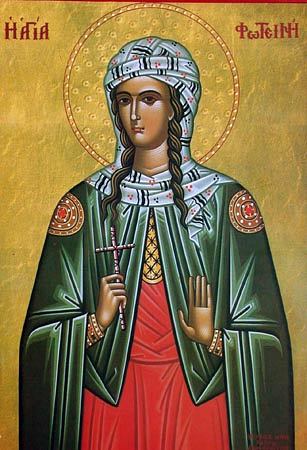
St. Photina, "The Enlightened One". Traditional name for the Samaritan woman at the well. Legend has it that she was martyred after spitting in Emperor Nero's face.

Today’s sermon from First Presbyterian, Boonville.

The text is John 4:5-42.

Over the past few decades a lot has been said and written on the topic of church growth in North America.  Most sources agree that there has been a tremendous decline in membership for older, mainline congregations like ours.  Many popular sources are selling the idea that the key to reversing this trend lies in imitating the worship style and the theological leanings of evangelical mega-churches.  However, I’m not convinced.

Here’s why: I heard about an Episcopal church in Colorado.  This was a small, traditional parish.  Their numbers were dwindling.  Almost all the members left in the pews were grandparents or great grandparents.  There was nothing about this parish that fit the popular model for church growth.  Closure seemed inevitable.

Several of these aging church members felt led to start a youth group.  They were praying for an opportunity to start one.  But even their priest was telling them not to hold their breath over it.  Their big opportunity came one day when that same priest was sitting in a local coffee shop.  He was wearing a clerical collar, which clearly identified him with his profession.

The priest looked up and suddenly, there was a teenager was standing in front of him.  This rough-looking young man was clad in leather and had piercings in every conceivable orifice.  “Hey.”  He said, “Are you one of those ministers who can do funerals without the body there?”  After taking a second to compose himself, the priest asked the teenager to sit down and talk.  As it turns out, he had a friend who had recently died of a drug overdose.  His family lived out of state and had shipped the body back east for burial.  None of his local friends had a chance to grieve their loss.  The priest said yes, their church could certainly have a memorial service for this young man.

The members of the church wanted to get involved too, but they were at a loss as to how to do it.  They had nothing in common with this group of hard-edged, punk rock teenagers.  When they prayed for a youth group, they were thinking of a cadre of nicely-dressed, well-behaved high school students who attended Bible studies and held bake sales.  What were they supposed to do with this motley crew?

After giving it some thought, they could think of only one natural way to relate to these youth: they were all grandparents.  Why not act like it?  On the day of the memorial service, they made their fellowship hall as warm and cozy as possible.  They made tea and hot chocolate.  They set out fresh-baked cookies on hand-crocheted doilies.  And when the youth arrived, everyone agreed to pretend they were their own grandkids.

Most of the youth stuck around for the reception.  Amid a sea of black leather and glinting lip rings, one could see an entire rainbow of artificial hair colors.  The event was such a success, they decided to invite the teenagers back at the same time next week.  To their surprise, most of them came back!  Week after week, the most unlikely relationships formed between these folks in their eighties and this scary-looking group of punk-rock teenagers.  They got the youth group they had been praying for, but it looked nothing like they expected!  Moreover, it bore no resemblance to the trendy programs that are supposed to attract youth to a congregation.

This kind of thing has happened before in Christian history.  In today’s gospel reading, we read about Jesus’ unconventional model for church growth in the most unlikely places.  It happened among a group of Samaritans.

This was the last place where Jesus’ disciples expected to find a warm welcome.  Samaritans and Jews shared common ethnic and religious roots, but the Samaritans were regarded as heretics and half-breeds.  No self-respecting Jew would be caught dead with a Samaritan in public.  Some Jews traveling from Galilee to Judea would go almost a hundred miles out of their way in order to avoid Samaritan territory.  It was bad enough that Jesus had decided to go through Samaria instead.  Did he have to talk to them as well?

As it turns out, these Samaritans gave this Jewish rabbi a warmer welcome than any synagogue.  Even in Jesus’ own hometown, they had tried to throw him off a cliff!  But these half-breed heretics had opened their doors and welcomed Jesus and the disciples with open arms.  When the members of the village heard Jesus speak, they all believed in him.  A church sprang up overnight in this Samaritan village.

What’s even more surprising is that the catalyst for this explosive church growth was not the local mayor or clergyperson, but the village pariah.  It was almost unthinkable that Jesus would even talk to her in the first place.  First of all, she was a Samaritan.  We already talked about the inborn hostility there.  Second, she was a woman.  Nice Jewish boys didn’t talk to women in public (not even their own wives).  Finally, she was even outcast from her own people.  The text tells us that she met Jesus by the well at noon.  In that world without air conditioning, it was ridiculous to go to a well at noon, when the sun was beating down.  Most people would go at sunrise or sunset, when the weather was cooler.  The village well is where people would gather to chat and gossip.  The only reason to go to the well at noon was if you didn’t want to bump into anyone else.

Later in the story, we learn a little more about this person.  We find out that she’d been married five times and was currently living with a man outside of wedlock. Even today, two millennia later, most people who read this story assume that she was a serial divorcee who hopped from relationship to relationship.  But here’s an important detail about ancient Semitic culture: women were not allowed to initiate a divorce.  A husband could divorce his wife for any reason (even if she burned his supper) but a wife had no rights.  She may have been abused and discarded by man after man until she landed in her current situation, where the man she was with didn’t even have the decency to make the relationship legitimate.  We don’t even know that this woman was divorced at all.  In a country with such a low life-expectancy, it’s entirely possible that she was simply widowed five times over.  It seems that she could have landed in her situation through no fault of her own.  Nevertheless, she was still considered “damaged goods” by her neighbors.  Her story would provide ample fuel for the local gossip engine.

Yet, in spite of all these barriers, Jesus chooses this woman to be the agent of transformation in her village.  He engages her in theological conversation.  He effectively ordains her as an evangelist to the village.  Through her, the entire village comes to faith in Christ and opens their arms in welcome to this band of strangers.  Jesus’ model for church growth makes use of the most unlikely people in the most unlikely places.  But, apparently, it works.

What did the disciples think of all this while it was happening?  Well, we read in the text that they were “astonished” at Jesus’ incessant boundary pushing.  It was bad enough that they had to go through Samaria at all, but then Jesus starts talking with this woman, and then they end up spending two days there: eating and sleeping with these untouchable, half-bred heretics!  If their old rabbis ever heard about this, they’d all be kicked out of the synagogue for sure!

Jesus interrupts their astonishment with an invitation.  He tells them it’s time to let go of their expectations and their pre-conceived notions about other people.  Jesus says, “Look around you.  You think the harvest is still a few months off, but I’m telling you that the time for the harvest is now!  So, get out your sickle!”  Jesus tells them it’s time for them to open their eyes and see what God is doing around them (even in this least-expected place).  He wants them to “enter into the labor”, to be part of what they see God doing here and now.  For Jesus, this is the key to effective church growth, not a bunch of fancy programs.  Jesus gets it.  The Samaritans got it.  The disciples were starting to get it.  The Episcopal church in Colorado got it.  What about us?

In spite of what popular sources say, I’m not ready to pronounce our church dead yet.  I think God still has a harvest for us here in Boonville.  It won’t look like the “good old days” all over again.  1955 has come and gone.  Likewise, it won’t look like these evangelical mega-churches.  That’s not who we are as a church or a community (besides, we don’t have the parking space).  It will involve letting go of our old expectations and pre-conceived notions.  The good news is that this is already happening.  You’re already doing it.  When you started your search for a new pastor over a year ago, who would have thought that you would be interested in calling an Episcopal priest with a pony tail?  But here we are!

What other “astonishing” surprises does God have in store for us?  Where is the harvest happening here and now in Boonville?  That’s the question we have to ask ourselves as a church.  I have a few of my own ideas about how we might answer that question.  I see this church as a haven for people who, for whatever reason, have been made to feel unwelcome at other churches in the North Country.

I’m thinking of people like intelligent skeptics who are interested in faith, but have a lot of honest questions about it.  Too many churches out there tell people to “shut up” and “get in line” with traditional doctrine.  I see this church as a place where people can ask their honest questions without fear of rejection.  Maybe we won’t even know the answers, but we can ask those questions together.

Likewise, I also see our church as the kind of place where people who are gay or lesbian can find a welcoming church home.  Too often, people in our society face exile from their churches, their families, and their homes when they “come out of the closet” (which means being honest and open about their attraction to people of the same gender).  Among youth, it’s one of the top causes of suicide and homelessness.  I believe that our church can be a place in the North Country where that doesn’t need to happen.

I envision this church as a haven where people can come, with all their doubts and their differences, and be welcomed as one of “us” rather than one of “them”.  I see this church as a place where people can come looking for belonging, and through that, find themselves believing.  This is the gospel harvest that Jesus has prepared for us.  Are we ready to “look around us” and “enter into the labor” of this harvest?  I think so.

Walking With God

This is the sermon I preached at last Tuesday’s Presbytery meeting.  The text is Micah 6:1-8.

Just yesterday, I was walking out of the cafeteria at Utica College when I bumped into Cristina, who is one of my students.  Cristina heads up an on-campus activist organization called UC Pride.  This week, Cristina and the others at UC Pride are organizing an event called “No Name-Calling Week”.  The purpose of this event is to raise awareness about bullying and the effect that abusive language can have on people.

Last autumn, a student at Rutgers named Tyler Clementi committed suicide after enduring brutal treatment from his fellow students because of his sexual orientation.  For a brief period of time, the media took notice of the fact that several other students around the country were committing suicide after receiving the same kind of torture from their classmates.

These events inspired Cristina to initiate “No Name-Calling Week”.  She made up a series of fliers with derogatory names like “Geek”, “Dork”, and “Stupid” written on them.  She hoped that these fliers would inspire others to think more carefully about the kind of language they use in everyday conversation.  I said to her, “It’s like you’re trying to teach the fish to notice the water.”

To her shock and dismay, Cristina discovered that people were ripping down her fliers, crumpling them up, and throwing them in trash cans.  When she replaced the original fliers with new ones containing the names of those who committed suicide last fall, these were torn down as well.  Cristina was disheartened, to say the least.  “How could people be so ignorant and immature?” she said.  I tried my best to comfort her.  “Your program is obviously having an effect,” I said, “otherwise, people wouldn’t feel so threatened that they would need to rip the fliers down just to get them out of sight.”

Cristina lives with a potent vision of the way this world could (and should) be.  She dreams of a society where people like Tyler Clementi would never be tormented to the point of suicide.  She longs for a world where all God’s people are treated with equal respect and decency.  At the same time, Cristina lives with an abiding pain, because this world is not as it should be.  People would rather shut her up than heed her message.  In this way, Cristina reminds me of the Hebrew prophet Micah.

Micah was a person who lived with a tremendous amount of tension in his soul.  He was a proud Israelite who celebrated the dignity of his heritage.  You might even call him a patriot.  In today’s reading from chapter 6, he recalls how God led Israel’s ancestors out of slavery in Egypt and protected them during their long journey across the desert.  He highlights particular moments when their survival was threatened by the evil King Balak and the corrupt prophet Balaam.  Whenever their enemies sought to curse the Hebrews, God would turn it into a blessing.

Like my student Cristina, Micah also held onto a powerful vision for the future of his people.  His description of this vision in chapter 4 is taken almost word for word from Isaiah chapter 2.  (If one of my students were to do what he did, I’d report them for plagiarism!)  Micah envisioned Jerusalem as an international center for education and spiritual renewal.  Fear and violence would be done away with as soldiers “beat their swords into plowshares”.

But this utopia felt like a long way off from the Jerusalem that Micah lived in during the 8th century BC.  In Micah’s world, we read that “the powerful dictate what they desire”.  Politicians and judges were sold to the highest bidder.  Powerful landowners foreclosed on houses and fields.  They declared war on the poor and defrauded working-class people of their inheritance.  So brutal was their treatment of their fellow human beings that Micah went so far as to call them “cannibals”.  All the while, people hid behind a façade of religious observance and false piety.

From Micah’s point of view, his society was on a collision course with itself.  Sooner or later, their hypocrisy would be exposed and their fragile house of cards would come crashing down around them.  The nation of Israel would undergo swift and drastic downsizing, and this time, there would be no divine bailout to protect them.

“Alright God,” the people said with checkbooks in hand, “What’s it gonna take?  Name your price!  You want calves?  Rams?  Oil?  Heck, I’ll even give you my firstborn child if it’ll get you off my back!”

And Micah said, “Wait a minute.  God isn’t interested in your pious posturing.  You know what God wants from you: Do justice, love kindness, and walk humbly with your God.”

We walk.  Walking is a dynamic thing.  There’s movement in it.  And the really funny thing about walking is that (if you’re doing it right) you inevitably end up in a different place than where you started from.  That kind of change is enough to make anyone uncomfortable.  But God doesn’t call us to stand still.  God doesn’t ask the people to adopt and orthodox doctrinal stance.  When Jesus called his first disciples, he didn’t say, “Go and stand over there”.  He said, “Come and follow me.”  No offense to the old Sunday school hymn, but we as Christians don’t “stand alone on the Word of God”.  We don’t stand at all… we walk.

We don’t walk alone, either.  According to Micah, we walk “with [our] God” and God walks with us.  This has been the case from the beginning.

Micah looks back at the events of Israel’s history and sees the hand of God leading them all the way.  I think the same is true of you and I.  If we could somehow find the courage to look at our life stories through the eyes of faith, we would see glimpses of that same hand leading us.  We come from God.  God is our Ground.

When Micah dreams ahead to this amazing vision of Jerusalem’s future, he’s not just regurgitating some nice words he plagiarized from Isaiah.  That vision does not ultimately belong to Micah or Isaiah.  The vision is God’s.  And God will see it through to the end.  As it was with them, so it is with us.  That’s why I have hope for my student Cristina.  Her struggle for equality is not in vain and I have faith that she will see justice established because the One who made her, sent her on this journey, and planted the dream in her heart is the One who will make the dream come true.  We come to God.  God is our Goal.

In the meantime, we walk through a world that has drifted so far from its divine Ground that the divine Goal seems unattainable.  Yet all is not lost.  We are still not alone, for the One who walks with us has promised to never leave us nor forsake us.  The Alpha and Omega who is both the Beginning and the End of our journey is also the One in whom we live, move, and have our being.  We come through God.  God is our Guide.

God is our Ground.  God is our Guide.  God is our Goal.

“From God and through God and to God are all things.  To God be the glory forever.  Amen.”  ~Romans 11

My Mind Was Changed

Below, I’ve posted a link to an interview with Rev. Dr. Arlo Duba, a seminary professor whose personal journey in relation to equality for LGBT Christians is remarkably similar to my own.

As a Christian who still considers himself to navigate (mostly) within the bounds of the evangelical and catholic faith, what I appreciate most about Duba is his grounding in biblical fidelity.

I hate the fact that polarization in our churches has led so many to the assumption that the relationship between LGBT equality and the Bible is “either/or”.  Too many on the extreme left dissect and ultimately dismiss the Scriptures as a unique and central source of revelation and enlightenment.  Too many on the extreme right refuse to look at the Scriptures with a new set of eyes.  They will not allow the Scriptures themselves to challenge long-standing theological and cultural assumptions.

If this argument is going to bear any fruit in our churches and in our denominations, it has to be a biblical argument.  If we allow our theological disagreement to deteriorate into a free-for-all over church property, then I believe we have all (on both sides) betrayed the Gospel of Christ and created a bloody spectacle worthy only of the Jerry Springer Show.

Those closest to me know how strongly I support the dual-cause of marriage and ordination equality for LGBT people in my church.  I think the relationship between LGBT equality and the Bible is “both/and”, not “either/or”.  I believe a biblical case can be made for our cause and I hope to call on others, especially my fellow pastors and biblical scholars, to join me in building it.

To those who work with me for LGBT equality in church and society: Let’s bring it back to the Bible, for it is there that we will find what we need to take our stand for the freedom of all God’s children.

To those who disagree with me on this issue: Let’s keep reading the Bible together.  Let’s read it as much as we can with as many different people as possible (including those who are different from or disagree with us).  Let’s let our sisters and brothers challenge our assumptions about the Scriptures.  Let’s let the Scriptures challenge our assumptions about our sisters and brothers.  We might not agree at the end of the day, but at least we will have sought the will of God together.  At least we will have (hopefully) grown in our love for God and our neighbors.  And that’s what God truly wants from all of us.

Wherever you stand, take a look at Arlo Duba’s words, posted at the link below.  There are seeds here that have the potential to grow into authentic and fruitful theological discourse.

Rev. Dr. Arlo Duba


My Mind Was Changed