
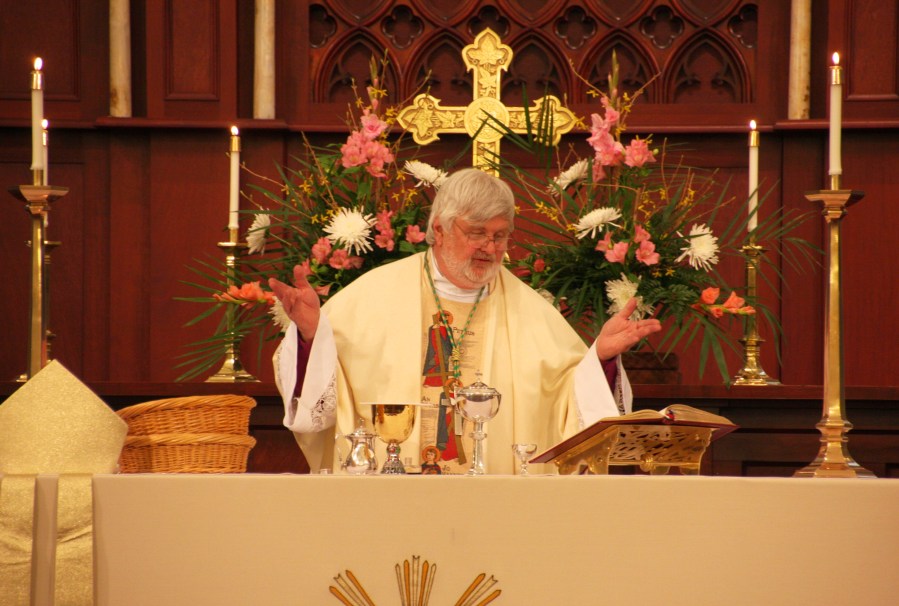
A couple of Sundays ago, I filled the pulpit for a friend in Coldwater, MI.
After church, I checked out a local barbecue joint and got to chatting with a lovely Evangelical couple in line with me. By the time we reached the register, we had become so friendly, the clerk thought we came together and rang us up as a single check. I decided to just roll with it and picked up the tab. They ended up inviting me to their table.
Knowing I had just come from a preaching gig, and seeing me cross myself before eating, the wife asked me how it is that I maintain a personal relationship with Jesus in the midst of worship that seemed so “religious.” I gave a response in the moment, but have continued to think about her question since then.
Here is my fleshed out response to my new friend, sent over Facebook:
One of the marks of a good question is when someone is still pondering it, weeks after it was asked. Such is the case with the question you asked over lunch in Coldwater, about my personal relationship with Christ in the Episcopal Church and its more formal, some might say “religious”, worship. Still thinking about that one. Bravo!
Continuing to formulate an answer:
As I tried to articulate on the spot, the worship I experience in the liturgy is no mere “going through the motions”. I have a personal relationship with Jesus Christ as my Lord and Savior. Bottom line. Full stop.
It is sadly true that such has not been the case for many in mainline denominations, Episcopal and otherwise, over the years. The temptation to simply “go through the motions” is ever present and one must be vigilant to guard against it. Equally dangerous is the temptation to snobbery that one form of worship is better or more pleasing to God than another. Christ was quite clear in his declaration that the Father is only interested in those who worship “in Spirit and in truth.”
Whether this takes place with a rock band or Gregorian chant is, at one level, irrelevant. Forms of worship are human creations. In their best moments, they are outward expressions of one’s deep relationship with God and vessels through which others can enter into a similar relationship.
My experience of the Church’s liturgy has been one such vessel for me. Furthermore, a careful reading of history, especially time-tested classics like the Rule of St. Benedict and the Book of Common Prayer, indicates that the liturgy was certainly born of sincere devotion and a desire to nurture others’ formation into the Imago Dei.
There are two staples of a healthy spiritual diet in our tradition: the Daily Office and the Eucharist.
The Daily Office is our version of what Evangelicals might call their “quiet time”. As the name indicates, it is meant to be practiced every day. Our current prayer book provides services for Morning, Noon, Evening, and Bedtime.
Its roots are in the monasteries, dating back to ancient times. Even today, at my favorite monastery in Three Rivers, the monks rise every day at 4am to pray and read Scripture. They repeat this pattern around the clock, seven times a day. Basically, the job of a monk or nun is to be a full-time intercessor. Our churches often employ full-time pastors for leadership, administration, preaching, worship, youth, and children… but why do we not encounter pastors whose whole ministry is prayer? Strip away the mystique surrounding monastic life and that is what you have: people who have given their whole lives to the work of prayer.
When practiced faithfully, the Daily Office causes us to step back from the hectic rhythm of life to remember that we are ever in God’s presence. Brother Lawrence (another famous monk) called this “the practice of the presence of God”.
The Offices contain prayers of Thanksgiving, Intercession, Confession, Adoration, and Self-offering. They contain copious readings of Scripture for study and reflection. They leave room for holy silence, which is so often lacking in our hectic world. In the service, we recite the Apostles’ Creed and the Lord’s Prayer as a way of calling us back to the center of Christian faith and spirituality.
Above all, the center of the Daily Office is the praying of Psalms. These ancient prayers were the first hymnal of the Church. They express every imaginable emotion. As prayers from Scripture, they are especially interesting because they are simultaneously God’s Word to us and our words to God. Reading them as one’s own prayers engages us in a holy conversation. If one is interested in exploring the power of liturgical worship, all one has to do is crack a Bible and read a Psalm as one’s own prayer.
The other thing is the Eucharist (a.k.a. Holy Communion or the Lord’s Supper). In our churches, we celebrate this mystery every Sunday. We can no more imagine a church service without Communion than Protestants can imagine a service without reading from the Bible… it just wouldn’t be church! Strip away the formality from the written prayers, and one can see a familiar pattern (I bet even the most casual church service follows something similar to this):
- -Welcoming the presence and power of the Holy Spirit
- -Praise and worship
- -Reading from the Bible
- -Hearing the Word explained in a sermon
- -Proclaiming our faith in Jesus Christ
- -Praying for the needs of the world
- -Confessing our need for God’s grace
- -Giving to support the work of the Church
And then comes the celebration of Communion itself. This is the high point of every service. For us, this is so much more than an occasional remembrance that Jesus died for us (although it certainly includes that). Think of it like an ‘altar call’:
- -The priest (pastor) recalls God’s creation of the world, humanity’s fall into sin, and Christ’s redemptive incarnation, death, and resurrection.
- -In response to this saving grace, we offer our whole lives to God’s service, along with the physical gifts of bread and wine.
- -The priest asks God to send the Holy Spirit upon this offering, to transform it (and us) into the Body of Christ (remember… you are what you eat).
- -Then we get up from our seats and walk down to the altar at the front of the church, with hands outstretched to say, “Yes, I want to receive Jesus Christ. I want to welcome him into my heart, my life, and even my body… so that I may become part of his Body in the world today.”
- -Then the priest pronounces God’s blessing and sends us out to be the hands and feet of Jesus in the world today: filled with the Holy Spirit, instructed by God’s Word, strengthened by prayer and worship, and fed by Christ.
- …and next Sunday, we do it all over again!
This is why I have come to love the worshipful liturgy of the Episcopal Church. This is home for me. Yes, I have to guard myself against “going through the motions”, but the same thing could be said of Evangelical churches where the same praise choruses are sung from week to week. Often, I find the words of the formal prayers helpful if I am feeling spiritually dry or empty. These ancient prayers carry me along, like floating down a river. Even when I am not strong enough to swim on my own (which is all the time), God is strong enough to bring me home. I think of it like the Good Shepherd who finds the lost sheep and carries it home on his shoulders. That’s me in worship.
Thanks for asking good questions and getting me thinking!
Christos anesti! (Christ is risen!)
Happy Easter!
Barrett

 Hopping Hadrian's Wall