
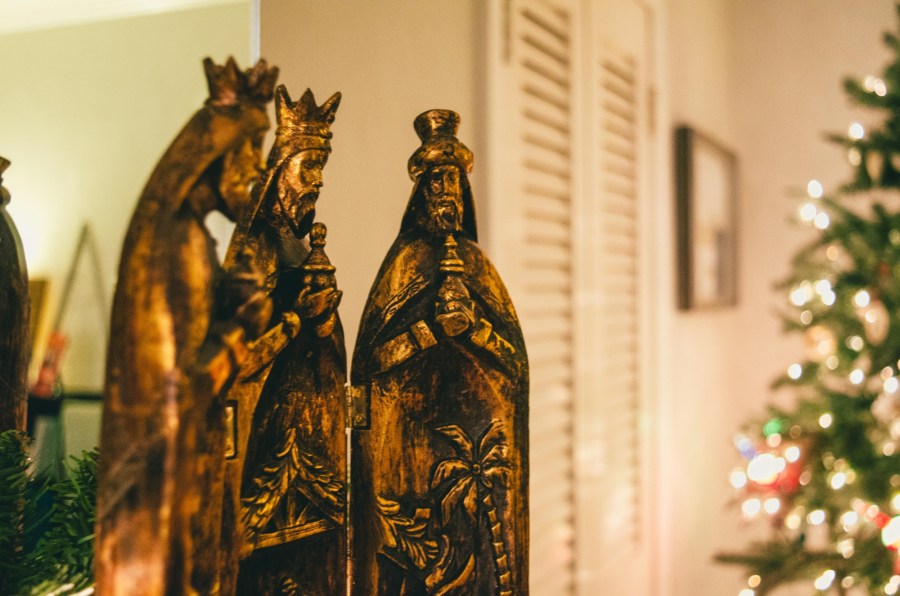
Home By Another Way

Sermon for the Feast of the Epiphany

The text is Matthew 2:1-12.

When I was younger, I used to believe that there was one specific right way, and a whole lot of wrong ways, to practice spirituality. I thought I had to believe all the right doctrines and follow all the rules perfectly, or else God would get mad at me and punish me accordingly.

Now, to be fair to my younger self, there were a few upsides to this way of thinking. For one, it gave me a very strong moral compass, which is a good thing for a young person to have. And number two, it gave me a strong sense of community with others who were trying to practice their spirituality in the same way. And that’s also a good thing.

The downside, however, was that I lived with a constant sense of dread—that if I asked too many tough questions, or failed to live up to my moral code, I would be in deep yogurt with God, who watched everything I did, listened to every word I said, and knew every thought I thunk, and was keeping a meticulous record of all of it, for which I would one day have to answer.

I knew very well just how much I failed to live up to the high standard I set for myself, and I figured that God was looking at me in just the same way—only more so, because God could never forget.

I’ll be honest. Living with that kind of fear, 24 hours a day, seven days a week, was crazy-making. I was told that I needed to trust in God, but the God I believed in—the all-seeing and all-knowing micromanager—wasn’t trustworthy. That kind of God was less like the lover of our souls and more like an abusive ex-boyfriend. No matter how hard I tried, nothing I did would ever be good enough.

I believed these things about God because I thought that’s what it said in the Bible. But then I made one fatal mistake: I actually read the Bible. And what I found there was something more complex, more nuanced, and more loving than the abusive ex-boyfriend I had been in a relationship with up to that moment.

It’s funny, isn’t it, how the Bible is a central source of our theology, but actually reading it can completely wreck that theology?

The gospel for the Feast of the Epiphany is one of those biblical passages that absolutely wrecked my theology. But it didn’t just break me down—it broke me open. This story opened my eyes to the reality that God is both bigger and more loving than all my narrow ideas about God.

This story—the visit of the magi, or wise men from the East, as our translation renders it—is one of the best-known and least-understood stories in the New Testament. The magi themselves were not Jewish. In all likelihood, they were Persian, from somewhere around the modern-day city of Baghdad in Iraq. The dominant religion in that area at that time was not Judaism, but Zoroastrianism. And these magi were astrologers.

And that’s the first place where the Bible starts to mess with my theology. Because I had always been told that astrology was fake and bad, and that I should stay away from it. But here was this famous story in the Bible, no less, where spiritual seekers are using astrology to find their way to the presence of Jesus. That made me go, wait, what?

And it didn’t stop there. It gets weirder—so hold on to your seats.

These Persian astrologers determined, by practicing their craft, that a great king was being born in the land of Judea, so they figured they should go and pay their respects. And if you’re looking for a newborn king, where else would you go except to the king’s palace in the capital city, right?

So they ring the doorbell and say, “Hey, congratulations.” And King Herod is just standing there like, “What? There’s no newborn king here. What are you talking about?” So he goes and consults with the bishops and the theology professors, and they tell him, “Yeah, it’s not happening here. It’s supposed to happen in Bethlehem, according to the ancient prophecies.”

So Herod sends the magi back out to find this new king—not because he wants to pay his respects, but because he wants to eliminate any possible threat to his power. But the magi don’t know that. So they set out again.

And another really interesting thing happens. The text of Matthew’s Gospel specifically says that the magi didn’t follow the directions the clergy had given them from the Bible. It says that they set out, and they saw the star again, and they followed that instead—and lo and behold, it led them to the exact same place the clergy had told them to go.

They weren’t following the “right” way that was prescribed by the Bible. They were following the light they knew, and it led them to the same place.

It’s hard to be a fundamentalist when you actually read the Bible.

So they get there, to the presence of Jesus, Mary, and Joseph. They pay their respects. They offer their gifts. And just as they’re getting ready to go home, they have a dream. And in this dream, God warns them not to return to Herod, but to return to their own country by another road.

Other translations render this sentence as “they went home by another way.” And I really like that turn of phrase.

The magi were going home by another way—not just at the end of the story, but the whole way through. They were not members of the God Squad in the traditional sense. And they didn’t follow the guidance of the Bible. They walked by the light of their own star and ended up exactly where they needed to be anyway.

That says something to me about the God we believe in today—not the abusive ex-boyfriend god, not the all-knowing micromanager, but one who is not afraid of people who ask questions, make mistakes, and travel by their own light. God was with the magi in ways that broke the rules. And that same God is still with us today and has been all along.

One of the many things that I love about the Episcopal Church is that we have a theological tradition where diversity is baked in. Our theology is not about obedience to a single infallible authority. It’s an ongoing dialogue between scripture, tradition, and reason. There is room in our theology for differing viewpoints, and the God we believe in is bigger than all of it.

No book or person or institution is capable of having the last word, because we believe that word hasn’t been spoken yet.

Like the magi, God is still guiding us closer to the presence of Jesus by many and various paths. So none of us has the right to pass judgment on another, or say with absolute certainty, “You’re wrong, and I am right.”

We might think we’re right, but God is usually standing off to the side with a little smirk, going, “Are you sure about that?”

If God could lead the magi to where they needed to be by the light of a star, then surely it’s no big problem for God to lead you wherever you need to be by means of whatever light you follow—no matter the size of your questions, the severity of your mistakes, or the strangeness of your personal beliefs.

Kindred in Christ, that’s the good news of Epiphany for us. What that good news asks of us is the courage to ask the big questions, the humility to make mistakes, and the confidence to trust that we are still loved, even when we don’t get it right.

That is the light that will lead us home by another way.

Amen?

The Adoration of the Outsiders

Eliza_Codex_24_Ethiopian_Biblical_Manuscript_a
Ethiopian Biblical Manuscript. Public Domain. Retrieved from Wikimedia Commons.

A few years ago, there was a big to-do about this book (and subsequent movie), The Da Vinci Code. I won’t get into the particulars of the plot, suffice to say that it provoked a lot of big, emotional reactions from people everywhere.

On the one hand, a lot of church-folks were offended by the ideas it presented, which didn’t exactly mesh with what we had learned as kids in Sunday School. On the other hand, a lot of folks from outside the church were really excited about the book because they thought it revealed a picture of Jesus that was bigger than the one presented by traditional Christianity.

I even had one friend who said, “I knew it! The Vatican has known about this stuff all along, they’ve just kept it hidden and locked up in some secret vault so that the rest of us won’t find out about it.”

Well, I don’t think I’d put much stock in that particular theory… or in the book’s ideas about the historical Jesus (The Da Vinci Code is a work of fiction after all), but I do find the whole phenomenon extremely fascinating from a sociological point of view.

During the peak of the book’s popularity, Jesus Christ was once again on the cover of popular, secular magazines. Books were being written (and read) about him. For a brief cultural moment (and not for the first or the last time), everyone was talking about who Jesus is and what he means to the world. It was a really interesting thing to behold.

And here’s what stood out to me in that conversation:

People feel drawn to Jesus. They want to be connected to him somehow, even if they never darken the door of a church or call themselves Christians. Jesus means a lot to people. There are few, even in the non-religious world, who speak negatively about Jesus or the things he said and did. Most secular criticism is directed, not at Jesus himself, but at us Christians (and what we have done in his name).

In this morning’s gospel reading, we read about a group of people, the wise men, who also felt drawn to Jesus. Like the readers of The Da Vinci Code, these people came to encounter him from outside the bounds of conventional, orthodox, institutional religion.

In the time of King Herod, after Jesus was born in Bethlehem of Judea, wise men from the East came to Jerusalem, asking, “Where is the child who has been born king of the Jews?”

To begin with, these wise men were not Jewish. The text of Matthew’s gospel simply says they were “from the east”, which probably means they came from Persia (the part of the world we now know as Iraq and Iran). They wouldn’t have known anything about the Bible or Jewish customs. They had probably never been to a synagogue service in their life.

So then, how did they come to be aware of this miraculous birth?

“For we observed his star at its rising, and have come to pay him homage.”

They were astrologers. They studied the stars and interpreted their movements as messages from heaven. We have astrologers today who do similar work, but most of it is for entertainment via 1-900 numbers. In the ancient world, astrology was generally accepted as a form of science. Kings and generals would have depended on the predictions of astrologers for guidance.

The message these particular astrologers were discerning from the stars was that something significant was happening in the Jewish homeland. A royal baby was being born. Matthew doesn’t say why, but something in these astrologers’ hearts was stirred enough that they felt compelled to go and pay their respects to the new baby.

So, they did what any reasonable person would do: bring gifts of congratulations to the royal palace in the capital city: Jerusalem. These wise men, Persian astrologers, felt drawn to Jesus, even though they had no idea where to go or what to do when they got there.

King Herod and the Jewish leaders, on the other hand, didn’t fare much better. Even though the astrologers had gotten a little turned around, at least they were aware that something important had happened. The astrologers’ arrival woke the Jewish leaders up to what they had forgotten or neglected in the midst of their own self-important agendas.

When King Herod heard this, he was frightened, and all Jerusalem with him; and calling together all the chief priests and scribes of the people, he inquired of them where the Messiah was to be born.”

The astrologers’ questions sent the theologians and seminary professors scrambling for answers. As it turned out, the answer they were looking for was in a tiny, little, forgotten village:

“They told him, “In Bethlehem of Judea; for so it has been written by the prophet: ‘And you, Bethlehem, in the land of Judah, are by no means least among the rulers of Judah; for from you shall come a ruler who is to shepherd my people Israel.'”

The arrival of these outsiders and their questions woke the Jewish religious scholars up to those parts of their own country and their own faith that they had neglected for too long. At this point, Herod and the religious leaders have an opportunity before them. Their eyes have been opened to the Messiah’s birth. They now have the chance to step outside their own selfish, little worlds and become part of what God is doing on earth. Is that what they do?

“Then Herod secretly called for the wise men and learned from them the exact time when the star had appeared.”

Instead, there is a reactionary pushback against this news of the Messiah’s birth. The powerful ones are secretly plotting and scheming, not so that they can be part of what God is doing in the world, but so that they can keep their power and maintain their privileged positions in Israel. Those who have power want to keep it, even if that means going against the very essence of what defines them as a people. They would do anything, even kill the Messiah, to maintain their illusion of power and control.

Herod is so delusional, so drunk with power, that he even starts ordering these foreign wise men around like they were his own subjects or property:

“Then he sent them to Bethlehem, saying, “Go and search diligently for the child; and when you have found him, bring me word so that I may also go and pay him homage.””

The irony here is that he is the one who is dependent on them. He would have no knowledge of this situation if it wasn’t for their pagan, foreign practice of astrology. Yet the wise men are the ones who respond with open hearts and minds. They came to pay their respects because they felt drawn by the heavens. All these secret, back-door deals combined with biblical hermeneutics and seminary professors probably seemed pretty strange to them. In the end, it seems like they (rightfully) disregarded everything Herod and the religious scholars had just taught them:

“When they had heard the king, they set out; and there, ahead of them, went the star that they had seen at its rising, until it stopped over the place where the child was.”

Does the text say that the wise men set out to follow the biblical scholars theologically correct directions? Or does it say that they went back to following what they already knew?

The answer is the latter, of course. The wise men basically took the Bible and theological training and threw it out the window. They didn’t know about all that Jewish stuff, nor did they want to. They knew about stars. So, when they set out again (probably more confused than when they arrived), they went back to working with what they knew.

One might think that such pagan backsliding would lead the wise men down the path of sin and deception. Surely, they would be lost forever in the desert, never to find the newborn king.

But that’s not what happened. The text tells us that the star “stopped over the place where the child was.” Get this: by following what they knew, they ended up exactly where they were supposed to be.

They set out on this journey in search of Jesus, and lo and behold: they found him (in spite of the so-called ‘advice’ given by powerful figures and religious leaders). And what was their reaction when they found him?

“When they saw that the star had stopped, they were overwhelmed with joy.”

Their hearts were more open than the hearts of those who had spent their lives studying this stuff.

“On entering the house, they saw the child with Mary his mother; and they knelt down and paid him homage.”

Despite their unorthodox methods and status as religious outsiders, the wise men ended up exactly where they were supposed to be: with Jesus. Their faith did not look anything like conventional Jewish faith, but it proved to be more real and more authentic than the faith of those people who were supposed to have all the answers.

I wonder whether the same thing might be true in the world today?

It seems to me, based on what I saw during The Da Vinci Code’s popularity, that there are a lot of people in this world who feel drawn to Jesus, but want nothing to do with the church or institutional Christianity. To be honest, I can’t blame them. We Christians have a lot to repent for when it comes to representing Jesus to the world. We have often attached his name to our own projects and agendas, but rarely have we acted in a way that is consistent with his Spirit. I think that is what it really means to “Take the Lord’s name in vain”: When we talk about him, but don’t act like him.

Meanwhile, those wise souls who are diligently searching for truth and love in Jesus are driven to look elsewhere because the church has done such a poor job of pointing the way to him. In those circumstances, I am not at all surprised that God is willing to reach out take hold of people’s hearts using things like astrology, science, philosophy, or other religions. I have met atheists who have a closer relationship with God than some Christians (even though the atheists would never use that name: God).

The good news in this is that God is willing to reach out to us human beings using any means necessary. As my seminary roommate was fond of saying, “God will broadcast on any antenna you put up.” Only God knows those hearts that truly seek after God. And, as Jesus himself promised: “Those who seek will find”… he never says they have to seek God in a particular way.

The challenge given to us then is this:

Are we open to what God is doing in the world? Are we open to the fact that God might show up in the least expected way, or in the least expected place? When we encounter others who might be seeking God in ways that seem foreign or unorthodox to us, do we have the faith to trust that God is working in their lives (as well as ours) to bring us all to that place where we can worship Jesus together?

Just like the wise men, these outsiders have precious gifts to bring to the table. Will we work with them and help them to open their treasure chests so that these gifts can be offered to Jesus and shared with the world?

God is inviting us Christians to open our hearts, minds, arms, and doors to those outsiders to the faith who bring unconventional gifts to the table and seek God in unorthodox ways. The question that God sets before us is not “Do we approve of them (or their strange methods)?” or even “Do we welcome/accept/tolerate them in our midst?”

The question is: “Will we travel to Bethlehem with them?”

Will we seek Jesus together as companions in life’s journey? Someone else’s journey might not look exactly like yours and that’s okay. Will we be open to the gifts that others bring to the table? Will we let those gifts challenge our structures of privilege and power? Will we let them change the way we think about church and “the way it’s always been” or the way we think it should be done?

These outsiders come to us, not because we have something they need, but because God has led them to us and called all of us to seek Christ together.

So then: Let’s get going.

Why Be Normal?

This week’s sermon from Boonville Presbyterian.

The text is Matthew 2:1-12.

Click here to listen to this sermon at fpcboonville.org

What is ‘Normal’?

People use this word all the time, as if they knew exactly what it meant.  Picky eaters at the dinner table whine, “Mom, why can’t we have normal food for dinner?”  Angst-ridden teenagers roll their eyes and moan, “Why can’t I have normal parents?”  Meanwhile, their parents are pulling their hair out and screaming, “Why can’t I just have normal children?”

For me, this question of ‘normalcy’ is a vocational one.  After college, many of my peers spent their twenties getting established in their respective careers.  They worked as real-estate agents, pastors, teachers, reporters, etc.  Meanwhile, I went to graduate school for 3 years and then got a job doing laundry for homeless and drug addicted people.  Since then, I’ve been a stay-at-home Dad, a philosophy professor, a chaplain in the inner-city, and the pastor of a country church.  Through it all, I often ask myself, “Why can’t I be happy in a normal job?”

So I ask again: what is ‘normal’?

Honestly, I’m beginning to think there’s no such thing as ‘normal’.    It’s an illusion people create, based on what they think other people’s lives are like.  But the truth is that most of your neighbors probably feel just as ‘abnormal’ as you do.

There are lots of ways in which a person can be made to feel abnormal.  I already mentioned family and work as two big ones.  We might feel abnormal because of our mannerisms or our relationships.

We might also be made to feel abnormal because of our spirituality.  I find this one especially interesting.  I think there are many people who have a very deep and abiding spirituality, but don’t feel comfortable in church.  Their relationship with God finds its expression in their enjoyment of the natural world, their study of the sciences, their pursuit of social justice, or their artistic endeavors.  I think the sad fact is that too many of these people don’t recognize their own activities as genuine expressions of faith.

For these people, and for anyone else who feels ‘not normal’ in any way, I have good news this morning: you are one of the Magi.

The Magi were an interesting group of people.  Church tradition has attached all sorts of ideas to them that aren’t necessarily true.  “We Three Kings of Orient Are” is an especially misleading hymn.  First, there weren’t necessarily three of them.  Next, they weren’t kings.  Finally, they weren’t from the so-called “Orient”.

In reality, the Magi were astrologers (like the ones you see on TV) who probably came from somewhere in the vicinity of present-day Iraq.  Their job was to study the movement of the stars and make predictions for the future based on the stars’ movement.  These Magi weren’t Jewish, so they wouldn’t have known about the Torah or the Hebrew prophets, and they certainly weren’t waiting for a Jewish Messiah to come and deliver them.  Nevertheless, God spoke to the Magi in the language they were most likely to understand: astrology. God didn’t send a rabbi along to teach them the Bible or take them to a synagogue.  Instead, God was willing to connect with these Magi through pagan rituals of divination!  Talk about ‘not normal’!

Let’s see what happens next:

The Magi head to Jerusalem and meet with the established religious and political authorities in order to find this newborn “King of the Jews”.  So the royal officials and scholars get together, have a Bible study, and figure out that the Messiah is supposed to be born in Bethlehem.  So the Magi set out again, but once they’re on the road, do they follow the instructions laid out by the religious scholars?  No!  Matthew’s gospel explicitly tells us that they follow the star again.

Think about how mind-boggling this is!  Even after going to Jerusalem and learning the Bible from the best scholars of the day, these Magi go right back to relying on their pagan practices; and instead of astrology leading the Magi astray, it brings them to the exact place where they were supposed to be: in the presence of Jesus.  From beginning to end, there is nothing ‘normal’ about this story!

This is good news for all of us who feel ‘not normal’ in some way (especially those of us who feel out-of-place in church).  This is good news because it means that the God we encounter in the person of Jesus Christ is a creative and inclusive deity.  It means that this God reaches out to all people in whatever way they are most likely to hear.  One of my roommates in seminary liked to say, “God will broadcast on any antenna you put up.”  The question of whether someone’s spiritual journey is ‘normal’ or ‘not normal’ by our standards is irrelevant in the eyes of God.

I am slowly coming to have an appreciation for the ‘not normal’ ways that God is at work in my life.  I told you before about the wandering path that my career has taken during these past few years.  I can see now that my dead-end job doing laundry with a Master’s degree was really a two-year extension of seminary.  I learned to apply the theological and pastoral skills I had learned in the classroom to real-life situations.  Likewise, I formed personal relationships with homeless and drug-addicted people that helped me in my future ministry.

In 2009, I started offering spiritual care to people in the inner-city through St. James Mission, an ecumenical outreach ministry in Utica.  We call it our Community Chaplaincy program.  While many people refer to me as a street preacher, the truth is that I don’t do much preaching at all.  I’m more of a street listener.  The job of a Community Chaplain is to help people listen for the ways in which God is already present and active in their lives.

I am constantly being taken by surprise in the course of this ministry.  The people I work with, who exist in the very margins of our society, live lives that can in no way be understood as ‘normal’.  I know one gentleman who is constantly struggling with addiction and mental illness.  He has been on and off the streets several times in the past few years.  The central point in his spiritual life is the image of planting seeds, which Jesus makes use of in several of his parables.  Planting seeds, for this man, meant doing small deeds of kindness for others.  So, in spite of his own struggles, he volunteered in several local organizations.  For a long time, he was an active participant in our Bible studies on Thursday nights.  He had dream of one day providing forums, called Feedback Seminars, where clients of social service agencies can offer insight and advice to service providers for making their organizations more effective.  “Just like a doctor puts on a white coat to go help people,” he said, “Jesus puts us on and uses us to heal others.”

This man’s faith looks very different from what we would call ‘normal’ Christianity, but it is nonetheless genuine.  He is one of the Magi, following the star God has set before him.  Likewise, without my ‘not normal’ experiences of feeling lost in my career, these pieces would never have come together to form the ministry that God has called me to be a part of on the streets of Utica, in college classrooms, and here in Boonville.  Even though my call to ministry looks very different from most other pastors, I believe this is the star that God has called me to follow right now.

I would like to invite you to examine those ‘not normal’ parts of your life, whatever they may be.  Are they just odd quirks in your circumstance or personality?  Are you just a misfit or a freak who doesn’t belong?  Or is God calling you to follow a star?  Could it be that God is calling you to embark on a wild and wonderful journey of faith and discovery?  I want to encourage you to follow that star and see where it leads you!

For those who may not feel this sense of ‘not normality’ that I’ve been talking about today, I want to encourage you to pay special attention to those unusual people in your family, your neighborhood, or your church.  Those people are Magi who have been specially chosen by God to teach us about the inclusive creativity of God and God’s work in the world.  Don’t write them off as freaks and misfits, but trust that God is leading them along a special path to the same place where God is leading you: to worship Christ, the newborn king who was born in a stable, the most ‘not normal’ king of who ever lived.