
I wrote the following book review for my diocesan magazine in late 2023. Reposting now because of the increased interest in Bishop Budde’s book.
Edgar Budde, Mariann. How We Learn to Be Brave: Decisive Moments in Life and Faith.(New York: Avery, Penguin Random House LLC, 2023)
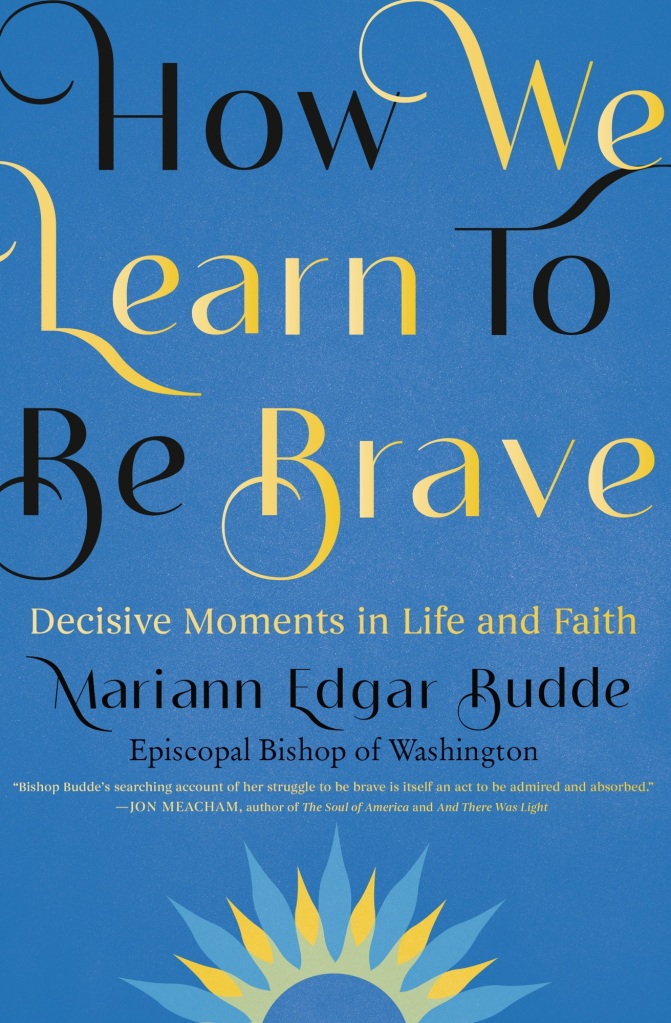
How We Learn to Be Brave: Decisive Moments in Life and Faith is the third and most recent book by the Rt. Rev. Dr. Mariann Edgar Budde, the ninth and current bishop of the Episcopal Diocese of Washington. Published earlier this year, this book was inspired by the teargassing of protesters to make room for a political photo-op outside St. John’s Episcopal Church, Lafayette Square on June 1, 2020. This event, and the ecclesiastical response to it, propelled Bishop Budde and The Episcopal Church into the center of public attention for the first time since Presiding Bishop Michael Curry preached at the royal wedding of 2018.
The book begins with an account of the events of June 1 from Bishop Budde’s point-of-view. After the initial retelling, the author occasionally refers to the events of that day, but the main thrust of the book has significantly more breadth and depth. As the title indicates, this is not a book about political grandstanding; it is a book about bravery.
Part memoir, part history, and part theological treatise, this book focuses on the virtue of courage as a choice that we make. Bishop Budde writes:
Decisive moments involve conscious choice, impressing their importance upon us as we experience them, for we know that we’re choosing a specific path of potential consequence. In a decisive moment, no matter how we got there, we no longer see ourselves as being acted upon by the slings and arrows of fortune or fate, but as ones with agency. We’re not on autopilot; we’re not half-engaged. We are, as they say, all in, shapers of our destiny, and cocreators with God. (xviii)
Across the chapters that follow, Bishop Budde explores the various kinds of decisions to which the virtue of courage may call us. There are chapters on Deciding to Go, Deciding to Stay, Deciding to Start, Accepting What You Do Not Choose, Stepping Up to the Plate, The Inevitable Letdown, and The Hidden Virtue of Perseverance.
Each chapter includes an autobiographical vignette and an historical profile to illustrate the particular theme. While the book is intended for a larger audience, the author does not shy away from biblical, liturgical, and theological references particular to Christians. Most (though not all) of the historical profiles are of prominent Episcopalians whose names are easily recognizable, even though their Episcopal faith may not be as widely-known. Historical examples include Franklin and Eleanor Roosevelt, Supreme Court Justice Thurgood Marshall, Jonathan Myrick Daniels, and the Rev. Dr. Pauli Murray. Contemporary Episcopal voices cited by the author include Dr. Brené Brown, the Rev. Dr. Kelly Brown Douglas, and Rachel Held Evans. The author makes a special point of highlighting examples from the lives of women and people of color.
When it comes to the autobiographical sections, the author does not shy away from experiences of personal failure and disappointment. This spiritual reflection on the virtue of courage is not a self-congratulatory polemic. There are many times in life when courage calls us to take responsibility for our mistakes. Bishop Budde describes personal experiences of such moments with an abundance of honesty and humility.
My primary criticism of the book is a relatively small and forgivable one. There are times when the several examples of historic Episcopalians come across as advertisements for our denomination. As a reader, it seemed like the author was implying, “Look at all these cool Episcopalians! Don’t you want to be one too?” A greater religious diversity among historical examples would have decreased my sense of evangelistic pressure and increased the book’s appeal to a wider audience. That being said, I think this fault is minor because the Episcopalians the author cites are indeed examples of the virtue she is expounding. Furthermore, since the author is an Episcopal bishop, I can’t really blame her for wanting to highlight the denomination she serves.
All in all, I think this book will appeal to parish book groups and individuals looking for personal development. Its language is accessible to readers without a theological education and its spiritual dimension is broad enough to include people who do not identify as religious. Finally, though I must admit some personal bias on this point, I think this book would be an excellent choice for Episcopalians in the process of discernment and formation for ordained ministry.
Courage, like love, is more choice than feeling. We blaze the trail of God’s call by putting one foot in front of the other, falling down, getting up, changing direction, and starting again. How We Learn to Be Brave gives ample inspiration, encouragement, and guidance for that process.
 Hopping Hadrian's Wall