
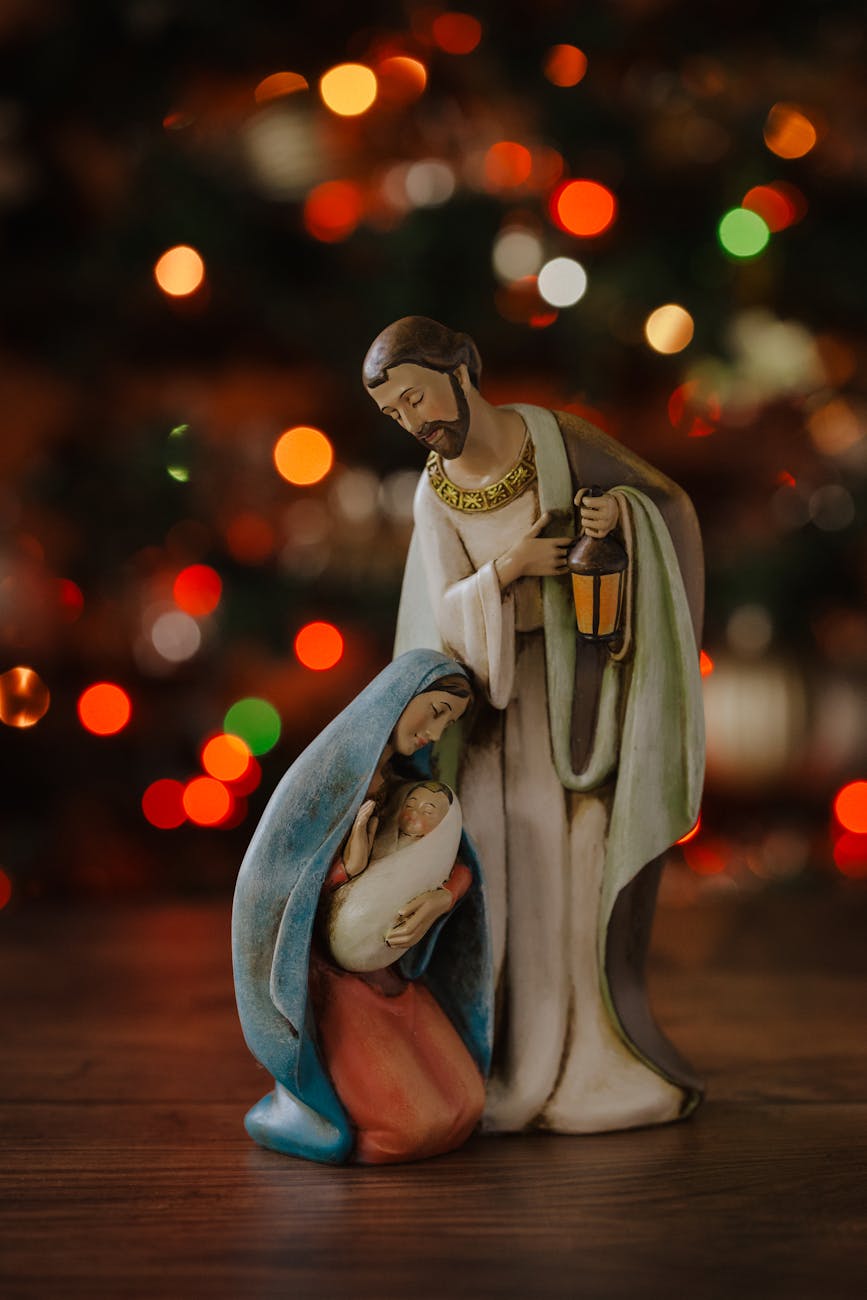
Showing Up When You Can’t Take Control

Sermon for the fourth Sunday of Advent, Year A.

The text is Matthew 1:18-25.

When my wife and I were in seminary, there was this Chinese restaurant that we liked to eat at. And at this restaurant, there was this spicy peanut noodle soup that I absolutely adored. But of course, we couldn’t eat there all the time because we were a couple of broke seminary students. So I decided, I’m going to try to figure out how to make this at home.

So I looked up some recipes, bought some ingredients, and decided I was just going to try and wing it. We had the noodles and the vegetables, of course. But the real kicker was chili oil, milk, and peanut butter. That’s how you got that nice sauce.

So, I was putting it all together and I thought to myself, “The peanut flavor in that soup was pretty strong, and this doesn’t seem like a lot of peanut butter. I better add some more to be safe.” So I did.

But what I ended up with was not so much soup as soggy clumps of peanut butter laced with noodles. And of course, it was completely inedible.

I got myself in over my head. And I learned that day that enthusiasm cannot make up for the fact that I have no idea what I’m doing.

It’s funny when the stakes are low.
It’s harder when they’re not.

Sometimes in life, we get in over our heads with something that really matters, and still, we have no idea what we’re doing. We care, but we’re clueless.

Most painful of all are those times when we get in over our heads with something that’s happening to someone we love, and we have no control over the outcome. We want to step in, help out, take charge, and fix it. We figure if we’re smart enough, committed enough—if we just love them enough—we can manage the outcome and stop the situation from getting messy.

But real life doesn’t work that way. Other people’s lives are not problems to be solved, no matter how much we love them. We can’t control who they are, what they go through, or how their story ends. It’s their life. They have to live it—even if we’re pretty sure we could do a better job living it for them.

All we can really do is show up and stand with them while they go through it. And that gap—that gaping chasm between love and control—is one of the most uncomfortable places a human being can stand.

And it’s exactly where St. Joseph is standing in today’s Gospel.

The story begins with our buddy Joe finding out that his fiancée, Mary, is pregnant. And for reasons that were probably explained to you in biology class, Joe is pretty sure that he is not the father. So, what’s a guy supposed to do in a situation like that?

The text of Scripture tells us that Joseph was a righteous man. And that’s important. He’s not reckless, cruel, or indifferent. He’s just a guy trying to do the right thing in a situation that he didn’t choose and doesn’t understand.

He’s caught between the competing goods of compassion and law, love and responsibility, mercy and obligation. He’s hit the limit of what he can manage. And it’s there, in the stunned silence of that moment, that God finally gives him the answer he’s looking for.

It’s not a full explanation or a long-term strategy, or even a promise that everything’s going to work out okay. What it is is something much quieter and more grounding.

The first thing Joe hears is his name: “Joseph, son of David.” Before he’s told what to do, he’s reminded who he is. Identity before instruction.

Joe is reminded that he’s not just some working-class bumpkin. He’s the descendant of kings. In modern language, we might render “Joseph, son of David” as “Joe Davidson.” And we can imagine his dad saying to him, “Hey, Joe. Buck up there, kiddo. I know you’ll figure this out, because you’re no chump. You’re a Davidson. And I believe in you.”

We all need to hear that sometimes.

The second thing the angel does for Joe is name what he’s feeling. The angel says, “Do not be afraid to take Mary as your wife.” And that’s important too.

So often, in the midst of a crisis, it’s easy to get caught up in what’s happening on the outside and forget to pay attention to what’s happening on the inside. The problem is, when we do that, we’re still being controlled by our emotions—it’s just happening unconsciously. So we’re just reacting.

The better way is to pause, take a breath, and pay attention to what’s happening inside, so we can choose to respond from our deepest morals and values rather than just reacting emotionally. We have to be aware of our emotions before we can do that.

And that’s what the angel does for Joseph. He’s not shaming it. He’s just naming it. “Joe, you’re afraid. Anybody would be in your shoes. But now that you know that, you don’t have to let it control you.”

Fear is not failure. It’s just a part of life. But if you can stay aware of it, Joe, you can stay awake and stay present with yourself and with Mary, because she needs you right now. She doesn’t need you to fix it. She needs you to show up and listen and stay engaged with her while this important thing that God is doing is still working itself out in her life.

Joe, that’s your job. That’s your role in all this. Don’t try to manage the mystery. Just stay present to it. Because what’s coming to birth through her is nothing less than Emmanuel, which is Hebrew for “God is with us.”

And that’s true. God is with us—here and now. Not after everything makes sense. Not after the crisis has passed. Not after the fear goes away, but right here and right now. In the mess. In the uncertainty.

Later on, when Joe woke up from the dream where all this happened, he woke up to a world where nothing had changed—and yet, everything had changed. The future was still unclear. The risk was still real. And poor old Joe still didn’t have the answer to the big questions.

But what he did have was the next step. The choice to relinquish control over the story and just show up in it instead.

And that kind of faithfulness is not the kind of thing you can learn overnight. It takes a lifetime.

For me personally, the place where I’ve had to learn that lesson over and over again is with my family, and especially my kids. They say that parenting doesn’t come with an instruction manual, and boy, they’re right.

Just when I think I’ve got one stage of my kids’ lives figured out, they go ahead and move on to the next one, where once again I find out that I have no idea what I’m doing.

The first time it hit me, I was standing in a hospital parking lot the day after my first child was born, and my task was to install a car seat for the first time. It hit me that I was now responsible for the life of another human being, and I was in way over my head.

I understand when people say they don’t feel ready to have kids, because the truth is, you’re never ready. You just take it as it comes and do the best you can. So I wedged my knee into that hard plastic, yanked the seatbelt through the loops, and did what I guess was an okay job—because we made it home from the hospital in one piece.

It was the first time, but certainly not the last time, that I felt that sense of panic.

As time went on and the kids grew up, we dealt with new challenges as they came to us—homework, friendships, drama, dating, breakups. Each stage of life offered something new that my wife and I were not prepared for. Our responsibility kept increasing, and our certainty never quite caught up.

This week, that same child for whom I installed the car seat told us that what he wants to do over his Christmas break is take a day trip to Chicago by himself. He showed us his plan of where he wants to go and what he wants to do. He’s got all the train schedules and the phone numbers. He’s ready, but his mother and I are not. And yet, we are taking that leap of faith anyway.

What faithfulness often looks like in real time is not confidence or control, but the choice to stand alongside a life that is unfolding at its own pace and in its own way. It takes courage. And I’ll let you know how it goes, because I don’t know yet.

Earlier this week, many of us read about another act of courage and faithfulness that took place during the massacre at Bondi Beach, Australia, where several of our Jewish neighbors had gathered to celebrate the first night of Hanukkah. In the midst of the carnage, a Muslim man named Ahmed al-Ahmed, “in the name of conscience and humanity,” ran toward the shooter and wrestled the gun away from him, taking five bullets in the process.

He did it to protect people of a different faith and culture from his own—people he didn’t even know. And in so doing, Ahmed al-Ahmed demonstrated to the rest of us that the faith of Joseph is still alive in the world today: the courage not of control, but of presence; the courage to step toward life even when the outcome is unclear.

That kind of courage is real, and it is still available to us today.

Kindred in Christ, there are moments in life when all of us are asked to stand alongside people we love in situations we cannot control.

Where is that happening for you today?

How are you being asked to protect without possessing, to care without controlling?

Where might faithfulness look less like fixing and more like staying?

Joseph shows us how faithfulness sometimes means showing up when walking away would be much easier and much safer. Joseph shows us how courage sometimes means staying engaged when we cannot manage the outcome of events.

That is the courage and the faith that St. Joseph holds before us in today’s Gospel.

May we also have the grace to recognize that courage when it is asked of us, trusting that God is with us even when the way forward is not yet clear.

Amen?

What Does A Stable Smell Like?

This week’s sermon from First Presbyterian Church of Boonville, NY.

The text is Matthew 1:18-25.

Click here to listen to the podcast.

If you were to ask the average person in the street what they think of Christianity, you’re likely to get a response that contains some combination of the words morals and values. Those who have a favorable opinion of Christianity might say something like, “More people should go to church, so they can learn positive morals and values.”  Others who are more hostile toward Christianity might say, “Who do those Christians think they are?  They shouldn’t impose their morals and values on everyone else!”

While these statements might seem to be polar opposites of one another, they proceed from a common assumption about who God is and what God wants.  They assume that God is primarily interested in creating a perfect moral universe where everyone acts as they should and everything works according to plan.

Christians, to be fair, have certainly done their part in perpetuating this idea of a “perfect moral universe”.  Theologians have called it “legalism”.  Historically speaking, the proceedings of the Salem Witch Trials remind us of legalistic Christianity at its worst.  More than two dozen people were wrongfully accused of practicing witchcraft and were executed by their neighbors in Massachusetts during the 17th century.

The legalistic spirit of this era was portrayed by the novelist Nathaniel Hawthorne in his literary classic, The Scarlet Letter. In this story, the main character, Hester Prynne, mothers a child out of wedlock and is subsequently ostracized by her neighbors.  They force her to wear a scarlet letter ‘A’ at all times as a reminder of her transgression.  Meanwhile, the child’s father (who happens to be the local minister) secretly and slowly tortures himself to death as self-inflicted punishment for his sins.

Examples of legalism in the Christian church are unfortunately not confined to volumes of history and literature.  Even today, many Christians find themselves spiritually (and sometimes literally) homeless when they confess their inability to live up to the moral standards set by their church communities.  The unspoken message that people in our society tend to hear from Christians is that there is no place in our churches for unwed mothers, divorced couples, addicts, or anyone else who doesn’t conform to this image of moral perfection.

When we hear these personal stories of people exiled from their homes and churches, when we read novels like The Scarlet Letter or reflect on historical accounts like the Salem Witch Trials, I think we have to ask ourselves: Is this really what God wants from us as Christians?

It’s tempting to answer “yes”, especially at Christmas.  After all, isn’t Christmas the “most wonderful time of the year”?  Doesn’t everyone want things to be “just perfect” at Christmas?  But when we read the Christmas story as it appears in today’s gospel reading, we see a situation that is far from being “just perfect”.

Our scene opens with Mary, the mother of Jesus, finding out that she is pregnant out of wedlock.  Biblical scholars estimate that Mary is probably about thirteen years old at this point in the story.  So our story literally begins with an unwed teenage mother.  In our society, this state of affairs would certainly make her the subject of raised eyebrows and town gossip.  But in first century Galilee, the stakes were much higher.  She was engaged to Joseph, who was quite certain the child wasn’t his.  To be betrothed to one man in that society and having someone else’s baby was considered adultery.  Mary could face the death penalty for that!  The shame on her family’s honor would damage their standing in the community long after she was dead.  So, when we read that Joseph was “unwilling to expose [Mary] to public disgrace”, we have to understand that this meant more than public embarrassment.  Her life was on the line.

Joseph, it seemed, was caught in the middle of an impossible situation.  His fiancée had apparently betrayed him.  He was a good and faithful Jew who obeyed the Torah, but in this case, strict adherence to the Bible meant putting Mary to death.  Even in his sorrow and anger, he wasn’t willing to do that.  What was he supposed to do?  He decided that the best thing for everyone would be to call of their engagement quietly, in hopes that the real father would step forward and take responsibility.  In that scenario, Mary and her baby would at least have a chance at leading decent lives.  It wasn’t a perfect solution, but it was the best he could do.

That night, during what I imagine must have been a fitful and restless sleep, Joseph had a dream.  In this dream, an angel stood before him and called out, “Joseph, son of David!”  This would have sounded odd to Joseph, because his father’s name was Jacob.  Sure, his family was related to the legendary King David, but one would have to go back centuries to trace that lineage.  Nevertheless, the angel calls him according to his royal heritage: “Joseph, son of David, do not be afraid to take Mary as your wife, for the child conceived in her is from the Holy Spirit.”

“Wait a second,” Joseph must have thought, “now you’re telling me that God is responsible for this?  And all of this has something to do with royal blood in my distant family history?”

The angel in the dream continued, “She will bear a son, and you are to name him Jesus, for he will save his people from their sins.”

“Now, hold it right there,” Joseph thought, “Name him?  You want me to name him?!  That means I’m claiming him as my own!  I’m saying to the world, ‘Yup.  It was me.  I did it.  I’m the father.’  I’d be ruined for life over something that’s not even true!  Are you saying God wants me to lie?!”  If he were alive today, this is where Joseph would probably say, “I’ve really got to switch to decaf after 6pm!”

Remember that this was “just a dream”.  How many times have you and I dreamed about something that was going on in our lives and dismissed it as stress subconsciously working itself out?  It would have been very easy for Joseph to do the same.  Besides, what this “angel” was saying went against everything he believed about God, morality, and the Bible.

Yet, we Christians believe this is how God chose to enter into human history.  The author of Matthew’s gospel cites a prophecy from the book of Isaiah as if to say, “This was God’s plan all along!”  We often marvel at the humility of Christ, who was willing to become incarnate among working-class peasants in Galilee.  However, have we ever stopped to think about how scandalous this situation must have been for the people involved?  Jesus was not born into a morally perfect situation.

Most of us are familiar with the story of the first Christmas from paintings, films, and pageants (like the one our kids have prepared for us after church today).  We are familiar with idyllic images of the baby Jesus, lying on a soft bed of hay in the stable, surrounded by warm and soft light while angels and shepherds look down with love.  But let me ask you this: What does a stable smell like?  It’s not pretty!  It’s not even hygienic.  It’s messy, just like life.

When the eternal mystery of God took on flesh and became incarnate in our world, it happened in the messiest possible way.  God is not afraid of our mess.  God does not wait for us to get our morals and values in order.  God meets us right where we are.  Ironically, it is God’s acceptance of our moral imperfection that mysteriously gives us the power to live transformed lives.  The Apostle Paul said it like this in his letter to the Romans: “God’s kindness leads to repentance.”

The French novelist Victor Hugo wrote about this kind of transformation in his book, Les Misérables. In this story, an ex-convict named Jean Valjean stops for the night at a bishop’s residence.  At dinner, he remarks that, after a hot meal and a warm bed, he’ll “be a new man in the morning.”  During the night, Valjean gets up and robs the bishop of his best silver and takes off.  He is caught and arrested the next day.  The police take Valjean back to the bishop’s house for questioning.  When they arrive, the bishop lies and tells the police that he gave the silver to Valjean, who is then set free.  Before sending him on his way (with even more silver), the bishop says to Valjean, “With this silver, I’ve purchased your soul.  I’ve ransomed you from fear and hatred.  And now I give you back to God.”  The rest of Hugo’s novel tells the story of how Valjean’s life was changed forever by that radical act of graciousness.  The bishop met Jean Valjean in the midst of his messiness and moral imperfection.  So it is between God and us.

This is good news.  It changes the way we look into the mirror.  When God comes into our lives on Christmas (or any other day), God takes us as we are, with all our messiness and moral imperfections.  There is no longer any need for us to beat ourselves up for our sins or hide from the One who loved us before we were born.

This good news also changes the way we look at each other, especially when our neighbors are mired in scandal.  Maybe they are facing a tough legal battle, like Mary.  Maybe an entire family is facing public humiliation in the community, like Mary’s.  Maybe an unwed or teen mother is facing a difficult choice, just like Mary.  Do Christians in these situations cross their arms and shake their heads in silent judgment?

If we take the gospel seriously, we have to recognize that it was in the midst of a messy and morally questionable situation like this that God chose to enter into human history.  So, if we are looking for God in our lives today, it only makes sense to start looking in the same kinds of messy and morally questionable situations.

If we can find the faith to do that, then I truly believe that we, like Jean Valjean, will discover our lives being transformed by God’s grace.  With open minds and open hearts, we’ll take our place this Christmas in that smelly, messy stable alongside the shepherds with their sheep, the ass, and the angels, beholding the glory of God’s eternal mystery coming in to our lives once again.

O come, let us adore him!