Whose Soul is Being Saved, Anyway?

Sermon for Christ the King Sunday, Year A

Matthew 25:31-46

When I was in high school, my parents, pastors, and other grownups I knew from church were pretty consistent in their spiritual advice to us teenagers. They told us that we should simply “read the Bible and do what it says,” which sounded like really fantastic advice… at least, that’s what the grownups at church thought until my friends and I actually started actually reading the Bible and trying to do what it said.

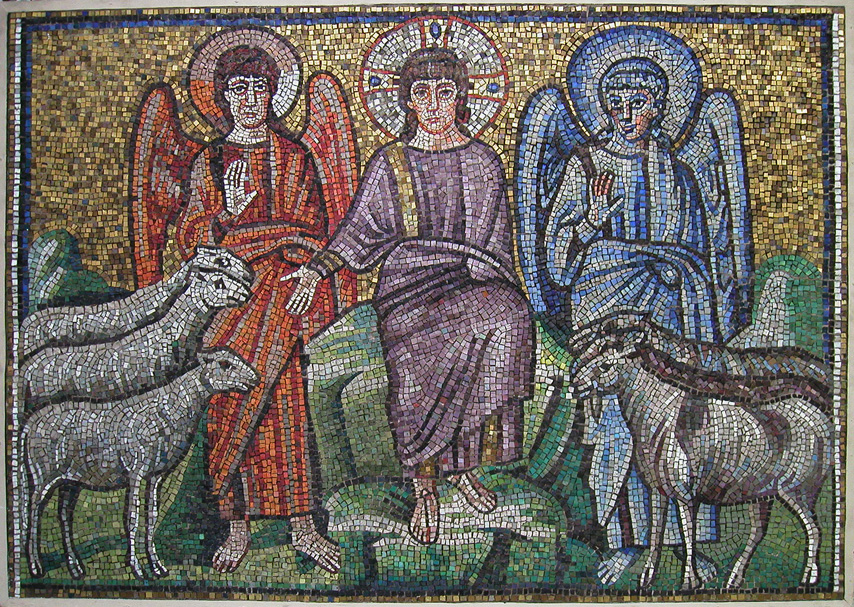
The problem was that the grownups didn’t specify exactly which part of the Bible they wanted us to read and obey first, so my friends and I picked the parable of the Sheep and the Goats from Matthew 25: the very passage we heard in today’s gospel.

We read this story about Jesus commanding his followers to feed the hungry & thirsty, welcome the stranger, clothe the naked, and visit the sick and imprisoned. And then, to really drive the point home, he said to them, “Truly I tell you, just as you did it to one of the least of these who are members of my family, you did it to me.”

It seemed to us that what Jesus had said was pretty clear, and we noticed that there were some homeless guys asking for money on the highway by our school, so we figured that Jesus wanted us to go invite them to lunch, which we did.

What resulted from that encounter was one group of well-fed homeless guys, who were happy to share their life stories with a group of awkward teenagers, and a group of very confused church teachers who were scratching their heads and wondering where it all went wrong.

When they encouraged us to study the Bible, they figured it would inspire us to do our homework, eat our vegetables, and basically just be good kids. But Jesus, as it turned out, had other plans.

Of course, that doesn’t mean that we got it right and our teachers got it all wrong. In fact, we eventually realized something very important that we had missed when we first started buying lunch for homeless guys:

As good Christian kids who imagined themselves as missionaries, we thought it was our God-given duty to bring Christ to the poor of the world, in order to save their souls.

But if you look closely at this passage in Matthew 25, you realize, as I eventually did, that I had been understanding this passage completely backwards from the way that Jesus intended it.

I was understanding it backwards in two ways:

  1. In thinking that I was bringing Christ to the world.
  2. In thinking that I was doing it in order to save their souls.

Let’s take a look at that first backward understanding: That I was bringing Christ to the world.

That’s not what Jesus says in this passage. He says, “I was hungry… thirsty… a stranger… naked… sick and… in prison.” Later on, he gets even more specific about exactly where he factors into this evangelistic equation when he says, “Truly I tell you, just as you did it to one of the least of these who are members of my family, you did it to me.”

Jesus isn’t with the missionaries bringing charitable services to the poor of the world; he is with the poor themselves. My friends and I weren’t bringing Christ to the homeless men outside our school; they were bringing Christ to us. That’s the first way in which I was understanding this passage backwards.

My second backwards understanding of the Parable of the Sheep & the Goats was in assuming that I was bringing Christ to the poor in order to save their souls. The folly of my assumption can be clearly seen in the last part of this passage.

This is a parable of the Final Judgment, which takes place at the Second Coming of Christ. The righteous sheep, who had done the things that Jesus had told them to do, “inherit the kingdom prepared for them from the foundation of the world, but the accursed goats, who did not care for the poor as Jesus commanded, are told to “depart from Jesus into the eternal fire prepared for the devil and his angels.”

So, there are souls being saved when Christians practice the Works of Mercy as Jesus commanded them, but it’s not the souls of the poor. Jesus is already with them. The souls being saved are our own.

So then, this was my backwards understanding of Matthew 25 that I was operating under as a well-intentioned teenager who was trying to practice his Christian faith:

My friends and I had mistakenly thought that we were bringing Christ to the poor of the world, in order to save their souls, but the truth that we eventually realized by studying the teachings of Jesus was that it is the poor of the world who bring Christ to us, in order to save our souls.

This is the same pattern that we encounter in the Eucharist. In this sacred mystery of our faith, Christ comes to us through the ordinary elements of bread and wine. By the action of the Holy Spirit, they become for us his Body and Blood, which we receive into our own bodies.

This Sacrament trains the eyes of our hearts to find Christ in this place, so that we can go out into the world and find him everywhere else.

In every moment and every encounter of our lives, Christ is coming to save us.

When we come forward to receive his Body and Blood in the Eucharist, that is Christ coming to save us.
When we pass the Peace to our neighbor in church, that is Christ coming to save us.
When we hear the news that a friend is sick, that is Christ coming to save us.
When our workday is interrupted by a phone call from the jail or a homeless person asking for money, that is Christ coming to save us.

Christ saves us, not only by forgiving our sins and securing place in heaven for us, but also by getting us unstuck from our own self-centeredness in this world. He calls upon us to satisfy the physical hunger of our poorest neighbors, so that they can satisfy the spiritual hunger in us.

Kindred in Christ, our Lord Jesus invites us this morning to reconsider our backwards understanding of the mission of the Church. He offers himself to us, not only in the Sacrament of his Body and Blood, but also in the bodies of ordinary people who lack adequate food, water, shelter, clothing, healthcare, and freedom. He asks those who have these things to share with those who don’t, to save not only them but us as well.

Let us open the eyes and ears of our hearts and minds today, so that we might be ready to receive him when he comes again in glory, and “inherit the kingdom prepared for us from the foundation of the world.”

Carry the Light

Sermon for Proper 27 A

Matthew 25:1-13

On October the 22nd, 1844, there was a group of people who were expecting something very, very big to happen. They were known as the Millerites, and they believed that they had figured out the exact day of the second coming of Christ.

And so they had prepared themselves in every way conceivable, selling possessions, quitting their jobs, gathering in prayer and waiting for the end of the age to come upon them. And then October the 22nd, 1844, came and went. And October the 23rd dawned like any other day will.

This became known among them as the Great Disappointment. I don’t want to make fun of them too hard, because they were waiting in faith for the fulfillment of all that Christ had promised: for the world to be set right, for every tear and sadness to be wiped away, as it says in the Scripture.

These were people who lived in hope, mistaken though they were about the exact time and date. I think all of us can relate to the Great Disappointment in some way or another. We have experienced disappointments of our own when we’ve been awaiting test results, or when we’ve been faithfully praying through mending a broken relationship that doesn’t work out, or when we’ve been out there doing the hard work of getting an education and looking for a job and it’s not materializing.

Sometimes when we just watch the news and we see this world that is the way it is, rather than the kind and gentle world that Jesus envisions for us, we too can understand disappointment.

And that’s what today’s Gospel brings us into. Jesus tells the story of these ten bridesmaids who have an important job as part of the wedding ceremony: Their job is to carry the light. Back then, if you recall, there were no street lamps or flashlights.

It’s hard to find your way in the dark, so you need people who carry torches, who walk with you and ahead of you to light the way to where the celebration begins. The bridesmaids, in addition helping the couple to celebrate, also serve a practical function in weddings in the ancient world.

On this particular occasion, the bridegroom is late and things are not going according to schedule. All of the bridesmaids fall asleep, which I think is a very interesting detail. No matter how faithful or how wise you are, everybody needs a nap sometime.

In the midst of the waiting, the time stretches on, the light grows dim, and finally, unexpectedly, they hear the shout at midnight that the bridegroom is coming.

The time is at hand. And there’s the five wise bridesmaids who have brought extra oil for their lamps, and the five foolish bridesmaids who did not. And the foolish bridesmaids say to the wise ones, “Give us some of your oil!”

The wise ones say, “No, we can’t. There won’t be enough.”

Jesus tells the story in this way to underscore the seriousness of the commitment that he’s talking about. Symbolically, he is talking about how prepared we are (or not) for the fulfillment of God’s promises in this world. We are still waiting, after 2,000 years.

While the wise bridesmaids were unable to share their oil, there was something else that I think maybe they could have shared: their light. I wonder: what if the foolish bridesmaids had not gone into town to find a late-night oil dealer, what could have happened instead?

If they had stayed with the wise bridesmaids and shared their light, there would not have been the danger of running out of oil. Then everyone would have made it to the celebration on time.

The wise ones couldn’t share their oil, just as we cannot give our personal faith to someone else, but we can share the light that we carry with us.

It makes me think of the pandemic, when we were all locked down, social distancing, and so many things were shut.

My family and I were holed up in our house, like most were. After a while, one of my neighbors had an idea. She said, “Could we gather outside, and social distance, just to be able to see one another’s faces?”

That’s what we ended up doing. On Tuesday night, everyone came over to our backyard. We stayed the six feet apart and ordered pizzas (we socially distanced the pizzas too).

It didn’t make the pandemic go any faster. It didn’t resolve the global crisis we were experiencing, but it helped us to share one another’s lives.

It was a comfort to us. It gave us strength and hope. It was a really sacred time that we had on those Tuesday nights.

There was no church service. It was just pizza and conversation from six feet away. Even in the darkest of times, we were able to share our lives with each other.

We Christians, as people of faith, have an opportunity to share our lives with one another. What that asks of us is that we trim our lamps and keep our oil stocked. That’s an analogy for our spiritual practices and good works. That’s what keeps the light of faith burning within us.

But it’s also true that each of us is only human, so our individual light can’t burn perpetually. Every now and again, the light within us gets a little dim, because we all have tough days.

That’s when we can lean on each other, to borrow some of the light.

We can’t borrow the oil, but we can borrow the light.

If I’m really honest, there’s a little bit of the wise bridesmaid and the foolish bridesmaid in me at all times.

There are some ways in which my oil is fully stocked and my light is burning brightly.
At the same time, there are parts of my life where it’s not burning so brightly, so I need to lean on someone else. I need to ask for help.

That’s okay. Because the good news is that the wedding is not canceled, even though it’s delayed. The celebration is still coming.

If we can do our part to hold on, keep our lamps lit, and ask for help when our lamps grow dim, then we have a better chance of making it through the dark of life’s great disappointments.

This is the gift that God gives us: The gift of each other. The gift of the light that is within us. There are so many ways that we can share gift.

Here in our church, we also have The Book of Common Prayer.

This book is one of the ways that the church is able to carry the light for us when our own hearts grow dim. This collection of prayers and liturgies, some of which are hundreds or even thousands of years old, help us to find the words to pray when we can’t think of the right words.

Some days, I come to church and can pray every single one of those words from the bottom of my heart. Some days, I’m tired and barely making it through. But the words of our liturgy sustain me. It’s a gift that can sustain all of us as well.

The promise holds true: the celebration is still coming. We don’t know how long we have to wait, but we know that the darkness will not have the last word.

So, let’s hold on to the light and hold on to each other.

Seriously, please watch this video.

“I’ve been looking for a Savior in these dirty streets…”

This lyric from Tori Amos has been the tagline for this blog since I started it last year.  It describes what I’m trying to do in my off-beat approach to ministry.  I want to go out there in the world and discover Jesus alive in the people around me.

Today, I caught a sighting of him.

Jesus shows up several times in this video footage from ABC News.  See if you can spot him:

Matthew 25:31-40:

When the Son of Man comes in his glory, and all the angels with him, then he will sit on the throne of his glory. All the nations will be gathered before him, and he will separate people one from another as a shepherd separates the sheep from the goats, and he will put the sheep at his right hand and the goats at the left. Then the king will say to those at his right hand, “Come, you that are blessed by my Father, inherit the kingdom prepared for you from the foundation of the world; for I was hungry and you gave me food, I was thirsty and you gave me something to drink, I was a stranger and you welcomed me, I was naked and you gave me clothing, I was sick and you took care of me, I was in prison and you visited me.” Then the righteous will answer him, “Lord, when was it that we saw you hungry and gave you food, or thirsty and gave you something to drink? And when was it that we saw you a stranger and welcomed you, or naked and gave you clothing? And when was it that we saw you sick or in prison and visited you?” And the king will answer them, “Truly I tell you, just as you did it to one of the least of these who are members of my family, you did it to me.”